A Simple Bayesian Modelling Approach to Event Extraction from Twitter
Deyu Zhou†‡ Liangyu Chen† Yulan He§†School of Computer Science and Engineering, Key Laboratory of Computer Network and Information Integration, Ministry of Education, Southeast University, China ‡State Key Laboratory for Novel Software Technology, Nanjing University, China
§School of Engineering and Applied Science, Aston University, UK
[email protected], [email protected], [email protected]
Abstract
With the proliferation of social media sites, social streams have proven to con-tain the most up-to-date information on current events. Therefore, it is crucial to extract events from the social streams such as tweets. However, it is not straight-forward to adapt the existing event ex-traction systems since texts in social me-dia are fragmented and noisy. In this pa-per we propose a simple and yet effec-tive Bayesian model, called Latent Event Model (LEM), to extract structured rep-resentation of events from social media. LEM is fully unsupervised and does not require annotated data for training. We evaluate LEM on a Twitter corpus. Ex-perimental results show that the proposed model achieves 83% in F-measure, and outperforms the state-of-the-art baseline by over 7%.
1 Introduction
Event extraction is to automatically identify events from text with information aboutwhathappened,
when,where, towhom, andwhy. Previous work in event extraction has focused largely on news ar-ticles, as the newswire texts have been the best source of information on current events (Hogen-boom et al., 2011). Approaches for event ex-traction include knowledge-based (Piskorski et al., 2007; Tanev et al., 2008), data-driven (Piskorski et al., 2008) and a combination of the above two categories (Grishman et al., 2005). Knowledge-based approaches often rely on linguistic and lexi-cographic patterns which represent expert domain knowledge for particular event types. They lack the flexibility of porting to new domains since ex-traction patterns often need to be re-defined. Data-driven approaches require large annotated data to train statistical models that approximate linguistic
phenomena. Nevertheless, it is expensive to obtain annotated data in practice.
With the increasing popularity of social media, social networking sites such as Twitter have be-come an important source of event information. As reported in (Petrovic et al., 2013), even 1% of the public stream of Twitter contains around 95% of all the events reported in the newswire. Never-theless, the social stream data such as Twitter data pose new challenges. Social media messages are often short and evolve rapidly over time. As such, it is not possible to know the event types a priori and hence violates the use of existing event extrac-tion approaches.
Approaches to event extraction from Twitter make use of a graphical model to extract canonical entertainment events from tweets by aggregating information across multiple messages (Benson et al., 2011). In (Liu et al., 2012), social events in-volving two persons are extracted from multiple similar tweets using a factor graph by harvesting the redundancy in tweets. Ritter et al. (2012) pre-sented a system called TwiCal which extracts an open-domain calendar of significant events repre-sented by a 4-tuple set including a named entity, event phrase, calendar date, and event type from Twitter.
In our work here, we notice a very important property in social media data that the same event could be referenced by high volume messages. This property allows us resort to statistical mod-els that can group similar events based on the co-occurrence patterns of their event elements. Here, event elements include named entities such as per-son, company, organization, date/time, location, and the relations among them. We can treat an event as a latent variable and model the genera-tion of an event as a joint distribugenera-tion of its indi-vidual event elements. We thus propose a Latent Event Model (LEM) which can automatically de-tect events from social media without the use of labeled data.
Latent Event Model
Post-processing Tweets Pre-processing
POS Tagging
Named Entity
Recognition Stemming
Temporal Resolution
Extracted Events
Name Entity Time Location Key words
... Amy
Winehouse 2011/0
7/23 London
Die, Death, .. Space Shuttle
Atlantis 2011/0
7/08
Kennedy
[image:2.595.78.522.67.144.2]Space Center Land ...
Figure 1: The proposed framework for event extraction from tweets.
Our work is similar to TwiCal in the sense that we also focus on the extraction of structured repre-sentation of events from Twitter. However, TwiCal relies on a supervised sequence labeler trained on tweets annotated with event mentions for the identification of event-related phrases. We pro-pose a simple Bayesian modelling approach which is able to directly extract event-related keywords from tweets without supervised learning. Also, TwiCal uses G2 test to choose an entity y with
the strongest association with a date dto form a binary tuple hy, di to represent an event. On the contrary, the structured representation of events can be directly extracted from the output of our LEM model. We have conducted experiments on a Twitter corpus and the results show that our pro-posed approach outperforms TwiCal, the state-of-the-art open event extraction system, by 7.7% in F-measure.
2 Methodology
Events extracted in our proposed framework are represented as a 4-tuplehy, d, l, ki, whereystands for a non-location named entity,dfor a date,lfor a location, andkfor an event-related keyword. Each event mentioned in tweets can be closely depicted by this representation. It should be noted that for some events, one or more elements in their corre-sponding tuples might be absent as their related in-formation is not available in tweets. As illustrated in Figure 1, our proposed framework consists of three main steps, pre-processing, event extraction based on the LEM model and post-processing. The details of our proposed framework are de-scribed below.
2.1 Pre-processing
Tweets are pre-processed by time expression recognition, named entity recognition, POS tag-ging and stemming.
Time Expression Recognition. Twitter users
might represent the same date in various forms.
For example, “tomorrow”, “next Monday”, “ Au-gust 23th” in tweets might all refer to the same day, depending on the date that users wrote the tweets. To resolve the ambiguity of the time ex-pressions, SUTime1 (Chang and Manning, 2012)
is employed, which takes text and a reference date as input and outputs a more accurate date which the time expression refers to.
Named Entity Recognition. Named entity
recognition (NER) is a crucial step since the results would directly impact the final extracted 4-tuple hy, d, l, ki. It is not easy to accurately identify named entities in the Twitter data since tweets contain a lot of misspellings and abbrevi-ations. However, it is often observed that events mentioned in tweets are also reported in news articles in the same period (Petrovic et al., 2013). Therefore, named entities mentioned in tweets are likely to appear in news articles as well. We thus perform named entity recognition in the following way. First, a traditional NER tool such as the Stanford Named Entity Recognizer2 is used to
identify named entities from the news articles crawled from BBC and CNN during the same period that the tweets were published. The recog-nised named entities from news are then used to build a dictionary. Named entities from tweets are extracted by looking up the dictionary through fuzzy matching. We have also used a named entity tagger trained specifically on the Twitter data3(Ritter et al., 2011) to directly extract named
entities from tweets. However, as will be shown in Section 3 that using our constructed dictionary for named entity extraction gives better results. We distinguish between location entities, denoted as l, and non-location entities such as person or organization, denoted asy.
1http://nlp.stanford.edu/software/
sutime.shtml
2http://nlp.stanford.edu/software/
CRF-NER.shtml
Finally, we use a POS tagger4 trained on
tweets (Gimpel et al., 2011) to perform POS tag-ging on the tweets data and apart from the pre-viously recognised named entities, only words tagged with nouns, verbs or adjectives are kept. These remaining words are subsequently stemmed and words occurred less than 3 times are filtered.
After the pre-processing step, non-location enti-tiesy, locationsl, datesdand candidate keywords of the tweets are collected as the input to the LEM model for event extraction.
2.2 Event Extraction using the Latent Event Model (LEM)
We propose an unsupervised latent variable model, called the Latent Event Model (LEM), to extract events from tweets. The graphical model of LEM is shown in Figure 2.
M N y
ʌ Į
d l k
e
E
ș ij ȥ Ȧ
[image:3.595.310.522.422.515.2]ȕ Ȗ Ș Ȝ
Figure 2: Laten Event Model (LEM).
In this model, we assume that each tweet mes-sage m ∈ {1..M} is assigned to one event in-stancee, whileeis modeled as a joint distribution over the named entities y, the date/time d when the event occurred, the locationlwhere the event occurred and the event-related keywordsk. This assumption essentially encourages events that in-volve the same named entities, occur at the same time and in the same location and have similar keyword to be assigned with the same event.
The generative process of LEM is shown below.
• Draw the event distribution πe ∼
Dirichlet(α)
• For each event e ∈ {1..E}, draw multino-mial distributionsθe ∼ Dirichlet(β),ϕe ∼
Dirichlet(γ),ψe ∼ Dirichlet(η),ωe ∼
Dirichlet(λ).
4http://www.ark.cs.cmu.edu/TweetNLP
• For each tweetw
– Choose an evente∼Multinomial(π), – For each named entity occur in tweet
w, choose a named entity y ∼
Multinomial(θe),
– For each date occur in tweet w, choose a dated∼Multinomial(ϕe),
– For each location occur in tweet w, choose a locationl∼Multinomial(ψe),
– For other words in tweet w, choose a wordk∼Multinomial(ωe).
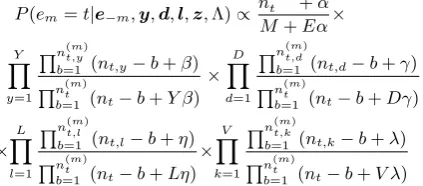
We use Collapsed Gibbs Sampling (Griffiths and Steyvers, 2004) to infer the parameters of the model and the latent class assignments for events, given observed data D and the total likelihood. Gibbs sampling allows us repeatedly sample from a Markov chain whose stationary distribution is the posterior ofemfrom the distribution over that
variable given the current values of all other vari-ables and the data. Such samples can be used to empirically estimate the target distribution. Let-ting the subscript −m denote a quantity that ex-cludes data frommth tweet , the conditional pos-terior foremis:
P(em=t|e−m,y,d,l,z,Λ)∝n −m
t +α
M+Eα×
Y
Y
y=1
Qn
(m) t,y
b=1 (nt,y−b+β)
Qn(tm)
b=1 (nt−b+Y β) ×
D
Y
d=1
Qn
(m) t,d
b=1 (nt,d−b+γ)
Qn(tm)
b=1 (nt−b+Dγ)
×YL
l=1
Qn
(m) t,l
b=1 (nt,l−b+η)
Qn(tm)
b=1 (nt−b+Lη)
×YV
k=1
Qn
(m) t,k
b=1 (nt,k−b+λ)
Qn(tm)
b=1 (nt−b+V λ)
wherent is the number of tweets that have been
assigned to the eventt;M is the total number of tweets,nt,yis the number of times named entityy
has been associated with eventt;nt,d is the
num-ber of times datesdhas been associated with event t;nt,l is the number of times locationslhas been
assigned with eventt;nt,kis the number of times
keywordkhas associated with eventt, counts with
(m) notation denote the counts relating to tweet m only. Y, D, L, V are the total numbers of dis-tinct named entities, dates, locations, and words appeared in the whole Twitter corpus respectively. Eis the total number of events which needs to be set.
sampler for 10,000 iterations and stop the iteration once the log-likelihood of the training data con-verges under the learned model. Finally we select an entity, a date, a location, and the top 2 keywords of the highest probability of every event to form a 4-tuple as the representation of that event.
2.3 Post-processing
To improve the precision of event extraction, we remove the least confident event element from the 4-tuples using the following rule. If P(element) is less than 1
ξP(S), where P(S) is the sum of
probabilities of the other three elements andξis a threshold value and is set to 5 empirically, the ele-ment will be removed from the extracted results.
3 Experiments
In this section, we first describe the Twitter corpus used in our experiments and then present how we build a baseline based on the previously proposed TwiCal system (Ritter et al., 2012), the state-of-the-art open event extraction system on tweets. Fi-nally, we present our experimental results.
3.1 Dataset
We use the First Story Detection (FSD) dataset (Petrovic et al., 2013) in our experi-ment. It consists of 2,499 tweets which are manually annotated with the corresponding event instances resulting in a total of 27 events. The tweets were published between 7th July and 12th September 2011. These events cover a range of categories, from celebrity news to accidents, and from natural disasters to science discoveries. It should be noted here that some event elements such as location is not always available in the tweets. Automatically inferring geolocation of the tweets is a challenging task and will be considered in our future work. For the tweets without time expressions, we used the tweets’ publication dates as a default. The number of tweets for each event ranges from 2 to around 1000. We believe that in reality, events which are mentioned in very few tweets are less likely to be significant. Therefore, the dataset was filtered by removing the events which are mentioned in less than 10 tweets. This results in a final dataset containing 2468 tweets annotated with 21 events.
3.2 Baseline construction
The baseline we chose is TwiCal (Ritter et al., 2012). The events extracted in the baseline are
represented as a 3-tuplehy, d, ki5, whereystands
for a non-location named entity, dfor a date and k for an event phrase. We re-implemented the system and evaluate the performance of the base-line on the correctness of the exacted three ele-ments excluding the location element. In the base-line approach, the tuplehy, d, ki are extracted in the following ways. Firstly, a named entity rec-ognizer (Ritter et al., 2011) is employed to iden-tify named entities. The TempEx (Mani and Wil-son, 2000) is used to resolve temporal expressions. For each date, the baseline approach chose the en-tityywith the strongest association with the date and form the binary tuple hy, di to represent an event. An event phrase extractor trained on an-notated tweets is required to extract event-related phrases. Due to the difficulties of re-implementing the sequence labeler without knowing the actual features set and the annotated training data, we as-sume all the event-related phrases are identified correctly and simply use the event trigger words annotated in the FSD corpus askto form the event 3-tuples. It is worth noting that the F-measure re-ported for the event phrase extraction is only 64% in the baseline approach (Ritter et al., 2012). 3.3 Evaluation Metric
To evaluate the performance of the propose ap-proach, we use precison, recall, and F −
measureas in general information extraction sys-tems (Makhoul et al., 1999). For the 4-tuple
hy, d, l, ki, the precision is calculated based on the following criteria:
1. Do the entityy, locationland datedthat we have extracted refer to the same event? 2. Are the keywordskin accord with the event
that other extracted elements y, l, d refer to and are they informative enough to tell us what happened?
If the extracted representation does not contain keywords, its precision is calculated by check-ing the criteria 1. If the extracted representation contains keywords, its precision is calculated by checking both criteria 1 and 2.
3.4 Experimental Results
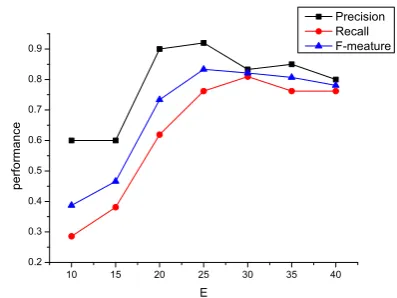
The number of events, E, in the LEM model is set to 25. The performance of the proposed
5TwiCal also groups event instances into event types such
Method Tuple Evaluated Precision Recall F-measure
Baseline hy, d, ki 75% 76.19% 75.59%
Proposed hy, d, li 96% 80.95% 87.83%
[image:5.595.323.522.102.251.2]Proposed hy, d, l, ki 92% 76.19% 83.35%
Table 1: Comparison of the performance of event extraction on the FSD dataset.
Method Tuple Evaluated Precision Recall F-measure
TW-NER hy, d, li 88% 76.19% 80.35%
TW-NER hy, d, l, ki 84% 76.19% 79.90%
NW-NER hy, d, li 96% 80.95% 87.83%
[image:5.595.75.300.147.202.2]NW-NER hy, d, l, ki 92% 76.19% 83.35%
Table 2: Comparison of the performance of event extraction using different NER method.
framework is presented in Table 1. The base-line re-implemented here can only output 3-tuples
hy, d, kiand we simply use the gold standard event trigger words to assign to k. Still, we observe that compared to the baseline approach, the per-formance of our proposed framework evaluated on the 4-tuple achieves nearly 17% improvement on precision. The overall improvement on F-measure is around 7.76%.
3.5 Impact of Named Entity Recognition We experimented with two approaches for named entity recognition (NER) in preprocessing. One is to use the NER tool trained specifically on the Twitter data (Ritter et al., 2011), denoted as “TW-NER” in Table 2. The other uses the traditional Stanford NER to extract named entities from news articles published in the same period and then perform fuzzy matching to identify named enti-ties from tweets. The latter method is denoted as “NW-NER” in Table 2. It can be observed from Table 2 that by using NW-NER, the per-formance of event extraction system is improved significantly by 7.5% and 3% respectively on F-measure when evaluated on 3-tuples (without key-words) or 4-tuples (with keykey-words).
3.6 Impact of the Number of EventsE
We need to set the number of events E in the LEM model. Figure 3 shows the performance of event extraction versus different value ofE. It can be observed that the performance of the proposed framework improves with the increase of the value ofEuntil it reaches 25, which is close to the actual number of events in our data. If further increasing E, we notice more balanced precision/recall val-ues and a relatively stable F-measure. This shows that our LEM model is less sensitive to the
num-ber of eventsE so long asE is set to a relatively larger value.
10 15 20 25 30 35 40 0.2
0.3 0.4 0.5 0.6 0.7 0.8 0.9
p
e
r
f
o
r
m
a
n
c
e
E
Precision Recall F-meature
Figure 3: The performance of the proposed frame-work with different number of eventsE.
4 Conclusions and Future Work
In this paper we have proposed an unsupervised Bayesian model, called the Latent Event Model (LEM), to extract the structured representation of events from social media data. Instead of em-ploying labeled corpora for training, the proposed model only requires the identification of named entities, locations and time expressions. After that, the model can automatically extract events which involving a named entity at certain time, location, and with event-related keywords based on the co-occurrence patterns of the event elements. Our proposed model has been evaluated on the FSD corpus. Experimental results show our proposed framework outperforms the state-of-the-art base-line by over 7% in F-measure. In future work, we plan to investigate inferring geolocations au-tomatically from tweets. We also intend to study a better method to infer date more accurately from tweets and explore efficient ranking strategies to rank evens extracted for a better presentation of results.
Acknowledgments
References
Edward Benson, Aria Haghighi, and Regina Barzilay. 2011. Event discovery in social media feeds. In Proceedings of the 49th Annual Meeting of the Asso-ciation for Computational Linguistics: Human Lan-guage Technologies - Volume 1, HLT ’11, pages 389–398, Stroudsburg, PA, USA. Association for Computational Linguistics.
Angel X. Chang and Christopher D. Manning. 2012. Sutime: A library for recognizing and normaliz-ing time expressions. In 8th International Confer-ence on Language Resources and Evaluation (LREC 2012).
Kevin Gimpel, Nathan Schneider, Brendan O’Connor, Dipanjan Das, Daniel Mills, Jacob Eisenstein, Michael Heilman, Dani Yogatama, Jeffrey Flanigan, and Noah A. Smith. 2011. Part-of-speech tagging for twitter: Annotation, features, and experiments. InProceedings of ACL.
Thomas L. Griffiths and Mark Steyvers. 2004. Find-ing scientific topics. In Proceedings of the Na-tional Academy of Sciences 101 (Suppl. 1), page 5228C5235.
Ralph Grishman, David Westbrook, and Adam Meyers. 2005. Nyu’s english ace 2005 system description. InACE 05 Evaluation Workshop.
Frederik Hogenboom, Flavius Frasincar, Uzay Kay-mak, and Franciska de Jong. 2011. An overview of event extraction from text. In Workshop on Detec-tion, RepresentaDetec-tion, and Exploitation of Events in the Semantic Web (DeRiVE 2011) at Tenth Interna-tional Semantic Web Conference (ISWC2011), pages 48–57.
Xiaohua Liu, Xiangyang Zhou, Zhongyang Fu, Furu Wei, and Ming Zhou. 2012. Exacting social events for tweets using a factor graph. In Proceedings of the Twenty-Sixth AAAI Conference on Artificial In-telligence, pages 1692–1698.
John Makhoul, Francis Kubala, Richard Schwartz, and Ralph Weischedel. 1999. Performance measures for information extraction. In Proceedings of DARPA Broadcast News Workshop.
Inderjeet Mani and George Wilson. 2000. Robust tem-poral processing of news. In Proceedings of the 38th Annual Meeting on Association for Computa-tional Linguistics, ACL ’00, pages 69–76, Strouds-burg, PA, USA. Association for Computational Lin-guistics.
Sasa Petrovic, Miles Osborne, Richard McCreadie, Craig Macdonald, Iadh Ounis, and Luke Shrimpton. 2013. Can twitter replace newswire for breaking news? InProceedings of ICWSM’13.
J. Piskorski, H. Tanev, and P. Oezden Wennerberg. 2007. Extracting violent events from on-line news for ontology population. In Business Information Systems, pages 287–300.
J. Piskorski, H. Tanev, M. Atkinson, and E. Van Der Goot. 2008. Cluster-centric approach to news event extraction. In International Conference on New Trends in Multimedia and Network Information Systems, pages 276–290.
Alan Ritter, Sam Clark, Oren Etzioni, et al. 2011. Named entity recognition in tweets: an experimental study. InProceedings of the Conference on Empiri-cal Methods in Natural Language Processing, pages 1524–1534. Association for Computational Linguis-tics.
Alan Ritter, Mausam, Oren Etzioni, and Sam Clark. 2012. Open domain event extraction from twitter. In Proceedings of the 18th ACM SIGKDD Inter-national Conference on Knowledge Discovery and Data Mining, KDD ’12, pages 1104–1112, New York, NY, USA. ACM.