University of Trento
Department of Mathematics
Doctoral School - XXX cycle
Ph.D. Thesis
Differential attacks using alternative
operations and block cipher design
Advisors:
Prof.
Massimiliano Sala
(University of Trento)
Dr.
C´
eline Blondeau
(Aalto University)
Ph.D. Candidate:
Roberto Civino
MSC 2010: 94A60, 68P25, 20B35, 20B15
Differential attacks using alternative
operations and block cipher design
Roberto Civino
Assessment Committee
Massimiliano Sala University of Trento Advisor
Christina Boura Versailles University Referee
Lars R. Knudsen Technical University of Denmark Referee
´
Eric Filiol ESIEA Examiner
Overview
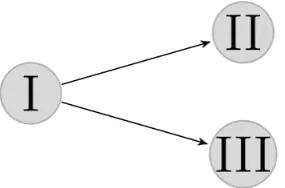
The thesis is divided into three parts, each of which is described in the corre-sponding section of this overview. Part Imainly serves as an introduction to the contents of PartIIand PartIIIwhich are, in turn, mutually independent.
Figure 1: Logical dependence of the parts of this thesis
Preliminaries Block ciphers are the main subject of this work and are
Differential cryptanalysis using alternative operations Chapter 4
and Chapter 5 deal with the following problem: is it possible that a block cipher apparently immune to classical differential cryptanalysis can be at-tacked considering a different operation on the message space? In [Ber92], Berson introduced the modular difference to study the MD/SHA family of hash functions. In [AS11], the authors tried to use a similar method to cryptanalyse the block cipher PRESENT [BKL+07], featuring a bit-wise
round-key addition. Even though this attempt has been unsuccessful, the idea of using alternative difference operations is for the first time taken into consideration and used in block ciphers with a bit-wise key addition. More recently, Calderini and Sala showed how to effectively compute alternative operations on a vector space which can serve as message space for a block cipher such that the resulting structure is still a vector space [CS17]. The authors used those operations to mount a linearisation attack against a toy cipher. Here we study similar operations in the differential context, inves-tigating how alternative operations interact with the layers of an SPN, and show how they influence the differential probabilities, when the difference taken into consideration is different from the usual bit-wise addition modulo two. In particular, in Chapter 4, we study constraints coming from the com-bination of the bit-wise key addition with these operations, by introducing and studying the key distribution table. Moreover, we study the differential uniformity, with respect to other operations, of some non-linear permuta-tions such as the classical cubic function. In Chapter 5we designed a 15-bit block cipher, which presents some similarities with the block ciphers PRINT-cipher [KLPR10] and PRINCE [BCG+12], and represents an example of SPN
which is resistant against the classical differential attack, with XOR differ-ences, but it is not resistant against a differential attack which makes use of alternative difference coming from another operation defined on the message space.
On the design of wave ciphers Round functions used as building blocks
bijectivity of any encryption function, crucial in order to make the decryp-tion possible, is guaranteed by the use of invertible layers or by the Feistel structure. In Chapter 6 a new family of ciphers, called wave ciphers, is in-troduced. In wave ciphers, round functions feature wave functions, which are vectorial Boolean functions obtained as the composition of non-invertible
Short contents
I
Preliminaries
1
1 Introduction to block ciphers 2
2 Differential cryptanalysis 17
3 Group theoretical security 37
II
Differential cryptanalysis using alternative
oper-ations
44
4 Alternative operations for cryptanalysis 45
5 Designing a cipher 85
III
On the design of wave ciphers
98
6 On wave functions 99
7 Group-theoretical study of wave ciphers 105
List of Tables 121
Contents
I
Preliminaries
1
1 Introduction to block ciphers 2
1.1 Block ciphers . . . 2
1.1.1 Perfect secrecy . . . 3
1.2 Iterated block ciphers . . . 5
1.2.1 Substitution-Permutation Networks . . . 6
1.2.2 PRESENT. . . 9
1.2.3 Feistel Networks. . . 10
1.2.4 GOST 28147-89 . . . 12
1.3 Classical round functions . . . 13
1.4 Cryptanalysis . . . 14
2 Differential cryptanalysis 17 2.1 Description of the attack . . . 17
2.2 Classical differential cryptanalysis . . . 19
2.3 The case of SPNs . . . 24
2.4 Resistance to classical differential cryptanalysis . . . 28
2.4.1 Non-linearity notions for confusion layers . . . 28
2.4.2 Known APN permutations . . . 31
2.4.3 Other non-linearity notions . . . 32
3 Group theoretical security 37
3.1 Algebraic security . . . 37
3.2 The group generated by the round functions . . . 38
3.3 Imprimitivity attack . . . 39
3.4 Resistance to imprimitivity attack . . . 42
II
Differential cryptanalysis using alternative
oper-ations
44
4 Alternative operations for cryptanalysis 45 4.1 Overview and motivation . . . 454.2 Differential cryptanalysis revised. . . 48
4.3 New operations on the message space . . . 49
4.3.1 Efficiently-computable new operations . . . 50
4.4 Interaction with the key-addition layer . . . 54
4.4.1 Introducing a product . . . 56
4.4.2 Assumptions on the weak keys . . . 59
4.4.3 Assumptions on ◦-affinities . . . 60
4.4.4 A more compact representation . . . 63
4.4.5 Differential probabilities and key-addition layer . . . . 67
4.5 Interaction with the confusion layer . . . 75
4.5.1 On the cubic function in odd dimension . . . 80
5 Designing a cipher 85 5.1 Interaction with the diffusion layer . . . 85
5.1.1 Compatible diffusion layers. . . 86
5.2 The case d=n−2 . . . 89
5.3 Experiments on a small cipher . . . 91
5.3.1 The operation ˆ◦ . . . 92
5.3.2 The target cipher . . . 93
III
On the design of wave ciphers
98
6 On wave functions 99
6.1 Overview and motivation . . . 99
6.2 Wave ciphers . . . 100
6.2.1 Feistel Networks with wave functions . . . 102
6.2.2 The group generated by the rounds of a wave cipher . . 104
7 Group-theoretical study of wave ciphers 105 7.1 Security reduction. . . 105
7.2 Conditions on SPN-like wave ciphers . . . 111
7.2.1 A wave cipher with a 4x5 APN S-box . . . 116
7.3 Conclusions and open problems . . . 119
List of Figures 119
List of Tables 121
Notation
The following notation and terminology will be used throughout all this work.
Functions We use the postfix notation for every function evaluation, i.e.
if f is a function andx an element in the domain of f, we denote by xf the evaluation of f in x. We denote by Imf the range of f and by Y f−1 the
pre-image of a set Y. A vectorial Boolean function is a function from (F2)n
to (F2)m, where n and m are integers, and F2 denotes the finite field with
two elements.
Vectors We denote by V a finite vector space overF2 of dimensionn∈N.
We assume dim(V) = n = s×b and write V = V1⊕V2 ⊕. . .⊕Vb, where dim(Vj) = s for 1 ≤ j ≤ b, and ⊕ represents the direct sum of subspaces, called bricks. When x ∈ V, for each 1 ≤ j ≤ b we denote by x[j] the s
components of x in the jth brick. The vector x[j] ∈ (
F2)s is also called a
brick. The canonical basis for V is denoted by {e1, e2, . . . , en}. For each 1≤j ≤b the mapπj :V → V denotes the canonical projection on Vj. The
Fields We denote byF2nthe finite field with 2nelements. For eachα ∈F2n,
the trace of α is defined as Tr(α) def= α +α2 +. . .+α2n−1
. The function Tr : F2n → F2 is a linear function, where both F2n and F2 are viewed as
vector spaces over F2. Let us also recall that for each α ∈ F2n it holds
Tr(α) = Tr(α2).
Groups If G is any finite group acting on V, for each g ∈ G and v ∈ V
we denote the action of g onv asvg. The group is called anabelian group if and only if g1g2 =g2g1 for eachg1, g2 ∈G; moreoverG is 2-elementary if for
each g ∈ G it holds g2 = 1
G, where 1G denotes the neutral element in the group. The action of G on V is said to be transitive if for each v1, v2 ∈ V
there exixts g ∈G such that v1g =v2. If for anyv1, v2 such g is unique, the
action of G on V is said regular. If H ⊂G, we denote H < Gto mean that
H is a subgroup of G.
The identity matrix over F2 of size ` is denoted by 1`, and the zero matrix
F2 of size `×h is denoted by 0`,h. The symmetric group acting on V, i.e. the group of all the permutations on the space V, is denoted by Sym(V).
The subgroup of Sym(V) generated by the even permutations, i.e. the per-mutations obtainable from an even number of two-element swaps, is called the alternating group and is denoted by Alt(V). The group of all the affine permutations of (V,+), which is a primitive maximal subgroup of Sym(V), is denoted by AGL(V,+). The group of all the linear permutations of (V,+) is denoted by GL(V,+). For any linear map λ ∈ GL(V,+) we denote by Ker(λ) the kernel of λ. The group of the translations of V is denoted by
T+
def
Part I
1
Introduction to block ciphers
In this first chapter the main subjects of this work, i.e. block ciphers, are introduced. Some preliminary results are shown and the notations used along the thesis are explained. This presentation as well as the one of Chapter 2
is inspired, among others, by the following references [Rij97, DR13, KR11,
LMM91].
1.1
Block ciphers
Block ciphers
all the procedures and keeping secret only the key, since “it should not be a problem if it [the cipher’s description]falls into enemy hands”. Moreover, for the above-mentioned procedures, a relatively simple description is required, and the following properties need to be satisfied:
efficiency there exists an efficiently computable procedure which, for any
message in the message space and any key in the key space, provides the encryption of the given message with the current encryption function, preferably on a wide range of platforms / devices. The same should hold for the decryption process;
security the #K key-induced permutations should look like being chosen
uniformly at random in the set of all the possible permutations of the message space, in such a way it is not possible, given a text, to predict whether it is a ciphertext of a randomly-generated string of the same length.
The second ideal requirement incidentally means that, parties not entitled to access the encrypted data recover no information on the plaintext when the ciphertext is given but the key used for the encryption is unknown. Such parties are called attackers or cryptanalysts, usually depending on whether one wants to put the accent on their bad or good intentions, respectively.
The following is a very general definition of block cipher.
Definition 1.1.1. LetMand Kbe non-empty sets. A block cipher Φ is an
injective function K → Sym(M). The set M is called the message space,
K the key space, and the permutation EK def
= KΦ is called the encryption function induced by the key K. The set {EK | K ∈ K} is called the set of
the encryption functions. It is common to identify
Φ≡ KΦ ={EK |K ∈ K} ⊂Sym(M).
1.1.1
Perfect secrecy
Block ciphers
does not rely on assumptions on the computational capabilities of the adver-sary, i.e. the cipher is unbreakable even if the computational power of the adversary is not bounded. Before recalling Shannon’s definition of perfect secrecy, let us consider the plaintext P and the key K as random variables. Let us assume that a probability distribution PM on M is given, in such a way we can denote by PM[P =p] the probability that the plaintext p∈ M
occurs. Moreover, let us consider a probability distribution PK on K, inde-pendent on P, such that PK[K = k] denotes the probability that the key
k ∈ K is chosen. Let us consider the random variable C : M × K → M
defined by (p, k)C = pEk, where M × K is equipped with the probability distribution PM,K=PM×PK.
Definition 1.1.2. A block cipher Φ is said to haveperfect secrecy if for each
p, c ∈ M it holds
PM,K[P =p|C =c] =PM[P =p].
The notion of perfect secrecy means that the a posteriori distribution of the plaintext P when the value of ciphertextC is known, is equal to the a priori
distribution of the plaintext, i.e. that an attacker obtains no more informa-tion on the plaintext when the ciphertext is known.
The following characterisation of the perfect secrecy is due to Shannon.
Theorem 1.1.3. Let Φbe a block cipher and let us assume that#M= #K.
Then Φ has perfect secrecy if and only if for each p, c ∈ M there exists a unique k ∈ K such that pEk =c and PK is uniform, i.e. for each k ∈ K it
holds PK[K =k] = 1/#K.
Iterated block ciphers
1.2
Iterated block ciphers
In the second part of this work, Shannon introduced the concepts of confu-sion and diffusion to guide the design of practical ciphers. Those are today considered cardinal principles for obtaining the properties of security and efficiency discussed before:
confusion the ciphertext statistics should depend on the plaintext statistics
in a manner too complicated to be exploited by the cryptanalyst;
diffusion the encryption spreads out of the influence of a single plaintext
digit over many ciphertext digits so as to hide the statistical structure of the plaintext.
Since a cipher should not only be difficult to break, but it must also be easy to use (i.e. to encrypt and decrypt when the secret key is known), a very common approach for creating diffusion and confusion is to use a
product cipher, i.e., a cipher that can be implemented as a succession of simple ciphers, each of which adds its modest share to the overall large amount of diffusion and confusion [Mas88]. This idea leads to the definition of an iterated cipher, which is the most common framework nowadays for block ciphers. What follows is a general definition of iterated cipher.
Definition 1.2.1. The block cipher Φ ={EK |K ∈ K}is called an iterated
block cipher if there exists R ∈N such that for each K ∈ K the encryption function EK is the composition of R functions, i.e. EK =ε1,Kε2,K. . . εR,K. For each 1≤i≤R, the functionεi,K is called theround function for the ith
round of the encryption function EK.
Iterated block ciphers
confusion layer is designed to provide the Shannon’s principle of confusion
by replacing certain blocks of bits of the state with other blocks of bits, following a specific rule. The relation between the input and the output of the confusion layer is designed to be as complex as possible, hence look-up tables are usually required in implementation;
diffusion layer is designed to provide the Shannon’s principle of diffusion
by rearranging the bits of the block in such a way that a change in one bit of the state affects as much bits as possible. Such a layer usually operates simple manupulations on the bits of the block;
key-addition layer is the only layer of the cipher whose input is not public.
It makes all the bits of the block dependent on a user-selected key in the manner intended by the designers of the cipher.
In the theory of modern iterated block ciphers, two frameworks are mainly considered: Substitution-Permutation Networks (SPN)(see e.g. AES [DR13], PRESENT [BKL+07], SERPENT [BAK98]) and Feistel Networks (FN) (see
e.g. DES [Pub77], Camelia [AIK+00], GOST [Dol10]). Figure1.1depicts the
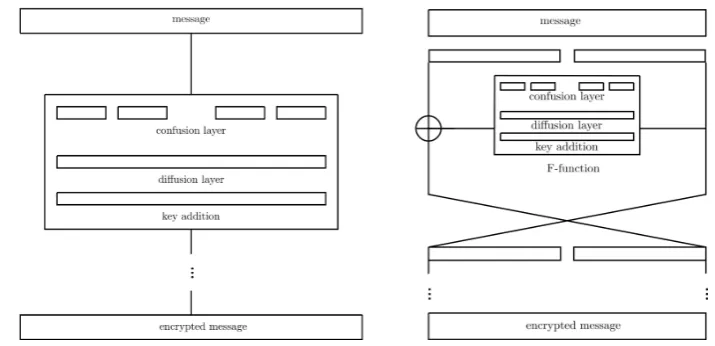
more general framework of SPNs, FNs and their round functions; one can note that inside the round function of an FN, a function called F-function is applied to a half of the state. In both cases, the principles of confusion and diffusion suggested by Shannon [Sha49] are implemented by considering each round function / F-function as the composition of key-induced permutations as well as non-linear confusion layers and linear diffusion layers, which are invertible in the case of SPNs and preferably (but not necessarily) invertible in the case of FNs. These two families are briefly discussed in the following sections.
1.2.1
Substitution-Permutation Networks
Iterated block ciphers
Figure 1.1: Round function of an SPN and of an FN
the bits of the block are mixed by means of a linear function. The key addi-tion may occur before or after these two operaaddi-tions. The following definiaddi-tion gives a mathematical description of SPNs in the model we will be using throughout this work. In this case we are assuming M=V.
Definition 1.2.2. An R-round iterated cipher Φ is called a
Substitution-Permutation Network (SPN) if Φ is a family of encryption functions {EK |
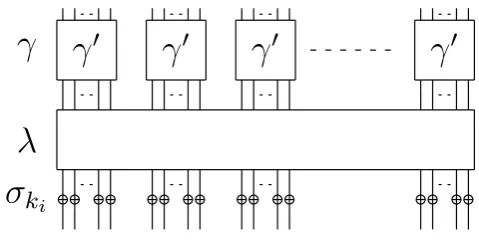
K ∈ K} ⊂Sym(V) such that for eachK ∈ Kthe mapEK is the composition of R round functions, i.e. EK =ε1,K ε2,K. . . εR,K, where εi,K =γλσki and
• γ ∈ Sym(V) is a non-linear bricklayer transformation which acts in a parallel way on each Vj, i.e.
(x1, x2, . . . , xn)γ = (x1, . . . , xs)γ1, . . . ,(xs(b−1)+1, . . . , xn)γb
.
The maps γj ∈ Sym(Vj) for each 1 ≤ j ≤ b are traditionally called
S-boxes;
• λ∈Sym(V) is a linear map;
• σki : V → V, x 7→ x+ki represents the key addition, where + is the
Iterated block ciphers
bb
bb
bb
bb
bb
bb
bb bb
γ
λ
σ
kiγ
0γ
0γ
0γ
0Figure 1.2: Example of 1-round encryption of an SPN
The function ρdef=γλ is called the generating function of the SPN. For each 1 ≤r ≤R we denote by EK(r) the composition of the first r round functions of the encryption functionEK. In particularEK =EK(R). Figure 1.2displays the structure of a round function for an SPN.
For example, for the classical AES-128 cipher a 10-round encryption is performed and 8-bit S-boxes are implemented. The state is arranged into a 4×4 matrix of bytes and the diffusion layer is a combination of ShiftRows and MixColumns: in the former the last three rows of the state are shifted cyclically, whereas in the latter a mixing operation which operates on the columns of the state combining the four bytes in each column is applied [DR13]. Instead PRESENT, briefly described also in Section 1.2.2, manip-ulates 4-bit S-boxes; the diffusion is granted by a permutation matrix. The designers have estimated that the iteration of 31 rounds gives a sufficient margin of security to the cipher [BKL+07].
Remark 1.2.3. Notice that a bit-wise XOR addition is not the only possible
way to define a key-addition layer. In many modern ciphers, the key addi-tion is performed e.g. by considering a modular addiaddi-tion. However, for the purposes of this work, when studying SPNs, only key-addition layers induced by the bit-wise sum modulo 2 will be considered. Moreover, Definition 1.2.2
Iterated block ciphers
x 0x 1x 2x 3x 4x 5x 6x 7x 8x 9x Ax Bx Cx Dx Ex Fx
xS Cx 5x 6x Bx 9x 0x Ax Dx 3x Ex Fx 8x 4x 7x 1x 2x
Figure 1.3: The S-box S of PRESENT
or post-whitening process) and in several ciphers the diffusion layer is not applied in the last round.
Notice that, since every round function is composed by invertible layers, the decryption can be performed by applying the inverse of the layers to the ciphertext, in reverse order.
1.2.2
PRESENT
The block cipher PRESENT [BKL+07] has been designed in 2007, for the purpose of being a lightweight cipher, i.e. a cipher suitable for hardware implementation in low-power devices or constrained environments such as RFID tags and sensor networks. It is an example of SPN and consists of 31 rounds. The block length is 64 bits and two key lengths of 80 and 128 bits are supported. The encryption functions are induced by 32 round-keys, 31 of which are used in the standard rounds and the remaining one is used in the last and atypical round for post-whitening. Typically the round function is unique and is obtained as the composition of the following three layers:
addRoundKey the 64-bit round key, derived by the designed key-schedule
[BKL+07], is XOR-ed to the partial state;
sBoxlayer the 64-bit block is split into 16 4-dimensional bricks, each of these
is substituted in accordance with the S-box S∈Sym(F2)4 displayed in
Fig. 1.3;
pLayer with the convention that the left-most bit of the block is in position
Iterated block ciphers
S
S S
S S
S S
S S
S S
S S
S S
S S
S S
S S
S S
S S
S S
S S
S S
S
ki
ki+1
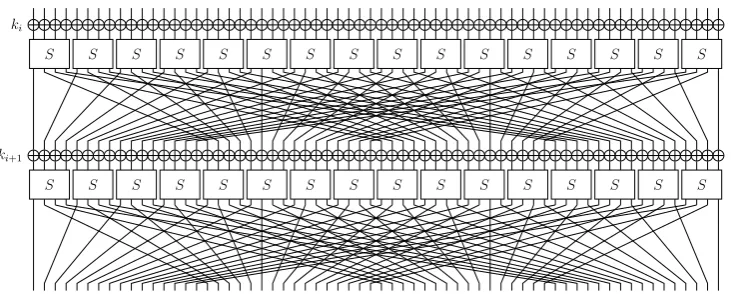
Figure 1.4: A 2-round encryption of PRESENT
is defined as follows
P(i)def=
16×i mod 63 0≤i <63
63 i= 63.
Figure 1.4 displays the composition of two typical round functions of PRESENT.
1.2.3
Feistel Networks
Besides SPNs, many modern ciphers and their precursors are based on the framework of Feistel Networks, which became popular when the U.S. Federal Government adopted the DES as the standard encryption algorithm for the protection of sensitive, unclassified electronic government data. This cipher, derived from the block cipher Lucifer designed by Horst Feistel and Don Cop-persmith in 1973, has been withdrawn in the end of the nineties, mainly due to its short key-length (56 bits). However, its study has highly influenced the advancement of modern cryptography, both in the direction of understanding the properties of FNs and developing new cryptanalytic techniques.
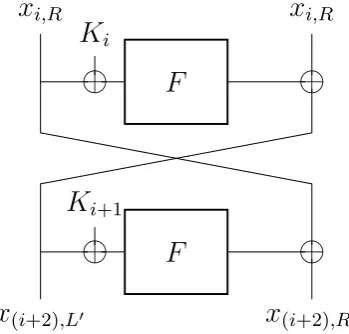
Similarly to SPNs, a 2n-bit Feistel Network consists of the repetition of
Iterated block ciphers
F
x
i,R⊕
K
ix
i,R⊕
F
⊕
K
i+1⊕
x
(i+2),L0x
(i+2),R0Figure 1.5: Example of 2-round encryption of a FN
keys. Such a function encrypts the right half of the state, which is then XOR-ed to the remaining part of the message. The two halves of the current state are then swapped and the round is repeated. Feistel Networks usually include an atypical last round, where no swap is performed. An example of 2-round encryption of an FN is illustrated in Fig. 1.5.
Let us now describe more formally this procedure.
Definition 1.2.4. Let f : (F2)n → (F2)n be a vectorial Boolean function.
We denote by f the formal operator f : (F2)2n→(F2)2n
f def= 0n 1n
1n f
!
,
which for any (x1, x2)∈(F2)n×(F2)nacts as (x1, x2)f
def
= (x2, x1+x2f). The
operator ¯f is called the Feistel operator induced by f.
The operator previously defined allows to give an algebraic description of FNs, which are defined on the message space M=V ×V.
Definition 1.2.5. AnR-round iterated cipher Φ is called a Feistel Network
Iterated block ciphers
Feistel operators, i.e. EK = ε1,K ε2,K. . . εR,K, where εi,K : V → V for 1≤i≤R.
Feistel operators are usually designed in accordance to the Shannon’s principles, i.e. contain layers providing confusion and diffusion. The key-addition layers may be designed in several ways, more frequently they are induced from the XOR or from a modular addition. Notice that, as in the case of Definition 1.2.2, we do not include possible atypical rounds in the definition of the cipher.
Remark 1.2.6. One advantage of the Feistel Network is that the
decryp-tion process is identical to encrypdecryp-tion, provided the round keys are taken in reverse order. Moreover, notice that a Feistel operator ¯f is always invertible, regardless the invertibility of f, and it has the following inverse
f−1 = f 1n
1n 0n
!
.
It is indeed easy to check that
(x2, x1+x2f)
f 1n
1n 0n
!
= (x1, x2).
The cipher presented in the following section is a FN with an easy de-scription.
1.2.4
GOST 28147-89
Developed in the 1970s, the cryptosystem GOST has been kept secret since the dissolution of the USSR, when it was declassified and it was released to the public in 1994. The cipher was a soviet alternative to the U.S. standard DES, with whom it shares a similar structure. It is a 64-bit FN with a key-length of 256 bits. Each Feistel operator applies to the 32-bit right half of the state a key-dependent F-function where confusion is provided by means of a parallel layer made up by 4-bit S-boxes, diffusion is provided by a left rotation of 11 bits, whereas the key is added to the state by means of an addition modulo 232. The full description of the variant GOST 28147-89
Classical round functions
1.3
Classical round functions
After having presented the main differences between SPNs and FNs, we intro-duce the notion ofclassical round function, which allows to describe formally both cipher families in a unified way, provided the round key is used as a translation (i.e., the key addition is the usual XOR). The family of classical round functions for iterated block ciphers of our model is large enough to include the round functions of well-established SPNs e.g. AES, PRESENT, SERPENT, and the F-function of FNs like Camelia. Notice that, for sake of simplicity, atypical rounds are again not considered in this description.
Definition 1.3.1. For each k ∈ V, a classical round function induced by k
is a map εk ∈Sym(V) of the typeεk=γλσk, where
• γ :V →V is a non-linear permutation (parallel S-box) which acts in a parallel way on each Vj, i.e.
(x1, x2, . . . , xn)γ = (x1, . . . , xs)γ1, . . . ,(xs(b−1)+1, . . . , xn)γb
,
applying the S-box γj :Vj →Vj to the jth brick;
• λ∈Sym(V) is a linear map,
• σk :V →V, x7→x+k represents the addition with the round key k.
When used inside block ciphers, the round keys in V are derived by the designer-provided key-scheduling function from the master key K ∈ K. Since, as we will discuss later in detail, studying the role of the key-schedule is out of the scope of this work, one can simply assume that round keys are randomly-generated vectors in V.
Cryptanalysis
as round functions, and saying FN to any cipher {EK |K ∈ K} ⊆Sym(M) having an FN-like structure with M = V ×V and having classical round functions on V as F-functions. Moreover, we assume that the Feistel oper-ators defining an FN are of the type of εi,K, where εi,K is a classical round function as in Definition 1.3.1. Hence, as in the case of SPNs, we refer to
ρdef=γλ by saying the generating function of the Feistel Network.
1.4
Cryptanalysis
When dealing with a new cryptosystem, one of the main issues is to define how its security can be evaluated. A first classification of the security of a block cipher, which was introduced in [Knu94a], can be made consider-ing the possible outcomes of the attacks, here listed in ascendconsider-ing order of dangerousness:
key recovery the attacker finds the secret key K used for the encryption;
global deduction the attacker finds a function which is equivalent to the
encryption function EK, without knowing the key K;
local deduction the attacker manages to encrypt or decrypt one message,
which he did not obtain from the legitimate sender;
information deduction the attacker recovers some bits of the key or of
the plaintext, which he did not get directly from the sender and which he did not have before the attack;
distinguishing attack the attacker can effectively distinguish between two
black boxes, one containing the block cipher with a randomly chosen encryption key and the other containing a randomly chosen permuta-tion over the same space.
Cryptanalysis
ciphertext-only the attacker has access to some ciphertexts, and has no
access to the corresponding plaintexts. This information is the easiest an attacker can gain access to, since the attacker only needs to intercept the messages of an encrypted conversation. However, today’s cipher are very unlikely vulnerable to this kind of attack;
known-plaintext the attacker has access to a number of pairs of plaintexts
and the corresponding ciphertexts, encrypted with the unknown key;
chosen-plaintext the attacker has access to an encryption oracle which can
provide the encryption with the same key of a set of messages provided by the attacker;
adaptive chosen-plaintext the attacker can behave several time as in the
chosen-plaintext scenario. After viewing and analysing the output of the oracle, the attacker can make new queries;
related-key the attacker has access to the encryption of the same
plain-text using unknown keys which are related to the target key in some mathematical way;
side-channel it is not an attack to the mathematical structure of the
ci-pher but rather to its implementation. The attacker exploit external facts related to the encryption / decryption process, such as electric noise, power consumption, computation time etc., to recover (partial) information of the plaintext or on the key used.
The attacks are listed here in ascending order of data required to the at-tacker, i.e. from the most practical to the most impractical. Since a proof of the security of a block cipher from every attack can almost never be given, focusing on rather impractical attacks, as the lasts in the list, gives a suffi-ciently reasonable margin of safety.
Cryptanalysis
time complexity the time needed to perform an attack, measured in terms
of operations the attacker needs to perform;
memory complexity the storage needed to perform the attack;
data complexity the amount of data to obtain in order to perform the
2
Differential cryptanalysis
In this chapter, the attack of differential cryptanalysis is described. Later in this work, we generalise the attack to the case of alternative difference operators.
2.1
Description of the attack
Differential cryptanalysis was publicly introduced by Biham and Shamir in the beginning of the 90’s [BS91a] as a powerful tool to cryptanalyse some cryptographic primitives, including mainly block ciphers. It is today known that the IBM designers of DES were already aware of the differential attack before it was published, and consequently designed the cipher in way to be resistant against the attack. However, for a matter of national security, they were asked by the NSA to keep the cryptanalytic technique secret. After the attack was published, many block ciphers were cryptanalysed using this method [BS91b, BS91c, BAB93, RP94]. The idea has later been widely generalised and many variants have been introduced in recent years [Knu94b,
BBS99,Knu98]. We will refer to the Biham’s and Shamir’s attack by saying the classical differential attack.
Informal description Let us recall that we denote by V a plaintext /
ciphertext space, where V = (F2)n. The classical differential cryptanalysis is
Description of the attack
For any x and y in V, the difference between x and y with respect to ∗ is defined as diff(x, y) def= x∗y−1, where ∗ is any group operation on V, and
y−1 is the inverse of y with respect to ∗. In order a cipher to be secure
against the larger class of attacks, we expect its encryption functions to destroy patterns in the plaintexts. For example, let P be a set of pairs P def=
{(x1, x2)|x1, x2 ∈V,diff(x1, x2) = ∆}, where all the corresponding elements
in a pair have difference fixed to a given value ∆∈V, i.e.
#{diff(x1, x2)|(x1, x2)∈P}= 1.
Let now E be an encryption function of the cipher and let C be the set obtained by encrypting every pair in P with the same encryption function
E, i.e. C def={(x1E, x2E)|(x1, x2)∈P}. Since the function E is an
encryp-tion funcencryp-tion, we expect that it is not possible to predict the difference of corresponding message in a pair after the encryption is performed (output difference), i.e. we expect that
#{diff (y1, y2)|(y1, y2)∈C}= #{diff (x1E, x2E)|(x1, x2)∈P} ∼#P.
Notice that, when P contains all the possible pairs having difference fixed to ∆, then #P = 2n−1. If it happens that there exists a suitable
differ-ence ∆ ∈ V such that, even if the key is unknown, it is possible to predict the difference after the encryption with a relatively high probability, then the cipher is vulnerable to differential cryptanalysis. Stated differently, if some differences propagate with unusually high or low probability during the encryption process, this leads to a non-uniform distribution of the output differences which may be used to show a non-random behavior of the cipher.
In order to attack anR-round iterated cipher, in the classical setting, the cryptanalyst needs to choose an input difference ∆I which, after a partial encryption of R−1 rounds, corresponds to an output difference ∆O with a significantly high probability p. Then he can proceed as follows:
• he generates a set of pairsP def={x|x∈V2} with the property that for
Classical differential cryptanalysis
• he submit P to an encryption oracle, which encrypts each pair with a target keyK, and obtains the setCdef={diff (x1EK, x2EK)|(x1, x2)∈P};
• for each pair in C he performs a partial decryption for each message of the pair, trying to guess the round key used in the last round, and he increments a counter every time for the selected round key the difference of the partially decrypted messages equals the expected value ∆O;
• after the previous step is performed for all the round keys of interest, he chooses the round key candidate with the highest value in its counter.
Assuming that if messages are partially decrypted with the wrong round key then their differences are uniformly distributed, if the probability p is sufficiently high the cryptanalyst succeeds in recovering some bits of the last round key.
2.2
Classical differential cryptanalysis
Although differences can be computed with respect to every operation∗such that (V,∗) is a group, in general the difference taken into consideration de-pends on the operation that is used to perform the key addition. In the case of the SPNs, for example, this operation is usually the XOR, since the key addition is performed by XOR-ing the round key bits with the bits of the message. However, keeping in mind that the scope of this work is to crypt-analyse an SPN using an operation different from the XOR, we will describe classical differential cryptanalysis with respect to a general group operation
∗. In order to keep the notation lighter, when it is clear from the context, we will not write explicitly the dependence on the operation ∗.
Let us consider Φ ={EK |K ∈ K}<Sym(V) anR-round iterated block cipher, let 1≤r ≤R and let ∗ be a group operation onV. Let us denote by diff the difference operator induced by ∗.
Definition 2.2.1. A pair (∆I,∆O)∈V2is called adifferential. The elements
Classical differential cryptanalysis
Actually we are not interested in the concept of the differential itself, but rather in its probability.
Definition 2.2.2. Letf ∈Sym(V), and let (∆I,∆O)∈V2 be a differential.
The differential probability of the differential (∆I,∆O) with respect to f and
to the operation ∗ is
p∆f
I(∆O)
def
= #{x|x∈V, diff (xf,diff (x,∆I)f) = ∆O}
#V ,
which represents the probability that given any two messages with input difference ∆I, i.e. x and diff (x,∆I), it holds that the corresponding output difference is ∆O, i.e. diff (xf,diff (x,∆I)f) = ∆O, where x is uniformly distributed on V. If p∆f
I(∆O) > 0 we say that the differential (∆I,∆O) is
admissible over f. Moreover, if p∆f
I(∆O) = 1, we say that the differential
p∆f
I(∆O) is deterministic over f, and if p
f
∆I(∆O) = 0 that the differential
(∆I,∆O) is impossible overf.
Remark 2.2.3. Let f ∈ Sym(V) and let (∆I,∆O) be an admissible
differ-ential over f. Then, sincef is bijective it holds
∆I = 0 ⇔∆O = 0.
Definition 2.2.4. Letf ∈Sym(V), (∆I,∆O)∈V2 be a differential, and let
x∈V. We say that the pair (x,diff (x,∆I))follows the differential(∆I,∆O)
with respect to f if diff (xf,diff (x,∆I)f) = ∆O.
As already mentioned, in a real case scenario, the key used for the en-cryption is unknown to the attacker. For this reason, we need to extend the notion of differential probability to the case when the function used is unknown.
Definition 2.2.5. Let (∆I,∆O) be a differential. Thedifferential probability
of the differential (∆I,∆O) with respect to Φ(r) is the expected value of the differential probability of (∆I,∆O) with respect to E
(r)
K , assuming that the keys are uniformly distributed on K, i.e.
p∆Φ(r)
I (∆O)
def = X
K∈K
pE
(r)
K
∆I (∆O)·
Classical differential cryptanalysis
When looking at a differential (∆I,∆O) with the intention of studying its differential probability with respect to Φ(r), we will also call (∆
I,∆O) an r
-round differential. If it is clear that (∆I,∆O) denotes anr-round differential, then pΦ(r)
∆I (∆O) is also written simply as p∆I(∆O).
Notice that, in the context of a differential attack, only plaintexts can be chosen by the attacker, whereas the key used for the encryption in unknown. In our definition of differential probabilities, however, we are assuming that the plaintexts and the keys are independent and uniformly random. These probabilities will be used to determine the best differential suitable to perform the attack. Hence, we are tacitly assuming that, for a given differential (∆I,∆O), the differential probability for a chosen key equals its expected value p∆I(∆O). This hypothesis is known with the name of hypothesis of
stochastic equivalence [LMM91].
Definition 2.2.6. The best differential probability over Φ(r) is defined as
pmax
def = max
∆I6=0,∆O
p∆Φ(r)
I (∆O).
Each differential (∆I,∆O) such that pΦ (r)
∆I (∆O) = pmax is called the best
differential over Φ(r).
The size of the value pmax reflects the security of the cipher in terms of
resistance against the standard differential attack. In particular, the cipher Φ is secure with respect to the classical differential cryptanalysis if it is not possible to detect a relevant bias in the distribution of all the possible r -round differentials, when r is close to the actual number of rounds R of the cipher. More precisely, we can assume that the cipher is secure if no
r-round differential (r close to R) has probability different enough from 2−n so that it is possible to distinguish the set of parametrised permutations from a random one. However, for a real-size cipher, the problem of determining the best r-round differential cannot practically be solved. For this reason, an approximation of this value is required.
Definition 2.2.7. Every sequence (∆0,∆1, . . . ,∆r) ∈ Vr+1 is called an r
-round differential trail. Given a differential (∆I,∆O), we denote byD(∆I,∆O),r
Classical differential cryptanalysis
Definition 2.2.8. Let (∆0,∆1, . . . ,∆r) ∈ Vr+1 be an r-round differential
trail, and let x∈ V. We say that the pair (x,diff (x,∆0)) follows the
differ-ential trail (∆0,∆1, . . . ,∆r) with respect to Φ(r) if for each 1≤i≤r it holds diffxEK(i),diff (x+ ∆0)E
(i)
K
= ∆i.
A differential trail (∆0,∆1, . . . ,∆r) is hence a sequence of intermediate dif-ferences at each round, starting and ending respectively at the extremities of the r-round differential (∆0,∆r). As in the case of differentials, we are inter-ested in the probability that a given differential trail holds, which is defined as the probability that a pair follows the differential trail.
Definition 2.2.9. Let (∆0,∆1, . . . ,∆r) ∈ Vr+1 be an r-round differential
trail, andK ∈ Kbe a key of the cipher. Then theprobability of the differential trail (∆0,∆1, . . . ,∆r) with respect to EK is
p(∆0,∆1,...,∆r),K
def =
#
n
x|x∈V,∀1≤i≤r diff
xEK(i),diff (x,∆0)EK(i)
= ∆i
o
#V .
It should be clear that if a pair (x,diff (x,∆I)) follows an r-round dif-ferential (∆I,∆O), then it is uniquely determined an r-round differential trail (∆0,∆1, . . . ,∆r) such that ∆0 = ∆I, ∆r = ∆O, and the difference of the partial states at the stage i equals ∆i. Conversely, each pair following an r−round differential trail (∆I,∆1, . . . ,∆r−1,∆O) follows the differential (∆I,∆O). Hence the following result holds.
Proposition 2.2.10. Let (∆I,∆O) be an r-round differential. For any
en-cryption function EK, it holds
pE
(r)
K
∆I (∆O) =
X
(∆I,∆1,...,∆r−1,∆O)
∈D(∆
I ,∆O),r
p(∆I,∆1,...,∆r−1,∆O),K.
Classical differential cryptanalysis
for a fixed key. Indeed, the number of paths from ∆I to ∆O having length
r+ 1, #D(∆I,∆O),r, increases so rapidly with r that it is not possible to list
all of them. Therefore, computing the probability of an r-round differential trail is still a difficult task, which can be simplified assuming the following hypothesis.
Definition 2.2.11. An iterated block cipher Φ is called a Markov cipher if
the probability of an output difference of any encryption function, once the input difference is given, is independent on the chosen message if the keys are uniformly distributed in the key space.
In such an hypothesis the following result holds.
Proposition 2.2.12. Let us assume that Φ it is a Markov cipher. Then the
probability of an r-round differential trail (∆0,∆1, . . . ,∆r)with respect to the
key K is
p(∆0,∆1,...,∆r),K =
r−1
Y
i=0
pEKi+1
∆i (∆i+1).
The Markov condition hence allows to calculate the probability of an
The case of SPNs
Definition 2.2.13. Let (∆0,∆1, . . . ,∆r) ∈ Vr+1 be an r-round differential
trail. Then the probability of the differential trail (∆0,∆1, . . . ,∆r) with
re-spect to Φ(r) is
p(∆0,∆1,...,∆r) =
X
K∈K
p(∆0,∆1,...,∆r),K ·
1 #K.
The following intuitive result links the probability of an r-round differential with the probability of all the r-round trails which compose the differential.
Theorem 2.2.14. Let (∆I,∆O) be a differential. Then
p∆Φ(r)
I (∆O) =
X
(∆I,∆1,...,∆r−1,∆O)
∈Dr,∆I ,∆O
p(∆I,∆1,...,∆r−1,∆O).
These values are still out of reach for a real-size cipher, therefore nowa-days the best methods to provide evidence that a given cipher is secure / insecure with respect to the classical attack are based on the assumption that it is possible to estimate the best (R−1)-round differential (∆I,∆O) by determining several high-probability (R−1)-differential trails from ∆I to ∆O.
2.3
The case of SPNs
As already mentioned is the previous chapter, a cipher which belongs to the family of the SPNs is a set of encryption functions, each of which is the composition of R round functions. Each of these round functions in turn is the composition of three different layers: a confusion layer which is public and XOR-non-linear, a diffusion layer which is public and XOR-linear, and a key addition layer which acts as a XOR-translation of the round key derived from the user-selected master key.
The case of SPNs
the difference operator, hence to consider diff (x, y)def=x+y.
In this context, the following trivial result shows that affine maps admit deterministic differentials.
Lemma 2.3.1. Let f ∈ AGL(V,+), and let A ∈ GL(V,+) and a ∈ V such
that xf = xA+a for each x ∈V. Then for each ∆I ∈V, (∆I,∆IA) is the
only admissible differential overf. In particular iff ∈Tn, thenp∆fI(∆I) = 1.
Proof. Let ∆I ∈V, then for each x∈V it holds xf+ (x+ ∆I)f =xA+a+ (x+ ∆I)A+a=xA+a+xA+ ∆IA+a= ∆IA, hence for each ∆∈V
p∆f
I(∆) =
1 if ∆ = ∆IA 0 if ∆6= ∆IA
.
In particular, if f is a translation, then A=1n, hence the desired holds.
Rephrased in the language of SPNs, the previous result means that, when studying the propagation of differentials through the layers of a SPN, diffu-sion and key-addition layer have deterministic differentials, hence only the confusion layer requires a probabilistic analysis.
Corollary 2.3.2. Let Φ be an SPN and let λ be its diffusion layer. To
each input difference ∆ ∈ V to the diffusion layer corresponds the output difference ∆λ for each x ∈ V. Moreover, to each input difference ∆ to the key-addition layer corresponds the output difference ∆ for each x∈V.
Remark 2.3.3. In the light of the previous result, the probability of any
1-round differential does not depend on the used round-key.
The case of SPNs
Proposition 2.3.4. Let us assume that Φis a Markov SPN. Then the
prob-ability of an r-round differential trail (∆0,∆1, . . . ,∆r) with respect to Φ(r)
is
p(∆0,∆1,...,∆r)=
r−1
Y
i=0
p∆γi(∆i+1λ−1).
Proof. Let us fix a key K ∈ K. Then
p(∆0,∆1,...,∆r),K =
r−1
Y
i=0
pEKi+1
∆i (∆i+1)
by virtue of Proposition 2.2.12. The right side of the equation does not depends of the actual value of the round key derived from the actual K
for Remark 2.3.3. Moveover, from Corollary 2.3.2, each round function of an SPN sends the input difference ∆I to the output difference ∆O with probability p if and only if the confusion layer γ sends ∆I to ∆Oλ−1 with probability p. Indeed, if this happens, then the diffusion layer sends ∆Oλ−1 to ∆O with probability 1, and the key-addition layer keeps this difference unchanged.
Since the confusion layer γ is a parallel map, then the probability of a 1-round differential can be expressed as the product of the probability that the bricks of the difference pass through the corresponding S-boxes. In this count, thanks to Remark 2.2.3, S-boxes entered with a zero difference can be ignored. The latter are important in the context of a differential attack, therefore they are worth a more formal definition.
Definition 2.3.5. Let (∆0,∆1, . . . ,∆r) be an r-round differential trail. Let
1≤j ≤b and let 1≤` ≤r. The S-box γj is said to beactive at the round` with respect to (∆0,∆1, . . . ,∆r) if ∆`−1πj 6= 0, i.e. if the coordinates of the
jth brick of the input difference at the round (`−1) is non-zero. If an S-box is not active, then it is called non-active.
The case of SPNs
Proposition 2.3.6. Let us assume that Φis a Markov SPN. Then the
prob-ability of an r-round differential trail (∆0,∆1, . . . ,∆r) with respect to Φ(r)
is
p(∆0,∆1,...,∆r) =
r−1
Y
i=0
b
Y
j=1
pγj
∆[ij] (∆i+1λ
−1)[j] .
In the light of the previous result, the complexity of computing the prob-ability of a single trail is significantly reduced. In terms of memory, indeed, this computation requires storing bmatrices with 2s×2sentries, one for each S-box, containing the data required to predict the output difference after the S-box, once the input difference is given. It should be clear now that the number of active S-boxes plays a crucial rule in determining the size of the probability for a differential trail, and consequently in the success of a differential attack: the higher this number, the lower the probability that a given pair follows the differential trail.
Let us recall that in the following three cases the transaction from a difference to another occurs with probability 1:
• when entering with a zero difference any S-box (entering a non-active S-box),
• when passing through the diffusion layer,
• when passing through the key-addition layer.
Having noticed this, security from differential cryptanalysis, i.e. guaranteeing that the probability of each (R−1)-round differential is low enough that the cipher cannot be distinguished from a random permutation, is based on the fact that the differential probabilities induced by the S-boxes (i.e. the only non-deterministic layers of the cipher in term of difference propagation) are low. This is mainly possible in two ways:
• the differential probabilities of the S-boxes are low themselves,
Resistance to classical differential cryptanalysis
We will discuss these design goals in detail in the following sections, keep-ing in mind that the success of a differential attack is due to a failure in a good design of the confusion or of the diffusion layer, or maybe in their poor interaction.
2.4
Resistance to classical differential
crypt-analysis
The problem of determining conditions on the layers of an SPN guaranteeing that a given cipher is vulnerable to differential cryptanalysis is difficult. This is due to the fact that security from differential attacks is based not only on suitable properties of the layers, but also on the way they interact. In this section and in the following ones, some of the most used design criteria for diffusion and confusion layers will be explained. As already mentioned, we will not focus on any key-schedule-related property, since we will assume that all the round keys are randomly generated. It is worth to mention though that also the key-scheduling function may affect, if bad designed, the security of the cipher in terms of differential attack. However, including such a topic would lead us out of the scope we have established for this work.
2.4.1
Non-linearity notions for confusion layers
The non-linearity of the confusion layer is a necessary condition for the secu-rity of the cipher against the most common attacks, and by virtue of Lemma
2.3.1 is particularly crucial in the context of differential attacks. In order to understand what is a good confusion layer with respect to differential cryptanalysis, let us assume the most extreme hypothesis: all the encryption functions are affine. Then in that case, fixing ∆∈ V and considering P the set of pairs having a fixed difference ∆, i.e. P def={(x, x+ ∆) |x∈V}, after encrypting all these pairs with an affine function E we obtain
#{x1E+x2E |(x1, x2)∈P}= 1.
Stated alternatively, the function ∂∆E :x7→xE+ (x+ ∆)E in constant on
Resistance to classical differential cryptanalysis
in terms of the number of values that the function ∂∆E assumes, for each
∆∈V. Let us define this in a concrete way.
Definition 2.4.1. Letf : (F2)s→(F2)tbe a vectorial Boolean function and
let u∈(F2)s. The derivative of f in the direction u, denoted by ∂uf, is the function
∂uf : (F2)s → (F2)t
x 7→ xf+ (x+u)f.
As already noted, wheneverf is linear, the derivatives in every direction are constant. Hence, the more the derivatives of f are far from being constant, the more we can assume that f is non-linear. In this sense, the following definitions can give a first estimate of the non-linearity of f [Nyb93].
Definition 2.4.2. Let f : (F2)s → (F2)t, u ∈ (F2)s and v ∈ (F2)t. Let us
define
δf(u, v) def
= #{x∈(F2)s |x ∂uf =v}= #
{v}(∂uf)−1 .
The values δf(u, v) previously defined can be stored in a table, which is important to predict how differences propagate through the S-boxes.
Definition 2.4.3. Let f : (F2)s → (F2)t. The difference distribution table
(DDT) of f is the integer table DDTf ∈Zs×t where
DDTf[u, v] def
=δf(u, v).
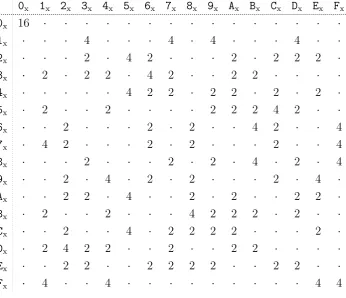
Example 2.4.4. Figure 2.1 displays the DDT of the 4×4 S-box S of the
cipher PRESENT described in Section 1.2.2. As already noticed in Remark
2.2.3, since the considered S-box is invertible, x ∈ (F2)4 is a solution of
xS + (x+ ∆)S = 0 if and only if ∆ = 0, hence the first row and the first column of DDTS are null except for the entry 16 = #(F2)4 corresponding to
the input / output pair (0x,0x). The remainder of the table reads as follows:
since DDTS[1x,3x] = 4, it means that the equation xS+ (x+1x)S =3x
ad-mits four solutions in (F2)4, hence the probability that the output difference
Resistance to classical differential cryptanalysis
0x 1x 2x 3x 4x 5x 6x 7x 8x 9x Ax Bx Cx Dx Ex Fx
0x 16 · · · ·
1x · · · 4 · · · 4 · 4 · · · 4 · ·
2x · · · 2 · 4 2 · · · 2 · 2 2 2 ·
3x · 2 · 2 2 · 4 2 · · 2 2 · · · ·
4x · · · 4 2 2 · 2 2 · 2 · 2 ·
5x · 2 · · 2 · · · · 2 2 2 4 2 · ·
6x · · 2 · · · 2 · 2 · · 4 2 · · 4
7x · 4 2 · · · 2 · 2 · · · 2 · · 4
8x · · · 2 · · · 2 · 2 · 4 · 2 · 4
9x · · 2 · 4 · 2 · 2 · · · 2 · 4 ·
Ax · · 2 2 · 4 · · 2 · 2 · · 2 2 ·
Bx · 2 · · 2 · · · 4 2 2 2 · 2 · ·
Cx · · 2 · · 4 · 2 2 2 2 · · · 2 ·
Dx · 2 4 2 2 · · 2 · · 2 2 · · · ·
Ex · · 2 2 · · 2 2 2 2 · · 2 2 · ·
Fx · 4 · · 4 · · · 4 4
Figure 2.1: DDT of the S-box S of PRESENT
The DDT of an S-box is related to its differential probabilities as stated in the following trivial result. Notice that, for sake of simplicity, differentials have been defined as pairs of elements in the same set, and their probabil-ity have been defined only with respect to a bijective function. However Definition 2.2.2 can be easily generalised to the case of different sets and non-bijective functions.
Lemma 2.4.5. Let f : (F2)s → (F2)t. Then for any ∆I ∈ (F2)s and ∆O ∈
(F2)t, the probability of the differential (∆I,∆O) with respect to f is
p∆f
I(∆O) =
Resistance to classical differential cryptanalysis
Notice that, the number of non-zero element in a row DDTf[∆,·] corre-sponds to the number of different values that∂∆f can assume. The following
definition is a way to use these numbers as an indicator for the non-linearity of f.
Definition 2.4.6. Let f : (F2)s→(F2)t. The differential uniformity of f is
defined as
δ(f)def= max u,v u6=0
DDTf[u, v],
The function f is said to be δ-differentially uniform if δ=δ(f).
It is straightorward to notice the following properties:
• if x is a solution of xf + (x+ ∆I)f = ∆O, also x+ ∆I is a solution, hence DDTf[∆I,∆O] is always even, and so isδ(f);
• 2≤δ(f)≤2s;
• for each ∆I
X
∆
DDTf[∆I,∆] = 2s.
Since the lower the entries of DDTf[∆I,·], the more the values∂∆If assumes,
functions f which reach the lower bound δ(f) = 2 are optimal in terms of non-linearity, in the sense of preventing difference propagation.
Definition 2.4.7. Let f : (F2)s → (F2)t. If δ(f) = 2, f is called
almost-perfect non-linear (APN).
2.4.2
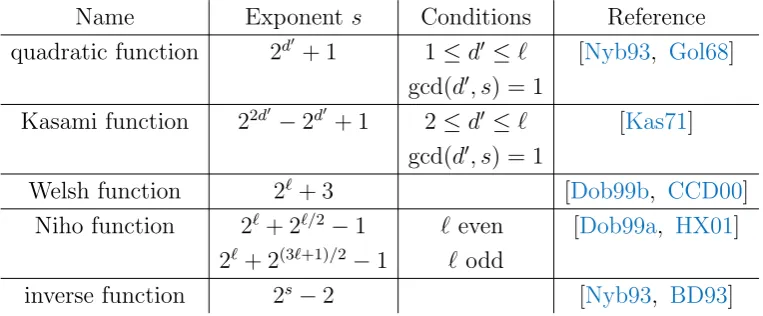
Known APN permutations
Resistance to classical differential cryptanalysis
Name Exponent s Conditions Reference quadratic function 2d0+ 1 1≤d0 ≤` [Nyb93, Gol68]
gcd(d0, s) = 1
Kasami function 22d0−2d0+ 1 2≤d0 ≤` [Kas71] gcd(d0, s) = 1
Welsh function 2`+ 3 [Dob99b, CCD00] Niho function 2`+ 2`/2−1 ` even [Dob99a, HX01]
2`+ 2(3`+1)/2−1 ` odd
inverse function 2s−2 [Nyb93, BD93]
Table 2.1: Known APN permutations of the typex7→xdon (F2)s,s= 2`+1
up to equivalence. It has been shown that no permutation in (F2)s is APN
when s= 4 [BL08,CSV17], and the problem is still open for s≥8.
In the casesodd instead, APN permutations are known. In what follows we will briefly recall the case of power functions, i.e. (F2)s-valued function
of the type of x7→ xd, d∈
N. It is known that an APN power function is a
permutation over (F2)s if and only if s is odd [Car10], hence let us focus on
the case s = 2`+ 1. Table 2.1 collects some families of known APN power functions in odd dimension which are bijective [Blo11].
2.4.3
Other non-linearity notions
In this section we will quickly discuss other non-linearity notions for Boolean functions. Even if not necessarily related to differential attacks, they will be used in the remainder of this work. The following definitions were introduced in [CDVS09b] for the study of group-theoretical properties of ciphers.
Resistance to classical differential cryptanalysis
Definition 2.4.8. Let f : (F2)s → (F2)t, and let δ ≥ 2. Then f is called
weakly δ-differentially uniform if δ is the least integer such that for each
u∈(F2)s\ {0} it holds
# Im(∂uf)> 2s−1
δ .
The adjective weak is justified by the following result [CDVS09b].
Proposition 2.4.9. Let f : (F2)s → (F2)t, and let δ ≥ 2. If f is δ
-differentially uniform, then f is weakly δ-differentially uniform.
Proof. Let u ∈(F2)s, u6= 0. From the definition of δ-differential uniformity
follows that for v ∈(F2)t it holds #v(∂uf)−1 ≤δ. Moreover
(F2)s=
[
v∈Im(∂uf)
v(∂uf)−1,
and from the hypothesis it follows
2s = #
[
v∈Im(∂uf)
v(∂uf)−1
≤# Im(∂uf)δ.
Therefore
# Im(∂uf)≥ 2s
δ >
2s
δ .
Another useful notion of non-linearity comes from the following consid-eration. Let f ∈ Sym(F2)s be such that 0f = 0. If f is linear, every
vecto-rial subspace of (F2)s is sent to a subspace of (F2)s of the same dimension,
i.e. the dimension of subspace is invariant under f. When f is not linear, the null space is mapped into itself, every 1-dimensional subspace {0, a} is mapped into the 1-dimensional subspace {0, af}, whereas the 2-dimensional subspace{0, a, b, a+b}is mapped into a 2-dimensional subspace if an only if
af+bf = (a+b)f. It should be clear that the bigger the dimensionl < sof the subspace, the more unlikely the image of the subspace under f is still a vector subspace. The following definition [CDVS09b] is given in this sense.
Definition 2.4.10. Letf ∈Sym(F2)sbe such that 0f = 0 and let 0< δ < s.
The functionf is said to beδ-non-invariant if for any subspacesU, V ≤(F2)s
Resistance to classical differential cryptanalysis
Being δ-non-invariant then means that the largest proper subspace sent by f into another subspace has co-dimension greater than δ.
Example 2.4.11. As an example, let us consider the so-called patched
in-version f ∈ Sym (F28), which maps every non-zero element into its multi-plicative inverse. It is well known that a function which is equivalent tof, up to a change of variable, is used as S-box in the AES. The patched inversion is 4-differentially uniform on F28 [Nyb93], whereas it is known that, for each
u ∈ F28, u 6= 0, it holds # Im(∂uf) = 27 − 1 > 26, hence f is weakly 2-differentially uniform. On the other hand, it has been proven in [CDVS09b] that f is 1-non-invariant.
2.4.4
Requirements on the diffusion layer
As we have discussed in previous sections, the confusion layer of an iterated cipher, due mainly to efficiency reasons, is a local non-linear transformation, i.e. any output bit depends on only a limited number of input bits. In particular, it does not provide any interaction between the different bricks. This role is played by the diffusion layer that, acting over all the bricks of the block, spreads the information of a single bit also to bricks different to the one the bit belongs to. In our setting, diffusion is always realised by means of a linear map onV. The following definitions were given as minimal requirement for diffusion in [CDVS09b], in the case of a bijective layer, and were used to derive group-theoretical results on SPNs.
Let us recall that V = V1⊕V2 ⊕. . .⊕Vb, and that each s-dimensional
space Vj is called a brick.
Definition 2.4.12. Awall V0 ofV is a non-trivial and proper sum of bricks
of V, i.e. there exists ∅ 6=J ({1,2, . . . , b} such thatV0 =⊕j∈JVj.
We say that a diffusion layerλis proper if no wall ofV is invariant under
λ, and thatλ is strongly proper if no wall of V is mapped byλ into another wall of V.
Definition 2.4.13. A linear transformationλ∈Sym(V) is aproper diffusion
layer if for any wallV0 =L
Resistance to classical differential cryptanalysis
Definition 2.4.14. A linear transformationλ∈Sym(V) is astrongly proper
diffusion layer if for any ∅ 6= J1, J2 ( {1,2, . . . , b} such that #J1 = #J2 it
holds
M
j∈J1
Vj
!
λ6=M
j∈J2
Vj.
It is clear that the condition in Definition 2.4.14 implies the one in Defi-nition 2.4.13.
On the other hand, with an eye on the security with respect differential attacks, following the approach of [DR13], the diffusion can be estimated in terms of a lower bound on the number of the active S-box of any 1-round differential trail (see Definition 2.2.7).
Definition 2.4.15. Let x ∈ V, x = (x[1], x[2], . . . , x[b]), with x[j] ∈ (
F2)s
being the jth brick, for each 1≤j ≤b. The brick weight of x is defined as
weightb(x)def= X x[j]6=0
1.
Let now consider an iterated cipher Φ whose generating function is ρ =
γλ. Notice that, if (∆0,∆1, . . . ,∆r) is an r-round differential trail, the num-ber of active S-boxes at the round `with respect to (∆0,∆1, . . . ,∆r), defined in Definition 2.3.5, is exactly weightb(∆`−1). In the context of evaluating
the diffusion properties of λ with respect to differential cryptanalysis, a con-siderable measure is the minimum number of active bricks at the input and output of ρ, called the branch number of λ, which basically provides a lower bound for the minimum brick weight of any 1-round differential trail. To formalise this, we need the following definition [DR13].
Definition 2.4.16. Let λ∈Sym(V). The branch number of λ is defined as
min x,y∈V x6=y
{weightb(x+y) + weightb(xλ+yλ)}.
Resistance to classical differential cryptanalysis
diffusion layer is (at least) proper, the larger the branch number, the less the number of rounds the encryption needs to be iterated. On the other hand, the counterpart for this is that layers with a larger branch number have higher implementation costs. As an illustration for this, let us recall that the proper diffusion layer of AES has branch number equal to five, and the cipher, in its version with a 128-bit key, performs a 10-round encryption. On the other hand, the permutation matrix of PRESENT has branch number equal to two, due to the fact that, for example, the vector (1,0,0, . . . ,0) is fixed. The encryption in this case is iterated for 31 round. The following theorem, due to Daemen and Rijmen [DR13], relates the branch number of
λ to a bound on the number of active S-boxes in a differential trail.
Theorem 2.4.17. Let Φ be an iterated block cipher having generating
3
Group theoretical security
3.1
Algebraic security
The group generated by the round functions
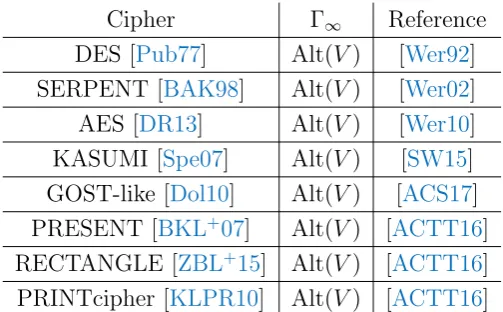
symmetric cryptography is focused on showing that the group generated by the encryption functions of a given cipher is primitive and not of affine type [ACTT16, ACDVS14, ACS17, CDVS09a, CDVS09b, SW08, Wer92, Wer02,
Wer10].
The definition of the group under consideration presents some issues, which we discuss in the following section.
3.2
The group generated by the round
func-tions
As already explained in Section 3.1, statistical attacks are just some of the issues that can threaten block ciphers. Several researchers have shown in recent years that also algebraic attacks can be effective. In this work, the fo-cus is on a particular group-theoretical attack, described in [Pat99] and here treated in Section 3.3, based on an undesirable property of the permutation group generated by the round functions of a cipher, the imprimitivity.
Let us define now the target of the so-called imprimitivity attack: the group generated by the round functions of the cipher.
Let Φ = {EK | K ∈ K} ⊆ Sym(M) be an R-round iterated block cipher. We have stressed that the group generated by all encryption functions
Γ(Φ)def=hEK |K ∈ Ki ≤Sym(M)
can reveal weaknesses of the cipher. However, since Γ(Φ) is strictly related to the key-scheduling procedure, which is not easy to describe in terms of groups and their action, its algebraic study is not an easy task. For this reason researchers classically focus on a group which is related to Γ(Φ) and which, ignoring the effect of the key-schedule, is easier to study (for a recent example of a key-schedule related study, see [BF17]). The latter can be defined as follows: since each permutation EK is the composition of Rround functions ε1,K, ε2,K. . . , εR,K, for each 1 ≤r ≤ R, it is possible to define the group
Γr(Φ) def
Imprimitivity attack
where all the possible round keys for the round r are considered. This lead to the definition of the group
Γ∞(Φ)def=hΓr(Φ) |1≤r ≤Ri,
which is calledthe group generated by the round functions of Φ, and trivially contains the group generated by the encryption functions as a subgroup.
Example 3.2.1. Let us denote by Φ the block cipher PRESENT defined in
Section 1.2.2. As already mentioned, the problem of describing the group Γ(Φ) is out of reach today. However, being ρ the generating function of PRESENT, i.e. the composition of its confusion and diffusion layers, one can easily prove that the group generated by the rounds of the cipher is Γ∞(Φ) =
hρ, T64i. Indeed, the left-to-right inclusion is trivial due to the definition of
round function. On the other hand, when the null key is considered, we obtain ρ ∈ Γ∞, hence also ρ−1 ∈ Γ∞, and consequently T
64 < Γ∞. This
proves the right-to-left inclusion. The same description holds for a large class of ciphers, called translation-based ciphers [CDVS09b], which also includes the block ciphers AES and SERPENT and some lightweight ciphers.
3.3
Imprimitivity attack
Before describing the imprimitivity attack, let us recall some basic notions from permutation group theory. Let G be a finite group acting on the set M. We denote by vG = {vg | g ∈ G} the orbit of v ∈ M and by
Gv = {g ∈ G | vg = v} its stabiliser. A partition X of M is trivial if
X = {M} or X = {{v} | v ∈ M}, and G-invariant if for any X ∈ X and
g ∈G it holds Xg ∈ X. Any non-trivial and G-invariant partition X of M
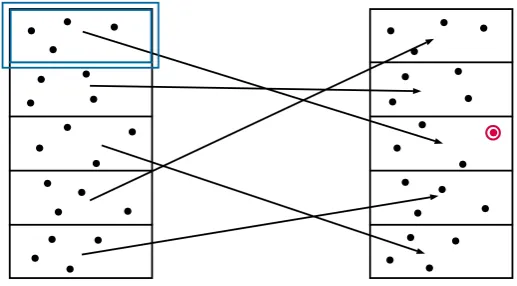
is called a block system. In particular any X ∈ X is called an imprimitivity block. The groupG isprimitive in its action onM(or Gacts primitively on
M) ifGis transitive and there exists no block system. Otherwise, the group
G is imprimitive in its action on M (or G acts imprimitively on M).
Imprimitivity attack
Lemma 3.3.1. A block of imprimitivity is the orbitvH of a proper subgroup
H < G that properly contains the stabiliser Gv, for some v ∈ M.
Lemma 3.3.2. If T is a transitive subgroup of G, then a block system forG
is also a block system for T.
Lemma 3.3.3. Let us assume that M is a finite vector space over F2 and
T its translation group, i.e. T = {σv | σv : M → M, x 7→ x+v, v ∈ M}.
Then
• T is 2-elementary, abelian and regular;
• T is transitive and imprimitive on M;
• for any proper and non-trivial subgroup U of (M,+), {U+v |v ∈ M}
is a block system.
Description of the imprimitivity attack
When the group Γ∞(Φ) turns out to act imprimitively onM, then it is pos-sible to individuate a non-trivial partition X of Mwhich is invariant under the action of Γ∞(Φ). Then an attacker