U
NIVERSITY OF
TRENTO
D
EPARTMENT OF
M
ATHEMATICS
P
HD
IN
MATHEMATICS
XXVIII C
YCLE
Cyclic Codes: Low-Weight Codewords
and Locators
Author:
Claudia T
INNIRELLOAdvisor:
Prof. Massimiliano S
ALAHead of the Doctoral School:
Prof. Valter M
ORETTI1 Introduction 1
1.1 Objectives and Contributions . . . 1
1.1.1 Finding Low-weight codewords . . . 1
1.1.2 Decoding cyclic codes . . . 2
1.2 Thesis Organization . . . 3
I
Preliminary results
5
2 Algebraic and Complexity Background 7 2.1 Modular Arithmetic . . . 72.2 Some Notions in Complexity Theory . . . 8
2.2.1 Basic notions . . . 8
2.2.2 Theory of NP-Completeness . . . 10
2.3 Basic Notions in Finite Fields . . . 12
2.4 Linear Recurring Sequences . . . 17
2.5 Discrete Logarithms . . . 18
2.5.1 Computing Discrete Logarithms . . . 19
2.5.2 Zech Logarithm Table . . . 22
3 Decoding Problem for Cyclic Codes 25 3.1 An overview on error correcting codes . . . 25
3.2 Linear Codes . . . 28
3.2.1 Basic definitions . . . 28
3.2.2 Decoding Linear Codes . . . 31
3.3 Cyclic Codes . . . 33
3.3.1 Basic definitions . . . 33
3.3.2 Decoding Cyclic Codes . . . 37
4 Correlation Attacks on LFSR-based Stream Ciphers 49 4.1 Preliminaries . . . 49
4.1.2 Boolean functions . . . 50
4.1.3 Birthday Problem . . . 52
4.2 Stream ciphers . . . 55
4.2.1 Standard properties of keystream sequences . . . 55
4.2.2 LFSR-based stream ciphers . . . 57
4.3 Correlation attacks on LFSR-based stream ciphers . . . 59
4.3.1 Correlation attacks . . . 60
4.3.2 Fast correlation attacks . . . 61
II
Main results
65
5 Discrete logarithm-based approach for fast correlation attacks 67 5.1 Strategy and preliminary results . . . 675.2 The algorithm . . . 72
5.2.1 Description of Algorithm 3 . . . 72
5.2.2 Complexity estimates . . . 74
5.3 Significant Examples . . . 77
6 On the shape of the general error locator polynomial 79 6.1 A new representation of the locator polynomial . . . 79
6.2 Sparse locators for some classes of codes witht= 2. . . 83
6.3 Sparse locators for some classes of codes witht= 3. . . 90
6.4 On the complexity of decoding cyclic codes . . . 98
6.4.1 Complexity of the proposed decoding approach . . . 98
6.4.2 Comparison with other approaches . . . 101
III
Appendices
105
A Some tables 107 B Some MAGMA codes 109 B.1 Implementation of the Algorithm 3 . . . 109B.2 Binary cyclic codes witht = 3 . . . 114
B.3 Some classes of binary cyclic codes presented in Chapter 6 . . . 117
Introduction
Error correcting codes has become an integral part of the design of reliable data transmis-sions and storage systems. Their employment in these applications provide mechanisms for the detection and correction of errors. Error correcting codes are also playing an increasingly important role for other applications such as the analysis of pseudorandom sequences and the design of secure cryptosystems. Cyclic codes form a large class of widely used error correct-ing codes, includcorrect-ing important codes such as the Bose-Chaudhuri-Hocquenghem (BCH) codes, quadratic residue (QR) codes and Golay codes. Cyclic codes were studied first by E. Prange in 1957 [Pra57], who discovered their rich algebraic structure. Their extensive employment in real-life applications is due to two main aspects: they offer powerful error detection and cor-rection capabilities and possess algebraic properties permitting the use of simplified processing procedures and a much easier investigation when compared to non-cyclic codes. For instance, the encoding of data into cyclic code words can easily be achieved in hardware using a simple linear feedback shift register. Currently, the main drawback of cyclic codes is the lack of an efficient decoding algorithm for them.
1.1
Objectives and Contributions
This thesis is devoted to two problems arising in the study of cyclic codes: finding low-weight codewords and decoding. In the rest of this section we briefly describe where our con-tribution is positioned and point out the main results of the thesis.
1.1.1 Finding Low-weight codewords
different approaches, one based on the birthday paradox [CJM02] and another based on discrete logarithms [DLC07]. A cipher like E0 ([GPS04]) is not immediately subject to these types of attacks, since no apparently single LFSR is correlated to the keystream output. In [LV04], Lu and Vaudenay introduced a new fast correlation attack (often called faster correlation attacks) which is able to successfully recover the state of E0. Their attack requires a different precompu-tation step which computes a single parity check of multiple LFSRs. Since the data complexity of the attack is bounded from below by the degree of the parity check, one tries to find a parity check of degree less than a target degree. The complexity of their precomputation step is not far from the complexity of their full attack, and they employed the generalized birthday approach presented in [Wag02]. In Chapter 5 an alternative approach for solving this problem based on discrete logarithms is described. In some interesting cases our algorithm has a time complexity comparable to the generalized birthday approach, while having a much lower memory com-plexity (i.e. O(1)). These cases are relevant to faster correlation attacks to a class of stream
ciphers (including the Bluetooth cipher E0) and when the polynomial is the product of many irreducible factors. The design of the new algorithm has been published [PST16].
1.1.2 Decoding cyclic codes
In the last fifty years many efficient bounded-distance decoders have been developed for special classes of cyclic codes, e.g. the Berlekamp-Massey (BM) algorithm ([Mas69]) designed for the BCH codes. Although BCH codes can be decoded efficiently, it is known that their de-coding performance degrades as the length increases ([LW67]). Cyclic codes are not known to suffer from the same distance limitation, but no efficient bounded-distance decoding algorithm is known for them (up to their actual distance).
In [OS05] Orsini and Sala introduced the general error locator polynomial and presented an algebraic decoder which permits to determine the correctable error patterns of a cyclic code in one step. They constructively showed that these polynomials exist for any cyclic code (it is shown to exist in a Gröbner basis of the syndrome ideal), and gave some theoretical results on the structure of such polynomials in [OS07], without the need to actually compute a Gröb-ner basis. They also provide a structure theorem for these locators for a class of binary cyclic codes, which has been generalized by Chang and Lee [CL10] for binary cyclic codes that could be defined by only one syndrome. In Chapter 6 a generalization of this result is showed, along with several results for infinite classes of binary cyclic codes witht= 2andt= 3. From these,
a theoretically justification of the sparsity of the general error locator polynomial is obtained for all binary cyclic codes witht ≤ 3andn < 63, except for three cases where the sparsity is
1.2. Thesis Organization
1.2
Thesis Organization
The remainder of the thesis is structures in three parts.
Part I: Background
In this part we aim to introduce and motivate our research objectives. We also provide some preliminary results which we will use in Part II. This part does not contain original contributions. It is organized as follows:
Chapter 2
In this chapter we review some well-known results in arithmetics, in complexity theory and in finite field theory that will be used along the thesis. Particular focus is directed towards fundamental properties of polynomials over finite fields and discrete logarithms computation.
Chapter 3
In this chapter the study of error correcting codes is introduced. Basic properties of linear codes are presented, and it is discussed the complexity of the decoding problem for these codes. The algebraic structure of cyclic codes is described and the problem of decoding cyclic codes is addressed. Established decoding techniques for BCH codes are presented along with their complexity. Finally, general error locators for cyclic codes are introduced, and it is discussed some promising properties of these locators for decoding cyclic codes.
Chapter 4
In this chapter basic notions in Cryptography and current algorithms for solving the Gen-eralized Birthday Problem are briefly reviewed. Some basic properties of LFSR-based stream ciphers, their security level and the standard procedures for achieving a good level of security are described. Finally, correlation attacks and fast correlation attacks on LFSR-based stream ciphers are introduced.
Part II: Contributions
This part is devoted to our original results. It is organized as follows:
Chapter 5
birthday approach and to the straightforward generalization of the discrete log approach for the case of a single primitive polynomial. Significant examples of our approach are outlined in the final part of the chapter, where we show that for the fast correlation attack in [LV04] our algo-rithm could be more convenient to use in the second precomputation step than the generalized birthday approach, and that the method we propose is substantially better than the generalized birthday approach in the case where the polynomial can be decomposed in several irreducible factors, each one of degree less than20. This chapter is based on a journal publication [PST16].
Chapter 6
In this chapter we deal with some issues concerning the efficiency of the Orsini-Sala bounded-distance decoding algorithm based on general error locators for cyclic codes. A new result on the structure of the general error locator polynomial for a class of cyclic codes is obtained, and it is shown sparse general error locator polynomials for infinite classes of binary cyclic codes with error correction capabilityt≤3, adding theoretical evidence to the sparsity of this locator
for infinite classes of codes. Finally, the complexity of bounded-distance decoding of certain classes of cyclic codes is studied.
Part III: Appendices
This part contains two appendices.
• Appendix A includes two tables. The first table lists the binary cyclic codes witht = 3
andn <63, while the second table reports a general error locator polynomial for binary
cyclic codes witht= 3andn = 55.
Part I
Algebraic and Complexity Background
In this chapter we fix some notations and report well-known results in arithmetics, in com-plexity theory and in finite field theory that will be used along the thesis.
For this chapter definitions and results are mainly from [LN97, Knu81, GJ79, MP13, MM07, MBG+13, Mor03].
2.1
Modular Arithmetic
In a Euclidean ring, we denote by amodc the remainder of the division of a by c. We
write a ≡ b (mod c) if a is congruent to b modulo c. We denote by LCM and GCD the
Least Common Multiple and the Greatest Common Divisor — respectively — of polynomials or integers, depending on its inputs.
Definition 2.1.1. Letaandnbe integers withn >0andGCD(a, n) = 1. The smallest positive
integerkwithak≡1 mod nis called themultiplicative order of amodulonand is denoted by ordn(a).
Note that, as a consequence of Euler’s theorem, ordn(a) always divides ϕ(n), ϕ being the
Euler’s function.
Definition 2.1.2. Letaandnbe positive integers withGCD(a, n) = 1, and letibe an integer
with0≤i < n. The set
Ci ={i, ia, ia2, . . . , ias−1},
wheresis the smallest positive integer withias≡i (mod n), is said thecyclotomic coset of a
(ora-cyclotomic coset)moduloncontainingi.
The distincta-cyclotomic cosets modulonpartition the set of integers
[0, n−1] :={0,1, . . . , n−1}.
A subset{i1, . . . , is}of[0, n−1]is called acomplete set of representativesof cyclotomic cosets
ofamodulon ifCi1, . . . , Cis are distinct and
Ss
j=1Cij = [0, n−1]. Note that ordn(a)is the size of thea-cyclotomic cosetC1modulon.
Theorem 2.1.3(Chinese Remainder Theorem). Letm1, m2, . . . , mr be positive integers which are relatively prime in pairs, i.e.
GCD(mj, mk) = 1 when j 6=k.
Let m = m1m2· · ·mr, and let a, u1, u2, . . . , ur be any integers. Then, there is exactly one integeruwhich satisfies the conditions
a≤u < a+m, u≡uj (mod mj), 1≤j ≤r.
We are interested in the following generalization of Theorem 2.1.3.
Theorem 2.1.4 (Generalized Chinese Remainder Theorem). Let m1, m2, . . . , mr be positive integers. Letm= LCM(m1, m2, . . . , mr), and leta, u1, u2, . . . , urbe any integers. Then, there is exactly one integeruwhich satisfies the conditions
a ≤u < a+m, u≡uj (mod mj), 1≤j ≤r
provided that
ui ≡uj (mod GCD(mi, mj)), 1≤i < j ≤r.
We will denote by CRT(u1, u2, . . . , ur, m1, . . . , mr) the result of applying the (Generalized)
Chinese Remainder Theorem to integersui and modulimi.
2.2
Some Notions in Complexity Theory
In this section we recall some notions from computational complexity theory. Since it is not within our scope to deal with details of computational complexity, most of our definitions will be informal. For more details we refer the reader to [GJ79].
2.2.1 Basic notions
The goal of computational complexity theory is to measure the difficulty of problems. By aproblem, we mean a general question to be answered. A problem whose answer, orsolution, is “yes” or “no”, is called adecision problem. A problem usually possesses severalparameters whose values are left unspecified. Aninstanceof a problem is achieved by specifying values for those parameters.
Example 2.2.1. Consider the following problem
Problem (PRIME)
Input: An integern≥2 Question: Isnprime?
The problemPRIMEis an example of decision problem having one parametern. An instance
2.2. Some Notions in Complexity Theory
Notice that, given a problem, there are many ways in which its instances can be described. We assume that for each problem one particular way has been chosen in advance. The func-tion which maps the problem instances into the strings describing them is called theencoding schemeof the problem. Theinput lengthfor an instanceI of a problemΠis defined to be the
number of symbols in the description ofI obtained from the encoding scheme forΠ.
A general step-by-step procedure, solving a problem, in a finite number of steps is called an algorithm.
The difficulty of a problem is measured by examining algorithms to solve it. The (worst-case) time complexityfor an algorithm expresses its time requirements by giving, for each possible input length, the largest amount of time needed by the algorithm to solve a problem instance of that size. The time complexity function of an algorithm is usually denoted byT(n), withnthe
input length.
Note that, depending on the assumptions, may be necessary consider separately thespace com-plexity of an algorithm, which is the number of registers used in the course of the algorithm. This is not essential for single-tape Turing machine, whose running time combines the time and memory complexity. A very significant fact about Turing machines is that any algorithm can be modeled by a Turing machine program. However, for a general algorithm writing such a program is a notably time-consuming task.
Different algorithms may have very different time complexity functions. One would like to characterize which of these algorithms are “too inefficient”, or “ intractable”, and which are “tractable”. Computer scientists recognize a simple distinction that offers considerable insight into these issues.
Definition 2.2.2(Big O Notation). Letf, g : N → R+ be two positive real-valued functions.
We say thatf isO(g(n))if there a positive constantcand an integern0 such that
f(n)< c·g(n), (2.1)
for all values ofn≥n0.
Apolynomial time algorithmis defined to be one whose time complexity function isO(p(n))
for some polynomial functionp, where ndenotes the input length. Any algorithm whose time
complexity function cannot be so bounded is called anexponential time algorithm. We shall refer to a problem asintractableif no polynomial time algorithm can possibly solve it.
Arandomized algorithmis one wherein certain decisions are made based on the outcomes of coin flips made in the algorithm. Byprobabilistic polynomial time algorithm, we mean a randomized algorithm whose time complexity function is bounded by a polynomial in the size of the input.
Definition 2.2.3. We define
wheren is the size of the input space,0 ≤ γ ≤ 1, cis a constant andlnn denotes the natural
logarithm.
Let A be an algorithm. Denote with T(n) its time complexity function. We note that if
T(n) = L[n,0, c] then A is a polynomial time algorithm, while if T(n) = L[n,1, c] then A is an exponential time algorithm. We say that A is a subexponential time algorithm if
T(n) = L[n, γ, c]with0< γ <1.
2.2.2 Theory of NP-Completeness
The theory of complexity is designed to be applied only to decision problems. The reason is that they possess useful properties allowing a better understanding of their complexity than non-decision problems. Moreover, most problems can be reduced to decision problems.
An important class of decision problems is the class P. We say that a decision problem Π
belongs toP ifΠis a polynomial-time algorithm. Another important class of decision problems
is the class NP. In order to introduce this class let us first consider the following example.
Example 2.2.4. The problem PRIME in Example 2.2.1 is an example of problem in the class
P. A (deterministic) polynomial time algorithm solving it, is the AKS primality test [AKS04].
Let us examine the following problem
Problem (THREE DIMENSIONAL MATCHING)
Input: A subsetU ⊆T ×T ×T, whereT is a finite set
Question: Is there a set W ⊆ U such that |W| = |T|, and no two elements of W agree in
any coordinate?
No polynomial time algorithm is known for solving theTHREE DIMENSIONAL MATCHING. However, suppose someone claimed, for a particular instance (T, U)of this problem, that the
answer for that instance is “yes” providing us with a setW which satisfies the property. It is
reasonable to expect that the problem of verifying the truth or falsity of such a claim, would be easier than the problem itself. It can be seen that for theTHREE DIMENSIONAL MATCHING this verification problem can be solved with a polynomial time algorithm. The class NP captures this notion of polynomial time verifiability.
An algorithm is said deterministic if its computation is fully determined by its input. An algorithm is nondeterministic if it is not deterministic, that is, if there may be more than one computation for a given input.
A nondeterministic algorithm is composed of two stages:
1. Guessing stage (nondeterministic): Given a problem instance I, some structure S is
“guessed”. Scan be thought of as a candidate solution of the problem for the instanceI.
2. Verification stage(deterministic): Taken as inputI andS, it returns “yes” if the candidate
2.2. Some Notions in Complexity Theory
LetΠbe a decision problem. Denote withDΠthe set of instances ofΠ. We say that an instance
I ∈ DΠ is an yes-instanceof Π if the solution of Π when particularized to the instance I is
“yes”. We denote the set of all yes-instances ofΠwithYΠ.
A nondeterministic algorithm is said to solve a decision problemΠif for all instancesI ∈DΠ:
• IfI ∈YΠ, then there exists some structureSthat, when guessed for inputI, will lead the
verification stage to respond "yes" forIandS.
• If I /∈ YΠ, then there exists no structureS that, when guessed for inputI, will lead the
verification stage to respond "yes" forIandS.
In the complexity investigation of a decision problemΠ, one is usually interested in showing
that a polynomial-time algorithm exists forΠor thatΠis NP-complete.
A decision problemΠbelonging in NP is said an NP-complete problemif a polynomial-time algorithm for Π would yield a polynomial-time algorithm for every decision problem in the
class NP. A decision problem which has this property but is not necessary in NP is called an NP-hard problem.
The concept of NP-completeness was introduced in 1971 by Cook [Coo71] which also provided the first known NP-complete problem. Since the class NP is known to contain many problems that are considered computationally hard, the NP-completeness of a problemΠis considered as
a strong evidence suggesting thatΠdoes not admit a polynomial-time algorithm. Today a wide
variety of problems are known to be NP-complete. Note that, once we have at least one known NP-complete problem available, a straightforward method for proving that a decision problem
Πis NP-complete consists in showing that
• Π ∈N P;
• some known NP-complete problemΠ0 can be transformed with a polynomial time
trans-formation inΠ.
NP-hard
NP-complete NP
P
P=NP= NP-hard
=NP-complete
P6=N P P=N P
co
m
pl
ex
it
y
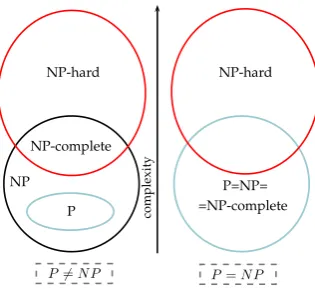
Note also that, trivially,P ⊆N P. On the contrary, whether or notN P ⊆P is one of the major
unsolved problems in computer science. Figure 2.1 shows a diagram of complexity classes under the two assumptions thatP 6=N P andP =N P.
2.3
Basic Notions in Finite Fields
We denote by Fq the field ofq elements, whereq is a power of a prime p, by F∗q the
mul-tiplicative group of non-zero elements ofFq, byFq the algebraic closure of Fq, and by Fqnthe
standardn-dimensional vector space overFq.
In this section we recall some of the basic properties of finite fields.
Definition 2.3.1. A subset K of a field F that is a field under the operations of F is called a subfieldofF, and we writeK⊆F. In this context,Fis a called anextensionofK. IfM is any
subset of F, then the fieldK[M]is defined as the intersection of all subfields of F containing bothKandM. For finiteM ={θ1, . . . , θn}, we writeK(θ1, . . . , θn).
Proposition 2.3.2. Let Fq be a finite field withq = ps. Every subfield of Fq haspm elements for some integerm dividings. Conversely, for any integer m dividings there exists a unique subfield ofFqwithpm elements.
LetFq[x]be the ring of univariate polynomials overFq.
Definition 2.3.3. Let f ∈ Fq[x]. The coefficient of the highest power ofx in f is called the
leading coefficientoff. We say thatf ismonicif its leading coefficient is1.
Definition 2.3.4. Letθ ∈ Fqr andf(θ) = 0wheref(x)is a monic polynomial in Fq[x]. Then
f(x)is called theminimal polynomialofθoverFqifθis not a root of any nonzero polynomial
inFq[x]of lower degree.
Definition 2.3.5. A polynomial f ∈ Fq[x] is an irreducible polynomial over Fq if f has a
positive degree andf =ghwithg, h∈Fqimplies that eitherg orhis a constant polynomial.
Proposition 2.3.6. Let θ ∈ Fqr and f(x) be its minimal polynomial over Fq. Then f is an irreducible polynomial.
Definition 2.3.7. Letf be a non-zero polynomial inFq[x]. Iff(0) 6= 0, then the order of f is
the least positive integerN such that1 +xN is a multiple off, and we denote it byord(f).
Proposition 2.3.8. Let f be a polynomial inFq[x]of positive degree and f(0) 6= 0. Letf =
fb1
1 · · ·frbr, whereb1, . . . , br ∈ Nandf1, . . . , fr are distinct irreducible polynomials of degree
n1, . . . , nr, be the factorization off inFq[x]. Then,
1. ord(f) = qtLCM(ord(f
2.3. Basic Notions in Finite Fields
2. Iffiis irreducible, thenord(fi)|qni−1;
Definition 2.3.9. Letf ∈Fq[x]of degreen. We say thatf isprimitiveiford(f) = qn−1.
Note that by point 2. of Proposition 2.3.8 we have that any primitive polynomial is irreducible.
Definition 2.3.10. Let f ∈ Fq[x] be monic and of positive degree and F be an extension of
Fq. Then f is said to split in F if can be factored as a product of linear factors in F[x], i.e.
f(x) = (x−α1)· · ·(x−αn). The field Fis asplitting field off overFq iff splits inFand F=Fq(α1, . . . , αn).
Proposition 2.3.11(Existence and Uniqueness of Splitting Field). Letf ∈Fq[x]be monic and of positive degree. Then there exists a splitting field off overFq. Moreover, any two splitting fields off overFqare isomorphic.
Next theorem summarizes some fundamental properties of finite fields
Theorem 2.3.12. LetFqbe a finite field withq=ps. Then
1. (a+b)pk
=apk
+bpk
fora, b∈Fqandk ∈N
2. everya ∈Fqsatisfiesaq =a.
3. xq−1factors in
FqasQa∈F∗
q(x−a)
4. Fq is isomorphic to the splitting field ofxq−xoverFp
5. F∗q is a cyclic group
Definition 2.3.13. An elementθ∈Fqwhich multiplicatively generates the groupF∗qis called a primitive element.
Proposition 2.3.14. LetFq be a finite field, nbe an integer with GCD(n, q) = 1, andFqm be the splitting field ofxn−1over
Fq. Then there exists an elementα ∈Fqmsuch that
xn−1 = n−1
Y
i=0
(x−αi). (2.2)
A such elementαis called a primitiventh root on unity overFq.
Definition 2.3.15. LetFqm be an extension ofFq. An automorphism of Fqm is said to be an automorphism of Fqm over Fq if it fixes the elements of Fq. If α ∈ Fqm, then the elements
α, αq, . . . , αqm−1
are called theconjugatesofαwith respect toFq.
Proposition 2.3.16. The distinct automorphisms of Fqm overFqare exactly the functions
f0,f1,. . .,fm−1, where
fj(α) =αq
j
for α ∈Fqm,
for0≤j ≤m−1. The functionf1is called the Frobenius automorphism ofFqm overFq.
Theorem 2.3.17. Let Fq be a finite field andFqm be the splitting field of xn−1 overFq. Let
α∈Fqm be a primitiventh root of unity overFqwithGCD(n, q) = 1. Then
• For each integeriwith0≤i < n, the minimal polynomial ofai overFqis
mαi(x) =
Y
j∈Ci
(x−αj)∈Fq[x],
whereCi is theq-cyclotomic coset moduloncontainingi.
• The conjugates ofαi are the elementsαs withs∈C i.
• The polynomialxn−1has the factorization into monic irreducible polynomials overFq
xn−1 = Y i
mαi(x),
whereiruns through a set of representatives of theq-cyclotomic cosets modulon.
An important property of finite fields is that every function defined on a finite field can be realized by a polynomial with coefficients in that field. It is remarkable that this property characterizes finite fields in the sense finite fields are the only commutative ring with identity satisfying it. The next result tell us how to obtain a polynomial representing a given function over a field.
Theorem 2.3.18 (Lagrange Interpolation Formula). For n ≥ 0, let a0, a1, . . . , an be n + 1 distinct elements of a fieldF, and letb0, b1, . . . , bnben+ 1arbitrary elements inF. Then there exists exactly one polynomial f ∈ F[x] of degree≤ n such that f(ai) = bi for i = 0, . . . , n. This polynomial is given by
f(x) = n
X
i=0
bi n
Y
k=0
k6=j
(ai−ak)−1(x−ak).
For finite fields we can do somewhat better.
Theorem 2.3.19. Every function f : Fq → Fq can be represented by a unique polynomial over Fq of degree at most q−1, i.e there exist exactly one polynomial P ∈ Fq[x] such that
P(a) =f(a)for alla∈Fq. Moreover such a polynomial is given by
X
a∈Fq
f(a) 1−(x−a)q−1
2.3. Basic Notions in Finite Fields
The previous result can be extended to functions with any number of variables.
Theorem 2.3.20. For any integer r ≥ 1, let f : Frq → Fq. Then f can be represented by a unique polynomialP ∈Fq[x1, . . . , xr]of degree at mostq−1in each variable. Moreover, such a polynomial is given by
X
(a1,...,ar)∈Frq
f(a1, . . . , ar)
Y
1≤i≤r
1−(xi−ai)q−1
.
Definition 2.3.21. Let f ∈ Fq[x1, . . . , xn]given byf(x1, . . . , xn) = Pai1...inx
i1
1 · · ·xinn with
n ≥ 1. If ai1...in 6= 0, thenai1...inx
i1
1 · · ·xinn is called atermoff andi1 +· · ·+inis called the
degree of the term. Forf 6= 0, we define thedegreeoff, denoted bydeg(f), as the maximum
of the degrees of the terms off. Forf = 0we setdeg(f) = −∞. Iff = 0or if all terms off
have the same degree, thenf is calledhomogeneous.
An important class of polynomials innvariables we will treat in Chapter 6 is that of
sym-metric polynomials.
Definition 2.3.22. Let f ∈ Fq[x1, . . . , xn]. We say that f is symmetric if f(xi1, . . . , xin) =
f(x1, . . . , xn)for any permutationi1, . . . , inof the integers1, . . . , n.
Example 2.3.23. Let z be a variable over Fq[x1, x2, . . . , xn], and let g(z) = (z − x1)(z −
x2)· · ·(z−xn). Then
g(z) =zn−σ1zn−1+σ2zn−2+· · ·+ (−1)nσn, (2.3)
where
σk =σk(x1, . . . , xn) =
X
1≤i1<···<ik≤n
xi1· · ·xik, k = 1,2, . . . , n. (2.4)
Sinceg remains unchanged under any permutation of thexj, then the polynomialsσk are
sym-metric polynomials. Moreover, by definition, they are homogeneous.
Definition 2.3.24. For k = 1,2, . . . , n, the polynomial σk defined by (2.4) is called the kth elementary symmetric polynomialin the variablesx1, . . . , xnoverFq.
Theorem 2.3.25(Fundamental Theorem on Symmetric Polynomials). For any symmetric poly-nomialf ∈ Fq[x1. . . , xn] there exists a uniquely determined polynomial h ∈ Fq[x1, . . . , xn] such that
f(x1, . . . , xn) =h(σ1, . . . , σn).
Definition 2.3.26. Fork ≥ 1, the polynomialxk
Theorem 2.3.27(Newton’s identities). Letσ1, . . . , σnbe the elementary symmetric polynomials in the variables x1, . . . , xn over Fq, and let s0 = n ∈ Z andsk = sk(x1, . . . , xn)be the kth power sum polynomials in the variables x1, . . . , xn over Fq for k ≥ 1. Then the following formula holds fork ≥1
sk−sk−1σ1 +sk−2σ2+· · ·+ (−1)m−1sk−m+1σm−1+ (−1)m
m
nsk−mσm = 0,
wherem= min(k, n).
Theorem 2.3.28(Waring’s Formula). With the same notation as Theorem 2.3.27, fork ≥1, we have that
sk=
X
(−1)i2+i4+i6+···(i1+i2+· · ·in−1)!
i1!i2!· · ·in!
kσi1
1 σ
i2
2 · · ·σ
in
n,
where the summation is extended over all n-tuples (i1, . . . , in) of non-negative integers with
i1+ 2i2+· · ·+nin =k. The coefficient ofσi11σ
i2
2 · · ·σinn is always an integer.
We conclude this section by recalling a classical technique, due to Kronecker [Kro82], for reducing problems concerning multivariate polynomials to the case of univariate polynomials. While this technique can be applied to any ring we describe it only for finite fields.
LetFq be a finite field, and letP =Fq[x1, . . . , xn]. Forf ∈ P, let us denote bydegif the
degree off in the variablexi. Moreover, ford∈N, let
Pd:={f ∈Fq[x1, . . . , xn]|degif < d, for alli}.
Definition 2.3.29. The mapχd:P →Fq[x]defined by
χd(F(x1, x2, . . . , xn)) =F(x, xd, . . . , xd
n−1
)
is calledKronecker’s substitution.
Theorem 2.3.30. With the above notation, we have that the restrictionχdof the map χdtoPd is aFq-vector space isomorphism betweenPdand its image inFq[x], which is
Im(χd) = {f ∈Fq[x]|degf ≤dn−1}.
The previous result is a straightforward consequence of the fact that every non-negative integer
ais uniquely represented asPn
i=1aid
i−1, where0≤a
i < d. Iff =Pjcjxa
(j) , then
χ−d1(f) =X j
cjx a(j)1
1 · · · x
a(j)n
n ,
wherea(1j)+a2(j)d+· · ·an(j)dn−1 is thed-adic representation ofa(j).
2.4. Linear Recurring Sequences
2.4
Linear Recurring Sequences
Sequences of finite fields elements whose terms depend in a simple manner on their prede-cessors are employed in several applications. In many of these applications the underlying field is oftenF2, but the results can be extended quite generally for any finite field. Of particular
interest for the applications is the case where the terms depend linearly on a fixed number of predecessors. These sequences are calledlinear recurring sequences.
Definition 2.4.1. Letk be a positive integer, anda0, a1, . . . , ak−1 be given elements of a finite
fieldFq. A sequences0, s1, . . .of elements ofFqsatisfying the relation
si+k=ak−1si+k−1+ak−2si+k−2+· · ·+a1si+1+a0si+a for i= 0,1, . . . (2.5)
is called a (k-order) linear recurring sequence in Fq. We call the terms s0, s1, . . . , sk−1 that
uniquely determine the rest of the sequence, the initial values of the sequence, or the initial stateof the sequence if we refers to the vector(s0, s1, . . . , sk−1). Ifa = 0then the sequence is
calledhomogeneous, otherwise it is calledinhomogeneous.
From now on, if not differently specified, we consider only homogeneous linear recurring se-quences.
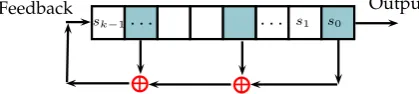
A common way to implement the generation of linear recurring sequences is to uselinear feedback shift registers(LFSR). LFSRs are useful tools both in coding theory and in cryptogra-phy. In particular they are one of the most useful devices in the generation of keystreams. A linear feedback shift register consists of two parts: a shift register of lengthkand a feedback
functionF. The shift register is a register with k cells each containing an element ofFq. The
content of thekcells forms thestateof the LFSR. The feedback function is usually theXORof the content of certain cells, which are calledtaps. The first output sequence element is the least significant element of the initial state, i.e the element in the rightmost cell of the shift register. Then, the shift register is shifted by one cell to the right and the new leftmost cell is filled with theXOR of the taps. By iterating the previous procedure, the LFSR produces a semi-infinite sequence of elements inFq. Figure 2.2 shows a general LFSR in the Fibonacci representation.
Output Feedback
s0
s1
sk−1. . . .
Figure 2.2: Linear feedback shift register
In the following we recall some basic results concerning linear recurring sequences.
Definition 2.4.2.Let S be an arbitrary nonempty set, and lets0, s1, . . .be a sequence of elements
ofS. The sequences0, s1, . . .isperiodicif there exists an integerr >0such thatsn+r=snfor
Proposition 2.4.3. If s0, s1, . . . is a kth-order linear recurring sequence in a finite field Fq satisfying the linear recurrence relation(2.5), and if the coefficienta0 of (2.5)is nonzero, then
the sequences0, s1, . . .is periodic and its periodris≤qk.
Lets0, s1, . . .be an homogeneous linear recurring sequence inFq satisfying
si+k=ak−1si+k−1+ak−2si+k−2+· · ·+a1si+1+a0si for i= 0,1, . . . , (2.6)
whereaj ∈Fq, for0≤j ≤k−1. To this linear recurring sequence we associate the following
k×kmatrix overFq
A=
0 0 0 . . . 0 a0
1 0 0 . . . 0 a1
0 1 0 . . . 0 a2
... ... ... ... ... ...
0 0 0 . . . 1 ak−1
. (2.7)
We note that the matrixAdepends only on the linear recurrence relation satisfied by the given
sequence. In particular it does not depend on the initial state of the sequence. The polynomial
f(x) =xk−ak−1xk−1−ak−2xk−2− · · · −a0 ∈Fq[x]
is said thecharacteristic polynomial of the linear recurring sequence, and, as the matrixA, it
depends only on the linear recurrence relation (2.6). It is easy to see thatf(x) corresponds to
the characteristic polynomial of A in the sense of linear algebra. Linear recurring sequences
whose periods are very large are of particular interest in applications. Next Theorem suggests how to produce such sequences.
Theorem 2.4.4. Lets0, s1, . . .be an homogeneous linear recurring sequence inFqwith nonzero initial state, and suppose its characteristic polynomial f(x) ∈ Fq is irreducible over Fq and satisfiesf(0)6= 0. Then the sequence is periodic with period equal toord(f(x)).
By Theorem 2.4.4 it follows thatkth-order maximal period sequences inFqare those whose
characteristic polynomial is a primitive polynomial overFq, and its period is equal to the largest
possible value for the period of anykth-order linear recurring sequences inFq– namelyqk−1.
Sequences with maximal period have also many desirable statistical properties. The best known of these properties is to satisfy Golomb’s axioms for pseudo-random sequences [G+82].
2.5
Discrete Logarithms
LetK =FqandF =Fqm. UsuallyF is represented as anm-dimensional vector space over
K, so additions inF become trivial given the arithmetics inK. However, the choice of a basis
ofF over K is crucial for efficiently performing multiplication, inversion and exponentiation.
2.5. Discrete Logarithms
of bases of particular importance. The first is apolynomial basis{1, α, α2, . . . , αm−1}whereα
is a root of an irreducible polynomial of degreemoverK. In this context, one often prefersα
to be a primitive element ofF. The second basis is anormal basis, that is, a basis of the form {α, αq, . . . , αqm−1}.
An alternative to using basis representations is to represent the non-zero elements ofF as the
powers of a primitive elementα ∈F. In this case multiplication inF is trivial, but addition then
becomes difficult. In practical applications where repeated computations over a relatively small finite field are required, this problem can be overcome using discrete logarithms in conjunction with Zech logarithms. In addition to this employment, discrete logarithms in finite fields play an important rule in cryptanalysis.
In this subsection we summarize the main current algorithms for computing discrete loga-rithms in finite fields and their use to improve arithmetic in small finite fields.
Definition 2.5.1(Discrete Logarithm). Letα∈ Fqa primitive element andβ ∈Fq, β 6= 0. We
define the discrete logarithm ofβ with respect toα as the unique integer0 ≤ i < q such that αi =β. We use the notationi= DLogα(β).
2.5.1 Computing Discrete Logarithms
The most obvious method for finding discrete logarithms inFq is to precompute a table of
logarithms once and for all time. Another one is to successively compute consecutive powers of
αand compare withβuntil a match is found. Both methods become computationally infeasible
whenqis sufficiently large, since they costO(q). A more interesting method, but still not very
practical, to compute discrete logarithms inFq withq = ps is given by Mullen and White in
[MW86] and it consists in exhibiting a polynomial representation for theDLogfunction modulo
p. They prove the following result
Proposition 2.5.2. Letαbe a generator forFq withq = ps. For anyβ =αi ∈
F∗q,q ≥ 3, we have that
i≡ −1 + q−2
X
k=1
βk
α−k−1 (mod p)
The two main kind of methods used to compute discrete logarithms in finite fields are the Pohlig-Hellman methodcombined with theBaby-step Giant-step algorithmor with the
Pollard-ρalgorithm, and theIndex-Calculus method. In practice, many computational algebra systems use the Pohlig-Hellman method for computing discrete logarithms in Fq when the maximal
prime factor of q is approximately less than 236, and they use Index-Calculus method in the
other cases.
Baby-step Giant-step algorithm
The first algorithm we describe is the Baby-step Giant-step algorithm attributed to Shanks. The algorithm works as follows. Letr, sbe integers withr·s > q. Precompute a list of pairs,
(i, αi)for0 ≤i < r and sort this list by second component. These precomputations are called baby-steps. The giant steps consist on computing for eachj, 0 ≤ j < s, the element βα−jr
and see (by a binary search) if this element is the second component of some pair in the list. If
βα−jr =αi for somei,0 ≤ i < r, thenDLogα(β) = qifi =j = 0 andDLogα(β) = i+jr
otherwise. The baby steps require a table withO(r)entries, while to sort the table and search the
table for each value ofjrequiresO(r+s)field operations. Usually one chooser =s =√q−1
in order to getO(√q−1)for both time and memory complexity.
Pollard-ρmethod
One drawback of Shanks algorithm is the need to sort and store a list of size √q−1.
Pol-lard [Pol78] introduced a probabilistic algorithm which eliminates the need for such storage. PartitionF∗q into three setsS1, S2, S3 of roughly equal size. Consider the sequence of elements
inF∗q x0, x1, x2, . . .withx0 = 1and
xi =
βxi−1 xi−1 ∈S1
x2
i−1 xi−1 ∈S2
αxi−1 xi−1 ∈S3
It is easy to see that this sequence defines two sequences of integers{ai}and{bi}wherexi =
βaiαbi, i≥0,a
0 =b0 = 0,ai+1 ≡ ai+ 1,2aiorai (mod q−1)andbi+1 ≡bi,2bi orbi+ 1 (mod q−1)depending on which setS1, S2orS3 containsxi−1. Making use of Floyd’s cyclic
algorithm, Pollard computes the six-tuple(xi, ai, bi, x2i, a2i, b2i)untilxi =x2i. At this stage we
haveβr =αswithr ≡a
i−a2iands≡bi−b2i (mod q−1). It follows thatrDLogα(β)≡s (mod q−1). Since there are onlyd= GCD(r, q−1)possible values forDLogαβ, ifdis small
then each of these possibilities can be list to obtain the correct value.
Making the heuristic assumption that the sequence {xi}is a random sequence in F∗q, then
the expected time complexity of this method isO(√q−1)field operations.
Pohlig-Hellman method
The Pohlig-Hellman method computes discrete logarithms in finite fields taking advantage of the integer factorization ofq−1. Letq−1 =Qt
i=1p
ei
i wherepiis a prime number andeiis a
positive integer, for1≤i≤t. Ifx= DLogα(β)then the approach of Pohlig and Hellman is to
obtainxmodulopei
i for eachiand then use the Chinese Remainder Theorem to getx modulo
2.5. Discrete Logarithms
e a positive integer. Lete0 = de/2e and e1 = be/2c. We have that x = x0 +pe0x1, where
0≤x0 < pe0 and0≤x1 < pe1. Soβ =αx =αx0+p
e0x1
. Elevating both sides tope1 we get
βpe1
=αpe1x0+pe0pe1x1 =αpe1x0+pex1 =αpe1x0,
where the last equality holds becauseαis a primitive element inFq. Thenx0 = DLogp
e1
α (βp
e1
).
Sinceβα−x0 =αpe0x1, thenx
1 = DLogp
e0
α (βα−x0). Using one of the two previous methods we
determinex0andx1, and thusx.
For the case where q− 1 = pe this technique requires O(e(log(q− 1) +p
(p) log(p)))
[PH78].
Then, using Pohlig-Hellman algorithm in conjunction with Baby-step Giant-step method or with Pollard-ρmethod one can compute discrete logarithms inFqin approximatelyO(
√
I)field
operations, whereI is the largest prime dividingq−1. Note that in this case the characteristic
p of the field is irrelevant. Basing on the computationally capacity of modern computers is
reasonable to use this method whenIis relatively small, say less than236. As a consequence, if
one is going to design a cryptographic system based on a finite fieldFq one must selectqsuch
that the factorization ofq−1contains a suitable large prime.
Index Calculus
Unlike the Shanks and Pollard-ρmethods, which take exponential time (O(√q−1)field
op-erations), index calculus techniques are subexponential with heuristic running timeL[q,1/3, c],
and evenL[q,1/4, c]in some cases. The basic idea of index calculus algorithms dates back in
1922 in the work of Kraitchik [Kra22, pp.119-123].
LetFq be the finite field in which we want to compute the discrete logarithm and letα be
a primitive element ofFq. Consider a subset S ={p1, p2, . . . , pt}ofFq with the property that
a ”significant “ fraction of all elements inFqcan be written as the product of elements fromS.
The setS is usually called thefactor base for the index calculus method. The index calculus method consists of two main stages. In the first stage one attempts to find the discrete logarithms of all the elements ofS. In the second stage one compute logarithms of elements inFq which
are not inS. To obtain discrete logarithms of elements ofS we proceed as follows. We pick a
random integeraand attempt to writeαaas a product of elements inS, αa = Qt i=1p
λi
i . If we
are successful then we have that
a≡XλiDLogαpi (mod q−1).
After collecting a sufficient number, i.e greater thant, of relations of this type, the corresponding
system of equations can be expected to have a unique solution for the variables DLogαpi, 1≤ i ≤ t. Letβ ∈ F∗q. To computeDLogαβ we repeatedly pick an integersat random until αsβ can be written as the product of elements inS, that isαsβ = Pt
i=1p
bi
we have that
DLogαβ ≡
t
X
i=1
biDLogαpi−s (mod q−1).
Note that to complete the description of the method one should precise how to choose the set S and how to efficiently generate the relations expressing an element ofFq as product of
elements inS.
In the last fifty years several different index calculus algorithms were developed forFqwith
q = pn, and the best algorithms vary with the relative sizes of the characteristic p and the
extension degreen.
For a long time the best index calculus algorithms for discrete logs had running times of the formL[q,1/2, c]for various constantsc >0. The first practical method that broke through
this running time barrier was Coppersmith’s algorithm [Cop84] for discrete logs in fields of size q = pn where p is a small prime and n is large. It had running time of approximately L[q,1/3, c] with c varying slightly with the values of p and n. This initial progress quickly
led to the introduction of several other heuristic algorithms with similar running time. For a long time, index calculus algorithms focused on field with small characteristic, prime fields and occasionally fields of the formFpn for small values ofn [Sch00]. The view changed in 2006, when was showed that taken together, the Number Field Sieve [JL06] and the Function Field Sieve [AH99] are enough to cover the whole range of finite fields. Both these algorithms have heuristic running time ofL[q,1/3, c]. Essentially, the consequence was to split the finite field in
three groups, small characteristic with complexityL[q,1/3,(32/9)1/3], medium characteristic
with complexityL[1/3,(128/9)1/3]and large characteristic with complexityL(1/3,(64/9)1/3).
In 2013 and 2014, two notable improvements on the complexity of discrete logarithm algo-rithms have been made: two variants of the Number Field Sieve have been designed for finite fields with medium to high characteristic [BP14] and the complexity for finite fields with small characteristic have been dropped to approximatelyL[q,1/4, c][Jou14, BGJT14, GKZ14]].
We conclude this subsection by noting that the expected running times of all the previous algorithms are heuristic, and that the best algorithms with rigorously proved expected running time cost approximatelyL[p,1/2,√2][MBG+13].
2.5.2 Zech Logarithm Table
In small finite fields is useful to employ tables of Zech logarithms to efficiently perform additions and multiplications. The procedure is the following.
LetFq be a finite field. Represent the non-zero elements ofFq as the powers of a primitive
elementα ∈ Fq. Then, identifying the elements of Fq with their discrete logarithms, the
mul-tiplication of two elements in Fq is reduced to the addition of the corresponding two discrete
logarithms, since
2.5. Discrete Logarithms
where the addition is modulo q −1. In this representation, to perform the addition of two
elementsβ, γ ∈Fqone needs to compute the discrete logarithmDLogα(β+γ). Sinceαa+αb =
αa(1 +αb−a), to do that it suffices to compute the discrete logarithms for sums involving1, i.e.
logarithms of the formDLogα(1 +γ). This motivates the following definition
Definition 2.5.3(Zech’s Logarithm). LetFqbe a finite field and letαbe a primitive element of
Fq. TheZech’s logarithm(orJacobi logarithm) with baseαof an integernis the integerZα(n)
defined by the equation
1 +αn =αZα(n),
where the caseαn=−1is excluded.
When q is small, say less than 220, the Zech logarithms can be precomputed and, when
needed for an addition, recovered by a simple table lookup. Moreover, exploiting some prop-erties of Zech’s logarithm [Hub90] one can reduce the storage requirements fromq = pk to
roughlyq/6k.
Decoding Problem for Cyclic Codes
The main problem of information theory can be described as follows. Suppose that a source of data has been transmitted over a noisy channel. In this context, the following question arise naturally: how can we tell when the original data has been changed? And when it has, how can we recover the original data? One of the goal of Coding Theory is to answer to the two previous questions.
In the first section of this chapter we formalize the above problems and introduce error correcting codes. In Section 3.2 we recall some basic properties of linear codes and discuss the complexity of decoding problem for these codes. Finally, in Section 3.3, after recalling some properties of cyclic codes, we address the decoding problem for cyclic codes and discuss interesting open problems regarding general error locators.
Most of the results in this chapter are well-known in the literature. Here we use as main references [MS77], [PW72] and [PHB98].
3.1
An overview on error correcting codes
Coding theory is the study of the properties of codes and their suitability for a specific application. One of these applications is the design of efficient and reliable data transmission methods. A code designed with this purpose is called anerror correcting code. There are two fundamentally different types of codes: block codeswhich break the sequence of information digits intok-symbol blocks, andtree codeswhich operates on the information sequence without breaking it into independent blocks.
In this thesis attention is focused on block codes. From now on, when we say error correct-ing codes we actually mean block error correctcorrect-ing codes.
Definition 3.1.1. LetFq be a finite field. A subsetC ofFqnof sizeM is called ablock code(or
also aq-ary block code) of lengthnand sizeM overFq, and its elements are calledcodewords.
We call an element ofFqasymbol, and an element ofFqn(which is not necessary inC) aword.
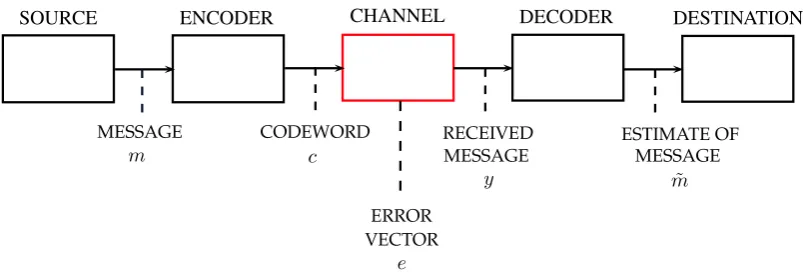
A general communication system which uses an error correcting codeCis showed in Figure
3.1. It consists of essentially five parts:
1. Aninformation source: which produces a messagem = (m1, . . . , mk) ∈ Fqkto be
DESTINATION
SOURCE ENCODER CHANNEL DECODER
MESSAGE CODEWORD RECEIVED ESTIMATE OF MESSAGE MESSAGE
ERROR
m c
e
y m˜
VECTOR
Figure 3.1: A simple model of communication system. We omit to represent both the transmitter and the receiver.
2. An encoder: which produces a codeword c = (c1, . . . , cn) ∈ C,where n > k, from a
messagem
3. Atransmitter: which operates on the codewordcin order to produce a signal suitable for
transmission over the channel
4. Anoise channel: which is the medium used to transmit the signal from a transmitter to a receiver, and it is supposed to be noisy
5. Areceiver: performing the inverse operation of the transmitter, i.e. recovering the word
y∈Fn
q corresponding to the received signal
6. Adecoder: which tries to recover the original messagemfromy
7. Adestination: the person who the message is addressed to.
We callencodingthe process of converting the messagem ∈Fk
q into a codewordcof a given
codeC. The process of recovering the messagesmfrom the received wordyis saiddecoding. The central idea in using error-correcting codes for communication data is that the sender encodes the message in a redundant way by using an error-correcting code in a such way (de-pending on the channel used for the transmission) that the redundancy allows the receiver to detect and/or correct possible transmission errors.
Example 3.1.2. Let us consider the set
C ={00000,01011,10101,11110}.
C is a binary code of lengthn= 5withM = 4codewords.
Suppose that we want to employ C in order to guarantee a reliable transmission data over a
noisy channel, and that the (corrupted) codewordy = 00101is received. The set of possible
3.1. An overview on error correcting codes
From the previous example it is clear that to decide which error out of a set of errors is the “right one”, that is to decode, one needs to make additional assumptions about the likelihood of errors and error patterns. One need also to specify how the sent codewordscand the error
patternseare combined to form the received codewordsy=f(c, e).
Throughout all the thesis we will assume that for aq-ary code, codewordscand error patterns eare combined through a moduloq addition, that isy = c+e where+is the addition inFqn.
A such channel is called anaddition channel. We will also assume that the channel is an q-ary
symmetric channel. In the next definition we recall the notion of symmetric channel.
Definition 3.1.3(q-ary symmetric channel). Aq-ary symmetric channel(qSC)without memory is a discrete channel withq-ary symbols both as inputs and as outputs. Moreover it satisfies the
following properties
• the probability that a symbol changes into another is the same for all theq−1symbols
• the probability that a symbol changes does not depend on its position in the transmitted word
• if the ith component of a transmitted word changes, then this fact does not affect the
probability that itsjth component changes
The transition probabilities of theq-ary symmetric channel depend on a single parameter
as follows
P[b|a] =
1− b=a
/(q−1) b6=a
whereP[b|a]denotes the probability to receive the symbolb given that the symbolawas sent. In other words, in aq-ary symmetric channel every symbol is left untouched with probability
1−and is distorted to each of theq−1possible different symbols with probability.
An important requirement in order to define a transmission model is to fix a distance measure between codewords. The most prevalent measure for our purpose is Hamming distance, which is defined as follows.
Definition 3.1.4. Given two vectors x = (x0, . . . , xn−1) and y = (y0, . . . , yn−1) in Fqn, we
define the Hamming distance between x and y as the number of components in which they
differ
d(x, y) = |{0≤i≤n−1|xi 6=yi}|.
TheHamming weight of a vectorx ∈Fn
q is the number,w(x), of its non-zero components, i.e. w(x) = d(x,0).
LetC be aq-ary code,y ∈ Fn
q be the received word, andebe the error vector occurred in
Definition 3.1.5. We say thatC has error correction capabilityt (or thatC can correct up to terrors) if for any error vector ewithw(e)≤ t, Callows to recoverx. Similarly, we say that C haserror detection capabilitys(or thatC can detect up toserrors) if for any error vectore
withw(e)≤s,Callows to detect that an error occurred in the transmission.
Next two definitions introduce two important parameters of an error correcting code.
Definition 3.1.6. TherateRof aq-ary block code of lengthnwithM codewords is given by
R = (logqM)/n
The rate of a code is a measure of the efficiency of the code.
Definition 3.1.7. The redundancy r of a q-ary block code of length n with M codewords is
given by
r =n−logqM.
We can say that the birth of the subject of coding theory for data transmission occurred in 1948 when Shannon published the paper “ A Mathematical Theory of Communication” [Sha48]. His work focuses on the problem of how best to encode the information a sender wants to transmit. He established the limits of the gains possible with coding theory, and proved the existence of codes that could effectively reach these limits. More precisely, Shannon showed the following theorem. Beforing stating it, we introduce the capacity of aq-ary symmetric channel.
Definition 3.1.8. Given aq-ary symmetric channel with probability of symbol error, we say
that the capacity of the channel is
C() = 1 +logq() + (1−) logq(1−)−plogq(q−1).
Theorem 3.1.9(Shannon). For any δ > 0andR < C(), there is a (linear) code overFq of rateR0 ≥RwithPerr < δ, wherePerris the probability that the output of the decoder does not correspond to the originally transmitted vector.
So, if one wishes to communicate over a channel of capacity Q at a rate R, then one can do
so as reliably as desired, if and only if R < Q. Although Shannon [Sha48] answered to the
question “Do good codes exist?” affirmatively, his work raises two other questions “ How can we construct such codes?” and “How can we decode them?”. In a sense, the study of error correction codes is all about these two questions.
3.2
Linear Codes
3.2.1 Basic definitions
3.2. Linear Codes
Definition 3.2.1. LetC be aq-ary block code of length n. We say thatC is a linear (block)
code if it is a linear subspace of the vector spaceFqn. If the dimension of the subspaceC isk,
then we say that the codeChasdimensionkand thatCis a[n, k]-code.
We do not treat in this thesis the case of non-linear block codes, so often we will use the word “code” for referring to linear block code. When we do not specify the field, we implicitly mean that the code is defined overFq. Note that if C is an[n, k]-code over Fq, then|C| = qk
where|C|denotes the cardinality ofC.
As subspace ofFqn, an[n, k]-code admits a basis. This leads to the definition of a generator
matrix of a code.
Definition 3.2.2. LetC be an[n, k]-code overFq. Any matrixGwhose rows form a basis for
Cas ak-dimensional subspace ofFqnis called a generator matrix ofC.
IfGhas the formG= [1k|A], where1kis thek×kidentity matrix, thenGis called a generator
matrixin standard form. In general, there are many generator matrices for a codes, nevertheless any code has a unique generator matrix in standard form.
Given x = (x0, . . . , xn−1) and y = (y0, . . . , yn−1) in Fqn, we denote by x· y the scalar
product ofxandyinFn
q, that isx·y=
Pn−1
i=0 xiyi. We recall thatxandyare saidorthogonal
ifx·y= 0.
Definition 3.2.3. LetCbe an[n, k]-code. The setC⊥of vectors inFqnwhich are orthogonal to
all codewords ofCis again a linear code and it is called thedual codeofC.
We note that the dual code of an[n, k]-codeCis an[n, n−k]-code.
Definition 3.2.4. Aparity-check matrixHfor an[n, k]-code is a generator matrix ofC⊥.
By previous definitions we easily get that ifC is an[n, k]-code then a generator matrixG
ofChas sizek×nand a parity-check matrixH has size(n−k)×n. To check if ann-vector x∈Fn
q belongs toCit is sufficient to computeHxT. Indeed it holds that
∀x∈Fqn, HxT = 0 ←→x∈C (3.1)
Definition 3.2.5. LetCbe an[n, k]-code overFql. Thesubfield subcodeC
FqofCwith respect
toFqis the set of codewords inCeach of whose components is inFq.
BecauseCis linear overFql, thenC
Fqis a linear code overFq.
Remark3.2.6. LetC be an[n, k]-code over Fql andH be a parity-check matrix ofC. To find a parity check matrix forCFqconsidering a basis{b1, b2, . . . , bl} ⊂ Fql ofFql overFq. Each elementz ∈Fqlcan be uniquely written asz =z1b1+· · ·+zlbl, wherezi ∈Fq for1≤i≤l. Associate toz the column vectorz¯= (z1, . . . , zl)T. CreateH¯ fromH by replacing each entry
hby the vector¯h. BecauseH is an(n−k)×nmatrix with entries inFql,H¯ is al(n−k)×n matrix overFq. A parity check matrix forCFqis obtained fromH¯ by deleting dependent rows.
Definition 3.2.7. The minimum distance (or simply the distance) of a codeC is the smallest
(Hamming) distance between distinct codewords, that is
d(C) = min{d(x, y)|x, y ∈C, x6=y}.
IfCis a[n, k]-code and we known the distance ofCthen we also refer to it as an[n, k, d(C)]
-code.
The following result shows that it is possible to define the distance of a linear code using the weight of codewords instead of mutual distance between all codewords.
Proposition 3.2.8. LetCbe an[n, k, d]-code. Thend(C) = min{w(c)|c∈C, c6= 0}.
LetCbe an[n, k, d]linear code overFq. IfDis a vector subspace ofC, then we say thatD
is a (linear) subcode ofC. Moreover we haved(C)≤d(D).
Definition 3.2.9. LetC be an[n, k, d]-code. We denote byAi the number of the codewords of
weighti. The set of{Ai}0≤i≤nis called the weight distribution ofC.
Definition 3.2.10. LetC1 andC2 be two linear codes. We say thatC1 andC2 arepermutation
equivalentif there is a permutation of coordinates which sendsC1 toC2.
Two permutation equivalent codes have the same weight distribution.
Proposition 3.2.11. Let C be linear code and let H be a parity-check matrix ofC. Then C
has distancedif and only ifH has a set ofdlinearly dependent columns and any set ofd−1 columns is linearly independent.
The following theorem is a consequence of the previous result. It gives an upper bound for the distance of a code.
Theorem 3.2.12(Singleton bound). LetCbe an[n, k, d]-code. Then
d ≤n−k+ 1
A code reaching the equality in the Singleton bound is called a maximum distance separable codeor anMDScode.
Definition 3.2.13. Let xbe any vector in Fn
q and letC be an[n, k, d] code with parity-check
matrixH. The vectors ∈ (Fq)n−k such thats = HxT is called the syndrome vector of xwith respect toH (or simply thesyndrome of x).
Equation (3.1) tell us that a vectorx∈Fqnis a codeword ofCif and only if the syndrome of xis zero. The syndrome, however, tell us more than a vector being in the code or not. Suppose
the vectorcwas transmitted andv was received, wherev =c+e, withethe error vector. Note
that
s=HvT =H(c+e)T =HcT +HeT =HeT,
sincec∈C. Then, the syndrome does not depend on the received vector but on the error vector.
3.2. Linear Codes
Proposition 3.2.14. LetC be an[n, k, d]-code and letH be a parity-check matrix ofC. Then, there is a1-1correspondence between errors of weight≤ b(d−1)/2cand syndromes.
This property of linear codes justify the following definition
Definition 3.2.15. LetC be an[n, k, d]-code overFq. We callcorrectable syndromesthe
syn-drome vectorss∈Fn−k
q corresponding to errors of weightµ≤twitht=b(d−1)/2c.
Proposition 3.2.16. LetCbe an[n, k, d]-code overFq. Then
• C has detection capabilityd−1
• C has error correction capabilityt=bd−1c/2.
The previous result shows that the distance of a code reflects the error correction capability of the code. Evidently, we would liket, and hence alsod, to be large.
We conclude this section summarizing the properties a good error correcting code should have. In the study of error correcting codes it is important to construct[n, k, d]-codes having
the following properties:
1. large rateR;
2. large distanced;
3. admitting efficient encoding and decoding algorithms.
There is a trade-off between the rateRand the minimum distancedfor any linear code. Indeed,
by the Singleton bound and the definition of rate of a code, we have that
R+ d
n ≤1 +
1
n.
So we have to make a compromise between the rate and the minimum distance. The third property above is also very important for a code, as codes with large rate and distance may be useless if they have no efficient encoding and decoding algorithms. In the next section we trait the problem of decoding linear codes.
3.2.2 Decoding Linear Codes
Suppose to use an [n, k]-code C over Fq for a reliable transmission of data over a noisy
channel, and to receive the wordy∈Fn
q. The optimal decoding strategy is to find the codeword
c∈C that maximizes the probabilityP r(c|y)thatcwas transmitted given thatywas received.
On a q-ary symmetric channel, this strategy is equivalent to find the closest codeword toy in
the Hamming metric [MS77].
Definition 3.2.17. A decoder forC that always finds the closest codeword tor(or one of the
Maximum-likelihood decoding of aq-ary[n, k, d]-code can be trivially accomplished inO(qk)
by simply computing the Hamming distance between the received wordy and all theqk
code-word of C. However, this procedure is computationally infeasible when the number of
code-words is large. An other method accomplishing this task is the following, which costsO(qn−k).
LetC be an[n, k]-code overFq. For any vectoru∈Fnq the set
u+C={u+c|c∈C}
is called a coset of C. Every vector of Fn
q is contained in such a coset. Since C is a linear
subspace ofFqn, two cosets are either disjoint or identical. Suppose that a codewordxwas sent
via a noisy channel, and a vectoryis received, then the error vector ise=y−x. LetH denote
a parity check matrix ofC. It follows thatHeT =HyT, that is the syndrome ofecorresponds
to the syndrome of y. Obviously, all the vectors of a coset have the same syndrome. The
minimum weight vector of a coset is called the coset leader (if there is more than one vector with the same minimum weight, choose one at random and take it as the coset leader). A naive decoding procedure consists in first computing the syndrome of a received vector HyT, then
take the coset leadereof the coset having syndromeHyT as the error vector, and finally decode
the received vectoryto bey−e. Since the number of possible syndromes isqn−k, this method
costsO(qn−k).
Although maximum-likelihood decoding is the optimal decoding strategy, Berlakamp et al. [BMvT78] showed that for the general class of linear codes, polynomial-time maximum-likelihood decoding algorithms are unlikely to exist (unless P=NP). Bruck and Naor [BN90] showed that this remains true even if the code is known in advance and can be preprocessed for a long as desired in order to devise a decoding algorithm. Moreover, such algorithms are not known today even for any specific family of useful codes, such as the binary BCH codes, for instance. On the contrary, in [GV05], it was proved the NP-completeness of maximum likelihood decoding for generalized Reed-Solomon codes. A potential way