A STUDY TO EVALUATE THE EFFECTIVENESS OF VIDEO
ASSISTED TEACHING PROGRAM ON KNOWLEDGE
AND PRACTICE REGARDING FAST FOOD RELATED
HEALTH HAZARDS AMONG ADOLESCENT BOYS
FROM SELECTED SCHOOL AT MADURAI.
BY
G.KANAGAMANI
A dissertation submitted to the Tamil Nadu Dr. M. G. R. Medical University, Chennai.
In partial fulfillment of the requirements for the degree of Master of Science in Child Health Nursing
UNDER THE GUIDANCE OF
Prof. Dr. N. JESSIE METILDA, M. SC, Ph.D (N)., HOD Child Health Nursing,
C. S. I. Jeyaraj Annapackiam College of Nursing, Madurai-625004.
ii
CERTIFICATE
This is to certify that the dissertation entitled “A study to evaluate the
effectiveness of video assisted teaching program on knowledge and
practice regarding fast food related health hazards among adolescent boys
from selected school at Madurai” is a bonafide work done by
G.Kanagamani, C. S. I. Jeyaraj Annapackiam College of Nursing, Madurai
submitted in partial fulfillment for the degree of Master of Science in Nursing.
Signature of the Principal: _________________________________________ Prof. Dr. C. JOTHI SOPHIA, M. SC, PhD (N)
iii
A STUDY TO EVALUATE THE EFFECTIVENESS OF VIDEO
ASSISTED TEACHING PROGRAM ON KNOWLEDGE AND
PRACTICE REGARDING FAST FOOD RELATED HEALTH
HAZARDS AMONG ADOLESCENT BOYS FROM
SELECTED SCHOOL AT MADURAI.
Approved by the dissertation committee on...
RESEARCH CO-ORDINATOR ...
Prof. Dr. C. JOTHI SOPHIA, M. SC, Ph.D (N)., Principal,
C. S. I. Jeyaraj Annapackiam College of Nursing, Madurai-625004.
RESEARCH GUIDE
...
Prof. Dr. N. JESSIE METILDA, M.Sc., Ph.D (N)., HOD- Child Health Nursing,
C. S. I. Jeyaraj Annapackiam College of Nursing, Madurai-625004.
MEDICAL GUIDE
...
Dr. (Mrs). SELVA PRAMILA, M.B.B.S., DCH.DNB. Department of Pediatrics,
Christian Mission Hospital, Madurai-625001.
A dissertation submitted to
The Tamil Nadu Dr. M. G. R. University, Chennai. In partial fulfillment of the requirement for the Degree of
Master of Science in Nursing
iv
CERTIFICATE OF THE EXAMINERS
This is to certify that the dissertation entitled “A study to evaluate the effectiveness of video assisted teaching program on knowledge and practice regarding fast food related health hazards among adolescent boys from selected school at Madurai” is a bonafide work done by G.Kanagamani. C. S. I. Jeyaraj Annapackiam College of Nursing, Madurai, submitted in partial fulfillment for the degree of Master of Science in Nursing.
SIGNATURE OF THE EXAMINERS:
v
ACKNOWLEDGEMENT
“Thanks be to God for his indescribable gift”
First, I thank the almighty Omnipotent, Omniscient and Omnipresent God for giving me strength and courage throughout the period of my studies and for this guidance and for helping me to complete this dissertation.
I wish to express my immense thanks to Prof. Dr. C. Jothi Sophia, M. Sc, Ph. D (N)., Principal, and C. S. I. Jeyaraj Annapackiam College of Nursing of Nursing for her support throughout the research study.
I convey my heartfull thanks Prof. Dr. Merlin Jeyapal, M. Sc, Ph. D (N), Vice Principal, and C. S. I. Jeyaraj Annapackiam College of Nursing for her support during my research study.
I extend my deep sense of duty to express our gratitude to my research Guide Prof. Dr.N. JESSIE METILDA, M.Sc, Ph. D (N), Head of Child health Nursing Department, C. S. I. Jeyaraj Annapackiam College of Nursing for her support to ensure the best quality of this piece of work. Her excellent guidance, valuable suggestions, constant help, affectionate support and assistance from initial step to complete of the study.
I extend my sincere thanks to medical guide Dr. (Mrs). SELVA PRAMILA, M.B.B.S., DCH, DNB. Department of Pediatrics, Christian Mission Hospital, Madurai.
I intimate my immense thanks to our PG coordinators Prof.Dr.Y.John Sam
vi
Nursing for their support, wholehearted encouragement and opinions towards this study.
My sincere gratitude and thanks to prof. Dr.M. Kannan, M.A (MSW). M.B.A., M.Phil. (TISS)., Ph.D., Mr. Mani, M.Sc., M.Phil., Statistician for his meticulous opinion, suggestion in analysis and interpretation of data without which the dissertation would not have been accomplished.
I wish to express my sincere thanks to the Phd scholars Prof. Dr.Nalini, M.Sc, Ph.D (N), and Principal Ultra College of Nursing Madurai, Prof. Dr. Helen Pertida, M.Sc, Ph.D (N)., Dr. Sebasan, MBBS, DPM, and MNAMS, Ph.D.
Psychiatrist, Christian Mission Hospital. Mr.Prabhakarn, M.SC Biochemistry Mrs. Thenmozhai M.Phil, Ph.D., Nutrition Dr.Charles, M.S., M.ch., DHM, DA,
Medical Director, Christian mission hospital, for his excellent guidance and support for the successful completion of the study.
The grapes are trodden until all the juice is expressed my special thanks to all the participants who participated in this study.
I wish to express my thankful to Mr. David Brother with help of make video for my research study.
I thank our department staff Prof.Mrs.V.Gomathi, M.Sc(N)., Ph.D., Asso. Professor, Prof.Mrs.Christina M.Sc.,(N) Asso.Professor, Prof.Mrs.Grace balammal M.Sc.,(N) Asso. Professor, Mrs.Jabarani M.Sc.,(N) lecture and Miss.Jesintha B.Sc.(N)., Clinical Instructor.
vii
Medical University, Chennai and CMC, Vellore for their cooperation and assistance towards building a sound knowledge base for this study.
I have no word to appreciate all my classmates VINEYARD AT BAALHAMON’16 those bestowed their endurance in one or another way to the triumphant of the study.
I thank Miss.Priyanka M.Sc(N)., Lecture for her guidance.
My emotions fall short of right vocabulary to express my immense debts to my lovable husband Mr.T.Alaguraj Petrol Chemical Engineering my sweet sun
A.Sudeep Kannan, Studying L.K.G, my dearest uncle, aunty Mr.Thangaraj, and T. Dhanalkshmi my brother in law T. Suseeyandran Studying Civil Service, who
are the person for all this hard work and study. Their constant prayers, love, sacrifice, encouragement and support throughout the master program without which this study would not have been possible. Once again, my deepest thanks to all.
viii
ABSTRACT
“A study to evaluate the effectiveness of video assisted teaching program on
knowledge and practice regarding fast food related health hazards among adolescent boys from selected school at Madurai”was undertaken by G. Kanagamani in partial fulfilment of the requirement for the degree of Master of Science in Nursing at C.S.I Jeyaraj Annapackiam College of Nursing, affiliated to the Dr.M.G.R Medical University, Chennai, October -2018.
Objectives
1. To assess the pre-test and post-test knowledge and practice regarding video assisted teaching program on fast food related health hazards among adolescent boys in control and experimental group .
2. To evaluate the effectiveness of video assisted teaching program regarding fast food related health hazards among adolescent boys in experimental group. 3. To compare the pre-test and post-test score of video assisted teaching program
on knowledge and practice regarding fast food related health hazards among adolescent boys between control and experimental group.
4. To find out the co-relation between knowledge and practice on video assisted teaching program regarding fast food related health hazards among adolescent boys in control and experimental group.
ix
Review was done relevant to this study. The conceptual framework for the study was based upon general system theory model. The research design was quasi-experimental non-randomized control group design. To evaluate the effectiveness of video assisted teaching program on knowledge and practice regarding fast food related health hazards among adolescent boys in selected school at Madurai. For pilot study, 6 samples were selected at CSR Thirunagar higher secondary school at Madurai. The feasibility of main study found through the pilot study. A total of 60 samples were included in this study using purposive sampling technique. The experts validated the tool on self-administered structured questionnaires assessed by the researcher. Reliability of the tool was r = 0.88. Main study was done in CSI boys higher secondary school at Madurai. The collected data was analyzed tabulated and interpreted using descriptive and inferential statistics. Result showed that
The effect of video assisted teaching program regarding fast food related
health hazards in the experimental group was highly significant among adolescent boys.
Level of knowledge regarding fast food related health hazards among
adolescent boys with adequate knowledge 75%, moderate knowledge 51-75%, inadequate knowledge less than 50% in experimental group.
Level of practice regarding fast food related health hazards among adolescent
boys with poor practice 33%, average practice 34 -66%, good practice more than 66% in experimental group.
Over all paired ‘ t ’ test was found in experimental group pre and post- test
x
Over all paired ‘ t’ test was found in experimental group pre and post-test
score to evaluate the effectiveness of video assisted teaching program on practice regarding fast food related health hazards among adolescent boys ‘t’ value is 8.25 and p value p<0.001 was highly significant.
Over all unpaired ‘t’ test was found in pre-test score knowledge level between
control and experimental group regarding fast food related health hazards among adolescent boys ‘t’ value is 0.34 and p value p<0.734 was no
significant.
Over all unpaired ‘t’ test was found in post-test score knowledge level
between control and experimental group to evaluate the effectiveness of video assisted teaching program regarding fast food related health hazards among adolescent boys in’t’ value is 8.515 and p value p< 0.001was highly
significant.
Over all unpaired ‘t’ test was found in pre-test score practice level between
control and experimental group regarding fast food related health hazards among adolescent boys in’t’ value is 0.32 and p value p<0.746 was no
significant.
Over all unpaired ‘t’ test was found in post-test score practice level between
control and experimental group to evaluate the effectiveness of video assisted teaching program regarding fast food related health hazards among adolescent boys in’t’ value 7.07 and p value p<0.001 was highly significant. Co-relation between knowledge and practice in control and experimental
xi
There was no significant association between pre-test levels of knowledge in
control and experimental group with their selected demographic variables. There was significant association between pre-test levels of practice in control
xii
INDEX
CHAPTERNO
CONTENTS PAGE
NO
I INTRODUCTION
Significant and need for the study Statement of the problem
Objectives of the study Hypothesis Operational definitions Assumption Delimitation Projected outcomes 1-10 4 6 6 7 8 9 9 9
II REVIEW OF LITERATURE
Studies related to effectiveness of video assisted teaching program on fast food related health hazards among adolescent boys.
Studies related to knowledge and practice regarding fast food
conceptual frame work
11-27 11
19
25
III RESEARCH METHODOLOGY
Research approach Research design Setting of the study Population
Sample Sample size
Criteria for sample collection Description of the tool Scoring procedure
Validity and reliability of the tool pilot study
xiii
Protection of human rights 35
IV DATA ANALYSIS AND INTERPRETATION 36-72
V DISCUSSION 73-79
VI SUMMAR AND RECOMMENDATIONS
Summary Conclusion Implication Limitation Recommendation
80-85 80 81 83 85 85 REFERENCES
APPENDICES
xiv
LIST OF TABLES
TABLE NO TITLE PAGE NO
4.1.1
Frequency and percentage wise distribution to evaluate the effectiveness of video assisted teaching program on knowledge and practice regarding fast food related health hazards among adolescent boys from selected schools at Madurai according to their demographic variables in control and experimental group.
41
4.2.1
paired ‘t’-test was found in experimental group pre and post- test score to evaluate the effectiveness of video assisted teaching program on knowledge regarding fast food related health hazards among adolescent boys from selected schools at Madurai
55
4.2.2
paired ‘t’-test was found in experimental group pre and post-test score to evaluate the effectiveness of video assisted teaching program on practice regarding fast food related health hazards among adolescent boys from selected schools at Madurai
57
4.2.3
Unpaired ‘t’-test was found in pre-test score knowledge level between control and experimental group regarding fast food related health hazards among adolescent boys from selected schools at Madurai .
58
4.2.4
Unpaired ‘t’-test was found in post-test score knowledge level between control and experimental group to evaluate the effectiveness of video assisted teaching program regarding fast food related health hazards among adolescent boys from selected schools at Madurai.
60
4.2.5
Unpaired ‘t’-test was found in pre-test score practice level between control and experimental group regarding fast food related health hazards among adolescent boys from selected schools at Madurai.
xv 4.2.6
Unpaired ‘t’-test was found in post-test score practice level between control and experimental group to evaluate the effectiveness of video assisted teaching program regarding fast food related health hazards among adolescent boys from selected schools at Madurai
63
4.3.1
Correlation between knowledge and practice regarding fast food related health hazards among adolescent boys in control and experimental group.
64
4.4.1
Association between pre-test score levels of knowledge in control group with their Selected demographic variables.
65
4.4.2
Association between pre-test score levels of knowledge in experimental group with their Selected demographic variables.
67
4.4.3 Association between pre-test score levels of practice in
control group with their Selected demographic variables. 69
4.4.4
Association between pre-test score levels of practice in experimental group with their Selected demographic variables.
xvi
LIST OF FIGURES
FIGURENO TITLE PAGE NO
4.1.1 Conceptual frame work 27
4.2.1 Schematic presentation in methodology 29
4.1.A
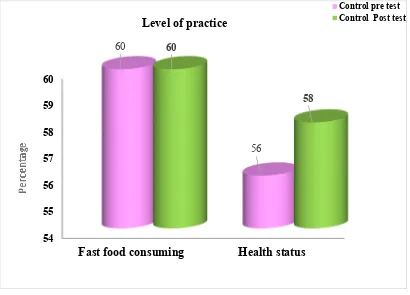
Mean, SD and mean percentage pre and post- test score of control group knowledge level regarding fast food related health hazards among adolescent boys from selected schools at Madurai.
45
4.1.B
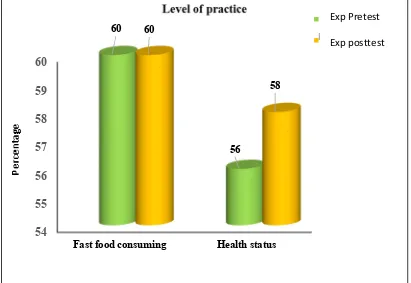
Mean, SD and mean percentage pre and post- test score experimental group knowledge level of video assisted teaching program regarding fast food related health hazards among adolescent boys from selected schools at Madurai
46
4.1.C
Mean, SD and mean percentage pre and post- test score of control group practice level regarding fast food related health hazards among adolescent boys from selected schools at Madurai.
47
4.1.D
Mean, SD and mean percentage pre and post- test score experimental group practice level of video assisted teaching program regarding fast food related health hazards among adolescent boys from selected schools at Madurai
48
4.1.E
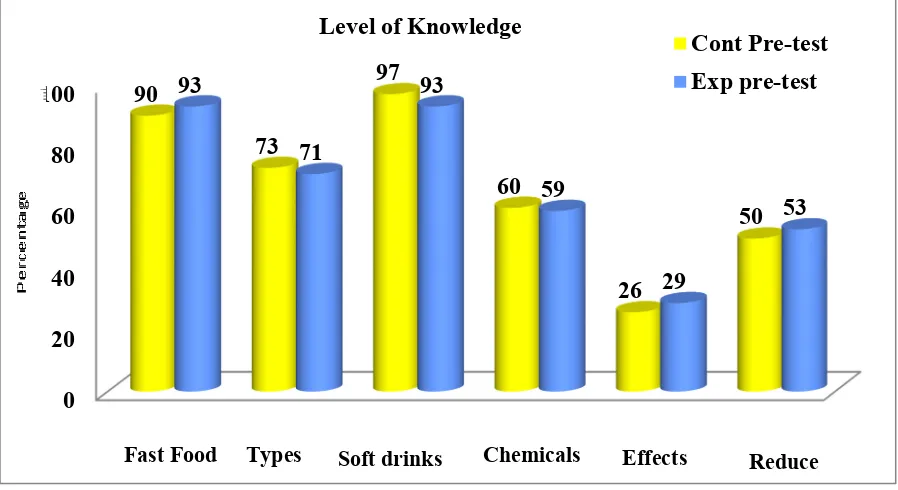
Mean, SD and mean percentage pre-test score between control and experimental group knowledge level regarding fast food related health hazards among adolescent boys from selected schools at Madurai
49
4.1.F
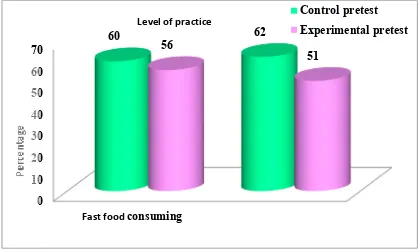
Mean, SD and mean percentage pre-test score between control and experimental group practice level regarding fast food related health hazards among adolescent boys from selected schools at Madurai
xvii 4.1.G
Mean, SD and mean percentage post – test score between control and experimental group knowledge level of video assisted teaching program regarding fast food related health hazards among adolescent boys from selected schools at Madurai
51
4.1.H
Mean, SD and mean percentage post – test score between control and experimental group practice level of video assisted teaching program regarding fast food related health hazards among adolescent boys from selected schools at Madurai
52
4.1.I
Frequency and percentage wise distribution to evaluate control and experimental group the level of knowledge regarding fast food related health hazards among adolescent boys from selected schools at Madurai
53
4.1.J
Frequency and percentage wise distribution to evaluate control and experimental group level of practice regarding fast food related health hazards among adolescent boys from selected schools at Madurai
xviii
LIST OF APPENDICES
APPENDIX NO. TITLE PAGE NO
A Letter for seeking experts opinion for content
validity i
B Letter for seeking permission to conduct the
pilot study. ii
C Letter for seeking permission to conduct the
research study iii
D Letter seeking permission for content validity. iv E List of experts for content validity of the tool v
F
Instrument: Part I Demographical variables Part II knowledge semi structure questionnaires Part III practice self- expressed structured
interview questionnaire
vi
G
Intervention package (video assisted teaching program regarding fast food related health hazards)
1
CHAPTER –I
INTRODUCTION
“BODY IS TEMPLE OF GOD”
HEALTH IS WEALTH
Fast food is a name for food that is made and presented to customers in short time. It is usually made with preheated or precooked ingredients, prepared in bulk and sold in packages for take-away. As a term, “fast food” appeared for the first time in Merriam–Webster dictionary in 1951 but its roots are much, much older. Fast food is a necessity of civilization since we have civilizations. From the ancient to modern times street vendors sold food ready to eat for those with less money and on hard times. Today we have restaurants that do the same.
2
style, the ready availability, taste, Low cost, peer pressure and marketing strategies, which makes it popular among children and adolescents.
A growing number of women are working outside the homes and they have less time to prepare food for their children so children skip meals and eat fast food. Studies have shown a positive correlation of increased body mass index (BMI) among adolescents, advertisement on television, magazine, craze for trendy foods, convenience, mood, body image are the factors that fluency the food choice of adolescents. The frequent fast food consumption causes teens and young adult to gain more weight and increased the risk of obesity. Globally 200 million schoolchildren are either overweight or obese, of those 40 – 50 million are classified as obese. Globally Indians are now amongst the top ten lists of most frequent consumers of fast food s because people particularly adolescent are replacing healthy nutritious foods by fast foods. Hence, they are at a greater risk of developing health hazards such as risk of diabetes, hypertension, cardiac problems, osteoporosis and obesity which is a major health problem in worldwide. Nutritional intake during adolescence periods is important .Sever physical, psychological and behavioral changes may affect food habits during adolescence and have long – term consequences on adult health status .FOOD!’’, fast food comprises of anything that is quick tasty, convenient and fashionable. It seems to have engulfed every age, every race and the newest are children. Children are experiencing so much growth they my always feel hungry. He or She may come to the dinner table ready to eat anything.
3
related problems. Healthy and nutritionally sound adolescents reflect the country’s potential. Human resource and its future greatly depends on them, India has an edge over many Other countries as its adolescent population from 22.8% or two thirds of the world’s 230Million adolescent population (census 2001).India is becoming the disease capital of the world. Our food is a lethal cocktail of highly processed, genetically modified foods, Filling with chemicals and preservatives, topped with excessive sugar and salt Bombing our bodies, and deadening our brains leading to physical and psychological disorders including cancer. Eating right and being physically active are not just a diet or a program these are the keys to a healthy life style. The healthful habits you may reduce your risk many chronic disease such as heart disease. In1905, William fletcher discovered that eating unpolished rice instead of helped to prevent the disease beriberi. Many of the fast foods are high on carbohydrates; low on fiber heavy on fat with little vitamin contents.. If adolescents eating habits are unsupervised they tend to eat faddish or quick snack foods rather than more nutritionally sound ones because both hungry and peer pressure. More children turn away from five pyramid food groups to eat great quantities of fast foods.
4
greatest pleasure from sugar, fat or salt (prof Kessler, who ran the FDA from 1990 to is now professor of pediatrics, epidemiology and biostatistics at the California). According to a National survey of India (2005) at least 30 % of adolescents have dental carries, 17% are overweight the problem is growing literally. Overweight teenagers are now a very visible urban phenomenon. In Delhi and Chandigarh, one in every four teenagers are obese while the study of school children in Chennai shows 18 % boys and 16% girls are overweight because of eating habits of unhealthy food items. ’A prospective , observational study was conducted in Karnataka (2003) a prospective, observational analysis on relationship between consumption of sugar- sweetened drinks and childhood obesity showed that 30% of children aged 13 -16 years are overweight . This study focuses on the trends in childhood nutrition over the past few years, such as changes in fast food and soft drink consumption.
NEED FOR THE STUDY
5
promote beverages and sweets. Marketing to adolescents has become a multi-billion dollars business. Approximately 23 million teenagers spend 100 billion dollars annually for fast food and other snacks. Fast food consumption national level 80% Indian level 33.66% once per week.
6
of adolescents throughout the world. Fast foods pose health risks both because of what they contain and because of what they replace in diet. Even though fast foods are tastier and easily available, it has become the biggest effects of cancer. Stuffed with loads of fat, these eatables increase the level of cholesterol in the body and invite obesity, which is believed to be ‘Mother of Cancer. Most colors in fast foods are often
inedible, carcinogenic and harmful to the body; they can affect the digestive system and can lead to hyperactive activity and lapses of concentration in children. Children suffering from learning disabilities are often advised against eating food with artificial coloring. Studies suggest that one soda contains 9 Teaspoons of sugar, gives more added sugar than its recommendation. There are over 500 Calories and 40% of daily-recommended fat in quarter-pound cheeseburgers. In large fries, there is 510 more calories plus 47% g of daily-recommended fat. All these acts as a base for childhood obesity.
STATEMENT OF THE PROBLEM
A study to evaluate the effectiveness of video assisted teaching program on knowledge and practice regarding fast food related health hazards among adolescent boys from selected schools at Madurai.
OBJECTIVES
1. To assess the pre-test and post-test knowledge and practice regarding video assisted teaching program on fast food related health hazards among adolescent boys in control and experimental group .
7
3. To compare the pre-test and post- test score in knowledge and practice on video assisted teaching program regarding fast food related health hazards among adolescent boys between control and experimental group.
4. To find out the co- relation between knowledge and practice on video assisted teaching program regarding fast food related health hazards among adolescent boys in control and experimental group.
5. To find out the association between pre knowledge and practice on video assisted teaching program regarding fast food related health hazards with their selected demographical variables among adolescent boys in control and experimental group.
HYPOTHESIS
H1 – There is a significant difference between pre - test and post-test score knowledge and practice on video assisted teaching program regarding fast food related health hazards among adolescent boys in experimental group.
H2 – There is a significant difference between the pre-test and post-test score knowledge and practice on video assisted teaching program regarding fast food related health hazards among adolescent boys in control and experimental group.
H3 – There is a co-relation between knowledge and practice on video assisted teaching program regarding fast food related health hazards among adolescent boys in control and experimental group.
8
OPERATIONAL DEFINITION
EVALUATE
It refers to systematic performance of video assisted teaching program regarding fast food related health hazards among adolescent boys age between (13 – 16) years.
Effectiveness
It refer to a significant outcome of video assisted teaching program regarding fast food related health hazards among adolescent boys comparing with the control and experimental group.
Video assisted teaching program regarding fast food related health hazards
It refers that a video assisted teaching program regarding fast food related health hazards among adolescent boys through LCD presentation. It was about 45 minutes. It include introduction , history, definition, factors affecting the nutritional status, classification of fast food items, fast food caused system based ill effects, maintain healthy life style, adolescent boys in normal height and weight, recommended diet for adolescent boys.
Knowledge
It refers to the correct responses of the adolescent boys to the items listed in semi-structured knowledge questionnaire regarding fast food related health hazards.
Practices
9
Adolescent Boys
It refers to the adolescent boy’s age between 13 – 16 years.
Assumption
• Video assisted teaching program may improve awareness regarding fast food related health hazards among adolescent boys.
• Video assisted teaching program may reduce fast food consuming among adolescent boys.
• Video assisted teaching program may improve the healthy life style among adolescent boys
Delimitation
• The study was delimited to adolescent boys within the age group of13 – 16 years from selected school, Madurai.
• Adolescent boys were available during the period of study • Data collection time was limited to 4 weeks.
PROJECTED OUTCOME
10
11
CHAPTER – II
REVIEW OF LITERATURE
A review of literature enables to get an insight into the various aspects of the problem under study. It covers promising methodological tools, throws light on ways to improve the efficiency of data collection and suggest how to increase effectiveness of the data analysis and interpretation. Review of literature therefore is an essential step in the development of a research project.
“The review of literature is defined as broad, comprehensive, in depth, systematic and critical review of scholarly publications, unpublished scholarly print materials, and audio visual materials and personal communications.”
The related literature is organized and presented under the following headings
a) Studies related to effectiveness of video assisted teaching program on fast food related health hazards among adolescent boys.
b) Studies related to pre knowledge and practice regarding fast food
a) Studies related to effectiveness of video assisted teaching program on fast
food related health hazards among adolescent boys
12
risk factors of coronary artery disease present among adolescents .A sample of 591 students aged between 12-18 years were selected by nonprobability convenient sampling. A structured questionnaire was used to collect the data regarding modifiable and non-modifiable risk factors. The results showed that 71 percent of the samples consumed fast food daily and 67 percent of the samples were found to have 3 or more risk factors for coronary artery disease whereas 22 percent of them had 2 risk factors and 11 percent of them had 1 risk factor for coronary artery disease.
13
J Jialo, 2015 at New Delhi, This paper examined whether the reported health impacts of frequent eating at a fast food or quick service restaurant on health were related to having such a restaurant near home. Methods: Logistic regressions estimated associations between frequent fast food or quick service restaurant use and health status, being overweight or obese, having a cardiovascular disease or diabetes, as binary health outcomes. In all, 2001 participants in the 2008–2009 Seattle Obesity Study survey were included in the analyses. Results showed eating ⩾2 times a week at a fast food or quick service restaurant was associated with perceived poor health status, overweight and obese. However, living close to such restaurants was not related to negative health outcomes. Frequent eating at a fast food or quick service restaurant was associated with perceived poor health status and higher body mass index, but living close to such facilities was not.
14
Gordon-StrachanG, 2015 at Jamaica, estimated the prevalence of overweight, obesity and high waist circumference in 15-19-year-old adolescents and to investigate the association with fast food and sweetened beverage consumption. This study enrolled 1317 (598 male, 719 female) adolescents aged 15-19 years using multistage, nationally representative sampling. The overall prevalence of overweight, obesity and high waist circumference was approximately 15 %, 6 % and 10 %, respectively. Obesity (8.0 % in females, 3.3 % in males) and high WC (16.2 % in females, 1.7 % in males) were significantly more prevalent in females when using internal Z-score cut-offs High WC was associated with the absence of fruit consumption (P = 0.043) and overweight with high sweetened beverage consumption (P = 0.018). Overweight occurs frequently among Jamaican 15-19-year and was associated with increased consumption of sweetened beverages. High WC was more prevalent among females and was related to low consumption of fruits and vegetables.
Harsh Kumar el at. 2013 at Punjab, The study was conducted during the October-November 2011 in the Lovely Professional University hostels. At present 18,000 students residing in the university hostels as information obtained from the university authority from which 10.06% of the total samples i.e., 1811 were targeted and non-parametric test (chi-square) was applied to check the goodness of fit, at 95% level of significance. The survey provides converging evidence of a direct causal link between food advertising, parent’s role and behavioral pattern of the hostlers about the fast food consumption.
15
foods might stop the children from taking healthy meals either at school or at home. The practice of high consumption of junk foods like magi noodles, burgers, pao-bhaji, sandwiches, hot dogs, patties, pastries, pop-corn, potato chips, carbonated drinks, biscuits, muffins, toast, kulcha-channa, samosa, chocolates etc. They frequently over consume fast foods and under consume fruits, vegetables and dairy products. According to WHO, in India, more than 3 per cent of the population is in the obese category. It is one of the most effective tool of changing the food habits without affecting their sentiments. Nutrition counseling regarding the importance of balanced diet, harmful effects of junk foods will help to curb the junk food addiction and improving their nutritional status. It should be suggested that there is a need to focus on nutrition counseling to facilitate the intake of healthy junk foods like fermented foods, wheat noodles by adding lots of vegetables, sprouted pulses, sprouted tikka, vegetable samosa & cutlets, wheat and multigrain bread.
David H. Freedman 2013 at USA, Effects of junk foods, Burger King launches low-fat French fries. These lower-calorie fries are part of a marketing ploy to convince Americans that fast food can be healthy. Burger King benefits from Americans being obese. According to the Centers for Disease Control and Prevention, 35% of adults and 17% of children in America are obese. As a nursing student, I see the long-term effects of obesity on a regular basis. These serious problems can only be helped with major lifestyle changes to lower weight and improve overall health.
16
juices (22.2%) and main place were home (38.2%) school (22.1%). The study concluded that sweet beverage intake was frequent among adolescents specially soft drinks and were consumed at home and at school. The nutrition education program should aim to stimulate the intake of more healthy beverages by adolescents. The result revealed that 30.3% of total sample reported consuming fast food. Adolescents ate more total energy and had poorer diet quality on days with compared with without fast food. The study concluded that consumption of fast food among adolescents in the United States seems to have an adverse effect on dietary quality in ways increase risk for obesity.
Sudha murthy, 2011 at Gujarat, The study includes two private school; samples of 12-15 years were selected randomly using a random sampling method. Predesigned and pre-tested questionnaire was used to collect dietary data. Results states that, the overall prevalence of obesity and overweight was 6.55% and 13.9% .The study showed that important determinants of overweight and obesity were low level of physical activity, watching television or playing computer games, and consuming junk foods.
17
factors (n = 21) and 76% indicated fast food restaurants were more prevalent in low-income areas compared with middle- to higher-low-income areas.
S Stender, 2007 at Denmark, Fast food generally has a high-energy density, which, together with large portion sizes, induces over consumption of calories. Chemical analyses of 74 samples of fast-food menus consisting of French fries and fried chicken (nuggets/hot wings) bought in McDonalds and KFC outlets in 35 countries in 2005–2006 showed that the total fat content of the same menu varies from 41 to 65 g at McDonalds and from 42 to 74 g at KFC. In addition, fast food from major chains in most countries still contains unacceptably high levels of industrially produced trans-fatty acids and have powerful biological effects and may contribute to increased weight gain, abdominal obesity, and type two diabetes and coronary artery disease. The food quality and portion size need to be improved before it is safe to eat frequently at most fast-food chains.
18
Stephan E 2003, at French, According to the research, the consumption of fast food on a regular basis leads to excess energy intake leading to an increased risk of overweight and obesity. Calorie content consumed by the children of out-of-home meals was 55% higher than of in-out-of-home meals. Results there were 1811 hostlers that took part in the survey having girls (51.5%) and boys (48.5%). Majority of the hostlers belonging to the age group 21-23 years (47.8%) and were undergraduate (70.1%). Most of the hostlers preferred fast food just to satisfy their craving for different tastes (76.7%) in contrast to those (12.0%) that ate it as a normal meal. At least every student skips its one time hostel meal every day (63.8%), preferably lunch (50.5%) and with intention (58.4%). Maximum hostlers agreed that their fast food habit increased after they left their parent’s home (65.5%) and this habit going to increase day by day (42.4%). On and average majority of the hostlers spent Rs. 21-40, daily on fast food purchase (38.7%) and maximum hostlers parent’s know about their fast food eating habit (56.7%). Most of the hostlers preferred to eat fast food in-group (60.1%), whereas other preferred to eat with opposite gender (22.6%) but only few to prefer to eat when they were alone (12.2%). Maximum numbers of hostlers aware that obesity, heart diseases are associated with fast food consumption (61.8, 73.3%) and believed that advertisement influence their fast food eating behavior that changes their attitude towards normal meal (72.5, 52.0%).
19
b) Studies related to knowledge and practice regarding fast food
Shaba Devi supkota, 2018 at Nepal, assess the junk food consumption and patterns of consumed junk food among secondary level students. Material and Methods: - This was a descriptive cross-sectional research. Simple statistical methods Results: The findings revealed that more girls (53.5%) consumed junk food than boys (79.6%) and those respondents were aware of the meaning of junk food. Majority of respondents (90.1%) preferred junk food for taste, is faster to prepare (44.4%), preferred as influenced by TV advertisements (15.5%), because of peer influences (31.7%) and some (29.6%) respondents preferred junk food because nothing else was available. Concerning patterns of consumed junk food all respondents (100%) consumed ‘chat-pat’ and noodles, panipuri (97.2%), doughnuts (93%), chocolates (92.3%), biscuits (95.8%), ice cream (65.5%) and cold drinks (65.5%). Only 54.2% of respondents were aware of risks associated with poor eating habits. Conclusion: Adolescents consumed a greater amount of junk food, which led to a majority of ill effects later on. It is recommended that the school and community conduct and implement awareness program on junk food consumption and its ill effects.
National Heart, Lung and Blood Institute (NHLBI), 2017 at United
20
Michelle M. Rank, 2017 at Australian, impact of junk food in adolescent brain. Adolescence is a significant period of physical, social, and emotional development, and is characterized by prominent neurobiological changes in the brain. The maturational processes that occur in brain regions responsible for cognitive control and reward seeking may underpin excessive consumption of palatable high fat and high sugar “junk” foods during adolescence. Recent studies have highlighted the negative impact of these foods on brain function, resulting in cognitive impairments and altered reward processing. The increased neuroplasticity during adolescence may render the brain vulnerable to the negative effects of these foods on cognition and behavior. In this review, we describe the mechanisms by which junk food diets influence neurodevelopment during adolescence. Diet can lead to alterations in dopamine‐mediated reward signaling, and inhibitory neurotransmission controlled by γ‐amino butyric acid two major neurotransmitter systems that are under construction across adolescence. We propose that poor dietary choices may affects the normal adolescent maturation process and influence neurodevelopmental trajectories, which can predispose individuals to eating and impulsive behaviors.
21
participants 100(62.2%) eat a medium amount of fast food and 83(51.9%) reported they drank soft drinks. The majority of the respondents 116(72.5%) reported that the main reason to have fast food was its delicious taste. Describes that 51(31.87%) of participant had inadequate knowledge, 67(41.88%) of the participants had moderate knowledge and42 (26.2%) of the participates had a adequate knowledge. Out of 77 females, 12(15.6%) had inadequate knowledge, 40(51.9%) had moderate knowledge and 25(32.5) that adequate knowledge.
Dr. Asha P. Shetty, March 2016 at Mangalore, the present study was conducted to assess the knowledge regarding the effects of fast food on health among adolescents in selected Pre University College at Mangalore. Objectives: To assess the knowledge regarding the effects of fast food on health among adolescents in selected Pre University College. To find the association between knowledge of adolescents regarding the effects of fast food on health and the selected demographic variables. Methods: A non-experimental descriptive survey design was adopted. A structured knowledge questionnaire regarding effects of fast food consumption was prepared in order to assess the knowledge of adolescents. A sample of 100 adolescents were selected by using non-probability Purposive Sampling technique. Result: The result revealed that 13% of adolescents had inadequate knowledge, 69% has moderate knowledge and 18% has adequate knowledge regarding effects of fast food on health. It was also found that there is a significant association between the knowledge score with selected demographic variables.
22
representative sample of nearly 60 000 adolescents and assessed the role of possible modifiers. Methods: Data come from the Italian 2009–10 Health Behavior in School-aged Children survey. Data on Eating patterns, sedentary behaviors, physical activity, peers network, Body mass index and socio-economic status were collected following study protocol. Results: Unhealthy food consumption was significantly associated with a lower intake of fruit and vegetables and with the increase of sedentary behaviors in both sexes and in all ages. Conclusions: This study adds evidence to support the importance of investing more resources in educational initiatives both to increase parents’ awareness to support adolescents on dietary choices and on time spent in screen-based behaviors.
Vyas, 2012 at New Delhi, survey done on adolescents in metro cities like New Delhi, Bengaluru, Mumbai and Chennai showed that 43% of the children above seven years were obese as their Body Mass Index was found extremely on the higher side. The findings observed that the problem of obesity is due to lifestyle changes in adolescents and would cause Vitamin-D deficiency in them.
23
As per Chitra and Reddy 2007, with the advent of urbanization and increase in per capita income of the country and particularly the northern region, it is witnessing a shift from an active to a sedentary lifestyle. The importance of breakfast and its contribution to health, especially for children is evident from various studies. Breakfast ideally must provide 25% of daily nutrient requirements. The regular consumption of breakfast helps children to be healthy. The percentage of internet use of adolescents falling in the age of 12 to 17 on a daily basis was increased from 42% in 2000 to 61 % in 2006.
According to Gigli 2004, in contrast to the steady rise of various media technologies, the role of print media has slowed down in many countries as compared to the role it once played in the past. The number of readers has declined due to different developments in the communication technology. The reasons for this could be many the availability of better quality of information from electronic and new media. Moreover, young children are provided with several media options and different technologies. Countries, which are economically weak, have very less number of publications, which cater to the needs of the youth. Moreover these publications are expensive and beyond the reach of the children to afford.
24
25
CONCEPTUAL FRAMEWORK
The conceptual framework plays interrelated roles in the progress of science. Their overall purpose is to make is an interrelated concept on abstractions are assembled together in some scheme by virtue of their relevance to a common scheme. It is a device that helps to stimulate research and the extension of knowledge by providing the direction. The present study was aimed at determining the knowledge and practice among adolescent boys regarding fast food related health hazards and evaluating the effectiveness of video assisted teaching program.
The conceptual framework of this study was derived from Ludwing von Bertanlanffy (1968) as cited by Christensen.J.Paula and KennyW.Janet (1995) General system theory. The general system theory was initially introduced in 1930s by Von Bertanlanffy. A system is a set of interrelated parts that come together to form a “whole”. Each part is necessary or integral component is required to make a complete meaning whole. These parts are input, throughput, and feedback.
26
Throughput is the second component in which it allows the input to be changes, so that it is useful to the system. In this study throughput refers to the intervention that is process of transformation of video assisted teaching program on knowledge and practice regarding fast food related health hazards among adolescent boys. In control group
Output is the third component of the system, which measures the success of failure of the output and consequently the effectiveness of the system. In this the expected outcome was obtained by evaluating the effectiveness of video assisted teaching program regarding fast food related health hazards among adolescent boys through demographical data and self-administered questionnaires
27
CONCEPTUAL FRAMEWORK
Understanding general system theory introduced by Von Bertanlanffy in 1930
Experimental Group
• Adequate knowledge
• Moderate knowledge
• Inadequate knowledge
• Poor practice
• Average practice
• Good practice
INPUT
THROUGH PUT
OUPUT
Demographic data
. Age, religion, type of family,
education status, no of siblings, dietary history, family income, place of residence, source of information, classification based Body Mass Index, fast food consuming history, reason to
choose the fast food, residing
PRE TEST
Control group
Intervention
Control group
No intervention for control group
POST TEST
Control group
Control Group
• Adequate knowledge
• Moderate knowledge
• Inadequate knowledge
• Poor practice
• Average practice
• Good practice
Experimental group
Experimental group
Video assisted teaching program regarding fast
food related health hazards among adolescent boys
28
CHAPTER III
METHODOLOGY
This chapter with the methodology followed in the study and it was discussed under the heading research approach, research design, variables, settings, population, sample and sampling technique, development and description of tools, scoring key, content validity, reliability, pilot study, protection of human rights, procedure for data collection, plan for data analysis and interpretation of the results.
RESEARCH APPROACH
The quantitative approach was adopted for this study
RESEARCH DESIGN
The researcher had chosen the quasi-experimental non-randomized control group design to evaluate the effectiveness of video assisted teaching program regarding fast food related health hazards among adolescent boys.
GROUP PRE-TEST INTERVENTION POST-TEST
E O1
video assisted teaching
program O2
C O1 ---- O2
Key:
E = Experimental group, C = Control group, O1 = pre assessment knowledge and
practice regarding fast food related health hazards among adolescent boys., X = video assisted teaching program, O2 = post assessment knowledge and practice
29
SCHEMATIC REPRESENTATION OF METHODOLOGY
Research approach: Quantitative Approach
Research design: Qusi- experimental – non-randomized control group design
Setting of the study: - Video assisted teaching program on knowledge and practice regarding fast food related health hazards among adolescent boys
at selected CSI higher secondary school at Madurai
Sample: adolescent boys 60
Sample technique: Purposive sampling technique.
Sample size: 60
Control group: 30 samples
Data collection: Semi structured and self-expressed questionnaire
Finding and Conclusion Pre test
No intervention Post-test
Experimental group: 30 samples
Pre test Intervention: video
assisted program Post-test
30
SETTING OF THE STUDY
The study was conducted at selected CSI boy’s higher secondary school at Madurai. It is a quarter km away from C S I Jeyaraj Annapackiam College of nursing. For control group samples selected from CSI, school boy’s hostel30. For experimental group samples selected from CSI, school day - scholarsboys30. In this study total 60 sample were selected.
POPULATION
Target population
Adolescent boys between the age group of 13 – 16 years the researcher would like to generalize the research findings from selected school at Madurai.
Accessible population
The accessible population was composed of samples from the target population that are accessible to the researcher as study participants.
The adolescent boys between the age group of 13 – 16 years from CSI higher secondary school in Pasumalai at Madurai.
SAMPLING TECHINQUE
Non-probability purposive sampling technique are used to select the sample for both control and experimental group in this study.
Sample
31
Sample size
The total 60 samples were selected for this study out of which 30 samples for control group and out of which 30 samples for experimental group.
CRITERIA FOR SAMPLE SELECTION
The samples were selected based on the following inclusion and exclusion criteria.
Inclusion criteria
1. Adolescent boy’s age between 13 to 16 years participated in this study
2. Adolescent boy’s with consuming of fast food since child hood period for consider as a experimental group
3. Adolescent boys without consuming of fast food since childhood period for consider as a control group
4. Hostel adolescent boys consider as a control group and day- scholars adolescent boys consider as a experimental group
5. Adolescent boys are willing to participate in this study 6. Adolescent boys able to read and write Tamil
Exclusion criteria
1. Adolescent boys exposed to similar teaching previously 2. Adolescent boys not available during data collection 3. Adolescent boys not willing to participate
4. English medium adolescent boys not included in this study
DEVELOPMENT OF AN INSTRUMENT
32
DESCRIPTION OF TOOL
The tool was prepared by the investigator based on objective of the study with the help of review of literature and consultation with experts. A semi structured questionnaire interview schedule was developed to measure the effectiveness of video teaching program on knowledge and practice regarding fast food related health hazards among adolescent boys selected school at Madurai. Tool consist of three parts.
Part I – Demographical variables
It consists of age, religion, no of female siblings, type of family, and educational status, dietary pattern, and family income, place of residence and source of information, fast food consuming history, .and classification of BMI
Part II – knowledge questions
It semi structure questionnaire to evaluate the knowledge regarding fast food related health hazards among adolescent boys. There were 20 questions.
a) Definition of fast food – 1 b) Fast food items- 5
c) Chemical in fast food – 4 d) Effects of fast food – 9 e) Help to avoid fast food – 1
Part III – practice questions
Self-expressed structure questionnaire to evaluate the practice regarding fast food related health hazards among adolescent boys. There were 15 questions.
33
SCORING PROCEDURE
Part I
Questionnaire on knowledge regarding fast food related health hazards among adolescent boys age between 13 – 16 years. It consists of 20 multiple choice questions have one right answer, which was allotted a score of one for every right answer and every wrong answer 0 score is given. The total attainable score in knowledge questionnaire was 20.
The knowledge score was interpreted as follows:
Adequate knowledge - More than 75% Moderate knowledge - 51- 75%
Inadequate knowledge - Less than 50%
Part II
Questionnaire on practice regarding fast food related health hazards among adolescent boys age between 13 – 16 years. It consists of 15 questions the total attainable score in 45. The items were measured on a 3-point rating scale.
The practice score was interpreted as follows,
Good - More than 66% Average - 34 – 66%
Poor - Less than 33%
CONTENT VALIDITY OF THE INSTRUMENT
34
from three nursing Phd scholars, medical persons four members, statisticians two, and psychologist one.
The final instruments were reframed after consulting with guide, and statistician. Then tool and video assisted teaching content were edited by English language experts, translated into Tamil, edited by Tamil language expert and reedited by English language expert.
RELIABILITY OF THE STOOL
The reliability of the effectiveness of video assisted teaching program regarding fast food related health hazards was tested by retest method and Cronbach’s alpha method respectively, r = 0.88 which was found to be positive co-relation.
PILOT STUDY
The pilot study was conducted among 6 adolescent boys in CSR Thirunagar Higher Secondary School Madurai. Formal permission was obtained from the institution, ethical committee and the head of the department. Anonymity and confidentiality was maintained while collecting information and oral consent obtained from the samples. 3 samples in control group and 3 samples in experimental group. Post-test was done 7 days after intervention. The pilot study helped the investigator to confirm the feasibility of the main study.
DATA COLLECTION PROCEDURE
Data collection is the gathering information to address the research problem.
35
purposive sampling based on sample selection criteria. A total 60 adolescent boys were selected for this study out of which 30 samples to control group and 30 samples experimental group. The objective and purpose of the study were explained and oral consent was obtained.
Control group: Pre-test data were collected regarding fast food related health hazards using semi-structured. Questionnaire for knowledge and self-expressed structured interview questionnaire for practice. The time duration about 20 minutes during 3 pm to 6 pm. After 7 days, Post-test was done.
Experimental group, Pre-test data were collected regarding fast food related health hazards using semi-structured questionnaire for knowledge and self-expressed structured interview questionnaire for practice. The time taken was about 20 minutes duration 3 pm to 6 pm. In experimental group intervention given regarding fast food related health hazards. After 7 days Post-test was done. After completing the pre and post data thanked the adolescent boys both control and experimental group.
As a ethical consideration, I educated the control group using video assisted teaching program regarding fast food related health hazards. The collected data were compiled and analyzed using descriptive and inferential statistics and interpretation were presented in tables and figures.
PROTECTION OF HUMAN RIGHTS
36
CHAPTER – IV
DATA ANALYSIS AND INTERPRETATION
This chapter deals with data analysis collected among adolescent boys and interpretation of the present study involves compilation, editing, coding, classification and presentation of the data for statistical calculation in order to draw inferences and conclusions. Using descriptive and inferential statistics, the study objectives were computed.
The data collected from the respondents were organized, tabulated, analyzed and included applying descriptive and inferential statistics based on the objectives.
1. To assess the pre-test and post-test knowledge and practice regarding video assisted teaching program on fast food related health hazards among adolescent boys in control and experimental group .
2. To evaluate the effectiveness of video assisted teaching program regarding fast food related health hazards among adolescent boys in experimental group. 3. To compare the pre-test and post- test score in knowledge and practice on video
assisted teaching program regarding fast food related health hazards among adolescent boys between control and experimental group.
4. To find out the co- relation between knowledge and practice on video assisted teaching program regarding fast food related health hazards among adolescent boys in control and experimental group.
37
selected demographical variables among adolescent boys in control and experimental group.
The study findings were presented with tables and figures under the following captions:
Section I
4.1.1 Frequency and percentage wise distribution to evaluate the effectiveness of video assisted teaching program on knowledge and practice regarding fast food related health hazards among adolescent boys from selected schools at Madurai according to their demographic variables in control and experimental group.
Section II
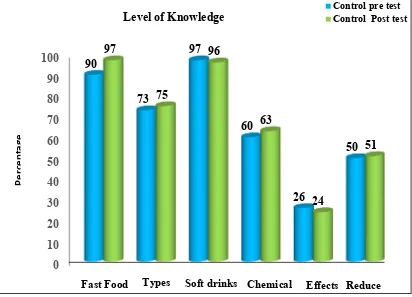
4.1.A Mean, SD and mean percentage pre and post- test score of control group knowledge level regarding fast food related health hazards among adolescent boys from selected schools at Madurai.
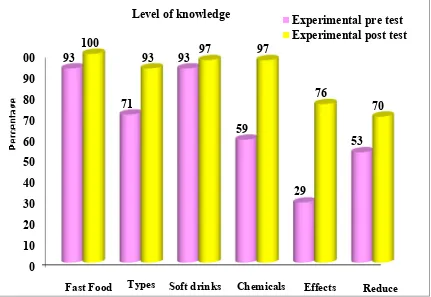
4.1B Mean, SD and mean percentage pre and post- test score experimental group knowledge level of video assisted teaching program regarding fast food related health hazards among adolescent boys from selected schools at Madurai.
4.1.C Mean, SD and mean percentage pre and post- test score of control group practice level regarding fast food related health hazards among adolescent boys from selected schools at Madurai.
38
4.1.E Mean, SD and mean percentage pre-test score between control and experimental group knowledge level regarding fast food related health hazards among adolescent boys from selected schools at Madurai.
4.1.F Mean, SD and mean percentage pre-test score between control and experimental group practice level regarding fast food related health hazards among adolescent boys from selected schools at Madurai.
4.1.G Mean, SD and mean percentage post – test score between control and experimental group knowledge level of video assisted teaching program regarding fast food related health hazards among adolescent boys from selected schools at Madurai.
4.1.H Mean, SD and mean percentage post – test score between control and experimental group practice level of video assisted teaching program regarding fast food related health hazards among adolescent boys from selected schools at Madurai.
4.1.I Frequency and percentage wise distribution to evaluate control and experimental group the level of knowledge regarding fast food related health hazards among adolescent boys from selected schools at Madurai.
4.1.J Frequency and percentage wise distribution to evaluate control and experimental group the level of practice regarding fast food related health hazards among adolescent boys from selected schools at Madurai.
Section III
39
regarding fast food related health hazards among adolescent boys from selected schools at Madurai.
4.2.2 paired ‘t’-test was found in experimental group pre and post-test score to evaluate the effectiveness of video assisted teaching program on practice regarding fast food related health hazards among adolescent boys from selected schools at Madurai.
4.2.3 Unpaired ‘t’-test was found in pre-test score knowledge level between control and experimental group regarding fast food related health hazards among adolescent boys from selected schools at Madurai .
4.2.4 Unpaired ‘t’-test was found in post-test score knowledge level between control and experimental group to evaluate the effectiveness of video assisted teaching program regarding fast food related health hazards among adolescent boys from selected schools at Madurai.
4.2.5 Unpaired ‘t’-test was found in pre-test score practice level between control and experimental group regarding fast food related health hazards among adolescent boys from selected schools at Madurai.
4.2.6 Unpaired ‘t’-test was found in post-test score practice level between control and experimental group to evaluate the effectiveness of video assisted teaching program regarding fast food related health hazards among adolescent boys from selected schools at Madurai.
Section IV
40 Section V
4.4.1 Association between pre-test score levels of knowledge in control group and experimental group with their selected demographic variables.
41
SECTION I
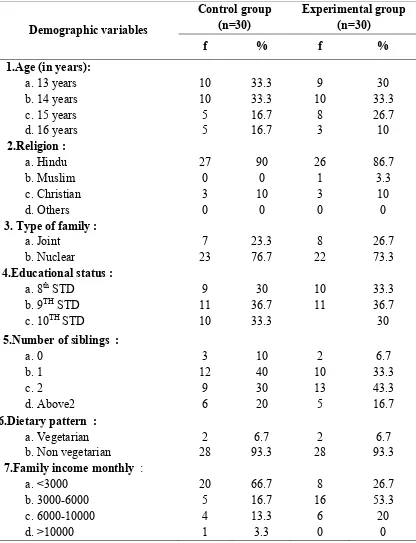
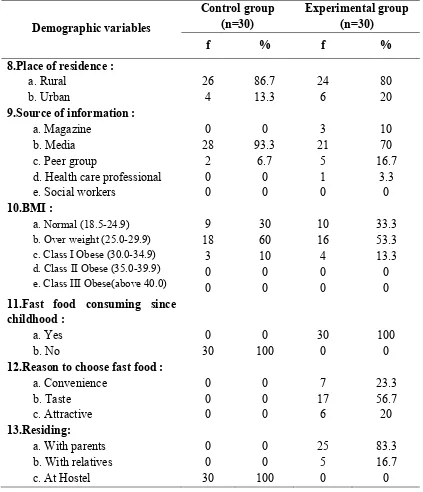
Table: 4.1.1: Frequency and percentage wise distribution to evaluate the effectiveness of video assisted teaching program on knowledge and practice regarding fast food related health hazards among adolescent boys from selected schools at Madurai according to their demographic variables in control and experimental group. Demographic variables Control group (n=30) Experimental group (n=30)
f % f %
1.Age (in years): a. 13 years b. 14 years c. 15 years d. 16 years
10 10 5 5 33.3 33.3 16.7 16.7 9 10 8 3 30 33.3 26.7 10 2.Religion : a. Hindu b. Muslim c. Christian d. Others 27 0 3 0 90 0 10 0 26 1 3 0 86.7 3.3 10 0 3. Type of family :
a. Joint b. Nuclear 7 23 23.3 76.7 8 22 26.7 73.3 4.Educational status :
a. 8th STD b. 9TH STD c. 10TH STD
9 11 10 30 36.7 33.3 10 11 33.3 36.7 30 5.Number of siblings :
a. 0 b. 1 c. 2 d. Above2 3 12 9 6 10 40 30 20 2 10 13 5 6.7 33.3 43.3 16.7 6.Dietary pattern :
a. Vegetarian b. Non vegetarian
2 28 6.7 93.3 2 28 6.7 93.3 7.Family income monthly :
[image:59.595.114.530.220.763.2]42 Demographic variables Control group (n=30) Experimental group (n=30)
f % f %
8.Place of residence : a. Rural b. Urban 26 4 86.7 13.3 24 6 80 20 9.Source of information :
a. Magazine b. Media c. Peer group
d. Health care professional e. Social workers
0 28 2 0 0 0 93.3 6.7 0 0 3 21 5 1 0 10 70 16.7 3.3 0 10.BMI :
a. Normal (18.5-24.9) b. Over weight (25.0-29.9) c. Class I Obese (30.0-34.9) d. Class II Obese (35.0-39.9) e. Class III Obese(above 40.0)
9 18 3 0 0 30 60 10 0 0 10 16 4 0 0 33.3 53.3 13.3 0 0 11.Fast food consuming since
childhood : a. Yes b. No 0 30 0 100 30 0 100 0 12.Reason to choose fast food :
a. Convenience b. Taste c. Attractive 0 0 0 0 0 0 7 17 6 23.3 56.7 20 13.Residing:
a. With parents b. With relatives c. At Hostel
[image:60.595.111.534.72.564.2]0 0 30 0 0 100 25 5 0 83.3 16.7 0
43
(33.3%) samples are between the age group 14 years, 8(26.7%) samples are between the age group 15 years, 3 (10%) samples are between the age group 16 years.
Regarding religion of adolescent boys in control, group 27 (90%) samples are Hindu, and 3 (10%) samples are Christians. In experimental group, 26(86.7%) samples are Hindu. 1 (3.3%) samples are Muslim, and Christian 1(10%)
Regarding type of family in control group 7 (23.3%) samples are joint family, 23 (76.7%) samples are nuclear family. In experimental group 8 (26.7%) samples are joint family, 22 (73.3%) samples are nuclear family.
Regarding educational status of control, 9 (30%) samples are 8th standards, 11(36.7%) samples are 9th standards and 10 (33.3%) samples are 10th standards. In experimental group, 17 (56.7%) samples are 8th standards, 11(33.3%) samples are 9th standards, and 13 (43.3%) samples are 10th standards.
Regarding number of siblings in control group 3 (10%) samples are only one 12 (40%) samples are siblings with one, 9(30%) samples are siblings with 2, 6(20%), and number of siblings above 2. In experimental group 6 (7%) samples are only one. 10 (33.3%) samples are siblings with one, 13(43.3%) samples are siblings with 2, and 5 (16.7%) samples are siblings above 2.
Regarding dietary pattern in control group 2 (6.7%) samples are vegetarian and 28 (93.3%), samples are non-vegetarian. In experimental group 2 (6.7%) samples are vegetarian, 28 (93.3%) samples are non-vegetarian.
44
family income 3000 – 6000 rupees.6(20%)samples family income 6000 – 10,000 rupees , none of them families are above 10,