ISSN(Online): 2319 - 8753
ISSN (Print) :2347 - 6710
International Journal of Innovative Research in Science,
Engineering and Technology
(An ISO 3297: 2007 Certified Organization)
Vol. 4, Issue 1, January 2015
A Study to Assess the Effectiveness of Video Assisted
Teaching Programme on Knowledge Regarding the
Benefits of Outdoor Play Among School Going Children
in Selected School of Bhilai, Chhattisgarh
Ariya .S. Kurup, Prof. V. Hemavathy
Tutor, Sree Balaji College of Nursing, Chrompet, Chennai, India
Principal, Sree Balaji College of Nursing, Chrompet, Chennai, India
ABSTRACT: As adults we know that we learn through doing, it is the same for children. Playing outside the home is the natural inclination of kids. The conceptual model for the study was developed by the investigator based on Bertalnaffy’s general system–theory. The research design for this study is one group pretest-post test design. The investigator has used a simple random sampling- lottery method. Sample size 60 School going children (10-11 years) who are studying in Khalsapublicschool,Durg, Chhattisgarh. Tools are divided in two sections SECTION-Ai-sociodemographic variables, ii-demographic profile of study parameters,SECTION-B-questionaries regarding benefits of outdoor play.The pilot study was conducted in D.A.V Public School, Hudco, Bhilai, Chhattisgarh, reliability of tool was found, r = 0.78. The major findings that in pre test knowledge score revelled poor knowledge 41.67%, average 58.33%, mean is 11.23, SD 5.4, CV 48.09 while the post test knowledge score has been increased to good 40% and 60% were excellent, mean 30.87, SD 1.56, CV 5.05.The t- test revealed 26.50 was found highly effective i.e. video assisted teaching programme was found highly effective in increasing the knowledge of the children regarding benefits of outdoor play.
KEYWORDS: Video assisted teaching programme, knowledge, outdoor play, School going children.
I. INTRODUCTION
Outdoor plays give us all benefits of physical exercise. Outdoor play is open air games. So, we breathe in plenty of fresh air. We breathe in plenty for oxygen. Hence our blood circulation works very well. In outdoor games we play together. So, we have to obey the rules of them. Here we learn obedience to law and obedience to umpire. We learn how to behave with our fellow players. Hence, we learn manners. In outdoor games we learn sportsmanship.
II. OBJECTIVES
i. To assess the pre test and post test knowledge score regarding benefits of outdoor play among school going
children in selected school of Bhilai, Chhattisgarh.
ii. To assess the effectiveness of video assisted teaching programme regarding benefits of outdoor play among
school going children in selected school of Bhilai, Chhattisgarh.
iii. To find out the association between per-test knowledge score with selected sociodemographic variable with
ISSN(Online): 2319 - 8753
ISSN (Print) :2347 - 6710
International Journal of Innovative Research in Science,
Engineering and Technology
(An ISO 3297: 2007 Certified Organization)
Vol. 4, Issue 1, January 2015
III. HYPOTHESIS
H1- There will be significant effectiveness of video assisted teaching programme on knowledge regarding benefits of
outdoor play among school going children.
H2-There will be significant association between pre-test knowledge score with selected sociodemographic variables among school going children.
IV. METHODOLOGY
ISSN(Online): 2319 - 8753
ISSN (Print) :2347 - 6710
International Journal of Innovative Research in Science,
Engineering and Technology
(An ISO 3297: 2007 Certified Organization)
Vol. 4, Issue 1, January 2015
V. RESULTS
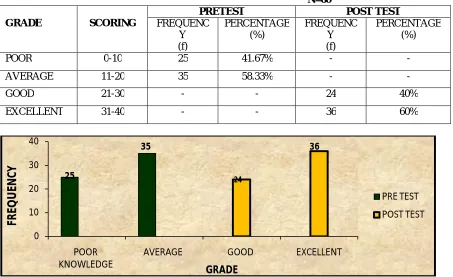
SECTION A: Data analysis related to comparison of pre-test knowledge and post - test knowledge scores among school going children regarding benefits of outdoor play.
N=60
GRADE SCORING
PRETEST POST TEST
FREQUENC Y (f)
PERCENTAGE (%)
FREQUENC Y (f)
PERCENTAGE (%)
POOR 0-10 25 41.67% - -
AVERAGE 11-20 35 58.33% - -
GOOD 21-30 - - 24 40%
EXCELLENT 31-40 - - 36 60%
Figure 2 showing maximum number of subject i.e. 35 (58.33%) had average knowledge regarding benefits of outdoor play and 25 (41.67%) had poor knowledge. In post test maximum number of subject i.e. 36 (60%) had excellent knowledge and24 (40%) had good knowledge
SECTION B: Data analysis related to effectiveness of video assisted teaching programme related to post-test knowledge score among school going children regarding benefits of outdoor play.
N= 60
AREA MEAN SD CV EFFECTIVENESS tVALUE SIGNIFICANE
PRETEST 11.23 5.4 48.09 174.89 26.50 P<0.0001HS POSTTEST 30.87 1.56 5.05
0 10 20 30 40
POOR KNOWLEDGE
AVERAGE GOOD EXCELLENT
PRE TEST
POST TEST
FR
EQ
U
ENC
Y
GRADE 25
35
24
ISSN(Online): 2319 - 8753
ISSN (Print) :2347 - 6710
International Journal of Innovative Research in Science,
Engineering and Technology
(An ISO 3297: 2007 Certified Organization)
Vol. 4, Issue 1, January 2015
Fig3 showing on an average, in pre-test, school going children are having 11.23 score and in post test, school going children are having 30.87 score. Difference is 19.64 score. The difference between pre-test and post-test knowledge score is large and it is statistically significant. Score.
SECTION C :Data analysis related to association between pre-test knowledge with selected sociodemographic variable
As per chi-square testing age of the subjects, type of the family, monthly income of family and awards or achievements for outdoor was found significant with knowledge of subjects regarding benefits of outdoor play as their chi square value 4.23, 5.65, 10.45 and 3.86 respectively of P > 0.05 level of significance.Benefits of outdoor play with gender, number of children in family, number of sibling, birth order, educational status of father, educational status of mother, occupation of father, occupation of mother, source of information, outdoor games which can play, time spends is less than the table value and hence non significant at 0.05
VI. CONCLUSION
On the basis of the findings of the study, the following conclusions were drawn 1st Objective - To assess the pre test
and post test knowledge score regarding benefits of outdoor play among school going children (10-12 years) in selected school .Bhilai (Chhattisgarh) has been fulfilled by the following findings that in pre test knowledge score revelled poor knowledge 41.67%, average 58.33%, mean is 11.23, SD 5.4, CV 48.09 while the post test knowledge score has been increased to good 40% and 60% were excellent, mean 30.87, SD 1.56, CV 5.05.2nd objective - To assess the effectiveness of video assisted teaching programme regarding benefits of outdoor play among school going children (10-12 years) in selected school Bhilai (Chhattisgarh).Has been fulfilled by the following findings that t- test revealed 26.50 was found highly effective i.e. video assisted teaching programme was found highly effective
in increasing the knowledge of the children regarding benefits of outdoor play.3rd objective- To find out the
association between pre-test knowledge with selected sociodemographic variable.Has been fulfilled by following finding that there is significant association between knowledge regarding benefits of outdoor play in school going children and age of the subjects, type of the family, monthly income of family and awards or achievements.
VII. RECOMMENDATIONS
Based on the findings of the study the investigator proposes the following recommendations for future research. 0
10 20 30 40 50 60
MEAN SD CV
PRETEST
POSTTEST 11.23
30.87
5.4
1.56
48.09
ISSN(Online): 2319 - 8753
ISSN (Print) :2347 - 6710
International Journal of Innovative Research in Science,
Engineering and Technology
(An ISO 3297: 2007 Certified Organization)
Vol. 4, Issue 1, January 2015
REFRENCES
1. Basavanthappa B.T, “Child Health Nursing” 1stEdition, New Delhi, Ahuja Publishing House, (2008), page no 192-194.
2. Burns et.al. “Understanding nursing Research” 3rd Edition, Pennsylvania, Saunders publication, 2003, Page no.193-198.
3. Clifford & Harken, “Research methodology in nursing and health care active learning”,1st Edition, Newyork, Churchill living stone publication,
Page no.105-108.
4. Dr. Rajesh Dixit, “Child development birth to adolescence”, 1st Edition, Bhopal, Indra publication, 2006, page no.53-58.
5. Bakeman.R&Bownlee, “The strategic use of parallel play”,A sequential analysis, child development, 1980, page no. 91
6. Balaji, A., Balaji, T.M., Rao, S.R., "Angiotensin II levels in gingival tissues from healthy individuals, patients with Nifedipine induced gingival
overgrowth and non responders on Nifedipine", Journal of Clinical and Diagnostic Research, v-9, i-8, pp:92-94, 2015.
7. Behura, S.S., Masthan, M.K., Narayanasamy, A.B., "Oral mucosal lesions associated with smokers and chewers – A case-control study in
chennai population", Journal of Clinical and Diagnostic Research, v-9, i-7, pp:17-22, 2015.
8. Solomon, P.J., Margaret, P., Rajendran, R., Ramalingam, R., Menezes, G.A., Shirley, A.S., Lee, S.J., Seong, M.-W., Park, S.S., Seol, D., Seo,
S.H., "A case report and literature review of Fanconi Anemia (FA) diagnosed by genetic testing", Italian Journal of Pediatrics, v-41, i-1, pp:-, 2015.
9. Jimson, S., Sree Ranjani, S., Lenka, S., Jimson, S., "Comparative Effects of Clonidine and Adrenaline with Lignocaine During Maxillary
Infiltration Anaesthesia for Dental Extraction", Journal of Clinical and Diagnostic Research, v-9, i-5, pp:85-88, 2015.
10. Renuga, S., Lakshmi, K., Chitralekha, S., Illamani, V., "Prevalence of Pseudomonas aeruginosa and its antibiotic susceptibility pattern in a
Tertiary Care Hospital", International Journal of Research in Pharmaceutical Sciences, v-6, i-1, pp:27-30, 2015. 11. www.Education.com.htm
12. www.PeacefulPlaygrounds.htm
13. www.StudentAwardsArtsandScience2.htm