Copyright to IJIRSET DOI:10.15680/IJIRSET.2017.0612006 22271
Performance Analysis of EEG Signal using
Various Level of Daubechies Wavelet
Transform
Sumit1, Nisha Raheja2
M.Tech Scholar, Dept. of ECE, OITM, Hisar, India 1
Asst. Professor, Dept. of ECE, OITM, Hisar, India2
ABSTRACT:For the Daubechies wavelet transforms, the scaling signals and wavelets have slightly longer supports, i.e., they produce averages and differences using just a few more values from the signal. This slight change, however, provides a tremendous improvement in the capabilities of these new transforms. They provide us with a set of powerful tools for performing basic signal processing tasks. These tasks include compression and noise removal for audio signals and for images, and include image enhancement and signal recognitionEEG is used to measure the brain activity. For analyzing the EEG signal various transform methods are used here wavelet transform is used at various levels Accuracy of db10 is more than the other levels. The accuracy is 100 which is not practically possible. so calculate the entropy and energy of the signal before and after db10. By figure 13 we can say that accuracy decreases as we go below and after db 10.
KEYWORDS:Fringing Field, Etching Holes, Capacitance, COMSOL.
I. INTRODUCTION
A large collection of wavelet transforms discovered by Daubechies. The Daubechies wavelet transforms are defined in the same way as the Haar wavelet transform—by computing running averages and differences via scalar products with scaling signals and wavelets— the only difference between them consists in how these scaling signals and wavelets are defined. For the Daubechies wavelet transforms, the scaling signals and wavelets have slightly longer supports, i.e., they produce averages and differences using just a few more values from the signal. This slight change, however, provides a tremendous improvement in the capabilities of these new transforms. They provide us with a set of powerful tools for performing basic signal processing tasks. These tasks include compression and noise removal for audio signals and for images, and include image enhancement and signal recognition.
II. PERFORMANCE ANALYSIS OF EEG
There are many Daubechies transforms, but they are all very similar. In this section we shall concentrate on the simplest one, the Daub wavelet transform. The Daub wavelet transform is defined in essentially the same way as the Haar wavelet transform. EEG signal is classified and analysed using Daubechies wavelet transform at different levels. For classification state vector machine is used.
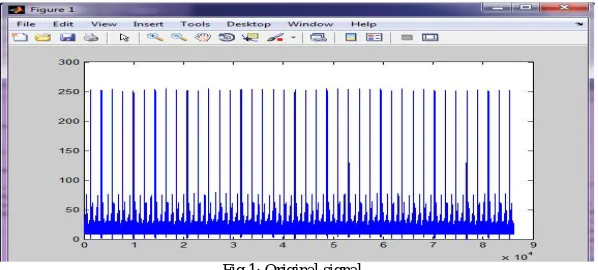
Fig 1 shows the input signal of EEG signal. This signal is analyzed at the various Daubechies wavelet transform levels.
Fig 2: Decomposition of EEG signal
The above fig shows the decomposition of original EEG signal using Daubechies wavelet transform.
Performance analysis of EEG using Daubechies wavelet transform at level 8
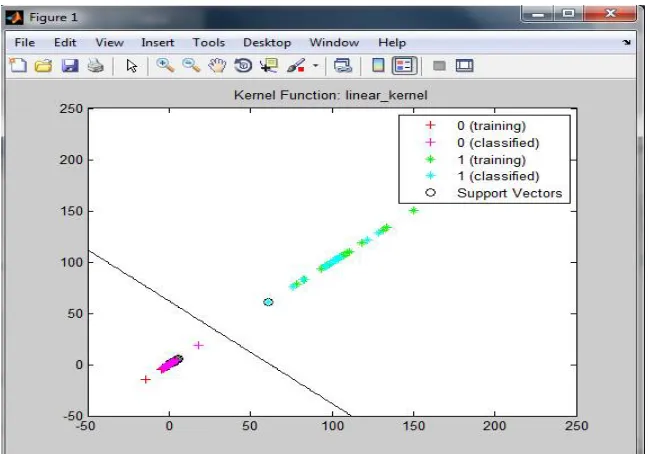
The performance analysis of EEG signal at Daubechies wavelet level db8 is done. State vector machine is used for separate the training and classified signal.
Copyright to IJIRSET DOI:10.15680/IJIRSET.2017.0612006 22273
The fig 3 shows the classified out for getting accuracy at Daubechies wavelet at level 8.
Fig4: Mean accuracy at dbw1 level
The mean accuracy at wavelet level db8 is 97.86.
Performance analysis of EEG using Daubechies wavelet transform at level 9
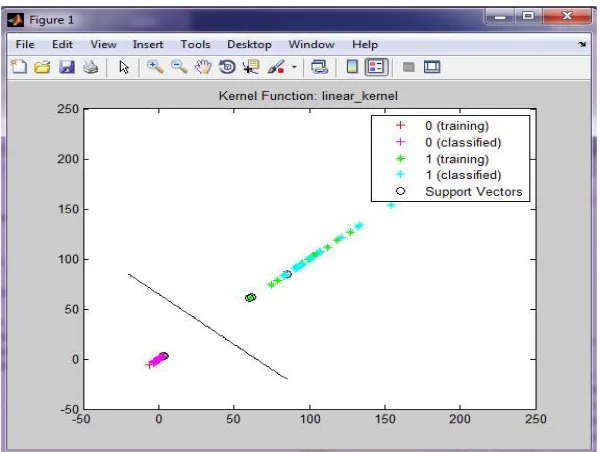
The analysis of input EEG signal at wavelet level db9 and stave vector classifier is used for separate the training and classified signal.
Fig 5: Classified signal output at dbw9
The fig 5 shows the classified out for getting accuracy at Daubechies wavelet at level 9.
94 95 96 97 98 99
1 2 3 4 5 6 7 8 9 10
Accuracy of dbw at level 8
Fig 6: Mean accuracy at db9 level
Mean Accuracy at wavelet level db9 is 98.4
Analysis of input signal wavelet level at Db10
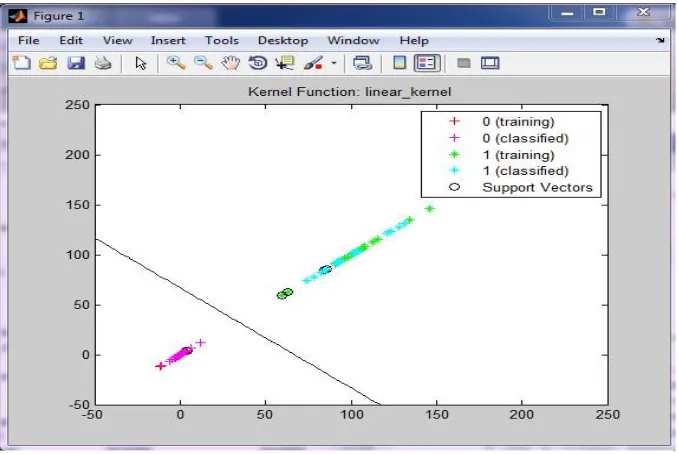
The analysis of the input EEG signal at wavelet level db10 and svmtran classifier.
Fig 7: Classified signal output at db10
96.5 97 97.5 98 98.5 99
1 2 3 4 5 6 7 8 9 10
Accuracy of dbw at level 9
Copyright to IJIRSET DOI:10.15680/IJIRSET.2017.0612006 22275
The fig shows the classified out for getting accuracy at wavelet level db10.
Fig 8: Mean accuracy at db10 level
Mean accuracy at db10 is 100.
Analysis of signal at Db11
The analysis of the input EEG signal at wavelet level db4 and svmtran classifier.
Fig 9: Classified signal output at db11
0 20 40 60 80 100 120
1 2 3 4 5 6 7 8 9 10
Accuracy of dbw at level 10
The fig shows the classified out for getting accuracy at wavelet level db11.
Fig 10: Mean accuracy at db11 level
Mean accuracy at db11 is 98.13
Analysis of signal at Db12
The analysis of the input EEG signal at wavelet level db4 and svmtran classifier.
Fig 11: Classified signal output at db12
The fig shows the classified out for getting accuracy at wavelet level db12.
96.5 97 97.5 98 98.5 99
1 2 3 4 5 6 7 8 9 10
Accuracy of dbw at level 11
Copyright to IJIRSET DOI:10.15680/IJIRSET.2017.0612006 22277
Fig 12: Mean accuracy at db11 level
Mean accuracy at db12 is 98.13
Comparative Results
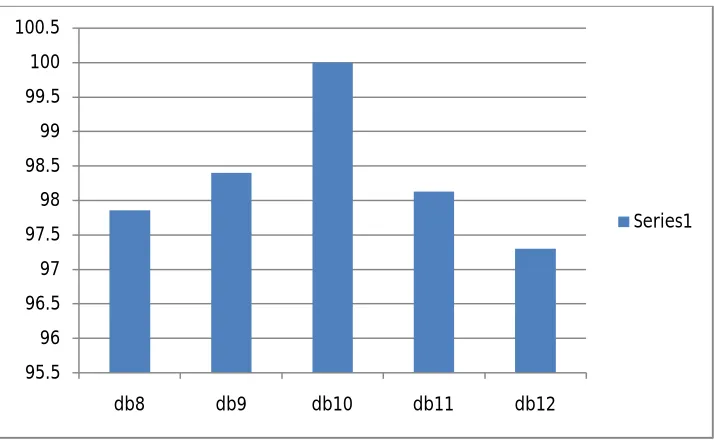
Fig 13: comparison of Mean accuracy of all level
Accuracy of db10 is more than the other levels. The accuracy is 100 which is not practically possible. so calculate the entropy and energy of the signal before and after db10. By figure 13 we can say that accuracy decreases as we go below and after db 10.
III. CONCLUSION
In this paper we have concluded the accuracy of EEG signal using svmtrans classifier and extraction using wavelet transform. Here conclude that accuracy of db10 is more than the other levels. The accuracy is 100 which is not
94 95 96 97 98 99
1 2 3 4 5 6 7 8 9 10
Accuracy of dbw at level 12
db12 95.5 96 96.5 97 97.5 98 98.5 99 99.5 100 100.5
db8 db9 db10 db11 db12
practically possible. so calculate the entropy and energy of the signal before and after db10. We can say that accuracy decreases as we go below and after db 10.
REFERENCES
[1] O. Faust, U. R. Acharya, H. Adeli, and A. Adeli, “Wavelet-based EEG processing for computer-aided seizure detection and epilepsy
diagnosis,” Seizure Eur. J. Epilepsy, vol. 26, pp. 56–64, 2015.
[2] H. Ullah, A. Aamir, S. Malik, and R. Fayyaz, “Feature extraction and classification for EEG signals using wavelet transform and machine
learning techniques,” Australas. Phys. Eng. Sci. Med., vol. 38, no. 1, pp. 139–149, 2015.
[3] M. Bin Heyat and M. M. Siddiqui, “Recording of EEG , ECG , EMG Signal,” vol. 5, no. 10, pp. 813–815, 2015.
[4] A. S. Al-fahoum and A. A. Al-fraihat, “Methods of EEG Signal Features Extraction Using Linear Analysis in Frequency and
Time-Frequency Domains,” vol. 2014, 2014.
[5] R. Saini, N. Bindal, and P. Bansal, “Classification of heart diseases from ECG signals using wavelet transform and kNN classifier,” pp. 1208–
1215, 2015.
[6] K. B. Kannan, “ECG Signal Feature Extraction and Classification using Harr Wavelet Transform and Neural Network,” pp. 1396–1399, 2014.
[7] S. Banerjee, S. Member, and M. Mitra, “Application of Cross Wavelet Transform for ECG Pattern Analysis and Classification,” vol. 63, no. 2,
pp. 326–333, 2014.
[8] M. Systems, “BRAIN-COMPUTER INTERFACE AS MEASUREMENT AND CONTROL SYSTEM THE REVIEW PAPER Remigiusz J.
Rak, MarcinKołodziej , AndrzejMajkowski,” vol. XIX, no. 3, pp. 427–444, 2012.
[9] M. Nandish, S. Michahial, H. K. P, and F. Ahmed, “Feature Extraction and Classification of EEG Signal Using Neural Network Based
Techniques,” vol. 2, no. 4, pp. 1–5, 2012.
[10] N. Engineering, “A review of classification algorithms for EEG- based brain-computer interfaces ( Topical review ). J Neural Eng 4 : R1-R13
A Review of Classification Algorithms for,” no. July 2016, 2007.
[11] R. Saab, M. J. Mckeown, and L. J. Myers, “A Wavelet Based Approach for the Detection of Coupling in EEG Signals,” no. 1, pp. 616–620,