Cao, B, Zhao, J, Yang, P, Yang, P, Liu, X, Qi, J, Simpson, A, Elhoseny, M, Mehmood, I and Muhammad, K
Multiobjective Feature Selection of Microarray Data via Distributed Parallel Algorithms
http://researchonline.ljmu.ac.uk/id/eprint/10219/
Article
LJMU has developed LJMU Research Online for users to access the research output of the University more effectively. Copyright © and Moral Rights for the papers on this site are retained by the individual authors and/or other copyright owners. Users may download and/or print one copy of any article(s) in LJMU Research Online to facilitate their private study or for non-commercial research. You may not engage in further distribution of the material or use it for any profit-making activities or any commercial gain.
The version presented here may differ from the published version or from the version of the record. Please see the repository URL above for details on accessing the published version and note that access may require a subscription.
For more information please contact [email protected]
Citation (please note it is advisable to refer to the publisher’s version if you
intend to cite from this work)
Cao, B, Zhao, J, Yang, P, Yang, P, Liu, X, Qi, J, Simpson, A, Elhoseny, M, Mehmood, I and Muhammad, K (2019) Multiobjective Feature Selection of Microarray Data via Distributed Parallel Algorithms. Future Generation Computer Systems, 100. pp. 952-981. ISSN 0167-739X
Multiobjective Feature Selection of Microarray Data
via Distributed Parallel Algorithms
Bin Caoa,b, Jianwei Zhaoa,b,∗, Po Yangc,∗∗, Peng Yangb, Xin Liua, Jun Qic,
Andrew Simpsonc, Mohamed Elhosenyd, Irfan Mehmoode,
Khan Muhammadf
aState Key Laboratory of Reliability and Intelligence of Electrical Equipment, Hebei University of Technology, China
bSchool of Artificial Intelligence, Hebei University of Technology, China cDepartment of Computer Science, Liverpool John Moores University, UK
dFaculty of Computers and Information, Mansoura University, Egypt
eDepartment of Computer Science and Engineering, Sejong University, Seoul, Republic of Korea
fCollege of Electronics and Information Engineering, Sejong University, Seoul, Republic of Korea
Abstract
Many real-world problems are large scale and hence difficult to address. Due to the large number of features in microarray datasets, feature selection and classification are even more challenging. Although there are numerous fea-tures, not all features contribute to the classification, and some features are even impeditive. Through feature selection, a feature subset that contains only a small quantity of essential features is generated, which can increase the classification accuracy and significantly reduce the time consumption. In this paper, we construct a multiobjective feature selection model that simultaneously considers classification error, feature number and feature re-dundancy. For this model, we propose several distributed parallel algorithms through different encodings and an adaptive strategy. Additionally, to re-duce the time consumption, various tactics are employed, including feature number constraint, distributed parallelism and sample-wise parallelism. For
∗Corresponding author ∗∗Corresponding author
Email addresses: [email protected](Jianwei Zhao),
a batch of microarray datasets, the proposed algorithms are superior to sev-eral state-of-the-art multiobjective evolutionary algorithms in terms of both effectiveness and efficiency.
Keywords: microarray data set, high dimension, multiobjective feature selection, distributed parallelism, feature redundancy
1. Introduction
An object can be abstracted to a series of features that indicate various
properties. Based on these features, we can classify a number of object
instances, perform analyses, and so forth [1, 2, 3, 4, 5]. With the emergence of the big data era, many problems are becoming increasingly larger in scale. 5
For the feature selection problem with respect to microarray data [6, 7], as the number of genes reaches more than tens of thousands, its complexity increases even more rapidly. If the feature selection problem is viewed as a
combination problem, assuming that there are n features, then the number
of possible combinations will be 2n due to their exponential relationship.
10
Thus, for microarray datasets, the exhaustive enumeration will be very time consuming and intolerable.
Due to the high computational cost, the research on feature selection of microarray datasets is focused on filter methods [6, 7], and studies on wrapper and embedded methodologies are relatively few. However, in such 15
filter methods, the classifier is not considered simultaneously, often leading to poor classification performance.
For NP-hard problems and the aforementioned time-consuming combina-tion problems, heuristic algorithms can explore the search space using simple population-based strategies, finding suboptimal solutions within a tolerable 20
time without examining every possible solution. In [8], a simple genetic al-gorithm (GA) [9] was enhanced with a local improvement strategy, resulting in a powerful evolutionary algorithm (EA) aiming at feature selection. In each experiment, a desirable feature number was introduced, and a penalty was applied to the fitness. Gu et al. [10] employed the competitive swarm 25
optimizer, a variant of particle swarm optimization (PSO) [11], to generate a feature subset from a large number of features, and a threshold was uti-lized to select features represented by continuous values. In [12], a feature selection algorithm was proposed by hybridizing PSO and SVM; specifically, the feature selection status and the parameters of the RBF kernel function 30
in SVM were simultaneously optimized utilizing PSO. Onan et al. [13] uti-lized a GA to aggregate the feature rankings from filter methods for feature selection. In [14], the grey wolf optimization was transformed to a binary form, outperforming PSO and GA.
However, the above research mainly considered one objective, namely, the 35
classification accuracy, while the feature number was fixed and a threshold was applied. To simultaneously consider multiple objectives, multiobjective evolutionary algorithms (MOEAs) are suitable. Thus, many research efforts have been devoted to the multiobjective feature selection problem [15].
In the studies on MOEAs, the classification accuracy is always the main 40
concern, such as the overall classification accuracy, the true positive rate and the true negative rate [16]. The feature number is also an objective [17]. However, the feature redundancy is rarely considered [18, 19]. In this paper, we propose a multiobjective feature selection model by simultaneously considering three objectives: classification error, feature number and feature 45
redundancy.
Microarray datasets contain an extremely large number of features. Al-though MOEAs are more efficient than brute force methodologies, the time consumption may still be intolerable to some extent. Consequently, feature number constraining and distributed parallel MOEAs [20] will be benefi-50
cial. Additionally, for high-dimensional multiobjective problems (MOPs), by separating variables into several groups, the cooperative coevolutionary (C-C) framework [21] divides the original problem into several low-dimensional tasks, yielding better optimization effectiveness and efficiency.
In summary, the contributions of this paper can be highlighted as follows: 55
1. A multiobjective feature selection model is proposed by simultaneously considering three objectives: classification error, feature number and feature redundancy.
2. Several distributed algorithms are presented to address the multiob-jective feature selection problem. Specifically, different encodings are 60
considered, resulting in weight-encoded and binary-encoded algorithms with real and binary-encoded values, respectively. In addition, an adap-tive improvement is tested, yielding two binary-encoded algorithms. 3. By constraining the feature number, time consumption is greatly
re-duced. Based on variable grouping and individual allocation, a two-65
layer distributed parallel structure is constructed. A large number of CPU cores can perform the individual evaluation in parallel,
signifi-cantly reducing time consumption. Sample-wise parallelism is quite beneficial for reducing the time consumption of the recording process. The remainder of this paper is organized as follows. Section 2 introduces 70
the multiobjective feature selection model. The proposed algorithms are detailed in Section 3. The experimental analysis follows in Section 4. Finally, we conclude this paper in Section 6.
2. Multiobjective Feature Selection Model
For the feature selection problem, we simultaneously consider three ob-75
jectives, namely, classification error, feature number, and the redundancy among features, with respect to the generated feature subset, which will be detailed in the following subsections.
2.1. Classification Error
The classification error possesses the utmost importance, and it can be 80 formulated as follows: fE = NN NN +NP (1)
where fE represents the fitness value of the classification error objective and
NN andNP denote the numbers of misclassified and correctly classified
sam-ples, respectively.
2.2. Feature Number
85
This objective describes the feature number of the generated feature sub-set, illustrated in the following:
fN =
Nf
Nth F
(2)
where fN denotes the fitness value of the feature number objective and Nf
and Nth
F are respectively the feature number in the generated feature subset
and the maximum number of features allowed in a feature subset, thus,Nf ≤
90
2.3. Feature Redundancy
We utilize the Pearson correlation coefficient, as follows, to measure the correlation among features:
r(Fα, Fβ) = PNS i=1 Fα(i)−Fα Fβ(i)−Fβ q PNS i=1 Fα(i)−Fα 2qPNS i=1 Fβ(i)−Fβ 2 (3)
where NS is the number of training samples, α and β denote features, Fα(i)
95
(Fβ(i)) represents the α (β) feature value of the i-th sample, Fα (Fβ) is
the average value of feature α (β) over all samples, and r(Fα, Fβ) is the
correlation value, which is a positive value in the range of [0.0,1.0], between
features α and β.
Furthermore, the objective value of the feature redundancy,fR, is
formu-100 lated as follows: fR= 1 Nf(Nf −1)/2 X α,β∈SF, α6=β r(Fα, Fβ) (4)
where SF denotes the set of features selected and Nf = |SF| represents the
cardinality of the set. If the generated feature subset only contains one
feature, fR cannot be calculated as above; therefore, the following formula is
applied: 105 fR= 1 NF −1 X β6=α r(Fα, Fβ) (5)
where NF denotes the number of all features, α represents the selected
fea-ture, and β is another feature among the remaining ones.
2.4. Multiobjective View
For an MOEA, the optimization target can be summarized as follows:
min (fE, fN, fR) (6)
From the above specifications of these three objectives, it is easy to com-110
prehend that their value ranges all lie in [0.0,1.0], and our aim is to minimize
3. Proposed Algorithms
In this section, we introduce the proposed algorithms. First, we illustrate the overall framework of the algorithm. Subsequently, based on this frame-115
work, by utilizing different encoding methods and an additional adaption improvement, we describe the proposed algorithms one by one. Finally, the feature number constraint and parallelism details are provided.
3.1. Overall Framework 3.1.1. Grouping
120
In microarray datasets, there are numerous features, and each feature is encoded by one variable; thus, the dimensionality of the multiobjective fea-ture selection problem will be quite high. For high-dimensional problems, simultaneously optimizing all variables will be ineffective, whereas by sepa-rating variables into several groups and optimizing each variable group under 125
the CC framework [21], the original problem can be separated into several low-dimensional ones, which can be addressed more effectively and efficiently.
For this purpose, we randomly separate all variables intoNG uniform groups.
The proposed algorithms are based on our previous study [22] — dis-tributed parallel cooperative coevolutionary multiobjective large-scale evolu-130
tionary algorithm (DPCCMOLSEA). There are two types of variables, name-ly, variables in the currently optimized group and remaining variables in the other groups, for which the evolutionary strategies are different, detailed as follows.
3.1.2. Evolution of Variables in the Current Group
135
For each parent individual, to generate the variables in the current group for an offspring individual, another single individual (for binary-encoded al-gorithms) or two individuals (for the weight-encoded algorithm) are selected from the parent population; then, crossover or adaptive differential evolution (DE) [23, 24] will be applied, which will be detailed in Sections 3.2.1 and 140
3.3.1.
3.1.3. Evolution of Remaining Variables in the Other Groups
As in DPCCMOLSEA [22], for the remaining variables in an offspring, they are the crossover result of its parent and another two randomly selected individuals in the parent population. The crossover rate adopts the adaptive 145
ugj+1,i = xg,ij , if r ≤CRi xg,r1 j , else ifr0 ≤0.5 xg,r2 j , otherwise (7) s.t. j /∈SkG
whereg, iandj denote the generation number, the individual index and the
variable index, respectively, thus, xg,ij represents the variable j of individual
i in the population of generation g, u is the trail vector, r and r0 denote
two random numbers uniformly generated in the range of [0.0,1.0),SkG is the
150
variable set in the currently considered groupk, and the crossover rate,CRi,
is formulated as follows:
CRi =Gauss(µCR,0.1) (8)
where Gauss(µ, σ) generates a random value according to the Gaussian
dis-tribution with the location parameter of µ and the scale parameter of σ,
here, CRi is bounded to the range of [0.0,1.0], thus, it will be truncated to
155
0.0 or 1.0 ifFi <0.0 or if Fi >1.0, respectively . Initially set as 0.5, µ
CR is updated as follows: µCR = (1.0−c)×µCR+c× P i∈SCRCR i |SCR| (9)
where c= 0.1 represents the learning factor and SCR and |SCR| denote the
set of indices of the individuals successfully updated in the prior generation and its cardinality, respectively.
160
3.1.4. Mutation
After the generation of variables in the current group and remaining vari-ables in the other groups, an offspring is preliminarily generated. To increase the probability of jumping over local optima, mutation is then performed. The details are presented in Sections 3.2.2 and 3.3.2.
165
3.2. Weight-Encoded Algorithm
By encoding each feature via a weight value, we propose the distribut-ed parallel cooperative coevolutionary multiobjective large-scale evolutionary
algorithm for feature selection with weight encoding, denoted as DPCCMOLSEA-FS-w. In this algorithm, the selection priority of one feature is represented 170
by its weight; in other words, the higher the weight is, the more likely it is to be selected.
Therefore, each gene (variable) is a weight value of the corresponding feature. Additionally, another variable is employed to control the feature number. We can illustrate the encoding of each individual as follows:
175 x0, . . . , xNF−1 | {z } Feature weights , xNF |{z} Feature number (10) s.t. xj ∈[0.0,1.0], j = 0, . . . , NF.
where x0 to xNF−1 encode the selection weights of all NF features and xNF
controls the feature number. Specifically, the selected feature number is
Nf = xNF ×N
th
F + 1 (will be truncated to NFth if Nf > NFth), which is an
integer from 1 to Nth
F .
Then, to form the feature subset, the topNf features with higher weights
180
are selected.
3.2.1. Evolution
As mentioned in Section 3.1.2, to evolve the variables in the currently con-sidered group, we use an adaptive strategy similar to JADE [25], formulated as follows: 185 ugj+1,i =xg,ij +Fi× xg,r3 j −x g,r4 j (11) s.t. j ∈SkG
where r3 6=r4 6=i are two randomly selected individuals and Fi denotes the
scaling factor of individual i, which, similar to JADE [25], has the following
form:
Fi =Cauchy(µF,0.1) (12)
where Cauchy(µ, σ) generates a random value according to the Cauchy
dis-tribution with the location parameter ofµand the scale parameter ofσ, here,
190
Fi ≤ 0.0 and will be truncated to 1.0 if Fi >1.0. Initially, µ
F = 0.5, and it
will be updated as follows:
µF = (1.0−c)×µF +c× P i∈SF (F i)2 P i∈SF F i (13)
wherec= 0.1 denotes the learning factor andSF represents the set of indices
of the individuals successfully updated in the prior generation. 195
3.2.2. Mutation
Polynomial mutation (PM) [26] is utilized to adjust the variable values
with the probability ofpm = nDim1 , here,nDim=NF+1 is the dimensionality
of the feature selection problem. The formula is as follows:
xg+1,i=P M ug+1,i, pm
(14)
Finally, each offspring individual,xg+1,i, i= 1, . . . , N P, will be generated.
200
Here, N P is the population size.
3.3. Binary-Encoded Algorithms
We propose two types of binary-encoded algorithms, namely, distribut-ed parallel cooperative coevolutionary multiobjective large-scale binary evo-lutionary algorithm for feature selection and distributed parallel cooper-205
ative coevolutionary multiobjective large-scale adaptive binary evolution-ary algorithm for feature selection, denoted as DPCCMOLSBEA-FS and DPCCMOLSABEA-FS, respectively. In these two algorithms, each feature is represented by a binary value, 1 or 0, which indicates whether the cor-responding feature is selected to form the feature subset, while there is no 210
extra variable to encode the feature number, and the encoding is as follows:
x0, . . . , xNF−1
| {z }
Binary encoding
(15) s.t. xj ∈ {0,1}, j = 0, . . . , NF −1
3.3.1. Evolution
To evolve the variables in the currently considered group as mentioned in Section 3.1.2, for both DPCCMOLSBEA-FS and DPCCMOLSABEA-FS, the process can be described as follows:
215 ugj+1,i = xg,r5 j , if r≤CRiB xg,ij , otherwise (16)
wherer5 6=idenotes a randomly selected individual in the parent population,
r is a random number uniformly generated in the range of [0.0,1.0), and
CRi
B represents the crossover rate of individual i. The difference between
DPCCMOLSBEA-FS and DPCCMOLSABEA-FS depends on the value of
CRi B:
220
1. For DPCCMOLSBEA-FS,CRBi = 1.0 for alli= 1, . . . , N P.
2. For DPCCMOLSABEA-FS, CRi
B is generated adaptively, similar to
CRi, detailed as follows:
CRiB =Gauss µBCR,0.1 (17)
whereCRi
B is truncated to [0.0,1.0], and the initial value ofµBCR is 0.9,
and it is updated as follows: 225 µBCR = (1.0−c)×µBCR +c× P i∈SCRB CR i B |SCRB| (18)
where c= 0.1 denotes the learning factor and SCRB and |SCRB|
repre-sent the set of indices of individuals successfully updated in the prior generation and its cardinality, respectively.
3.3.2. Mutation
To mutate a preliminarily generated offspring, we have the following for-230 mula: xgj+1,i= 1−ugj+1,i, if r≤pm ugj+1,i, otherwise (19)
whereris a random number uniformly generated within the range of [0.0,1.0),
and as mentioned in Section 3.2.2, pm = nDim1 is the mutation probability,
3.3.3. Feature Adjustment
235
In the feature number objective (Eq. 2), there is a constraint that at
most Nth
F features can be selected to form a feature subset. In this type of
binary-encoded algorithm, from the generated offspring, the cardinality of
the corresponding feature subset can exceed Nth
F or be less than 1; thus, an
adjustment procedure is applied. 240
The adjustment procedure includes two phases, as follows:
1. Reset the feature number: set the feature number, Nf, to a random
integer in the range of 1, Nth
F
.
2. Randomly add or remove features: if the cardinality of the original
feature subset is above Nth
F , then randomly remove NFth−Nf different
245
features by setting the corresponding variable values to 0; otherwise,
randomly add Nf different features by setting the corresponding
vari-able values to 1.
3.4. Feature Number Constraint and Parallelism Details
MOEAs are based on population and iteration. During the evolution, 250
numerous generations of populations will be produced, and a large number of fitness evaluations (FEs) are performed. To reduce the time consumption, three strategies are applied:
A) Feature number constraint: From the objective functions (Section 2), it is clear that the time consumption depends on the cardinality of the 255
feature subset and that the classification error objective is the most time-consuming one, compared to which the evolution of the population and other objectives are very efficient. Thus, the classification error objective is considered to be the only time-consuming procedure for analysis. In this study, the nearest neighbor classifier (1-NN) is employed; thus, the 260
time consumption is proportional to the selected feature number. For the considered microarray data, the feature number can reach more than tens of thousands, for which the cardinality of the feature subset can be quite high and the time consumption will be intolerable. By applying the constraint, only a small number of features are considered in the 265
objective evaluation; thus, the time consumption can be greatly reduced. B) Distributed parallelism: The former strategy reduces the time consump-tion of each FE; however, the evaluaconsump-tions of all individuals in the offspring population are conducted in serial. By taking advantage of the variable
groups and the population-based evaluation, we construct the following 270
distributed parallel structure:
a) Assume that there are NC CPU cores and that the group number is
NG. For each group, we form a population withN P individuals, and
we divide the CPU cores uniformly to these populations, as follows:
NCi = NC
NG
(20) s.t. i= 1, . . . , NG.
where NCi denotes the number of CPU cores allocated to population
275
i.
b) Then, the individuals in each population are separated to the CPUs in the population for FEs, as follows:
NCi,j = N P
Ni C
(21) s.t. i= 1, . . . , NG, j = 1, . . . , NCi.
where NCi,j denotes the number of individuals in the charge of CPUj
in population i.
280
c) In summary, for the evolution of populations, all individuals are in the charge of one CPU in each population; thus, the evolution is parallel at the population level; for the time-consuming FE, all CPUs are utilized — each CPU evaluates the individuals allocated, and all CPUs operate in parallel. Thus, the evaluation process is parallel at 285
the individual level.
C) Sample-wise parallelism: To observe the evolution behavior of MOEAs during the optimization process, every predefined number of generations, we record the fitness values of the individuals of the current population. In addition, we also test the individuals on the test set and record the 290
results. Although the number of recordings is extremely small compared to the overall generation number, if the evaluation on the test set is performed in serial, its time consumption exceeds that of the optimization process with distributed parallelism.
Therefore, we also parallelize this test procedure. Specifically, when e-295
subset, which is broadcast to all otherNC CPUs. Then, the classification
burdens of all test samples are uniformly allocated to all CPUs, and all the CPUs perform their own tasks in parallel. Finally, the root CPU gathers the classification results from all CPUs.
300
After this parallelism, the overall time consumption is significantly re-duced, and the benefit of the parallelism of the optimization process is not impeded by the recording process.
4. Experimental Analysis
4.1. Microarray Datasets
305
Few years ago in the twentieth century, the study of genes was very low in efficiency with only one or few genes checked at one time. While in the living things, there are substantial numbers of genes, and for an instance, we humans own approximately 20,000 genes. Consequently, the investigation process can take a scientist’s lifetime. Fortunately, by the aid of microarray
310
technology, the expression situations of numerous genes can be investigated at once. Compared to healthy cells, there seems to be something wrong with the gene expression. Via microarray the expression levels of numerous genes of healthy and cancer cells (or different cancer cells) can be obtained; then through feature selection and classification, the potential genes causing the
315
cancer (or the relationship among cancers) can be detected, facilitating the study of the mechanism. Additionally, by comparing the difference of gene expression before and after a therapy, the mechanism of treatment and its effectiveness can be examined.
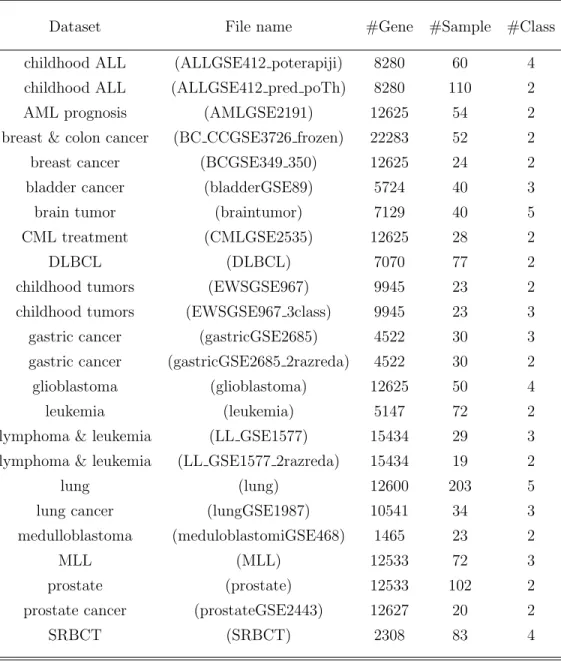
The microarray datasets1 utilized in this paper are listed in Table 1.
320
There are 24 datasets, each of which is characterized by a very high feature number and low sample instance number. For each dataset, the data are normalized with respect to each feature; then, we generate a training set using the stratified bootstrap. Thus, the class distribution is maintained, and the samples that are not selected form the test set. Furthermore, the leave-325
one-out (LOO) methodology is employed for calculating the classification error.
1The utilized microarray datasets can be downloaded at
http://www.biolab.si/
Table 1: Details of the Datasets
Dataset File name #Gene #Sample #Class
childhood ALL (ALLGSE412 poterapiji) 8280 60 4 childhood ALL (ALLGSE412 pred poTh) 8280 110 2
AML prognosis (AMLGSE2191) 12625 54 2
breast & colon cancer (BC CCGSE3726 frozen) 22283 52 2
breast cancer (BCGSE349 350) 12625 24 2
bladder cancer (bladderGSE89) 5724 40 3
brain tumor (braintumor) 7129 40 5
CML treatment (CMLGSE2535) 12625 28 2
DLBCL (DLBCL) 7070 77 2
childhood tumors (EWSGSE967) 9945 23 2
childhood tumors (EWSGSE967 3class) 9945 23 3
gastric cancer (gastricGSE2685) 4522 30 3
gastric cancer (gastricGSE2685 2razreda) 4522 30 2
glioblastoma (glioblastoma) 12625 50 4
leukemia (leukemia) 5147 72 2
lymphoma & leukemia (LL GSE1577) 15434 29 3
lymphoma & leukemia (LL GSE1577 2razreda) 15434 19 2
lung (lung) 12600 203 5
lung cancer (lungGSE1987) 10541 34 3
medulloblastoma (meduloblastomiGSE468) 1465 23 2
MLL (MLL) 12533 72 3
prostate (prostate) 12533 102 2
prostate cancer (prostateGSE2443) 12627 20 2
SRBCT (SRBCT) 2308 83 4
4.2. Utilized Algorithms and Parameter Settings
For comparison, four algorithms are utilized, as follows:
1. Cooperative coevolutionary generalized differential evolution 3 (CCGDE3) 330
2. Cooperative multiobjective differential evolution (CMODE) [28].
3. Multiobjective evolutionary algorithm based on decomposition (MOEA/D) [29].
4. Nondominated sorting genetic algorithm II (NSGA-II) [30]. 335
For a fair comparison, the population size of all algorithms is fixed to 120. In particular, for CCGDE3, there are two swarms, each of which has 60 individuals; for CMODE, there are three swarms for three objectives, with a size of 20 for each of them, and the size of the archive is 120.
The maximum number of FEs is 6×10⁴. For each dataset, each MOEA
340
runs 20 times.
In CCGDE3, DE [23, 24] is utilized, in whichF = 0.5 andCR = 1.0, and
the same settings are adopted in DE employed in MOEA/D. For CMODE, adaptive DE variants are utilized, and their parameter settings can be found in [31] and [25].
345
In NSGA-II, GA [9] is utilized, the distribution indices for crossover and
mutation are both 20, and their probabilities are 1.0 and nDim1 , respectively.
For all the above algorithms, different encodings are tested, denoted as CCGDE3-FS, CCGDE3-FS-w, CMODE-FS, CMODE-FS-w, MOEA/D-FS, MOEA/D-FS-w, NSGA-II-FS and NSGA-II-FS-w. For the binary encod-350
ing, the feature adjustment in Section 3.3.3 is also added. Note that for
CCGDE3-FS, CMODE-FS, MOEA/D-FS and NSGA-II-FS, each variable is still encoded as a real value; thus, for the binary representation issue, a threshold (i.e., the mid-value) is utilized.
For the proposed algorithms, for DE, F follows the adaptive strategy in
355
JADE [25], while CR is fixed to 1.0 or adaptive as in JADE. The number of
variable groups is simply set to 5. For PM, its distribution index is 20, and
the probability is nDim1 . Similar to MOEA/D, each individual corresponds
to a weight vector in the objective space, for which they have the same parameter settings.
360
4.3. Analysis
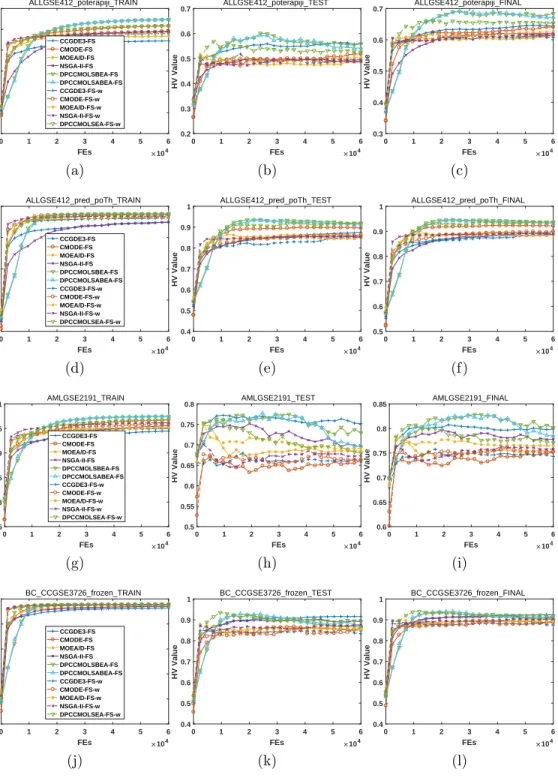
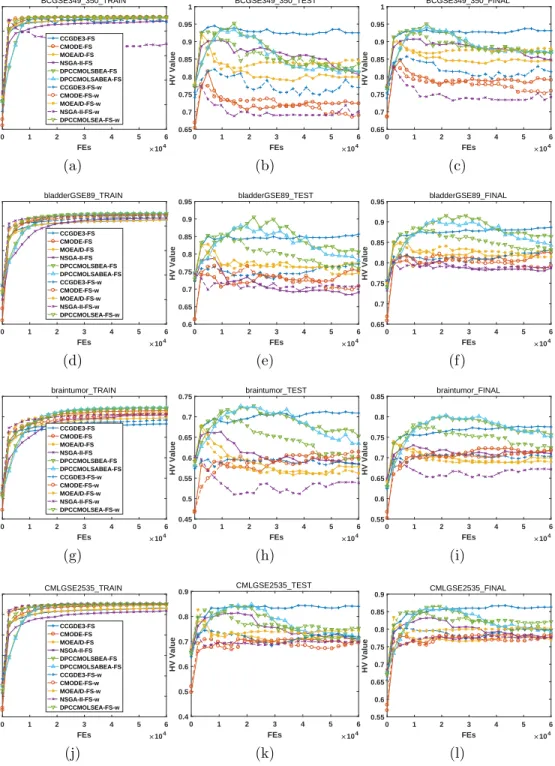
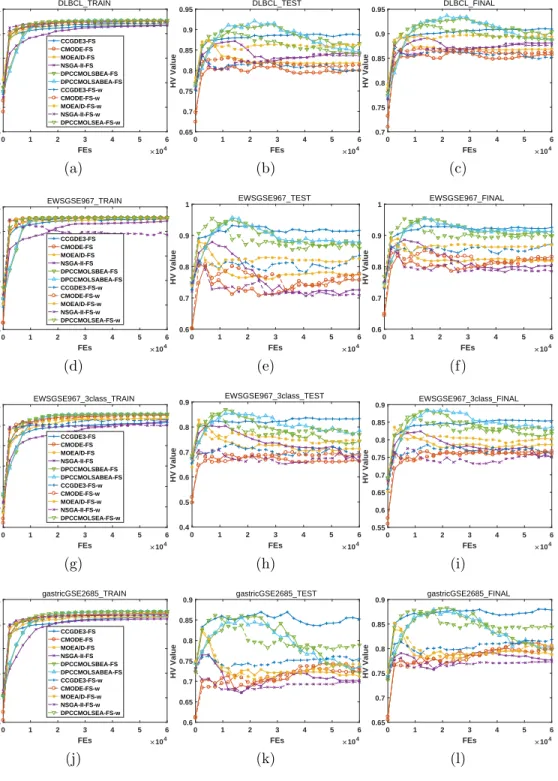
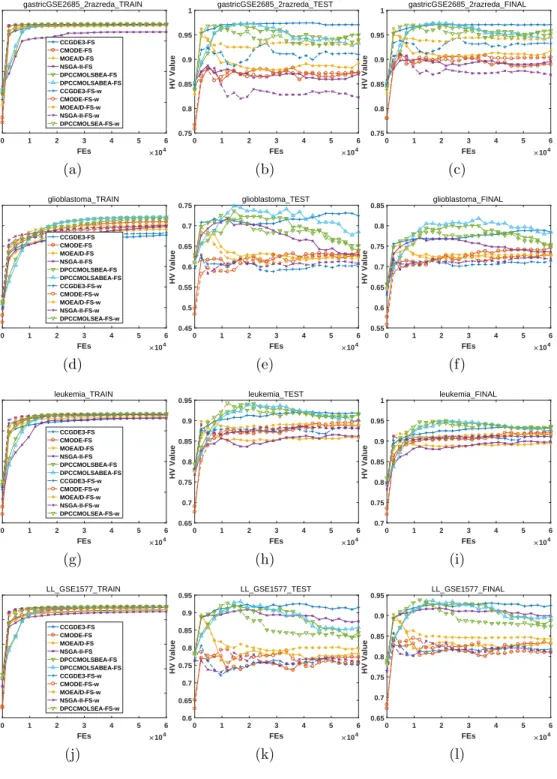
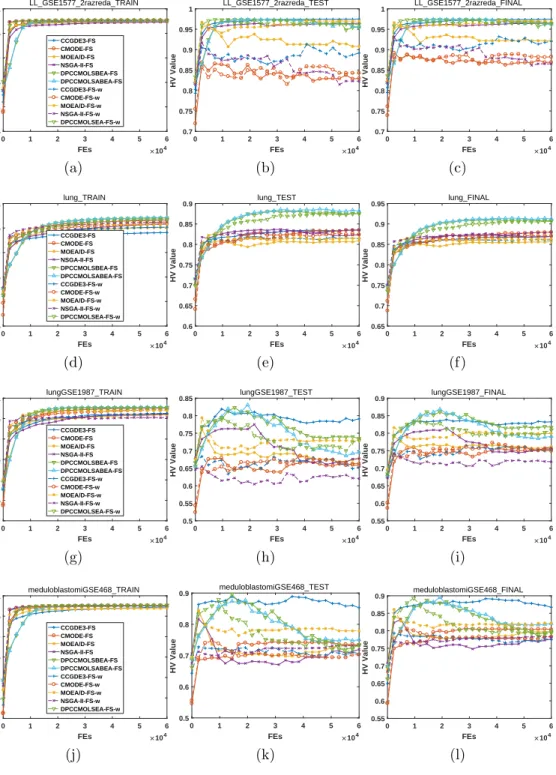
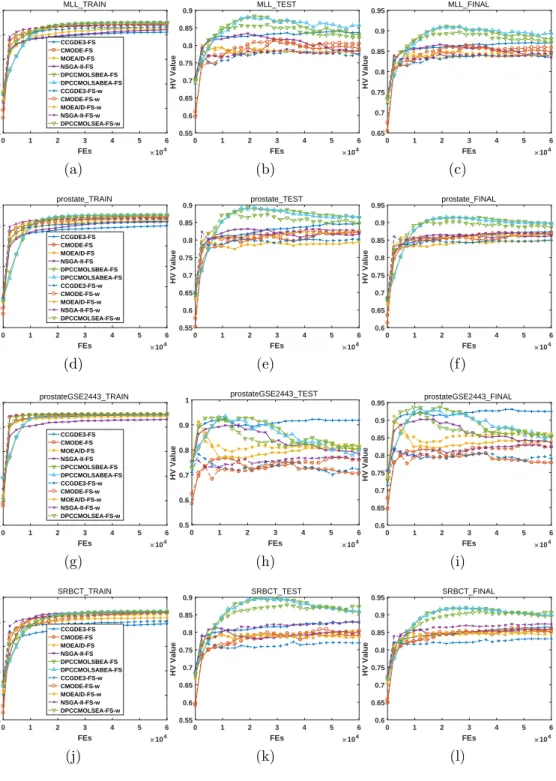
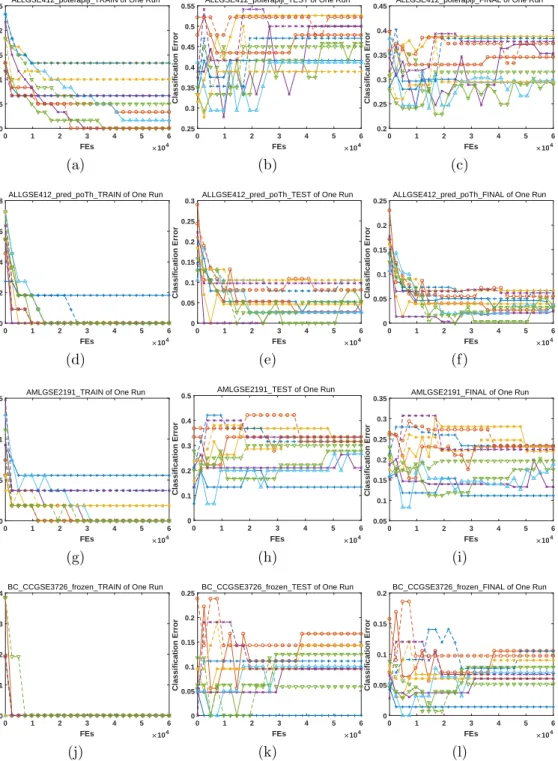
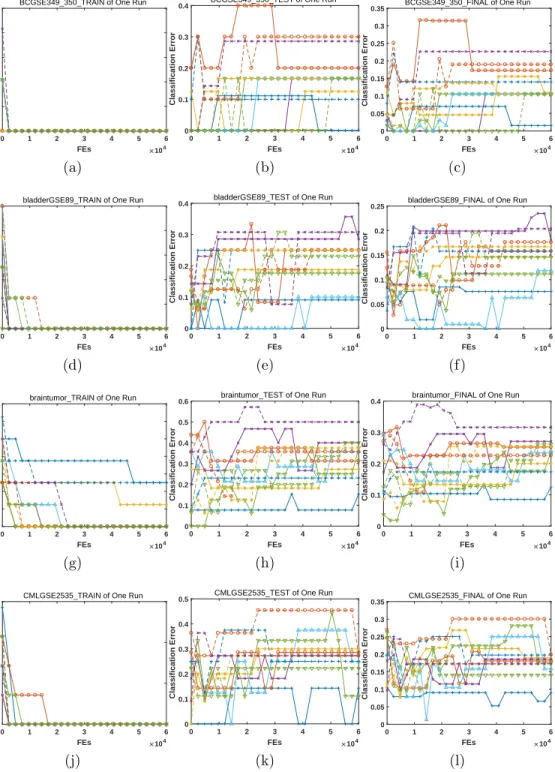
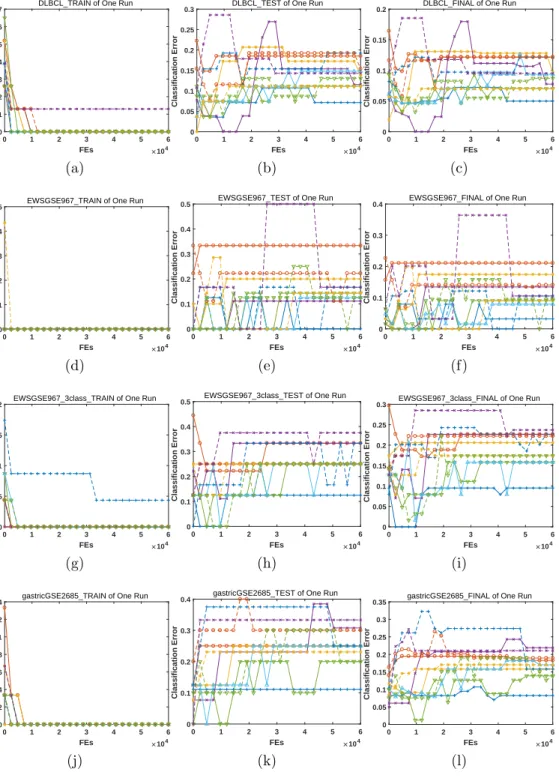
In the following images (Fig. 1 to Fig. 24), there are three columns, corresponding to the training results, the test results and the final results. Specifically, for an obtained population, a feature subset is decoded from each individual. The classification error objective is calculated with respect 365
to the training set, the test set and the weighted sum of the former two, as follows:
fEF IN AL = 0.368×fET RAIN + 0.632×fET EST (22)
where fF IN AL
E denotes the final classification error value, which depends on
fT RAIN
E and fET EST — classification errors on the training set and the test
set, respectively. Nevertheless, the remaining two objectives are only related 370
to the inherit property of the feature subset.
4.3.1. Hypervolume Indicator
In Figs. 1 to 6, we illustrate the hypervolume (HV) indicator [27] values, which can simultaneously measure the distribution and convergence of the obtained nondominated solutions during the evolution. For the reference 375
point in HV, because all objective values are not above 1, we set it as (1,1,1).
For the first column, we observe that the HV indicator values are monotonous-ly increasing, indicating that the qualities of the obtained nondominated
so-lutions are being ameliorated. Specifically, for the first approximately 104
FEs, the performance of all algorithms is improved rapidly; however, during 380
the following FEs, the improvement is minimal. For the second column, the HV indicator curves are not as monotonous because the classification error is derived based on the test set. At the beginning, the performance is improving quickly; then, however, for most datasets and algorithms, there are drops in the curves, indicating the occurrence of overfitting. In other words, although 385
the optimization performance on the training set is still good, the validation results on the test set deteriorate to some extent, and the situations become quite worse for some cases. Finally, by simultaneously considering the train-ing and testtrain-ing performance, the final optimization results are illustrated in the third column. Due to the nonmonotonic behavior of the results on the 390
test set, the final HV indicator values are also not monotonic during the evolutionary process.
Regarding the optimization performance of different algorithms, we have the following:
1. For the training results, the differences among various algorithms are 395
minimal. However, the proposed algorithms can always achieve the best results. For the two types of encodings, the weight-encoded ones converge faster than the binary-encoded ones. The ranking of other algorithms depends on the considered dataset.
2. For the test results, the performance varies. In most cases, overfitting 400
occurs. The common trend is that the indicator value increases rapidly to the maximum value within a very small number of FEs; then, over-fitting occurs, and the indicator value decreases or fluctuates. The only exception is the CCGDE3 algorithm, as its evolutionary curve only has slight fluctuations without a large drop, while the binary-encoded C-405
CGDE3 is much better than the weight-encoded one. However, with the view of the whole process, the peak HV indicator values are always obtained by the proposed algorithms.
3. For the final results, the proposed algorithms can generally obtain the peak HV indicator values.
410
4.3.2. Classification Error
To better clarify the optimization results, we illustrate the lowest classi-fication errors during the evolutionary process of the run with median HV indicator value in Fig. 7 to Fig. 12. We can summarize the results as follows: 1. For the training data, in most cases, most algorithms can achieve zero 415
classification error. Especially, for 12 datasets of BC CCGSE3726 frozen,
BCGSE349 350, bladderGSE89, CMLGSE2535, EWSGSE967, gastricGSE2685, gastricGSE2685 2razreda, leukemia, LL GSE1577, LL GSE1577 2razreda, meduloblastomiGSE468 and prostateGSE2443, the classification errors remain at 0 almost during the whole evolutionary process. The dif-420
ference among all algorithms is the convergence issue, which is trivial. For the proposed algorithms, with respect to all datasets, there exists at least one algorithm that achieves zero classification error, and the same situation is also true for CMODE.
2. For the test data, the minimum classification error fluctuates violently 425
during evolution, which is more complex with respect to that on the training data; thus, we focus on the lowest value over the whole evolu-tion. For 20 out of 24datasets, zero classification error can be obtained; in particular, for the datasets of braintumor, MLL and prostate, only the proposed algorithms achieve zero classification error. On the con-430
trary, the classification errors obtained by CMODE are usually quite high, indicating the serious overfitting problem.
3. Comprehensively considering the training and test data, zero fication error indicates that the corresponding feature subset classi-fies all samples correctly in both the training data and the test data, 435
which is the expected result. For the following 13datasets of
ALL-GSE412 pred poTh, BC CCGSE3726 frozen, BCGSE349 350, bladderGSE89, DLBCL, EWSGSE967, EWSGSE967 3class, gastricGSE2685 2razreda,
LL GSE1577, LL GSE1577 2razreda, MLL, prostateGSE2443 and
S-RBCT, zero classification errors are observed. Specifically, for the
440
datasets of BC CCGSE3726 frozen and bladderGSE89, only the pro-posed algorithms can obtain zero classification error, while for all other datasets, the proposed algorithms are also generally not worse than their counterparts. And the binary-encoded ones are better than the weight-encoded one.
445
Corresponding to the above individuals with minimum classification er-rors, the feature numbers and feature redundancy are illustrated in the fol-lowing two subsections from Figs. 13 to 18 and Figs. 19 to 24, respectively.
4.3.3. Feature Number
For 15 datasets of ALLGSE412 pred poTh, BC CCGSE3726 frozen, BCGSE349 350, 450
CMLGSE2535, DLBCL, EWSGSE967, EWSGSE967 3class, gastricGSE2685, gastricGSE2685 2razreda, leukemia, LL GSE1577, LL GSE1577 2razreda, lung-GSE1987, meduloblastomiGSE468 and prostateGSE2443, illustrated in Figs.
13 to 18, all algorithms can generate a subset within 10 features (fN =
Nf
Nth F
=
10
50 = 0.2), except some special cases of CCGDE3. For the other datasets,
455
the feature number fluctuates along the evolution. With respect to the train-ing data and test data, however, in contrast to the status analyzed in the previous sections, the evolutionary curves share similar characteristics.
4.3.4. Feature Redundancy
For the feature redundancy objective, the evolutionary curves in Figs. 460
19 to 24 are characterized by undulations, which is subtle to comprehend. By formulating the feature redundancy as an objective, during the evolu-tion, it will lead the algorithm to form good-performing feature subsets with relatively few features with little redundancy.
4.3.5. Time Consumption
465
In Table 2, we list the average operating time for each algorithm with respect to each dataset. Additionally, the sum of time consumption over all datasets is listed in the second line from the bottom, and the speedup ratios are the values in parenthesis. With respect to the proposed algorithms, all
other MOEAs are at least one magnitude slower, except for the simple algo-470
rithm of CCGDE3-FS. For the proposed distributed algorithms, the number of utilized CPU cores is 60. Additionally, the speedup ratios with
respec-t respec-to respec-the mosrespec-t respec-time-consuming serial MOEA, CMODE, are 3.77E+ 01 and
4.91E+ 01, respectively, which are quite close to the ideal value of 60.
There-fore, we can conclude that the proposed algorithms are able to obtain better 475
0 1 2 3 4 5 6 FEs 104 0.4 0.5 0.6 0.7 0.8 0.9 1 HV Value ALLGSE412_poterapiji_TRAIN CCGDE3-FS CMODE-FS MOEA/D-FS NSGA-II-FS DPCCMOLSBEA-FS DPCCMOLSABEA-FS CCGDE3-FS-w CMODE-FS-w MOEA/D-FS-w NSGA-II-FS-w DPCCMOLSEA-FS-w (a) 0 1 2 3 4 5 6 FEs 104 0.2 0.3 0.4 0.5 0.6 0.7 HV Value ALLGSE412_poterapiji_TEST (b) 0 1 2 3 4 5 6 FEs 104 0.3 0.4 0.5 0.6 0.7 HV Value ALLGSE412_poterapiji_FINAL (c) 0 1 2 3 4 5 6 FEs 104 0.6 0.7 0.8 0.9 1 HV Value ALLGSE412_pred_poTh_TRAIN CCGDE3-FS CMODE-FS MOEA/D-FS NSGA-II-FS DPCCMOLSBEA-FS DPCCMOLSABEA-FS CCGDE3-FS-w CMODE-FS-w MOEA/D-FS-w NSGA-II-FS-w DPCCMOLSEA-FS-w (d) 0 1 2 3 4 5 6 FEs 104 0.4 0.5 0.6 0.7 0.8 0.9 1 HV Value ALLGSE412_pred_poTh_TEST (e) 0 1 2 3 4 5 6 FEs 104 0.5 0.6 0.7 0.8 0.9 1 HV Value ALLGSE412_pred_poTh_FINAL (f) 0 1 2 3 4 5 6 FEs 104 0.75 0.8 0.85 0.9 0.95 1 HV Value AMLGSE2191_TRAIN CCGDE3-FS CMODE-FS MOEA/D-FS NSGA-II-FS DPCCMOLSBEA-FS DPCCMOLSABEA-FS CCGDE3-FS-w CMODE-FS-w MOEA/D-FS-w NSGA-II-FS-w DPCCMOLSEA-FS-w (g) 0 1 2 3 4 5 6 FEs 104 0.5 0.55 0.6 0.65 0.7 0.75 0.8 HV Value AMLGSE2191_TEST (h) 0 1 2 3 4 5 6 FEs 104 0.6 0.65 0.7 0.75 0.8 0.85 HV Value AMLGSE2191_FINAL (i) 0 1 2 3 4 5 6 FEs 104 0.5 0.6 0.7 0.8 0.9 1 HV Value BC_CCGSE3726_frozen_TRAIN CCGDE3-FS CMODE-FS MOEA/D-FS NSGA-II-FS DPCCMOLSBEA-FS DPCCMOLSABEA-FS CCGDE3-FS-w CMODE-FS-w MOEA/D-FS-w NSGA-II-FS-w DPCCMOLSEA-FS-w (j) 0 1 2 3 4 5 6 FEs 104 0.4 0.5 0.6 0.7 0.8 0.9 1 HV Value BC_CCGSE3726_frozen_TEST (k) 0 1 2 3 4 5 6 FEs 104 0.4 0.5 0.6 0.7 0.8 0.9 1 HV Value BC_CCGSE3726_frozen_FINAL (l)
0 1 2 3 4 5 6 FEs 104 0.75 0.8 0.85 0.9 0.95 1 HV Value BCGSE349_350_TRAIN CCGDE3-FS CMODE-FS MOEA/D-FS NSGA-II-FS DPCCMOLSBEA-FS DPCCMOLSABEA-FS CCGDE3-FS-w CMODE-FS-w MOEA/D-FS-w NSGA-II-FS-w DPCCMOLSEA-FS-w (a) 0 1 2 3 4 5 6 FEs 104 0.65 0.7 0.75 0.8 0.85 0.9 0.95 1 HV Value BCGSE349_350_TEST (b) 0 1 2 3 4 5 6 FEs 104 0.65 0.7 0.75 0.8 0.85 0.9 0.95 1 HV Value BCGSE349_350_FINAL (c) 0 1 2 3 4 5 6 FEs 104 0.75 0.8 0.85 0.9 0.95 1 HV Value bladderGSE89_TRAIN CCGDE3-FS CMODE-FS MOEA/D-FS NSGA-II-FS DPCCMOLSBEA-FS DPCCMOLSABEA-FS CCGDE3-FS-w CMODE-FS-w MOEA/D-FS-w NSGA-II-FS-w DPCCMOLSEA-FS-w (d) 0 1 2 3 4 5 6 FEs 104 0.6 0.65 0.7 0.75 0.8 0.85 0.9 0.95 HV Value bladderGSE89_TEST (e) 0 1 2 3 4 5 6 FEs 104 0.65 0.7 0.75 0.8 0.85 0.9 0.95 HV Value bladderGSE89_FINAL (f) 0 1 2 3 4 5 6 FEs 104 0.7 0.75 0.8 0.85 0.9 0.95 1 HV Value braintumor_TRAIN CCGDE3-FS CMODE-FS MOEA/D-FS NSGA-II-FS DPCCMOLSBEA-FS DPCCMOLSABEA-FS CCGDE3-FS-w CMODE-FS-w MOEA/D-FS-w NSGA-II-FS-w DPCCMOLSEA-FS-w (g) 0 1 2 3 4 5 6 FEs 104 0.45 0.5 0.55 0.6 0.65 0.7 0.75 HV Value braintumor_TEST (h) 0 1 2 3 4 5 6 FEs 104 0.55 0.6 0.65 0.7 0.75 0.8 0.85 HV Value braintumor_FINAL (i) 0 1 2 3 4 5 6 FEs 104 0.7 0.75 0.8 0.85 0.9 0.95 1 HV Value CMLGSE2535_TRAIN CCGDE3-FS CMODE-FS MOEA/D-FS NSGA-II-FS DPCCMOLSBEA-FS DPCCMOLSABEA-FS CCGDE3-FS-w CMODE-FS-w MOEA/D-FS-w NSGA-II-FS-w DPCCMOLSEA-FS-w (j) 0 1 2 3 4 5 6 FEs 104 0.4 0.5 0.6 0.7 0.8 0.9 HV Value CMLGSE2535_TEST (k) 0 1 2 3 4 5 6 FEs 104 0.55 0.6 0.65 0.7 0.75 0.8 0.85 0.9 HV Value CMLGSE2535_FINAL (l)
0 1 2 3 4 5 6 FEs 104 0.75 0.8 0.85 0.9 0.95 1 HV Value DLBCL_TRAIN CCGDE3-FS CMODE-FS MOEA/D-FS NSGA-II-FS DPCCMOLSBEA-FS DPCCMOLSABEA-FS CCGDE3-FS-w CMODE-FS-w MOEA/D-FS-w NSGA-II-FS-w DPCCMOLSEA-FS-w (a) 0 1 2 3 4 5 6 FEs 104 0.65 0.7 0.75 0.8 0.85 0.9 0.95 HV Value DLBCL_TEST (b) 0 1 2 3 4 5 6 FEs 104 0.7 0.75 0.8 0.85 0.9 0.95 HV Value DLBCL_FINAL (c) 0 1 2 3 4 5 6 FEs 104 0.75 0.8 0.85 0.9 0.95 1 HV Value EWSGSE967_TRAIN CCGDE3-FS CMODE-FS MOEA/D-FS NSGA-II-FS DPCCMOLSBEA-FS DPCCMOLSABEA-FS CCGDE3-FS-w CMODE-FS-w MOEA/D-FS-w NSGA-II-FS-w DPCCMOLSEA-FS-w (d) 0 1 2 3 4 5 6 FEs 104 0.6 0.7 0.8 0.9 1 HV Value EWSGSE967_TEST (e) 0 1 2 3 4 5 6 FEs 104 0.6 0.7 0.8 0.9 1 HV Value EWSGSE967_FINAL (f) 0 1 2 3 4 5 6 FEs 104 0.7 0.75 0.8 0.85 0.9 0.95 1 HV Value EWSGSE967_3class_TRAIN CCGDE3-FS CMODE-FS MOEA/D-FS NSGA-II-FS DPCCMOLSBEA-FS DPCCMOLSABEA-FS CCGDE3-FS-w CMODE-FS-w MOEA/D-FS-w NSGA-II-FS-w DPCCMOLSEA-FS-w (g) 0 1 2 3 4 5 6 FEs 104 0.4 0.5 0.6 0.7 0.8 0.9 HV Value EWSGSE967_3class_TEST (h) 0 1 2 3 4 5 6 FEs 104 0.55 0.6 0.65 0.7 0.75 0.8 0.85 0.9 HV Value EWSGSE967_3class_FINAL (i) 0 1 2 3 4 5 6 FEs 104 0.75 0.8 0.85 0.9 0.95 1 HV Value gastricGSE2685_TRAIN CCGDE3-FS CMODE-FS MOEA/D-FS NSGA-II-FS DPCCMOLSBEA-FS DPCCMOLSABEA-FS CCGDE3-FS-w CMODE-FS-w MOEA/D-FS-w NSGA-II-FS-w DPCCMOLSEA-FS-w (j) 0 1 2 3 4 5 6 FEs 104 0.6 0.65 0.7 0.75 0.8 0.85 0.9 HV Value gastricGSE2685_TEST (k) 0 1 2 3 4 5 6 FEs 104 0.65 0.7 0.75 0.8 0.85 0.9 HV Value gastricGSE2685_FINAL (l)
0 1 2 3 4 5 6 FEs 104 0.8 0.85 0.9 0.95 1 HV Value gastricGSE2685_2razreda_TRAIN CCGDE3-FS CMODE-FS MOEA/D-FS NSGA-II-FS DPCCMOLSBEA-FS DPCCMOLSABEA-FS CCGDE3-FS-w CMODE-FS-w MOEA/D-FS-w NSGA-II-FS-w DPCCMOLSEA-FS-w (a) 0 1 2 3 4 5 6 FEs 104 0.75 0.8 0.85 0.9 0.95 1 HV Value gastricGSE2685_2razreda_TEST (b) 0 1 2 3 4 5 6 FEs 104 0.75 0.8 0.85 0.9 0.95 1 HV Value gastricGSE2685_2razreda_FINAL (c) 0 1 2 3 4 5 6 FEs 104 0.7 0.75 0.8 0.85 0.9 0.95 1 HV Value glioblastoma_TRAIN CCGDE3-FS CMODE-FS MOEA/D-FS NSGA-II-FS DPCCMOLSBEA-FS DPCCMOLSABEA-FS CCGDE3-FS-w CMODE-FS-w MOEA/D-FS-w NSGA-II-FS-w DPCCMOLSEA-FS-w (d) 0 1 2 3 4 5 6 FEs 104 0.45 0.5 0.55 0.6 0.65 0.7 0.75 HV Value glioblastoma_TEST (e) 0 1 2 3 4 5 6 FEs 104 0.55 0.6 0.65 0.7 0.75 0.8 0.85 HV Value glioblastoma_FINAL (f) 0 1 2 3 4 5 6 FEs 104 0.8 0.85 0.9 0.95 1 HV Value leukemia_TRAIN CCGDE3-FS CMODE-FS MOEA/D-FS NSGA-II-FS DPCCMOLSBEA-FS DPCCMOLSABEA-FS CCGDE3-FS-w CMODE-FS-w MOEA/D-FS-w NSGA-II-FS-w DPCCMOLSEA-FS-w (g) 0 1 2 3 4 5 6 FEs 104 0.65 0.7 0.75 0.8 0.85 0.9 0.95 HV Value leukemia_TEST (h) 0 1 2 3 4 5 6 FEs 104 0.7 0.75 0.8 0.85 0.9 0.95 1 HV Value leukemia_FINAL (i) 0 1 2 3 4 5 6 FEs 104 0.75 0.8 0.85 0.9 0.95 1 HV Value LL_GSE1577_TRAIN CCGDE3-FS CMODE-FS MOEA/D-FS NSGA-II-FS DPCCMOLSBEA-FS DPCCMOLSABEA-FS CCGDE3-FS-w CMODE-FS-w MOEA/D-FS-w NSGA-II-FS-w DPCCMOLSEA-FS-w (j) 0 1 2 3 4 5 6 FEs 104 0.6 0.65 0.7 0.75 0.8 0.85 0.9 0.95 HV Value LL_GSE1577_TEST (k) 0 1 2 3 4 5 6 FEs 104 0.65 0.7 0.75 0.8 0.85 0.9 0.95 HV Value LL_GSE1577_FINAL (l)
0 1 2 3 4 5 6 FEs 104 0.75 0.8 0.85 0.9 0.95 1 HV Value LL_GSE1577_2razreda_TRAIN CCGDE3-FS CMODE-FS MOEA/D-FS NSGA-II-FS DPCCMOLSBEA-FS DPCCMOLSABEA-FS CCGDE3-FS-w CMODE-FS-w MOEA/D-FS-w NSGA-II-FS-w DPCCMOLSEA-FS-w (a) 0 1 2 3 4 5 6 FEs 104 0.7 0.75 0.8 0.85 0.9 0.95 1 HV Value LL_GSE1577_2razreda_TEST (b) 0 1 2 3 4 5 6 FEs 104 0.7 0.75 0.8 0.85 0.9 0.95 1 HV Value LL_GSE1577_2razreda_FINAL (c) 0 1 2 3 4 5 6 FEs 104 0.75 0.8 0.85 0.9 0.95 1 HV Value lung_TRAIN CCGDE3-FS CMODE-FS MOEA/D-FS NSGA-II-FS DPCCMOLSBEA-FS DPCCMOLSABEA-FS CCGDE3-FS-w CMODE-FS-w MOEA/D-FS-w NSGA-II-FS-w DPCCMOLSEA-FS-w (d) 0 1 2 3 4 5 6 FEs 104 0.6 0.65 0.7 0.75 0.8 0.85 0.9 HV Value lung_TEST (e) 0 1 2 3 4 5 6 FEs 104 0.65 0.7 0.75 0.8 0.85 0.9 0.95 HV Value lung_FINAL (f) 0 1 2 3 4 5 6 FEs 104 0.7 0.75 0.8 0.85 0.9 0.95 1 HV Value lungGSE1987_TRAIN CCGDE3-FS CMODE-FS MOEA/D-FS NSGA-II-FS DPCCMOLSBEA-FS DPCCMOLSABEA-FS CCGDE3-FS-w CMODE-FS-w MOEA/D-FS-w NSGA-II-FS-w DPCCMOLSEA-FS-w (g) 0 1 2 3 4 5 6 FEs 104 0.5 0.55 0.6 0.65 0.7 0.75 0.8 0.85 HV Value lungGSE1987_TEST (h) 0 1 2 3 4 5 6 FEs 104 0.55 0.6 0.65 0.7 0.75 0.8 0.85 0.9 HV Value lungGSE1987_FINAL (i) 0 1 2 3 4 5 6 FEs 104 0.7 0.75 0.8 0.85 0.9 0.95 1 HV Value meduloblastomiGSE468_TRAIN CCGDE3-FS CMODE-FS MOEA/D-FS NSGA-II-FS DPCCMOLSBEA-FS DPCCMOLSABEA-FS CCGDE3-FS-w CMODE-FS-w MOEA/D-FS-w NSGA-II-FS-w DPCCMOLSEA-FS-w (j) 0 1 2 3 4 5 6 FEs 104 0.5 0.6 0.7 0.8 0.9 HV Value meduloblastomiGSE468_TEST (k) 0 1 2 3 4 5 6 FEs 104 0.55 0.6 0.65 0.7 0.75 0.8 0.85 0.9 HV Value meduloblastomiGSE468_FINAL (l)
0 1 2 3 4 5 6 FEs 104 0.75 0.8 0.85 0.9 0.95 1 HV Value MLL_TRAIN CCGDE3-FS CMODE-FS MOEA/D-FS NSGA-II-FS DPCCMOLSBEA-FS DPCCMOLSABEA-FS CCGDE3-FS-w CMODE-FS-w MOEA/D-FS-w NSGA-II-FS-w DPCCMOLSEA-FS-w (a) 0 1 2 3 4 5 6 FEs 104 0.55 0.6 0.65 0.7 0.75 0.8 0.85 0.9 HV Value MLL_TEST (b) 0 1 2 3 4 5 6 FEs 104 0.65 0.7 0.75 0.8 0.85 0.9 0.95 HV Value MLL_FINAL (c) 0 1 2 3 4 5 6 FEs 104 0.7 0.75 0.8 0.85 0.9 0.95 1 HV Value prostate_TRAIN CCGDE3-FS CMODE-FS MOEA/D-FS NSGA-II-FS DPCCMOLSBEA-FS DPCCMOLSABEA-FS CCGDE3-FS-w CMODE-FS-w MOEA/D-FS-w NSGA-II-FS-w DPCCMOLSEA-FS-w (d) 0 1 2 3 4 5 6 FEs 104 0.55 0.6 0.65 0.7 0.75 0.8 0.85 0.9 HV Value prostate_TEST (e) 0 1 2 3 4 5 6 FEs 104 0.6 0.65 0.7 0.75 0.8 0.85 0.9 0.95 HV Value prostate_FINAL (f) 0 1 2 3 4 5 6 FEs 104 0.75 0.8 0.85 0.9 0.95 1 HV Value prostateGSE2443_TRAIN CCGDE3-FS CMODE-FS MOEA/D-FS NSGA-II-FS DPCCMOLSBEA-FS DPCCMOLSABEA-FS CCGDE3-FS-w CMODE-FS-w MOEA/D-FS-w NSGA-II-FS-w DPCCMOLSEA-FS-w (g) 0 1 2 3 4 5 6 FEs 104 0.5 0.6 0.7 0.8 0.9 1 HV Value prostateGSE2443_TEST (h) 0 1 2 3 4 5 6 FEs 104 0.6 0.65 0.7 0.75 0.8 0.85 0.9 0.95 HV Value prostateGSE2443_FINAL (i) 0 1 2 3 4 5 6 FEs 104 0.75 0.8 0.85 0.9 0.95 1 HV Value SRBCT_TRAIN CCGDE3-FS CMODE-FS MOEA/D-FS NSGA-II-FS DPCCMOLSBEA-FS DPCCMOLSABEA-FS CCGDE3-FS-w CMODE-FS-w MOEA/D-FS-w NSGA-II-FS-w DPCCMOLSEA-FS-w (j) 0 1 2 3 4 5 6 FEs 104 0.55 0.6 0.65 0.7 0.75 0.8 0.85 0.9 HV Value SRBCT_TEST (k) 0 1 2 3 4 5 6 FEs 104 0.6 0.65 0.7 0.75 0.8 0.85 0.9 0.95 HV Value SRBCT_FINAL (l)
0 1 2 3 4 5 6 FEs 104 0 0.05 0.1 0.15 0.2 0.25 Classification Error
ALLGSE412_poterapiji_TRAIN of One Run
(a) 0 1 2 3 4 5 6 FEs 104 0.25 0.3 0.35 0.4 0.45 0.5 0.55 Classification Error
ALLGSE412_poterapiji_TEST of One Run
(b) 0 1 2 3 4 5 6 FEs 104 0.2 0.25 0.3 0.35 0.4 0.45 Classification Error
ALLGSE412_poterapiji_FINAL of One Run
(c) 0 1 2 3 4 5 6 FEs 104 0 0.02 0.04 0.06 0.08 Classification Error
ALLGSE412_pred_poTh_TRAIN of One Run
(d) 0 1 2 3 4 5 6 FEs 104 0 0.05 0.1 0.15 0.2 0.25 0.3 Classification Error
ALLGSE412_pred_poTh_TEST of One Run
(e) 0 1 2 3 4 5 6 FEs 104 0 0.05 0.1 0.15 0.2 0.25 Classification Error
ALLGSE412_pred_poTh_FINAL of One Run
(f) 0 1 2 3 4 5 6 FEs 104 0 0.05 0.1 0.15 Classification Error
AMLGSE2191_TRAIN of One Run
(g) 0 1 2 3 4 5 6 FEs 104 0 0.1 0.2 0.3 0.4 0.5 Classification Error
AMLGSE2191_TEST of One Run
(h) 0 1 2 3 4 5 6 FEs 104 0.05 0.1 0.15 0.2 0.25 0.3 0.35 Classification Error
AMLGSE2191_FINAL of One Run
(i) 0 1 2 3 4 5 6 FEs 104 0 0.01 0.02 0.03 0.04 Classification Error
BC_CCGSE3726_frozen_TRAIN of One Run
(j) 0 1 2 3 4 5 6 FEs 104 0 0.05 0.1 0.15 0.2 0.25 Classification Error
BC_CCGSE3726_frozen_TEST of One Run
(k) 0 1 2 3 4 5 6 FEs 104 0 0.05 0.1 0.15 0.2 Classification Error
BC_CCGSE3726_frozen_FINAL of One Run
(l)
0 1 2 3 4 5 6 FEs 104 0 0.02 0.04 0.06 0.08 0.1 Classification Error
BCGSE349_350_TRAIN of One Run
(a) 0 1 2 3 4 5 6 FEs 104 0 0.1 0.2 0.3 0.4 Classification Error
BCGSE349_350_TEST of One Run
(b) 0 1 2 3 4 5 6 FEs 104 0 0.05 0.1 0.15 0.2 0.25 0.3 0.35 Classification Error
BCGSE349_350_FINAL of One Run
(c) 0 1 2 3 4 5 6 FEs 104 0 0.02 0.04 0.06 0.08 0.1 Classification Error
bladderGSE89_TRAIN of One Run
(d) 0 1 2 3 4 5 6 FEs 104 0 0.1 0.2 0.3 0.4 Classification Error
bladderGSE89_TEST of One Run
(e) 0 1 2 3 4 5 6 FEs 104 0 0.05 0.1 0.15 0.2 0.25 Classification Error
bladderGSE89_FINAL of One Run
(f) 0 1 2 3 4 5 6 FEs 104 0 0.02 0.04 0.06 0.08 0.1 0.12 0.14 Classification Error
braintumor_TRAIN of One Run
(g) 0 1 2 3 4 5 6 FEs 104 0 0.1 0.2 0.3 0.4 0.5 0.6 Classification Error
braintumor_TEST of One Run
(h) 0 1 2 3 4 5 6 FEs 104 0 0.1 0.2 0.3 0.4 Classification Error
braintumor_FINAL of One Run
(i) 0 1 2 3 4 5 6 FEs 104 0 0.05 0.1 0.15 Classification Error
CMLGSE2535_TRAIN of One Run
(j) 0 1 2 3 4 5 6 FEs 104 0 0.1 0.2 0.3 0.4 0.5 Classification Error
CMLGSE2535_TEST of One Run
(k) 0 1 2 3 4 5 6 FEs 104 0 0.05 0.1 0.15 0.2 0.25 0.3 0.35 Classification Error
CMLGSE2535_FINAL of One Run
(l)
0 1 2 3 4 5 6 FEs 104 0 0.01 0.02 0.03 0.04 0.05 0.06 0.07 Classification Error
DLBCL_TRAIN of One Run
(a) 0 1 2 3 4 5 6 FEs 104 0 0.05 0.1 0.15 0.2 0.25 0.3 Classification Error
DLBCL_TEST of One Run
(b) 0 1 2 3 4 5 6 FEs 104 0 0.05 0.1 0.15 0.2 Classification Error
DLBCL_FINAL of One Run
(c) 0 1 2 3 4 5 6 FEs 104 0 0.01 0.02 0.03 0.04 0.05 Classification Error
EWSGSE967_TRAIN of One Run
(d) 0 1 2 3 4 5 6 FEs 104 0 0.1 0.2 0.3 0.4 0.5 Classification Error
EWSGSE967_TEST of One Run
(e) 0 1 2 3 4 5 6 FEs 104 0 0.1 0.2 0.3 0.4 Classification Error
EWSGSE967_FINAL of One Run
(f) 0 1 2 3 4 5 6 FEs 104 0 0.05 0.1 0.15 0.2 Classification Error
EWSGSE967_3class_TRAIN of One Run
(g) 0 1 2 3 4 5 6 FEs 104 0 0.1 0.2 0.3 0.4 0.5 Classification Error
EWSGSE967_3class_TEST of One Run
(h) 0 1 2 3 4 5 6 FEs 104 0 0.05 0.1 0.15 0.2 0.25 0.3 Classification Error
EWSGSE967_3class_FINAL of One Run
(i) 0 1 2 3 4 5 6 FEs 104 0 0.02 0.04 0.06 0.08 0.1 0.12 0.14 Classification Error
gastricGSE2685_TRAIN of One Run
(j) 0 1 2 3 4 5 6 FEs 104 0 0.1 0.2 0.3 0.4 Classification Error
gastricGSE2685_TEST of One Run
(k) 0 1 2 3 4 5 6 FEs 104 0 0.05 0.1 0.15 0.2 0.25 0.3 0.35 Classification Error
gastricGSE2685_FINAL of One Run
(l)
0 1 2 3 4 5 6 FEs 104 -1 -0.5 0 0.5 1 Classification Error
gastricGSE2685_2razreda_TRAIN of One Run
(a) 0 1 2 3 4 5 6 FEs 104 0 0.05 0.1 0.15 0.2 0.25 0.3 Classification Error
gastricGSE2685_2razreda_TEST of One Run
(b) 0 1 2 3 4 5 6 FEs 104 0 0.05 0.1 0.15 0.2 Classification Error
gastricGSE2685_2razreda_FINAL of One Run
(c) 0 1 2 3 4 5 6 FEs 104 0 0.02 0.04 0.06 0.08 0.1 0.12 Classification Error
glioblastoma_TRAIN of One Run
(d) 0 1 2 3 4 5 6 FEs 104 0.1 0.2 0.3 0.4 0.5 Classification Error
glioblastoma_TEST of One Run
(e) 0 1 2 3 4 5 6 FEs 104 0.05 0.1 0.15 0.2 0.25 0.3 0.35 Classification Error
glioblastoma_FINAL of One Run
(f) 0 1 2 3 4 5 6 FEs 104 0 0.01 0.02 0.03 0.04 0.05 0.06 Classification Error
leukemia_TRAIN of One Run
(g) 0 1 2 3 4 5 6 FEs 104 0 0.05 0.1 0.15 0.2 0.25 Classification Error
leukemia_TEST of One Run
(h) 0 1 2 3 4 5 6 FEs 104 0 0.05 0.1 0.15 Classification Error
leukemia_FINAL of One Run
(i) 0 1 2 3 4 5 6 FEs 104 0 0.005 0.01 0.015 0.02 0.025 0.03 0.035 Classification Error
LL_GSE1577_TRAIN of One Run
(j) 0 1 2 3 4 5 6 FEs 104 0 0.1 0.2 0.3 0.4 0.5 Classification Error
LL_GSE1577_TEST of One Run
(k) 0 1 2 3 4 5 6 FEs 104 0 0.05 0.1 0.15 0.2 0.25 0.3 Classification Error
LL_GSE1577_FINAL of One Run
(l)
0 1 2 3 4 5 6 FEs 104 -1 -0.5 0 0.5 1 Classification Error
LL_GSE1577_2razreda_TRAIN of One Run
(a) 0 1 2 3 4 5 6 FEs 104 0 0.05 0.1 0.15 0.2 Classification Error
LL_GSE1577_2razreda_TEST of One Run
(b) 0 1 2 3 4 5 6 FEs 104 0 0.05 0.1 0.15 0.2 Classification Error
LL_GSE1577_2razreda_FINAL of One Run
(c) 0 1 2 3 4 5 6 FEs 104 0 0.01 0.02 0.03 0.04 0.05 Classification Error
lung_TRAIN of One Run
(d) 0 1 2 3 4 5 6 FEs 104 0.04 0.06 0.08 0.1 0.12 0.14 0.16 0.18 Classification Error
lung_TEST of One Run
(e) 0 1 2 3 4 5 6 FEs 104 0.02 0.04 0.06 0.08 0.1 0.12 0.14 Classification Error
lung_FINAL of One Run
(f) 0 1 2 3 4 5 6 FEs 104 0 0.02 0.04 0.06 0.08 0.1 0.12 Classification Error
lungGSE1987_TRAIN of One Run
(g) 0 1 2 3 4 5 6 FEs 104 0 0.1 0.2 0.3 0.4 0.5 Classification Error
lungGSE1987_TEST of One Run
(h) 0 1 2 3 4 5 6 FEs 104 0 0.05 0.1 0.15 0.2 0.25 0.3 Classification Error
lungGSE1987_FINAL of One Run
(i) 0 1 2 3 4 5 6 FEs 104 0 0.02 0.04 0.06 0.08 0.1 Classification Error
meduloblastomiGSE468_TRAIN of One Run
(j) 0 1 2 3 4 5 6 FEs 104 0 0.1 0.2 0.3 0.4 0.5 Classification Error
meduloblastomiGSE468_TEST of One Run
(k) 0 1 2 3 4 5 6 FEs 104 0 0.05 0.1 0.15 0.2 0.25 0.3 0.35 Classification Error
meduloblastomiGSE468_FINAL of One Run
(l)
0 1 2 3 4 5 6 FEs 104 0 0.02 0.04 0.06 0.08 0.1 Classification Error
MLL_TRAIN of One Run
(a) 0 1 2 3 4 5 6 FEs 104 0 0.05 0.1 0.15 0.2 0.25 0.3 Classification Error
MLL_TEST of One Run
(b) 0 1 2 3 4 5 6 FEs 104 0 0.05 0.1 0.15 0.2 Classification Error
MLL_FINAL of One Run
(c) 0 1 2 3 4 5 6 FEs 104 0 0.02 0.04 0.06 0.08 Classification Error
prostate_TRAIN of One Run
(d) 0 1 2 3 4 5 6 FEs 104 0 0.05 0.1 0.15 0.2 0.25 0.3 0.35 Classification Error
prostate_TEST of One Run
(e) 0 1 2 3 4 5 6 FEs 104 0 0.05 0.1 0.15 0.2 0.25 Classification Error
prostate_FINAL of One Run
(f) 0 1 2 3 4 5 6 FEs 104 0 0.01 0.02 0.03 0.04 0.05 0.06 Classification Error
prostateGSE2443_TRAIN of One Run
(g) 0 1 2 3 4 5 6 FEs 104 0 0.05 0.1 0.15 0.2 0.25 0.3 0.35 Classification Error
prostateGSE2443_TEST of One Run
(h) 0 1 2 3 4 5 6 FEs 104 0 0.05 0.1 0.15 0.2 0.25 Classification Error
prostateGSE2443_FINAL of One Run
(i) 0 1 2 3 4 5 6 FEs 104 0 0.02 0.04 0.06 0.08 0.1 0.12 Classification Error
SRBCT_TRAIN of One Run
(j) 0 1 2 3 4 5 6 FEs 104 0 0.05 0.1 0.15 0.2 0.25 0.3 0.35 Classification Error
SRBCT_TEST of One Run
(k) 0 1 2 3 4 5 6 FEs 104 0 0.05 0.1 0.15 0.2 0.25 Classification Error
SRBCT_FINAL of One Run
(l)