Author: Marc Montal`a Flaquer.
Facultat de F´ısica, Universitat de Barcelona, Diagonal 645, 08028 Barcelona, Spain. Abstract: The development of image processing software has been one of the most relevant achievements in astronomy of the last decade. After succeeding to get technical improvement on telescopes and detection systems it was needed to perfect the image processing software in order to make good use of the equipment provided. Matched filter algorithms were implemented within a flexible test oriented software which allows the exploration of various scenarios that could arise during the research. These matched filter techniques have proved to be more precise when processing stellar imagery for asteroid detection and tracking. The main purpose of this report is to put into operation the image processing code SALTAD, which stands for SAIC Algorithm Test bed for Asteroid Detection, and compare its results with another image processing software, Visual PinPoint.
I. INTRODUCTION
Near Earth Objects (NEOs) are asteroids or comets with sizes that range from a few meters to tens of kilome-ters and whose orbits are close to the Earth’s. Even that the chance of an asteroid colliding the Earth is very small it is very important to detect and catalog all those po-tential Earth impactors that would cause great destruc-tion[1]. One of the most important activities of the ESA’s Space Situational Awareness (SSA) is to track and pre-dict the orbits of those objects. Nowadays of the more than 600 000 known asteroids in our Solar System, almost the 2% of them are NEOs.
Asteroid detection can be characterized by searching for moving bodies in a star-cluttered background. Due to the short exposition time between the frames captured, it will be assumed that asteroids follow a linear motion with uniform velocity across the field of view and its intensity is fairly constant. As the star-cluttered background has a spatial frequency content similar to that of the aster-oids it is impossible to distinguish a NEO just looking at a single static frame. What needs to be done is to put together all the exposures of the same region and blink them, so that the stars will remain motionless and a rel-ative movement of the asteroid will be seen. Local and global levels of the background can vary with time due to seeing conditions during the exposures and an associated noise component will appear depending on the detection electronic device and star scintillation[2].
These effects, amongst others, will be considered to maximize accuracy in detecting real asteroids over the false alarms for the image processing software. A false alarm is a detection made by the image processing soft-ware which is not an asteroid. One particular example of false alarm commonly seen is the presence of momentary hot pixel signletone in a single frame. A major progress in false alarm reduction is done when the raw data is cleaned of those spots before the image processing starts. The Matched Filter Technique consist of correlating a known signal with an unknown signal to detect the presence of a pattern of this last one. The matched fil-ter is the optimal linear filfil-ter for maximizing the signal
to noise ratio (SNR) in the presence of stochastic noise. The use of these techniques has provided nearly a half magnitude gain on moving target detections which leads to two major improvements: Mitigation of False Alarms and Reduction in Runtime Loading[3].
The first one is bound to the fact that obtaining a no-table gain of the magnitude on the detected bodies pro-vides a better value of the SNR which is a crucial param-eter to distinguish the asteroids from the false alarms. The second improvement is based on the avoidance of high computational operations and the reduction of as-teroids motion hypothesis assuming a point source target.
II. FACILITIES AND EQUIPMENT
The detection of the NEOs will be done with images provided by the Telescope Fabra ROA Montsec (TFRM) which is allocated at the summit of the Montsec d’Ares (Sant Esteve de la Sarga, Lleida).
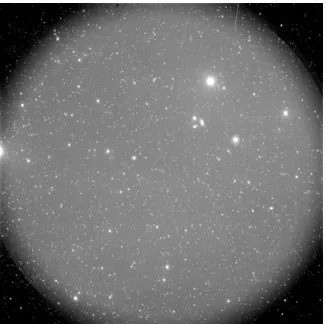
The TFRM project consists of the refurbishment of the 0.5 meter f/1 Baker-Nunn Camera (BNC) for robotic CCD surveying purposes. Its outstanding field of view allows to obtain images of 4.4◦x4.4◦ using a 4kx4k 9 µm-sized CCD. The figure below (FIG.1) is the full field of view taken with TFRM[4].
III. PINPOINT OVERVIEW
PinPoint is a programmable engine that provides sen-sitive astrometric image processing for FITS files. It has built-in all-sky plate solving and at a cost of additional time it eliminates the requirement for approximate image centerpoint coordinates and plate scale. Moreover, Pin-Point works at the cloud service of Astrometry.net and uses a visual interface, Visual PinPoint, which includes several automated tools for asteroid and supernova track-ing with optional blinktrack-ing for validation[5].
FIG. 1: TFRM 4096x4096 image frame sample of a star-cluttered field.
A. PinPoint Performance
The first step is the plate solving, which by matching the stars from the FITS image with the cataloged ones gives precise asteroid and comet detection and measure-ment of their positions. Although the optics can produce astrometric distortion PinPoint is able to remove it via adaptive higher-order solution conferring this engine a great accuracy.
As the image size increases the time spent solving the plates grows steeply. While other packages crash when asked to detect stars in a field containing more than a hundred detectable stars, PinPoint can handle up to 15,000 field stars and match thousands of them[5]. The following times are approximate theoretical times to com-plete a plate solution and they are bound to a statistical process either for the detection of the objects against the background noise and the catalog-field star matching:
512x512 1024x1024 4096x4096 Field (stars) 100 1,000 10,000 Catalog (stars) 20 300 2,000
Match(stars) 15 250 1,700 Time (seconds) 0.5 2 30
TABLE I: Field stars, catalog stars, matched stars and ap-proximate elapsed time for a 1.5GHz class machine running Windows XP when solving the plates of diferent sized images with PinPoint[5].
Once the plate is solved, the second step of the proce-dure is asteroid detection. Since the star positions have been determined by matching with the catalog, the en-gine uses an enhanced thresholded peak-finder for object
detection. Background noise statistics are calculated first and used afterward to set the peak-finder’s threshold in 32 zones of the image. Although PinPoint is a very ef-fective tool with a great precision it is unavoidable to obtain false alarms when trying to detect asteroids due to the fact that seeing conditions may vary during the exposures.
IV. SALTAD OVERVIEW
The SAIC Algorithm Test bed for Asteroid Detection (SALTAD) is a collection of image processing modules built together as a common set of data structures and uniform coding standards. The software was developed under two C++ development systems in order to allow for both CPU and GPU user hardware configurations[6]. These modules were created to provide the Near Earth Asteroid (NEA) search community with advanced image processing software for both detecting and tracking as-teroids. They are able to apply matched filter processing techniques that achieve fainter asteroid detection than the current moving target indicator (MTI) used by the NEA community.
A. SALTAD Image Processing
The SALTAD Driver Interface module is the one used to declare all the internal structures and data arrays of the SALTAD library. The first step in any image pro-cessing software is the one that involves the input im-agery data and the processing parameters. In order to be compatible with most astronomical imaging facilities the input imagery will be in the FITS file format[7] and the control and run parameters will be set through an ASCII text file that can be modified at any moment.
After the imagery is read into memory the next step is to register each frame in the sequence of images. The software can support a minimum sequence of three frames up to a maximum of nine. It is required to set the time step (in seconds) between the frames in relation to the first one. In addition, the software is provided with a two-dimensional second order warped fit to account for frame distortions. Moreover, the possible shift in both X and Y axis between the frames must be set in order to get the correct frame-to-frame star association.
Once all images are stored into memory the next step is equalization. This step consists of comparing and equalling the background levels of the images in order to remove the mean. This is done to prevent the high noise background of a single frame from dominating the mean estimation. For that reason, all the frames are ref-erenced to the first one on a pixel by pixel basis based on the background trend.
The SALTAD software computes the spatial-temporal mean of each pixel in a finite extent region around each pixel and across all frames. So if a straight temporal
mean is removed of all frames then there will be a target loss capture due to the fact that part of the brightness of the asteroid is removed when the frames are demeaned. To correct that loss of signal-to-noise relation it will be assumed that the asteroid will only appear on the frame that has the brightest return for a given pixel. In other words, the spatial-temporal mean will be calculated skip-ping the brightest pixels.
The Point Spread Function parameter is related to shape of the source of light and it can be specified a pixel width of a symmetric Gaussian function, a Moffat function or just a point source.
The next step of the procedure is the covariance esti-mation. This step consists of whitening the regions of the image with high variability, such as scintillating stars, by removing the noise in the image. With this purpose, a noise covariance estimate of the second order noise statis-tics needs to be done. It will be assumed that the noise variance is not correlated between pixels and it will be estimated using the mean since bright tend to have vari-ances in proportion to their means.
The main processing loop of SALTAD involves the mo-tion hypothesis steps where a momo-tion template file can be specified. As the time step between frames is small it can be considered a linear type motion and the lower and up-per motion speed can be set as well. Once the hypothesis of speed and direction of motion is made the images are shifted and added together according to the time spacing between frames and motion hypothesis vector.
After resolving the motion hypothesis it is necessary to convolve the PSF, that means integrating all the pixels around the point target since the object may have trailed across the image plane. Note that the PSF convolution is done outside the hypothesis loop to save on computation time.
The detection of asteroid motion requires a CFAR (Constant False Alarm Rate) detection scheme where each pixel location in the integrated image is tested rela-tive to the mean and variance of the matched filter output covering a donut region around the tested pixel. Those pixels that cross the CFAR threshold are placed into a preliminary detection list. As many false alarms are gen-erated by the CFAR test it was implemented a second test to reduce them. Now the boundary is that detected asteroids should have a relative constant level of intensity across the frames. This assumption will eliminate a large number of false alarms from pixel noise spikes or bright star diffraction figures.
The final detection list is output to an ASCII text file for review by the user. The report contains information of the signal-to-noise ratio, coordinates of the asteroid both the raw main image and the sub-images surveyed[6].
V. SOFTWARE PERFORMANCE RESULTS The data used in this analysis includes 9 images (3 fields of view with 3 frames each) from the 0.5 meter
telescope with a f/1 refurbished Baker-Nunn Camera on October the 6th of 2013 under good seeing condi-tions[4]. Evaluations were made on the performance of the SALTAD software in detecting asteroids. In the fol-lowing subsections we will discuss the results from that analysis.
A. PinPoint Results
The PinPoint software has demonstrated a precise abil-ity to detect a good amount of asteroids in the images provided. The catalog used to solve the plates was the USNO UCAC2 which is a high density and gratly accu-rate catalog of more than 48 million stars[8]. The maxi-mum magnitude threshold for asteroid detection was set at 18, which is a reasonable one because it does not cross the fainter limit where asteroids are difficult to detect (near 21st magnitude).
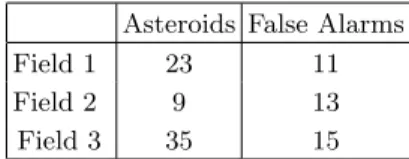
In TABLE II the results of both the detected asteroids and false alarms on the three fields of view are shown. It should be noted that the proposal for this report was to put into operation the SALTAD software so these results will be taken as a reference as we will be expecting similar results with it.
Asteroids False Alarms Field 1 23 11 Field 2 9 13 Field 3 35 15
TABLE II: Asteroid and false alarms detected with PinPoint in three diferent star-cluttered fields.
B. SALTAD Results
The SALTAD matched filter algorithms have shown to be a very powerful tool in asteroid detection and tracking. After several processing scans we found positive matches on asteroid detection when readjusting some parameters that will be discussed immediately.
Below it can be seen (TABLE III) the results of de-tected asteroids and false alarms on the same three fields of view we scanned with the PinPoint software. Note the strong decrease in the number of false alarm detections while the total amount of asteroid detections is just a little bit lower than before.
Asteroids False Alarms Field 1 15 1 Field 2 10 7 Field 3 31 5
TABLE III: Asteroid and false alarms detected with SALTAD in three diferent star-cluttered fields.
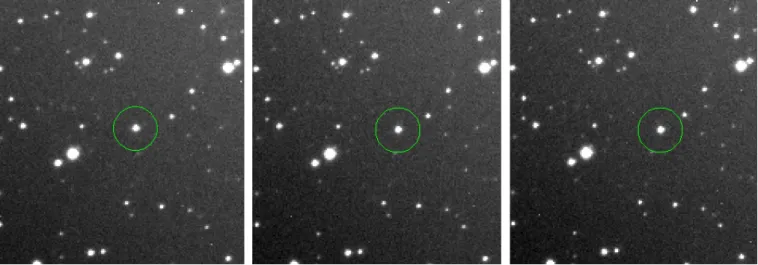
FIG. 2: Example of asteroid detection with the SALTAD software on Field 3. The asteroid is located in the green circle which radius is constant on the same three frames.
An example of a positive asteroid detection can be seen above (FIG.2) where the use of SAOImage DS9 was re-quired to open and blink the frames as we did not use the visual interface of the SALTAD software.
C. SALTAD Result Summary
One particular parameter that appeared to be highly relevant for asteroid detection was the pixel shift reso-lution per frame which controls the number of pixels a frame can shift in relation to the first one. Its recom-mended value is 1.0 because it saves computation time when processing but increasing that threshold until 2.0 will provide us with more detections despite a higher computation time.
While trying to reduce the computation time we real-ized that SALTAD can scan the frames by dividing them into subimages. At first glance that did not seem to improve our results because computation time remained fairly constant but by dividing the frame into subimages we obtained much more detections.
Obtention of a great amount of detections carries an intrinsic problem which is the presence of false alarms. That is why we needed to readjust more parameters, so the second critical restriction we modified was the signal-to-noise (SNR) constancy limit. Its default value was fixed on 6.0 which in our opinion was a fairly relaxed boundary so we decided to tighten this condition and set the SNR constancy limit to 3.0. Having this done we had a reduction of over the 50% over 50 % of the total detections and only one or two positive detections, which means asteroids, where lost in this step.
In order to achieve better detection ratios between asteroid tracking and false alarms we tried to optimize some of the multiple parameter options available in the SALTAD software. The first one we readjusted was the covariance which we preferred to estimate using the
sec-ond highest pixel in an image set rather than the diagonal mean as it was set by default. Moreover, it was initially proposed to use a global starless mean but after several trials with a local median average and a local median mean we returned to the default setting which performed better.
In addition it was found that SALTAD detection per-formance was less effective when it used a point model representation of the Point Spread Function (PSF) rather than a Gaussian function. This is due to the fact that applying a point model was too restrictive and the only detections made appeared to be false alarms. From there on different values of the Gaussian radius extension and the half-power at half-width were evaluated and finally set to the default ones which better performed with our imagery.
One area that needs further refinement is in the re-evaluation of candidate detections by automated means in order to reject a greater percentage of false alarms. The main cause of these false alarms is bound to the presence of bright single pixel flares on one frame or CCD pixel bleed lines from bright stars. Those effects should be removed prior to application of SALTAD image pro-cessing modules.
Also, in this report only sequences of three frames are surveyed and analyzed despite the software capability of processing up to nine frames. Although a five frame se-quence was tried to be processed we did not get any pos-itive results, which means to us that all the parameters should be retested and reset for the new scenario. This question opens new options and requires further investi-gation.
VI. CONCLUSIONS
• The main purpose of this report was to put into operation the SALTAD image processing software
and, comparing the results obtained between both PinPoint and SALTAD, we can conclude that this software is now perfectly set to detect asteroids. • The analysis of the results presented reveals that
while PinPoint seems to yield around 10% more as-teroids than SALTAD does - this second software is able to mitigate better false alarm detections which means that it is more accurate.
• Looking into optimize the multiple settings avail-able to the software we found that the Pixel Shift Resolution per frame setting was a critical param-eter for asteroids to be detected during the image processing. By increasing its value we relaxed a little bit the constraint of the pixel shifting and ob-tained a larger list of detections.
• Finally in closing, we would like to remark that further improvement could have been made if raw images have had their bright pixel flares and CCD pixel bleed lines removed.
Acknowledgments
I would like to gratefully acknowledge Dr. Jorge N´u˜nez of the DAM Universitat de Barcelona for his help and ad-vices when starting and developing this report. Further-more, Adri`a Gr`acia and Irene Escudero have also con-tributed with their support and corrections.
[1] Arianna E. Gleason and Jeffrey A. Larsen,Final Compar-ison of SAIC SALTAD Algorithms to Current Spacewatch MTI Software, University of Arizona, 2003.
[2] Peter S. Gural, Dr. Jeffrey Larsen and Arianna E. Gleason, ”Matched Filter Processing for Asteroid Detection”. The Astronomical Journal,130: 19511960 (2005).
[3] Peter S. Gural and Dr. Jeffrey Larsen, Asteroid Search with Advanced Detection Algorithms, NASA Tech. Rep. 20040021361; Hanover: NASA.
[4] O. Fors, J. N´u˜nez, F.J. Montojo, J.L Mui˜nos, J. Boloix, R. Baena, R. Morcillo and M. MerinoTelescope Fabra ROA Montsec: A New Robotic Wide Field Baker - Nunn Fa-cility. The Astronomical Society of the Pacific, Vol. 125,
Num. 297, (2013).
[5] PinPoint Astrometrical Engine (http://pinpoint.dc3.com/)
[6] Peter S. Gural,SALTAD 1.51 Software User’s Guide, Sci-ence Applications International Corp., 2011.
[7] Wells, D. C., Greisen, E. W. and Harten, R. H,FITS: A Flexible Image Transport System, Astronomy and Astro-physics Supplement Series 44: 363370, (1981).
[8] Smithsonian Astrophysical Observatory - Telescope Data Center (http://tdc-www.harvard.edu/catalogs/index.html).