University of South Carolina
Scholar Commons
Theses and Dissertations
1-1-2013
Models and Software Development For
Interval-Censored Data
Chun Pan
University of South Carolina
Follow this and additional works at:https://scholarcommons.sc.edu/etd Part of theBiostatistics Commons
This Open Access Dissertation is brought to you by Scholar Commons. It has been accepted for inclusion in Theses and Dissertations by an authorized administrator of Scholar Commons. For more information, please [email protected].
Recommended Citation
Models and Software Development for Interval-Censored Data
by
Chun Pan
Bachelor of Science Nanjing University 2001
Master of Science Nanjing University 2004
Master of Science
University of South Carolina 2009
Submitted in Partial Fulfillment of the Requirements
for the Degree of Doctor of Philosophy in
Biostatistics
Arnold School of Public Health
University of South Carolina
2013
Accepted by:
Bo Cai, Major Professor
Lianming Wang, Committee Member
Jiajia Zhang, Committee Member
Andrew Ortaglia, Committee Member
c
Acknowledgments
This dissertation is a summary of the research work I have done under the supervision
of my advisor Dr. Bo Cai. I am deeply grateful to him for his insightful, intelligent,
and patient guidance and his creative suggestions when I encountered difficuties in
the past three years. I sincerely appreciate all of his great support along the way as
I would not be able to make it without him.
I am very grateful to Dr. Lianming Wang for instructing me with his expertise
on interval-censored data. I have learned a lot about the concept and modeling
methodology for this type of data by meeting with him and studying his R programs
and publications.
I would like to express my sincere gratitude to Dr. Jiajia Zhang for her
enlight-ening comments on my work. Especially worth to mention, I have been stuck at my
second project for months and one day Dr. Zhang’s comment solved the riddle for
me immediately.
Dr. Andrew Ortaglia has gone through the writing of my dissertation in detail.
Also he has been so cordial and supportive both during the completion of the
dis-sertation and during my course study, which has really encouraged me a lot when I
came to barriers.
I also would like to thank Dr. Suzanne McDermott and Dr. Joshua Mann for
their financial support and advice during my PhD study. Finally, I thank my parents
Abstract
Interval-censored time-to-event data occur naturally in studies of diseases where the
symptoms are not directly observable, and periodic lab or clinical examinations are
re-quired for detection. Due to the lack of well-established procedures, interval-censored
data have been conventionally treated as right-censored data, however, this
intro-duces bias at the first place. This dissertation focuses on methodological research
and software development for interval-censored data. Specifically, it consists of three
projects. The first project is to create an R package for regression analysis and
sur-vival curve estimation of interval-censored data based on several published papers
by our research team. In the second project, a Bayesian semiparametric
propor-tional hazards model with spatial random effect is developed for spatially correlated
interval-censored data. In the third project, we propose a multivariate frailty model
for clustered interval-censored failure times, which is analogous to a mixed model in
Table of Contents
Acknowledgments . . . . iii
Abstract . . . . iv
List of Tables . . . . vii
List of Figures . . . . viii
Chapter 1 Introduction . . . . 1
1.1 Interval-Censoring . . . 1
1.2 Likelihood function . . . 2
1.3 Motivations . . . 3
Chapter 2 Background Knowledge . . . . 5
2.1 The Poisson Distribution and the Poisson Process . . . 5
2.2 Monte Carlo Markov Chain Methods . . . 7
2.3 I-Splines . . . 10
Chapter 3 ICBayes: An R Package for Modeling Interval-Censored Data . . . . 14
3.1 Introduction . . . 14
3.2 Models Included in the Package . . . 17
3.3 ICBayes Package Design and Use . . . 21
3.4 Breast Cosmesis Example . . . 22
Chapter 4 Modeling Interval-Censored Survival Data with
Spa-tial Correlation . . . . 34
4.1 Proportional Hazards Model with Spatial Random Effect . . . 36
4.2 Prior specifications and posterior computation . . . 40
4.3 Model Comparison . . . 42
4.4 A Simulation Study . . . 44
4.5 Smoking-Relapse Data Application . . . 51
Chapter 5 Multivariate Frailty Model for Clustered Interval-Censored Data . . . . 59
5.1 Introduction . . . 59
5.2 Prior and Augumentation for Frailties . . . 60
5.3 Modeling Interval-Censored Data . . . 62
5.4 Gibbs Sampling Algorithm . . . 63
5.5 A Simulation Study . . . 65
5.6 Lymphatic Filariasis Example . . . 70
Chapter 6 Conclusions. . . . 76
List of Tables
Table 4.1 Geweke’s convergence diagnostic for MCMC chains of the model
parameters in the 1st simulated dataset . . . 47
Table 4.2 Estimation results for simulation 1 . . . 47
Table 4.3 Estimation results for simulation 2 . . . 50
Table 4.4 Geweke’s convergence diagnostic for MCMC chains of the model
parameters in the smoke-relapse data . . . 55
Table 4.5 Estimation results for the smoking cessation study . . . 56
Table 5.1 Geweke’s convergence diagnostic for MCMC chains of the model
parameters in the 1st simulated dataset . . . 69
Table 5.2 Posterior homogeneity probabilities and Bayes factors of frailties
in the simulation study . . . 70
Table 5.3 Posterior probabilities of the 8 possible models in the simulation
study . . . 70
Table 5.4 Estimated fixed effects and coverage probabilities in the
simula-tion study . . . 70
Table 5.5 Geweke’s convergence diagnostic for MCMC chains of model
pa-rameters in the lymphatic filariasis study . . . 74
Table 5.6 Posterior homogeneity probabilities and Bayes factors of frailties
in the lymphatic filariasis study . . . 75
Table 5.7 Posterior probabilities of the 8 possible models in the lymphatic
filariasis study . . . 75
List of Figures
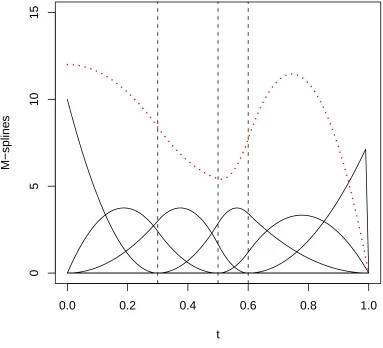
Figure 2.1 A set of M-splines with order = 3, t = {0,0.3,0.5,0.6,1}, and
f = 1.2M1+ 2.0M2+ 1.2M3+ 1.2M4+ 3.0M5+ 0.0M6 . . . 12
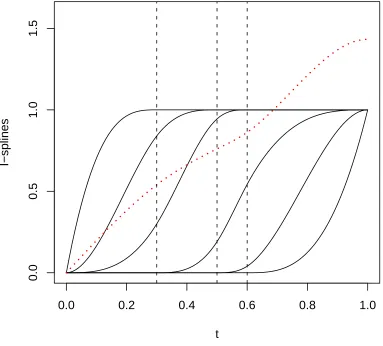
Figure 2.2 A set of I-splines with order = 3, t = {0,0.3,0.5,0.6,1}, and f = (1.2I1+ 2.0I2+ 1.2I3+ 1.2I4+ 3.0I5 + 0.0I6)/6 . . . 13
Figure 3.1 Traceplot of MCMC chain for β of case 2 PH model in breast cancer study . . . 25
Figure 3.2 Traceplot of MCMC chain forβof case 2 probit model in breast cancer study . . . 26
Figure 3.3 Estimated survival curves for two groups of patients in breast cancer study . . . 28
Figure 3.4 Traceplot of MCMC chain for β in case 1 PH model for lung cancer data . . . 30
Figure 3.5 Traceplot of the MCMC chain ofβ in case 2 PH model for lung cancer data . . . 32
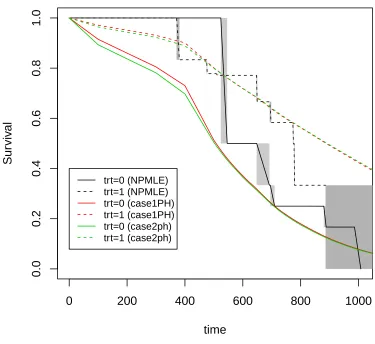
Figure 3.6 Estimated survival curves for two groups of patients in lung cancer study . . . 33
Figure 4.1 A recent mapping of air pollution particle levels in China . . . 35
Figure 4.2 Traceplot of fixed effect β1 in the 1st simulated dataset. . . 45
Figure 4.3 Traceplot of fixed effect β2 in the 1st simulated dataset. . . 46
Figure 4.5 Plot of estimated baseline survival curve based on 100 simulated
data sets using proposed model (with 95% pointwise credible
in-tervals) and Weibull model, compared to true baseline survival
curve (simulation 1). . . 48
Figure 4.6 Maps of posterior means for the spatial random effects φi over 46
counties of SC based on proposed model and Weibull model
(simu-lation 1). . . 49
Figure 4.7 Plot of estimated baseline survival curve based on 100 simulated
data sets using proposed model (with 95% pointwise credible
in-tervals) and Weibull model, compared to true baseline survival
curve (simulation 2). . . 51
Figure 4.8 Traceplot of fixed effect β1 in the smoking-relapse data. . . 53
Figure 4.9 Traceplot of fixed effect β2 in the smoking-relapse data. . . 53
Figure 4.10 Traceplot of spatial precision τφ in the smoking-relapse data. . . . 54
Figure 4.11 Traceplot of spatial precision τφ in the smoking-relapse data. . . . 54
Figure 4.12 Estimated survival curves for the smoking cessation study, using
Turnbull method, proposed model, and Weibull model; event of
interest is time to relapse to smoking. Four curves are plotted
for each method based on the four subgroups formed by gender
and treatment. . . 57
Figure 4.13 Maps of posterior means for the spatial random effects φi over 51
zip codes areas in southeast Minnesota based on proposed model
and Weibull model. The other 32 zip code areas without data are
plotted in white color. . . 58
Figure 5.1 Traceplot of fixed effect β1 in simulation study. . . 67
Figure 5.3 Traceplot of the probability of homogeneity forξi1 in simulation
study. . . 68
Figure 5.4 Traceplot of the probability of homogeneity forξi2 in simulation
study. . . 68
Figure 5.5 Traceplot of the probability of homogeneity forξi3 in simulation
study. . . 69
Figure 5.6 Traceplot of fixed effect β1 in lymphatic filariasis study. . . 72
Figure 5.7 Traceplot of fixed effect β2 in lymphatic filariasis study. . . 72
Figure 5.8 Traceplot of the probability of homogeneity forξi1 in lymphatic
filariasis study. . . 73
Figure 5.9 Traceplot of the probability of homogeneity forξi2 in lymphatic
filariasis study. . . 73
Figure 5.10 Traceplot of the probability of homogeneity forξi3 in lymphatic
Chapter 1
Introduction
1.1 Interval-Censoring
Interval-censored data occur naturally in studies of diseases where the symptoms
of interest are not directly observable, and laboratrory or clinical examinations are
required for detection. The exact time to event of interest T is not directly observed,
but is known to fall within a time interval (L, R], such that 0≤L < T ≤R≤ ∞.
Consider in a tumorigenicity study, a lab animal has to be dissected to check
whether a tumor has developed. Let C denote the time of dissection, and T denote
the true tumor onset time, then the data observed is (C,1(T ≤C)). Then
(L, R] =
(0, C], T ≤C
(C,∞), T > C
(1.1)
This is called case 1 interval-censored or current status data.
Suppose there are two examination timesU andV for each subject, then the data
observed is (U, V, δ1 =I(T ≤U), δ2 =I(U < T ≤V)). Then
(L, R] =
(0, U], T ≤U
(U, V], U < T ≤V
(V,∞), T > C
(1.2)
This is the case 2 interval-censored data. Case k interval-censoring refers to when
there are k examination times per subject.
Consider another situation. In an oncology clinical trial for non-small cell lung
scanned by CT every couple of weeks for evaluation of tumor sizes and new lesions.
Then the scan results are read by a diagnostic radiologist to determine if progression
has occurred or not. Then PFS is interval-censored as the exact time to progression
is not observed but is known to fall within a time interval (L, R]. Suppose Oi =
{Oi1, . . . , Oi,ni}are the examination times for the ith patient, i= 1, . . . , n. Then
(L, R] =
(0, Oi,1], T ≤Oi,1
(Oi,L, Oi,R], Oi,L < T ≤Oi,R
(Oi,ni,∞), T > Oi,ni
(1.3)
This is called general interval-censoring, which includes case 1, case 2 and case k
interval-censoring as special cases. In the dissertation, we will focus on general
interval-censoring.
1.2 Likelihood function
Throughout the dissertation, we assume the following two basic assumptions (Huang
and Wellner, 1997). (A1) The failure time is independent of the examinations times
given the covariates. (A2) The distribution of the examination times does not involve
the parameters of interest.
Under these assumptions we can derive the likelihood function. For case 1, or
equivalently current status data, the joint density of a single observation (C, δ =
I(T ≤C),x) is:
f(δ, c,x) =f(δ|c,x)f(c,x) =f(δ|x)f(c,x)
=F(c|x)δ(1−F(c|x)1−δf(c,x)),
where F is the cdf of T. So for an independent sample of size n from the same
distribution, the likelihood function is proportional to:
L=
n
Y
i=1
n
For case 2 and general interval-censoring, let δ1,δ2, δ3 denote left-, interval-, and
right-censoring, the joint density of a single observation (δ1, δ2, δ3, L, R,x) is:
f(δ1, δ2, δ3, L, R,x) =f(δ1, δ2, δ3|L, R, x)f(L, R,x) = f(δ1, δ2, δ3|x)f(L, R,x)
=F(R|x)δ1(F(R|x)−F(L|x))δ2(1−F(L|x))δ3f(L, R,x).
The likelihood function for an independent sample of sizenfrom the same distribution
is proportional to:
L=
n
Y
i=1
n
F(Ri|xi)δ1i(F(Ri|xi)−F(Li|xi))δ2i(1−F(Li|xi))δ3i
o
.
1.3 Motivations
For interval-censored data, the conventional approach in pharmaceutical industry
treats the right-point of the time interval as the observed time, and then apply the
standard right-censored methods. However, this approach can lead to biased
estima-tion and invalid inferences (Rücker and Messerer, 1988; Odell et al., 1992; Lindsey
and Ryan, 1998; Sun and Chen, 2012). Better estimations can be obtained if the
information of interval censorship is taken into account in modeling.
Quite a few new methods for analysis of interval-censored time-to-event data have
been proposed in the last two decades. However, most of these methods either rely
on parametric assumptions that are hard to verify in practice or are computationally
challenging. As a result, none of them has been accepted by the pharmaceutical
industry as a standard procedure. We propose to model the survival function
semi-parametically through I-splines (Ramsay, 1988) and estimate survival function and
regression coefficients through Markov chain Monte Carlo (MCMC) algorithm. Our
models are relatively straightforward to implement in practice and give more accurate
estimates. Specifically, the dissertation research consists of three projects; each has
Currently, a few packages and SAS macros, mainly the ‘interval’ and ‘glrt’
pack-ages in R and the %EMICM and the %ICSTEST macros in SAS, have been developed
to provide estimation and comparison for survival functions for interval-censored data.
However, there are currently few options available for fitting regression models, except
the ‘survBayes’ package and the ‘intcox’ package. As the first project of this
disser-tation, we have built an R package, ICBayes, which fits proportional hazards (PH),
proportional odds (PO), and probit regression models from a Bayesian perspective.
It is possible that failure times of interest are both interval-censored and spatially
correlated. For instance, in a lung cancer clinical trial, patients are recruited from
a number of regions where air quality in a region is similar to that in its neighbors
but might differ substantially from that in the other regions. If air quality exerts
an effect on treatment outcome, then survival times of patients may be spatially
correlated. Only one spatial frailty model has been developed for such type of data
under parametric Weibull PH cure rate model (Banerjee and Carlin, 2004). We
propose a semiparametric spatial frailty PH model, which provides greater flexibility
for modeling failure time.
Clustered interval-censored survival data can easily occur in multicenter clinical
trials for cancer, HIV, or other infectious diseases. Tumor progression, HIV
progres-sion to AIDS, and presence/absence of an infection normally all need periodic lab
examinations for detection. Characteristics that vary by center may affect survival
times, which implies either an overall frailty to account for baseline hazard
hetero-geneity across centers or a frailty corresponding to a certain predictor to account for
center-wise variation of this predictor’s effect. We propose to model the variance of a
potential frailty with a mixture of point mass and gamma distribution, because rather
than arbitrarily assuming the heterogeneity structure, we want to actually estimate
Chapter 2
Background Knowledge
2.1 The Poisson Distribution and the Poisson Process
2.1.1 Additive Property of Poisson DistributionSuppose X1, . . . , Xn are
inde-pendent with Xi ∼Poisson(λi), i= 1, . . . , n, then
Yi =
n
X
i=1
Xi ∼Poisson(
n
X
i=1
λi).
This can be proved through the moment generating function method. This property
will be used in introducing Poisson latent variables in our data augmentation.
2.1.2 Poisson Process A Poisson process is a counting process in which events
occur continuously and independently of one another. Let N(t) be the number of
events in time interval (0, t]. The process{N(t), t≥0}is said to be a Poisson process
with rate (or intensity) λ, λ >0, if
• N(0) = 0.
• (independent increment) the number of events in non-overlapping intervals are
independent.
• (stationary increment) the number of events in a time interval depends only on
the length of the interval.
• limh→0P(N(hh)=1) =λ.
Some useful properties of Poisson process are:
• The number of events in an interval of length t is a Poisson random variable
with mean λt.
• The interarrival times are independent exp(λ) random variables.
• The time of thenth event is Gamma(n, λ) random variable, whereλis the rate
parameter.
2.1.3 Nonhomogeneous Poisson ProcessA nonhomogeneous Poisson process
relaxes the stationarity assumption of a Poisson process. A process {N(t), t >= 0}
is a nonhomogeneous Poisson process with rate (intensity) λ(t), t≥0, if
• N(0) = 0.
• (independent increment) the number of events in non-overlapping intervals are
independent.
• limh→0P(N(t+h)h−N(t)=1) =λ(t).
• limh→0P(N(t+h)h−N(t)≥2) = 0.
The mean-value function (cumulative intensity function) is defined as:
m(t) =
Z t
0 λ(s)ds, t≥0.
Some useful properties of a nonhomogeneous Poisson process are:
• Fort >0, N(t)∼Poisson(m(t)).
• N(t+h)−N(t)∼Poisson(m(t+h)−m(t)).
• For each 0 ≤ t1 < t2 < . . . < tm, N(t1), N(t2)−N(t1), . . . , N(tm)−N(tm−1)
• Let Sn be the time of the nth occurrence, then P {Sn> t} =P {N(t)< n}=
Pn−1
j=0
e−m(t)(m(t))j
j! . This property will be particularly used to derive data
aug-mentation in our models.
The relationship between Poisson process and nonhomogeneous Poisson process
can be illustrated as follows. Suppose that events are occurring according to a Poisson
process with rate λ, and the probability that an event at time t is counted is p(t).
Then the process of counted events constitutes a nonhomogeneous Poissson process
with rate λ(t) = λ·p(t).
2.2 Monte Carlo Markov Chain Methods
2.2.1 Markov Chains A Markov chain is a stochastic process in which the next
state depends only on the current state. This memoryless characteristic is called the
Markov property. In mathematical form, consider a drawθ(t) at iterationt, then the
next draw θ(t+1) at iterationt+ 1 only depends on the current draw θ(t), and not on
any past draws. So the draws in a Markov chain are slightly dependent.
Suppose we have a target distributionf(θ) and we want to estimateE(g(θ)), where
g() is some function. Instead of solving it analytically asI =RSg(θ)f(θ)dθ, whereSis
the parameter space (state space). We can approximate the integral via Monte Carlo
integration by simulating M values from f(θ) and calculating Ib= M1 PMt=1g(θ(t)). If
the M values are independent, then by Strong Law of Large Numbers (SLLN),Ibis a
consistent estimator of I. The Markov analog to the SLLN is the Ergodic Theorem.
It is the reason why Markov chain Monte Carlo methods works: it allows us to use a
sample path from a Markov chain to estimate various quantities of interest.
For a discrete Markov chain, it is defined to be irreducible if all its states
commu-nicate. A state i is recurrent if E(Vi|θ(0) = i) =∞, where Vi is the number of visits
in state i. Most MCMC methods are based on general state space Markov chains.
Definition 1 (Irreducibility). Given a distribution µ on the state space S, a
Markov chain is said to be f-irreducible if for all sets A with f(A) > 0 and for all
x∈S, there exists anm∈N0 such that
P(θ(t+m)∈A|θ(t)=x) =
Z
AK
(m)(x, y)dy >0,
where K(m)(x, y) is the m-step transition kernel.
Definition 2 (Recurrence). A set A ⊂ S is said to be recurrent for a Markov
chain θ if for all x∈A
E(VA|θ(0) =x) =∞.
And a Markov chain is said to be recurrent if
i. The chain is irreducible.
ii. Every measurable set with f(A)>0 is recurrent.
Theorem 1 (Ergodic Theorem). Letθbe af-irreducible, recurrentRd-valued
Markov chain with stationary distribution f. Then for any integrable function g :
Rd→R, we have
limM→∞
1
M M
X
t=1
g(θ(t))→
Z
Sg(θ)f(θ)dθ,
with probability 1 for almost every starting value θ(0). If θ is Harris-recurrent, then
this holds for every starting value θ(0).
A MCMC method for the simulation of a distributionf is any method producing
an ergodic Markov chain (θ(t)) whose stationary distribution is f. The two most
commonly used MCMC algorithms are the Metropolis-Hastings algorithm and the
Gibbs sampler.
2.2.2 Metropolis-Hastings AlgorithmThe Metropolis-Hastings algorithm
en-ables generating random numbers from a probability distribution f without directly
sampling from it. It constructs an ergodic Markov chain that satisfies the detailed
The transition kernel K is based on a proposal distribution q(θ|θ(t)). Specifically,
given the current state θ(t), we generate a candidate value θ′ ∼q(θ|θ(t)), and set the
next stateθ(t+1) as:
θ(t+1) =
θ′, w.p. a(θ(t), θ′) = min(1, f(θ′)q(θ(t)|θ′)
f(θ(t))q(θ′|θ(t)))
θ(t), w.p. 1−a(θ(t), θ′)
(2.1)
This leads to the following transition kernel
K(θ(t), θ(t+1)) = q(θ(t+1)|θ(t))a(θ(t), θ(t+1)) + (1−X
θ′
a(θ(t), θ′)q(θ′|θ(t)))δθ(t)(θ(t+1)).
It is straightforward to show that the two additive items in the equation above satisfy
the detailed balance condition, soK is in detailed balance with respect to f:
K(θ(t−1), θ(t))f(θ(t−1)) = K(θ(t), θ(t−1))f(θ(t)).
Thusf is the stationary distribution of the Markov chain (θ(0), θ(1), . . .).
Further-more, if q(θ|θ(t)) >0 for all θ, θ(t) ∈ S, then the Makov chain is irreducible. And
since the chain is Harris recurrent if it is irreducible (Tieney, 1994), then it is Ergodic.
2.2.3 Gibbs Sampler Suppose we have a joint distributionf(θ1, θ2, . . . , θk) that
we want to sample from. We can use the Gibbs sampler (Geman and Geman, 1984)
to sample from it if we know the full conditional distributions for each parameter.
The full conditional distribution, f(θj|θ−j, y), is the distribution of the parameter
conditional on data and all the other parameters.
The Gibbs sampler iterates through the following steps:
i Start with initial values θ(0).
ii Draw a value θ(1)1 from its full conditional distribution f(θ1|θ2(0), . . . , θ (0)
k , y).
iii Draw a value θ(1)2 from its full conditional distribution f(θ2|θ1(1), θ (0)
3 , . . . , θ
(0)
k , y).
v Repeat steps ii-iv forM iterations.
Then we get the Markov chain (θ(0),θ(1), . . . ,θ(M)).
The Hammersley-Clifford Theorem (Robert and Casella, 1999, p298) proved that
if (θ1, θ2, . . . , θk) satisfy the positivity condition and have joint density, then the full
conditionals fully specify the joint distribution. It can be shown thatf(θ1, θ2, . . . , θk)
is the invariant distribution of the Markov chain (θ(0),θ(1), . . .) generated by the Gibbs
sampler. Also, if the joint density f(θ1, θ2, . . . , θk) satisfies the positivity condition,
then the Gibbs sampler yields an irreducible, recurrent Markov chain. Hence the
chain is ergodic.
Definition 3 (Positivity condition). Random variables (X1, . . . , Xn) with joint
density f(x1, . . . , xn) and marginal densities fXi(xi) is said to satisfy the positivity
condition if fXi(xi)>0 for all i= 1, . . . , n impliesf(x1, . . . , xn)>0.
2.3 I-Splines
2.3.1 Splines A spline function f is a piecewise polynomial function defined on an
interval [xmin, xmax] with specified continuity constraint. The interval is subdivided
by a mesh of points xmin = ξ1 < . . . < ξq = xmax, and within each subinterval
[ξj, ξj+1) is a polynomial Pj of order k.
Let n denote the number of free parameters that specify the spline function. A
knot sequence t = {t1, . . . , tn+k} is derived by placing knots at boundary values ξi
according to the order of continuity at that boundary. The simplest case is to put
a single knot at each boundary value, which implies that the order of continuity is
(k−1) and that (k −2) derivatives match at boundary points ξi. So the knots are
t1 = . . . =tk = xmin, tk+1 = ξ2, . . ., tn+1 = . . .= tn+k =xmax. Under this simplest
case, the number of free parameters n equals the number of interior knots plus the
2.3.2 M-Splines With a suitable set of basis splines, for instance, the M-spline
family Mi(x|k, t), we can construct a spline f as a linear combination:
f =
n
X
i=1
aiMi.
A set of M-splines can be defined by the following recursions:
Fork = 1, Mi(x|k = 1, t) = t 1
i+1−ti; 0 otherwise.
Fork > 1,Mi(x|k, t) = k[(x−ti)Mi(x|k−1,t)+(ti+k−x)Mi+1(x|k−1,t)]
(k−1)(ti+k−ti) .
As we can see, Mi(x|k, t) > 0 only if ti ≤ x≤ ti+k. It is an important property,
as it implies that the coefficient ai will only affect f within this subinterval. Other
useful properties include: 1)Mi ≥0; 2)Mi integrates to 1; 3)Mi hask−2 continuous
derivatives at interior knots.
Figure 2.1 shows an M-spline of order 3 on the interval [0,1], with three interior
knots at 0.3, 0.5, 0.6, and a spline based on the M-splines.
2.3.3 I-Splines Because M-splines are nonnegative, monotone splines can be
derived based on them using integration:
Ii(x|k, t) =
Z x
xmin
Mi(u|k, t)du.
This is called I-splines. EachIi is a piecewise polynomial of degreek (order k), since
eachMi is a piecewise polynomial of degree k−1 (order k).
For a simple knot sequence, an I-spline Ii of orderk can be expressed in terms of
the M-splines Mi of order k+ 1:
Ii(x|k, t) =
0, i > j
Pj
m=i(tm+k+1−tm)Mm(x|k+ 1, t)/(k+ 1), j−k+ 1≤i≤j
1, i < j−k+ 1.
(2.2)
Figure 2.2 shows the I-splines that were derived from the M-splines above, and a
0.0 0.2 0.4 0.6 0.8 1.0
0
5
10
15
t
M−splines
Figure 2.1 A set of M-splines with order = 3,t ={0,0.3,0.5,0.6,1}, and
0.0 0.2 0.4 0.6 0.8 1.0
0.0
0.5
1.0
1.5
t
I−splines
Figure 2.2 A set of I-splines with order = 3, t={0,0.3,0.5,0.6,1}, and
Chapter 3
ICBayes: An R Package for Modeling
Interval-Censored Data
3.1 Introduction
In clinical trials and medical studies, there are often times where the event of interest
is not directly observable and patients are examined periodically for disease
occur-rence or progression. In such situations, each individual is checked at a sequence
of times and the exact survival time is only known to fall within a time interval
(L, R]. This time to event is known to be interval-censored (Peto, 1973; Odell et
al., 1992; Gentleman and Geyer, 1994). A special case of general interval-censored
data is case 1 interval-censored data or equivalently referred to as current status data
(Schick and Yu, 2000), where the event of interest is not directly observable and each
subject in the study has only one observation time, and hence the failure times are
either left-censored or right-censored. Case 1 interval-censored data often occur in
tumorigenicity studies where lab animals are sacrificed to see if a certain tumor has
developed or not. Three major statistical problems in survival analysis are
estima-tion of survival funcestima-tion, k-sample survival comparison, and estimaestima-tion of regression
coefficients from censored data.
In the past two decades, many new methods have been developed for the analysis
of interval-censored data. The survival function for interval-censored data is normally
estimated through a classic nonparametric maximum likelihood procedure based on
empir-ical survival curve that maximized the overall likelihood for interval-censored data.
Based on observed intervals, a set of distinct intervals was defined. He proved that
the likelihood is a function of the magnitude of the decrease of the survival function
in these intervals only, and the empirical survival curve should be flat everywhere
else. He described a constrained Newton-Raphson algorithm to search for the
non-parametric maximum likelihood estimator (NPMLE). Turnbull (1976) proved that
the NPMLE could be found by solving a self-consistency equation. This equation
can be solved using the EM algorithm (Dempster, Laird, and Rubin, 1977) with the
method of Gentleman and Geyer (1994) to ensure global maximum. Later, more
efficient algorithms were proposed, for examples, iterative convex minorant (ICM) by
Groeneboom and Wellner (1992) and EM iterative convex minorant (EM-ICM) by
Wellner and Zhan (1997).
Most of the research on interval-censored data has been focused on subgroup
sur-vival comparison. Finkelstein (1986) developed a method for fitting the proportional
hazards (PH) model (Cox, 1972) for interval-censored data. The likelihood is written
as a function of regression parameters and nuisance parameters that are
transforma-tions of baseline survival at distinct time points. Regression coefficients are estimated
by the maximum likelihood method and covariance matrix of estimators is estimated
by Fisher information. One drawback of this classic method is that the number of
nuisance parameters increases as sample size increases and nuisance parameters often
approach the boundary of the constrained parameter space, which violates the
regu-larity conditions of maximum likelihood. To avoid the boundary problem associated
with likelihood-based tests (e.g., score test, Wald test, and likelihood ratio test) for
comparing survival functions, Fay (1996) developed a permutational variance for the
score statistic, which requires that censoring is independent of covariates. Also he
proposed grouping data to reduce the number of nuisance parameters, such that none
(1996) only consider treatments as covariates and are only able to provide hypothesis
testing but not point estimation. Sun (1996) developed a nonparametric test for
com-paring subgroup survival distributions by assuming that failure time is discrete. Zhao
and Sun (2004) presented a generalized log-rank test of subgroup survival function
comparison for interval-censored data. The test statistic is constructed
nonparamet-rically and its covariance matrix is estimated based on Rubin’s multiple imputation.
Sun et al. (2005) proposed a new class of nonparametric generalized log-rank tests
for k-sample comparison problem of interval-censored data, and also established the
asymptotic distribution of the test statistic. Zhao et al. (2008) presented a class of
generalized log-rank tests for partly interval-censored data that include both exact
and interval-censored observations, and established their asymptotic properties.
To provide point estimation of treatment effects while controlling for relevant
co-variates, a regression model is needed. Most regression methods for interval-censored
data have been developed under the proportional hazards model, with the first one
be-ing Finkelstein (1986). Pan (1999) extended the ICM algorithm, originally developed
to compute the NPMLE of survival function, to the PH model for interval-censored
data. Compared to the Newton-Raphson iteration suggested in Finkelstein (1986),
Pan (1999) used ICM to obtain the MLEs of regression coefficients and baseline
sur-vival function. A bootstrap method was applied to estimate standard errors of MLEs
of regression coefficients. Recently splines have been used to model baseline hazard
function. For instance, Cai and Betensky (2003) modeled the logarithm of baseline
hazard function with a linear spline mixed model. Their method produces
estima-tion for regression coefficients and baseline hazard. The covariance matrix of the
estimators is obtained through the sandwich method.
Currently, a few R packages and SAS macros have been developed for analyzing
interval-censored data. The ‘interval’ package in R provides the NPMLE of survival
Geyer (1994) algorithm, and performs several tests for k-sample comparison based
on Sun (1996), Finkelstein (1986), and Fay (1996). The ‘glrt’ package in R includes
functions to perform three generalized logrank tests based on Zhao and Sun (2004),
Sun, Zhao, and Zhao (2005), Zhao, Zhao, Sun, and Kim (2008), and Finkelstein’s
score test. The SAS macro %EMICM uses the EM-ICM algorithm by Wellner and
Zhan (1997) to compute the NPMLE of the survival functions for different groups
and %ICTEST applies the nonparametric tests developed in Zhao and Sun (2004)
and Sun, Zhao, and Zhao (2005). The only software packages available for
regres-sion analysis are the two R packages ‘intcox’ and ‘survBayes’. The ‘intcox’ package
gives point estimate for a regression coefficient and estimation for baseline survival
curve. However, a bootstrap method is needed to estimate the standard errors of
point estimates. The ‘survBayes’ package gives regression coefficient estimation and
baseline survival curve estimaiton, based on a Bayesian approach. We have recently
proposed approaches to fit proportional hazards model, proportional odds model, and
probit model for interval-censored data (Lin and Wang, 2009; Cai et al., 2011; Wang
and Lin, 2011; Lin et al., 2013). The R package ‘ICBayes’ is created based on these
models for estimating survival functions and regression coefficients.
3.2 Models Included in the Package
We have included four models in our package for either case 1 or general
interval-censored failure time data. The common parts of our methods are: (1) we used a
monotone spline based on a set of I-splines to provide a smooth estimation for
sur-vival function; (2) we developed our posteriors through different data augmentations.
(3) The MCMC algorithms we proposed are relatively straightforward to implement
since most posterior distributions are of standard forms. In the following, we briefly
describe the data and model form, spline approximation, data augmentation, and
3.2.1 Proportional Hazards Model for Case 1 Interval-Censored Data
For the ith subject in study, let Ti denote the failure time of interest, Ci denote the
observation time, andδi indicate left-censoring,i= 1, . . . , n. Also letxbe the vector
of covariates, and β be the vector of regression coefficients. Under the PH model
λ(t|x) = λ0(t)exp(β′x), Cai et al. (2012) proposed to model the baseline cumulative
hazard function with a linear combination of monotone splines (Ramsay, 1988):
Λ0(t) =
K
X
l=1
γlbl(t), (3.1)
where{bl}is a set of I-splines, each of which is nondecreasing from 0 to 1, and{γl}is a
set of nonnegative coefficients. As we have noted in Chapter 2, the set of I-splines are
determined by specifying the placement of knots and the order of the I-splines. The
number of I-splines K equals the number of interior knots plus the order (Ramsay,
1988).
To facilitate posterior computation, data augmentation with Poisson latent
vari-ables is employed. Redefine left-censoring indicator as δi =I(Zi > 0), where latent
variableZi ∼Poisson(λ0(ci)exp(β′xi)). Furthermore, based on the additive property
of Poisson distribution and the form of (3.1), import mutually independent latent
variables Zil such that Zi =Pkl=1Zil and Zil ∼Poisson(γlbl(ci)exp(β′x
i)). Then the
augmented data likelihood in terms of the latent variables is as follows:
L= n Y i=1 "K Y l=1
Poi(Zil|γlbl(ci)ex′iβ) #
[I(Zi >0)]δi
[I(Zi = 0)]1−δi
.
This is a product of Poisson functions, which allows relatively straightforward
deriva-tion of posteriors.
In the Gibbs sampler, the full conditional distributions of the latent variables{Zi}
and {Zil}, and the coefficients {γl} are all of standard forms. The full conditional
distributions of regression coefficients βr, r = 1, . . . , p, are not standard and are
sampled using adaptive rejection Metropolis sampling (ARMS) algorithm (Gilks et
3.2.2 Proportional Hazards Model for General Interval-Censored Data
For subject i in a study, let (Li, Ri] denote the observed interval, δi1, δi2, δi3 be
left-, interval-left-, and right-censoring indicatorsleft-, i = 1, . . . , n. Lin et al. (2013) further
extended the method for case 1 interval-censored data to case 2 interval-censored
data, under the PH model. The same as (3.1), a linear combination of I-splines is
used to provide an approximation of the baseline cumulative hazard function Λ0(t).
In order to derive posteriors that are relatively easy to sample from, a two-step
data augmentation is employed. It was shown that the failure time of interest Ti is
equivalent to the time of the first occurrence of a recurrent event E for which the
number of occurrences N(t) within time interval (0, t] is a nonhomogeneous Poisson
process with mean value function Λ0(t)exp(x′iβ). Let two time points ti1 < ti2 such
that for left-censored observation, ti1 = Ri, for interval-censored observation, ti1 =
Li and ti2 = Ri, and for right-censored observation, ti2 = Li. Then two latent
variables Zi = N(ti1) and Wi = N(t2i)−N(t1i) are independent Poisson random
variables. Furthermore, mutually independent latent variables {Zil} and {Wil} are
derived similar to{Zil} in the previous section. Then the augmented data likelihood
is:
Laug =
n
Y
i=1
"K
Y
l=1
Poi(Zil)Poi(Wil)δi2+δi3 #
[I(Zi >0)]δi1[I(Zi = 0)]δi2[I(Wi >0)]δi2[I(Zi = 0)]δi3[I(Wi = 0)]δi3.
The full conditional distributions of the latent variables {Zi}, {Zil}, {Wi}, {Wil},
and the coefficients {γl} are all of standard form. The full conditional distributions
of regression coefficients βr, r = 1, . . . , p, are not standard and are sampled using
ARMS. For more details, please refer to Lin et al. (2013).
3.2.3 Proportional Odds Model for Case 1 Interval-Censored Data Lin
under the PO model:
F(t|x)
1−F(t|x) =
F0(t)
1−F0(t)
exp(x′β), (3.2)
where ω(t) = F0(t)/(1−F0(t)) is the baseline odds function. A linear combination
of I-splines is used to approximate ω(t) as in (3.1).
A data augmentation with Poisson latent variables was used to obtain posteriors
that are easy to sample from. Redefine left-censoring indicator as δi = I(Zi > 0);
latent variable Zi has conditional probability of Zi|ξi ∼ Poisson(ω(ci)ex′
iβξi); and
ξi ∼ exp(1). Furthermore, based on the additive property of Poisson distribution
and the form of (3.1), import mutually independent latent variables Zil such that
Zi = Pkl=1Zil and Zil ∼ Poisson(γlbl(ci)ex′
iβξi). Then the data likelihood can be
expressed in terms of the latent variables as follows:
Laug = n Y i=1 " k Y l=1
Poi(Zil|γlbl(ci)ex′iβξi) #
[I(Zi >0)]δi
[I(Zi = 0)]1−δi
.
This is a product of Poisson probabilities, which makes most posterior distributions
to be of standard forms. In the Gibbs sampler, latent variables {Zi}, {Zil}, {ξi},
and spine coefficients {γl} are sampled from standard distributions, while regression
coefficients {βr} are sampled by ARMS algorithm.
3.2.4 Probit Model for General Interval-Censored Data The probit model
(Lin and Wang, 2009) specifies the cumulative distribution function (CDF) of failure
time T is modeled as: F(t|x) = Φ(α(t) +x′β), where Φ is the CDF of the standard
normal distribution. A linear combination of I-splines is used to model α(t):
α(t) =γ0+
K
X
l=1
γlbl(t),
where γ0 is an unconstrained constant, {γl} and {bl}are defined as before.
Let ti =RiI(δi1 = 1) +LiI(δi1 = 0), a data augmentation with truncated normal
latent variable Zi is employed, where
where Ai is interval (0,∞) if δi1 = 1, (α(Li)−α(Ri),0) if δi2 = 1, and (−∞,0) if
δi3 = 1. The augmented likelihood now consists of constrained normal densities:
Laug =
n
Y
i=1
N(zi;α(ti) +x′iβ,1)
{I(zi >0)}δi1{α(Li)−α(Ri)< zi <0}δi2{I(zi <0)}δi3π(λi).
The full conditional distributions for {Zi} are truncated normal. Coefficients γ0,
{γl}are sampled from standard distributions. The regression coefficients vector β is
sampled from a multivariate normal distribution.
3.3 ICBayes Package Design and Use
To use our package, infinity in right-censored observations should be written as NA.
There are four modeling methods included in the package: case2ph, case2probit,
case1po, and case1ph. case2ph and case2probit fit PH and probit model for general
interval-censored data respectively. case1po and case1ph fit PO and PH model for
case 1 interval-censored data only. A user can call these models through the model
argument using the main functionICBayes. The functionICBayesallows for a generic
input format where a user specifies the left endpoints L, right endpoints R, censoring
status, and covariate matrix, etc. Also it allows for a formula input format, where a
user inputs a survival object returned by theSurv function of the ‘survival’ package.
Most arguments in the ICBayes function are set to reasonable default values to
make it more convenient for users. For the I-splines, the order is set to be 2. The
default knots is set to be from minimum observed time point to maximum observed
time point, with length = 10. The Normal prior standard deviation for eachβ in the
PH model and case 1 PO model is set to be 10. The support of the target density for
samplingβusingarmsin library ‘HI’ is set to be (-5, 5) (coef_range = 5). The Normal
prior precision for the coefficient γ0 in the general interval-censored probit model is
= 0.95). The argument grids specifies a sequence of time points to estimate survival
probabilities for. Its default value is from minimum time point to maximum time
point, with length = 100. It is default that survival probabilities at grids are saved
in the output for plot (plot_S = TRUE). One may want to save the MCMC chains
for later convergence diagnosis. This can be done by settingchain.save = TRUE and
specifying a local .txt file to store the chains using argumentdd1. Finally, the default
number of iterations is 5000, burn-in is 1000. One can letthinbe a value greater than
1 to thin the MCMC chains. It is recommended that a user can adjust knots and
grids based on his/her data. It is also recommended that a user adjusts coef_range
based on his/her rough guess of the possible range for the regression coefficients β.
The available methods for the ICBayes object are print, $, and plot. The print
method prints as a list the estimated regression coefficients, sample standard deviation
of MCMC draws for each regression coefficient, and credible intervals. The $ method
allows picking out each component from theICBayes object. Theplot method plots
the estimated baseline survival function at the time points specified bygrids. To use
the plot method, one must let the argument plot_S = TRUE. Then the estimated
baseline survival probabilities at grids are stored in the ICBayes function output,
though not printed by theprint method.
3.4 Breast Cosmesis Example
To demonstrate the use of our package, we first analyze the general interval-censored
breast cancer cosmesis data from Finkelstein and Wolfe (1985). Early breast cancer
patients treated with either radiotheraph (x1 = 0) alone or radiotherapy with
adju-vant chemotherapy (x1 = 1) were examined periodically for breast retraction. The
time unit is month. The following are the first few observations of the data.
> library(ICBayes)
> bcdata<-data.frame(bcdata)
> attach(bcdata)
> head(bcdata)
L R status x1
[1,] 45 NA 2 0
[2,] 6 10 1 0
[3,] 0 7 0 0
[4,] 46 NA 2 0
[5,] 46 NA 2 0
[6,] 7 16 1 0
3.4.1 Fit the PH Model for General Interval-Censored DataThe following
function uses the formula input format and fits a PH model. The input data should
be data frame. The range of the observed time points (i.e., L and R) is from 0
to 60, so we set 10 equally spaced knots for I-splines using knots = seq(0.1, 60.1,
length=10), and we ask for survival estimation at grids = seq(0.1, 60.1, by=1). The
MCMC chain for β is stored in the file specified by dd1. The argument x_user =
c(0, 1) tellsICBayes to estimate survival atgrids for x1 = 0 and forx1 = 1. For this
data, we only have one covaritae x1. If we have more than one covariate, say, gender
and age, and we want to estimate the survival curve at gender = 0 and age = 50 and
another survival curve at gender = 1 and age = 50, then we should specifyx_user =
c(0, 50, 1, 50).
> try1<-ICBayes(formula = Surv(L, R, type = "interval2") ~ x1,
+ data = bcdata, model = "case2ph", status = bcdata[, 3],
+ order=4, coef_range = 2, x_user=c(0,1), niter=11000,
+ knots=seq(0.1,60.1,length=10),grids=seq(0.1,60.1,by=1),
The result is as follows. Assume PH model is reasonable, we estimate the
re-gression coefficient β to be 0.71, with a sample standard deviation of 0.27, and 95%
credible interval = (0.17, 1.25).
coef #Estimted regression coefficients
[1] 0.712153
coef_ssd #Sample standard deviation
[1] 0.2741571
coef_ci #Credible interval of coefficients
2.5 %CI 97.5 %CI
[1,] 0.1749649 1.251057
As shown in the code above, we have saved the MCMC chain forβ in the local file
‘C:/MCMC/bcdatapar.txt’. Now we can perform convergence diagnosis. In Figure
3.1, a traceplot of the MCMC chain for β is created to check if it is mixed well and
stable. Our chain seems to converge.
> wd1<-paste(’C:/MCMC/’)
> setwd(wd1)
> f.name<-paste(’bcdatapar’,’.txt’, sep=’’)
> parest<-data.matrix(read.table(f.name))
> plot.ts(parest)
3.4.2 Fit the Probit Model for General Interval-Censored Data Since for
general interval-censored data, we have two types of models availabe in our package:
the PH model and the probit model, now, the probit model is fit to compare with
the PH model. In order to do that, one only needs to changemodel = “case2ph” to
model = “case2probit”.
iteration
0 2000 4000 6000 8000 10000
−1.0
−0.5
0.0
0.5
1.0
1.5
Figure 3.1 Traceplot of MCMC chain forβ of case 2 PH model in breast cancer study
+ data = bcdata, model = "case2probit", status = bcdata[, 3],
+ order=4, x_user=c(0,1), niter=11000,
+ knots=seq(0.1,60.1,length=10),grids=seq(0.1,60.1,by=1),
+ chain.save=TRUE, dd1 = ’C:/MCMC/bcdatapar2.txt’)
The result is as follows. Under the probit model assumption, the regression
coef-ficient is estimated to be 0.48, with a sample standard deviation of 0.23, and a 95%
credible interval = (0.04, 0.93).
coef #Estimted regression coefficients
[1] 0.4818546
coef_ssd #Sample standard deviation
[1] 0.2254858
coef_ci #Credible interval of coefficients
2.5 %CI 97.5 %CI
The traceplot of the MCMC chain of β in the probit model is presented in Figure
3.2. It shows that our chain mixes well and has converged to its stationary
distribu-tion.
iteration
0 2000 4000 6000 8000 10000
0.0
0.5
1.0
Figure 3.2 Traceplot of MCMC chain forβ of case 2 probit model in breast cancer study
3.4.3 Plot of Survival Functions for the Breast Cancer Data In the input
for both PH and probit models, we used c(0, 1) as the user-specified covariate vector,
which means estimating survival probabilities at grids for x1 = 0 and x1 = 1. Of
course, here S(t|x1 = 0) = S0(t). Based on the survival probabilities stored in the
output, we can plot the estimated survival functions for the two treatment groups.
Using the code shown below, we plotted the estimated survival curves based on the
NPMLE method using the icfit function in the ‘interval’ package, and the case 2 PH
model and case 2 probit model in our package. In theICBayesobject, the vector that
stores the estimated survival probabilities at grids for x_user = c(0, 1) is S_m. Its
length is G∗2, where G = length(grids). The first G elements are the ˆS(t|x1 = 0) and
the rest G elements are the ˆS(t|x1 = 1) atgrids. From Figure 3.3, we can see that our
two models produce similar results for the data. Compared to the step function based
with polynomials.
# compared to NPMLE plot
library(interval)
R2<-ifelse(is.na(R),Inf,R)
fit1<-icfit(Surv(L,R2,type = ’interval2’)~x1, data = bcdata)
plot(fit1)
S_m1<-matrix(try1$S_m,ncol=length(try1$grids),byrow=TRUE)
lines(try1$grids,S_m1[1,],col=2)
lines(try1$grids,S_m1[2,],col=2,lty=2)
S_m2<-matrix(try6$S_m,ncol=length(try6$grids),byrow=TRUE)
lines(try6$grids,S_m2[1,],col=3)
lines(try6$grids,S_m2[2,],col=3,lty=2)
rect(3,-0.035,20,0.2,col=’white’,border=NA)
legend(1,0.3,c(’x1=0 (NPMLE)’,’x1=1 (NPMLE)’,’x1=0 (case2PH)’,
’x1=1 (case2PH)’,’x1=0 (case2probit)’,’x1=1 (case2probit)’),
lty=c(1,2,1,2,1,2),col=c(1,1,2,2,3,3),cex=0.8)
3.5 Lung Cancer Example
Hoel and Walberg (1972) studied time to onset of lung cancer for two groups of mice:
one group living in conventional environment (96 mice, treatment = 1) and the other
group in germfree environment (48 mice, treatment = 0). Each mouse was sacrificed
at a random time to check for lung tumors. Hence it is case 1 interval-censored data.
The following are the first few observations from the data set. The time unit is day.
> library(ICBayes)
> data(lungdata)
0 10 20 30 40 50 60
0.0
0.2
0.4
0.6
0.8
1.0
time
Sur
viv
al
x1=0 x1=1
x1=0 (NPMLE) x1=1 (NPMLE) x1=0 (case2PH) x1=1 (case2PH) x1=0 (case2probit) x1=1 (case2probit)
Figure 3.3 Estimated survival curves for two groups of patients in breast cancer study
> head(lungdata)
L R status treatment
1 0 381 1 1
2 0 477 1 1
3 0 485 1 1
4 0 515 1 1
6 0 563 1 1
3.5.1 Fit the PH Model for Case 1 Interval-Censored Data Suppose we
want to fit a PH model, and for illustration purpose, this time we use the generic
input format. Now instead of putting L, R, and covariate matrix in a formula, we
specify them separately, and we do not have data argument. We observe that the
observed time points (i.e., L and R) range from 0 to 1008, ruthermroe, the observed
time points are not evenly distributed. So we setknots andgrids as unequally spaced
to try to match with the data structure. Other arguments are the same.
> # generic form
> try2<-ICBayes(model="case1ph", L=lungdata[, 1],
+ R=lungdata[, 2], status=lungdata[, 3], xcov=lungdata[, 4],
+ niter=11000, x_user=c(0,1), order=2,
+ knots=c(0,100,200,300,400,seq(450,1008,length=50)),
+ grids=c(0,100,200,300,400,seq(402,1008,by=2)),
+ chain.save=TRUE,dd1 = "C:/MCMC/lungpar.txt")
The output is as follows. Assume the PH model is reasonable, we estimate the
regression coefficient β to be -1.11, with a sample standard deviation of 0.27, and
95% credible interval = (-1.66, -0.57). This is consistent with Huang (1996) which
concludes that mice in conventional environment seems to have lower risk of tumor
(p-value = 0.054).
coef #Estimted regression coefficients
[1] -1.113273
coef_ssd #Sample standard deviation
[1] 0.2749167
coef_ci #Credible interval of coefficients
[1,] -1.659517 -0.5730999
We can look at the traceplot of the MCMC chain of β to check for convergence.
As shown in Figure 3.4, the chain seems to converge.
iteration
0 2000 4000 6000 8000 10000
−2.0
−1.5
−1.0
−0.5
0.0
Figure 3.4 Traceplot of MCMC chain forβ in case 1 PH model for lung cancer data
3.5.2 Fit the PH Model for General Interval-Censored Data Since case 1
data is a special case of general interval-censored data, then we expect that our case
2 PH model should produce very similar results as the case 1 PH model. The results
will not be exactly the same, because our model construction processes are different.
For comparison, the case 2 PH model is fit using the code below:
# case2ph
> status_new=2*(lungdata[,3]==0)+0*(lungdata[,3]==1) # important!
> try7<-ICBayes(formula=Surv(L,R,type=’interval2’)~treatment,
+ data=lungdata,model=’case2ph’,status=status_new,
+ order=2,x_user=c(0,1),niter=11000,
+ knots=c(0,100,200,300,400,seq(450,1008,length=50)),
+ grids=c(0,100,200,300,400,seq(402,1008,by=2)),
To be consistent with the methodology papers this package is based on, we have
used 1 to indicate left-censoring and 0 to indicate right-censoring for case 1 data.
We have used 0, 1, and 2 to indicate left-, interval-, and right-censoring for general
interval-censored data. So it is important to note that when we fit case 2 models for
case 1 data, our censorship variable need to be redefined using the first line of code
shown above.
We obtained the following result:
coef #Estimted regression coefficients
[1] -1.139954
coef_ssd #Sample standard deviation
[1] 0.2668109
coef_ci #Credible interval of coefficients
2.5 %CI 97.5 %CI
[1,] -1.675733 -0.6267516
The traceplot for ourβ suggests convergence, as seen in Figure 3.5. By comparing
with the results from fitting case 1 PH model, we can see that the point estimate,
the SSD, and the credible interval are all very close to their counterparts from for the
two models.
3.5.3 Plot of Survival Functions for the Lung Cancer Data In the input
for both case 1 and case 2 PH models, we used c(0, 1) as the user-specified covariate
vector, which means calculating survival probabilities at grids for treatment = 0
and treatment = 1. Of course, S(t|treatment = 0) = S0(t). Based on the survival
probabilities stored in the ICBayes output element S_m, we can plot the estimated
survival functions for the two treatment groups, using the code shown below. From
Figure 3.6, we can see that the curves from case1PH and case2PH models are not
very close to that from the NPMLE. Actually, the NPMLE is based on Turnbull
iteration
0 2000 4000 6000 8000 10000
−3.0
−2.5
−2.0
−1.5
−1.0
−0.5
Figure 3.5 Traceplot of the MCMC chain of β in case 2 PH model for lung cancer data
the estimated survival probability before time = 524 days is 1. Similarly, the first
Turnbull interval = (371, 381] for the treatment = 0 group. So the corresponding
estimated survival probability befoer time = 371 is 1. However, our estimates are
smooth rather than step functions, so the estimated survival probabilities during the
two early periods are not going to be constantly 1.
# compared to NPMLE plot
library(interval)
L<-lungdata[,1]; R<-lungdata[,2]; treatment<-lungdata[,4]
R2<-ifelse(is.na(R),Inf,R)
fit1<-icfit(Surv(L,R2,type = ’interval2’)~treatment, data = lungdata)
plot(fit1)
S_m1<-matrix(try2$S_m,ncol=length(try2$grids),byrow=TRUE)
lines(try2$grids,S_m1[1,],col=2)
lines(try2$grids,S_m1[2,],col=2,lty=2)
S_m2<-matrix(try7$S_m,ncol=length(try7$grids),byrow=TRUE)
lines(try7$grids,S_m2[2,],col=3,lty=2)
rect(400,-0.035,800,0.1,col=’white’,border=NA)
legend(0,0.4,c(’trt=0 (NPMLE)’,’trt=1 (NPMLE)’,
’trt=0 (case1PH)’,’trt=1 (case1PH)’,
’trt=0 (case2ph)’,’trt=1 (case2ph)’),
lty=c(1,2,1,2,1,2),col=c(1,1,2,2,3,3),cex=0.8)
0 200 400 600 800 1000
0.0
0.2
0.4
0.6
0.8
1.0
time
Sur
viv
al
treatment=0 treatment=1
trt=0 (NPMLE) trt=1 (NPMLE) trt=0 (case1PH) trt=1 (case1PH) trt=0 (case2ph) trt=1 (case2ph)
Chapter 4
Modeling Interval-Censored Survival Data with
Spatial Correlation
In randomized clinical trials, subjects are recuited from different geographical regions.
Uncontrolled factors that vary spatially and exert an effect on study outcome may
cause dependency among subjects. Suppose a clinical trial for lung cancer is carried
out in China with patients being recruited from all the provinces. Then from this
mapping of air pollution particles in China (Figure 4.1) , we can see that particle level
varies greatly across the country, and two provinces closer to each other probably have
similar particle level. Since air quality may well affect a person’s lung function, it
suggests that patients may be spatially correlated. Patients from the same province
may be correlated because they share the same air quality, and a province’s air
qual-ity may be affected by its neighboring provinces. In this project, we will model the
described spatial dependency through the conditional autoregressive (CAR)
distri-bution. Furthermore, suppose an endpoint of the trial is progression for lung cancer
patients, then the time-to-event is interval-censored, since progression can only be
examined by CT scan very few weeks.
The conditional autoregressive (CAR) distribution is the most commonly used
model for region-specific random effects. Different from commonly used random
ef-fects that are assumed to be independently and identially distributed, the spatial
random effects are dependent and they jointly follow the CAR distribution. Hodges