Using Semantically Annotated Corpora to Build Collocation Resources
M. Alonso Ramos
1, O. Rambow
2and L. Wanner
31Universidade da Coruña, La Coruña, Spain
2Columbia University, New York
3ICREA and Universitat Pompeu Fabra, Barcelona
E-mail: [email protected], [email protected], [email protected]
Abstract
We present an experiment in extracting collocations from the FrameNet corpus, specifically, support verbs such as direct in Environmentalists directed strong criticism at world leaders. Support verbs do not contribute meaning of their own and the meaning of
the construction is provided by the noun; the recognition of support verbs is thus useful in text understanding. Having access to a list of support verbs is also useful in applications that can benefit from paraphrasing, such as generation (where paraphrasing can provide variety). This paper starts with a brief presentation of the notion of lexical function in Meaning-Text Theory, where they fall under the notion of lexical function, and then discusses how relevant information is encoded in the FrameNet corpus. We describe the resource extracted from the FrameNet corpus.
1.
Introduction
Collocations, i.e., lexically restricted binary word cooccurrences, pose a challenge for many NLP applications. No wonder that the compilation of collocation resources from corpora has been a popular
research topic for over twenty years now.1 Usually, the
corpus is required to be POS- or syntax-annotated. However, POS or syntactic tree annotation is not sufficient to automatically compile and structure collocation resources in the manner of modern collocation
dictionaries (Oxford Collocations Dictionary, BBI, LTP
etc.), namely, according to semantic (rather than only syntactic) criteria. For this purpose, a corpus annotated with lexical semantic information is crucial. We present an experimental compilation of collocation resources from such a corpus. Our working scenario is as follows:
A. Following the common lexicographic tradition
(Cowie, 1993) we assume that a collocation is a restricted binary co-occurrence of lexical units (LUs) between which a syntactic relation holds,
and that one of the LUs (the base) keeps the
semantics it has in isolation, while the semantics
of the other (the collocate) is predetermined by
the combination as a whole. The semantics of collocates can be generalized across all collocation occurrences, allowing to assign to each collocation a semantic class label.
B. As collocation typology, we use lexical functions
(LFs) from Explanatory Combinatorial
Lexicology (Mel’čuk, et al., 1995). The
LF-typology is arguably the most fine-grained semantic collocation typology. Furthermore, as LFs are relations between LUs and do not reference other semantic notions (such as specific ontologies or meaning theories), they are particularly easy to use in NLP.
C. As corpus, we use the FrameNet’s (FN) corpus
1Cf. Computer
Speech & Language, 19(4) for an overview.
of examples (Ruppenhofer et al., 2006). This corpus contains both syntactic and semantic annotations, and, very important, seeds of
collocation annotation.2
We present some experiments on the identification of LFs in the FN-corpus. The experiments demonstrate that it is feasible and beneficiary to use semantically annotated corpora for the compilation of collocation resources.
2.
LFs as a semantic collocation typology
LFs are a means to encode restricted lexical co-occurrence and lexico-semantic derivation. More
specifically, each LF f is an abstract directed
lexico-semantic relation that holds between an LU Lk, the
keyword of f, and an LU Lvi, the value of f:3
SPEECH – f1– DELIVER
BUY – f4– SELL
SPEECH – f1– GIVE
GIVE – f4– RECEIVE
WALK – f1– TAKE
CURE – f5– DOCTOR
EXAM – f2– PASS
LETTER – f6– ADDRESSEE
PROMISE – f2– KEEP
CRY – f7– TEARFUL
ARGUMENT – f3– STRONG
BEND – f7– FLEXIBLE
SMOKER – f3– HEAVY
SAND – f8– GRAIN4
2 Publications on FN (Fillmore et al., 2001; Ruppenhofer et al.,
2006) state that it is planned to enrich the FN-corpus by LFs. Our work is a contribution to this endeavour.
3 For a general presentation of LFs, see (Mel’čuk, 1996); for an
interpretation of LFs as a classification typology, see (Wanner, 2004).
4 As the illustration shows, the same relation can hold between
Hill, J. and M. Lewis (eds.) (1997). LTP Dictionary of Selected Collocations. London: LTP.
Mel’čuk, I. A. (1996). Lexical Functions: A Tool for the
Description of Lexical Relations in a Lexicon. In: L.
Wanner (Ed.) Lexical Functions in Lexicography and
Natural Language Processing, Amsterdam/
Philadelphia, PA: Benjamins Academic Publishers, pp. 37–102.
Mel’čuk, I. A., Clas, A. & Polguère, A. (1995).
Introduction à la lexicologie explicative et combinatoire. Louvain: Duculot.
Ruppenhofer, J., Ellsworth, M., Petruck, M., Johnson, C.
R. and Scheffczyk, J. (2006). FrameNet II: Extended
Theory and Practice.
http://framenet.icsi.berkeley.edu/index.php?option=co m_wrapper&Itemid=126
Wanner, L. (2004). Towards automatic fine-grained
classification of verb-noun collocations. Natural
Language Engineering. 10(2):95-143.
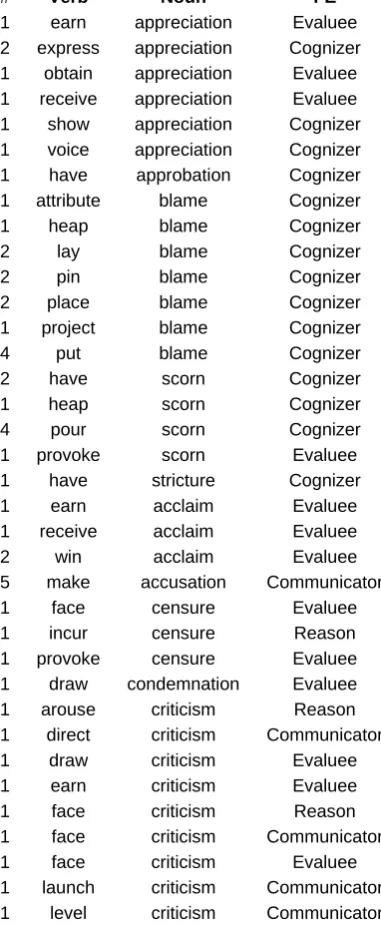
# Verb Noun FE
1 earn appreciation Evaluee
2 express appreciation Cognizer
1 obtain appreciation Evaluee
1 receive appreciation Evaluee
1 show appreciation Cognizer
1 voice appreciation Cognizer
1 have approbation Cognizer
1 attribute blame Cognizer
1 heap blame Cognizer
2 lay blame Cognizer
2 pin blame Cognizer
2 place blame Cognizer
1 project blame Cognizer
4 put blame Cognizer
2 have scorn Cognizer
1 heap scorn Cognizer
4 pour scorn Cognizer
1 provoke scorn Evaluee
1 have stricture Cognizer
1 earn acclaim Evaluee
1 receive acclaim Evaluee
2 win acclaim Evaluee
5 make accusation Communicator
1 face censure Evaluee
1 incur censure Reason
1 provoke censure Evaluee
1 draw condemnation Evaluee
1 arouse criticism Reason
1 direct criticism Communicator
1 draw criticism Evaluee
1 earn criticism Evaluee
1 face criticism Reason
1 face criticism Communicator
1 face criticism Evaluee
1 launch criticism Communicator
1 level criticism Communicator
2 make criticism Communicator
1 prompt criticism Reason
1 provoke criticism Reason
2 receive criticism Communicator
1 receive criticism Evaluee
1 target criticism Communicator
1 voice criticism Communicator
2 attract praise Evaluee
1 confer praise Communicator
1 draw praise Evaluee
1 earn praise Evaluee
3 give praise Communicator
3 have praise Communicator
3 heap praise Communicator
2 receive praise Evaluee
4 sing praise Communicator
2 win praise Communicator
2 win praise Evaluee
1 employ ridicule Communicator
1 pour ridicule Communicator
Figure 1: Table of some extracted support verbs. The first column shows the number of examples of this support
verb tuple found in the FrameNet corpus. Appreciation,
blame, scorn and structure are from the Judgment frame,