Compact Microstrip UWB Power Divider with Dual Notched Bands
Using Dual-Mode Resonator
Lihua Wu1, Shanqing Wang2, Luetao Li3, and Chengpei Tang4, *
Abstract—In this paper, a novel ultra-wideband (UWB) power divider with dual notched bands using square ring multiple-mode resonators (SRMMRs) is presented. The characteristics of the proposed SRMMRs are investigated by using even- and odd-mode analysis. Then, the initial UWB performance is achieved by introducing SRMMRs to the basic Wilkinson power divider. Finally, two desired notched bands inside the UWB passband are achieved by embedding a pair of coupled dual-mode stepped impedance resonators (DMSIRs) into the SRMMRs. The central frequencies of the notched bands can be easily controlled by the electrical length of the DMSIRs. To validate the design concept, a novel compact UWB power divider with dual notched bands centered at frequencies of 5.8 GHz and 8.0 GHz is designed and measured. The simulated and measured results indicate that it has a low insertion loss and good return loss performance at all the three ports, and a high isolation between the two output ports across the UWB bandwidth from 3.1 to 10.6 GHz with a small size of 0.46λg×0.69λg, whereλg is the guided wavelength at 6.85 GHz.
1. INTRODUCTION
Power dividers play an important role in communication systems, such as transceivers, phase arrays, and power amplifiers, due to their ease of design and good performance. The most popular power divider is the Wilkinson power divider, which obtains completely matched output ports with sufficiently high isolation between them. However, it has less than 20% fractional bandwidth. With the rapid growth of unlicensed use of ultra-wideband (UWB) for radar imaging system, short-range broadband communication, and indoor wireless communications systems, there has been tremendous interest in exploration of various UWB components allocated 3.1 ∼ 10.6 GHz band. To achieve this goal, a few typical methods to design UWB power dividers have been developed so far [1–10].
In [3], multi-section Wilkinson power dividers have to be cascaded, which increases the size and insertion loss to obtain wider bandwidth. However, the fractional bandwidth is not ideal. In [4], a waveguide power divider with high power capacity and very low insertion loss is designed. However, the waveguide structure is large and inflexible. In [5], parallel-coupled lines and stepped-impedance open-circuited stubs are directly cascaded to construct UWB power dividers, which will increase fabrication cost. In [6], a multilayer broadside-coupled structure is used to obtain UWB performance, but the multi-layer structure is hardly compatible with the existing microwave-integrated circuit. What is more, the existing wireless networks like 5.8 GHz WLAN signals and some 8.0 GHz satellite communication systems signals can interfere with UWB networks, thus compact power dividers with dual notched bands are emergently required to reject these interfering signals.
Received 9 January 2018, Accepted 24 March 2018, Scheduled 11 April 2018
* Corresponding author: Chengpei Tang ([email protected]).
In this paper, a novel UWB power divider with dual notched bands based on square ring multiple-mode resonators (SRMMRs) is proposed and designed. The resonance properties of the proposed SRMMRs with two pairs of resonance modes are theoretically analyzed. Then, the UWB performance is obtained by introducing SRMMRs to the basic Wilkinson power divider. Finally, two desired notched bands inside the UWB passband are achieved by embedding a pair of coupled dual-mode stepped impedance resonators (DMSIRs) into the SRMMRs. The central frequencies of the notched bands can be easily controlled by the electrical length of the coupled DMSIRs. To validate the design concept, a new compact UWB power divider with two notched bands centered at frequencies of 5.8 GHz and 8.0 GHz is designed and measured. Both simulated and experimental results are provided with good agreement.
2. INITIAL UWB POWER DIVIDER
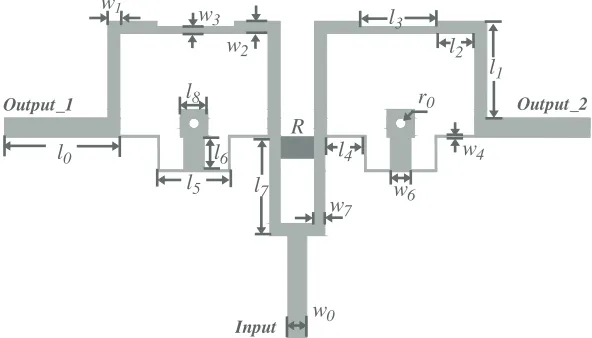
Figure 1 shows the layout of the proposed initial UWB power divider. The microstrip line l0 =λg/4 is used to achieve good impedance match at port 1. An isolation resistor R is placed at the end of
l7. Notice that meander transmission lines are also utilized in the design to further reduce the power divider size. The layout of the equivalent circuit of the SRMMR is shown in Fig. 2.
Output_1
l0
w0
Input
Output_2
l1
w1
l2
w2
w3 l3
l4 w4
l5
l6
w6
l8 r0
l7
w7
R
Figure 1. Layout of the proposed initial UWB power divider.
Por t 1 Por t 2
Y1 2θ1
Y2 θ2 Y2 θ2
Y3 θ3
θ4 Y4
Y3 θ3
Figure 2. Schematic of the proposed SRMMRs.
To illustrate the design theory, the resonance characteristics of the initial UWB power divider with various dimensions are analyzed with HFSS 12.0. The proposed UWB power divider is fabricated using Rogers 4050B with a thickness of 0.508 mm, relative dielectric constant of 3.38 and loss tangent of 0.009. The dimensions are selected as follows: l0 = 6 mm,l1= 5.7 mm,l2 = 2.9 mm,l3 = 4.4 mm,l4 = 2.1 mm,
Y2 θ2
Yi n e
Y1 θ1
Y3 θ3 2Y4 θ4
Y2 θ2
Yi n o
Y1 θ1
Y3 θ3
(b) (a)
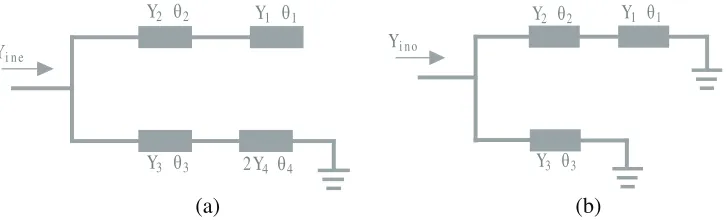
Figure 3. The Equivalent circuit model of the proposed SRMMRs. (a) Even mode circuit model. (b) Odd mode circuit model.
w3 = 0.5 mm, w4 = 0.1 mm, w6 = 1.2 mm, w7 = 0.6 mm, r0 = 0.3 mm. The size of the whole circuit is 20 mm×30 mm.
The even- and odd-mode analysis method can be employed to the proposed initial UWB power divider for the symmetry characteristics of the new structure. The simple schematic of the SRMMR is shown in Fig. 2, while the odd- and even-mode equivalent circuits are shown in Figs. 3(a) and (b).
From port 1 to port 2, two transmission paths with characteristic admittance Y2 and Y3 are introduced, a shorted stub with characteristic admittance Y4 and electrical length θ4 is connected in the center of the second transmission path. The characteristic impedance at port 1 is 50 Ω. When the even-/odd-mode signals are excited from ports 2 to 1, a virtual open/short stub-loaded resonator appears along the centre of the square ring resonator. In the even mode, the stepped impedance stub is divided in half along the plane of symmetry. In the odd mode, the plane of symmetry can be considered as a ground plane, with no current flows through the plane of symmetry. The even/odd-mode input admittance Yine/Yino of Fig. 3 can be illustrated as:
Yino = −jY3cotθ3−j
Y1cotθ3−jY2tanθ2
Y2+Y1cotθ1tanθ2
(1)
Yine = jY2
Y1tanθ1+Y2tanθ2
Y2tanθ2−Y1tanθ1tanθ2 −
jY3
Y4cotθ4+ 2Y3tanθ3 2Y3+Y4cotθ4tanθ3
(2)
As analyzed in [3], due to the symmetry of the square ring resonator, the resonance frequencies can be calculated whenYine/Yino= 0 from one end of the even- and odd-mode circuit. Hence, it cannot solve the expressions for the two pairs of resonance modes directly. Thus, another two odd mode resonator frequencies fodd1 (θ1 = 120◦, 4f0/3) and fodd2 (θ1 = 180◦, 2f0) can be realized. As we can see, the bandwidth of the UWB power divider decreases as Y3 increases, and increases asf0 asθ4,Y4 increase. In this way, the bandwidth for the passband of the UWB power divider with the SRMMRs can be conveniently controlled by varying the characteristic matrix Y3, Y4 and θ4 when Y1, Y2 and θ1,θ2 are fixed. Therefore, by properly tuning the dimensions of the SRMMRs, a new compact microstrip UWB power divider can be achieved with a wanted bandwidth.
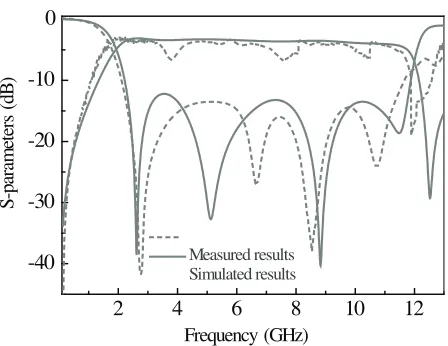
The measurement was carried out on the network analyser Agilent 85052D. The measured and simulated results are shown in Fig. 4. As we can see from Fig. 4, the fabricated UWB power divider has a passband from 2.1 GHz to 11.7 GHz. The return loss is under −10 dB, and the insertion loss is close to 3 dB, which ensures the good transmission performance in the passband.
3. UWB POWER DIVIDER WITH NOTCHED BANDS
2 4 6 8 10 12 -40
-30 -20 -10 0
S
-p
aram
eters
(d
B
)
Frequency (GHz) Measured results Simulated results
Figure 4. Simulated and measured performance of the initial UWB power divider.
le1 le2
we2
we3 le3
le4
we4 r0
Input Ouput
wgap
Figure 5. Geometry of the coupled DMSIRs.
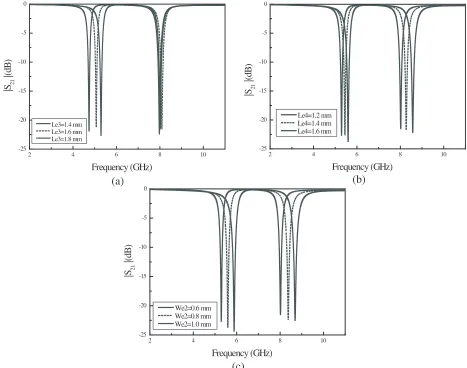
The transfer characteristics of the proposed DMSIRs with various dimensions are studied by HFSS 12.0, as shown in Fig. 6. It can be seen that the dual notched bands decrease simultaneously as we2 increases. However, only the upper notched band increases asle4 decreases, and only the lower notched band increases as le3 decreases. Therefore, by appropriately adjusting the resonator dimensions, dual notched bands can be achieved at desired frequencies.
2 4 6 8 10 -25
-20 -15 -10 -5 0
Frequency (GHz)
|S21
|(
dB
)
Le3=1.4 mm Le3=1.6 mm Le3=1.8 mm
2 4 6 8 10
-25 -20 -15 -10 -5 0
Frequency (GHz)
|S21
|(
dB
)
Le4=1.2 mm Le4=1.4 mm Le4=1.6 mm
2 4 6 8 10
-25 -20 -15 -10 -5 0
Frequency (GHz)
|S21
|(
dB
)
We2=0.6 mm We2=0.8 mm We2=1.0 mm
(b) (a)
(c)
Figure 6. Simulated S-parameters of the coupled DMSIRs for various dimensions: (a) Le3, (b) Le4, (c)W e2.
0 2 4 6 8 10 12 14 -50
-40 -30 -20 -10 0
S
-p
ara
m
ete
rs
(d
B
)
Frequency (GHz)
|S11|
|S21|
|S22|
|S23|
|S31|
|S33|
Figure 8. Simulated S-parameters of the designed UWB power divider with dual notched bands.
2 4 6 8 10 12 14
-40 -35 -30 -25 -20 -15 -10 -5 0
|S 21
|(
dB
)
Frequency (GHz) Measured Simulated |S11|
|S21|
Figure 9. Simulated and measuredS-parameters of the designed UWB power divider with dual notched bands.
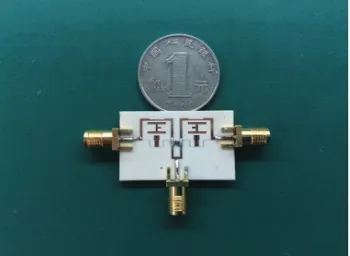
Figure 10. Photograph of the proposed UWB power divider with dual notched bands.
Table 1. Comparisons with other proposed UWB divider.
Ref. Circuit
dimension
Pass band (GHz)
Insertion loss (dB)
Notch frequency (GHz)/
[4] 3-D 3.5∼10.8 0.5 N/A
[5] 2-D 3.5∼10.1 0.4 N/A
[6] 3-D 3.1∼11.5 2.0 N/A
This work 2-D 2.1∼11.7 0.3 5.8/8.0
4. CONCLUSION
desirable frequency location by controlling the parameters of the DMSIR. The introduced DMSIRs are simple and flexible for blocking undesired narrow band radio signals appearing in UWB band. Using the advantage of small real estate, outstanding performance can be realised for broadband power divider, which is now widely demanded in UWB applications. To summarize, the proposed power divider is very useful for modern UWB wireless communication systems owing to its marked properties of simple topology, compact size, and excellent performance.
ACKNOWLEDGMENT
This paper is supported by the special fund of Guangdong frontier and key technology innovation (No. 2016B010108005), special fund of Guangdong applied science and technology research and development (No. 2016B010125001), Guangdong science and technology plan (No. 2016B090918110), 2015 Guangdong provincial-level information industry development special fund (Internet of Things Supports Industrial 4.0-oriented Steel Structure Intelligent Manufacturing System Development and Demonstration).
REFERENCES
1. Zhao, J. D., J. P. Wang, and J. L. Lin, “Compact UWB bandpass filter with triple notched bands using parallel U-shaped defected microstrip structure,” IET Electron. Lett., Vol. 50, No. 2, 89–91, 2014.
2. Wei, F., X. Wang, X. Zou, and X. Shi, “UWB filtering power divider with two narrow notch-bands and wide stop-band,”Frequenz., Vol. 72, Nos. 1–2, 2017.
3. Lee, S. W., C. S. Kim, K. S. Choi, J. S. Park, and D. Ahn, “A general design formula of multi-section power divider based on singly terminated filter design theory,” IEEE MTTS-S Int. Microwave Symp. Dig., Vol. 2, 1297–1300, Phoenix, AZ, USA, 2001.
4. Xue, Q. and K. Song, “Ultra-wideband coaxial-waveguide power divider with flat group delay response,”IET Electron. Lett., Vol. 46, No. 17, 1236–1237, 2010.
5. Wong, S. W. and L. Zhu, “Ultra-wideband power divider with good in-band splitting and isolation performances,”IEEE Microw. Wirel. Compon. Lett., Vol. 18, No. 8, 518–520, 2008.
6. Song, K.-J. and Q. Xue, “Novel ultra-wideband (UWB) multilayer slotline power divider with bandpass response,”IEEE Microw. Wirel Compon. Lett., Vol. 20, No. 1, 13–15, 2010.
7. Wang, J., W. Hong, H. J. Tang, Y. Zhang, J.-X. Chen, and J.-Y. Zhou, “Ultra-wideband bandpass filter with multiple frequency notched bands based on SIW and SIR technology,” Proceedings of the 36th European Microwave Conference, 268–271, 2009.
8. Abbosh, A. M., “Multilayer bandstop filter for ultra wideband systems,” IET Microw. Antennas Propag., Vol. 3, No. 1, 130–136, 2009.
9. Matthaei, G., L. Young, and E. Jones, Microwave Filters, Impedance-matching Network, and Coupling Structures, 219–220, Artech House, Norwood, MA, USA, 1980.