R E S E A R C H
Open Access
Research on image correction method of
network education assignment based on
wavelet transform
Weiwei Hu
Abstract
The network assignment image not only has a sharpness problem in the system audit but also the image angle deviates from the normal angle. Based on this, this study is based on image processing technology, using wavelet transform as the basic algorithm to process the image images collected by the network education system. At the same time, this study extracts the image content by wavelet transform in image edge recognition and enhances the image to enhance the image clarity. For the problem of image tilt, this study proposes a method of detecting the edge of the image with wavelet transform and then performing image tilt correction with Hough transform. In addition, this study compared the performance of the image correction method of this research and the traditional image method through experimental verification. Through comparative analysis, we can know that the performance of this research algorithm is better, and it can provide theoretical reference for subsequent related research.
Keywords: Wavelet transform, Network education, Job image, Correction, Image tilt
1 Introduction
With the continuous prevalence of online education, the network has replaced physical schools to a certain extent and has become an important part of the education model. At the same time, online education assignments are also carried out through online sub-mission. Under normal circumstances, after the image is collected, transmitted, and some other processing, it will inevitably lead to a decline in image quality. In particular, video under mobile surveillance will be af-fected by lighting conditions, relative motion, and at-mospheric flow, and image information will become blurred. At the same time, various types of noise are introduced during the transmission, which will make the image distorted. The same is true for network as-signment graphics, so the corresponding method is required to correct the job graphics [1].
The development of digital image processing tech-nology has gradually developed with the development of technologies such as computers and integrated cir-cuits. In the 1940s and 1950s, computers entered the
“electronic tube computer era” and “transistor
com-puter era.” Especially after the computer enters the “transistor computer era”, the processing speed of the computer has been greatly improved, and the re-source consumption is even less. At this time, the rise of computer programming language has led to the de-velopment of digital image processing technology [2]. A general-purpose computer based on the von Neumann structure has become a general-purpose digital image processing platform. This platform uses high-level language to write program code. The entire execution process is a single instruction and single data serial processing. The serial processing process inevitably brings the defects that cannot meet the high-speed processing requirements. It is suitable for some occasions where the processing speed is not high, and it is also suitable for the primary verifica-tion of image processing algorithms [3].
In order to solve the shortcomings of high-speed processing capability, multiprocessor systems and par-allel processing architecture computers have been given heavy responsibility. Scholars from various countries have conducted a lot of research in this
Correspondence:[email protected]
School of Foreign Studies, Ankang University, Ankang 725000, China
aspect. Computers and programming languages with multiple parallel structures have been proposed, which make multiprocessor systems overcome the limitations of serial work and improve the ability of computers to process data. However, even so, it is not parallel processing in the actual sense; its image processing capabilities still cannot meet the actual needs [4]. In order to solve the problem of insufficient real-time image processing capability, equipment manufacturers began to turn their attention to integrated circuit image processing special chips. The application specific integrated circuit chip (ASIC) is a hardware chip specially designed for a specific algorithm appli-cation [5]. ASIC has the advantages of high speed, good performance, high reliability, light weight, and small size, which is suitable for mass production. The ASIC is a dedicated chip, which takes a long time from design to production and practical application, and cannot be modified after the design is formed and the film is successfully succeeded, so the flexibil-ity is poor [6].
ASICs are suitable for high-volume image process-ing systems. In small-volume image processprocess-ing sys-tems, digital image processors (DSPs) are generally required to be replaced [7]. DSP is a special structure microprocessor designed for fast implementation of various digital signal processing algorithms. It has a dedicated hardware multiplier inside, and it uses a wide range of pipeline operations to provide special DSP instructions. DSP has been used as a processor for small batch image processing systems, and has been widely used in image compression and transmis-sion, image encoding and decoding, machine vitransmis-sion, image enhancement, and other fields. However, funda-mentally speaking, DSP only provides hardware optimization for some fixed operations, and its system is still serial instruction operating system, which makes it unable to meet the needs of many image al-gorithms, and its use is limited [8].
In recent years, with the development of programmable logic devices, most scientific research institutions and companies have used FPGA as a platform for image
pro-cessing system development, which has made
FPGA-based PLD technology widely used in image pro-cessing and achieved rapid development [9]. Field programmable logic gate array YIj (FPGA) devices are widely used programmable logic devices today, also known as programmable ASICs. Currently widely used FPGAs are based on SRAM technology, such as Altera Cyclone series, AlteraStratix series, XilinxVertex series, XilinxSpartan series, and so on. In addition, there are FPGAs based on Flash, EPROM, and anti-fuse technology. Machine vision surface inspection technology, as an emerging surface inspection method, has been widely
used in industrial production, such as the DualSen-sorTM steel surface inspection system developed by ISRAVISION Parsytec, Germany. The system uses a dual camera for surface fusion detection. Among them, the area array CCD camera cooperates with the infrared light dark field for imaging, and the linear array CCD camera combines the visible light source directly into the bright field for imaging. The system combines the characteristics of different light sources, different cameras and different illumination modes, and utilizes a combination of multiple configurations to effectively enhance the accuracy and real-time per-formance of steel plate surface inspection. At the same time, the system can also be well adapted to steel sheets with different thickness and surface con-ditions [10].
SURFILESDIRIS 3D rail surface inspection equip-ment was developed by Austrian Nextsense. The de-vice uses four cameras and four lines of laser light source to circumscribe the symmetrical arrangement to perform 3D scanning imaging on the entire surface of the rail to realize stereoscopic imaging of the rail, thereby achieving the purpose of surface inspection. At the same time, the device also has a special laser device to identify and read the rail number. The de-vice not only detects and records the identification of defect characteristics but also is resistant to high tem-peratures, which can be applied to long strip products with temperatures up to 1000 °C [11].
According to the above analysis, the current image tection and image correction techniques have been de-veloped, but the research on applying it to network job image correction is less. Therefore, based on wavelet transform image processing technology, this study de-tects and analyzes network education assignment im-ages, and improves the efficiency of network education, laying a foundation for the development of follow-up network education.
2 Research methods
2.1 Wavelet assignment image enhancement processing
Wavelet, as its name suggests, refers to a small area, a finite length, and a waveform of zero energy.
“Small” means that it is attenuating, “wave” means
Wavelet transform has achieved good application in image enhancement. Image enhancement using wave-let transform is mainly divided into four steps [14]: image acquisition, wavelet transform, enhancement processing, and wavelet inverse transform. The
wave-let transform of the image is based on the
two-dimensional wavelet transform, that is, based on the Mallat tower algorithm. The Mallat Tower algo-rithm was proposed by Mallat in 1989 on the basis of multi-resolution analysis, which acts like the fast Fou-rier transform in the FouFou-rier transform. Therefore, it is also called fast wavelet transform. The basic princi-ples of the Mallat Tower algorithm are: f(x,y)Hj+ 1 is
set to indicate that the image signal resolution is 2j+
1
, and f(x,y)Hj+ 1 is decomposed by a low-pass filter
to obtain a detail signal f(x,y)Gjbetween 2j+ 1 and 2j. The wavelet basis function ψ(x,y) of the image two-dimensional signal is known. The two-dimensional scaling function φ(x,y) is set to have separable proper-ties, i.e., φ(x, y) =φ(x) φ(y), so that the wavelet basis function of the detail space shape in three directions can be obtained [14]:
Ψ01ðx;yÞ ¼φð Þx Ψð Þy ð1Þ
Ψ10ðx;yÞ ¼Ψð Þφx ð Þy ð2Þ
Ψ11ðx;yÞ ¼Ψð Þx Ψð Þy ð3Þ
The wavelet basis function of the two-dimensional sig-nal is obtained:
ψij;;km;nðx;yÞ ¼2−jx−m;2−jy−n ð4Þ
On this basis, the low-frequency component and the high-frequency component of the image signal f(x, y) at different scales are obtained. The low-frequency compo-nent can be expressed as follows [15]:
f xð ;yÞHj¼ f xð ;yÞφj;m;nðx;yÞ ð5Þ
The high-frequency component can be expressed as follows:
f xð ;yÞG01
j ¼ f xð ;yÞψ01j;m;nðx;yÞ ð6Þ
f xð ;yÞG10
j ¼ f xð ;yÞψ10j;m;nðx;yÞ ð7Þ
f xð ;yÞG11
j ¼ f xð ;yÞψ11j;m;nðx;yÞ ð8Þ
The selection of wavelet basis functions is crucial in wavelet decomposition. Different wavelet basis functions for the same image will get different enhancement effects.
Principles for selecting wavelet basis functions in image enhancement processing: (1) It has translation invariance. The continuous wavelet transform has
translation invariance, but it is destroyed when the translation parameters are sampled, that is, the discrete wavelet transform does not have this prop-erty. In order to ensure translation invariance, a cer-tain amount of redundancy needs to be introduced for the transform coefficients. (2) Solving the bound-ary effect problem. Commonly used solutions include periodicizing the signal and constructing a boundary wavelet function. The Daubechies wavelet is a com-pactly supported orthogonal base that can achieve ac-curate reconstruction, but the disadvantage is that the compact wavelet does not have symmetry, so the boundary effect increases with the increase of the scale. The spline wavelet is a non-compact orthogonal symmetrical wavelet with high smoothness, good fre-quency characteristics, strong frefre-quency dividing abil-ity, small frequency coherence, and linear phase characteristics. However, in the low order, the time domain decays very quickly, and the cutoff is poor in the frequency domain. In practical applications, it is necessary to select a suitable wavelet basis function according to the specific situation to obtain a better enhancement effect. In this topic, we choose Hal wavelet as the wavelet basis function. Hal wavelet has a good localization feature, its orthogonal set is a spe-cific value in the specified area, but in other areas, it is composed of square wave blocks with attenuation of 0. In the interval [0,1], as long as the square inte-grable function can be expanded into the Harr series, the Haar wavelet transform is easier and faster than other transforms.
The 2D wavelet decomposition process of the image will be convolved with the 1D low-pass filter (H) and the high-pass filter (G) in rows and columns, and then resampled (down two samples). In contrast, the inverse wavelet transforms of the image first re-samples the col-umns and rows (up to two samples) and then convolves with the one-dimensional low-pass (H) and high-pass (G) filters.
The specific implementation process of the algo-rithm: (1) The image signal f(x, y) is transformed into a wavelet transform function (WTf)j, k(x,y). Among
them, j is the scale level and k is the decomposition direction. (2) The threshold (WTf)j, k(x,y) of the wavelet Tj, k(x,y) is calculated. The processed image
than Tj, k(x,y), and the expansion enhancement pro-cessing is performed on the wavelet coefficient larger than Tj, k(x,y):
W Tf
j;kðx;yÞ
h i
new ¼Gj;kðx;yÞ W Tf
j;kðx;yÞ ð9Þ
Gj, k(x,y) represents the gain in the corresponding scale and direction.
(4) After the processed wavelet coefficients are in-versely transformed, the enhanced image signal func-tion f(x, y) is obtained. The above algorithm can enhance the high-frequency component of the image, compress the low-frequency component of the image, and realize the compensation of the image contour information. Because the contour of the image con-tains a large number of spatial high-frequency compo-nents, the high-frequency components are relatively prominent, which obviously enhances the contour of the image. In this way, a large amount of detailed in-formation contained in the image can be clearly dis-played for image enhancement purposes.
2.2 Image edge detection
From the introduction of wavelet transform theory above, wavelet transform has good locality and multi-resolution characteristics. Therefore, applying wavelet transform to image edge detection can greatly improve accuracy and ef-fectiveness. h(x,y) is set to be a two-dimensional image smoothing function, which is defined as
ψ1ðx;yÞ ¼∂h xð ;yÞ
∂x ;ψ2ðx;yÞ ¼
∂h xð ;yÞ
∂y ð10Þ
Its two first-order partial derivativesψ1(x,y) andψ2(x,y) are used as two-dimensional wavelets. The wavelet trans-form of the image f(x,y) is shown in the following equa-tion under the scale S:
Wxs½f xð ;yÞ ¼ f xð ;yÞ ψ1sðx;yÞ ð11Þ
Wys½f xð ;yÞ ¼ f xð ;yÞ ψ2sðx;yÞ ð12Þ
As above, when the scale S = 2j, the wavelet transform is as shown in Eq. (13):
Wxs½f xð ;yÞ Wys½f xð ;yÞ
¼2
∂
∂xðf h2jÞðx;yÞ
∂
∂yðf h2jÞðx;yÞ 2 6 4 3 7 5 8 > < > :
¼2j!∇ðf h2jÞðx;yÞ ð13Þ
At this time, the Eq. (13) is called the dyadic wavelet transform of the imagef(x,y). The matrixes and gradient directions of the gradient vector !ð∇ f h2jÞðx;yÞ are
shown in Eqs. (14) and (15), respectively:
Mf 2 j;x;y¼
ffiffiffiffiffiffiffiffiffiffiffiffiffiffiffiffiffiffiffiffiffiffiffiffiffiffiffiffiffiffiffiffiffiffiffiffiffiffiffiffiffiffiffiffiffiffiffiffiffiffiffiffiffiffiffiffiffiffiffiffiffiffi WX
2j½f xð ;yÞ
2
þWy2j½fðx;yÞ
r
ð14Þ
Af 2 j;x;y¼argtanW
y
2j½f xð ;yÞ WX
2j½f xð ;yÞ
ð15Þ
Using Eq. (5), for each scale 2j, the local maximum point of the modulus in the gradient direction is ob-tained. Edges and noise are points where the gray level changes sharply, so the resulting point may be noise or edge points. However, according to the multi-scale thinking, when the scale increases, the noise decreases rapidly, while the edge-following scale does not change much. The detailed detection edge steps are as follows:
1. After the imagef(x,y) is wavelet transformed, the model image family and the phase angle image family are formed at different scales, which are respectively recorded asM2jfðx;yÞandA2jfðx;yÞ. 2. In the mode imageM2jfðx;yÞ, the local modulus
maximum points along the phase angle direction A2jfðx;yÞare found. By retaining these local
modulus maximum points and marking the pixels of other non-local modulus maximum points to zero, a possible edge imageB2jðx;yÞcan be obtained.
3. Ann×nsmall window is applied to process the possible edge image, and the pixel modulus of the image is taken with a threshold processing and the appropriate thresholdTis selected. A pixel whose modulus value is greater than the thresholdTis reserved, and a pixel whose modulus value is smaller than the threshold is set to 0. After the threshold processing is performed as described above, the edge image obtained at the
corresponding scale can be obtained from the possible edge imageB2jðx;yÞ.
4. According to steps 1–3, the edge images at all scales are found.
5. The edge map obtained at each scale according to the above steps is output.
Edge detection is performed on the original image by the edge detection algorithm based on wavelet trans-form, and the obtained effect is shown in Fig.1.
images. In view of the large amount of computation of Hough transform, this algorithm combines wavelet transform and Hough transform to complete the cor-rection of image tilt. The specific operation is (1) image preprocessing: the original oblique image is first grayscale, and then the grayscale image is binar-ized. (2) Edge detection: the tilted binary image ob-tained in step (1) is subjected to wavelet transform, and the edge line information of the image is ex-tracted to realize edge detection. (3) Inclination detec-tion: the image obtained in the previous step is then subjected to Hough transform to calculate the tilt angle. (4) Image rotation: according to the tilt angle obtained in the step (3), the image is rotated to ob-tain a corrected image.
2.3 Picture angle recognition for network assignments
Projection method is one of the commonly used tilt angle detection methods, which mainly utilizes the char-acteristics of projection maps. The deviation value of the projection map is an evaluation function of the tilt angle, and the tilt angle corresponds to the global maximum value of the function. The binary image matrix is as-sumed to be:
Iðx;yÞ ¼ 0 Representing black pixels 1 Represents white pixels
ð16Þ
The line projection in the horizontal direction of the image and the column projection in the vertical direc-tion are respectively calculated, and are expressed as follows:
I yð Þ ¼XHx¼−01I xð ;yÞð0≤y≤WÞ ð17Þ
I xð Þ ¼XWx¼−01I xð ;yÞð0≤x≤HÞ ð18Þ
In the formula, His the number of rows of the matrix, and W is the number of matrix columns. The projection process realizes the transformation of the two-dimensional function image to the one-dimensional function. If the image does not have any tilt, the peak of the line projection of the image and the peak of the projected image appear larger than the value and frequency after the image is tilted. It can be seen that the projection method performs a cer-tain rotation on the oblique image to the right and left in some specific steps. Whenever an angle is rotated, a new rotated image appears, and the computer image projection change rate and the peak average value appear, and the maximum rotation angle, that is the inclination angle of the original image, is obtained.
3 Results
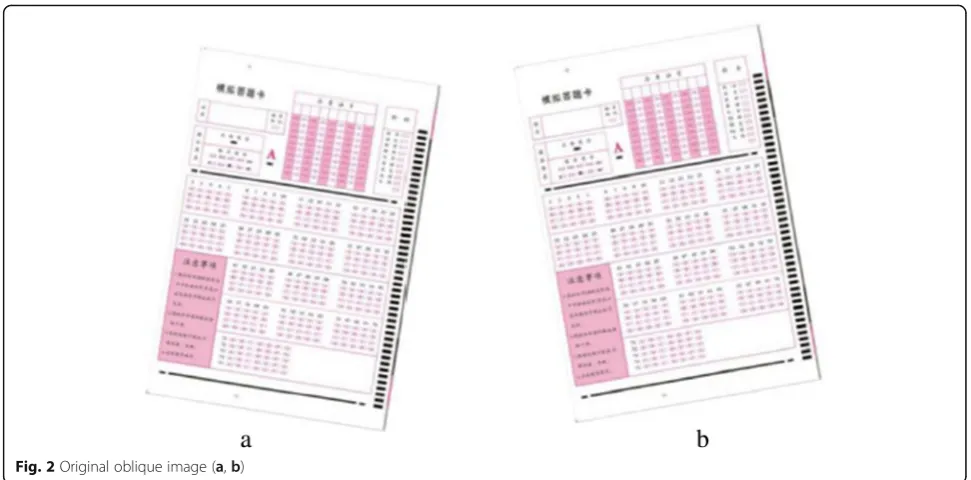
In order to verify the performance of the algorithm pro-posed in this paper, the traditional Hough transform cor-rection algorithm is selected as the comparison algorithm, and the two answer card images with different dip angles (a) and (b) are simulated and verified, as shown in Fig.2. Among them, the actual tilt angles of image (a) and image (b) are 9.36° and−10.12°, respectively.
First, the original image is subjected to edge detection based on wavelet transform. Combined with the algo-rithm proposed in this study and the particularity of net-work job images, the edge detection results shown in Fig.3are obtained in the analysis.
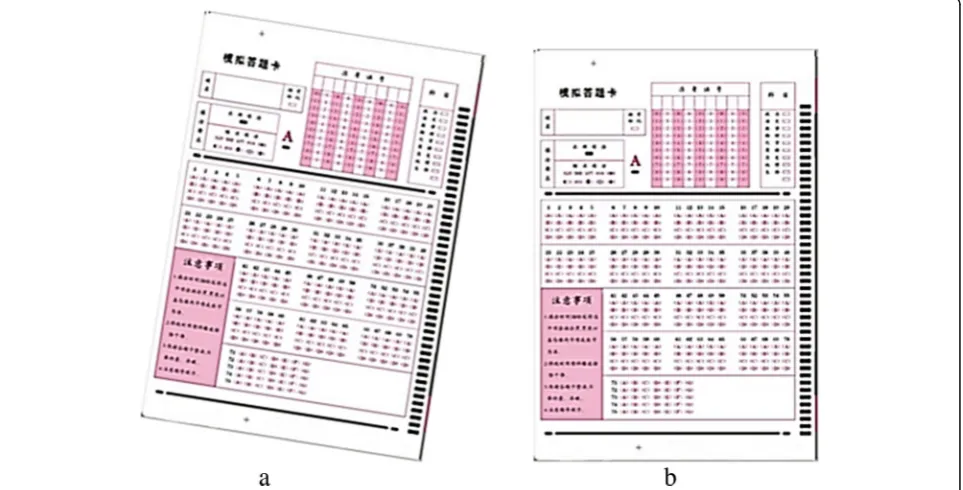
On the basis of edge recognition, the image is en-hanced to improve the image clarity, which is conveni-ent for teachers to improve efficiency in subsequconveni-ent review operations. The results obtained by wavelet trans-form in this study are shown in Fig.4.
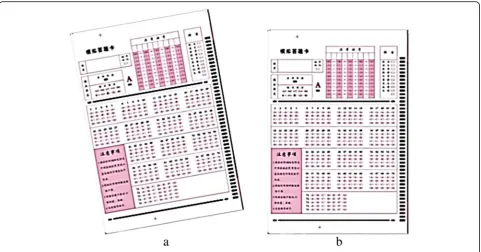
Among them, Fig.5a is the original image, and Fig. 5b is the corrected image.
Figure 6 shows the image correcting effect of Fig. 2b, among them, Fig. 6a is the original oblique image, and Fig.6b is the corrected image.
The parameters of the image detection process are counted, and the results are shown in Table 1. The two images in Fig. 2 are named as 9.36° image and − 10.12° image respectively, and the detection results of time and tilt angle used in the detection of the trad-itional algorithm and the algorithm image are com-pared. By comparing the length of use to compare
the detection efficiency of the algorithm, the shorter the time, the higher the efficiency. Simultaneously, the tilt angle detection result is compared with the actual tilt effect to judge the performance of the trad-itional algorithm and the proposed algorithm.
4 Analysis and discussion
Traditional oblique image detection algorithms have some shortcomings in image edge detection, image processing, image tilt recognition, etc. The traditional algorithm mainly considers the chromaticity value of the point near the recovery point as the chromaticity Fig. 2Original oblique image (a,b)
value of the point. This method has a simple calcula-tion process and has a good recovery effect on the color smoothing area, but the effect of the edge chan-ging position is not good, and edge blurring and color errors may occur. The weighting coefficient method is an edge-based interpolation method, which has a good effect on the edge processing, but it is difficult to implement in hardware due to complicated calcula-tion. In this paper, by combining the advantages of
both the traditional algorithm and the wavelet trans-form, and considering the correlation between the image information, the difference interpolation is per-formed in the gradient direction. Compared with the experimental results, the combination method of the research algorithm has a good recovery effect at the edge position, and at the same time reduces the calculation amount and is easy to implement in hardware.
Fig. 4Original oblique image (a,b)
It can be seen from the above several experiments that whether it is a grayscale transformation or a histogram correction method, the image information is globally processed, and the processing method is simple and practical. However, if the image contains local feature in-formation, these algorithms cannot get better processing results, and even cause partial information degradation. The image enhancement method based on wavelet transform solves this problem better. By wavelet decom-position of the image, the detail information at different resolutions can be separated, and then the wavelet coef-ficients at different scales are separately enhanced, so that the contour and detail information of the image are well enhanced. After comparing the images processed by different methods, it is found that the details processed by the wavelet transform method are obviously en-hanced, the layering is also improved, and the visual ef-fect is very good.
This article studies the image detection algorithm for online education assignments. According to the charac-teristics of network job images and the possible prob-lems in the actual submission process, an image
correction and detection algorithm based on wavelet transform is proposed. The method performs gray scale correction by estimating the background of the real image, basically eliminates the non-uniform illumination effect of the surface image, and combines the wavelet transform vision with the object vision to detect the un-clear region of the surface image, which is un-clear and ef-fective. The network operation image based on wavelet transform can be applied to the online monitoring sys-tem of network education, and the image can be effect-ively monitored through the collected assignment image of network education. Edge detection can accurately capture the image, then enhance the image, improve the image sharpness, and then detect the blurred area, so that the area content can be better detected, and the image tilt can be calculated and processed, and then the image can be restored to meet the teacher’s review requirements.
In the research, the wavelet transform theory is intro-duced, and the wavelet correction algorithm based on wavelet transform is proposed. The algorithm firstly uses wavelet transform technology to reduce the resolution of the image, then uses edge detection technology to obtain the edge information of the binary image, and combines the Hough transform to find the tilt angle of the image. The algorithm compensates for the large computational complexity of the Hough transform to a certain extent, and shortens the computational time while improving the effect.
This paper proposes a projection method for image processing through projection scanning in online Fig. 6Image detection results with a tilt angle of−10.12°.aOriginal oblique image.bCorrected image
Table 1Comparison of various parameters of image correction
Image Parameter Traditional algorithm
Algorithm proposed in this paper
9.36° image Time (s) 2.87 1.01
Angle (°) 10.13 ° 9.36° −10.12° image Time (s) 1.45 0.35
education assignment submission. The method scans a job subject at any position and any size in the scan space, and obtains an offset value of the projection cen-ter position from the artifact width on the reconstructed image. Then it corrects the position of the projection data and finally eliminates ring artifacts on the recon-structed image. This method does not require a dedi-cated model, and it is also more accurate than the direct measurement method.
Because the real-time requirements of the algorithm are high in the oblique image detection system, the image angle judgment and correction algorithm based on wavelet ana-lysis is introduced for the characteristics of the eye tracking image. The algorithm not only can effectively correct the distorted image, but also has high efficiency. In the actual operation, the algorithm first maps the acquired image data onto an image, and defocus the image with the gravity cter extraction method. The algorithm then divides the en-tire image into a number of uniform rectangular regions. Finally, in each rectangular region, coordinate transform-ation is performed on the gaze coordinate points by a poly-nomial coordinate transformation method. Experimental analysis shows that the method can effectively correct the distortion image and reduce the running time compared with the traditional algorithm, which has good practical value. From the results shown in Fig.6and Table1, it can be concluded that the detection algorithm has a great im-provement in detection accuracy and operation efficiency compared with the traditional algorithm.
In addition, the algorithm of this study can be further improved. Specifically, the affine transformation parame-ters between the feature points of each frames are calcu-lated by extracting the strong corner feature of each frame of the dithered video sequence, and the trans-formation parameters in the window are smoothed by the method of accumulating and moving averaging, and affine transformation is sequentially performed for each frame. The affine transformation of the image contains rotation and translation, so the transformed frame has a margin at its edges. In order to display the affine trans-formed video sequence frame content as completely as possible, according to the translation parameters and ro-tation parameters in the affine transformation parame-ters, the largest inscribed rectangle (the center remains unchanged) visible area in convex polygon after each frame transformation is calculated. The smallest visible area is selected as the rectangular visible area of all frames of the video sequence.
5 Conclusion
Based on the image processing technology of wavelet transform, this study detects and analyzes the image of online education assignments, and corrects it to improve the efficiency of network education and lay a foundation
for the development of follow-up network education. In terms of image enhancement, this study uses wavelet transform as the basic algorithm. The selection of wave-let basis functions is crucial in wavewave-let decomposition. Selecting different wavelet basis functions for the same image will result in different enhancements. At the same time, the edge detection is performed by wavelet trans-form, which realizes the clear reproduction of the image content. On the basis of edge recognition, the image is enhanced, and the image clear effect is improved, which is convenient for teachers to improve efficiency in subse-quent review operations. In addition, the successful ap-plication of wavelet transform in the field of image edge detection provides a new method for the correction of oblique images. In view of the large amount of computa-tion of Hough transform, this algorithm combines wave-let transform and Hough transform to compwave-lete the correction of image tilt. In order to verify the perform-ance of the algorithm proposed in this paper, the trad-itional Hough transform correction algorithm is selected as the comparison algorithm, and the two answer card images with different dip angles are simulated and veri-fied respectively. The shorter the time used, the higher the efficiency of the algorithm. At the same time, this study compares the tilt angle detection result with the actual tilt effect to judge the performance of the trad-itional algorithm and the proposed algorithm. Through comparison and verification, it can be seen that the re-search algorithm of this paper has certain advantages compared with the traditional algorithm and has certain practicality.
Acknowledgements
The authors thank the editor and anonymous reviewers for their helpful comments and valuable suggestions.
Funding
Not applicable.
Availability of data and materials
Please contact author for data requests.
Authors’contributions
The author takes part in the discussion of the work described in this paper. The author read and approved the final manuscript.
Competing interests
The author declares that she has no competing interests.
Publisher’s Note
Springer Nature remains neutral with regard to jurisdictional claims in published maps and institutional affiliations.
Received: 29 October 2018 Accepted: 7 January 2019
References
2. O. Perederieieva, M. Ehrgott, A. Raith, et al., Numerical stability of path-based algorithms for traffic assignment. Optimization Methods Softw.
31(1), 53–67 (2016)
3. H. Ha, C. Yim, Scalable video transmission over wireless networks based on loss distribution and layer information. Wirel. Pers. Commun.83(3), 1–16 (2015)
4. X. Ma, Benefits assignment mechanism for construction machinery supply chain based on improved cooperative game model[C]//Advanced Materials Research. Trans Tech Publications.143, 971–975 (2011)
5. K. Ito, Y. Tsutsumi, Y. Date, et al., Fragment assembly approach based on graph/network theory with quantum chemistry verifications for assigning multidimensional NMR signals in metabolite mixtures. ACS Chem. Biol.
11(4), 1030 (2016)
6. A. Rafi, K.A. Samsudin, C.S. Said, Training in spatial visualization: the effects of training method and gender. J. Educ. Technol. Soc.11(3), 127–140 (2008) 7. J. Yao, F. Shi, S. An, et al., Evaluation of exclusive bus lanes in a bi-modal
degradable road network. Transp. Res. Part C Emerg. Technol.60, 36–51 (2015)
8. W. Jelkmann, Erythropoietin after a century of research: younger than ever. Eur. J. Haematol.78(3), 183–205 (2010)
9. X. Huang, H. Wang, Research the correction method of geometric distortion based on CCD optical system. Zho. Yi Liao Qi Xie Za Zhi40(3), 225 (2016) 10. X. Ma, S. Jiang, J. Wang, et al., A fast and manufacture-friendly optical
proximity correction based on machine learning[J]. Microelectron. Eng.168, 15–26 (2017)
11. X. Gong, R. Xiong, C.C. Mi, A data-driven bias-correction-method-based lithium-ion battery modeling approach for electric vehicle applications. IEEE Trans. Ind. Appl.52(2), 1–6 (2016)
12. S. Taran, V. Bajaj, Motor imagery tasks-based EEG signals classification using tunable-Q wavelet transform[J]. Neural Comput. & Applic., 1–8 (2018) 13. B. Yan, C. Yan, F. Long, et al., Multi-objective optimization of electronic
product goods location assignment in stereoscopic warehouse based on adaptive genetic algorithm. J. Intell. Manuf.29(6), 1273–1285 (2018) 14. J.B. Wekselblatt, E.D. Flister, D.M. Piscopo, et al., Large-scale imaging of
cortical dynamics during sensory perception and behavior. J. Neurophysiol
115(6), 2852 (2016)