APPLICATION FAST BI-DIRECTIONAL MATCH FOR IN
EAR RECOGNITION BASED ON SIFT FEATURES
1MA CHI, 2ZHU YONG YONG, 3TIAN YING
1,3 College of Software, University of Science and Technology Liaoning, Anshan 114051, China
2 Departments of Economics and Business Administration, Chongqing University of Education, Chongqing
400067, China
E-mail: [email protected], [email protected],[email protected]
ABSTRACT
The human ear is unique and stability and it has broad application prospects in the field of identity verification. Ear image matching is an important part of the ear recognition, has gained widely research. SIFT(Scale invariant feature transform) descriptor is one of the most effective local features that is used for scale, rotation and illumination invariant. In this paper a fast bi-directional matching algorithm based on SIFT is proposed. Firstly the single-feature points and multi-feature points in two images are extracted, then match the single-feature points and multi-feature points respectively by using the BBF(Best Bin First)-based bi-directional matching algorithm. The integrated matching pairs are the final matches. The experimental results show that the proposed algorithm can reduce mismatch probability and decrease the matching time.
Keywords: Ear Image Matching; Invariant Features; SIFT
1. INTRODUCTION
As a branch of the biometric identification, ear recognition has the advantages of easy collection, easy to accept, low-cost equipment and is unaffected by facial expressions[1]. Furthermore, The human ear has smaller the image size, a small amount of data processing, and more consistent color distribution. Finally, it is detectable and easily captured from a long distance and its appearance it is not altered by make-up, spectacles, beards or glasses, although, it is often occluded by hair and earrings. Image matching of the human ear is the important part of the human ear recognition[2]. Common sense, image matching[3] is a process based on known image patterns, to find the model of sub-image in strange and unknown images.
Feature extraction is one of the most important research areas in image matching. The quality of feature extraction affects the final match result directly. Feature descriptor is local features detected from image, such as angle points[4], edges[5], contours[6], etc., then according to the needs of matching target, the features to be combined and transformed, and then get steady feature vector, it can make matching easy. The image matching problem is transformed into feature
matching. In recent years, in the area of computer vision, target recognition and matching based on local invariant descriptors[7,8]has made significant progress.
This paper achieves SIFT-based human ear image matching using OpenCV. In order to reduce the mismatch rate, we propose a BBF-based bi-directional matching algorithm. And on this basis, a fast matching algorithm is proposed to realize BBF-based bi-directional matching. It can not only decrease the mismatch rate but also reduce the running time of matching algorithms.
2. SIFT FEATURES
keypoint descriptor is created from local image gradients.The main steps of algorithm [10] is:
1) Detect the scale-space extreme points: Under a variety of reasonable assumptions the only possible scale-space kernel is the Gaussian function. Therefore, the scale space of an image is defined as a function:
) , ( ) , ( ) , ,
(x y G x y I x y
L σ = σ ∗ (1)
where * is the convolution operation, that is a variable-scale Gaussian,
2 ) (
2 /2
2 1 ) , ,
( 2 2 σ
πσ
σ e x y
y x
G = − + (2)
To efficiently detect stable keypoint locations in scale space, using scale-space extrema in the difference-of-Gaussian function convolved with the image. DOG operator is:
( , , ) ( ( , , ) ( , , )) ( , )
( , , ) ( , , )
D x y G x y k G x y I x y L x y k L x y
s s s
s s
= - *
= - (3)
In order to find extreme points in scale space, and each sample point compare to all of its neighbors to know whether the image scale larger or smaller than its domain and adjacent domains point scale. The middle of checkpoint and with the same scales of 8 neighboring points .Compare with the upper and lower 9 × 2 total of 26 points which corresponding to the adjacent scales . Ensuring the two-dimensional image in space and space scales are detected extreme point.
2) Precise positioning extreme point: Three-dimensional quadratic function through the preparation and precise determination of location and scale of key points, while removing the low contrast and unstable critical points in order to enhance the stability of match and improve noise immunity.
3) Orientations are assigned to each keypoint location: The keypoint neighborhood pixel gradient direction distribution to describe the direction of parameters specified for each keypoint, so that the operator with rotation invariance. For each image
sample, L(x,y), at this scale, the gradient magnitude,
m(x,y), and orientation, θ(x,y), is precomputed
using pixel differences:
2 2
( , ) ( ( 1, ) ( 1, )) ( ( , 1) ( , 1))
m x y = L x+ y −L x− y + L x y+ −L x y− (4)
( , )x y tan 2(( ( ,L x y 1) L x y( , 1)) / ( (L x 1, )y L x( 1, )))y
θ =α + − − + − − (5)
Multiple orientations assigned to keypoints from an orientation hisogram, which significantly improve stability of matching.
4) Generation of keypoint descriptors:
After the orientations of the keypoints have been assigned, the gradient magnitude and orientation are computed at each sample point in their nearby region. A Gaussian function is used to weight the magnitude of each sample point. The feature descriptor is computed by accumulating the orientation histograms on the 4×4 subregions. Each histogram has 8 bins, so the SIFT feature descriptor has 4×4×8=128 elements. Finally, the feature vector is normalized o reduce the effects of illumination change [10].
3. SIFT-BASED OF BI-DIRECTIONAL
IMAGE MATCHING ALGORITHM
A. Image matching algorithm
When we using image matching features base on SIFT, after feature vector generated from the two images, take a critical point of image 1, and to find out two keypoints from image 2 where their euclidean distance is the shortest. Lowe found a method that can distinguish the nearest neighbor and second nearest neighbor. If distance percentage is less than a threshold of T, that is the right match.
Lowe and others proposed use of BBF (Best Bin First) algorithm to find the nearest neighbor and second nearest neighbor[7]. It is a modified k-d tree search algorithm. In fact, k-d tree algorithm spent most of the time in searching node, and only parts of the nearest neighbor nodes to meet the conditions. Therefore, they could limit k-d tree’s
leaf nodes to reduce the search time. When
backdate search, the nodes and the queried nodes are the order of increasing distance to search nodes. Searching along with a branch direction of the current node, a member will be joined the priority queue. This member records the information of a branch of the node in another direction, the location of the node in the tree and the distance between the node and the queried node. Finish searching a leaf node, the first term which is deleted from the priority queue as the current node. Continue to search for other branches that include the most nearest node.
B Bi-directional image matching algorithm
algorithm performance. Although SIFT features operator has good stability and uniqueness[4], the phenomenon of feature point’s mismatching still exists in actual matching. The paper summarized some reason that mismatching point pairs during the matching image using the SIFT-based operator:
1) Two different images, the different
coordinates position of the image 1 that may exist similar area in shapes, similar to image 2 within the corresponding region. Once extracted SIFT operator, the feature vector is very similar and may have mistakenly assigned;
2)As the SIFT operator's own characteristics, the
image of the same coordinate point may have multi-feature vectors. Multi-point feature vector matching theory can improve the robustness of the matching algorithm, but the actual match, the same image on multiple is similar to different points within the region, may have similar multi-feature vector. In this case, the image matching with the images to be matched, will increase the possibility of mismatching;
3) Select the matching threshold value T. When
T is small (T = 0.4), the matching accuracy rate is
higher and the mismatch rate reduce naturally;
when T is large (T> = 0.8), Mismatch rate increase;
In the field of the actual registration and recognition, we can adjust threshold value to meet
the change of application requirement. When T=0.6,
for the general demand, all the experimental
threshold values are obtained T = 0.6 in this paper.
Factors 1) and 2) can produce obvious
mismatching and many to one mismatching, or even lead to duplicate match point. In this paper we
propose BBF-based bi-directional matching
algorithm. The first matching reserve the matching point pairs 1 and 2 in the original image. Second matching, the known has been matched feature
point P(x, y) of image 2, a new matching point will
be find out from all feature points of image 1,
Euclidean distance of new matching point P(x, y)
seek respectively the with image 1, the Euclidean
distance of original point that P(x, y) in the first
match with image 1. Choose a smaller Euclidean distance of matching point pair that is the correct matching point pair. If the Euclidean distance is equaled, we view the original and the new match
point that image 1 corresponds to P(x, y) having the
same coordinates of points. This bi-directional matching algorithm aims at the factors 1) and 2) to mismatch point pair’s existence. It not only can effectively reduce the apparent mismatching, but also reduce the many to one mismatching. Based on
the above ideas, this paper has realized the corresponding algorithm that based on exhaustive bi-directional matching.
C Fast bi-directional matching algorithm
Because of SIFT operator own characteristics, this paper treat multi-feature vectors which have the same position in the image as many feature points. The position coordinates of the points with a single feature vector as a single feature point. Quick Match: before two images match, at first, a single
feature point and multi-feature points are
respectively extracted from images, then match a single feature point, at last match the multi-feature points. The integrated matching point pairs as the final matches. Compared with the direct matching two images of all the feature points, this method can reduce the run time of algorithms.
Set, n: image 1, the total number of feature points;
n1: image 1, the number of single feature point; n2:
image 1, the number of multi-feature points; m:
Image 2, the total number of feature points;m1:
image 2 the number of single feature point;m2:
image 2, the number of multi-feature points; then: 2
1 n
n
n= + , m=m1+m2 ,direct matching time
complexity:O(nm); fast matching time complexity:
) 2 2 1 1
(nm n m
O + . For ease of calculation, in image
1, the number of cycles of core code is used to approximate replace the execution time of algorithm, another set,a(0<a<n): a=n1; k1: in image 1, the proportion of single feature point held
by the multi-feature points, That n2=k1×a ;
a k
n=(1+ 1)× ; b(0<b<m); b=m1; k2: in image 2,
the proportion of single feature point held by the
multi-feature points, that m2=k2×b; m=(1+k2)×b.
Time difference of two algorithms:
0 ) 2 _ 1 ( ) 2 2 1 1 ( )
( − + = >
=
∆ mn n m n m k k ab (6)
4 . THE ANALYSIS OF MATCHING EXPERIMENTAL RESULTS
Experiment image database is from the human ear Laboratory of the University of Science and Technology Beijing. There are 77 people in the image library, the four images per person, with a
resolution of 300×400 pixels. The first one is ear
positive image, second and third one is respectively for the ear, +30 degrees and -30 degrees of depth rotated image, The first one is ear positive image, second and third one is respectively for the ear, +30 degrees and -30 degrees of depth rotated image, the fourth one is ear positive image of change the illumination conditions. At first, comparing the
difference between BBF-based bi-directional
matching and other algorithms in time and mismatch probability, further comparing the difference between BBF-based fast bi-directional matching and BBF-based bi-directional match on the running time. Finally, making a integrated test to compared with the BBF-based algorithm matching, BBF-based bi-directional matching, BBF-based fast bi-directional matching about the time and mismatch probability differences.
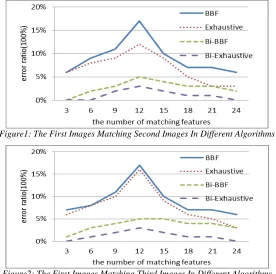
Experiment 1: Using first, second and third images of image database as test data to test the stability of the algorithm under the affine transformation. Comparison with the algorithm matching of BBF, the matching algorithm of exhaustion, BBF-based bi-directional matching, and exhaustive bi-directional matching algorithm’s different on running time, mismatch probability. Mismatch rate is:
es totalMatch misMatches
errorratio= / (7)
In equation(7), totlaMatches obtained by
matching the total number of matching point pairs,
misMatches obtained by artificial selection that the
wrong number of matching point pair. The test results are shown in Figure 1 and figure 2. Figure 1, matching the first images with second images, bi-directional matching can reduce the mismatch rate; Figure 2, matching the first images with third images, BBF bi-directional matching compared with exhaustive algorithm, can reduce the running time; comprehensive analysis of Figure 1 and Figure 2, BBF bi-directional matching algorithm can achieve a very low mismatch probability, but compare with the BBF algorithm, matching and running time is still slow.
Figure1: The First Images Matching Second Images In Different Algorithms
Figure2: The First Images Matching Third Images In Different Algorithms
Experiment 2: In order to verify the effect of the algorithm matches the image of the human ear illumination changes, we use first images and
[image:4.612.169.445.395.669.2]Figure3: The First Images Matching Fourth Images In Different Algorithms
From above figure that we can see our method has better stability for illumination change.
[image:5.612.88.525.72.238.2]Experiment 3: To verify Fast Bi-BBF time complexity. We select 8 set of images of the human ear experiment comparison of BBF-based bi-directional matching, the difference of BBF-based bi-directional matching based on fast matching’s idea (that is, BBF-based is fast than bi-directional matching) in running time. From the data of table 1 we can see that, regardless of the matching number of feature points, BBF-based is fast than bi-directional matching and it can reduce the running time at least 40%.
Table 1: Compare computing time between the BI-BBF match and the fast BI-BBF match
Image Pairs
Bi-BBF Match
Fast Bi-BBF Match
Reduced Ratio
(25,34) 24.69 ms 13.59 ms 44.96%
(18,23) 17.535ms 8.75ms 50.10%
(17,16) 14.77 ms 7.105 ms 51.90%
(16,25) 15.855 ms 8.225 ms 48.12%
(17,22) 16.25 ms 8.75 ms 46.15%
(13,14) 11.48ms 4.935 ms 57.01%
(20,29) 20.01 ms 10.93 ms 45.38%
(32,25) 26.72 ms 14.37 ms 46.22%
total 147.31 ms 76.655 ms 47.96%
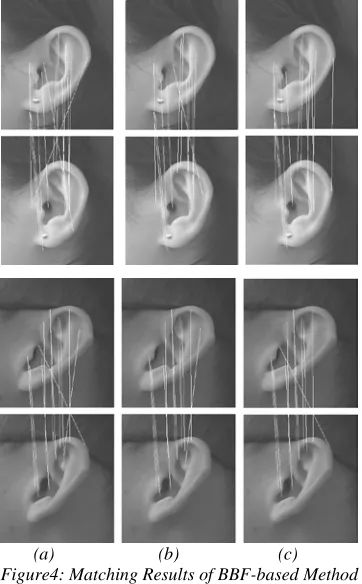
Figure 4 is the test result of USTB human ear image database, in which (a) is the BBF algorithm matching, (b) is the BBF-based bi-directional matching, and (c) is fast BBF-based bi-directional matching. We take the upside image in figure 4 as example, 12 matched pairs in figure (a), with three pairs of mismatching, running time is 7.4ms; 12 matched pairs in figure (b), mismatched 1 pair, 14.6ms; 12 matching pairs in figure(c) and with one pair of mismatching, 8.2ms. The results of comprehensive test show that, fast BBF-based bi-directional matching obtained the best performance while reducing the running time of matching.
(a) (b) (c) Figure4: Matching Results of BBF-based Method
This paper summarizes a large number of
experiments: BBF-based fast bi-directional
matching compared with the BBF-based bi-directional matching that the average reduction is 42% at the match running time.
5.CONCLUSIONS
[image:5.612.328.509.249.541.2]levels. The fast bi-directional matching could get a shorter running time based on the exhaustive algorithm, because the running time of BBF algorithm matching spend on creating the k-d tree and querying feature point.
The next step in this paper will study relation of matching feature points and the matching time from the theory and practice. And then realize the type of adaptive fast two-way matching: Whether using BBF-based fast bi-directional matching or exhaustive algorithm according to the number of matching feature points. The number of matching feature points decide which to be used, the fast bi-directional matching of BBF or the exhaustive algorithm.
A
CKNOWLEDGMENTS:
This paper is supported by LNEN Grant #L2010194
Thanks for the image library of Ear Recognition Laboratory at USTB.
REFRENCES:
[1] D J Hurley, M S Nixon, J.N.Carter. Force Field Feature Extraction for Ear Biometrics[J]. Computer Vision and Image Understanding, 2005, 98(3): 491-512.
[2] Chen Hui, Bhanu Bir, “Contour matching for
3D ear recognition”, Proceedings of the 7th
IEEE Workshops on application of computer vision. Breckenridge, CO,USA,2005,pp.123-128.
[3] L.G.Brown. “A survey of Image Registration
Techniques”, ACM Computing Surveys,
vol.24,no.4, 1992,pp. 325-376.
[4] HARRIS C, STEPHENS M. “A combined corner and edge detector”. Proceedings of the Fourth Alvey Vision Conference,1988,pp.47-151.
[5] TIAN Ying, YUAN Weiqi, “Automatic ear recognition based on contour curve and local feature”, Journal of Optoelectronics. Laser, vol.19, no.4, 2008, pp.549-553.
[6] Y. Rui, A. C.She, and T. S. “Huang. Modified fourier descriptors for shape representation - a practical approach”, International Workshop on Image Databases and Multi Media Search, 1996.
[7] Mikolajczyk K, Schmid C. “Scale & affine invariant interest point detectors”,
International Journal of Computer Vision,
vol.60, no.1, 2004, pp.63-86.
[8] Mikolajczyk Krystian,Leibe Bastian,Schiele Bernt, “Local features for object class
recognition”,Proc.ICCV[C].[S.l.]:[s.n.],2005,
2, pp.1792-1799.
[9] LOWE D G. “Object recognition from local
scale-invariant features”, International
Conference on Computer Vision,.Corfu,
Greece, Sep 1999, pp.1150-1157.
[10] LOWE D G. “Distinctive image features from
scale-invafiant key points”, International
Journal of Computer Vision, vol.60,no.2,2004,
pp.91-110.
[11] D. R. Kisku, M. Tistarelli, J. K. Sing, and P. Gupta, “Face recognition by fusion of local and global matching scores using DS theory: An evaluation with uni-classifier and
multi-classifier paradigm”, IEEE Computer Vision
and Pattern Recognition (CVPR) Workshop on
Biometrics, 2009.
[12] U. Park, S. Pankanti and A. K. Jain, “Fingerprint verification using SIFT features”,
Proceedings of SPIE Defense and Security
Symposium, 2008.
[13] A. Rattani, D. R. Kisku, M. Bicego, and M. Tistarelli, “Feature level fusion of face and fingerprint biometrics”, Proceedings of the 1st IEEE International Conference Biometrics: Theory, Applications and Systems, 2007, pp. 1-6.
[14] SUN Nong-liang, LI Huan-huan, YANG Ning,et al., “Identification of Correspongding Points Based on SIFT Twice Matching
Method”,Computer Engineering, no.4,