University of South Carolina
Scholar Commons
Theses and Dissertations
1-1-2013
Synthesis and Characterization of One
Dimensional Boron-Based Nanomaterials
Rui Li
University of South Carolina - Columbia
Follow this and additional works at:https://scholarcommons.sc.edu/etd
Part of theMechanical Engineering Commons
This Open Access Dissertation is brought to you by Scholar Commons. It has been accepted for inclusion in Theses and Dissertations by an authorized administrator of Scholar Commons. For more information, please [email protected].
Recommended Citation
S
YNTHESIS ANDC
HARACTERIZATION OFO
NED
IMENSIONALB
ORON-
BASEDN
ANOMATERIALSby
Rui Li
Bachelor of Materials Science and Engineering China University of Geosciences in Beijing, 2005
Master of Applied Chemistry
China University of Geosciences in Beijing, 2007
Submitted in Partial Fulfillment of the Requirements For the Degree of Doctor of Philosophy in
Mechanical Engineering
College of Engineering and Computing University of South Carolina
2013 Accepted by:
Xiaodong Li, Major Professor Anthony Reynolds, Committee Member
Guiren Wang, Committee Member Goutam Koley, Committee Member
ii
iii
D
EDICATIONTo
iv
A
CKNOWLEDGEMENTSFirst of all, I would like to take this opportunity to sincerely thank my advisor, Dr. Xiaodong Li, for his crucial advice, guidance and support in the research and courses of my graduate work. He deeply impresses on me his enthusiasm towards scientific research, his forsight in the field of nano community, and his extremely hard work to support the group. This dissertation could not be finished without his guidance and support. I highly appreciate all the efforts he has made for me since the beginning of my graduate study in Fall 2007.
I am very grateful for having an exceptional doctoral committee and wish to thank Dr. Tony Reynolds, Dr. Guiren Wang, Dr. Goutam Koley, for their valuable comments, suggestions and encouragement.
I would like to thank Dr. Andreas Heyden and Dr. Jianmin Lu for the assistance with DFT calculation. And thank Dr. Soumitra Ghoshroy, Ms. Jibin Zhao, Dr. Douglas Blom at the USC Electron Microscopy Center. And thank Dr. Hans-Conrad zur Loye and his group members for the characterization service. Thank Dr. Shuguo Ma for the XPS testing.
v
Zhao, Mr. Boran Zhou, Mr. Jianchao Chen, Mr. Yanming He, Ms. Ningning Song and Ms. Yang Sun.
vi
A
BSTRACTOne dimensional (1D) metal borate and boride nanomaterials have attracted tremendous attention due to their good chemical inertness, high-temperature stability, excellent mechanical properties, and low thermal expansion coefficient.
Beta-BaB2O4 (BBO) is a well-known nonlinear optical material with a high
second-order nonlinear susceptibility, wide transparency range, and high damage threshold. Using a low temperature, organic-free hydrothermal technique, single-crystalline barium polyborate Ba3B6O9(OH)6 (BBOH) nanorods were synthesized. It was
found that BBO nanospindles can be achieved by annealing the BBOH nanorods at a relatively low temperature of 810 oC. Transmission electron microscopy (TEM), X-ray diffraction (XRD), and X-ray photoelectron spectroscopy (XPS) techniques were used to characterize these nanomaterials. The formation mechanisms are discussed in conjunction with the crystallographic characteristics and surface energy of the BBOH nanorods and BBO nanospindles. UV-vis absorption spectra demonstrated that both BBOH nanorods and BBO nanospindles are transparent from the ultraviolet to the visible regions.
Single crystalline strontium borate (SrB2O4) nanorods were synthesized for the
first time via a sol-gel route at low temperature. The SrB2O4 nanorods have a good
vii
of SrB2O4 nanorods was measured to be 158.2 ± 7.9 GPa, exhibiting a significant
increase compared with other borate nanostructures and bulk borates. We calculated the Young’s moduli of bulk SrB2O4 and SrB2O4 nanorods with consideration of surface stress
effect of nanorods by density functional theory. The simulated results were found consistent with the experimental values.
Zirconium diboride (ZrB2) is a highly covalent refractory and ultrahigh
temperature ceramic material with a hexagonal crystal. This along with its relatively low density of ~6.09 g/cm3 and good high temperature strength makes it a candidate for high temperature aerospace applications such as hypersonic flight or rocket propulsion systems. We present the synthesis and structural characterization of ZrB2 nanorods.
Single crystalline ZrB2 nanorods were synthesized for the first time via a simple route at
a relatively low temperature of 800 oC. The XRD analysis revealed that the as-synthesized nanorods have hexagonal phase of ZrB2. In this Dissertation, the mechanical
properties of ZrB2 nanorods were also characterized by atomic force microscope-based
nanoindentation technique. Furthermore, the Young’s modulus of ZrB2 nanorods was
viii
T
ABLE OFC
ONTENTSDEDICATION ... iii
ACKNOWLEDGEMENTS ... iv
ABSTRACT ... vi
LIST OF TABLES ... xi
LIST OF FIGURES ... xii
LIST OF SYMBOLS ...xv
LIST OF ABBREVIATIONS ... xvi
CHAPTER 1INTRODUCTION AND LITERATURE REVIEW ...1
1.1BORON NANOMATERIALS ...1
1.2METAL BORATE NANOMATERIALS ...6
1.3METAL BORIDE NANOMATERIALS ...11
1.4DENSITY FUNCTIONAL THEORY FOR CALCULATION OF ELASTIC PROPERTIES OF NANOWIRES ...34
CHAPTER 2MOTIVATION AND RESEARCH OBJECTIVES ...38
2.1MOTIVATION ...38
ix
CHAPTER 3LOW TEMPERATURE, ORGANIC-FREE SYNTHESIS OF BA3B6O9(OH)6 NANORODS
AND ΒETA-BAB2O4 NANOSPINDLES ...40
3.1INTRODUCTION ...41
3.2EXPERIMENTAL ...42
3.3RESULTS AND DISCUSSION ...44
3.4CONCLUSIONS ...53
CHAPTER 4SYNTHESIS, STRUCTURAL, OPTICAL AND MECHANICAL CHARACTERIZATION OF SRB2O4 NANORODS ...54
4.1INTRODUCTION ...55
4.2EXPERIMENTAL ...56
4.3CALCULATION METHODS ...59
4.4RESULTS AND DISCUSSION ...60
4.5CONCLUSIONS ...74
CHAPTER 5ZRB2 NANORODS: SYNTHESIS, STRUCTURAL, NANOMECHANICAL CHARACTERIZATION AND CALCULATION BY DFT ...75
5.1INTRODUCTION ...76
5.2EXPERIMENTAL ...77
5.3CALCULATION METHODS ...79
5.4RESULTS AND DISCUSSION ...80
5.5CONCLUSIONS ...89
x
CHAPTER 7DIRECTIONS OF FUTURE WORK ...92
REFERENCES ...95
APPENDIX ACOPYRIGHT PERMISSION LETTER FOR CHAPTER 3 ...121
xi
L
IST OFT
ABLESTable 1.1. Summary of boron, borate and boride nanomaterials. ...20
Table 4.1. The single crystal elastic constants (cij in GPa) for SrB2O4 obtained from DFT
calculation.. ...70
xii
L
IST OFF
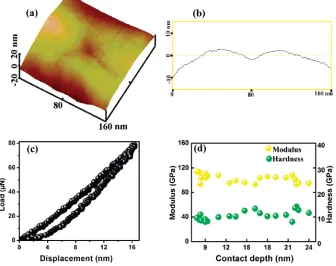
IGURESFigure 1.1. Nanoindentation on individual Ca2B2O5·H2O (CBOH) nanobelts. (a) 3D AFM
image of a nanoindentation mark made on a CBOH nanobelt. (b) Cross-sectional height profile of the nanoindentation mark shown in (a). (c)
Representative nanoindentation load-displacement curve. (d) Elastic modulus and hardness of as a function of indentation contact depth ...17
Figure 1.2. (a) Three-dimensional (3D) AFM image of a nanoindentation impression made on a clamped Al4B2O9 nanowire. (b) Cross-sectional height profile of
the indentation impression shown in (a). (c) Representative nanoindentation load-displacement curve. (d) Elastic modulus and hardness of Al4B2O9
nanowires as a function of indentation contact depth. ...18
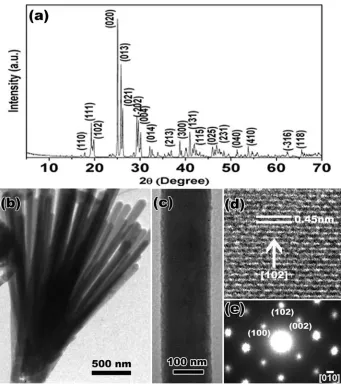
Figure 3.1. (a) XRD pattern of the sample synthesized via hydrothermal at 160℃ for 8 h, (b) low magnification TEM image, (c) high magnification TEM image, (d) HRTEM image, and (e) corresponding SAED pattern of BBOH nanorods....44
Figure 3.2. TGA and DTA curves of BBOH nanorods. ...45
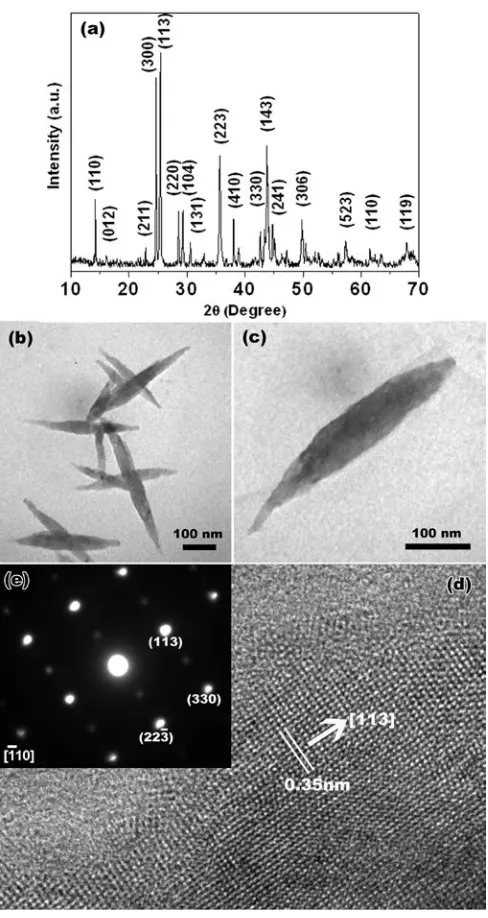
Figure 3.3. (a) XRD pattern, (b) low magnification TEM, (c) high magnification TEM, (d) HRTEM, and (e) corresponding selected area electron diffraction pattern of BBO nanospindles ...47
Figure 3.4. XPS spectra of (α) BBOH nanorods and (β) BBO nanospindles. (a) Survey spectra, (b), (c), and (d), detailed spectra of Ba 3d, B 1s and O 1s core levels, respectively ...48
Figure 3.5. UV-vis absorption spectrum of (α) BBOH nanorods and UV-vis absorption spectrum of (β) BBO nanospindles ...49
xiii
Figure 3.7. Schematic diagram showing the growth processes of BBOH nanorods in the autoclave (a-d) and BBO nanospindles in the alumina boat (e-h)...51
Figure 4.1. (a) XRD pattern and the corresponding JCPDS standard (PDF#84-2175) (b, c) SEM images, (d) EDS spectrum, (e) TEM image, (f) HRTEM image and (inset) corresponding FFT pattern of SrB2O4 nanorods. ...60
Figure 4.2. TGA and DTA curves of the precursor. ...62
Figure 4.3. XPS spectra of SrB2O4 nanorods. (a) Survey spectrum, (b), (c), and (d),
detailed spectra of Sr 3d, B 1s and O 1s core levels, respectively. ... 63
Figure 4.4. UV-vis absorption spectrum of SrB2O4 nanorods.. ... 64
Figure 4.5. FTIR spectrum of SrB2O4 nanorods.. ... 65
Figure 4.6. AFM-based three-point bending test on an individual SrB2O4 nanorod. (a)
Schematic image of an EBID-fixed SrB2O4 nanorod in a three-point bending
test with an AFM tip. (b) SEM and (c) AFM images of a fixed SrB2O4
nanorod suspended over the trench. (d) Representative bending force-piezo position (F-Z) curves of the SrB2O4 nanorod directly sitting on Si wafer and
the SrB2O4 nanorod bridging a trench with both ends of the SrB2O4 nanorod
fixed. ...66
Figure 5.1. XRD pattern of the ZrB2 nanorods and the corresponding JCPDS #34-0423
standard pattern. ...81
Figure 5.2. (a) SEM image, (b) TEM image, (c) HRTEM image and (d) corresponding fast Fourier transform (FFT) pattern of ZrB2 nanorods. ...81
Figure 5.3. XPS spectra of ZrB2 nanorods. (a) Survey spectrum, (b) detailed spectra of Zr
3d5/2, Zr 3d3/2 and B 1s core levels. ...82
Figure 5.4. Schematic image of an EBID-fixed ZrB2 nanorod in a nanoindentation test
with an AFM tip. ...83
Figure 5.5. (a) 3D AFM image of a nanoindentation impression made on a ZrB2 nanorod.
xiv
xv
L
IST OFS
YMBOLSEn Elastic modulus of SrB2O4 nanorods.
I Moment of inertia.
r Radius of the nanorod.
L The suspended length of the nanorod.
F Applied load.
B Bulk modulus.
G Shear modulus. ν Poisson’s ratio.
cij Elastic constants.
D Diameter.
xvi
L
IST OFA
BBREVIATIONS1D ... One Dimensional
AFM ... Atomic Force Microscopy
BBO ... β-BaB2O4
BBOH ... Ba3B6O9(OH)6
CTAB ... Cetyltrimethylammonium Bromide
CVD ... Chemical Vapor Deposition
DTA ... Differential Thermal Analysis
DFT ... Density Functional Theory
EBID ... Electron Beam Induced Deposition
EDS ... Energy Dispersive Spectroscopy
FESEM ... Field Emission Scanning Electron Microscopy
FFT ... Fast-Fourier Transform
FTIR ... Fourier Transform Infrared
HRTEM... High-Resolution Transmission Electron Microscopy
xvii
SEM ... Scanning Electron Microscopy
TEM ... Transmission Electron Microscopy
TGA ... Thermogravimetric Analysis
UV-vis ... Ultraviolet-Visible
XRD ... X-Ray Diffraction
1
CHAPTER 1
Introduction and Literature Review
Boron is a chemical element with chemical symbol B and atomic number 5, and has properties which are borderline between metals and non-metals. Because boron is produced entirely by cosmic ray spallation and not by stellar nucleosynthesis, it is a low-abundance element in both the solar system and the Earth’s crust.1
Boron-based materials have been widely applied in the areas of glass, ceramics, detergent formulations and bleaching agents, insecticides, semiconductors, magnets, high-hardness and abrasive compounds, shielding in nuclear reactors, and pharmaceutical and biological applications.1-47
The literature review on the boron-based nanomaterials in the following sections will be categorized into boron nanomaterials, metal borate nanomaterials and metal boride nanomaterials, in terms of synthesis, properties and applications of these boron-based nanomaterials.
1.1
Boron nanomaterials
2
is chemically inert and resistant to the attack of boiling hydrofluoric or hydrochloric acid. When finely divided, it can be attacked slowly by hot concentrated hydrogen peroxide, hot concentrated nitric acid, hot sulfuric acid or hot mixture of sulfuric and chromic acids.1
1.1.1 Synthesis of boron nanomaterials
The crystalline boron nanowires with mean diameter around 10 nm and typical length of several microns were prepared by using Si (100) as a substrate and a simple radio-frequency magnetron sputtering process under argon atmosphere with Au catalyst.48 The product was influenced by sputtering parameters, such as substrate temperature, sputtering pressure and sputtering time. This method required the vacuum (5.0×10⁻³ Pa), and highly pure argon gas (purity 99.99%) for sputtering deposition growth. Guo et al.
investigated amorphous boron rich nanowires obtained on ZrB2 particles using diborane
3
compounds.52 Large-scale arrays of feather-like boron nanowires were prepared using magnetron sputtering with a target of highly pure boron and boron oxide mixture.53 The branched boron nanofeathers always nucleated and grew on the same sidewall of the backbone nanowire. Yang et al. reported aligned single crystal boron nanowires by using nanochannel-Al2O3 as a substrate and a CVD process.54 Crystalline boron nanowires
were formed on Pt coated sapphire substrates using pulsed laser ablation at different temperatures under the pressure of 50 Pa.55,56 The synthesis temperatures, intensities of the laser beams, the types of the metal catalysts are the main factors on the growth for pulsed laser ablation method. Zhang et al. used boron powders as boron source and, Si and Ni as catalysts to synthesize boron nanowires.57 For this method, Si and Ni were critical in the synthesis of the boron nanowires. In addition, the boron nanowire yield was significantly improved when Si was added.
4
1.1.2 Properties of boron nanomaterials
Boron is a trivalent element possessing strong covalent bonds.49 As the nearest neighbor of carbon in the Periodic Table of the Elements, boron has exceptional properties, such as low density, low volatility, good resistance to corrosion, and high melting point. It is stronger than steel, harder than corundum, and lighter than aluminum.58 Boron is one of the hardest materials known (Vicker’s hardness, Hv = 3000 kg·mm–2).49 The mechanical response of crystalline boron nanowires was studied with the mechanical resonance method and tensile testing.59 The mechanical resonances of cantilevered boron nanowires were excited and their frequencies were used to obtain the Young’s modulus of the nanowires, according to simple beam theory.60 Electrical-transport studies on individual boron nanowires distinguished them as p-type semiconductors with low carrier mobility.61 It has been revealed that there are six stable configurations of boron nanowires obtained by growing along different base vectors from the unit cell of the bulk alpha-rhombohedral boron (alpha-B) and beta-rhombohedral boron (beta-B). It has been well known that, the bulk boron is usually metallic without magnetic property. However, theoretical results about the magnetic and electronic properties showed that, for both the alpha-B-based and the beta-B-based nanowires, the magnetic property was dependent on the growth direction. When the boron nanowires grew along the base vector [001], they exhibited ferromagnetism with the magnetic moments of 1.98 and 2.62 µB for the alpha-c
5
of 0.19 eV. So boron nanowires possessed the unique direction dependence of the magnetic and semiconducting behaviors, which was distinctly different from that of the bulk boron. Therefore, these theoretical findings would bring boron nanowires to many promising applications.58,61 High-pressure induced superconductivity in boron nanowires with rhombohedral crystal structure was studied by Sun et al.62 These boron nanowires became superconductors with T(c)=1.5 K at 84 GPa, while bulk beta-r-B was still a semiconductor at the same pressure.62 There was a study showing that the boron nanowire films had good field emission characteristics. The turn-on field was 9.0 V/μm and the threshold field was 14 V/μm.63 This turn-on field value of boron nanowires is better than that of In2O3 nanowires and GaN nanowires, but higher than that of graphene
(turn-on electric field of 0.7 V/m) and carbon nanotube (turn-on electric field of 2-3 V/m).173,174
In summary, these exceptional properties of boron nanomaterials, including mechanical, magnetic, conductive and optical properties, have been well reported. However, it is still not clear regarding the mechanism that governs these novel properties of boron nanomaterials with reference to the bulk boron materials. The properties of boron nanowires must be further studied in terms of solid-state physics and solid-state chemistry.
1.1.3 Applications of boron nanomaterials
6
compounds.51,52 Electrical-transport studies on individual boron nanowires established them as p-type semiconductors with low carrier mobility.61 Boron nanowires with rhombohedral crystal structure could serve as superconductors.62 It was reported that the boron nanowires could be applied in the field emission community, such as flat plane display and electron emission nanodevices.63
The bulk boron materials have been used in various fields, such as in the fields of glass, ceramics, detergent formulations and bleaching agents, insecticides, magnets, high-hardness and abrasive compounds, shielding in nuclear reactors. Some applications of the boron nanomaterials have been reported as mentioned above. However, more applications need to be investigated by learning from the well-developed applications of bulk boron materials, such as those in the fields of glass, ceramics, magnets, high-hardness, abrasive, and shielding in nuclear reactors.
1.2 Metal borate nanomaterials
Recently, more and more attention has been paid to the preparation and characterization of nanowires of the family of one dimensional metal borate nanomaterials due to their novel properties, such as chemical inertness, high-temperature stability, excellent mechanical properties, and low thermal expansion coefficient.1-47 In this section, synthesis, properties and applications of metal borate nanomaterials will be reviewed.
1.2.1 Synthesis of metal borate nanomaterials
Nanowires of metal borates Al18B9O33 and MgB4O7 were synthesized by thermal
7
oxide.13 This method may allow researchers to choose and combine other interesting oxide vapors to fabricate nanowires of new compounds. Anderson et al. investigated the phase transformations (dehydration, amorphization, crystallization, polymorphic transitions), thermal expansion of M+B5O6(OH)4·2H2O (M+ = K, Rb, Cs) compounds and
the polymorphic transformations of the CsB5O8 compound.90 Raja et al. prepared single
crystals of potassium pentaborate (KB5O8·4H2O or KB5) by low temperature solution
growth methods.16 High-aspect-ratio and single-crystal aluminum borate (Al18B4O33)
nanowire bundles with an ordered orientation were formed by using an innovative sucrose-assisted growth process.18 Sucrose, used as the monodispersed solvent and a novel adhesive template in this process, is a cheap and safe reactant. Therefore, this process is environment-friendly and easy for the large-scale production of high-aspect-ratio ordered orientation nanowire bundles.
Magnesium borate (Mg2B2O5) nanowires were obtained by CVD method.9 In addition,
Ma et al. reported single-crystal Al18B4O33 microtubes using solution method followed by
annealing at 1050 °C for 1 h under the gas flow of N2(H2).14 Zhao et al. synthesized
thorn-like polycrystalline Ca2B2O5·H2O microspheres with nano-sized slices using boric
acid and calcium hydroxide as reactants by a hydrothermal method.42 This method is catalyst-free, and carried out at low temperature. Hierarchical laminar superstructures of rhombic priceite (Ca4B10O19·7H2O) were reported in terms of hydrothermal synthesis,
8
morphology and structure of Al4B2O9 and Al18B4O33 nanowires could be controlled by
adjusting the boron oxide content in the sol-gel derived precursors and the calcined temperature. Strontium borate SrBO2(OH) and barium polyborate Ba3B6O9(OH)6 were
prepared using hydrothermal techniques.25 Zhang et al. studied uniformly BN-coated Al18B4O33 nanowires by the reaction of Al4B2O9 nanowires with ammonia at high
temperature.26 Experimental investigations by in situ providing the precursors for BN coating indicated that the reaction precursors strongly controlled the composition and morphology of aluminum borate nanomaterials. Liu et al. reported rod-like nickel borate by a thermal conversion route.32 These nickel borate rods had a length within the range of 6-20 μm. Therefore, this method is suitable for synthesizing micro-scale materials.
Bulk beta phase barium borate (beta-BaB2O4 or BBO) crystals were generally grown by
high temperature methods, such as the modified Kyropoulos and Czochralski techniques.3,6,8 The beta phase crystal could be directly synthesized from a BaB2O4
9
injection was implemented with a vertical downstream apparatus, avoiding continuous precursor injection and an inverted vertical reactor geometry.
To date, only a few of methods mentioned above have been used to synthesize barium borate nanomaterials, such as coprecipitation, sol-gel deposition, and metal organic chemical vapor deposition. Solution methods usually bring pollutions into the nanomaterials. In addition, the productivity and product purity by using these methods are low. Therefore, it remains a great challenge to develop a cost-effective and productive technique for synthesizing metal borate nanomaterials. Meanwhile, in order to obtain high-quality barium borate nanomaterials, we also need to pay more attention to the process of synthesis.
1.2.2 Properties of metal borate nanomaterials
One dimensional metal borate nanomaterials possess chemical inertness, high-temperature stability, excellent mechanical properties, as well as low thermal expansion coefficient.1-47 Below are the specific properties of metal borate nanomaterials reported in literature.
The optical, mechanical, lubricative and thermal properties of BBO were reported.4,5,6,11,12 The dielectric constant and loss tangent of single crystals of potassium pentaborate (KB5O8·4H2O or KB5) were determined as a function of
temperature.16 A novel fluorine beryllium borate crystal Sr0.23Ca0.77Na2Be2B2O6F2 has
10
The IR spectrum and thermal behavior of Sr0.23Ca0.77Na2Be2B2O6F2 were also
reported.64 Li3Cs2B5O10 was studied to be a congruently melting and deep UV
nonlinear optical material.40 Ni3(BO3)2 particles showed remarkable reflection within
the visible light wavelength range of 425-690 nm, as well as within the near ultraviolet wavelength range of 270-400 nm.32 The presence of NaCl during the synthesis did not show significant effect on the UV-vis properties of the Ni3(BO3)2
particles.
These novel properties of metal borate nanomaterials mentioned above have been studied, such as optical and mechanical properties. However, we still need to conduct futher investigation on more properties of metal borate nanomaterials with reference to the properties of bulk metal borates, such as chemical inertness, high-temperature stability. The mechanism that controls these novel behaviors must be further studied to explain the novel phenomena and measure new properties, and more attention should be paid to the relationship between the properties and structures of metal borate nanomaterials.
1.2.3 Applications of metal borate nanomaterials
11
A novel fluorine beryllium borate crystal, Sr0.23Ca0.77Na2Be2B2O6F2, exhibited a very
wide transmission range revealed by optical transmittance spectrum. Thus, it could be used as an optical material.64 The BBO crystal has typical applications in nonlinear optics, quantum electronics and radiation shielding.15,17,33,35,41 Potassium pentaborate was reported to be applied in dielectric components.16 Li3Cs2B5O10 is a deep UV nonlinear
optical material.40
In summary, some applications of metal borate nanomaterials have been reported in the fields, such as optical and mechanical applications. However, we should probe more applications, such as heterogeneous catalysis, sensors, energy conversion and storage, oxidation-resistant and whisker-reinforced composites, by measuring more novel properties of metal borate nanomaterials, understanding the growth mechanism and the relationship between the properties and structures of these metal borate nanomaterials.
1.3 Metal boride nanomaterials
1.3.1 Synthesis of metal boride nanomaterials
CoB thin films were obtained by the electroless coating technique and showed charge/discharge cyclic characteristics.65 A solid state heterojunction diode based on a micrometer thick n-Mg2B14 on p-type Si substrates was deposited by laser ablation.66 The
mechanochemical synthesis of W2B5 powders was carried out at room temperature.67
TiB2 were used to promote LiBH4-MgH2 composite for reversible hydrogen storage by a
novel three-step method.68 Hafnium boride (HfB2) was applied to improve the
12
process of in situ reaction and thermal gradient chemical vapor infiltration.69 Tungsten boride compounds were synthesized by self-propagating high-temperature synthesis method and following leaching process.71 Yin et al. reported the strength at elevated temperatures of in-situ toughened ZrB2-TiB2 ceramic composites that were prepared via
pressureless sintering at 2100 oC for 2 h.72 Yubuta et al. investigated the layered boride YbAlB4 single crystals with YCrB4-type and ThMoB4-type phases derived from a
hexagonal AlB2-type.82 It is significantly important for understanding transport and
magnetic properties to reveal the nanostructures of both phases in the real space.
Zirconium diboride (ZrB2) is a leading material in the category of ultrahigh temperature
ceramics (UHTCs) due to very high melting point, high thermal conductivity, good thermal shock resistance, low coefficient of thermal expansion, retention of strength at elevated temperatures and stability in extreme environments.110-112 Superior mechanical properties (hardness and four-point bending strength), thermal shock and oxidation resistance are due to the highly covalent nature of this ceramic. These properties render it potential candidate to thermal protection system for hypersonic flight and atmospheric reentry and rocket propulsion. When dropped in the atmosphere of earth, the nose cap and leading edge of space crafts have to endure very high temperature and high speed ions ablation.110 According to the reentry simulation testing, SiC reinforced ZrB2
13
1.3.2 Properties of metal boride nanomaterials
Metal borides, in general, have drawn significant attention because of their promising scientific and technological characteristics, such as efficient field emission, high melting point, hardness, chemical stability, antiablation capability, oxidation resistance, superconductivity, semiconducting, thermal neutron detecting, catalysis, wear resistance and magnetic properties.74,65 This section focuses on the synthesis, properties and applications of metal boride nanomaterials.
Among the metal borides, lanthanum hexaboride was mainly used in making filaments of electron microscope where a high brightness electron source with long service life was required. LaB6 had a unique combination of desired properties including high melting
point, high electrical conductivity, low work function and low vapor pressure at high temperature. This made it one of the best thermionic materials for high electron density cathodes.74 A solid state heterojunction diode based on a micrometer thick n-Mg2B14 on
p-type Si substrates was demonstrated as thermal neutron detector.66 WB has a lower compressibility at high pressure. From the partial densities of states (PDOS) of WB, it was found that the Fermi level was mostly contributed by the d states of W atom and p states of B atom, and the contributions from the s, p states of W atom and s states of B atom were small.75 Rodriguez-Castro et al. studied the wear resistance of the FeB/Fe2B
layers using the four-ball test.76 The brittleness results were comparable to the values of ceramic materials, such as sintered carborundum, Al2O3, and aluminum oxide nitride.
14
applications in ultra-high temperature environments where both oxidation and mechanical damage mechanisms (such as creep) were operative.77 CrB4 showed an
almost temperature-independent paramagnetism, consistent with low-spin Cr-I in a metallic compound. Conductivity measurements confirmed the metallic character.73 Fe2B
layers showed good fracture toughness determined by the Vickers indentation,79 and Berkovich nanoindentation.80 The structure stability, magnetism, electronic structure and elastic properties of Mo2FeB2 in nonmagnetic (NM), ferromagnetic (FM) and
antiferromagnetic (AF) cases were reported.70 HoB66 and LuB66 were studied on the
low-temperature specific heat, magnetic susceptibility, and thermal expansion.81 HoB66 had
one of the largest magnetic moments among all rare-earth ions, and hence a higher transition temperature into an ordered state might be expected. Nickel boride nanoparticles exhibited the activity of catalysis in hydrogenation reactions.78 Low temperature hydrogen treatment (T < 100 oC) of nickel boride nanoparticles in the presence of ethanol may induce a substantial increase in the catalyst activity for the direct hydrogenation.
15 nanomaterials.
1.3.3 Applications of metal boride nanomaterials
Metal boride nanomaterials should find applications in various areas, including glass, ceramics, catalysis, wear resistance, semiconductors, flat plane display and electron emission nanodevices, magnets, high-hardness and abrasive compounds, and shielding in nuclear reactors.74,65 In this section, the applications of metal borate nanomaterials will be discussed.
Hafnium boride (HfB2) was applied to improve the anti-oxidation and ablation
properties of carbon/carbon (C/C) composites.69 The wear resistance of the FeB/Fe2B
layers was reported by using the four-ball test.76 LaB6 could be used as filaments of
electron microscope and thermionic materials for high electron density cathodes.74HoB66
and LuB66 could be applied as magnets due to their low-temperature specific heat,
magnetic susceptibility, and thermal expansion.81 Nickel boride nanoparticles were used as catalyst in hydrogenation reactions.78 Although these applications of metal boride nanomaterials have been investigated, more applications of these nanomaterials still need to be further studied with reference to the applications of their bulk counterparts.
In our group, Mg2B2O5 nanowires with (010) twins were synthesized for the first time
using a catalyst-free method. The microstructure of the Mg2B2O5 nanowires was
extensively studied by cross-sectional high-resolution transmission electron microscopy. The mechanical properties of the Mg2B2O5 nanowires were tested by nanoindentation
16
achieved comparable hardness but 19% decrease in elastic modulus compared to their bulk counterpart. The elastic softening mechanisms of the Mg2B2O5 nanowires were
discussed with reference to their twin defects, size, and surface effects.20
Single crystalline Ca2B2O5·H2O (CBOH) nanobelts and stacking faulted Ca2B2O5
(CBO) nanogrooves were synthesized by catalyst-free routes and its structural and mechanical properties were characterized.28 The CBOH nanobelts grew along the [104] direction. The mechanical properties of the CBOH nanobelts (Figure 1.1) and the CBO nanogrooves were tested by nanoindentation performed directly on individual CBOH nanobelts and CBO nanogrooves. The measured elastic modulus and hardness of the CBOH nanobelts were 126.6 ± 15.2 and 6.3 ± 1.2 GPa, respectively. It was found that the CBOH nanobelts, with the presence of hydrated H2O, achieved 28.7% increase in elastic
modulus, whereas the stacking faulted CBO nanogrooves, with the absence of hydrated H2O, exhibited 99% loss in elastic modulus, compared to bulk CBO.
17
Figure 1.1 Nanoindentation on individual Ca2B2O5·H2O (CBOH) nanobelts. (a) 3D AFM
image of a nanoindentation mark made on a CBOH nanobelt. (b) Cross-sectional height profile of the nanoindentation mark shown in (a). (c) Representative nanoindentation load-displacement curve. (d) Elastic modulus and hardness of as a function of indentation contact depth. 28
Two kinds of aluminum borate nanowires, Al4B2O9 and Al18B4O33, were synthesized by
a one-step combustion method through control of the Al:B atomic ratio and synthesis temperature.85 Both nanowires are single crystalline but have distinguishing growth habits. Nanomechanical characterization (Figure 1.2) shows the elastic modulus and indentation hardness values of the Al4B2O9 nanowires were 102.8 ± 1.3 and 10.4 ± 0.3
GPa, respectively. It was found that the elastic modulus of Al18B4O33 nanowires was
18
respectively. Al18B4O33 nanowires exhibited higher hardness and elastic modulus than
Al4B2O9 nanowires.
Figure 1.2 (a) Three-dimensional (3D) AFM image of a nanoindentation impression made on a clamped Al4B2O9 nanowire. (b) Cross-sectional height profile of the
indentation impression shown in (a). (c) Representative nanoindentation load-displacement curve. (d) Elastic modulus and hardness of Al4B2O9 nanowires as a function
of indentation contact depth.85
19
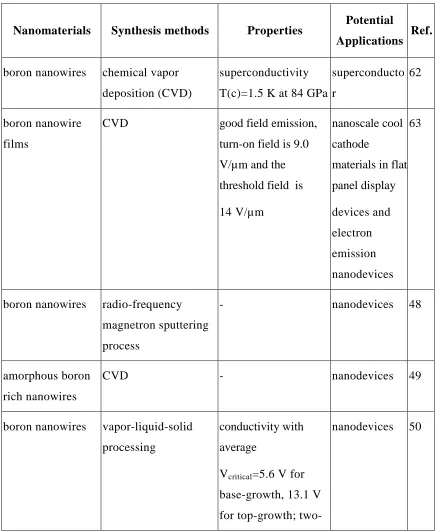
Table 1.1 summarizes the synthesis methods, properties and potential applications of boron, borate and boride nanomaterials. Various methods have been used to synthesize these boron-based nanomaterials. However, among these methods, hazardous chemicals or a torch sealed and evacuated tube system is usually essential. For example, the gas precursor, diborane, is usually used to synthesize boron nanomaterials, and it is hazardous to public health and the environment. Therefore, we should develop the methods for synthesizing boron-based nanomaterials without using diborane. It remains a great challenge to develop a not only easy, cost-effective, productive, but also environment-friendly technique for synthesizing boron-based nanomaterials. Meanwhile, we also should pay more attention to the process of synthesis in order to obtain high-quality boron-based nanomaterials. Although the bulk boron-based materials have been used in various fields, the application of boron-based nanomaterials remains an open question. We need to further study the mechanism of the exceptional behaviors mentioned above in these nanomaterials to explain the novel phenomena and measure new properties, especially, pay attention to the relationship between the properties and structures of the boron-based nanomaterials. To the best of our knowledge, only one paper reported the successful production of bulk barium polyborate,Ba3B6O9(OH)6-the
first reported chain borate, in which the boron atoms were all tetrahedrally coordinated by oxygen atoms.25 The Ba3B6O9(OH)6 nanomaterials have not been reported in literature.
20
properties are completely unknown. One dimensional ZrB2 nanostructures are still
lacking and their properties must be further studied.
Table 1.1 Summary of boron, borate and boride nanomaterials.
Nanomaterials Synthesis methods Properties Potential
Applications Ref.
boron nanowires chemical vapor deposition (CVD)
superconductivity T(c)=1.5 K at 84 GPa
superconducto r
62
boron nanowire films
CVD good field emission, turn-on field is 9.0 V/µm and the threshold field is 14 V/µm
nanoscale cool cathode
materials in flat panel display devices and electron emission nanodevices 63
boron nanowires radio-frequency magnetron sputtering process
- nanodevices 48
amorphous boron rich nanowires
CVD - nanodevices 49
boron nanowires vapor-liquid-solid processing
conductivity with average
Vcritical=5.6 V for
base-growth, 13.1 V for top-growth;
21
stage behavior of the I–E curves
patterned boron nanowires
thermoreduction good field emission: turn-on field is 15 V/µm, and the apparent
threshold field is 24 V/µm
nanodevices 51
feather-like boron nanowires
magnetron sputtering - nanodevices 53
boron nanowires pulsed laser ablation - nanodevices 55,5 6 boron nanowires - - p-type
semiconductivity: (δ = 10-2 (Ω cm)-1 with low carrier mobility (µH = 10-3 cm2/Vs),
similar to those of bulk boron. p-type semiconductor s 61 B/SiOx nanonecklaces
growth in tube furnace at 1500 oC
electrical conductivity, reinforcement effect: hardness=0.34±0.05 GPa, elastic modulus= 4.75±0.39 GPa, a 32.3% increase in elastic modulus, and a 61.9% increase in
electrical and mechanical nanodevices
22
indentation hardness, compared to the matrix.
Al18B9O33
nanowires
thermal evaporation - nanodevices 13
MgB4O7 nanowires thermal evaporation - nanodevices 13
Al18B4O33
nanowire bundles
innovative sucrose-assisted growth process
- nanodevices 18
Mg2B2O5
nanowires
CVD wide band gap semiconductor: the conductivity is 10-4(Ω cm)-1
semiconductor nanodevices
9
Al18B4O33
microtubes
CVD - nanodevices 14
Thorn-like Ca2B2O5·H2O
hydrothermal method - optical material
42
Ca4B10O19·7H2O
nanosheets
hydrothermal method weak absorption within the wavelength ranges 280-320 nm (UV region), 550-610 nm, and 750-790 nm(visible region), indicating the quasi transparent characteristic optical material 43,4 7
23
nanoparticles properties material network-like
beta-BaB2O4
sol-gel method nonlinear optical properties
optical material
87
beta-BaB2O4
nanofilms
sol-gel deposition nonlinear optical properties
optical material
12
beta-BaB2O4
nanofilms metal organic chemical vapor deposition optical properties: micro-Raman spectra show an intense peak at 637 cm−1 that is the fingerprint of BBO
wave guiding applications
22,2 4
KB5O8·4H2O low temperature
solution growth methods
dielectric property dielectric material
16
Al4B2O9 nanowires sol-gel route followed
by calcination
thermal property: a very broad exothermal peak from 100 to 900
o
C
nanodevices 19
Al18B4O33
nanowires
sol-gel route followed by calcination
thermal property: a constant weight was maintained from 400 to 1000 oC
nanodevices 19
SrBO2(OH) hydrothermal method thermal property:
weight loss of about 6.0% in the range 100–300 oC in air
thermal material
25
24
weight loss corresponding to the removal of the hydroxyl groups is about 7.0% in the range 100–600 oC in air, with endothermic effects at about 140 and 350 oC
material
BN-coated Al18B4O33
nanowires
reaction of Al4B2O9
nanowires with ammonia at high temperature
- - 26
nickel borate thermal conversion route
- - 32
Li3Cs2B5O10 - nonlinear optical
property
nonlinear optical material
40
Sr0.23Ca0.77Na2Be2
B2O6F2
high temperature solution method from its self-flux system
optical transmittance, thermal behavior
thermal material
64
zinc borate - increasing the rapidest decomposition temperature and reducing the
decomposition rate of
modification of polymers
25 wood-flour-polyvinyl chloride composites lithium difluoro(oxalato)bo rate
solution method electrochemical performances: 0.9 mol·L-1 lithium difluoro(oxalato)borat e/DMS (1:1, by volume) electrolyte is stability against oxidative
decomposition (>5.5 V) and satisfactory conductivity lithium-ion batteries 124 lithium bis(oxalato)borate compressing dry granulation method electrochemical performances: high oxidation potentials (>5.3 V) and
satisfactory conductivities
lithium ion batteries
126
NaSrBO3:xEu3+ photoluminescence
properties: characteristic red emission of Eu3+ ions
phosphors 125
Mg2B2O5
nanowires
catalyst-free method good hardness but 19% decrease in elastic modulus
hard material 20
Al4B2O9 nanowires one-step combustion
method
lower hardness and elastic modulus
mechanical area
26 Al18B4O33
nanowires
one-step combustion method
higher hardness and elastic modulus
hard material 85
Ca2B2O5·H2O
nanobelts
catalyst-free method elastic modulus mechanical area
28
Ca2B2O5
nanogrooves
catalyst-free method stacking faulted mechanical area
28
LiMnBO3
nanoparticle
sol-gel method electrochemical performances: first discharge capacity of 136 mAh·g-1 within a window of 4.7-1.7 Vat C/20 rate.
high-capacity cathode material 127 calcium borate nanoparticles thermal treatment method via co-precipitation
thermal stability of the annealed samples at higher temperatures
thermal field 128
Mg2B2O5 nanorods soft template method optical property:
Raman spectra
optical material
129
La2CaB10O19:Pr3+
nanocomposites
crystallization from lower temperature solutions
laser operated elasto-optical properties optical material 130 cerium borate nanoparticles
sol-gel method under micro-emulsion by oleic acid
27 nickel borate nanostructures precursor- mediated route antiferromagnetic behavior with the Neel temperature ranging from 44 to 47 K
magnet 88
Al4B2O9
nanowhiskers
high energy ball-milling pretreatment
- - 131
Mg3B2O6
nanoarchitectures
precipitation reaction and sequential
calcination
- - 132
BN-coated Al18B4O33
nanowhiskers
sol-gel and post-thermal-treatment method
increase in composite hardness by the addition of coated nanowhiskers into Mg alloys
aerospace application
133
LaBO3 hollow
nanospheres soft-template self-assembly process high coulombic efficiency and charge-discharge cycling capacities of up to 100 cycles in the lithium-ion batteries lithium-ion batteries 134 Tb modified yttrium borate core-nano silica shell
solid state reaction and sol-gel method
intense green emission
phosphor 135
Ni3(BO3)2
nanorods
28 magnesium borate nanoparticles surface-modified method better tribological capacity in base oil
wear resistance application 137 calcium borate nanoparticles
- better antiwear property and friction-reducing property in base oil under the novel process
additives in lubricant oils
138
Fe3BO6 nanorods supercooled liquid
precursor
- electrodes, gas sensors, and medical tools
139
calcium borate nanoparticles
modified by oleic acid significant synergistic effects on tribological properties, and corrosion-inhibiting property wear resistance application 140 zinc borate nanoflakes
solid-liquid reaction flame retardant of polyethylene
flame retardant application
141
Mg2B2O5 nanorods solvothermal method
at the super-critical conditions
- - 142
nickel borate nanoparticles
reverse micellar route antiferromagnetic ordering with Neel temperature of 47 K
magnetic field 143
LiB3O5
nanocrystals
mechanical method UV-induced red shift optical application
29 Cu2+ doped
beta-barium borate nanopowder
co-precipitation Cu2+ ions are in a tetragonally distorted octahedral site in the host lattice
optical application
145
Sr3Y2(BO3)4 doped
with Eu3+ ions
sol-gel Pechini method photoluminescence properties: red emission with the quantum yield of 54%-55% phosphor for plasma display panels and luminescent tubes 146 zinc borate/ polypropylene nanocomposites
melt blending method flammability properties and
thermal stability: 38% reduction in the peak heat release rate; a slight increase in the limiting oxygen indices flame retardant application 147 calcium borate nanoplatelets one-step precipitation reaction in aqueous solution
an increase in
dispensability of oleic acid modified
calcium borate in lubrication
lubricant application
148
Eu(BO2)3
nanowires
direct sintering Eu(NO3)3·6H2O and
H3BO3 with Ag as
catalyst
photoluminescence properties: Eu3+ orange-red emission at 591 nm
optical application
149
Al4B2O9 nanorods sol-gel method with
glucose as the
complex network structures formed in
30
template aqueous solutions lanthanum borate nanoparticles modified by triethanolamine monooleate better friction-reducing property in base oil lubricant application 151 magnesium borate hydroxide nanowhiskers
one step hydrothermal process
optical properties: enhanced absorption in the
low-wavelength region; broad emission band with the peak
maximum at around 400 nm optical material 152 zinc borate nanoflakes coordination homogeneous precipitation method excellent inflaming retarding effect for polypropylene
flame retardant application
153
MgB2O5 nanorods solvothermal method
under supercritical conditions
- - 154
Mg3B2O6 nanorods solvothermal method
under supercritical conditions
- - 154
Mg3B2O6 nanobelts heating mixed
powders of boron and MgO under flowing Ar/H2O gases at 1100 o
C
- - 155
31 nanowhiskers reaction in aqueous
solution
to 10-20; an increase in the thermal
stability of
polyethylene upon the addition of the
nanowhiskers
application
copper borate nanoparticles
one-step precipitation reaction in aqueous solution
hydrophobic, and the friction coefficients of basic oil decreased with adding the hydrophobic copper borate
lubricant application
157
Al4B2O9 nanorods
low-heating-temperature solid-state precursor method
single phase, large surface area, narrow size distribution of 20-30 nm
- 158
zinc borate nanoplatelets
one-step precipitation reaction in aqueous solution
hydrophobic - 159
zinc borate nanonets
coordination homogeneous
precipitation method
better char formation effect
flame-retardant filler 160
Mg2B2O5
nanowires
heating the mixed tablet of Mg(BO2)2
and graphite directly in vacuum at 1200 oC
lubricating properties: significantly decrease in the friction
coefficient of the oil by the addition of Mg2B2O5 nanowires.
lubricant application
32 Al18B4O33
nanowires
spray pyrolysis technique
generation of 3D hollow spherical architectures; good photocatalytic activities
photocatalyst 162
Mg2B2O5 nanorods calcinations of mixed
powders containing Mg(OH)2 and H3BO3
- - 163
Y0.9Er0.1Al3(BO3)4
nanopowders
sol-gel method very stable to obtain homogeneous gels and transparent amorphous thin films
integrated optical systems
164
CoB thin films electroless coating technique charge/discharge cyclic characteristics electrical material 65
n-Mg2B14 on
p-type Si substrates
laser ablation electrical property: the neutron signal from a thermal neutron source with 105 ns-1 cm-2 from a spallation beam solid state heterojunction diode, thermal neutron detector 66
W2B5 powders mechanochemical
method
- - 67
TiB2 - reversible hydrogen
storage
promote LiBH4-MgH2
composite
68
HfB2 in situ reaction and
33 chemical vapor
infiltration
material
Mo2FeB2 - structure stability,
magnetism, electronic structure and elastic properties
magnets 70
ZrB2
nanocrystalline
mechanochemical processing
mechanical properties hard material 110
tungsten boride self-propagating high-temperature synthesis
- - 71
in-situ toughened ZrB2-TiB2 ceramic
composites
pressureless sintering the strength at
elevated temperatures
72
LaB6 - high melting point,
high electrical conductivity, low work function and low vapor pressure at high temperature thermionic materials for high electron density cathodes, filaments of electron microscope 74
FeB/Fe2B layers powder-pack boriding
method
wear resistance wear resistance
76
CrB4 -
temperature-independent
paramagnetism and conductivity
34 Fe2B layers powder-pack boriding
method
good fracture toughness
nanodevice 80
HoB66 borothermic reduction low-temperature
specific heat, magnetic susceptibility, and thermal expansion magnetic, thermal material 81
LuB66 borothermic reduction low-temperature
specific heat, magnetic susceptibility, and thermal expansion magnetic, thermal material 81 nickel boride nanoparticles
sol-gel method the activity of catalysis in hydrogenation reactions
catalyst 78
1.4 Density functional theory for calculation of elastic properties of
nanowires
35
of functionals of the electron density. DFT is one of the ab initio (or from first principles) methods since it is based only on basic physical laws and is parametrization free in theory, and is among the most popular and versatile methods available in condensed-matter physics, computational physics, and computational chemistry.
For the past 30 years, DFT has been the dominant method for the quantum mechanical simulation of periodic systems. In recent years it has also been adopted by nanomechanic researchers for the simulation of elastic properties of nanowires. Guo and Li169 elucidated the size dependency of the elastic modulus of ZnO nanowires using the concept of surface stress. Surface stress is defined as the reversible work per unit area required to elastically stretch a surface, while surface energy is the reversible work per unit area required to create a surface. The elastic modulus of a nanowire is proposed to be described in the following form: 168,169
3 2
) 1 ( 5 8
D L g
E
En = b+ −ν (1-1)
where, En and Eb are the elastic modulus of the nanorod and bulk materials,
respectively, L and D is the length and diameter of the nanorod, g is the surface stress, and ν is Poisson’s ratio. Thus, a positive (tensile) surface stress would lead to an
36
elastic modulus of ZnO nanoplates with thickness below 3 nm would be higher than those of bulk materials and increase as their size decreases. Guo and Li178 calculated the bulk and surface properties of the materials using DFT method. The calculated properties include Young’s modulus, Poisson’s ratio, surface energy, and surface stress. They predicted Young’s moduli of Ag, Au, and ZnO nanowires as functions of nanowire diameter.
Although these simulations mentioned above by DFT method are encouraging, they only have determined the elastic properties of a few nanowires, such as Au, Ag, and ZnO. The elastic properties of more nanowires, for example, borate and boride nanomaterials with exceptional mechanical properties, still need to be widely investigated by DFT method.
37
38
CHAPTER 2
Motivation and Research Objectives
2.1 Motivation
From literature review in Chapter 1, although significant advancement in syntheses of low dimentional nanomaterials has been achieved, to the best of our knowledge, only one paper reported the successful production of bulk barium polyborate, Ba3B6O9(OH)6; the Ba3B6O9(OH)6 nanomaterials, SrB2O4 nanomaterials and one
dimensional ZrB2 nanostructures have not been investigated in literature. Their
nanoscale-enabled properties are completely unknown. Furthermore, there is an urgent need for theory, modeling, simulation and experimental research on the nanoscale to discover to links between the key properties, functionalities and reliabilities of nanomaterials and their size, shape and composition.
2.2 Research objectives
39
2.2.1 To synthesize Ba3B6O9(OH)6 nanorods and β-BaB2O4 nanospindles, understand
the growth mechanism, and investigate the structural, morphological, chemical, thermal, and optical properties of these nanomaterials.
2.2.2 To prepare SrB2O4nanorods, and study the structural, morphological, chemical,
mechanical properties of these nanomaterials; to calculate the Young’s moduli of bulk SrB2O4 and SrB2O4 nanorods with consideration of surface stress effect of
nanorods by DFT.
2.2.3 To synthesize ZrB2 nanorods, and characterize them in terms of the structural,
40
CHAPTER 3
Low temperature, organic-free synthesis of Ba
3B
6O
9(OH)
6nanorods and
β-BaB
2O
4nanospindles
1
1
Rui Li, Xinyong Tao and Xiaodong Li. 2009. Journal of Materials Chemistry. 19: 983-987.
41
3.1 Introduction
One dimensional (1D) metal borate nanomaterials have attracted tremendous attention due to their good chemical inertness, high-temperature stability, excellent mechanical properties, and low thermal expansion coefficient.9,14,18,19,20,74,91 Barium borate has potential applications in radiation shielding17, lubricating additives11 and dielectric devices.16 It has two crystalline phases with the transition temperature of 925 oC, namely, high temperature phase α-barium borate and low temperature phase β-barium borate, β-BaB2O4 (BBO). Among them, BBO is a well-known nonlinear
optical material with a high second-order nonlinear susceptibility (deff =2.2 pm/V),
wide transparency range (189 nm-3500 nm), and high damage threshold.4,15,23,122 Bulk BBO crystals are generally grown by high temperature methods, such as the modified Kyropoulos and Czochralski techniques.3,6,8 To date, only a couple of methods have been used to synthesize barium borate nanomaterials. BBO nanoparticles were synthesized via coprecipitation using different bases as precipitants by Zhou et al.84 Network-like BBO nanostructures were produced by a sol-gel method.87 BBO nanofilms were prepared by sol-gel deposition12 and metal organic chemical vapor deposition22. To date only one paper reported the successful production of bulk barium polyborate,Ba3B6O9(OH)6 (BBOH), which is the first reported chain borate in
which the boron atoms are all tetrahedrally coordinated by oxygen atoms.25 The BBOH nanomaterials, however, have not been reported in literature.
42
synthesis of single crystalline BBOH nanorods. Morever, we found that single crystalline BBO nanospindles can be easily obtained by annealing the BBOH nanorods at a relatively low temperature of 810 oC. Both BBOH and BBO were transparent from ultraviolet to the visible regions.
3.2 Experimental
All chemicals used in our experiments were purchased and used without further purification. Barium chloride dihydrate (BaCl2·2H2O) was purchased from Alfa.
Boric acid (H3BO3) and sodium hydroxide (NaOH) were purchased from Fisher.
Scheme3.1 Schematic process of synthesizing the products by hydrothermal method.
In a typical experiment, as shown in Scheme 3.1, 2 mmol of BaCl2·2H2O, 3 mmol
of H3BO3, and 4 mmol of NaOH were dissolved in 12 ml distilled water under
43
then was allowed to cool to room temperature naturally. The precipitate was separated by centrifugation, washed with distilled water and absolute ethanol three times, respectively, and then dried at room temperature. The as-prepared powders were placed in a alumina boat and annealed at 810 oC for 3 h in air .
The products were first analyzed by X-ray diffraction (XRD, Rigaku DMax 2200 using Cu Kα radiation). A few drops of ethanol solution containing the as-prepared products
44
3.3 Results and discussion
Figure 3.1 (a) XRD pattern of the sample synthesized via hydrothermal at 160℃ for 8 h, (b) low magnification TEM image, (c) high magnification TEM image, (d) HRTEM image, and (e) corresponding SAED pattern of BBOH nanorods.
Figure 3.1a shows a representative XRD pattern of the sample synthesized via hydrothermal method at 160 oC for 8 h. All the peaks can be readily indexed to the monoclinic phase of BBOH (JCPDS file, no.01-071-2501), with lattice constants of
45
observed. The low and high magnification TEM images (Figure 3.1b and 3.1c) show that the synthesized BBOH exhibits rod-lik morphology with an average diameter of 115 nm and length ranging from 1 to 3 μm. The representative HRTEM image (Figure 3.1d) and corresponding selected area electron diffraction (SAED) pattern (Figure
3.1e) at the zone axis of jointly indicate that the synthesized BBOH nanorods are single crystals with the growth orientation along the [102] direction. No defects such as dislocations and twins were found. The measured distance between the lattice fringes for the (102) planes is 0.45 nm.
Figure 3.2 TGA and DTA curves of BBOH nanorods.
46
TGA curve (Figure 3.2) reveals that the weight loss occured in two stages, as in the case for some reported borate hydrates.90 The first stage is in the temperature range of 125-240
o
C with the weight loss 2.6% and the second stage proceeds in the range of 300-600 oC with the weight loss 5.0%. These two weight loss stages agree well with the two endothermic effects at about 197 oC and 382 oC in the DTA curve (Figure 3.2), which are 57 oC and 32 oC higher than those of the bulk BBOH, respectively.25 The exothermic effect at about 763 oC can be attributed to the crystallization of the BBO crystals, which will be discussed in the following paragraphs.
Figure 3.3a shows the XRD pattern of the product obtained after annealing the BBOH nanorods at 810 oC for 3 h in air. All the peaks can be readily indexed to the hexagonal phase of BBO (JCPDS file, no.80-1489), with lattice constants of a=12.53, c=12.73 Å and space group of R3c. The TEM images (Figure 3.3b and 3.3c) reveal that the obtained BBO exhibits spindle-like morphology with an average length of 600 nm and width ranging from 35 to 60 nm in the widest section. The HRTEM image and SAED pattern
47
Figure 3.3 (a) XRD pattern, (b) low magnification TEM, (c) high magnification TEM, (d) HRTEM, and (e) corresponding SAED pattern of BBO nanospindles.
48
Figure 3.4b, the peaks at 779.8 eV and 795.1 eV in the BBOH curve and the peaks at 780.1 eV and 795.4 eV in the BBO curve can be attributed to Ba 3d5/2 and Ba 3d3/2,
respectively. B 1s and Ba 4p1/2 peaks overlapped in the survey spectra, and XPSPEAK
software (Version 4.1) was used to fit this overlapped peak with two components, i. e.,B 1s and Ba 4p1/2 peaks. In Figure 3.4c, the peak at 191.7 eV in the BBOH curve and the
peak at 191.9 eV in the BBO curve correspond to B 1s core level. The binding energies of Ba 3dand B 1s of BBO are 0.3 eV and 0.2 eV greater than
Figure 3.4 XPS spectra of (α) BBOH nanorods and (β) BBO nanospindles. (a) Survey spectra, (b), (c), and (d), detailed spectra of Ba 3d, B 1s and O 1s core levels, respectively.
49
materials. In Figure 3.4d, the O 1s peaks at 531.27 eV in the BBOH curve and at 531.8 eV in the BBO curve suggest that the oxygen exists as O2– species in the BBOH nanorods and BBO nanospindles. These results for BBO nanospindles are in good agreement with the values for crystalline BBO reported in literature.2,87
Figure 3.5 UV-vis absorption spectra of (α) BBOH nanorods and (β) BBO nanospindles.
50
Figure 3.6 FTIR spectra of (α) BBOH nanorods and (β) BBO nanospindles.
Figure 3.6 shows the FTIR spectra of the BBOH nanorods and BBO nanospindles.
The BBOH nanorods show an absorption in the range of 4000-2700 cm-1, indicating the presence of hydroxyl groups. The broad strong bands observed close to 831 cm–1 are due to the vibrations of tetrahedral (BO4)5– groups, that are the basic units of the
BBOH structure.25 The FTIR spectrum of the BBO nanospindles exhibits broad absorptions in the 900-1500 cm–1 range. The absorption peak at 1235 cm–1 results from the B-O stretching in the BO33– unit, which is a component of the (B3O6)3– ring.
51
Figure 3.7 Schematic diagram showing the growth processes of BBOH nanorods in the autoclave (a-d) and BBO nanospindles in the alumina boat (e-h).
Based on the above experimental results, the formation mechanisms of the BBOH nanorods and BBO nanospindles are proposed. The whole process, which is described in the following reactions,
3 Ba2+ + 6 H3BO3 + 6 OH- = Ba3B6O9(OH)6↓ + 9 H2O (3-1)
Ba3B6O9(OH)6 = 3 BaB2O4 + 3 H2O↑ (3-2)
52
autoclave and began to aggregate most probably by electrostatic gravitation and intermolecular force (Figure 3.7c). The smaller ones were attached to the aggregate and extended in a certain way because the anisotropic growth of the nanocrystals in a template-free method is generally related to the different surface energy of different crystal planes of the nanocrystals. Those planes with high surface energy have a strong tendency to capture smaller nanoparticles from the reaction solution in order to reduce their surface energy.10,121 This leads to growth along those planes and formation of the 1D BBOH nanorod bundles in Figure 3.7d. After ultrasonic treatment BBOH nanorods were obtained.
53
Third, in Figure 3.7g, the nanoparticles aggregated in a certain way driven likely by electrostatic attraction and intermolecular force. Finally single crystal BBO nanospindles were formed (Figure 3.7h).
Spindle-shaped nanostructures have great potential applications in field of optics,7,21,27 the detailed optical and optoelectronic properties will be studied further in future. The mechanical properties of BBOH nanorods and BBO nanospindles also lack and will be investigated.
3.4 Conclusions
54
CHAPTER 4
Synthesis, structural, optical and mechanical characterization of SrB
2O
4nanorods
2
2
55
4.1 Introduction
One dimensional (1D) metal borate nanostructures have attracted tremendous attention due to their outstanding chemical inertness, high temperature stability, excellent mechanical properties, and low thermal expansion coefficient.20,84-100 As an important type of optical materials,92 strontium borates have shown various promising applications in high pressure sensors,93 magnetooptical media,94 ultraviolet (UV) phosphors,95 and detectors for thermoluminescent dosimetry.96 Guided by the SrO-B2O3 phase diagram,97 five bulk strontium borate materials have been synthesized,
which are Sr3B2O6, Sr2B2O5, SrB2O4, SrB4O7, and Sr2B16O26.98 The representative
synthesis techniques include solid state reactions between strontium oxide and boric acid and hydrothermal method. However, to our knowledge, strontium borate nanostructures are still absent in literature and their nanoscale-enabled properties are completely unknown.
In our previous work, 1D nanostructures of magnesium borate,20 aluminum borate,85 barium borate,86 and calcium borate28 have been successfully synthesized. These borate nanostructures exhibit superior mechanical properties. However, the mechanical properties of strontium borates are rarely reported, even for the bulk materials. On the other hand, the optical properties of strontium borate nanostructures have not been explored or theoretically predicted. In this chapter, we report the synthesis, structural, optical and mechanical characterization of SrB2O4 nanorods.
56
route at a relatively low temperature of 800 °C. The X-ray diffraction (XRD) analysis revealed that the as-synthesized nanorods have an orthorhombic phase of SrB2O4 with
lattice constants of a= 12.01, b= 4.34 and c = 6.59 Å, and space group of Pbcn
(JCPDS#84-2175). The high-resolution transmission electron microscopy (HRTEM) characterization showed that individual SrB2O4 nanorods are single crystals with the
growth direction along the [511] orientation. The ultraviolet-visible (UV-vis) absorption spectroscopy study unveiled that the SrB2O4 nanorods are transparent from
the ultraviolet to the visible regimes. Atomic force microscopy (AFM) three-point bending tests were performed directly on individual nanorods to probe their mechanical properties. The elastic modulus of the SrB2O4 nanorods was measured to
be 158.2 ± 7.9 GPa. Such structural, optical and mechanical information provides design guidelines for developing SrB2O4 nanostructure-based nanodevices and
nanocomposites, and lays a constitutive foundation for modeling the nanostructures of strontium borates and other borate nanostructures.
4.2 Experimental
All chemicals used in our experiments were purchased and used without any further purification. Strontium chloride dehydrate (SrCl2·2H2O) was purchased from Alfa
Aesar. Sodium borohydride (NaBH4) and cetyltrimethylammonium bromide (CTAB)
57
Scheme4.1 Schematic process of synthesizing the products by sol-gel method.
In a typical experiment, shown in Scheme 4.1, 1 mmol of SrCl2·2H2O and 1.5
mmol CTAB, and 6 mmol of NaBH4 and 1 mmol CTAB were separately dissolved in
12 ml distilled water with constant magnetic stirring at room temperature. Then the NaBH4 solution was added dropwise to the SrCl2 solution in 2 minutes. The reaction
mixture was stirred for half an hour, and then stored in air at room temperature without stirring or shaking, and after 48 h a white gel was formed. The as-prepared precursors were placed in an alumina boat and annealed at 800 oC for 1 h in Ar. The white products were washed with distilled water and absolute ethanol three times, respectively, and dried at room temperature.
The chemical process for synthesizing SrB2O4 nanorods can be described in the