Solving Economic Dispatch Problems By
Using Grey Wolf Optimization Technique
AlaaSiddig Ali
Alaa.FSheta
Faculty of Graduate Studies
Computer Science
Department
Faculty of Computer Science and Information
Technology
Taif University
Sudan University of Science and Technology
Taif , saudiarabia
Email: [email protected]
Email:
[email protected]
ABSTRACT
The Economic dispatch (ED) is of vital importance since it
doesn’t only reduces the operation cost of the generation utility
but also helps in conserving fast dwindling energy resources.
They are many researches that have been developer to minimize
fuel cost based on swarm intelligence also.The Swarm
Intelligence algorithms preserve information about the search
space over the course of iteration, whereas evolutionary
algorithms (EA) discard the information of the previous
generations. SI algorithms have fewer operators compared to
evolutionary approaches. This paper discussed some issues of
Swarm Intelligence techniques for a new meta-heuristic and
product Grey Wolf Optimizer (GWO) inspired by grey
wolves(Canis lupus). The efficiency and effectiveness of the
proposed technique is benchmarked for different test cases
consisting of three, six for generating units with high
non-linearity. The results of the GWO compared with that of other
intelligence optimization algorithms in terms of operating cost
of generators and power generation. Wide contrasting simulation
results are observed with the other swarm, nature and bio
inspired algorithms.GWO results in minimum operating cost,
minimum standard deviation among best, mean and worst
solution showing good exportability, fast convergence with
iteration leads to robustness and good solution quality.
Economic dispatch (ED); Grey Wolf Optimization (GWO).
1.
INTRODUCTION
The main aim of power system supply utility has been identified
as to provide the smooth power generation system to the
consumers. It will be ensured that the electrical power is
generated with minimum cost. That is mean to achieve an
economic operation of the power system; the total demand must
be appropriately shared among the units. This will minimize the
total generation cost for the power system with the voltage level
maintained at the safe operating limits. Economic dispatcher
defined as the process of allocating generation levels to the
generating units in the mix so that the system load is fully
supplied in the most economical way. The method of economic
dispatch for generating units at different loads must have total
fuel cost at the minimum point.
Meta-heuristic classified into three main classes are
evolutionary, physics-based and swarm intelligence(SI). SI
includes Particle Swarm Optimization (PSO), Artificial Bee
Colony (ABC), Cuckoo Search (CS) and Firefly Algorithm (FA)
techniques. Many of these techniques are inspired by hunting
and search behaviors. To the best of our knowledge, however, SI
does not support grey wolves known by pack hunting; this
motivated our attempt to mathematically model the social
behavior of grey wolves in solving benchmark and real
problem.Grey wolf is a new population based method which is
introduced in 2014 by Mirjalili et al. GWO algorithm is inspired
by grey wolves. The technique follows the social hierarchy and
hunting path of grey wolves
Inspiration: The GWO are mostly preferred to live in a pack.
Our group size is 5-12 on average. The particular interest is that
they have a very strict social dominant hierarchy as shown in
Fig. 1.
Fig 1:
Hierarchy of grey wolf
The follow-up of grey wolf hunting are:
•
Tracking, chasing, and approaching the victim.
•
Pursuing, encircling, and harassing the victim until it stops
moving.
•
Attack towards the victim.
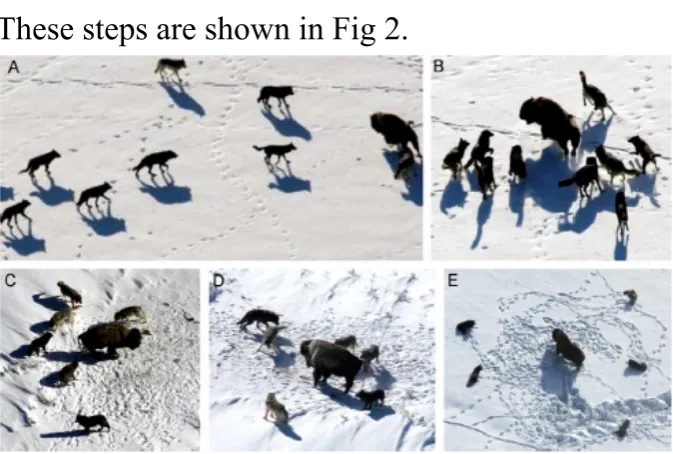
These steps are shown in Fig 2.
Fig 2.Hunting behaviour of grey wolves: (A) chasing, approaching, and tracking prey (B, C, D) pursuiting, harassing, and encircling(E) stationary situation and attack
In this paper we take three units and test power generation by
applying
newmeta-heuristictechnique
calledGrey
Wolf
Optimization (GWO) for solve the problem of economic load
dispatch by minimize fuel cost for unit generation, The GWO is
inspired by grey wolves(Canis lupus). The GWO algorithm
mimics the leadership hierarchy and hunting mechanism of
greywolves in nature. Four levels of grey wolves such as alpha,
beta, delta, and omega that work in a hierarchyare employed for
simulatingthe leadership hierarchy. In addition, there are three
main steps of hunting, searching for prey, encirclingprey, and
attacking prey, are implemented.
2.
METHODS
2.1. PROBLEM FORMULATION
The ED problem may be stated as to reduce the fuel cost of
generator units with several constraints. Mathematically, it may
express as:
A)
Economic dispatch problem
(Minimization of Fuel
Cost)
Fuel cost model
Subjected to following constraints
Where,
,
,
This equation is about how extract the minimal fuel cost by
choosing the best power generation which we take average of
minimal power generation and maximum power generation to
reach into best generation and minimal fuel cost,
.
2.2. Grey Wolf Optimization
2.2.1.Mathematical model and algorithm
Social hierarchy:
For modeling the social hierarchy of wolves
candidate solutions are considered to be omega (ω). The w
wolves follow these three wolves.
Encircling prey:
Next, for designing encircling behavior, some
equations are considered:
D= (C. X
P(t)-X(t))
X (t+1) =X
p(t)-A.D
Where(t) is the current iteration, A and C are coefficient
vectors, X
p(t) represents the position vector of the victim. The
vectors A and C can be calculated as below:
X=2.a.r1-a
C=2.r2
Where component of a are linearly decreased from 2 to 0 over
the course of iterations and r1 and r2 are random vectors in the
range [0, 1]
Hunting:
In GWO, the first three best solutions obtained are
stored so far and push the other search agents (including the
omegas) to update their positions due to the position of the best
search agents. The following equations are modeled.
The final position would be in a random position within a circle
which is defined by the positions of alpha, beta, and delta in the
search space.
3. Results and Discuss
3.1. Algorithms Numerical Settings
GWO: Population size =50, coefficient a=[0-2],Iterations=500
3.2.TheMetrics of Generation that we used in explain are as
MW: Mega Watt of Power Generation
PG
min(MW): Minimum Power Generation
PG
max(MW): Maximum Power Generation
3.3. Approach of Power Demand Formulation Using
GWOVariables
Power Generation (PG) and cost coefficients (a,b,c) of units
with fitness function as fuel cost, quadratic in nature and valve
point effect .
Constraints
Equality Constraints: Power Generation-Power
Demand=0(P
G=P
d)
In-Equality Constraints: Power Generation should be between
minimum and maximum limit of power generation.
Stopping Criteria
It is the maximum number of iteration for optimum solution.
3.4. Test System Data
To check the effectiveness of GWO for ED problems, two
different case studies are taken.
Table 1: Three generating unit system
data
Unit a($/MW2 ) b($/MW) c($ ) PGmin(MW) PGmax(MW)
1 0.008 7 200 10 85
2 0.009 6.3 180 10 80
3 0.007 6.8 140 10 70
Table 2: Six generating unit system data
Unit a($/MW2
) b($/MW) c($ ) PGmin(MW) PGmax(MW)
1 0.007 7 240 100 500
2 0.005 10 200 50 200
3 0.009 8.5 220 80 300
4 0.009 11 200 50 150
5 0.0080 10.5 220 50 200
6 0.0075 12 120 50 120
3.5.Numerical Result
The proposed technique is tested on different benchmarks for
simulation. Comparative analysis is demonstrated with other
optimization techniques
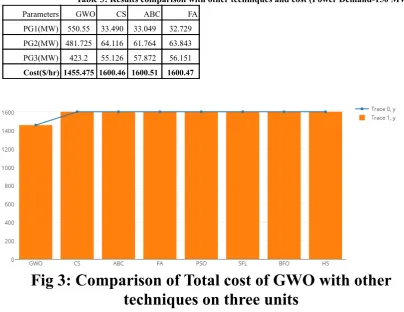
Table 3: Results comparison with other techniques and cost (Power Demand-150 MW) Parameters GWO CS ABC FA
PG1(MW) 550.55 33.490 33.049 32.729 PG2(MW) 481.725 64.116 61.764 63.843 PG3(MW) 423.2 55.126 57.872 56.151
Cost($/hr) 1455.475 1600.46 1600.51 1600.47
Fig 3: Comparison of Total cost of GWO with other
techniques on three units
Table 4: Result comparison of different technique cost
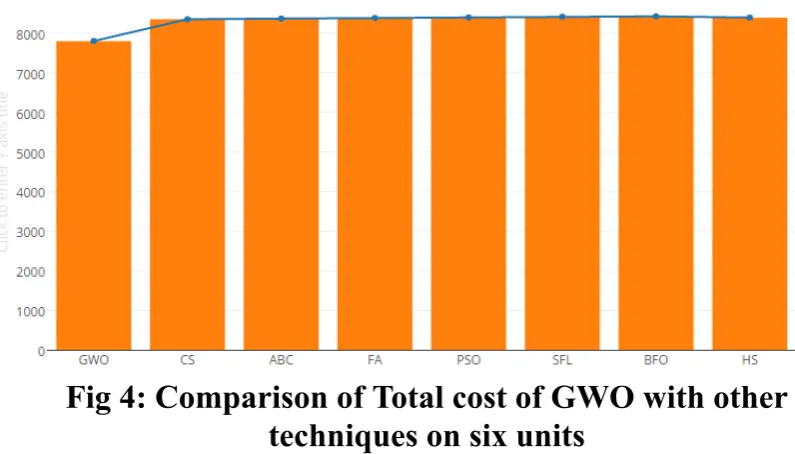
for six units
Techniques GWO CS ABC FA PSO SFL BFO HS
Cost($/hr) 7804.603125 8356.06 8372.27 8388.45 8401.45 8419.78 8428.69 8398.06