
Pairing Based Mutual Healing in Wireless Sensor
Networks
Sarita Agrawal
∗1, Jay Patel
†2, and Manik Lal Das
‡31
DAIICT, Gandhinagar, India
2
Chaudhary Technical Institute, Gandhinagar, India
3DAIICT, Gandhinagar, India
Dated: June 2, 2015
Abstract
In Wireless Sensor Networks(WSNs), a group of users communicating on an unreliable wireless channel can use a group secret. For each session, group manager broadcasts a message containing some keying material, from which only the group members authorized in that session can ex-tract the session key. If a member misses a broadcast message for key, it uses self healing to recover missing session key using most recent broadcast message. However, only self healing does not help if node needs to get most recent session key and have missed the corresponding broadcast. Through mutual healing, a node can request recent broadcast information from a neighboring node and then recover the required key using self-healing. In this paper, we propose a bi-linear pairing based self-healing scheme that reduces communication, storage and computation overhead in comparison to existing bi-linear pairing based self-healing schemes. Then, we discuss the mutual healing scheme that provides mutual authentication and key confirmation without disclosing the node locations to the adversary. The analysis with respect to active adversary shows a significant performance improvement for resource constrained sensor nodes along with the secu-rity features such as forward and backward secrecy, resilience against node collusion, node revocation and resistance to impersonation.
Keywords: Wireless sensor networks; Mutual healing; Bi-linear Pairing; Authentication
∗Email:sarita [email protected]; Corresponding author †Email:
jay sp [email protected]
‡Email:
1
Introduction
Wireless Sensor Network (WSN) is a network of autonomous sensor nodes com-municating through wireless medium. The nodes in WSN cooperatively moni-tor the physical and environmental phenomena and give the information as and when needed to a central authority, known as Base station, which in turn passes on the information to the external users. The main constraint in WSN is that sensor nodes have limited memory, power, computation and communication ca-pability. The WSNs are mostly deployed in unattended hostile environments such as military battle fields, forests, in earth quake prone areas and so on. It is therefore infeasible to look after them after deployment and nodes are exposed to attacks such as node subversion, node capture to read/alter the information contained and even physical destruction. Furthermore, the nodes in WSN com-municate via wireless medium, so they are also susceptible to routing attacks such as worm hole and sink hole.
Many WSN applications, for example, health care and military battle field surveillance, need the information within the network to be secured, i.e., only the authorized nodes within the network should be able to send/receive the in-formation. The receiving nodes should be assured of the authentication of the information being received and this authenticated information must be securely communicated within/outside the network as per the application requirement. The secure communication within the WSN may take place on node-to-node basis where a secret is shared between only a pair of nodes, or it can be a secret shared between a group of nodes, which may be done during the deployment or during the network operations. One of the possible approaches of sharing the secret during operations is broadcasting the secret to a group of nodes by a central authority. However, in the broadcast approach, if a node misses out on one or more broadcast then there should be some way to get the informa-tion, so that the required key can be extracted. This requirement motivated the researchers for incorporating the idea of self-healing and subsequently mutual healing.
In this paper, we review some recent works on mutual healing and self-healing in WSNs. Recently, Tianet al[11] proposed the self-healing and mutual healing based on bi-linear pairing. The scheme requires the nodes to perform multiple elliptic curve scalar multiplications and solving algebraic system of equations in order to extract the secret session key. For mutual healing node needs to perform bi-linear pairing operations and discloses its location in mutual healing request/response. We propose an improved scheme over [11]. Our scheme has following characteristics:
1. Self-healing to eliminate the need of re-broadcasting of keying material 2. Mutual healing
3. Security against active adversary
4. Improved performance and additional security over Tian el al’s scheme [11].
The remainder of the paper is organized as follows. A brief overview of existing self-healing work in WSN is given in section 2. In section 3, we present the preliminary concepts used in the paper. Section 4 describes the proposed pro-tocol in detail. Security and performance analysis is presented in section 5. We conclude the work in section 6.
2
Background and Related Work
Self-healing group key distribution concept was introduced by Staddonet al [1] to address secure group communication in unreliable networks such as in Mili-tary applications. The scheme is based on exponential arithmetic with an idea to do interpolation in the exponents. Later Blundoet al [3] suggested the simpler and enhanced version of this scheme. The security of these schemes depends on the difficulty of solving Distributed Diffie Hellman (DDH) problem. However, these schemes based on exponential arithmetic suffers from high computation costs and expensive maintenance costs. The technique in Staddonet al [1] uses secret sharing based on two dimensional polynomials to distribute group keys, enabling group members to recover lost session group keys as long as they have received one broadcast re-key message before and one after the above session. Liu et al [2] generalized the definitions in [1] and developed a novel personal key distribution technique incurring less storage and communication overhead and gave some constructions built upon the technique. Liuet al [2] proposed an improved scheme in terms of both memory storage and communication com-plexity. An advantage of both Staddon et al [1] and Liu et al [2] techniques is that the computation, communication, and storage overheads required to re-voke group members and achieve self-healing capability are independent of the group size, and thus are suitable for very large groups. Moreover, the techniques presented in [2] also deals with coalition of more evicted group members, which is an improvement over the techniques given in [1].
It is important to consider all types of collusion attacks when designing key distribution schemes for WSNs which are subject to node collusion. Yuanet al
model, which provides revocation and participation of at mostt nodes, respec-tively and also provides resilience to collusion of at most 2.t nodes. Since the parametert is considered to be much smaller than the maximum number of ses-sions (m), Yuanet al [4] scheme has less storage and communication overhead than the first two schemes in [1] [2]. In 2005, Hong [5] proposed a self-healing scheme which enabled a user to recover all the keys associated with sessions, in which the user was a member of group, from single broadcast message. Yuan
et al’s scheme[4] has a bit more communication overhead when compared to Hong’s scheme [5], but the same communication complexity (i.e., O(t ≤ j ≤
logq) forjthsession broadcast) with a constant factor of 2, as it uses 2.t-degree
polynomials which gives it 2.t-collusion resistance capability, as opposed to t -collusion resistance capability in [5].
. Yuanet al[6] also proposed a self healing scheme that has the unique property of limited group membership. It talks about a fixed number of (t-1) users and thus is bound to (t-1) membership, but, this way, it saves the communication bandwidth by maintainingt users throughout the communication resulting in enhanced quality of service. Furthermore, the scheme [6] eliminates the limi-tations of revoking at most t members, as it is able to revoke any number of members during the lifetime of the secure group communication. However, their scheme requires twice the memory space and about half the broadcast message size as compared to [5].
Subsequently, Tianet al [7] presented a self-healing scheme using access poly-nomial to reduce communication overhead and computation. However, Wang [9] discovered that the scheme in [7] does not provide forward secrecy and revo-cation capability. Access polynomial based scheme was also presented by Dutta [10]. However, it is noted that selective key distribution is not performed by the given algorithm and the effect is same as a simple broadcast of session key. Tian
et al[8] proposed self-healing key distribution scheme based on bi-linear pairing [15], in which the integrity and correctness of the cipher text could be verified by the user before key recovery operations are carried out. The scheme in [8] is free from any collusion of non-authorized users. Unless the private key of any user is disclosed/compromised, it is not affected by whatever number of other users are revoked and the storage overhead for each user is constant. Later, Tianet al also proposed the notion of mutual-healing using neighboring nodes in WSN [11] using bi-linear pairing. In [11], for each session, a subset of users is formed as a communication user group by group manager (GM) who broadcasts keying material. From this broadcast message, an authorized session group user can recover the session key of current as well as any previous session. For the construction of a broadcast message, the GM defines a |Gj−1| X |Gj| matrix
(where|Gj|is the size of the communication group in jthsession). During the
key recovery process, a node has to compute the matrix inverse operation to obtain a vector of size|Gj|and perform some bilinear pairing operations.
Mu-tual healing is assumed only between one-hop neighbors. Location based secret
LKx is set up for each node ux using range-based secure localization process
(sayui) upon missing a broadcast message in some session,t, locally broadcasts
an authentication request message with its own identity, its location and the session numbert of the requested broadcast messageBt, all in plain:
ui →*: IDi, li,t
A neighboring node (sayuj), upon receiving such request, verifies the claimed
locationli to be within its one-hop communication range and if so, calculates
a shared keyKji = e(LKj, H(IDikli)) and sends a uni-cast response to ui’s
request:
uj →ui: IDj,lj, (Bt)Kij
On receiving response,uiperforms location verification of neighboruj and then
ui calculates the key Kij = e(LKi, H(IDjklj)) shared with uj and extracts
the broadcast message (Bt). This scheme is collusion-free for any coalition of
non-authorized nodes, including the revoked nodes and new joined nodes.
Recently, Ramset al [12] presented a detailed survey of group-key distribution schemes with self-healing property. In this survey, the authors have classified, analyzed and compared most of the significant group key distribution schemes. According to [12], polynomial based algorithms [10] [4] [6] are simple and effi-cient, but they disclose some information about pre-distributed user data and also pre-distributed data can not be re-used. Exponent based algorithms such as [1] [3] overcome this weakness, however, they do not provide backward secrecy and also computationally heavy as compared to polynomial based schemes. One-way hash chain based schemes are the most efficient self-healing schemes, but lack the collusion-resistance property. Bi-linear pairing based schemes provide all the three security features required in self-healing schemes, namely, forward secrecy, backward secrecy and collision resistance at the cost of computation overhead in bi-linear pairing calculations. Recently Rams and Pacyna [13] pro-posed self-healing group-key distribution with extended revocation capability. The scheme requires the nodes to update the personal keys using the update polynomial distributed by the GM. Also, the users need to perform exponential computation for session key computation and need to evaluate polynomial in order to recover the update polynomial broad-casted by GM.
Our Observations. We observed that the bi-linear pairing based self-healing and mutual healing schemes provide the security features needed for group-key broadcast. In the bi-linear pairing based scheme proposed by Tianet al[11], the generation of broadcast message and key recovery process are computationally heavy, since the matrix computations and scalar multiplications at node end are involved. A sensor node needs to store two vectors of size|Gj|(the group size
in sessionj) and the public keys of all the nodes in the group. A member node needs to perform a matrix inversion operation and |Gj| scalar multiplications
verification failure. While the protocol in [11] suggests sending the broadcast message in plain during normal course of operation, it computes a shared key using bi-linear pairing for encrypting the broadcast message only to authenti-cate the response from the neighbor node. This is a computation overhead both for requesting and responding nodes.
3
The Proposed Protocol
The proposed protocol uses some primitives based on group theory, namely Bilinear Pairing. We first define it and some standard complexity assumptions that we have used in the proposed protocol.
3.1
Bilinear Pairings
Letq be a large prime number. We consider two cyclic groups G1 (additive) and G2 (multiplicative) defined over q. A mapping e:G1 ? G1 → G2 satisfies the below mentioned conditions:
1. Bilinearity: ∀P,Q ∈G1 and∀a,b ∈Zq∗,e(aP, bQ) = e(P, Q) ab
2. Non-Degeneracy: For any pointP,Q ∈G1,e(P, Q)= 1 iffP = O (point of infinity). Or, in other words,∃P∈G1 andQ ∈G1 such thate(P, Q)6= 1
3. Computability: An efficient algorithm exists to computee(P, Q) for any
P,Q ∈G1
Elliptic Curve Discrete Logarithm Problem (ECDLP): Given an elliptic curve pointP ∈G1 (orG2) and pointQ =s.P for any s∈Zq∗, it is difficult to find
the value ofs.
3.2
Network Model, Adversary Model and Assumptions
We consider a hierarchical WSN with a base station and a number of cluster heads that serve as group managers, managing a group of nodes. The cluster nodes can communicate within the group through a common cluster key. A new session key is broad-casted by the group manager for each communication session. Nodes may leave a group or join a group or may change the group. Due to this, for each session, the group manager may have a different set of authorized nodes in its group. Each member node gathers the data from the environment according to the application requirement and sends it to its current cluster head. A cluster head aggregates the data received from its cluster nodes and forwards the same to the base station.
We assume the presence of an active adversary, who can passively eavesdrop on the wireless channel and can read and intercept the messages being exchanged. The adversary can also delete, modify or insert the the packets into the network as per his/her attack goal.
broadcast a message to this communication group and each member in the group would recover the session key from the received broadcast message. A user can recover a missed communication from a session, if and only if it is an authorized member of that group in the session for which it seeks to obtain the communicated message. We focus on sharing of session key within a group of nodes in order to facilitate self-healing and mutual healing in a secure and cost-effective manner.
3.3
Notations used
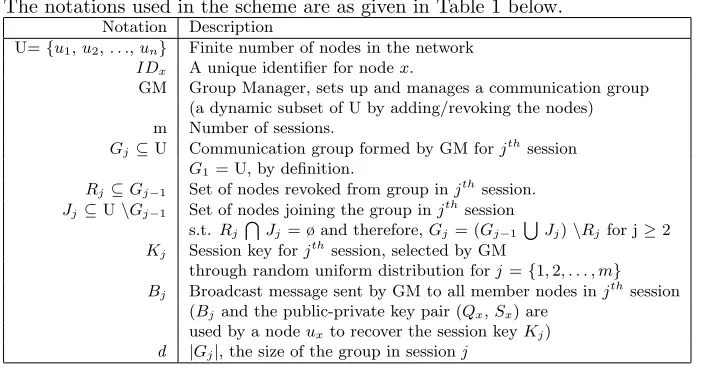
The notations used in the scheme are as given in Table 1 below.
Notation Description
U={u1,u2,. . .,un} Finite number of nodes in the network
IDx A unique identifier for nodex.
GM Group Manager, sets up and manages a communication group (a dynamic subset of U by adding/revoking the nodes) m Number of sessions.
Gj ⊆U Communication group formed by GM forjthsession
G1= U, by definition.
Rj ⊆Gj−1 Set of nodes revoked from group injthsession. Jj ⊆U\Gj−1 Set of nodes joining the group injthsession
s.t.RjTJj = ø and therefore,Gj = (Gj−1SJj)\Rj for j≥2
Kj Session key forjthsession, selected by GM
through random uniform distribution forj ={1,2, . . . , m}
Bj Broadcast message sent by GM to all member nodes injthsession (Bj and the public-private key pair (Qx,Sx) are
used by a nodeuxto recover the session keyKj)
d |Gj|, the size of the group in sessionj
Table 1: Symbols and Notations used in the Protocol
3.4
The Protocol
The proposed scheme consists of three phases. We first give the system set up and then present the step-wise description of the proposed protocol.
3.4.1 System Set-up phase
Group manager (GM) randomly selects a generator P ∈ G1 and defines two cryptographic hash functionsH1andH2as follows:
1. H1: {0,1}∗ →G1 2. H2: G2 → {0,1}n
For public-private key setup, GM selects a random number s ∈ Zq∗, which is known only to GM and serves as its private key. GM sets its own public key asPP ub=s.P (denotes scalar multiplication of integers with the elliptic curve
pointP). The system parameters consist ofparams = (G1,G2,q,P,PP ub,H1, H2). Each node in the network submits its identity to GM, using which, GM computes node’s public keyQID=H1(ID) andSID =s.QIDas private key for
GM selects independent session keysK1, K2, . . ., Km for m sessions using a
uniform distribution.
3.4.2 Group Key Broadcast
For a sessionj, GM randomly chooses session key Kj ∈Zq∗. This session key
can be used to communicate within the group for sessionj. GM now constructs a broadcast messageBj, which is used by the nodes in the communication group
to extract the keyKj. Here, GM chooses a random numberrj ∈Zq and
con-struct a broadcast message as follows:
Q =Q1 +Q2 +. . .+Qd
U =rj.PP ub
Ui =rj(Q−s.Qi), fori= 1 to d
Vj =Kj ⊕H2(e(PP ub,rj.Q))
zj = (U,Ui (fori= 1 tod),Vj)
GM, then, broadcasts the set Bj = (z1, z2, . . .,zj) for all the nodes which
are the members of the group in thejthsession.
3.4.3 Key Extraction
Upon receiving the broadcast message Bj, a node ux can extract the key by
computing the following:
e(PP ub,Ux).e(U,Sx)
= e(PP ub,Ux).e(rjPP ub, s.Qx)
= e(PP ub,Ux).e(PP ub,rj.s.Qx)
= e(PP ub,Ux +rj.s.Qx)
= e(PP ub,rj.Q)
Here (Qx, Sx) is the public-private key pair of nodeux andPP ubis the public
key of GM. Once e(PP ub,rj.Q) is computed, node ux can retrieve the keyKj
=Vj ⊕H2(e(PP ub,rj.Q))
3.4.4 Self Healing
In the group broadcast scenario, if a node misses any broadcast, it will have to request for that broadcast message again from GM. It is noted that nodes in WSN are energy-constrained and communication is costlier as compared to computation. Self-healing is the process through which a node can extract the key without the GM required to uni-cast the missing broadcast to that node, which allows saving node’s energy. In this process of self-healing, if a nodeux
misses the broadcast message Bi from session i < j (1 ≤ j ≤ m) and it was
member of the communication group in sessioni, then it can use the broadcast messageBjfrom sessionj>i, pick up the componentzifromBj(asBjcontains
zi, 1≤i≤j) and use the key extraction process (as explained in previous session)
3.4.5 Mutual Healing
Mutual healing is needed when a node misses more than one broadcasts. In that case, it needs to wait for the latest broadcast to retrieve the keys of the sessions for which it was a member. Mutual healing becomes inevitable when the node misses the current broadcast and can not recover the current key. In this ap-proach, similar to Tianet al [11] scheme, we assume that the sensor nodes are stationary after deployment and mobile robots compute the locationlxfor each
nodeuxin the network, using a secure localization process such as in [16] and
securely communicates the same to the nodes. Once the localization process is completed, the mobile robots leave the network. This location information will be used in the neighbor authentication process during mutual healing. The mutual healing phase has two sub-phases, which work as follows:
Mutual Healing Request. When a node ux needs the broadcast message Bt, it
broadcasts an authenticated request to the nodes in its local neighborhood:
ux→ ∗: IDx,{lx}Kc,t,c,
PRF(Kc, IDxklxktkc)
Here,IDx - ID of requesting nodeux
lx - location ofux
Kc- Group key in some previous sessionc,
of whichuxwas member
t - the session for which broadcast message is being requested
PRF() - Pseudo Random function
Mutual Healing Response. A node uy, which receives this Mutual healing
re-quest, first confirms that the request is from an authenticated node which is in its one-hop communication range. Nodeuy verifies |lx−ly| ≤ R (Here, R is
assumed to be one-hop communication distance between two nodes in the sen-sor network, based on the communication range of the nodes). If the location verification fails, nodeuysimply discards the request else it uni-casts a reply to
nodeux as follows:
uy→ux: IDy,{ly}Kc, zt,Ny, PRF(Kc, IDxkIDyklxklykztkNyktkc)
ux→uy: IDx,{Ny+ 1}Kt, PRF(Kt, IDxkIDyk(Ny+ 1))
In this protocol, the responding node uy sends the tth component zt of the
broadcast message Bt meant for the requested session t, along with its own
ID and encrypted location. The node need not to send the entire broadcast message Bt, since the requesting node has specified which broadcast message
it has missed, so it suffices to send the keying material specific to that session i.e. zt. It also sends a nonce Ny which is used by the requesting node ux to
confirm the reception of the message and recovery of the required keyKt. The
transmit-ted values using a key shared by the group in some previous sessionc. Nodeux
shares a previous session ID whose key is used for generating the PRF() for the request message. When nodeuy receives the message, it computes the PRF()
using the corresponding key Kc and is assured of the authenticity of nodeux.
Similarly,uxauthenticatesuyby calculating the PRF() of the response message
sent by node uy. Here, we assume that the requesting and responding nodes
share at least one session key from some previous session to complete this pro-tocol.
Once, requesting nodeux receives the broadcast message component zt, it
re-covers the key for session t, using the key extraction process. Then, it sends (Ny + 1) encrypted by the newly recovered keyKtback to responding nodeuy
to confirm the receipt of the the correct message and key.
3.4.6 Adding and Revoking Node
Suppose a nodeunew willing to join sessionj requests GM for including it in
the communication group. It sends its ID, IDnew, and the session ID, j, the
session from which it is interested to join the group. GM validates the identity ofunewby looking at the list of non-revoked nodes and if finds nodeunewto be
an authorized node, GM includes the new node’s public key in the computation ofQ and also computesUifor this new node while preparing for the broadcast
message i.e.
Q =Q1 +Q2 +. . .+Qnew +. . .+Qd
U =rj.PP ub
Ui =rj.(Q−s.Qi), fori = 1 tod
(includingi =new) ..
.
When a node, sayurov, is revoked from thejthsession, GM excludes its public
keyQrovin computation ofQ and,Uivalue corresponding to this revoked node
urov will not be included in the broadcast message i.e.
Q =Q1 +Q2 +. . .+Qd,
(excludingQrov)
U =rj.PP ub
Ui =rj.(Q−s.Qi), fori = 1 tod
(excludingi =rov) ..
.
Neither nodeurov’s public key is used in the computation of Q in the
subse-quent sessions, nor isUi computed fori =rov. Therefore, even ifurov receives
the broadcast message Bt for a session t ≥j, it would not be able to extract
the keyKtfor sessiont.
The newly joined node can participate in thejth session and subsequent
4
Analysis
4.1
Assumptions and Adversarial Model
GM is a trusted entity and the public-private key pairs are assigned by GM to all the nodes in the network through a secure channel before deployment. Each node needs to keep only its own public-private key pair. A node is not given access to the public keys of other nodes in the network. We assume that each node in the network knows its location once the secure localization protocol is carried out immediately after the deployment. During the network operations, the nodes do not disclose their locations to each other unless mutual healing request-response protocol is executed. The nodes delete the information shared during the mutual healing. Adversary has access to the public wireless communication channel and can intercept, inject or modify messages.
4.2
Security Analysis
4.2.1 Forward Secrecy and Backward Secrecy
Forward secrecy ensures that a session key derived from a set of long-term keys will not be compromised if one of the long-term keys is compromised in the future. Backward secrecy ensures that compromise of a session key does not reveal the past session keys or long-term keys. In the context of group key dis-tribution [12], forward secrecy ensures that any number of users revoked before or in sessionj colluding together can not recover any of the future session keys
Kj, Kj+1, . . ., Km. Similarly, backward secrecy implies that any number of
users joining after sessionj colluding together can not recover any of the past session keysK2,K3,. . .,Kj−1.
Theorem 1: The proposed scheme provides forward and backward secrecy. Proof: In order to prove forward secrecy, we need to show that a user revoked in a sessionj can not compute the future session keys, which means a userux∈Rj
can not compute a keyKw(j≤w≤m). Let us look at the process of generating
the broadcast message by GM for the sessionw. GM takes the public keys of only those users who are authorized members ofw and computesQ as:
Q =Pd
i=1Qi, forui∈Gw
GM, chooses the session specific random numberrw and computes
U =rw.PP ub, forrw∈RZq∗
Ui =rj(Q−sQi), fori = 1 to d,
wheres∈RZq∗- private key of GM
GM, then picks a random keyKwfor sessionw and computes
Vw=Kw⊕H2(e(PP ub,rw.Q))
zw= (U,Ui, Vw), fori = 1 tod
To obtain the session key for session w, a node needs to have access to the broadcast messageBw or the componentzwfrom some broadcastBt(w ≤t ≤
With the availability of component zw, the values Vw, U, Ui for (i=1 to d,
ui∈Gw) are available to any user having access to componentzw. The session
keyKw can be extracted as follows:
Kw=Vw⊕H2(e(Ppub, rw.Q))
However, for obtaining the expression e(Ppub, rw.Q)), the user needs to know
rw, which is ephemeral secret for sessionw known only to GM. . . .(1)
Furthermore, for a userui, authorized for sessionw, its public key componentQi
is used in the generation ofzw, souican compute the expressione(Ppub, rw.Q) as
e(Ppub, rw.Q)
= e(PP ub,Ui).e(U,Si)
(Si is private key ofui)
= e(PP ub,Ui).e(rw.PP ub, s.Qi)
= e(PP ub,Ui).e(PP ub, rw.sQi)
= e(PP ub,Ui +rw.sQi)
= e(PP ub,rw.Q) . . .(2)
An unauthorized user ux can not compute e(Ppub, rw.Q) in this manner,
be-cause, its public key is not used in the computation of Q.Ui computed using
private key ofux is also not part of the broadcast message for this sessionw.
Another possibility for an unauthorized useruxis to obtainrwin order to solve
the expression e(PP ub, rw.Q). Since, U and Ppub are known publicly, user ux
may attempt to extractrw usingU =rw.PP ub. However, due to the hardness
of Elliptic Curve Discrete Logarithm Problem (ECDLP), givenU (=rw.Ppub)
andPpub, it is not possible to obtainrw. . . .(3)
Since a userux ∈Rj can neither obtain Ux for a session w nor can it directly
compute e(Ppub, rw.Q), the expression H2(e(Ppub, rw.Q)) could not be solved
and hence extraction ofKw is not possible for any userux∈Rj.
For backward secrecy, a user joining the group after session j should not be able to compute any of the past session keys, that is, a userux ∈Jj+1 can not compute a keyKw(2≤w ≤j). The proof is on similar lines to that for forward
secrecy.
Hence, the proposed scheme provides both forward and backward secrecy. 2
Example: Let U = u1, u2, . . ., u10 is the universe of users in the given WSN. Gj =u1,u2,u4,u6 is the set of 4 users who form the communication group in jthsession i.e. |G
j|=d = 4. Thus forjth session: Q =Q1 +Q2+Q4 +Q6. Uis (for i = 1, 2, 4 and 6) will be rj.(Q−s.Q1), rj.(Q−s.Q2), rj.(Q−s.Q4) andrj.(Q−s.Q6). Now suppose nodeu3, who is not part of the communication group in this sessionj, attempts to extract the keyKj from the broadcast
mes-sageBj. Nodeu3proceeds to compute e(PP ub,rj.Q) = e(PP ub,Ux). e(U, Sx).
pairi, j), u3 still can not compute e(PP ub,rj.Q) = e(PP ub, Ux). e(U,Sx) and
extractKj. The same argument can be given for any sessiont afterjthsession.
We can thus conclude that the proposed protocol provides both forward and backward secrecy.
4.2.2 Collusion Resistance
Any number of users revoked before a sessionj and joined after sessiont (j ≤
t) colluding together can not recover session keysKj,Kj+1,. . .,Kt.
Theorem 2: The proposed scheme is resistant to collusion of nodes revoked from session j and nodes joined after a session t.
Proof: We need to show that usersux∈Rj and uy ∈Jt+1 colluding together can not compute the keyKw(j≤w≤t).
According to Theorem 1 above, the revoked users can not compute the future session keys and and the newly joined users can not compute the past session keys. The key for the sessionw can be extracted only by a user which is an au-thorized member inGw. No userux∈Rj∪Jt+1is a valid member in any group Gw(j≤w≤t). So, even if all of the members inRj∪Jt+1collide together, they still don’t have a valid input to resolve the expressionH2(e(Ppub, rw.Q)) to
ex-tract the required session keyKw. 2
4.2.3 Resistance to Impersonation
Impersonation attack implies that an unauthorized user or adversary claims to be a valid member of the group.
Theorem 3: The proposed protocol is resistant to impersonation attack.
Proof: An adversary can claim to be a valid member of a sessionw, if he can get hold of the session keyKw. The session key is distributed by GM through a
broadcast messageBwwhich has the componentzwconstructed using the public
and private keys of only the authorized members of the sessionw and therefore, only those members can get hold of the key Kw using defined key extraction
process. An adversary may attempt to solve the expressionH2(e(Ppub, rw.Q))
for which it needs to know the random secret rw. Using the available
infor-mationU =rw.PP ubandPP ubadversary can try to extractrw. However, this
corresponds to solving ECDLP which is a hard problem. Thus, an unauthorized user/adversary can not solve it and obtain keyKw.
Hence, an unauthorized user/adversary can not claim to be a valid member of the group. 2
4.2.4 Node Revocation Capability
Node revocation implies that a revoked node is not able to obtain future session keys from any future broadcast message.
Proof: A node urov revoked in jth session may attempt to obtain the session
for any sessiont≥j. Suppose the nodeurov receives the broadcast message for
a sessiont. Thus,urov has the component zt from which it can extract session
key Kt. To extract keyKt, the node urov needs to compute (Ref subsection:
Key Extraction)
e(PP ub,Urov).e(U,Srov)
NodeurovhasPP ub, the public key of GM,U fromzt, andSrovas its own private
key. However, Urov is not available to urov, because during the construction
of broadcast message Bt, neither Qrov (the public key of urov) is included in
computation of Q, nor the component Urov is added. So, node urov can not
extractKt.
Hence proved that revoked node does not have access to future session keys. 2
4.2.5 Secured Node Location
In the mutual healing process given by Tian et al. [11], a node sends out its location ID in plain while requesting a missing broadcast message from its one-hop neighbors. This may lead to known location attacks, as the node location is easily available to the adversary. In our proposal, unlike the Tianet al [11] scheme, the node location is never transmitted in plain and the knowledge does not remain with any other node once the mutual healing process is completed. The proposed scheme does not disclose a node’s location to an outside adver-sary. We assume all nodes in the network know their respective location through some secure localization scheme [16]. In the mutual healing process, a node who needs a missing broadcast message, broadcasts a request for the same to its one hop neighbors:
ux→*: IDx,{lx}Kc, t,c, PRF(Kc, IDxklxktkc)
Since the location of the requesting node ux is encrypted with session key Kc
of some previous session c, only a one-hop neighbor ofux who was a member
in sessionc will be able to get the location information of nodeux.
A node having the requested broadcast message uni-casts the message to the requesting node:
uy →ux : IDy,{ly}Kc,zt, Ny, PRF(Kc, IDxkIDyklxklykztkNyktk c)
Again, due to the encryption of the location of nodeuy, locationuyis not
avail-able to any outside adversary during this communication. Once, the mutual healing process is completed, nodes delete the locations of each other. Hence, the location information of participating nodes will never be available to any outside adversary.
4.2.6 Mutual Authentication
In the proposed protocol, the missing broadcast request message and the uni-cast response message are as follows:
ux→*: IDx,{lx}Kc, t,c, PRF(Kc, IDxklxktkc)
uy →ux : IDy,{ly}Kc,zt, Ny, PRF(Kc, IDxkIDyklxklykztkNyktk c)
Both the messages do contain PRF code of the transmitted information that is generated using the session key of some previous session in which both requesting nodeuxand responding nodeuy were part of the communication group. When
a node receives the PRF code, it generates its own PRF using secretKc and
verifies the code. Since the session keyKc is not available to an adversary, the
node is assured that the message has been sent by some node who is valid group member in sessionc. Thus, apart from verifying the one-hop distance as in [11], the nodes are able to mutually authenticate each other.
4.2.7 Key Confirmation
In a mutual healing session, the responding node can confirm if the valid key is received at the requesting end. Requesting node ux receives the component
zt of missing broadcast message Bt, recovers the required session key Kt and
sends the incremented nonce encrypted with the key Kt, it had recovered for
the requested sessiont, back to the responder nodeuy:
ux→uy : IDx,{Ny+ 1}Kt, PRF(Kt, IDxkIDyk(Ny+ 1))
Whenuy gets back the correct incremented nonce after decryption using the
same key Kt, it is assured that the correct message has been received by the
requesting nodeux. This ensures the key confirmation.
Table 2 below gives the comparison of major security features in Tianet al’s scheme [11] and the proposed scheme.
Attributes→ Forward Mutual Key Secure
and Authen- Confirmation Node Schemes↓ Backward tication (In Mutual Location
Secrecy Healing)
Tianet al Yes Yes No No
[11]
Proposed Yes Yes Yes Yes
Scheme
Table 2: Comparison of Security Features with Tian’s scheme [11]
4.3
Performance Analysis
4.3.1 Computation cost
A node after receiving the broadcast message, takes the jth component and
for computing e(PP ub, rt.Q), it needs to perform two bi-linear pairing
H2(e(PP ub, rt.Q)) and finally extracts key Kj using an XOR operation. The
hash and XOR computation cost is negligible in comparison to the bi-linear pairing computation. So, ifTpis the cost of bi-linear pairing computation, then
self-healing and key-recovery operation takes only 2 *Tp. In Tianet al’s [11]
proposal, GM needs to define a|Gj−1|X|Gj|matrix and compute|Gj−1| addi-tional ECC points using public keys of the members of current communication group, in order to construct the broadcast message. A node in the group needs to perform matrix inversion operation. Secondly, during the mutual healing process, the responding node encrypts the requested broadcast message with a key generated from the location based key using bi-linear pairing operation. The requesting node needs to calculate the same key again using bi-linear pair-ing operation. In our proposal, we avoid the need of any matrix, additional ECC points computations by GM, matrix inversion operation by node and bi-linear pairing operations for authentication during mutual healing. For mutual healing, one symmetric key encryption, and one PRF() computation for re-quest message, one symmetric key decryption, one simple comparison to check euclidean distance and one PRF() to verify response, and one symmetric key encryption for key confirmation. In case node is responder, then it needs one symmetric key decryption, one simple comparison to check euclidean distance and one PRF() to verify request, then for response one symmetric key encryp-tion, and one PRF() computation. When compared with Tian’s scheme [11], we find that computation cost is greatly reduced, as now a node does not re-quire to solve system of linear equations and also it could avoid doing scalar multiplication with respect to all other nodes in the group in order to recover a key.
4.3.2 Communication cost
The group manager broadcasts one single message in each session. So, for m sessions, there will be total m broadcast messages. In each sessionj,j(2d+4)log
q bits are transmitted as Bj, which is similar to Tian’s scheme [11]. At node
4.3.3 Storage cost
Each node stores its own public-private key pair and the group session keys for maximum m sessions. It also needs to temporarily store the broadcast message, which containsj (1≤j ≤m) entities. We are able to save on the cost of storing akGj|xkGj|matrix and also a node does not need to store the public keys of
all the nodes in the group to recover a session key, unlike in [11].
The comparison of performance parameters (overhead in bits) is presented in Table 3 below. In this table,
j: session number (1≤j≤m)
d: No. of users in the group in session j
Tp,Ts: Time for Pairing and Scalar multiplication respectively
Th, Tm: Time for Hash and PRF respectively
Te,Td: Time for Symmetric Encryption and Decryption respectively
Since the pairing operation is costliest in comparison to other operations, we
Schemes→ Tianet al. [11] Proposed Scheme Attributes↓ Self Healing Mutual Healing Self Healing Mutual Healing
Storage (2jd+ 2j+ 5)logq 2logq (2jd+ 2j+ 5)logq 0 Overhead + 2dlogq+ 16(d2+d) + 16 (for location based key) + 16
Communication 0 Requesting Node: 0 Requesting Node:
Overhead 3logq 8logq
Responding Node: Responding Node: ((2d+3)j+2)logq ((2d + 3) + 4)logq Computation 2Tp+Th+dTs Requesting Node: 2Tp+Th Requesting Node:
Overhead Tp+Td+Th 2Te+ 3Tm+Td
Responding Node: Responding Node:
Tp+Te+Th Te+ 3Tm+ 2Td
Table 3: Comparison of Performance with Tianet al’s scheme [11]
have eliminated the use of pairing during mutual healing. Instead, we are us-ing only encryption, decryption and PRF computation operations which take few microseconds to perform [18]. Also, for self-healing, we have reduced the computation time by eliminating the need to performd scalar multiplications. This reduces the self-healing computation overhead significantly. For example, if we consider an average group size of 10 nodes and the TinyPairing [17] imple-mentation of bilinear pairing and related operations for WSN with finite field GF(397), in which, the pairing operation takes 5.32 seconds and scalar multipli-cation takes 2.45 seconds, the proposed scheme reduces self-healing computation time by 2.45*10 (=24.5)seconds.
5
Conclusion
the required key. Self-healing and subsequently mutual healing is incorporated to achieve this purpose. In this work, we have proposed a simplified approach for generating the broadcast information and key extraction from the keying broad-casted material. In this approach, the central authority, group manager, generates a message involving the session key and the public keys of the mem-ber nodes in current session. It uses bi-linear pairing operation for generation of keying material and later extraction of key from the same in an efficient man-ner. During mutual healing, the scheme ensures secrecy of the node locations by keeping the location information out of reach of the adversary, while shar-ing the missshar-ing broadcasts for mutual healshar-ing. Our protocol not only provides the forward and backward secrecy, node revocation capability and resilience to node collusion, but gives additional security features such as resistance to im-personation attack and secrecy of node location and message confirmation with authentication in mutual healing. These additional features are provided along with reduced storage, computation and communication overhead, which is a significant achievement in WSN environment.
References
[1] J. Staddon, S. Miner, M. Franklin, D. Balfanz, M. Malkin, and D. Dean. Self-healing key distribution with revocation. In: IEEE Symposium on Se-curity and Privacy, Vol 0, Pages 241 - 257, 2002.
[2] D. Liu, P. Ning, and K. Sun. Efficient self-healing group key distribution with revocation capability. In Proceedings of 10th ACM conference on Com-puter and communications security, Pages 231 240, 2003
[3] C. Blundo, P. Darco, A. De Santis, and M. Listo. Design of self-healing key distribution schemes. Des. Codes Cryptography, Vol. 32, Pages 15 44, 2004.
[4] T. Yuan, J. Ma, Y. Zhong, and S. Zhang. Self-healing key distribution with revocation and collusion resistance for wireless sensor networks. In Proceed-ings of International Multi-symposiums on Computer and Computational Sciences, Pages 83 90, 2008.
[5] D. Hong and J. S. Kang. An efficient key distribution scheme with self-healing property. In: IEEE Communication Letter, Vol 9, No 8, Pages 759 761, 2005.
[7] B. Tian, S. Han and T. Dillon. An Efficient Self-Healing Key Distribution Scheme. In Proceedings of International Conference on New Technologies, Mobility and Security, Pages 1 - 5, 2008.
[8] B. Tian, E. Chang, T. Dillon, S. Han and F. Hussain. An authenticated self-healing key distribution scheme based on bi-linear pairings. In Proceedings of the 6th IEEE Conference on Consumer Communications and Networking Conference, Pages 1061 - 1065, 2009.
[9] H. Wang. On the Security of Some Self-healing Key Distribution Schemes. In Proceedings of the International Conference on Multimedia Information Networking and Security, Pages 777 - 780, 2010.
[10] R. Dutta, S. Mukhopadhyay, and T. Dowling. Enhanced access polyno-mial based self-healing key distribution. In Security in Emerging Wireless Communication and Networking Systems, Lecture Notes of the Institute for Computer Sciences, Social Informatics and Telecommunications Engi-neering, Vol.42, Pages 13 24, 2010.
[11] B. Tian, S. Han, J. Hu and T. Dillon. A mutual-healing key distribution scheme in wireless sensor networks. In: Journal of Network and Computer Applications, Vol. 34 Issue 1, Pages 80 - 88, 2011.
[12] T. Rams and P. Pacyna. A Survey of Group Key Distribution Schemes With Self-Healing Property. In IEEE Communications Surveys and Tutorials, Vol.15, No.2, Pages 820-842, 2013.
[13] T. Rams and P. Pacyna. Self-healing Group Key Distribution with Ex-tended Revocation Capability. In the proceedings of International Confer-ence on Computing, Networking and Communications, Communications and Information Security Symposium. Pages 347 - 353, 2013.
[14] H. Krawczyk, M. Bellare and R. Canetti. HMAC: Keyed-Hashing for Message Authentication. Request for Comments: 2104, 1997. (http://www.ietf.org/rfc/rfc2104.txt)
[15] Alfred Menezes. An introduction to pairing-based cryptography. In Recent Trends in Cryptography, Vol. 477 of Contemporary Mathematics, AMS-RSME, Pages 47 - 65, 2009.
[16] L. Lazos and R. Poovendran. Serloc: secure range-independent localization for wireless sensor networks. In the proceedings of the 3rd ACM Workshop on Wireless Security (WiSe), Pages 21 30, 2004.
![Table 2 below gives the comparison of major security features in Tian et al’sscheme [11] and the proposed scheme.](https://thumb-us.123doks.com/thumbv2/123dok_us/7933542.1317282/15.612.172.439.455.570/table-gives-comparison-security-features-sscheme-proposed-scheme.webp)
![Table 3: Comparison of Performance with Tian et al’s scheme [11]](https://thumb-us.123doks.com/thumbv2/123dok_us/7933542.1317282/17.612.133.480.317.415/table-comparison-performance-tian-et-al-s-scheme.webp)
