CSEIT1724109 | Received : 26 July 2017 | Accepted : 03 August 2017 | July-August-2017 [(2)4: 379-386]
International Journal of Scientific Research in Computer Science, Engineering and Information Technology © 2017 IJSRCSEIT | Volume 2 | Issue 4 | ISSN : 2456-3307
379
Fountain Code to Reduce Retransmissions and Delay in MPTCP
Bharati S Pochal, Syed Niyazuddin, Syed Khaja Ahmed
Department of Computer Studies and Computer Applications, Visvesvaraya Technological University, Center for PG Studies, Kalaburagi, Karnataka, India
ABSTRACT
The output of MPTCP (Multipath transmission control protocol) was predicted as good as of single disjoint path transmission. In reality the result of this MPTCP fails, it was not able to transmit the data as we have expected, in much cases there was some problem like delay in transmissions, high lose of packets. So that we have to retransmit the packets until it reached successfully to the destination therefore we developed “fountain code to reduce retransmissions and delay in MPTCP the aim of this work is to reduce delay and to avoid more number of retransmission. This project is developed to solve the problem which was present in MPTCP. In this project we designed the multiple subflows to frequently transmit the packets without delay and retransmission. This project takes the advantages of random nature of fountain code that the packets will be transmits without lose and less delay. And this will be transmitted the encrypted cipher text. We introduced a data allocation algorithm depends on expected packets reaching time and decrypting required to manage the transmissions of other sub flows. This project is used to solve the negative impact of the MPTCP. So that the fountain code expecting the less delay and no retransmission of packets.
Keywords : MPTCP, TCP, Spiral Life Cycle, SCTP, DCCP, CMT, DCN, RTO
I.
INTRODUCTION
Currently, the majority of data transmissions go through TCP. In a network with high loss and delay, such as a wireless network, the performance of TCP degrades significantly due to frequent retransmissions of lost or erroneous packets. In addition, a user may want to transmit data at a higher aggregate throughput when having multiple access links to the network. However, conventional TCP cannot enjoy the multi homing feature. In order to solve these problems, Multipath TCP (MPTCP) has been proposed to transmit TCP simultaneously over multiple paths to improve the good put and reliability. However, if the paths have high diversity in quality (i.e., with different loss or delay), the good put of MPTCP degrades sharply. When a receiver waits for a packet sent on a low-quality path, the receiver buffer may be filled up. Thus, even if other paths have good quality, they cannot send more packets, and the low-quality paths become the bottlenecks of MPTCP. Some studies show that the good put of MPTCP can be even worse than
that of an ordinary TCP in some cases. In Section III, we provide some performance studies to further illustrate the problems. To solve the bottleneck problem, some attempts have been made to improve the throughput over lossy networks
OBJECTIVES OF THE PROJECT
Objective of the proposed project is to transmit the file with no delay and no retransmission.
The file will be sent from sender to receiver with the help of routers.
The objective of the project to transmit the file by selecting the best quality path.
If path quality reduces the fountain code will be applied to the path so that the file will be transmitted with no delay and loss.
SCOPE OF THE STUDY
wherever we have a tendency to developed fountain code into MPTCP to boost the good put and solve the bottleneck impact due to different links.
II.
METHODS AND MATERIAL
Spiral Method
The spiral method is same as incremental method,
with many things placed on risk analysis. The
spiral methods have many phases like: Plans,
Risks Analysizes, and Engineers. Software
regularly checks each stage. Beginnings with
planning part, needs are collected and risk is
used. Each subflows developed on the spiral
method. Needs Are collected during the planning
stage. With risk analysis stage, a work is in
progress to recognize problems and its
clarification. A model is developed at the end of
each risk study. Product is designed in the
production part, and testing it at the completion of
each part. Calculation part enables clients to
calculate result of the application before the
module proceeds to the next stage. In spiral
method, the major module defines work, and the
radius of spiral defines prize.
.
Spiral Life Cycle.
The article plays an important job in designing the
system live cycle and it explains the whole
information of project. Which is used by engineers
and will be a fundamental test stage? If
modification is done the needs later should run
with official modification work.
Spiral was created by Barry Boehm in 1988,
"Spiral
Module
with
Software
design
improvements. It is not the initial step to clarify
repetitive model, but rather it was the main modal
to clarify the iterative model.
III.
LITERATURE SURVEY
In [1] The TCP protocol (Transmission control Protocol) transport layer protocol could be a sender-centric protocol with the information sender playacting
all necessary tasks with congestion control and responsibility. The receiver involve in the function of the protocol, but contributes only by sending comment in the terms of acknowledgments. While various TCP changes and alternatives have been developed for mobile hosts functioning in a wireless environment, all those protocols still retain the sender-centric nature of TCP. Even though the role of the receiver is significantly larger in some of the above protocols than in TCP, it is still limited to providing more meaningful comments, the sender having nil control over all key operations. Any transport protocol tailored for mobile hosts in a very wireless setting has got to tackle the distinctive characteristics of the “last-hop” wireless link, and therefore the consequences of the terminus being mobile. In fact, the common theme between the wide selection of transport protocols projected for various wireless environments, is absolutely the notion of indicating the issues projected by the wireless last-hop. No matter the wireless-aware behavior of those transport protocols, the congestion management and consistency mechanisms of the affiliation are still of times controlled by the client, a distant host is that the backbone of network. But, we tend to disagree of putting the transport protocol's intelligence at the mobile host, that is associate end-point of the wireless link, will change essentially smarter mechanisms for congestion management, loss revival, and power organization when put next to sender central approaches. Amazingly, mobile hosts are more and more becoming multi homed, possessing two or more interfaces. The distinct advantages presented by many other technologies further required for mobile hosts to have numerous interfaces.
Disadvantages’ of the tcp protocols
it was only one direction
if the node fails the remaining packets get blocked
Reconfiguration problem.
future. For instance, cheaper access to the Internet may prompt a home user to have continuous connectivity via multiple ISPs. Wireless devices may be continuous connected through multiple access technologies. Many and a lot of machines can have wired and wireless connections. The use of multi homing gradually increases a host's liability tolerance at an economically possible cost. Multiple active interfaces also propose the continuous existence of multiple links between the multi homed hosts. Through put for a network applications. CMT is that the continuous transfer of recent knowledge from a sender host to a receiver host through 2 or additional end-to-end methods. In our 1st efforts, we tend to assume that the most drawback queues on the end-to-end methods don't seem to be dependent of every alternative. 2 recent transport layer protocols, the Stream management Transmission Protocol (SCTP), and also the Datagram Congestion management Protocol (DCCP) [16] support multi orientating at the transport layer. The motivation for multi orientating in UN agency is quality, whereas SCTP is driven by a broader and additional generic application based, that involves defect tolerance and quality. Of the two, we tend to use SCTP primarily as a result of it's a homogenous protocol (and because of our experience with it). The problems planned during this paper and also the equivalent algorithms ought to be applicable to CMT exploitation alternative consistent, SACK-based transport layer protocols; some problems square measure applicable to unpredictable protocols further.
In [3] In last three Period, TCP has risen as a standout amongst the most as possible to utilize the system conventions in the Internet - and this is not anticipated that will change at any point. With the advancement of the Internet, systems to arrange the exchanges and to keep away from clog breakdown [1] have turned out to be important. In this unique circumstance, alleged Congestion Control (CC) systems assume a critical part in balancing out the entire system. Actually, every system flow ought to fulfill a few necessities which guarantee that the accessible assets are genuinely shared among the diverse clients. The actual standard for the Internet of today is that each network flow, regardless of its used protocol should be “TCP-friendly”. The notion of “sprite” is highly crucial in this context. It has therefore already been the topic of research, notably.
These methodologies have an attention on single way exchange – which is given by TCP. propels in transport convention advancement – like Multi Path TCP (MPTCP) and Concurrent Multi-way Transfer for SCTP (CMT-SCTP) [8] – make utilization of multi-way exchange. That is, they use numerous system multi-ways at the same time, so as to enhance the payload throughput execution. The asset pooling approach define plan objectives for multipath clog control components to guarantee a "sensibly reasonable" conjunction of multi-way and single-way flows inside a similar system. Be that as it may, this approach is only an augmentation of the single-way reasonableness approaches and is from our perspective – conflicting with multi-way exchange. In this paper, we add to the progressing decency exchange for multi-way exchange by elucidating ambiguities of the present existing methodologies. Specifically, we talk about the definition of the decency idea for multi-way exchange and utilize recreations for approval. In view of a well ordered examination in picked configuration situations, we present existing reasonableness definitions known for single-way flows and extend our situations to multi-way flows keeping in mind the end goal to demonstrate the new issues related with load sharing.
on some paths by moderately increasing transmission rates on other ones. Congestion and then generate traffic moving using packet losses that lack of information related to the amount of congestion. Furthermore, we argue that since packet losses indicate a quite serious congestion in most cases, traffic should be shifted as earlier as possible before losses occur, in order to avoid performance degradation caused by loss recovery.
In [5] Transmission Control Protocol (TCP) is the most important transport layer protocol in current networks, providing in order data delivery services to various applications and featuring reliable transmission and end-to-end congestion control. To achieve a secure Data Transmission using Transmission control protocol, the serialize TCP active both security and authentication .In reliable signals of packet have been used for triggering retransmission of lost packet , In further later, end-to-end congestion control ,signals of network overload have been used for triggering congestion response, which reduces the size of the congestion window and thus avoids further overloading a congested network However, how to identify signals and utilize the identified signals to perform effective congestion control and loss recovery has long been a very challenging research problem. The popular TCP variants, such as TCP Reno use the same set of signals for indicating packet loss and network overload. Two types of signals are used, namely retransmission timeout (RTO) and triple duplicate acknowledgments (ACKs). A retransmission timer is started when a data packet is first injected into the network, and will timeout if an ACK for the packet is still missing when the timer expires. Upon the occurrence of an RTO, all the outstanding packets will be retransmitted. At the same time, the network is deemed severely congested and cwnd will be forced to reopen from one packet size by employing the slow start algorithm. A TCP receiver would expect all the data packets received to be fast recovery will be activated, retransmitting the packet expected by the receiver and halving cwnd. Therefore, the arrival of triple duplicate ACKs, a direct signal of out-of-order packet events, is further used as an indication of congestion loss. By using triple
duplicate ACKs for activating packet retransmission and congestion response, the conventional TCP designs rely on the assumptions of a nearly in-order channel of negligible or recoverable transmission error. While the assumptions might hold over traditional wired networks, they are generally violated over wireless networks due to the significant level of occurrences of random packet losses and packet re ordering. As compared with the wired media, the wireless medium provides much more lossy physical links for data transmissions. Signals propagating over wireless channels suffer from degradation, interference, and noise. Packets received may be damaged beyond the recovery capability of error control codes, if any. [6] In traditional networks, data packets are carried by store-and-forward mechanisms in which the intermediate nodes (relays or routers) only repeat data packets that they have received. The concept of network coding was introduced for satellite communications in and then fully developed in for general networks. With network coding, a network node is allowed to combine several packets that it has generated or received into one or several outgoing packets. The original paper of ahlswede et al. Shown the utility of network coding for multicast in wireline networks. Recently, network coding has been applied to wireless networks and received significant popularity as a means of improving network capacity and coping with unreliable wireless links . In fact, the unreliability and broadcast nature of wireless links make wireless networks a natural setting for network coding. Moreover, network protocols in wireless networks, e.g., wireless mesh networks and mobile ad hoc networks, are not fully developed yet and hence there is more freedom to apply network coding in such environments compared to wire line networks such as the Internet. In spite of many research papers on the application of network coding in wireless networks, unfortunately, there are not many real implementations. Because of the need for tractability, theoretical results on network coding do not account for the detailed behavior of a wireless network, e.g., asynchronous transmissions due to random delays. Therefore, it is not well understood to what extent network coding improves the throughput capacity of a wireless network in a real implementation.
IV.
EXISTING SYSTEM
system, the presentation for tcp decreases significantly because of frequently retransmissions of lost or different parcels. As well, the end user might want to send data at a very high good put when having multple access paths to the netwrk. Still, typically TCP will not utilize multi homing characteristic. To resolve this bottleneck, MPTCP have developed to send data simultaneously over multple links to increase the good put and consistency. Where every link becomes perfect, the sub flows will be sent, and the good put of MPTCP will high as predicted. If the ways have very high range in quality, the good put of this project changes quickly.
Where a client looks for a packets transmitted on a very-low-quality link, the customer shield might be topped off. Consequently, regardless of the possibility that alternate ways have great quality, they can't transmit more bundles, and the low-quality ways turn into the genuine issue of MPTCP. . A few reviews indicates that the great put of mptcp are regularly more awful than that of an ordinary interchanges convention now and again so we give some execution studies to moreover describe the issues. To take care of the genuine issue, a less tries has been done to develop the yield over lossy netwrks. Thus, a most extreme number of packages must to be resent because of the enormous misfortune rate, a high operating cost to timtable bundle retransmissions would be brought about. It is much hard to oversee transmissions of the considerable number of ways.
DISADVANTAGES:
1. More number of retransmissions 2. High loss rate
3. High overhead 4. Slow transmission 5. Delay problem
V.
PROPOSED SYSTEM
A fountain is a straight arbitrary code with route for eradications with this natural information is picture shaped at a correct scope of the bites. Encrypted cipher text are created depends on upon irregular continuous blend of the source cipher text in the information block. By its less multifaceted nature and reiteration, other fountains are exhorted to use in other transmissions. The largest part developed for adaptation of consistent fountains has been institutionalized to give dependable
service of information items. As a key favorable position, the first information can be encrypted into irregular number of cipher text in view of the sent qualites and the calculated number of cipher text to use for information retrieval. The recipients can retrieve the first information with high exact subsequent to getting less number of the encrypted cipher text.
Exploiting fountain, a customer in fountain code to reduce delay and retransmission in Mptcp generates new encrypted cipher text for a square depends on upon the staying number of cipher text required for dependable decrypted at the receiver side. Behalf of retransmitting the lost packets with a similar way on which parcels are lost is distinguished, new cipher text with the same or distinctive pieces are kept into one or various packets. Packages are athletically allocated to various TCP sub flows for sending in view of the data landing time assessed by the transmission nature of each sub flows; the output of the low-quality ways will never again be the main problem of the general multpath TCP transmission. As just self-assertively created cipher text are required for decrypting, there is no requirement for proposed project to oversee transmissions on different ways, that altogether diminishes the complicated of planning, as well as decreases the gap in transmission time on assorted ways. This will thusly fundamentally enhance the TCP performance.
ADVANTAGES:
1. It decreases the gap in sending time on various paths.
2. Improve the TCP performance.
3. Higher and more stable performance.
VI.
RESULTS AND DISCUSSION
SYSTEM DESIGN
same as the structure that display and is amid usage, checking and maintain. The plan progress is repeatedly partitioned with two separates System.
System Designe otherwise known as level outline developed for determining the model that should to be in this project, the states of these models, and hwo we communicate with one and another to give the normal outcomes. With the highest point of the structure style every the key Knowledge figure record groups yield positions and furthermore the real model within project and thier particulars range unit set, the fundamental rationale of everything about modules proclaimed in framework style resolved. At the time of this project, data of the information of a model is essentially declared within an abnormal state design portrayal dialect, which independent of the objective dialect in order to provide that will be in the long run be implemented.
In structure style the principle concentrate is on determinant the model of good put elaborated approach the primary concentrate is on shaping the rationale for everything about models. The different works of project style we focus on what parts square measure needed while in cautious style howaver the parts will be upheld in software package is the main issue. Arrangement is disturbed to individual code parts formative links among parts. Formative Programming system architecture to report. Measured quality is one in everything about vital properties to monster project. It infers that the system will put into many components. At this stage communication in-between components are lowest minimal plainly, for example, among the project style workout.
MODULES DESCRIPTION:
1. FMTCP ARCHITECTURE
2. ENCODING MODULE
3. CODE SELECTION FOR FMTCP MODULE
4. DATA ALLOCATION MODULE
5. PERFORMANCE ANALYSIS INBETWEEN MPTCP
AND FETCH
FMTCP ARCHITECTURE:
The sender-side architecture of FMTCP is proposed here. We introduce the fountain code into the transport layer and transmit encoded data via multiple paths. A
byte stream from applications is divided into blocks, which are taken as the input of the encoding module inserted on top of the data allocation module. After the encoding, each block is converted to a series of encoded symbols, which are carried in packets and transmitted to the receiver. On the receiver side, encoded symbols are converted back to the original data through a decoding module appended on top of the data aggregation module. Once decoded, the data can be transmitted to the application layer, and the corresponding symbols can be removed from the receiving buffer.
ENCODING MODULE:
We focus on the packet scheduling part that breaks the byte stream received from the application into segments to transmit on different available sub flows. Before transmission, the coding module encodes the segment, and the data allocation module will determine which sub flow the segment will be assigned to based on the path quality estimation
CODE CHOSEN:
We are transmitting data via different paths and these paths may have very different quality, it is possible that the low quality paths block the high-quality ones, causing increasing transmission delay and low good puts. Therefore, we introduce Forward Error Correction (FEC) code for channels with erasures into the transport layer to alleviate this problem. Here, FEC is not used to correct bit errors, but to recover data in lost packets that will be introduced later. In this way, even if packets are lost on some low-quality paths, the receiver may still be able to recover the original data, and thus the low-quality paths will not block the high-quality ones. There are basically two categories of FEC codes: fixed-rate and rate less.
1. Fixed Rate Coding 2. Rate less Coding 3. Luby Transform codes 4. Raptor codes
DATA ALLOCATION MODULE:
we can design a new MPTCP option in place of the Data Sequence Signal (DSS) option in MPTCP [3], where an 8-bit source block number and a 24-bit encoding symbol ID are used according to RFC6330 to identify the data in the packet instead of the data sequence number used in MPTCP.
PERFORMANE ANALYSIS INBETWEEN MPTCP AND FMTCP:
We provide analysis to show that our data allocation scheme helps to reduce side effects due to low-quality transmission paths and path diversity, which will in turn improve the overall transmission quality of multipath TCP. We use, to denote the round-trip time and RTO of a sub flow, respectively. First, we want to show that symbols lost on a sub flow will not be appended on a sub flow with a lower quality. Thus, FMTCP will not be blocked by frequent loss on low-quality sub flows.
SYSTEM PERSPECTIVE:
Architecture
The sender-side architecture of FMTCP is proposed here. We introduce the fountain code into the transport layer and transmit encoded data via multiple paths. A byte stream from applications is divided into blocks, which are taken as the input of the encoding module inserted on top of the data allocation module. After the encoding, each block is converted to a series of encoded symbols, which are carried in packets and transmitted to the receiver. On the receiver side, encoded symbols are converted back to the original data through a decoding module appended on top of the data aggregation module. Once decoded, the data can be transmitted to the application layer, and the corresponding symbols can be removed from the receiving buffer.
Figure 1. Architecture
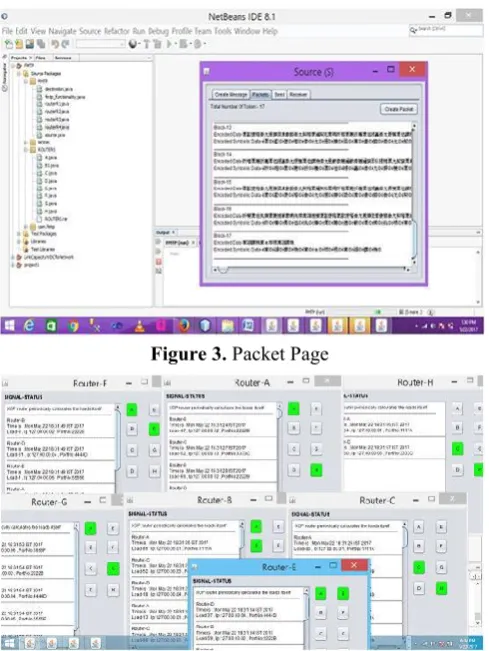
Figure 2.
Main Page
Figure 4.
Message Received Page
Figure 5.
Message Received Page
Figure 6.
Packet loss Graph Form
VII.
CONCLUSION
We propose FMTCP, an expansion of tcp, to empower proficient TCP transmissions in multi-entomb confront systems. We utilize fountain to encrypt sending information and exploit its arbitrary coding plan to maintain a strategic distance from retransmissions in MPTCP. Exploiting the elements of wellspring code, we propose a destination calculation to flexibility
dispense encoded images to various sub flows in light of the normal packet entry time over various ways.
VIII.
FUTURE ENHANCEMENTS
Fountain code is an exciting new area of study. With the ever demanding need for fast data transmission, more technological paradigm shifts are desired. Fountain code is the heart of tcp to send the data without any delay and with no retransmission, but especially in networking. When fountains are used in protocols, they can easily transmit the data very fast and secure. Thus monitoring cost is greatly decreased. But as networks are large which needs long range data transmission but the fountain codes are small, fountains are to be laid in high number. When large amount of data transmission takes place, the fountain gets slow to transmit. It is not possible to manually increase its size. Hence new techniques are needed that can help preserving fountain code.
IX.
REFERENCES
[1]. D. Wischik, C. Raiciu, A. Greenhalgh, and M. Handley, "Design, implementation and evaluation of congestion control formulti path TCP," in Proc. 8th USENIX NSDI, 2011, p. 8. [2]. S.Barré,C.Paasch,andO.Bonaventure,"Multipath
TCP:fromtheory to practice," in Proc. Netw.,2011,pp.444-457.
[3]. C. Raiciu, C. Paasch, S. Barre, A. Ford, M. Honda, F. Duchene, O. Bonaventure,andM.Handley,"Howhardcanitbe?d esigningandimplementingadeployablemultipathT CP," in Proc.9thUSENIXNSDI, 2012, vol. 12, p. 29.
[4]. A.Ford, C.Raiciu, M.Handley, and O.Bonaventure,"TCP extensions for multi path operation with multiple addresses,"RFC6824,2013