ISSN(Online): 2319-8753 ISSN (Print): 2347-6710
I
nternational
J
ournal of
I
nnovative
R
esearch in
S
cience,
E
ngineering and
T
echnology
(An ISO 3297: 2007 Certified Organization)
Website: www.ijirset.com
Vol. 6, Issue 8, August 2017
Fusion of Discriminative Robust Local Binary
Pattern and Local Directional Number
Pattern for Face Recognition
S. Gomathi Meena1, K.G. Srinivasagan2
Department of Computer Science, Vidhya Sagar Women’s College, Chengalpattu, Tamil Nadu, India1
Department of Information Technology, National Engineering College, K.R Nagar, Kovilpatti, Tamil Nadu, India2
ABSTRACT: Local texture pattern is one of the most vital scenarios in face recognition. The recently proposed Discriminative Robust Local Binary Pattern (DRLBP) represents the image with the help of directional information, and it provides promising results. This paper proposes DRLBP-based face recognition using the descriptor Local Directional Number (LDN) pattern, which is used to encode directional information of the texture patterns within the regions. In the proposed approach, the face image is divided into regions and compute its edge response using compass mask, which is used to distinguish textures with similar structural patterns. It provides the information about the entire neighbourhood. The performance analysis of the proposed method is conducted using two standard databases – FEI (Centro Universitário da Fundação Educacional Inaciana) Face Database and INRIA (Institut National de Recherche en Informatique et en Automatique). The performance is compared with the earlier techniques such as Robust Local Binary Pattern (RLBP), Robust Local Ternary Pattern (RLTP) and DRLBP. The experimental results show considerable improvement in terms of noise level and threshold values when compared with the previous works.
KEYWORDS: Binary Pattern; Robust, Ternary Pattern, Discriminative, Directional, Threshold
I. INTRODUCTION
The recognition of texture is one of the most important areas of research in pattern recognition. A wide array of applications of this technique is inspecting the surfaces, categorizing the materials, remote sensing, etc. Basically, the texture is one of the most important elements in the previous works and is categorized into micro and macro patterns. The spatial definition and the visual patterns of the face images are easily extracted, identified and represented using texture measures [1,2,3,4] even with different illumination conditions, intensity variations, appearance, etc. The modelling of the texture generally followed two-dimensional gray level variation to extract the feature after the images have been segmented into objects or regions. The texture discrimination in face images in terms of statistical properties are investigated in [5]. Co-occurrence statistics and difference histograms are the types of works related to statistical texture measures. In the later stage, advanced texture modelling techniques were applied to achieve variations in illumination, robustness to scale and rotational invariance. Rotational invariance is the most important application in texture classification that can appear in the captured object because of self-rotation or camera rotation. It is classified into three categories – global image rotation, local patch rotation and discarding local orientation.
ISSN(Online): 2319-8753 ISSN (Print): 2347-6710
I
nternational
J
ournal of
I
nnovative
R
esearch in
S
cience,
E
ngineering and
T
echnology
(An ISO 3297: 2007 Certified Organization)
Website: www.ijirset.com
Vol. 6, Issue 8, August 2017
The main advantages of the proposed system are: (1) the information about the entire neighbourhood is encoded using the directional numbers instead of bit strings; (2) both magnitude information and similar patterns are taken into account; (3) with implicit use of response sign, more information is encoded in less space; (4) the amount of noise is reduced much at the reasonable level.
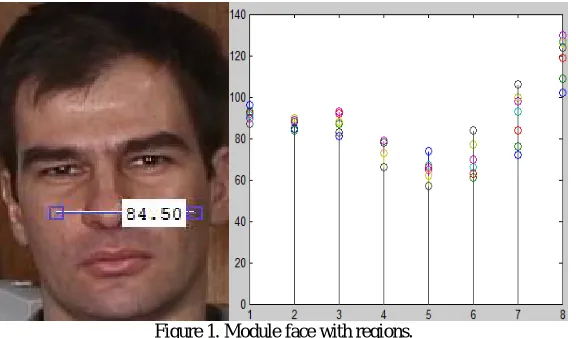
Figure 1. Module face with regions.
This paper is organized as follows: In Section 1, introduction and the review of face recognition are given. Sections 2 and 3 present the texture classification using DRLBP and LDN respectively. Section 4 describes the feature selection. Experimental results of the proposed work are presented in Section 5. Section 6 presents the summary and the scope of future work.
II. RELATED WORKS
ISSN(Online): 2319-8753 ISSN (Print): 2347-6710
I
nternational
J
ournal of
I
nnovative
R
esearch in
S
cience,
E
ngineering and
T
echnology
(An ISO 3297: 2007 Certified Organization)
Website: www.ijirset.com
Vol. 6, Issue 8, August 2017
III. TEXTURE CLASSIFICATION USING DRLBP
RLBP is sensitive to noise and small pixel value fluctuations. LTP solves this problem by using two thresholds that create three different states. It is more resistant to noise and small pixel variations. RLBP is used to solve the problem of LBP and show the difference in bright object against a dark background and vice-versa. But it is not applicable to ULBP and LLBP of LTP. DRLBP overcomes all these issues, and it retains both the edge and the texture information that is desirable to distinguish face images clearly.
,
,
...
...
...
...
...(
1
)
9
1
i
i
y
x
RLBP
y
x
w
DRLBP
where w(x,y) is calculated by gradient operator by finding the square root of the magnitude in x and y directions.
IV. TEXTURE CLASSIFICATION USING LDN
LDN encodes the directional information of the face images textures in a dense way producing a more discriminative code than current methods. To figure the structure of each micro-pattern with the support of a compass mask that extracts directional information and encodes such information using the well-known direction indices and sign, which allows us to distinguish among similar structural patterns that have different intensity transitions. Then the face images is divided into several regions and take out the distribution of the LDN features from them, then concatenate these features into a feature vector and used it as a face descriptor.
The descriptor performs consistently under illumination, noise, expression, and the time lapse variations. The LDN pattern is a six-bit binary code assigned to each pixel of an input image that represents the structure of the texture and its intensity transitions. As previous research indicates, edge magnitudes are largely insensitive to lighting changes. Accordingly, the pattern is created by computing the edge response of the neighbourhood using a compass mask, and by capturing the top directional numbers are both positive and negative directions of those edge responses.
The positive and negative responses give valuable information of the structure of the neighbourhood as they expose the gradient direction of bright and dark areas in the neighbourhood. Thus, this distinction between dark and bright responses allows LDN to discriminate between blocks with the positive and the negative directions swapped which is equivalent to swapping the bright and the dark areas of the neighbourhood by generating a different code for each case, while other methods may mistake the swapped regions as one. These transitions also occur repeatedly in the face image, for example, the top and the bottom edges of the eyebrows and mouth have different intensity transitions.
The code is generated using LDN, by analyzing the edge response of each mask, {M0,...,M7} that represents the
edge significance in its respective direction and by combining the dominant directional numbers. Given that the edge responses are not equally important the presence of a high negative or positive value signals a prominent dark or bright area. Hence to encode these prominent regions, implicit use of sign information as to assign a fixed position for the top positive directional number as the three most significant bits in the code, and the three least significant bits are the top negative directional numbers.
x
,
y
8
i
x,yj
x,y...
...
...
...
...
...
....(
2
)
LDN
where (x,y) is the central pixel of the neighbourhood being coded, ix,y is the directional number of the maximum
positive response, and jx,y is the directional number of the minimum negative response defined by:
,
0
7
...
...
...
...
...
...(
3
)
max
arg
,
II
x
y
i
i
xy i i
,
0
7
...
...
...
...
...
...(
4
)
max
arg
,
II
x
y
j
j
xy j jwhere Πi is the convolution of the original image, I, and the ith mask, Mi is defined by:
)
5
....(
...
...
...
...
...
...
...
...
i
i
I
M
ISSN(Online): 2319-8753 ISSN (Print): 2347-6710
I
nternational
J
ournal of
I
nnovative
R
esearch in
S
cience,
E
ngineering and
T
echnology
(An ISO 3297: 2007 Certified Organization)
Website: www.ijirset.com
Vol. 6, Issue 8, August 2017
To create the LDN code, a compass mask is used to compute the edge responses. The proposed code is analyzed using two different asymmetric masks: Kirsch and derivative-Gaussian. Both masks operate in the gradient space that reveals the face image structure. Gaussian smoothing is used to stabilize the code in the presence of noise by using the derivative-Gaussian mask. The Kirsch mask is rotated apart to obtain the edge response in eight different directions. This indicates the use of this mask to produce the LDN code by LDNK. Kirsch mask uses the derivative of a skewed Gaussian to create an asymmetric compass mask that is used to compute the edge response on the smoothed face. This mask is strong against noise and illumination changes while producing strong edge responses. Therefore, the Gaussian mask is defined by
...
...
...
...
...(
6
)
2
exp
2
1
,
22 2
2
y
x
y
x
G
where x and y are location positions, and their width of the Gaussian bell; this defines the mask as:
Mσ(x,y) = Gσ(x+k,y) * Gσ(x,y) where y is the derivative of Gσ with respect to x, σ is the width of the Gaussian bell, * is
the convolution operation, and k is the offset of the Gaussian with respect to its centre. A compass mask is generated, {M0σ,...,M7σ}, by rotating Mσ 45° apart in eight different directions. Thus, a set of masks is obtained.
V. FEATURE SELECTION
This section demonstrates the role and effect of similar patterns, which are generally discarded in most of the existing LBP approaches because this also contains discriminative information. In general, similar patterns are known to exhibit high discriminative patterns, and it does not generalize across different datasets because for complex images, similar patterns may not be the most frequently occurring ones [18,19]. To overcome this kind of drawback, the fusion of similar patterns of DLRBP and LDN performed and it contributes to both reducing the length of the feature vector and improving the performance of classifiers. In the proposed algorithm, the subset of discriminative patterns of each dataset from the training images is created based on most frequently occurring similar patterns and is used for classification. Let X1,..., XN represent the training images where the images are resized to 128×128 pixels by using
down-sampling method. The histograms (HG) are computed for all the training images , and are bin-wise summed together to find the distribution of patterns from the training images HG = HG1+...+HGN. The bins of the
summed histogram HG are sorted in the descending order, and the patterns corresponding to the first K bins are selected. The value of K is calculated as follows:
)
7
...(
...
...
...
...
...
arg
2
1 1
1
P
i N
i
N
i
HG
i
HG
Min
K
The total number of patterns (K) selected by the algorithm depend on the threshold parameter (τ) and the training
ISSN(Online): 2319-8753 ISSN (Print): 2347-6710
I
nternational
J
ournal of
I
nnovative
R
esearch in
S
cience,
E
ngineering and
T
echnology
(An ISO 3297: 2007 Certified Organization)
Website: www.ijirset.com
Vol. 6, Issue 8, August 2017
)
8
...(
...
matching
correct
of
number
Total
faces
accepted
Wrongly
FAR
)
9
....(
...
...
matching
correct
of
number
Total
faces
rejected
Wrongly
FRR
)
2
/
(%))
(%)
(
100
(
(%)
FAR
FRR
Accuracy
Gaussian noise is a general kind of noise that arises due to illumination, environmental circumstances, and so on. It really affects the quality and visualization of an image. For better recognition, noise needs to removed from the face image and its probability density function is given by the expression:
)
10
...(
...
...
...
...
...
...
2
)
(
2 / )
( 2
V
G
e
G
P
where G = gray level; µ = mean of average value of G; σ = standard deviation, and V= variance.
The distortion level represented by noise variance is uniformly sampled on a log-scale between 0.1, 0.15 and 0.2 [22,23].
VI. EXPERIMENTAL RESULTS
An empirical study is done extensively to evaluate the existing approaches and the proposed techniques with various variables and conditions. The proposed method is tested on two different texture datasets – FEI Face Database and INRIA Database. The major findings of this study are that texture features can often be characterized as noise level and threshold values that make us impart the human expressions in a better way.
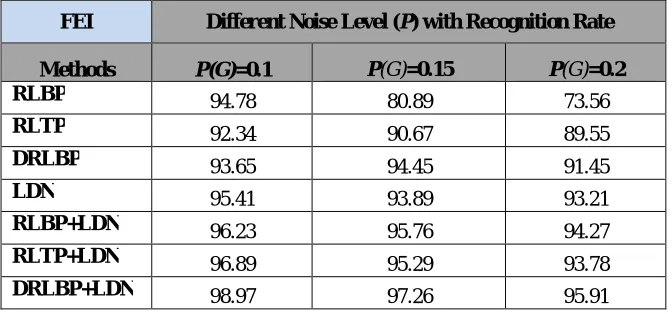
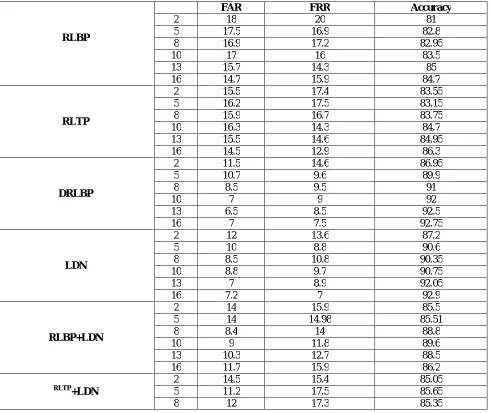
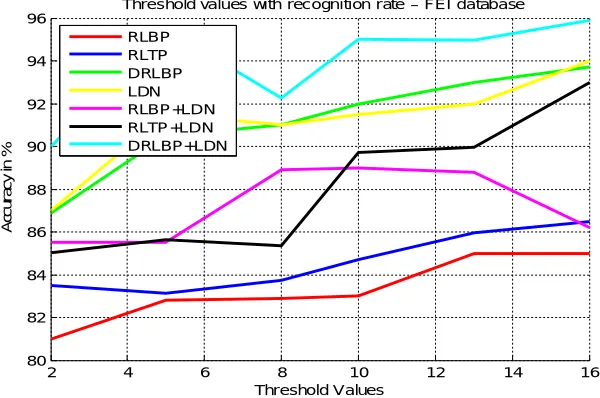
(1) FEI Face Database: The dataset consists of 2800 images from 14 different texture classes under different lighting conditions, rotations, and pose variations. The testing set consists of 2380 images, and the training set consists of (14×30)=420 images. It can be observed that the modifications in the proposed descriptors have achieved highest accuracy, 89.6%, 92.99% and 95.90% at the threshold values 10, 16 and 16 respectively for RLBP+LDN, RLTP+LDN and DRLBP+LDN. The highest recognition rate for the noise level is 98.99% at P(G)=0.1. The results of this experiment are shown in Figures 2 and 4, and Tables 1 and 2 respectively.
Table 1. Noise level with recognition rate – FEI database. FEI Different Noise Level (P) with Recognition Rate Methods P(G)=0.1 P(G)=0.15 P(G)=0.2
RLBP 94.78 80.89 73.56 RLTP 92.34 90.67 89.55 DRLBP 93.65 94.45 91.45
LDN 95.41 93.89 93.21
ISSN(Online): 2319-8753 ISSN (Print): 2347-6710
I
nternational
J
ournal of
I
nnovative
R
esearch in
S
cience,
E
ngineering and
T
echnology
(An ISO 3297: 2007 Certified Organization)
Website: www.ijirset.com
Vol. 6, Issue 8, August 2017
0.1 0.12 0.14 0.16 0.18 0.2
70 75 80 85 90 95 100
Noise Level
R
a
te
o
f
R
e
c
o
g
n
it
io
n
Noise level with recognition rate – FEI database
RLBP RLTP DRLBP LDN RLBP+LDN RLTP+LDN DRLBP+LDN
Figure 2. Noise level with recognition rate – FEI database.
Table 2. Threshold values with recognition rate – FEI database [15].
RLBP
Ʈ FAR FRR Accuracy
2 18 20 81
5 17.5 16.9 82.8
8 16.9 17.2 82.95
10 17 16 83.5
13 15.7 14.3 85
16 14.7 15.9 84.7
RLTP
2 15.5 17.4 83.55
5 16.2 17.5 83.15
8 15.9 16.7 83.75
10 16.3 14.3 84.7
13 15.5 14.6 84.95
16 14.5 12.9 86.3
DRLBP
2 11.5 14.6 86.95
5 10.7 9.6 89.9
8 8.5 9.5 91
10 7 9 92
13 6.5 8.5 92.5
16 7 7.5 92.75
LDN
2 12 13.6 87.2
5 10 8.8 90.6
8 8.5 10.8 90.35
10 8.8 9.7 90.75
13 7 8.9 92.05
16 7.2 7 92.9
RLBP+LDN
2 14 15.9 85.5
5 14 14.98 85.51
8 8.4 14 88.8
10 9 11.8 89.6
13 10.3 12.7 88.5
16 11.7 15.9 86.2
RLTP
+LDN
2 14.5 15.4 85.05
5 11.2 17.5 85.65
ISSN(Online): 2319-8753 ISSN (Print): 2347-6710
I
nternational
J
ournal of
I
nnovative
R
esearch in
S
cience,
E
ngineering and
T
echnology
(An ISO 3297: 2007 Certified Organization)
Website: www.ijirset.com
Vol. 6, Issue 8, August 2017
10 9.56 12.3 89.7
13 8.5 11.6 89.95
16 5.23 8.78 92.99
DRLBP+LDN
2 8.67 11.34 89.99
5 3.5 5.5 95.5
8 6.2 9.3 92.25
10 4.2 5.8 95
13 4.3 5.8 94.95
16 4 4.23 95.89
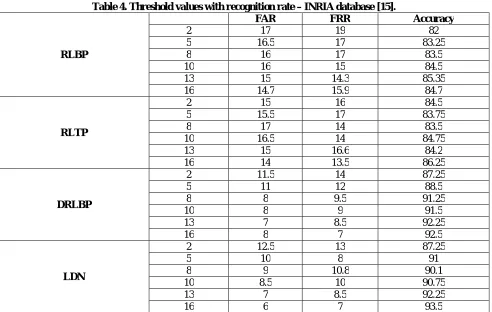
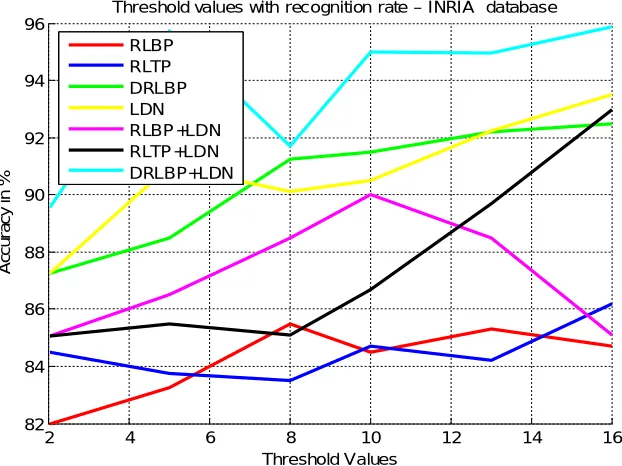
(2) INRIA Database: As for the dataset, 12,180 windows are sampled randomly from 1218 negative training photos under different lighting conditions, rotations, and pose variations. Then, the images are rotated at nine different angles (0°, 5°, 10°, 15°, 30°, 45°, 60°, 75° and 90°). The testing set consists of 11,630 images and the training set consists of 550 images. The results of this experiment are shown in Figures 3 and 5, and Tables 3 and 4 respectively. It can be observed that the modifications in the proposed descriptors have achieved highest accuracy, 90.05%, 93% and 95.89% at the threshold values 10, 16 and 16 for RLBP+LDN, RLTP+LDN and DRLBP+LDN. The highest recognition rate for the noise level is 98.89% at P(G)=0.1.
2 4 6 8 10 12 14 16 80
82 84 86 88 90 92 94 96
Threshold Values
A
cc
u
ra
c
y
i
n
%
Threshold values with recognition rate – FEI database RLBP
RLTP DRLBP LDN RLBP+LDN RLTP+LDN DRLBP+LDN
Figure 4. Threshold values with recognition rate – FEI database.
Table 3. Noise level with recognition rate – INRIA database.
INRIA Different Noise Level (P) with Recognition Rate
Methods P(G)=0.1 P(G)=0.15 P(G)=0.2
RLBP 93.25 87.25 90.1
RLTP 91.23 90.29 86.55
DRLBP 92.49 95.34 92.21
LDN 96 92.41 91.3
RLBP+LDN 94.29 94.37 93.33 RLTP+LDN 96.45 95 94.19
ISSN(Online): 2319-8753 ISSN (Print): 2347-6710
I
nternational
J
ournal of
I
nnovative
R
esearch in
S
cience,
E
ngineering and
T
echnology
(An ISO 3297: 2007 Certified Organization)
Website: www.ijirset.com
Vol. 6, Issue 8, August 2017
0.1 0.12 0.14 0.16 0.18 0.2
86 88 90 92 94 96 98 100
Noise Level
R
a
te
o
f
R
e
c
o
g
n
it
io
n
Noise level with recognition rate – INRIA database
RLBP RLTP DRLBP LDN RLBP+LDN RLTP+LDN DRLBP+LDN
Figure 3. Noise level with recognition rate – INRIA database.
Table 4. Threshold values with recognition rate – INRIA database [15].
RLBP
Ʈ FAR FRR Accuracy
2 17 19 82
5 16.5 17 83.25
8 16 17 83.5
10 16 15 84.5
13 15 14.3 85.35
16 14.7 15.9 84.7
RLTP
2 15 16 84.5
5 15.5 17 83.75
8 17 14 83.5
10 16.5 14 84.75
13 15 16.6 84.2
16 14 13.5 86.25
DRLBP
2 11.5 14 87.25
5 11 12 88.5
8 8 9.5 91.25
10 8 9 91.5
13 7 8.5 92.25
16 8 7 92.5
LDN
2 12.5 13 87.25
5 10 8 91
8 9 10.8 90.1
10 8.5 10 90.75
13 7 8.5 92.25
ISSN(Online): 2319-8753 ISSN (Print): 2347-6710
I
nternational
J
ournal of
I
nnovative
R
esearch in
S
cience,
E
ngineering and
T
echnology
(An ISO 3297: 2007 Certified Organization)
Website: www.ijirset.com
Vol. 6, Issue 8, August 2017
RLBP+LDN
2 14 15.9 85.05
5 13 14 86.5
8 8 14.9 88.55
10 8 11.9 90.05
13 9.3 13.7 88.5
16 11.9 17.9 85.1
RLTP+LDN
2 14.5 15.4 85.05
5 11 17.9 85.5
8 12 17.8 85.1
10 9.5 16.9 86.8
13 8 12.6 89.7
16 5 9 93
DRLBP+LDN
2 8 12.9 89.55
5 3 5.5 95.75
8 6 10.6 91.7
10 4 6 95
13 4.1 5.97 94.96
16 4 4.23 95.89
2 4 6 8 10 12 14 16
82 84 86 88 90 92 94 96
Threshold Values
A
cc
u
ra
c
y
i
n
%
Threshold values with recognition rate – INRIA database
RLBP RLTP DRLBP LDN RLBP+LDN RLTP+LDN DRLBP+LDN
Figure 5. Threshold values with recognition rate – INRIA database.
VII. CONCLUSION
ISSN(Online): 2319-8753 ISSN (Print): 2347-6710
I
nternational
J
ournal of
I
nnovative
R
esearch in
S
cience,
E
ngineering and
T
echnology
(An ISO 3297: 2007 Certified Organization)
Website: www.ijirset.com
Vol. 6, Issue 8, August 2017
respectively. The implementation of the proposed framework may be extended to a group of persons, which involves counting the number of face images, gender identification and also image compression and transmission. The classification of gender can be identified using either geometric-based or appearance-based feature extraction by detecting the portion of the face image and removing the background regions. The vital features in this technique are hair, forehead, brows, eyes, nose, mouth and clothes.
REFERENCES
[1] Lategahn, H., S. Gross, T. Stehle and T. Aach (2010). Texture classification by modeling joint distributions of local patterns with Gaussian mixtures, IEEE Transactions on Image Processing, 19(6), pp. 1548–1557.
[2] Lerski, R., K. Straughan, L. Shad, D. Boyce, S. Bluml and I. Zuna (1993). MR image texture analysis – an approach to tissue characterization, Magnetic Resononance Imaging, Vol. 11, pp. 873–887.
[3] Ojala, T., M. Pietikainen and D. Harwood (1996). A comparative study of texture measures with classification based on feature distributions, Pattern Recognition, 29(1), pp. 51–59.
[4] Strzelecki, M. (1995). Segmentation of Textured Biomedical Images Using Neural Networks (Ph.D. thesis), Technical University of Lodz, Poland.
[5] Julesz, B. (1975). Experiments in the visual perception of texture, Scientific American, Vol 4, pp. 34–43.
[6] Guo, Z., L. Zhang and D. Zhang (2010). Rotation invariant texture classification using LBP Variance (LBPV) with global matching, Pattern Recognition, 43(3), pp. 706–719.
[7] Guo, Zhenhua, L. Zhang and D. Zhang (2010). A completed modeling of local binary pattern operator for texture classification, IEEE Transaction on Image Processing, 19(6), pp. 1657–1663.
[8] Liao, S., M.W.K. Law and A.C.S. Chung (2009). Dominant local binary patterns for texture classification, IEEE Transactions on Image Processing, 18(5), pp. 1107–1118.
[9] Tan, Xiaoyang and B. Triggs (2010). Enhanced Local Texture Feature Sets for Face Recognition under Difficult Lighting Conditions. IEEE Transactions on Image Processing, 19(6), pp. 1635–1650.
[10] Chen, Jie, Vili Kellokumpu, Guoying Zhao and Matti Pietikäinen (2013). RLBP: Robust Local Binary Pattern, Proceedings of the British Machine Vision Conference (BMVC 2013), Bristol, UK.
[11] Liu, Li, Songyang Lao, Paul W. FieguthYulun Gao, Xiaogang Wang and Matti Pietikäinen. Median Robust Extended Local Binary Pattern for Texture Classification, IEEE Transactions on Image Processing, Vol. 25, Issue 3, pp. 1368–1381.
[12] Zhao, Yang, Wei Jia, Rong-Xiang Hu and Hai Min (2013). Completed Robust Local Binary Pattern for Texture Classification. Neurocomputing, Vol. 106, pp. 68–76.
[13] Wu, Xiaosheng, Junding Sun, Guoliang Fan and Zhiheng Wang (2015). Improved Local Ternary Patterns for Automatic Target Recognition in Infrared Imagery, Sensors, 15, pp. 6399–6418.
[14] Kohle, Rajashri A. and A.S. Deshpande (2016). DRLBP and DRLTP Based Object Recognition for Image Retrieval Systems. International Journal of Advanced Research in Computer and Communication Engineering, Vol. 5(9), pp. 291–296.
[15] Mehta, Rakesh and Karen Egiazarian (2016). Dominant Rotated Local Binary Patterns (DRLBP) for Texture Classification, Pattern Recognition, Vol. 71, pp. 16–22.
[16] Rizvera, Adin Ramirez and Jorge Rojas Castillo (2012). Local Directional Number Pattern for Face Analysis: Face and Expression Recognition, IEEE Transactions on Image Processing, Vol 22(5), pp. 1740–1752.
[17] Srinivasa Perumal, R. and P.V.S.S.R. Chandra Mouli (2016). Dimensionality-reduced Local Directional Pattern (DR-LBP) for face Recognition, Journal of Ambient Intelligence and Humanized Computing, 66, pp. 66–73.
[18] Liao, S., W. Law and A.C. (2009). Chung. Dominant local binary patterns for texture classification, IEEE Transactions on Image Processing, 18(5), pp. 1107–1118.
[19] Ojala, T., M. Pietikainen and T. Maenpaa (2002). Multiresolutiongray-scale and rotation in-variant texture classification with local binary patterns, IEEE Transactions on Pattern Analysis and Machine Intelligence, 24(7), pp. 971–987.
[20] Malik, J., Dhiraj Girdhar, Ratna Dahiya and G. Sainarayanan (2014). Reference Threshold Calculation for Biometric Authentication, International Journal Image, Graphics and Signal Processing, Vol. 2, pp. 46–53.
[21] Sudana, O. K. A., I. K. G. Darma Putra and Alan Arismandika (2014). Face Recognition System on Android using Eigen Face Method, Journal of Theoretical and Applied Information Technology, 3(10), Vol 1, No. 61, pp. 128–134.
[22] Ahirwal, Ram Ratan and Nachankar, Sagar (2016). A Novel Method of Average Filtering for Removing Noise and Face Recognition, European Journal of Computer Science and Information Technology, Vol. 4, No. 2, pp. 9–24.