Volume 2006, Article ID 36424, Pages1–7 DOI 10.1155/WCN/2006/36424
Rate-Optimal Multiuser Scheduling with Reduced Feedback
Load and Analysis of Delay Effects
Vegard Hassel,1Mohamed-Slim Alouini,2Geir E. Øien,1and David Gesbert3
1Department of Electronics and Telecommunications, Norwegian University of Science and Technology, 7491 Trondheim, Norway 2Department of Electrical Engineering, Texas A&M University at Qatar (TAMUQ), Education City, P.O. Box 5825, Doha, Qatar 3Mobile Communications Department, Eur´ecom Institute, 06904 Sophia Antipolis, France
Received 30 September 2005; Revised 13 March 2006; Accepted 26 May 2006
We propose a feedback algorithm for wireless networks that always collects feedback from the user with the best channel conditions and has a significant reduction in feedback load compared to full feedback. The algorithm is based on a carrier-to-noise threshold, and closed-form expressions for the feedback load as well as the threshold value that minimizes the feedback load have been found. We analyze two delay scenarios. The first scenario is where the scheduling decision is based on outdated channel estimates, and the second scenario is where both the scheduling decision and the adaptive modulation are based on outdated channel estimates.
Copyright © 2006 Vegard Hassel et al. This is an open access article distributed under the Creative Commons Attribution License, which permits unrestricted use, distribution, and reproduction in any medium, provided the original work is properly cited.
1. INTRODUCTION
In a wireless network, the signals transmitted between the base station and the mobile users most often have different channel fluctuation characteristics. This diversity that exists between users is calledmultiuser diversity(MUD) and can be exploited to enhance the capacity of wireless networks [1]. One way of exploiting MUD is by opportunistic scheduling
of users, giving priority to users having good channel condi-tions [2,3]. Ignoring the feedback loss, the scheduling algo-rithm, that maximizes the average system spectral efficiency among all time division multiplexing- (TDM-) based algo-rithms, is the one where the user with the highest carrier-to-noise ratio (CNR) is served in every time slot [2]. Here, we refer to this algorithm asmax CNR scheduling(MCS).
To be able to take advantage of the MUD, a base station needs feedback from the mobile users. Ideally, the base sta-tion only wants feedback from the user with the best channel conditions, but unfortunately each user does not know the CNR of the other users. Therefore, in current systems like Qualcomm’s high data rate (HDR) system, the base station collects feedback from all the users [4].
One way to reduce the number of users giving feedback is by using aCNR threshold. For theselective multiuser diver-sity(SMUD) algorithm, it is shown that the feedback load is reduced significantly by using such a threshold [5]. For this algorithm only the users that have a CNR above a CNR threshold should send feedback to the scheduler. If the
sched-uler does not receive a feedback, a random user is chosen. Because the best user is not chosen for every time slot, the SMUD algorithm however introduces a reduction in system spectral efficiency. In addition it can be hard to set the thresh-old value for this algorithm. Applying a high threshthresh-old value will lead to low feedback load, but will additionally reduce the MUD gain and hence the system spectral efficiency. Using a low threshold value will have the opposite effect: the feed-back load reduction is reduced, but the spectral efficiency will be higher.
The feedback algorithm proposed here is inspired by the SMUD algorithm, in the sense that this new algorithm also employs a feedback threshold. However, if none of the users succeeds to exceed the CNR threshold, the scheduler requests full feedback, and selects the user with the highest CNR. Consequently, the MUD gain [1] is maximized, and still the feedback load is significantly reduced compared to the MCS algorithm. Another advantage with this novel algorithm is that for a specific set of system parameters it is possible to find a threshold value that minimizes the feedback load.
feedback information will be outdated. The consequences of delay are analyzed by looking separately at two different ef-fects: (a) the system spectral efficiency degradation arising because the scheduler does not have access to instantaneous information about CNRs of the users, and (b) the bit error rate (BER) degradation arising when both the scheduler and the mobile users do not have access to instantaneous channel measurements.
Contributions
We develop closed-form expressions for the feedback load of the new feedback algorithm. The expression for the thresh-old value which minimizes the feedback load is also derived. In addition we obtain new closed-form expressions for the system spectral efficiency degradation due to thescheduling delay. Finally, closed-form expressions for the effects of out-dated channel estimatesare obtained. Parts of the results have previously been presented in [6].
Organization
The rest of this paper is organized as follows. InSection 2, we present the system model. The feedback load is analyzed in
Section 3, while Sections4and5analyze the system spectral efficiency and BER, respectively. InSection 6the effects of delay are discussed. Finally,Section 7lists our conclusions.
2. SYSTEM MODEL
We consider a single cell in a wireless network where the base station exchanges information with a constant numberNof mobile users which have identically and independently dis-tributed (i.i.d.) CNRs with an average ofγ. The system con-sidered is TDM-based, that is, the information transmitted in time slots with a fixed length. We assume flat-fading chan-nels with a coherence time of one time slot, which means that the channel quality remains roughly the same over the whole time slot duration and that this channel quality is uncorre-lated from one time slot to the next. The system uses adap-tive coding and modulation, that is, the coding scheme, the modulation constellation, and the transmission power used depend on the CNR of the selected user [7]. This has two ad-vantages. On one hand, the spectral efficiency for each user is increased. On the other hand, because the rate of the users is varied according to their channel conditions, it makes it possible to exploit MUD.
We will assume that the users always have data to send and that these user data are robust with respect to delay, that is, no real-time traffic is transmitted. Consequently, the base station only has to take the channel quality of the users into account when it is performing scheduling.
The proposed feedback algorithm is applicable in at least two different types of cellular systems. The first system model is a time-division duplex (TDD) scenario, where the same carrier frequency is used for both uplink and downlink. We can therefore assume a reciprocal channel for each user, that is, the CNR is the same for the uplink and the downlink for a
given point in time. The system uses the first half of the time slot for downlink and the last half for uplink transmission. The users measure their channel for each downlink transmis-sion and this measurement is fed back to the base station so that it can decide which user is going to be assigned the next time slot. The second system model is a system where diff er-ent carriers are used for uplink and downlink. For the base station to be able to schedule the user with the best down-link channel quality, the users must measure their channel for each downlink transmission and feed back their CNR measurement. For both system models the users are notified about the scheduling decision in a short broadcast message from the base station between each time slot.
3. ANALYSIS OF THE FEEDBACK LOAD
The first step of the new feedback algorithm is to ask for feed-back from the users that are above a CNR threshold valueγth. The number of usersnbeing above the threshold valueγthis random and follow abinomial distributiongiven by
Pr(n)=
wherePγ(γ) is the cumulative distribution function (CDF)
of the CNR for a single user. The second step of the feedback algorithm is to collect full feedback. Full feedback is only needed if all users’ CNRs fail to exceed the threshold value. The probability of this event is given by insertingγ=γthinto
Pγ∗(γ)=PγN(γ), (2)
whereγ∗denotes the CNR of the user with the best channel quality.
We now define thenormalized feedback load(NFL) to be the ratio between the average number of users transmitting feedback, and the total number of users. The NFL can be ex-pressed as a the average of the ration/N, wherenis the num-ber of users giving feedback:
F= N
30
Normalized feedback load for average CNR of 15 dB
2 users
5 users 10 users
50 users
Figure1: Normalized feedback load as a function ofγthwithγ =
15 dB.
A plot of the feedback load as a function ofγthis shown in Figure 1 forγ= 15 dB. It can be observed that the new algorithm reduces the feedback significantly compared to a system with full feedback. It can also be observed that one threshold value will minimize the feedback load in the sys-tem for a given number of users.
The expression for the threshold value that minimizes the average feedback load can be found by differentiating (3) with respect toγthand setting the result equal to zero:
γth∗ =Pγ−1
the optimum threshold can be found in a simple closed form as
4. SYSTEM SPECTRAL EFFICIENCIES FOR DIFFERENT POWER AND RATE ADAPTATION TECHNIQUES
To be able to analyze the system spectral efficiency we choose to investigate themaximum average system spectral efficiency
(MASSE) theoretically attainable. The MASSE (bit/s/Hz) is defined as the maximum average sum of spectral efficiency for a carrier with bandwidthW(Hz).
4.1. Constant power and optimal rate adaptation
Since the best user is always selected, the MASSE of the new algorithm is the same as for the MCS algorithm. To find the MASSE for such a scenario, the probability density function (pdf) of the highest CNR among all the users has to be found.
This pdf can be obtained by differentiating (2) with respect to γ. Inserting the CDF and pdf for Rayleigh fading chan-nels (pγ(γ)=(1/γ)e−γ/γ), and using binomial expansion [8,
equation (1.111)], we obtain
pγ∗(γ)= N
Inserting (6) into the expression for the spectral efficiency for optimal rate adaptation found in [9], the following ex-pression for the MASSE can be obtained [10, equation (44)]:
Cora
where ora denotesoptimal rate adaptationandE1(·) is the
first-order exponential integral function[8].
4.2. Optimal power and rate adaptation
It has been shown that the MASSE for optimal power and rate adaptation can be obtained as [10, equation (27)]
Copra
where opra denotesoptimal power and rate adaptationandγ0 is the optimal cutoffCNR level below which data transmis-sion is suspended. This cutoffvalue must satisfy [9]
∞
Inserting (6) into (9), it can subsequently be shown that the following cutoffvalue can be obtained for Rayleigh fading channels [10, equation (24)]:
N−1
5. M-QAM BIT ERROR RATES
The BER of coherentM-ary quadrature amplitude modula-tion (M-QAM) with two-dimensional Gray coding over an additive white Gaussian noise (AWGN) channel can be ap-proximated by [11]
for continuous-rate M-QAM can be approximated byM ≈
(1+3γ/2K0), whereK0= −ln(5 BER0) and BER0is the target BER. Consequently, it can be easily shown that the theoreti-cal constant-power ACR M-QAM scheme always operates at the target BER.
For physical systems only integer constellation sizes are practical, so now we restrict the constellation sizeMkto 2k,
wherekis a positive integer. This adaptation policy is called
adaptive discrete rate(ADR) M-QAM, and the CNR range is divided intoK+ 1fading regionswith constellation sizeMk
assigned to thekth fading region. Because of the discrete as-signment of constellation sizes in ADR M-QAM, this scheme has to operate at a BER lower than the target. The average BER for ADR M-QAM using constant power can be calcu-lated as [12]
is the probability that the scheduled user is in the fading re-gionkfor CNRs betweenγkandγk+1.
Inserting (11) and (6) into (13) we obtain the following expression for the average BER within a fading region:
BERk=
When power adaptation is applied, the BER approxima-tion in (11) can be written as [11] is the average transmit power. Inserting the continuous power adaptation policy given by [11, equation (29)] into (17) shows that the ADR M-QAM scheme using optimal power adaptation always operates at the target BER. Cor-respondingly, it can be shown that the continuous-power, continuous-rate M-QAM scheme always operates at the tar-get BER.
6. CONSEQUENCES OF DELAY
In the previous sections, it has been assumed that there is no delay from the instant where the channel estimates are obtained and fed back to the scheduler, to the time when the optimal user is transmitting. For real-life systems, we have to
take delay into consideration. We analyze, in what follows, two delay scenarios. In the first scenario, ascheduling delay
arises because the scheduler receives channel estimates, takes a scheduling decision, and notifies the selected user. This user then transmits, but at a possibly different rate. The second scenario deals with outdated channel estimates, which leads to both a scheduling delay as well as suboptimal modulation constellations with increased BERs.
Outdated channel estimates have been treated to some extent in previous publications [12,13]. However, the con-cept of scheduling delay has in most cases been analyzed for wire-line networks only [14,15]. Although some previous work has been done on scheduling delay in wireless networks [16], scheduling delay has to the best of our knowledge not been looked into for cellular networks.
6.1. Impact of scheduling delay
In this section, we will assume that the scheduling decision is based on a perfect estimate of the channel at timet, whereas the data are sent over the channel at timet+τ. We will as-sume that the link adaptation done at timet+τis based on yet another channel estimate taken att+τ. To investigate the in-fluence of this type of scheduling delay, we need to develop a pdf for the CNR at timet+τ, conditioned on channel knowl-edge at timet. Letαandατ be the channel gains at timest
andt+τ, respectively. Assuming that the average power gain remains constant over the time delayτ for a slowly-varying Rayleigh channel (i.e.,Ω = E[α2] = E[α2
τ]) and using the
same approach as in [12] it can be shown that the conditional pdfpατ|α(ατ|α) is given by is the zeroth-order modified Bessel function of the first kind
[8]. Assuming Jakes Doppler spectrum, the correlation co-efficient can be expressed asρ = J02(2π fDτ), whereJ0(·) is thezeroth-order Bessel function of the first kindand fD [Hz]
is the maximum Doppler frequency shift [12]. Recognizing that (18) is similar to [17, equation (A-4)] gives the follow-ing pdf at timet+τfor the new feedback algorithm, expressed in terms ofγτandγ[17, equation (5)]: expected. Whenτ approaches infinity (ρ =0) (19) reduces to the Rayleigh pdf for one user. This is logical since for large τs, the scheduler will have completely outdated and as such useless feedback information, and will end up selecting users independent of their CNRs.
[8, equation (3.352.2)], it can be shown that we get the fol-lowing expression for the MASSE:
Cora
Using a similar derivation as for the expression above it can furthermore be shown that we get the following expres-sion for the MASSE using both optimal power and rate adap-tation:
with the following power constraint:
N−1
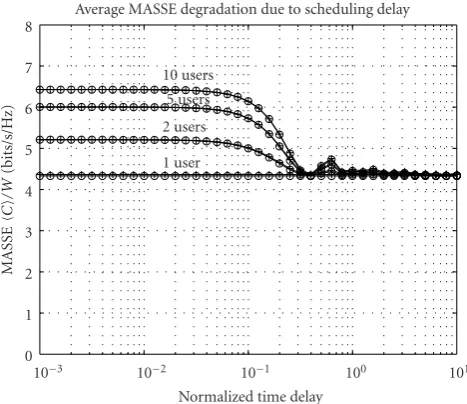
Figure 2shows how scheduling delay affects the MASSE for 1, 2, 5, and 10 users. We see that both optimal power and rate adaptation and optimal rate adaptation are equally ro-bust with regard to the scheduling delay. Independent of the number of users, we see that the system will be able to oper-ate satisfactorily if the normalized delay is below the critical value of 2·10−2. For normalized time delays above this value, we see that the MASSE converges towards the MASSE for one user, as one may expect.
6.2. Impact of outdated channel estimates
We will now assume that the transmitter does not have a per-fect outdated channel estimate available at timet+τ, but only at timet. Consequently, both the selection of a user and the decision of the constellation size have to be done at timet. This means that the channel estimates are outdated by the same amount of time as the scheduling delay. The constella-tion size is thus not dependent onγτ, and the time delay in
this case does not affect the MASSE. However, now the BER will suffer from degradation because of the delay. It is shown in [12] that the average BER, conditioned onγ, is
Average MASSE degradation due to scheduling delay
1 user 2 users
5 users 10 users
Optimal power and rate adaptation Constant power and optimal rate adaptation
Figure 2: Average degradation in MASSE due to scheduling de-lay for (i) optimal power and rate adaptation and (ii) optimal rate adaptation.
The average BER can be found by using the following equa-tion:
BERacr=
∞
0 BER(γ)pγ
∗(γ)dγ. (24)
For discrete rate adaptation with constant power, the BER can be expressed by (12), replacing BERkwith BERk, where
into (25), we obtain the following expression for the average BER within a fading region:
BERk=0.2N
reduces to (15), as expected.
10 1 10 2
10 3
Normalized time delay 10 4
10 3 10 2
A
ver
age
b
it
er
ro
r
rat
e
(BER
)
Average BER degradation due to time delay for BER0=10 3
1 user
10 users
Adaptive continuous-rate, constant-power M-QAM Adaptive discrete-rate, constant-power M-QAM Adaptive continuous-rate, continuous-power M-QAM Adaptive discrete-rate, continuous-power M-QAM
Figure3: Average BER degradation due to time delay for M-QAM rate adaptation withγ=15 dB, 5 fading regions, and BER0=10−3.
continuous-power, continuous-rate M-QAM is
BERacr,pa=
∞
γKBER( γ)pγ∗(γ)dγ
∞
γK pγ∗(γ)dγ
. (29)
Correspondingly, the average BER for the continuous-power, discrete-rate M-QAM case is given by
BERadr,pa=
∞
γ∗
0M1BER(γ)pγ∗(γ)dγ ∞
γ∗0M1pγ∗(γ)dγ
. (30)
Figure 3shows how outdated channel estimates affect the average BER for 1 and 10 users. We see that the average sys-tem BER is satisfactory as long as the normalized time de-lay again is below the critical value 10−2for the adaptation schemes using continuous power and/or continuous rate. The constant-power, discrete-rate adaptation policy is more robust with regard to time delay.
7. CONCLUSION
We have analyzed a scheduling algorithm that has optimal spectral efficiency and reduced feedback compared with full feedback load. We obtain a closed-form expression for the CNR threshold that minimizes the feedback load for this al-gorithm. Both the impact of scheduling delay and outdated channel estimates are analytically and numerically described. For both delay scenarios plots show that the system will be able to operate satisfactorily with regard to BER when the normalized time delays are below certain critical values.
ACKNOWLEDGMENTS
The work of Vegard Hassel and Geir E. Øien was supported in part by the EU Network of Excellence NEWCOM and by the NTNU Project CUBAN (http://www.iet.ntnu.no/projects/ cuban). The work of Mohamed-Slim Alouini was in part supported by the Center for Transportation Studies (CTS), Minneapolis, USA.
REFERENCES
[1] P. Viswanath, D. N. C. Tse, and R. Laroia, “Opportunistic beamforming using dumb antennas,”IEEE Transactions on In-formation Theory, vol. 48, no. 6, pp. 1277–1294, 2002. [2] R. Knopp and P. A. Humblet, “Information capacity and
power control in single-cell multiuser communications,” in
Proceedings of IEEE International Conference on Communica-tions (ICC ’95), vol. 1, pp. 331–335, Seattle, Wash, USA, June 1995.
[3] M. Andrews, K. Kumaran, K. Ramanan, A. Stolyar, P. Whit-ing, and R. Vijayakumar, “Providing quality of service over a shared wireless link,”IEEE Communications Magazine, vol. 39, no. 2, pp. 150–153, 2001.
[4] P. Bender, P. Black, M. Grob, R. Padovani, N. Sindhushayana, and S. Viterbi, “CDMA/HDR: a bandwidth-efficient high-speed wireless data service for nomadic users,”IEEE Commu-nications Magazine, vol. 38, no. 7, pp. 70–77, 2000.
[5] D. Gesbert and M.-S. Alouini, “How much feedback is multi-user diversity really worth?” inProceedings of IEEE Interna-tional Conference on Communications (ICC ’04), vol. 1, pp. 234–238, Paris, France, June 2004.
[6] V. Hassel, M.-S. Alouini, G. E. Øien, and D. Gesbert, “Rate-optimal multiuser scheduling with reduced feedback load and analysis of delay effects,” inProceedings of the 13th European Signal Processing Conference (EUSIPCO ’05), Antalya, Turkey, September 2005.
[7] K. J. Hole and G. E. Øien, “Spectral efficiency of adaptive coded modulation in urban microcellular networks,” IEEE Transactions on Vehicular Technology, vol. 50, no. 1, pp. 205– 222, 2001.
[8] I. S. Gradshteyn and I. M. Ryzhik,Table of Integrals, Series, and Products, Academic Press, San Diego, Calif, USA, 6th edition, 2000.
[9] A. J. Goldsmith and P. P. Varaiya, “Capacity of fading channels with channel side information,”IEEE Transactions on Informa-tion Theory, vol. 43, no. 6, pp. 1986–1992, 1997.
[10] M.-S. Alouini and A. J. Goldsmith, “Capacity of Rayleigh fading channels under different adaptive transmission and diversity-combining techniques,”IEEE Transactions on Vehic-ular Technology, vol. 48, no. 4, pp. 1165–1181, 1999.
[11] A. J. Goldsmith and S.-G. Chua, “Variable-rate variable-power MQAM for fading channels,”IEEE Transactions on Communi-cations, vol. 45, no. 10, pp. 1218–1230, 1997.
[12] M.-S. Alouini and A. J. Goldsmith, “Adaptive modulation over Nakagami fading channels,”Kluwer Journal on Wireless Com-munications, vol. 13, pp. 119–143, 2000.
[13] D. L. Goeckel, “Adaptive coding for time-varying channels us-ing outdated fadus-ing estimates algorithms,”IEEE Transactions on Communications, pp. 844–855, 1999.
[15] H.-H. Chen and W.-T. Tea, “Hierarchy schedule sensing pro-tocol for CDMA wireless networksperformance study under multipath, multiuser interference, and collision-capture ef-fect,”IEEE Transactions on Mobile Computing, vol. 4, pp. 178– 188, 2005.
[16] K.-W. Hung and T.-S. Yum, “Fair and efficient transmission scheduling in multihop packet radio networks,” inProceedings of IEEE Global Telecommunications Conference (GLOBECOM ’92), vol. 1, pp. 6–10, Orlando, Fla, USA, December 1992. [17] J. H. Barnard and C. K. Pauw, “Probability of error for
selec-tion diversity as a funcselec-tion of dwell time,”IEEE Transactions on Communications, vol. 37, pp. 800–803, 1989.
Vegard Hassel is currently pursuing the Ph.D. degree at the Department of Electron-ics and Telecommunications at the Norwe-gian University of Science and Technology (NTNU). He received the M.S.E.E. degree from NTNU in 1998 and the M.T.M. degree from the University of New South Wales (UNSW), Sydney, Australia, in 2002. Dur-ing the years 1999–2001 and 2002-2003, he was with the Norwegian Defence, working
with video conferencing and mobile emergency networks. His re-search interests include wireless networks, radio resource manage-ment, and information theory.
Mohamed-Slim Alouini was born in Tu-nis, Tunisia. He received the Ph.D. de-gree in electrical engineering from the Cal-ifornia Institute of Technology (Caltech), Pasadena, Calif, USA, in 1998. He was an Associate Professor with the Department of Electrical and Computer Engineering of the University of Minnesota, Minneapolis, Minn, USA. Since September 2005, he has been an Associate Professor of electrical
en-gineering with the Texas A&M University at Qatar, Education City, Doha, Qatar, where his current research interests include the design and performance analysis of wireless communication systems.
Geir E. Øienwas born in Trondheim, Nor-way, in 1965. He received the M.S.E.E. and the Ph.D. degrees, both from the Norwe-gian Institute of Technology (NTH), Trond-heim, Norway, in 1989 and 1993, respec-tively. From 1994 to 1996, he was an As-sociate Professor with Stavanger Univer-sity College, Stavanger, Norway. In 1996, he joined the Norwegian University of Science and Technology (NTNU) where in 2001 he
was promoted to Full Professor. During the academic year 2005-2006, he has been a Visiting Professor with Eur´ecom Institute, Sophia Antipolis, France. His current research interests are within wireless communications, communication theory, and informa-tion theory, in particular analysis and optimizainforma-tion of link adap-tation schemes, radio resource allocation, and cross-layer design. He has coauthored more than 70 scientific papers in international fora, and is actively used as a reviewer for several international jour-nals and conferences. He is a Member of the IEEE Communications Society and of the Norwegian Signal Processing Society (NORSIG).
David Gesbertis a Professor at Eur´ecom In-stitute, France. He obtained the Ph.D. de-gree from Ecole Nationale Sup´erieure des T´el´ecommunications, in 1997. From 1993 to 1997, he was with France Telecom Re-search, Paris. From April 1997 to October 1998, he has been a Research Fellow at the Information Systems Laboratory, Stanford University. He took part in the founding team of Iospan Wireless Inc., San Jose, Calif,