University of South Carolina
Scholar Commons
Theses and Dissertations
1-1-2013
I Hope It Rains So My Corn and Your Okra
Grows: A Case Study of A Kindergarten Teacher'S
Language Use In Expanding Children's Language
Repetoires
Linda D. Mook
University of South Carolina
Follow this and additional works at:https://scholarcommons.sc.edu/etd Part of theEducation Commons
This Open Access Dissertation is brought to you by Scholar Commons. It has been accepted for inclusion in Theses and Dissertations by an authorized administrator of Scholar Commons. For more information, please [email protected].
Recommended Citation
I HOPE IT RAINS SO MY CORN AND YOUR OKRA GROWS: A CASE
STUDY OF A KINDERGARTEN TEACHER'S LANGUAGE USE IN
EXPANDING CHILDREN'S LANGUAGE REPETOIRES
by
Linda D. Mook
Bachelor of Arts
Coastal Carolina College, 1990 Master of Education
University of South Carolina, 2002
______________________________________________________________
Submitted in Partial Fulfillment of the Requirements
For the Degree of Doctor of Philosophy in Language and Literacy Education
The Graduate School of Education University of South Carolina
2013
Accepted by:
Diane DeFord, Major Professor
Diane Stephens, Committee Member Tasha Laman, Committee Member Michelle Bryan, Committee Member
ii
iii DEDICATION
I dedicate this work to my husband, Wes, and three children, Jennifer, Sarah, and Sam.
My love for you is immeasurable. I can never express how much joy you have brought into my
life. As our family grows with the addition of spouses, boyfriends, and grandchildren my cup
iv
ACKNOWLEDGMENTS
This journey I have been on would not have been possible without the guidance
and support of a vast learning community. I wish to thank my committee chair, Dr. Diane
DeFord, a vital member of my learning community. I appreciate her willingness to share
her knowledge with me throughout this process. She was always available to meet with
me and extend my thinking. I will always be grateful for her dedication to our profession
and her dedication to helping me achieve this goal. Sitting side by side with Dr. DeFord,
thinking, and talking together about my research is an experience I will always cherish. I
feel very fortunate to have worked with her as she guided me through this process. Dr.
Diane Stephens, my advisor and a committee member was also a vital part of my learning
community. She helped me get started on this journey, and was always patient and
encouraging. Her knowledge, which she so willingly shared, pushed my thinking to a
higher level. I am grateful to have worked with her and to have learned from her. Thank
you to Dr. Tasha Laman and Dr. Michelle Bryan who provided helpful feedback during
this process. The knowledge I gained in their classes helped tremendously as I walked
this journey.
Many friends and family members have encouraged me along the way. I will
always value our engaging conversations about teaching and learning. Dr. Angela
Huggins, thank you for believing in me and encouraging me when I needed it the most.
v
thank you. Jessica Merritt, thank you for thinking with me about data. Gail Hughes and
Judy Gause, words cannot express my gratitude for your open door policy whenever I
needed to be in your room. Thank you from the bottom of my heart.
My mom, Erma Hauser, thank you for all of your encouragement and support.
You have always been my biggest cheerleader throughout my life and I know I could not
have done this without you. Wes Mook, my husband, who never complained when I had
to stay home and work on my research. Thank you for always supporting me in this
endeavor. I love you and appreciate your support more than words can convey.
vi ABSTRACT
The continuing disparity of academic success, commonlyreferred to as the
achievement gap, the gap between economically disadvantaged subgroups and their more
economically advantaged peers, is the greatest problem we face in the United States
today (Slavin & Madden, 2006). In this dissertation, I studied in-depth the complexity of
a quality teacher and her program at the kindergarten level, I focused my study on three
areas, realizing that each of these areas is very complex. Although they overlap, they also
have their own unique subtopics within the larger topic. The three areas of study are: oral
language development, teacher/child interactions, and teacher quality. This teacher's
success in closing or narrowing the achievement gap was a phenomenon worth studying.
For one year, I studied a kindergarten teacher and seven of her students who
exhibited the lowest language and literacy repertoires in her class. She taught in a school
with a 99% poverty index. In the analysis of the data, there appears to be a thread that ran
or perhaps intertwined throughout the day in Mrs. Lucas' kindergarten class. It emerged
as a critical tool in this teacher’s ability to scaffold even the lowest performing students.
The thread that intertwined throughout the day was the prevalence of talk used to foster
language development and the prevalence of opportunities Mrs. Lucas set up for her
kindergarten students to engage in talk. When a student's oral language is not yet where it
should be, instruction needs to occur so the students’ foundation will be sturdy. The
results of this study will be beneficial to Head Start programs, Preschool programs and
vii
TABLE OF CONTENTS
Dedication ... iii
Acknowledgment ... iv
Abstract ... vi
List of Tables ... ix
Chapter 1 Stepping Out of The Classroom ...1
Rationale for the Study ...9
Research Design...13
Research Questions ...14
Limitations ...14
Significance of the Study ...15
Chapter 2 Review of the Literature. ...17
Oral Language Development and School Success...17
Factors that Impact Language Development ...27
Factors that Impact Achievement ...35
Factors that Influence Teacher Quality ...39
Chapter 3 Purpose ...44
Context of Study ...45
Research Design...48
viii
Gathering Data ...59
Analyzing Data ...64
Chapter 4 Findings ...66
Research Question One ...66
Research Question Two... 83
Research Question Three... 85
Research Question Four... 88
Artfulness of Language... 90
Characteristics of Day... 95
Achievement Data... 102
Chapter 5 Discussion and Implications...107
Discussion` ...108
Implications...121
Conclusion ...123
ix
LIST OF TABLES
Table 1.1 Dominie Text ReadingResults for Mrs. Lucas’ Class... 12
Table 2.1 Stage I Sentence Types (15 months-30 months) ...21
Table 2.2 Brown’s Stages II to V...22
Table 2.3 Rosemberg and Silva’s Categories ...29
Table 2.4 Common Features in Effective 4th Grade Literacy Instruction ...40
Table 3.1 Timeline of Data Collection ...63
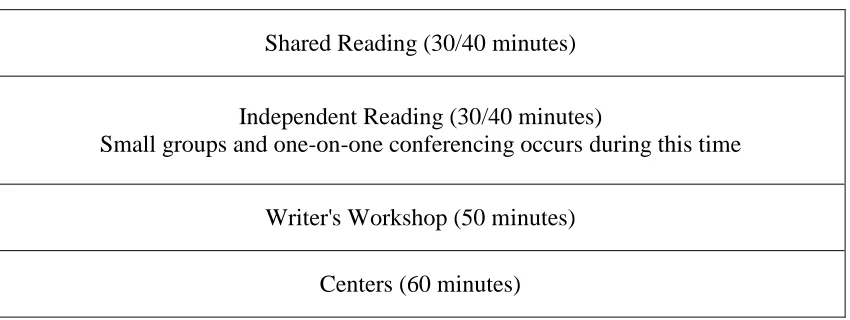
Table 4.1 Literacy Block Schedule ...68
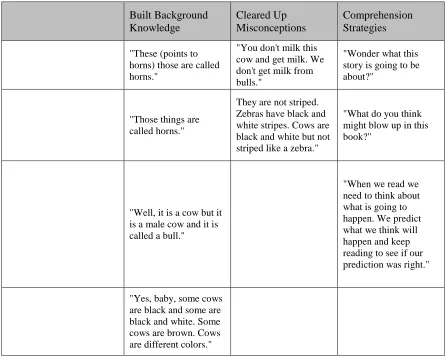
Table 4.2 Instructional Examples ...72
Table 4.3 Instructional Examples 2 ...94
Table 4.4 Definition of Subcategories under Characteristics of Day ...96
Table 4.5 Characteristics of Day ...97
Table 4.6 Student Language Used to Retell Stories ...101
Table 4.7 Research Test Data ...102
Table 4.8 Research Test Data 2 ...105
1
CHAPTER ONE
Stepping Out of the Classroom
In 1999, I was hired as a Teacher Specialist On Site (TSOS) by the State
Department of Education. The Teacher Specialist Program was a component of the
Education Accountability Act of 1998. The goal of the program was for teacher
specialists to help classroom teachers improve their instructional techniques and to help
students improve their academic achievement. I was assigned to third grade in a rural
school district about one hour from my home. The state department provided three
weeks of training that summer. The training was geared towards helping us learn about
our leadership styles and how to use our particular style to work with teachers.
As a third grade teacher, I had worked well with my students and was able to help
them achieve at a high level. I also had worked well with my third grade team. We had
planned our weekly lessons together, and I had shared current articles with my colleagues.
However, I did not see myself as responsible for improving their instruction. My
involvement in their teaching world ended there, with our planning. These two qualities
helped me obtain my role as TSOS, but they did not prepare me for working with adults
in a coaching role.
There were three teachers on the third grade team at the school where I was
assigned. As I introduced myself to the teachers with whom I would be working, I
received very different responses. The first year teacher was very excited. "Come into
my room whenever you want," she said, "I need all the help I can get." At the time this
2
teacher said, "Tell me what they [the state department] want me to do. I can do whatever
they want me to." Again, I thought to myself that she, too, would be easy to work with.
Finally, I was confronted with a very experienced teacher who, upon meeting me,
grumbled, "Just how old are you? How long have you taught?" She emphasized the
word you. At the time, this particular teacher concerned me. How could I convince her
to change her instruction? The state department expected us to improve student
achievement and to do this they assumed we would need to improve the instruction of the
teachers. I had never positioned myself as an expert; however, what I failed to realize
was that my new title, Teacher Specialist on Site, and the fact that I worked for the State
Department, screamed “expert” to the teachers with whom I had been assigned to work.
A turning point in my thinking occurred that year. I had been working with one
of the teachers for several weeks. I modeled lessons, we planned together, we stayed late
looking at student data to develop our plans, and we co-taught. Then it was time for her
to take over while I observed. It was a great lesson; I thought she did a great job. Later,
while talking with my daughter about the lesson, she said, "Wow, Mom, she sounds like a
mini you." I stopped. I thought to myself, “Is that what I am doing, trying to make
clones of my teaching self?” I started reflecting on my reactions and the feedback I
provided after an observation. Sure enough, the more the teaching imitated my model
lesson or the more the teaching looked like something I would do, the more positive my
response was. Sometimes a simple, innocent statement can cause tremendous change in
thinking, and this was one of those times. The teachers at this school already felt
defeated because they were working at a school the state had identified as a failing school.
3
resemble my own. I realized that my goal was not to make clones of myself; rather, my
goal was to create knowledgeable, thinking teachers who could make the best
instructional decisions for their students at that time. This realization forced me to
rethink my work with the teachers.
Merging Two Jobs
After my first year as a TSOS, I was informed the TSOS would be participating in
another initiative our state was beginning. For the next three years, I would be involved
in the South Carolina Reading Initiative (SCRI). We would begin this journey the
summer of 2000. I subsequently was both a TSOS and a Literacy Coach from 2000 to
2003.
Driven by research on teacher quality, professional development, and best
practices, the SCRI was modeled after the National Council for Teachers of English
(NCTE) Reading Initiative (RI). The goal of the RI was "to broaden and deepen
[teachers] knowledge base" through a three-year inquiry model that attempted to capture
what reading and reading instruction could look like and sound like in classrooms. A
state university and the state department worked together to create our state's version of
NCTE's RI. As part of SCRI, teachers could volunteer to participate in school-based
study groups, administrators would be required to attend. NCTE developed resources to
support the study groups. These resources included a collection of videotapes,
engagements, articles, and lists of professional books (Stephens et al., 2007).
The first group of literacy coaches participated in professional development from
2000-2003. Most of these coaches were assigned to four schools. They spent one day a
4
Literacy coaches also belonged to a cohort made up of other literacy coaches in their
geographic area and was supported by a regional coach. The regional coach observed the
literacy coaches in their assigned schools and provided them with feedback. For two
days each month, literacy coaches from around the state met for professional
development. A teaching team whose members were connected to universities within the
state and who formerly had led NCTE Reading Initiative study groups led these cohorts.
A state department person was assigned to a cohort to act as a liaison between the state
department and the cohorts.
The experience Teacher Specialists had with SCRI differed slightly from that of
other SCRI coaches. These differences, though small on paper, were huge when put into
practice. As a TSOS, I was assigned to one grade level in one school; consequently, in
my role as a literacy coach, I did not have to work in four different schools with multiple
grades and numerous teachers. The school to which I was assigned had three other TSOS
the first year and six TSOS the next two years. The six of us participated in SCRI. We
had the privilege to be at our school every day and work closely with three or four
teachers. We also were fortunate to have each other to collaborate with as we planned
our after school study groups. We also collaborated on our everyday work with the
teachers on our grade level.
SCRI began during my second year as a TSOS. I had begun to form trusting
relationships with the three teachers to whom I had been assigned, but something
happened during the second year. As after-school study groups began, the teachers and I
began learning together. Slowly, we were forming a culture of learning - a culture of
5
and we were willing to open up about our perceived weak areas of teaching. We were
beginning to trust each other and we were beginning to view our study group time as a
place to learn together.
SCRI literacy coaches needed to have a Masters Degree. To become a TSOS, that
degree was preferred, but not required. I did not yet have my Masters Degree so I
decided to enroll in an M.Ed. The courses I was taking in SCRI were courses offered by
a local university as part of both their M.Ed. and Ed.S. degrees, so the 27 hours I took
counted toward my degree. I just needed to take an additional six hours. I received my
degree in 2002.
The Best Change of All
As a TSOS, I was "on loan" to the State Department for three years from the
school district where I taught. After the three years, I was suppose to return to my home
district. The three years turned into four. The small district in which I was working
merged with a small neighboring district. I moved over to the elementary school in that
district as a TSOS and as a SCRI literacy coach. Again, I was assigned to one grade level
but because I was the only TSOS, I worked with other grade levels through my position
as a SCRI literacy coach. Everyone in the school participated in study group. As we
read and studied together, we created another culture of learning.
As the end of the year approached, my time as a TSOS was coming to an end. I
was asked to stay at this rural school, one that I was falling in love with, and assume the
role as the director of an Early Reading First Grant (ERF) they were about to receive
through the Federal Department of Education. This grant was designed to increase
6
development was an essential part of this grant. The teachers and directors of the ERF
grant visited other school districts, attended conferences, and continued to participate in
study groups after school.
As I began to spend time in Child Development and Kindergarten watching and
listening, I began to notice how some children were not talking, and other children were
only speaking in two or three word phrases, or verysimple sentences. I was drawn to
these children. They are the children who eventually led me to this study.
The rural school district in which I was working had one of the highest poverty
indexes in the state. In 2005, seventy-four babies in this rural county were born to
mothers younger than age twenty; of these, 14 were not the first births to the teen mothers
and, of these, 96.6% were born to single mothers (Child Trends & Center for Child
Health Research, 2004; South Carolina Kids Count, 2009). I noticedthatmany of the
children who demonstrated lower language and literacy abilities upon entering school,
despite having average intelligence, were from families with a cycle of generational
poverty. This cycle of poverty limited the variety of experiences the children had before
they began their formal education, and the language they had available as a resource to
talk about their experiences. It also influenced the range of literacy experiences the
children had outside of school. Because of the high levels of poverty in that area, the
disparities I saw in language and literacy abilities, and thus general achievement,
persisted across the grades that I served (4K-5th grade).
My Learning Continues
It was May of 2003. My daughter was graduating from college. Prior to her
7
leaned over and whispered, "Wouldn't you love to do that, to get your doctorate?" "No,
not really." I whispered in return. But, Mom had planted the seed. I was thirsty for more
knowledge. I wanted to understand the development of oral language in young children
and the role it played in school success. So, later that year, I enrolled in my first course,
“Just to see what it was like,” I told myself.
In 2004, the second year of the Early Reading First Grant (ERF), the district was
given the opportunity to apply to the state for the Reading First Grant (RF). It looked as
if I would once again have two jobs. The state had modeled their Reading First Grant
after SCRI. I was very excited that all the learning we had done with child development
and kindergarten would continue in grades 1-3. For two years, the school was part of
ERF and RF. The two programs merged nicely. Because they were a small school, we
also included 4th and 5th grade teachers in our learning. Being a part of an endeavor
where the entire school was learning together was an awesome journey. In study group, a
very experienced teacher commented, "Come on now, if this old dog can learn new tricks
I know the rest of you can!"
As my knowledge increased, I started to notice the way a kindergarten teacher,
Mrs. Lucas, who would later become the focus of this study, talked with her students. It
reminded me of a grandmother taking a walk with her grandkids. She was so attentive to
each and every one of her students. Mrs. Lucas always took time to listen to what her
students were trying to tell her. Very seldom would they walk in a straight line, with
getting from point A to point B as quickly and quietly as possible the ultimate purpose.
They walked in a group and when someone saw something interesting they stopped and
8
students and she did not just listen to be able to reply, she listened to understand.
Watching her inspired me to learn more about the importance of talk and the importance
of having conversations with young children.
In 2005, the school hired a new principal, Mrs. Jones. She had been a literacy
coach in a much bigger neighboring county. We had read the same books and we had the
same philosophies about teaching. Mrs. Jones had an Early Childhood background and
we began looking at the oral language of our youngest students.
A study done by Huggins (2011) in the same county found that the vocabulary of
the children entering the school's 4-year old program was significantly behind that of
their peers:
Data collected in 2008 from the Peabody Picture Vocabulary Test III (PPVT), a
test used to measure receptive language skills and a valid predictor of future
reading ability (Dunn & Dunn, 1997), shows 23% of four-year-old preschool
students entered school with a developmental age of two years old or less in
language. An additional 42% of their peers scored at least one year behind in
language development based on norms of the PPVT assessment. A combined
total of 65% of four-year-old children began their school career at least one year
behind their age level peers in 2008. (pp. 4-5)
As a Literacy Coach with RF, I had seen the positive influence of an early
intervention program entitled Reading Recovery. Children made significant learning
gains when they were tutored in a one-on-one setting as first graders. The research on
Reading Recovery has documented, however, that language difficulties often slow
9
class within the typical 12-week time frame set for services in Reading Recovery(Clay,
2001; Gentile, 2003). Consequently, many children with the lowest language and literacy
repertoires, whilemaking significant gains, are still referred for longer-term literacy
and/or language services. I began to wonder about the impact an enriched language and
literacy program in kindergarten might have on the development of children’s academic
discourse. Within the literature on children’s language, the term "the language gap,"
which is used to describe the difference in the quality of language spoken by some of the
different socio-economic groups, is characterized differently. Those who focus on an
academic gap tend to locate "the problem" in the children themselves, which often leads
to recommendations for remediation or identification of some children as “learning
disabled.” In another characterization, the focus is on the” opportunity gap,” and these
professionals focus on the opportunities that have not yet been provided to the children.
In this latter case, the recommendation is to provide a variety of opportunities. Thus the
problem is located outside of the children, rather than within them. The teacher at the
center of this study, Mrs. Lucas, believed there was an opportunity gap; she sought to
provide a variety of opportunities and simultaneously engage children in rich
conversations.
Rationale for the Study
The purpose of this study was to examine a kindergarten teacher, Mrs. Lucas, and
her oral language and literacy program. More specifically, I wanted to better understand
what was happening in her classroom that consistently produced significant academic
growth in her students – students who were attending a school in an area of the country
10
noticed very few of her students needed intervention by the time they were in third grade.
To better understand the complexity of a quality kindergarten teacher’s instruction within
her language and literacy program, I focused my study on three areas, realizing that each
is rather complex. Although these areas overlap, they also have their own unique
subtopics within the larger topic of the study. The three areas were: oral language
development, teacher/child interactions, and teacher quality. Given Mrs. Lucas’ success
in closing or narrowing the achievement gap, I believed that what was taking place in her
classroom was a phenomenon worth studying.
The continuing disparities in academic achievement between economically
disadvantaged subgroups and their more economically advantaged peers, commonly
referred to as the achievement gap, is one of the greatest problems we face in the United
States today (Slavin & Madden, 2006). One factor that contributes to this gap is oral
language development. Children’s oral language development has been thoroughly
researched (Brown, 1970; Bruner, 1983; Dudley-Marling and Searle, 1991; Halliday,
1975, 1977; Rosenberg and Silva, 2009; Vygotsky, 1978; Wells, 1999; Wells, 1986).
Wells (1986), for example, found that children’s language ability at school entry
predicted their academic achievement at the age of 10. Many of these researchers have
concluded that parents and other caregivers play an important role in oral language
development and their role is a key factor in school success. Another factor that
contributes to this gap is mastery of basic language structures. Research identifies the
importance of children’s mastery of the basic language structures (Brown, 1970; Bruner,
1983; Dudley-Marling and Searle, 1991; Genishi, 1988; Gleason, 1977; Lindfors, 1999;
11
Wells, 1986). A third factor that contributes to this gap is teacher-child interactions.
Studies have highlighted the importance of teacher-child interactions in early childhood
as a key element in developing oral language abilities (Dickinson and Tabors, 2002;
Hamre and Pianta, 2007; Mashburn and Pianta, 2008; Massey, 2004; Rosemberg and
Silva, 2009; Snow and Dickinson, 1991; Wilcox-Herzog and Kontos, 1998). Taken
together, these studies clearly identify factors that have a strong influence on academic
achievement.
Other work points to the critical importance of teacher quality, particularly for
students who begin schooling not yet at the level of their peers in oral language
development. Students who are assigned to several ineffective teachers in a row have
significantly lower achievement and lower gains in achievement than those who are
assigned to several highly effective teachers in a row (Sanders & Rivers, 1996). Indeed,
teacher quality has more of an effect on student achievement than class size and money
spent per pupil (Allington & Johnston, 2000; Sanders & Rivers, 1996). However, the
teacher quality research and its impact on children in early childhood and elementary
grades focuses mainly on preschool and first through fifth grades (Allington & Johnston,
2000; Hamre & Pianta, 2001, 2005; Pressley, Wharton-McDonald et al; 2001; Seplocha,
H. & Strasser J., 2008). Research has not been done on how kindergarten teachers might
potentially narrow the gap by offering an enriched oral language and literacy program.
Therefore, in this study, I focused on Mrs. Lucaswho has been successful in
narrowing the opportunity gap. She consistently has successful student outcomes based
on the Dominie Reading and Writing Assessment (DeFord, 2004), which is a
12
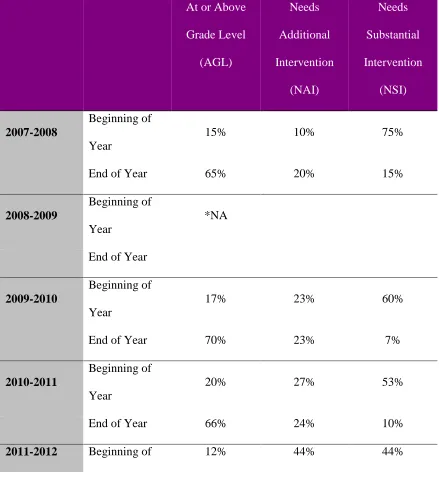
achievement bands, At-or-Above Grade Level (AGL), Needs Additional Intervention
(NAI), and Needs Substantial Intervention (NSI). The number of students in the NAI
category increases as the number of students in the NSI category decreases.
Table 1.1: Dominie Text ReadingResults for Mrs. Lucas’ Class
At or Above
Grade Level (AGL) Needs Additional Intervention (NAI) Needs Substantial Intervention (NSI) 2007-2008 Beginning of Year
15% 10% 75%
End of Year 65% 20% 15%
2008-2009
Beginning of
Year
*NA
End of Year
2009-2010
Beginning of
Year
17% 23% 60%
End of Year 70% 23% 7%
2010-2011
Beginning of
Year
20% 27% 53%
End of Year 66% 24% 10%
13 Year
End of Year 75% 20% 5%
* Teacher taught Child Development during that year.
Research Design
I was interested in understanding the characteristics of a particular educational
setting. This interest aligns with qualitative inquiry. Qualitative inquiry, or qualitative
research, is a methodology used to understand some social phenomena from the
perspective of those involved, in order to contextualize issues, and sometimes to
transform or change social conditions (Glesne, 2006). Qualitative inquiry is a powerful
tool for enhancing our understanding of teaching and learning. It allows us to be open to
discovery.
The phenomenon I wanted to understand was how a teacher’s language and
literacy program enabled her to scaffold low performing children's oral language and
literacy development. I chose to study this phenomenon using a case study methodology.
Case studies allow us to examine a complex issue within its real-life context. The
question of generalizability is raised with case studies, but the understandings that readers
take from the study about what is applicable to them makes this design appropriate
(Merriman 2009).
Yin (1984) defines the case study research method as an empirical inquiry that
investigates a contemporary phenomenon within its real-life context when the boundaries
between phenomenon and context are not clearly evident and in which multiple sources
14
focus of the study is to answer "how" questions and the contextual conditions are relevant
to the phenomenon being studied. I chose to conduct a case study because I was
interested in how Mrs. Lucas closes the opportunity gap for her students. The
opportunity gap occurs in precisely her type of classroom – a low SES rural setting.
Research Questions
Specifically, I sought to understand:
1. What key instructional components were included in Mrs. Lucas’ language and literacy
program?
2. What was the nature of Mrs. Lucas’ decision-making process related to instructional
decisions for low performing children in her classroom?
3. What instructional moves did Mrs. Lucas make which supported children's language and
literacy learning?
4. What were Mrs. Lucas’ patterns of verbal interaction that scaffold low performing
children's oral language and literacy development?
Limitations
As with any study, there are limitations and biases the researcher needs to
acknowledge at the outset of the study, while acknowledging that other limitations and
biases might surface throughout the study. Conducting the study at my home school had
its advantages and its limitations. The confidence and trust that I had developed with the
community, administration, faculty, and students in my research site were already in
place at the beginning of this study. Our history together had been a positive one.
Moreover, as a result of our existing relationship, Mrs. Lucas felt comfortable with me
15
her classroom. I also had access to student assessment information that she had collected
and she had access to the additional assessment information I needed. Though I viewed
our collaborative working relationship as an advantage, at the same time, I also
understand how it could be seen as a limitation. When a researcher is closely tied to the
person or topic being researched, objectivity is a factor. As the researcher, I had to
continually attend to what I saw,not what I thought I saw, while still acknowledging the
important role played by interpretation within qualitative inquiry. Consequently, I found
that videotaping events in Mrs. Lucas’ class helped me to triangulate and verify my
findings.
Other limitations of the study are those mentioned under Influences Outside of
School (p. 28) that affect student achievement. The school at which the study was
conducted has a 98.7% poverty rate, so health issues at times interfere with achievement.
Children do not always have access to the eyeglasses, medicine, and preventive
healthcare that they need. The school has programs to assist with healthcare needs, but
the process takes more time than it would if the children had access at the time of need.
Student mobility is also a limitation. Students who attend this school do not move often,
but mobility challenges are often reflected in their daily routines. For example, some
students often stay between two to three houses during a single week. This causes a lack
of stability, which can interfere with their academic achievement.
Significance of the Study
This study is significant for several reasons. Very little research has been
conducted on how kindergarten teachers can narrow the opportunity gap by offering an
16
important component of literacy and focusing on oral language is of greatest importance
for the children most at risk—children for whom English is a second language and
children who have not been exposed at home to the kind of language found in written
texts (Dickinson & Smith, 1994) and in K-12 classrooms. Indeed, the Common Core
State Standards, Appendix A, state that in the early grades teachers should be aware of
the influence of oral language on a child's later ability to read. Therefore, it is crucial to
document how an effective teacher allocates instructional time to the Standards that
address speaking (CCSS, pg.27).
This study examined the classroom of a highly effective kindergarten teacher in a
high poverty area of our country. It is critical that we learn to recognize the factors that
may help early childhood teachers meet the needs of all of their students. The findings of
this study can aid early childhood teachers in implementing an enriched oral language
and literacy program. While the issue of an achievement gap has existed in schools for
decades, it is an issue that needs to be alleviated. I believe that providing a rich, detailed
picture of one kindergarten teacher with a consistent record of effectively raising the
literacy achievement of at risk children, may assist other teachers and other schools in
understanding what has worked well in this classroom and perhaps ignite efforts that will
begin helping teachers identify and address opportunity gaps that can help close the
17
CHAPTER TWO
Review Of Literature
Oral language provides the foundation of literacy. The ability to think is often
tied to oral language. Proficiency in oral language provides children with a vital tool for
thought. Without fluent and structured oral language, children will find it very difficult
to think (Bruner, 1983). Children arrive in kindergarten with huge discrepancies in oral
language development . . . and the gap between language-advanced and language-delayed
children grows throughout the elementary school years (Biemiller, 2001). These realities
made me think about the relationship between oral language and school success. It also
made me wonder about what needed to be done in the kindergarten classroom to narrow
this gap.
In order to better understand the relationship that exists among oral language
development, literacy, and school success, I reviewed the research in the following areas:
• Oral language development and school success
• Factors that impact language development
• Factors that impact achievement
Oral Language Development and School Success
Oral language development is complex; yet almost all children, by age five, have
developed language sufficient to navigate their home and local community environment.
A classic study by Wells (1986) followed 32 children from just after age one through to
18
If the language of the school is different from that of the home, what is the nature
of these differences and do they affect all children equally? Is there a causal
connection between socioeconomic status and language experience in the
preschool years, and educational achievement? If so, what are the specific
linguistic skills, important for success in school that are associated with
membership of one social group rather than another, and what can be done to give
children from all types of family background a more equal opportunity to succeed
at school? (p. xi)
What Wells (1986) found was illuminating. Prior to school entry, children
followed similar paths of development, with some making greater progress than others.
The two biggest factors that differentiated those with greater language abilities at school
entry were the quantity and quality of conversational experiences in the home (parents
who were responsive to their children’s conversational initiations), and the opportunity to
hear stories. When Wells (1986) assessed students at school entry in terms of language
and literacy ability, and compared their rank in class at age 10, he found little change in
rank order. Those who were high, and those who were low, remained in the same
relative rank in class. Wells documented that the early conversational interactions and
levels of literacy knowledge established in the home were highly predictive of later
academic success.
Another key finding in this classic study was that the quality of oral language in
the schools was significantly different from that of the home. At home, children had
three times more opportunities to speak with adults, initiate conversations and ask
19
fosters language development. For no child was the language experience of the
classroom richer than that of the home—not even for those believed to be ‘linguistically
deprived.’” (p. 87) At school, Wells found that children were more often assigned
passive roles, asked to respond to an adult’s questions in shorter, phrase-level utterances,
and adults ignored or talked over them, and dominated the conversations. The teachers
did expand upon the concepts they introduced twice as often as parents were likely to do.
From the above research, Wells (1986) concluded that three aspects of oral
language development were particularly important in developing foundational structures
of language that influence school success: 1) progression of speech; 2) acquisition of
language structures; and 3) concepts children acquire based on the context in which
words are learned.
Progression of Speech
Oral language development starts long before an infant says their first word.
The progression of speech usually occurs in a predictable sequence (Wells, 1985). For
example, babbling occurs before a child produces recognizable words. Two word
phrases occur before simple sentences. When children enter school at five years of age,
and are speaking equivalent to an 18 month old, a knowledgeable teacher needs to know
how to accelerate their acquisition of oral language. Wells (1986) studied a cross section
of British families, trying to examine different economic levels and how family support
impacts language development. He found the majority of families engaged in similar
conversations throughout the day; they talked about meals, dressing and undressing, and
the performance of bodily functions. Wells (1986) argued that most important are the
20
conversations, the adult and the child focus on the same event when talking about
everyday occurrences, such as getting dressed, so they are more able to figure out the
meaning of each other’s words. The adult in the conversation is aware of the
developmental level of the child and monitors their language in certain ways. While
getting dressed a child says, “Me shirt.” Knowing the child speaks in two word phrases,
the majority of the time the adult expands their phrase with a simple sentence. The adult
may say, “Yes, let’s wear your red shirt.” The adult may not be conscious of why they
are doing this but they adjust their speech to the child’s current level of comprehension.
Interestingly enough, Wells found that some children heard language, but did not
participate in conversations with an experienced language user. Genishi (1988) points
out that such lack of participation hinders oral language development. As she notes,
“Children are born not just to speak, but also to interact socially. Even before they use
words, they use cries and gestures to convey meaning; they often understand the
meanings that others convey” (p. 38). Specific interaction strategies, e.g., expansion and
restructuring, have a positive impact on development; they promote understanding
between the child and his/her caregiver (Brown, 1973; Bruner 1977; Nelson, 1977; Snow
1972, 1983). Expansion occurs when a parent or caregiver uses the language of the child
and widens it by adding words to clarify meaning. Restructuring occurs when a parent or
caregiver uses the child’s idea and some of the child’s language to reorganize the
sentence syntactically. The sentence repeated back to the child, then, is a way to reaffirm
or clarify oral language communication.
Brown (1973) suggested stage theory as a way to describe qualitative differences
21
understand expressive language development. This development is continuous with no
distinct boundaries; language progresses from playing with sounds and babbling, to
acquiring a vocabulary (mostly of nouns to name objects and people) in Stage I, through
the development of complete sentences between the ages of approximately 15 to 52
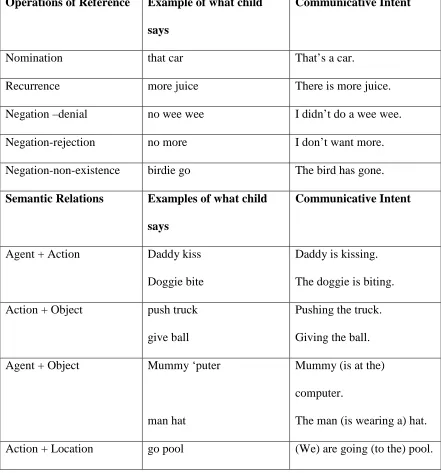
months of age (See Table 2).
Table 2.1: Stage I Sentence Types (15 months-30 months)
Operations of Reference Example of what child
says
Communicative Intent
Nomination that car That’s a car.
Recurrence more juice There is more juice.
Negation –denial no wee wee I didn’t do a wee wee.
Negation-rejection no more I don’t want more.
Negation-non-existence birdie go The bird has gone.
Semantic Relations Examples of what child
says
Communicative Intent
Agent + Action Daddy kiss
Doggie bite
Daddy is kissing.
The doggie is biting.
Action + Object push truck
give ball
Pushing the truck.
Giving the ball.
Agent + Object Mummy ‘puter
man hat
Mummy (is at the)
computer.
The man (is wearing a) hat.
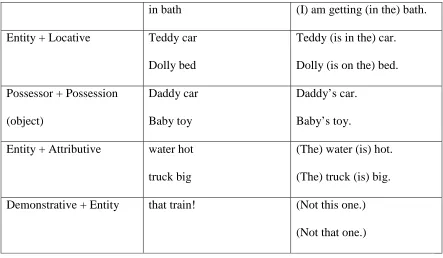
22
in bath (I) am getting (in the) bath.
Entity + Locative Teddy car
Dolly bed
Teddy (is in the) car.
Dolly (is on the) bed.
Possessor + Possession
(object)
Daddy car
Baby toy
Daddy’s car.
Baby’s toy.
Entity + Attributive water hot
truck big
(The) water (is) hot.
(The) truck (is) big.
Demonstrative + Entity that train! (Not this one.)
(Not that one.)
Table 2.2: Brown’s Stages II to V
Stage II 28 to 36 months Present Progressive
(-ing endings on verbs)
It going,
Falling off
In In box,
Kitty in
On On tree,
Birdie on head
-s plural (regular plurals) My cars,
Two ties
Stage III 36-42 months Irregular past tense Me fell down
-s possessives Doggie’s bone
23
Uncontractible copula (the
full form of the verb ‘to
be’ when it is the only
verb in a sentence
Are they there?
Is it Alison?
Stage IV 40-46 months Articles A book,
The book
Regular past tense (-ed
endings on verbs)
She jumped,
He laughed
Third person regular
present tense
He swims,
Man brings
Stage V 42-52+ months Third person irregular She has,
He does
Uncontractible auxiliary
(the full form of the verb
‘to be’ when it is an
auxiliary verb in a
sentence)
Are they swimming?
Contractible copula (the
shortened form of the verb
‘to be’ when it is the only
verb in a sentence
She’s ready.
They’re here.
24
shortened form of the verb
‘to be’ when it is an
auxiliary verb in a
sentence)
He’s going.
In general, the research on children's language development indicates that when
children enter kindergarten, they should be using language that is representative of all of
the above stages. A child's level of comprehension of the spoken word is directly related
to their level of oral language development; therefore, if the above structures are below
expectation, it will be more difficult for children to converse and comprehend at the same
level as their peers.
When children enter school as a four or five year old, their level of oral language
impacts learning. The five most common English sentence structures are:
1. Simple Sentence: I want to play.
2. Sentences containing prepositional phrases: I want to play with my friends.
3. Sentences containing two phrases or clauses linked by a conjunction: I want to play with my friends because it is fun.
4. Sentences containing two phrases or clauses linked by a relative pronoun: She saw the girl who took her toys.
5. Sentences containing two phrases or clauses linked by an adverb: She cried hard when they took her toys.
By the age of five, a child should be using all five types of sentences. Children who are
25
notes, “If children have been slow to acquire speech or have been offered fewer
opportunities to hold conversations there can be limitations in the grammar they control,
which might mean that they have difficulties with comprehending oral and written
language” (Clay, 1991, p.38). Oral language needs to be an instructional focus in
classroom instruction when it is not at the developmentally appropriate level for the child.
Gentile (2001) suggests that when children do not have control of the most
common syntax, as listed above, they will have difficulty interacting with the teacher and
with published materials used in reading instruction. This coincides with a longitudinal
study (Loban, 1963) of kindergarten students that showed students in sixth grade who
scored in the highest quartile of reading and writing also scored the highest on measures
of oral language in kindergarten. This study also found students in sixth grade scoring in
the lowest quartile in reading and writing scored lowest on the oral language measure in
kindergarten.
As children acquire the ability to speak, they use a variety of sentence structures
to communicate with people in their environment. Each child’s environment is different.
Therefore, they learn words in different settings and this affects their understanding of
concepts, and potentially the range of their oral language abilities and vocabulary prior to
school entry.
Concept Acquisition
Nelson (1988) believes that children use and understand language differently
based upon how they first learned to use language; the words they learn are grounded in
specific situations. For example, one child may learn that restaurant means getting in
26
up to a window and receiving your food in a bag. Another child may learn that
restaurant means putting on nice clothes, driving to a nice building, going inside, and
ordering your food by talking to a person and then waiting until the food is brought to
you on a plate. The child’s concept of restaurant develops based on key aspects of those
situations. For each child, the situations differ and therefore their understanding of the
concept differs. This is one explanation for the diversity we see in classrooms—there are
differences in how language users (through speaking, listening, reading, and writing)
understand and produce language. When different children hear or read the word
restaurant, they bring to mind their personal concept of restaurant, an understanding that
could be very different based upon situational differences.
In my family, everyone but my son requested cheesecake for their birthday. In
our house, this meant we had a no-bake cream cheese, graham cracker crust type of
cheesecake. My son did not like this cake, and so he decided that he did not like
cheesecake. One day, when my son was living away from home, he was with a friend
who ordered cheesecake. Out came a baked desert that looked different than he expected
it to look. My son tasted it, and found he loved it. His concept of cheesecake was built
around the situation in which he learned the word and that concept stayed with him for 18
years (and, as a result of his experiences, he stayed away from cheesecake!). All
language users understand their world by attending to the relationship between words,
categories of words, and ideas that form concepts. These concepts guide their thinking
and actions. As Rosemberg and Silva (2009) noted, “Concept acquisition is precisely one
of the aspects in child development where the connection between language and
27
Factors that influence Language Development
The Committee on Integrating the Science of Early Childhood Development
(2000) stated:
"Almost all children learn to talk without explicit instruction, suggesting that
language acquisition is a relatively resilient process, although they do not all learn to talk
well, suggesting that language acquisition includes some more fragile elements. Starting
from the first day of life, the development of communication skills, language, and literacy
are significant accomplishments” (p. 126).
A child's oral language development is influenced by several key factors: 1) the
role of parents and caregivers; 2) teacher and student interactions; and 3) school language.
The Role of Parents and Caregivers
When babies are born and placed in their parents’ arms, without specific guidance
or direct instruction in how to do so, parents and other caregivers seem to set forth the
necessary conditions in which the vast majority of children learn their mother tongue.
Indeed, Dudley, Marling and Searle (1991) synthesized the literature on language
acquisition in cultures around the world and concluded that across studies, there were two
common elements. First, most parents trust their children will learn to talk, so they
purposefully use language within the activities they do together. Secondly, parents
provide frequent opportunities and guide children to engage in conversation within these
authentic, meaningful settings. The point of learning language and interacting socially,
then, is not to master rules, but to make connections with other people and to make sense
of experiences (Wells, 1986). Conversations enable a child to see and hear language in
28
It is through these family conversations that children learn to talk. This has been
well established in the literature. Indeed, many experts have agreed that language is best
acquired through interactions with others (Gleason, 1977; Lindfors, 1999; Moll, 1990;
Rogoff, 1990; Vygotsky, 1978; Wells, 1999). As Gleason (1977) stated, “Language
acquisition is to a great extent the learning of how to make a conversation” (p. 203).
When children first acquire language, the conversation is heavily one sided. The
caretaker does most of the talking. The child responds with a smile or utterance of some
type and this keeps the conversation going. The main purpose of these conversations is
communication. Parents or caregivers use language with their children to understand and
communicate. Bruner (1983) concurred. He agreed that learning language is a
negotiation between two or more people. Children not only increase their vocabulary
through conversations but they also learn about their culture and the world in general.
Teacher and Student Interactions
Much of what we know of how infants acquire oral language informs us about
the development of language in classrooms as well. Teacher/student interactions are
crucial to the continued development of a child’s oral language, just as parent/child
interactions are crucial to the initial phases in the acquisition of oral language. Research
on adult/child interactions in classrooms has identified some specific strategies used by
teachers to increase oral language acquisition, enhance school based oral language, and
support further concept development as well as impart knowledge about the larger culture
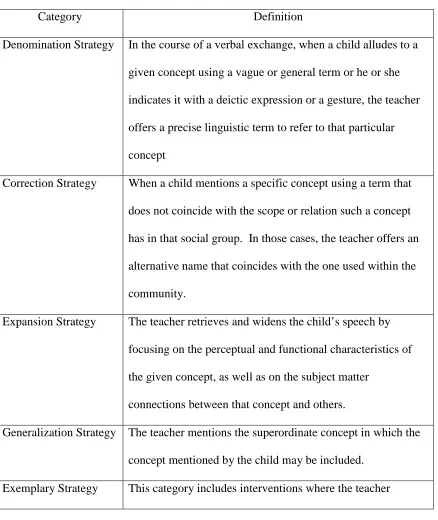
in which they live. Rosemberg and Silva (2009) categorized those strategies used in the
home and at school as denomination (adding more specific language), correction
29
(providing overarching concepts), and exemplary (adding descriptive information or
other examples) (p. 576).
Table 2.3: Rosemberg and Silva’s Categories
Category Definition
Denomination Strategy In the course of a verbal exchange, when a child alludes to a
given concept using a vague or general term or he or she
indicates it with a deictic expression or a gesture, the teacher
offers a precise linguistic term to refer to that particular
concept
Correction Strategy When a child mentions a specific concept using a term that
does not coincide with the scope or relation such a concept
has in that social group. In those cases, the teacher offers an
alternative name that coincides with the one used within the
community.
Expansion Strategy The teacher retrieves and widens the child’s speech by
focusing on the perceptual and functional characteristics of
the given concept, as well as on the subject matter
connections between that concept and others.
Generalization Strategy The teacher mentions the superordinate concept in which the
concept mentioned by the child may be included.
30
mentions concepts that are subordinate to the one referred to
by the child
In addition to the research on strategies teachers used to expand children’s
language, Hamre & Pianta (2007) argued that three distinct interactional domains build
language as well as motivate children to expand their language: emotional, instructional
and organizational. Mashburn & Pianta (2008) further explained these interactions.
Emotional interactions are characterized by a positive emotional tone, a lack of
negativity, and demonstrate that teachers are sensitive to students’ emotional, social and
instructional needs, placing a high regard on students’ interests, motivations and points of
view. In emotional interactions, teachers see all students as worthy human beings and
interact with them in ways that protect and build their emotional needs. Instructional
interactions are those that promote higher order thinking rather than fact-based learning
to provide feedback to and expand students’ learning and understanding rather than the
correctness of students’ responses. Finally, teacher interactions are organizational
interactions when they effectively manage children’s behavior, time and routines to
maximize learning opportunities, and instructional activities and materials.
As children enter school, they bring diverse levels of language acquisition and
diverse understandings of concepts to the learning process. Creating a supportive
framework for oral language and concept acquisition is not easy but it is crucial to the
child’s continued development. That is because oral language plays an important role in
supporting literacy, not just early literacy but also children's long-term language and
31
and Literacy Development in 1987. This was an intensive, longitudinal study. They
looked at how parents and teachers of children from low-income families supported the
development of language skills in young children. They found three categories that were
of importance for a child’s literacy growth: intellectually supportive environments, varied
vocabulary, and extended discourse. They defined intellectually supportive environments
as those that expose children to a variety of topics. This occurs through books,
conversations, and excursions around the neighborhood. Exposing children to new and
interesting words increases their vocabulary. Increasing their vocabulary helps them
expand their knowledge of the world. Extended discourse further develops children’s
oral language and literacy skills by engaging them in cognitively challenging
conversations. Extended discourse occurs when children participate in extended
conversations where they hear and produce explanations, personal narratives and pretend
talk.
This coincides with Wilcox-Herzog and Kontos’ (1998) teacher verbalization
scale where the highest level of teacher/student interaction occurred during pretend play.
The teacher verbalization scale included seven points that assess the level of a teacher's
verbal interactions:
1. Not talking with a child
2. Talking with children about assistance (getting materials, self-help, first
aid, clean up)
3. Talking with children about their behavior (restating rules, redirecting
children, telling children what to do)
32
5. Making simple statements or asking close-ended questions
6. Making simple statements or asking open-ended questions
7. Talking with children about fantasy play (teacher takes on a role).
According to Massey (2004), “Teachers devote considerable time to facilitating
children’s play, but the conversations are not filled with rich, stimulating content” (p.
227). She challenged teachers to create cognitively challenging conversations with their
students. This understanding, that conversation during pretend or fantasy play is very
important in a child's oral language development, has huge implications for early
childhood education. It lays the foundation for play and teacher-student interactions
during that playtime as an integral part of the early childhood curriculum.
As Snow and Dickinson (1991) examined the data from early childhood through
student achievement in fourth and seventh grades, they suggested that rich language
experiences during the Early Childhood years played an important role in ensuring that
children were able to read with comprehension when they reach middle school. Further,
Dickinson and Tabors (2002) found the scores that kindergarteners achieved on certain
measures (receptive vocabulary, narrative production, and emergent literacy) were highly
predictive of their scores on reading comprehension and receptive vocabulary in fourth
and seventh grade. In particular, they found that the ability to develop a narrative, a
varied use of vocabulary, and children’s use of pretend talk, which is the talk they use as
they engage in pretend scenarios taking on the roles of different characters, such as a
mom, a dentist, a dragon etc. were highly relevant to overall literacy growth.
Rosemary and Roskos’ 2002 study examined teacher-child talk with 4- and 5-year
33
audiotapes of the teacher and teaching assistant and field notes as they observed the two
adults throughout the day. As they analyzed their recordings and notes, the goal was to
locate and examine literacy-related adult - child verbal interactions. Then Rosemary and
Roskos coded the literacy utterances. They found most of the interactions were about
daily routines. Referring back to Wilcox-Herzog and Kontos’ (1998) teacher
verbalization scale, verbal interactions about daily routines, while necessary, is low on
the scale of interactions that assist children in acquiring the oral language needed for
school success.
A study from Argentina conducted by Rosemberg & Silva (2009) looked at
teacher-student interactions and concept development in kindergarten. The participants
in this study were three, four, and five year old children from suburban neighborhoods
outside of Buenos Aires, Argentina. Six different kindergarten groups participated in the
study. Weekly visits were made to the teachers in charge of these groups. They
examined the connection between cognition and language. Their work furthers our
understanding of linguistic strategies teachers use to promote the children’s conceptual
development.
Teachers in Rosemberg & Silva’s study (2009) used the strategy of denomination
(see Table 2.3, page 29) when they realized a student did not have the exact term for the
concept being discussed. They reported that linguistic exchanges between teacher and
child happened in the course of various activities throughout the day. They noticed that a
shared mental text was required in order for all these activities and exchanges to occur.
These mental texts formed a shared concept. In their verbal exchanges, teachers
34
for these objects. This expanded the child’s understanding of the concept. Rosemberg &
Silva described and gave examples of linguistic strategies teachers could use to promote
children’s conceptual development. They suggested that teachers apply these strategies
when there were problems or confusions between their own representations and the
children’s. They state, “They [these strategies] bring about conversation routines in
children’s classrooms that bridge the gap between children’s denomination and the
community’s” (p. 588).
School Language
Unfortunately, for many children, the language of the home is drastically different
from the language used in school. This can place many children at greater risk of failure.
Most children come to school with oral language abilities that mirror the school based
oral language that is necessary for academic success in the school setting. However,
some do not. Some children from non-dominant groups, for example, come to school
believing they should not elaborate when speaking, they should be direct and to the point.
When these children enter school, teachers sometimes assess their oral language as
lagging behind their peers because of their lack of details when telling a story. Research
indicates, however, that teachers need to acknowledge the richness of the language all
children bring to school (Heath, 1983; Michaels, 2005; Moll, 1990). They need to make
sure they value the language the child brings to school and, as needed, help all children
learn school based oral language. Students’ language, culture and background
knowledge need to become tools for learning (Dudley-Marling and Lucas, 2009; Dyson,
35
Teachers need to distinguish between children whose home language differs from
school language and children who come to school not yet where their peers are in oral
language development. Children whose home language does not differ from school
language are often where they should be in their acquisition of oral language. They are
using the language structures and vocabulary that are appropriate for their age and
appropriate for the more formal school setting. All students benefit from learning the
language of school. For children who arrive at school not fluent in school based oral
language patterns, teachers need to understand the concept of school talk, how school talk
and home talk differ, and how the values and beliefs of some cultural groups may be at
odds with various aspects of school based oral language patterns. Understanding teacher
– student verbal interactions that help children acquire school based oral language is
necessary to succeed in a school setting.
Children who come to school not yet where their peers are in oral language
development do not yet have the language structures and vocabulary that are appropriate
for their age. These children have trouble using language to navigate their home life.
Understanding teacher – student verbal interactions that help children acquire oral
language is different but also necessary to succeed in a school setting.
Factors that Impact Achievement
The opportunity gap problem is difficult to analyze because of all the factors that
affect a child’s performance within a school setting. Schools cannot be the sole solution
to the problem, but they do need to be part of the solution to this problem. Many social
and economic inequalities existing outside school settings appear to be driving factors in
36
factors outside schools that influence student achievement; and 3) factors that influence
teacher quality.
Issues That Influence Schools
The school setting can and should be part of the solution to closing the
opportunity gap. Despite the Federal Government’s attempts at improving the quality of
preschools through Head Start, children are still entering kindergarten poorly prepared to
handle the public school curriculum, particularly given the bias toward a middle class
curriculum model. Dudley Marling and Lucas (2009) note, “Children’s language plays a
crucial role in school success…and school failure.” At this early stage of a child’s
education, schools can be part of the solution if they choose to teach in ways that help all
children, regardless of social economic status, or cultural background, acquire the oral
language and literacy capabilities necessary for school success.
Schools can also be part of the solution when they provide teachers with an
in-depth understanding of students’ cultural backgrounds. Boutte and Hill (2006) help us
understand the importance of studying and addressing the needs of respective cultural
groups. Boykin (1994) suggested in the early years teachers embed the acquisition of
cognitive skills in a context that is culturally congruent to the students in our classroom.
In order to do this, teachers must understand the cultural backgrounds of their students.
Three areas of importance are:
• Task Definition – How a particular skill or task is defined for students
• Task Format – How the skill or task is acquired and performed
• Task Ambience – How the environment envelops the task and forms the
37
One dimension of the African American culture is Oral Tradition (Boykin, 1994;
Hale 2001). So, for example, if the task is to learn the elements of a story, it would be
culturally congruent to African American students to learn these elements through
storytelling. Instruction that uses students’ cultures to help them be successful in school
will be effective in closing the opportunity gap between students of color and white
students. By embracing a culturally relevant curriculum, schools can begin to close the
opportunity gap. However, if schools combine a culturally relevant curriculum while
attending to key outside influences, it may be possible to close the gap at a faster rate.
Outside Issues that Influence Schools
According to Linda Darling-Hammond (2010), international data on assessments
like Programme for International Student Assessment (PISA) assessments in mathematics,
science, and reading show that, the United States’ low rankings are largely a function of
inequality. The United States has the highest poverty rate of any industrialized nation. A
child living in poverty may receive fewer health services. A healthy child has a better
chance of being successful in school than an unhealthy child. Children of poverty also
tend to live in inadequate and unstable housing. With inadequate and unstable housing,
there is also a greater likelihood that families will move more often. This mobility issue
affects the students’ consistency in instruction and learning. It also interferes with the
teachers’ ability to establish trust and build relationships with children (Rothstein, 2005).
Funding is another outside factor that contributes to the achievement gap the
United States has experienced, and is still experiencing, due to lack of adequate or
equitable funding. Schools serving large numbers of students of color or children of