University of South Carolina
Scholar Commons
Theses and Dissertations
1-1-2013
The Reproductive Ecology of Plethodontid
Salamanders In the South Carolina Inner Coastal
Plain
Heather Rena Oswald University of South Carolina
Follow this and additional works at:https://scholarcommons.sc.edu/etd
Part of theLife Sciences Commons,Medicine and Health Sciences Commons, and thePhysical Sciences and Mathematics Commons
This Open Access Thesis is brought to you by Scholar Commons. It has been accepted for inclusion in Theses and Dissertations by an authorized administrator of Scholar Commons. For more information, please [email protected].
Recommended Citation
T
HER
EPRODUCTIVEE
COLOGY OFP
LETHODONTIDS
ALAMANDERS IN THES
OUTHC
AROLINAI
NNERC
OASTALP
LAINby
Heather Rena Oswald Bachelor of Science
University of South Carolina, 2009
Submitted in Partial Fulfillment of the Requirements For the Degree of Master of Science in
Biological Sciences College of Arts and Sciences University of South Carolina
2013 Accepted by:
Timothy A. Mousseau, Major Professor Jayme L. Waldron, Committee Member Shane M. Welch, Committee Member
D
EDICATIONA
CKNOWLEDGEMENTSI would like to thank Timothy Mousseau who as my advisor provided me with the opportunity to pursue my interests in ecology. He has been instrumental to my research and has provided ample resources to satisfy my project needs. His guidance and insight have been invaluable in directing my research and career goals. I would also like to thank Jayme Waldron and Shane Welch to whom I owe a debt of gratitude for their mentorship throughout my research project. They helped me develop many of the skills that were critical during my project development and have facilitated my growth as researcher, a naturalist, and a professional.
I would also like to thank several people who provided assistance and
companionship during my fieldwork and professional development. Fellow graduate students, Jennifer Fill, De Anna Beasley, and Michael Martin all were tremendously helpful during the fieldwork, data analysis, and writing phases of my research. They each provided great physical and mental support for which I am tremendously grateful. I also would like to thank my field technicians Jennifer Allison, David Cann, Joseph Colbert, and Vladamir Nekrutenko who provided invaluable assistance with data collection and fieldwork.
A
BSTRACTNest- site selection is a critical process in the life history of amphibians, directly influencing offspring survival and parental fitness. When and where an amphibian chooses to nest is strongly influenced by a range of environmental cues. We monitored plethodontid salamander breeding behavior in seepage wetlands in the South Carolina inner Coastal Plain. Seepage wetlands are ideal for monitoring semiaquatic salamander breeding, because they provide habitat for both larval and adult salamanders while having relatively predictable, constant water temperatures and presence year round. We observed the breeding phenology of three sympatric salamanders (Eurycea cirrigera,
Desmognathus auriculatus, and Pseudotriton ruber) in seepage wetlands. We determined that that these three species have temporally partitioned the year into distinct,
T
ABLE OFC
ONTENTSDEDICATION ... iii
ACKNOWLEDGEMENTS ... iv
ABSTRACT ...v
LIST OF TABLES ... vii
LIST OF FIGURES ... viii
CHAPTER 1:BREEDING PHENOLOGY OF PLETHODONTID SALAMANDERS IN THE SOUTH CAROLINA INNER COASTAL PLAIN ...1
1.1INTRODUCTION ...1
1.2MATERIALS AND METHODS ...3
1.3RESULTS ...6
1.4DISCUSSION ...7
CHAPTER 2:ENVIRONMENTAL EFFECTS ON SOUTHERN TWO-LINED SALAMANDER (EURYCEA CIRRIGERA)NEST-SITE SELECTION ...14
2.1INTRODUCTION ...14
2.2MATERIALS AND METHODS ...17
2.3RESULTS ...20
2.4DISCUSSION ...22
LITERATURE CITED ...30
L
IST OFT
ABLESTable 1.1 Parameter Estimates of Reproductive Events ...10
Table 1.2 Counts of Historical Breeding Observations ...11
Table 2.1 Predictors and descriptions nest-site selection...24
Table 2.2 Logistic regression models for seep scale. ...25
L
IST OFF
IGURESFigure 1.1 Mean Julian Date of Reproductive Events ...12
Figure 1.2 Distribution of Breeding Events ...13
Figure 2.1 Image of the underside of a coverboard after flipping ...26
Figure 2.2 E. cirrigera nesting probability and water temperature ...27
Figure 2.3 E. cirrigera nesting probability and water depth ...28
CHAPTER
1
B
REEDINGP
HENOLOGY OFP
LETHODONTIDS
ALAMANDERS IN THES
OUTHC
AROLINAI
NNERC
OASTALP
LAIN1.1 INTRODUCTION
The Plethodontidae is the largest family of salamanders reaching its greatest diversity in the southeastern United States (Petranka, 1998). All salamanders in this family are lungless and breathe through their skin and mouth lining (Petranka, 1998). This physiological constraint restricts plethodontids to habitats that maintain high levels of moisture, especially during the breeding season (Means, 2000, in press). This is
The reproductive activity of amphibians is distributed non-randomly throughout the year based on distinct changes in season resulting in a distinct breeding phenology (Gottsberger and Gruber, 2004). In temperate climates, temperature and moisture are the main abiotic factors influencing temporal patterns of reproductive activity (Oseen and Wassersug, 2002; Prado et al., 2005; Lin and Kam, 2008; Arnfield, et al., 2012; Lowe, 2012). However, in seepage wetlands where abiotic factors are more predictable and stable regardless of season, temporal variation in breeding phenology may be driven by competition for other resources. Because water temperature and presence are relatively constant in seepage wetlands, plethodontid salamanders breeding sympatrically in these habitats may use temporal cues to reduce competition for oviposition sites. This would result in the temporal partitioning of breeding seasons to accommodate the different breeding schedules and nesting requirements of each species (Southerland, 1986; Pasachnik and Ruthig, 2004; Kozak et al., 2009).
The objective of this study was to use field observations of breeding plethodontids to establish breeding phenologies of three common salamanders (Eurycea cirrigera,
the literature and how their breeding season may change in similar salamander communities in other geographic regions.
1.2 MATERIALS AND METHODS
Study area. We monitored the breeding phenology of three plethodontid species at two headwater seepage wetlands in the South Carolina inner Coastal Plain. The Wannamaker Nature Preserve (WNP) (33° 38′ 37.05″ N, -80° 42′ 23.36″ W) and
Singleton Plantation (SP) (33° 41′ 59.59″ N, -80° 43′ 11.33″ W) are located near St. Matthews in Calhoun County, South Carolina. Both study sites are headwater seepage wetlands at the base of an elevated, upland bluff dominated by a mixed-pine, hardwood forest (Tufford, 2011). The seepages at both WNP and SP are characterized by a wide, sheet flow of surface water covering a substrate of sand, gravel, and pockets of mud. These seepages provide semiaquatic salamanders with patches of both terrestrial and aquatic habitats.
Species Sampling. We sampled for E. cirrigera, D. auriculatus, and P. ruber
From May 2010 through February 2012, we sampled coverboards approximately every two weeks for presence of adult salamanders andnests. During each sampling event we visually searched under each coverboard for adults and nests. Adult
salamanders were collected for identification (i.e. species, gender), photographed (EOS Digital Rebel XS 1000D), measured for snout-vent length SVL (mm), total length TL (mm), and mass (g), and then returned to their nests unharmed. All nests were
photographed and identified by the species of the attending female.
Breeding Phenology. Statistical analyses were performed using SAS software, version 9.2.1. We estimated breeding season using Julian dates that corresponded to reproductive events. We considered captures of dimorphic (i.e. gravid) females as breeding events because they functioned as indicators of reproductive activity. We did not uniquely identify individual females; therefore, some of our reproductive events may have been recaptures. However, the total number of gravid female captures for each species was high relative to the number of nests and did not likely influence the differences observed in our results. Further, we recorded the date corresponding to the first observation of a nest (later observations of the same nests were excluded) as a reproductive event. Because E. cirrigera’s breeding season includes both December and January, we standardized Julian date to begin at an earlier date in the year where there were no breeding event observations from any species. “Day 1" corresponded to 17
negative binomial distribution. We tested for differences in Julian date to differentiate reproductive season overlap among species.
Historical Field Observations. We searched both published and unpublished literature for historical field observations of E. cirrigera, E. bislineata, D. auriculatus, and P. ruber breeding throughout the eastern United States to compare reproductive seasons. We added E. bislineata to this portion of the study, because in many instances the names E. cirrigera and E. bislineata were used interchangeably in the literature, especially in older sources (Jacobs, 1987). We considered each species separately during analysis, but treated them similarly for inference.
We searched Web of Science (Web of Knowledge, Philadelphia, PA) for articles on each species using the keywords: “nest,” “gravid,” “breeding,” “breeding season,” “egg,” “clutch,” and “mating” between the years of 1920 and 2013. We also searched the
reference lists of the selected articles for additional studies that met our inclusion criteria. We also searched field guides and unpublished observations from individual researchers throughout Appalachia (“Eastern Uplands”) and surrounding areas. We used approximate
traits, as reflected in USDA's Land Resource Regions. We categorized the season of individual breeding events by the date or time of year that each source described having seen the breeding event. We recognize that the generic terms for “season” will vary
among geographic regions; however, we used the terminology of the literature to
generalize the season when the breeding event was observed. We used standard Northern Hemisphere season dates to divide the year where “winter” begins December 21,
“spring” begins March 21, “summer” begins June 21, and “autumn” begins September
21. We summarized and compared the number of breeding observations for each species in each season (i.e. winter, spring, summer, and autumn) by geographic region.
1.3 RESULTS
Breeding Phenology. We counted the total number of gravid females (N=204) and the total number of nests observed (N=134) to assess the breeding season of each species. The average dates on which we observed reproductive events for E. cirrigera
We failed to detect a significant effect of site on breeding phenology (χ2 = 0.89, df = 1, p
= 0.35).
Historical Field Observations. The historical breeding observation data from published and unpublished sources (N= 40) is summarized in Appendix A. We
categorized each observation by geographic location (i.e. region) and season (i.e. winter, spring, summer, and autumn) (Figure 1.2; Table 1.2). E. cirrigera and E. bislineata in the Northern Crescent and Heartlands breed during the spring and summer and in the Eastern Uplands and Southern Seaboard during winter and spring. P. ruber breeding events occurred in the summer and autumn in the Southern Seaboard and autumn in the Northern Crescent and Southern Seaboard (Table 1.2). We found observations of D. auriculatus in both the summer and the fall in the Southern Seaboard and Fruitful Rim (Table 1.2).
1.3 DISCUSSION
Our results show a general delineation of breeding seasons between E. cirrigera,
D. auriculatus, and P. ruber salamanders in South Carolina seepage wetlands. E.
before laying a clutch, possibly to avoid competition for nest- sites. Pseudotriton ruber
nest during the autumn months of October and November. Although we had
observations of gravid E. cirrigera females in the seep at the same time that P. ruber was nest- guarding, we never observed an E. cirrigera nest and a P. ruber nest in the seep at the same time. This suggests that E. cirrigera may “wait” for P. ruber to finish brooding before entering the seep to nest. This is expected since large plethodontids like P. ruber
adults are the main predator of E. cirrigera nests (Gustafson, 1993). D. auriculatus may act as a nest- site generalist in seepage habitats. Even though females carry eggs for the majority of the year, D. auriculatus did not lay nests in the seepage at the same time as the other species. Gravid females are likely waiting for conditions to become suitable and competition for nest- sites to become reduced before laying their nest.
Historical observations of breeding offered a broad explanation of “breeding season” for each of the three species and there was an overall ambiguity in the literature
season is consistent with our field observations. P. ruber move into the seepages in late summer and nest during the autumn. In the seepages of the South Carolina inner Coastal Plain, P. ruber is likely to initiate the breeding season, and E. cirrigera breed afterward. We observed D. auriculatus breeding through most of the summer. Observations from the literature suggest that this trend is consistent throughout most of the D. auriculatus
range. This supports the idea that D. auriculatus have flexible breeding phenologies, and nesting observations are likely most common during times of the year when competition for nest- sites is reduced (Juterbock, 1986; Hom, 1987).
In the South Carolina inner Coastal Plain, plethodontid salamanders have
established discrete, non-overlapping breeding seasons in seepage wetlands. We believe that sympatric species of salamanders will temporally partition the year into distinct breeding seasons as a mechanism for reducing competition for net sites while staying within the limitations of their physiology. Therefore, this suggests that these three species of salamanders are able to coexist within the same habitat, because they have different reproductive niches (Southerland, 1986; Macarthur and Levins, 1967). Further, this trend is repeated in other geographic regions along the extent of their natural range.
Plethodontids in different geographic areas apparently shift their breeding phenology to compensate for shifts in abiotic stressors related to season.
Table 1.1 Parameter Estimates (β) for fixed effects from negative binomial regression examining the effect of Julian Date on occurrence of reproductive events for three plethodontid salamanders. (SE = standard error; LCL = lower 95% confidence limit; UCL = upper 95% confidence limit)
Parameter β +/- SE df LCL UCL χ 2 p
P. ruber 4.23 ± 0.08 1 4.07 4.39 2821.9 < 0.0001
D. auriculatus 5.46 ± 0.04 1 5.37 5.54 15150.5 < 0.0001
Table 1.2 Counts of historical breeding observations (N=40) for E. cirrigera, E. bislineata, D. auriculatus, and P. ruber for each season in six United States Department of Agriculture (USDA) Economic Research Service (ERS) Farm Resource Regions. (Numbers in parentheses represent USDA Region numbering.)
Region Species Winter Spring Summer Autumn
Northern Crescent (2) E. cirrigera - - - -
E. bislineata - 2 2 -
D. auriculatus - - - -
P. ruber - - - 1
Heartland (1) E. cirrigera - 5 - -
E. bislineata - - - -
D. auriculatus - - - -
P. ruber - - - -
Eastern Uplands (5) E. cirrigera 1 4 - -
E. bislineata 1 5 - -
D. auriculatus - - - -
P. ruber - - 3 2
Southern Seaboard (6) E. cirrigera 2 2 - -
E. bislineata 1 - - -
D. auriculatus - - 1 2
P. ruber - - - 1
Mississippi Portal (9) E. cirrigera - 1 - -
E. bislineata - - - -
D. auriculatus - - - -
P. ruber - - - -
Fruitful Rim (7) E. cirrigera 2 1 - 1
E. bislineata - - - -
D. auriculatus - - - 1
12
D. auriculatus
E. cirrigera P. ruber
N=8
Figure 1.1. Mean Julian date of reproductive events for E. cirrigera (5 February) (N gravid= 58; N nest=120), D.
auriculatus (6 July) (N gravid= 122; N nest=8), and P. ruber (22 November) (N gravid= 24; N nest=6). Error bars
13
CHAPTER
2
E
NVIRONMENTALE
FFECTS ONS
OUTHERNT
WO-L
INEDS
ALAMANDER(
E
URYCEA CIRRIGERA)
N
EST-
S
ITES
ELECTION2.1 INTRODUCTION
Nest- site selection is one of the most important and influential maternal effects by which female oviposition site choice affects offspring survival and fitness (Howard, 1978; Bernardo, 1996; Mousseau and Fox, 1998; Kolbe and Janzen, 2002). The nest-site selection process is strongly influenced by a range of environmental cues that indicate conditions for high offspring survival (Petranka and Petranka, 1981; Mousseau and Collins, 1987; Figiel and Semlitsch, 1995; Resetarits, 1996; Rudolf, 2005; Snodgrass et al., 2007). For example, some oviparous reptiles use thermal cues to assess nest- site suitability in order to optimize embryo thermoregulation (Angilletta et al. 2009; Lowenborg et al. 2010; Pike et al. 2011). Similarly, passerine birds tend to select nest-sites concealed by vegetation to reduce the risk of nest predation (Martin 1993; Liebezeit and George 2002; Davis, 2005) or environmental contaminants (Møller and Mousseau, 2007). By investigating the environmental characteristics of an organism’s nest- sites, we
can better understand the factors influencing how females assess nesting habitat suitability, and ultimately, increase the survival of their offspring.
ponds or seeps in a landscape, coupled to the heterogeneity of resources within a habitat, necessitate a scale-dependent consideration of nest-site selection (Johnson 1980; Kristan et al. 2007). Distinguishing the environmental characteristics of suitable habitat at multiple spatial scales allows us to differentiate the hierarchy of factors influencing the nest- site selection process and offspring survival.
Amphibians are ideal models for examining the hierarchical effects of environmental variation on nest-site selection behavior. Because of their extreme
sensitivity to environmental conditions (Blaustein et al. 1994), plethodontid salamanders exhibit physiological constraints that subject them to a narrow range of habitats (Highton, 1995). For example, many plethodontids live and breed near permanent, stream-like bodies of water because of their reliance on cutaneous respiration (Crawford and
Semlitsch, 2007). As ectotherms, they have thermoregulatory constraints that necessitate discrimination among habitats based on a limited range of moisture and temperature conditions (Petranka and Petranka, 1981; Petranka, 1990; Blaustein et al., 1994). Thus, both their limited mobility and strict physiological requirements place constraints on the suitability of nest- sites.
The suitability of a nest- site, however, will be dictated by more than just physiological requirements, but also by protection from predators and minimization of competition for resources. In many cases, the presence of conspecifics, predators, and competitors serve as negative cues for reproductive success (Resetarits and Wilbur, 1989; Vredenburg, 2004). Exposure to predators and increased competition for resources
the increased risk of direct mortality (e.g., Forester 1981). Because plethodontid
salamanders nest- guard throughout egg development, the role of biotic stressors become important when assessing suitability of nest- sites at the microhabitat scale.
In this study, we examined southern two-lined salamander (Eurycea cirrigera) nest-site selection in headwater seepage wetlands (HSWs) in the South Carolina Coastal Plain. They have a biphasic life cycle in which females deposit egg clusters under fallen trees, slabs of bark, rocks, and leaves (Petranka, 1998) and nest- guard throughout the entire egg development period and shortly after larvae hatch (Forester, 1981). E.
cirrigera are common throughout the southeastern US and primarily breed in streams and headwater seepages. Headwater seepage wetlands are unique within the Atlantic Coastal Plain in that they mimic the mountainous, stream-like habitats typical of populations across the majority of the species’ range, while providing suitable nesting habitat within an atypical landscape (i.e., seepages are generally spring-fed, quick moving, permanent bodies of water, have gravel/ sandy bottoms, and fishless) (Grenfell et al., 2005). Thus, HSWs in the South Carolina inner coastal plain are important for understanding E. cirrigera nesting behaviors across a broad geographic range and among peripherally distributed populations.
predict E. cirrigera nest-site locations. We hypothesized that hydrology and temperature were the most variable and would strongly influence female nest-site selection at the landscape scale. In contrast, we expected that biotic factors would contribute more to nest-site selection at the microhabitat (coverboard) scale, where competition for resources and predator avoidance are likely to be important. This study will enable us to better understand drivers of E. cirrigera nesting behavior as they relate to environmental heterogeneity. This information is crucial in advancing our understanding of ecological and evolutionary drivers of nest-site selection of plethodontid salamanders at multiple spatial scales and will further the understanding of the environmental factors affecting nesting success of E. cirrigera.
2.2 MATERIALS AND METHODS
Study area. We monitored nesting E. cirrigera at two headwater seepage wetlands in the South Carolina inner Coastal Plain. The Wannamaker Nature Preserve (WNP) (33° 38′ 37.05″ N, -80° 42′ 23.36″ W) and Singleton Plantation (SP) (33° 41′ 59.59″ N, -80° 43′ 11.33″ W) are located near St. Matthews in Calhoun County, South
Coverboard Sampling. We sampled for E. cirrigera nests using coverboards (Houze, 2002), which have been observed to provide nesting habitat for semi-aquatic plethodontid salamanders (S. Bennett, South Carolina Department of Natural Resources, unpub. data). We placed thirty plywood coverboards (1.2 cm x 61cm x 61 cm/ 3-Ply Rtd Sheathing) throughout each study site using a random-walk sampling design and basing direction on a random azimuth (0-350, at 10 degree intervals) and distance (5-25 meters). Coverboards placed a minimum of 5 meters apart were allowed to “weather” in the seeps
(e.g., worn by water, sun, and rain) for approximately one year before we began monitoring them for nests.
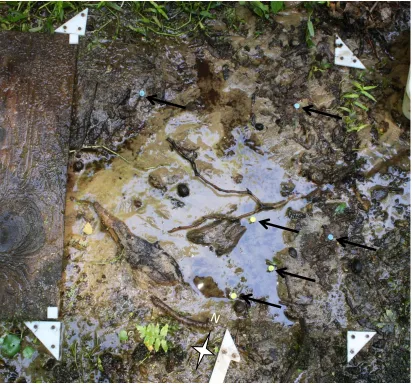
From May 2010 through February 2012, we sampled coverboards approximately every two weeks for E. cirrigera nests. We used digital photography (EOS Digital Rebel XS 1000D) to record the coverboard landscape and identify nest locations. Each
coverboard was sampled by first orienting it northward to ensure that subsequent
sampling of a coverboard would be recorded from the same perspective, and then flipping the coverboard to examine the area beneath for salamanders and nests (Figure 2.1). Adult salamander locations were marked with colored pegs and individuals collected for
identification (photographed) were measured for snout-vent length SVL (mm), total length TL (mm), and mass (g).
corner and one in the center of the substrate). Prior to flipping each coverboard, we visually estimated the percent of the coverboard exposed to sunlight (Table 1).
All statistical analyses were performed using SAS software, version 9.2.1. In the analysis, we only included coverboards that were sampled during the E. cirrigera nesting season (November- April). We did not include coverboards that were lost or that where not sampled (e.g. floated away or buried in mud). All other coverboards (N=43) were
classified as either “used” (1) or “not used” (0) for nesting during the nesting season. We
averaged data collected from repeated visits to the same coverboard and then z- standardized all continuous environmental predictors (Table 1) to examine nest-site selection.
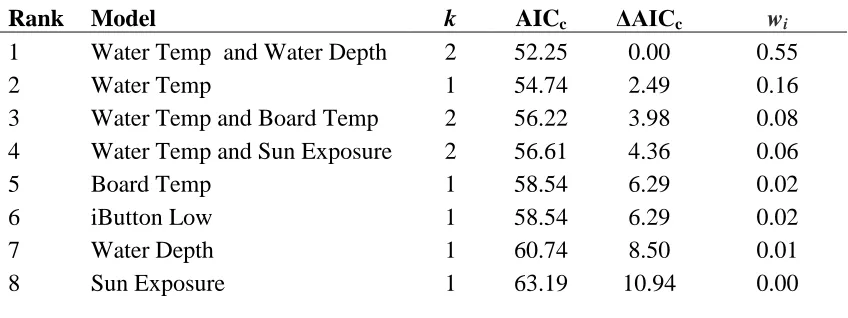
We used logistic regression to model the probability that a female nesting under a coverboard. We examined correlation coefficients for all predictors, prior to analysis (PROC CORR). If r > 0.70, we selected one the variables in the pair for analysis and excluded the other. We developed eight candidate models a priori to examine the effects of abiotic stressors on nest-site selection (Table 2). We expected that water temperature would have the greatest influence on nest location and therefore included it as a predictor in several models. We also included the coverboard and iButton temperatures, water depth, and sun exposure in separate models. We used AICc model selection (Burnham
and Anderson, 2002) to rank candidate models, retaining models with ΔAICc < 2.00 for
inference. We examined goodness-of- fit of the global model using the Hosmer and Lemeshow goodness-of-fit test.
coverboard, for mapping using ArcGIS version 10.0. Photographs were imported to ArcGIS and georectified to a 61 cm x 61 cm template to correct for distortion in the images. We mapped locations of nests (N=108) in ArcGIS and paired each “used” (1)
nest location with 20 “random" (0) locations under the board. We categorized the
substrate beneath each nest and random point as sand, coarse woody debris (CWD), or mucky soil. Similarly, we categorized the hydrology of each used and random nest location as either saturated, standing, or flowing. We measured distances from each nest and random location to the nearest edge of board, nearest crayfish burrow, and nearest neighboring nest (Table 1).
We used logistic regression to model where a nest occurred under a coverboard. We constructed seven candidate models a priori to test for an effect of hydrology, substrate, and distance to edge (Table 3). We used AICc model selection to rank models.
We retained models with a ΔAICc < 2.00 for inference. We examined goodness of fit of
the global model using the Hosmer and Lemeshow goodness-of-fit test.
2.3 RESULTS
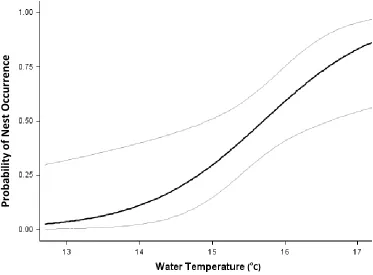
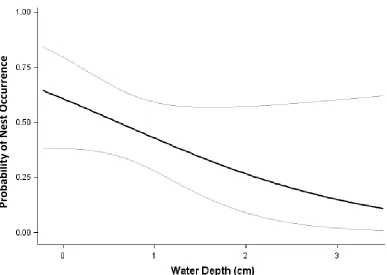
ratio 95% CL= 3.71, 1.43-9.62). Water depth was negatively associated with the probability of nesting (β = -0.8917 ± 0.461, df = 1, χ2 = 3.747, 95% CI=- 1.7947 to 0.0112, p = 0.0529) (Figure 2.3). For every centimeter increase in water depth, there was a decrease in the probability of a nest occurring under the coverboard (odds ratio, 95% CL= 0.41, 0.17-1.01). There was no effect of site (χ2= 0.18, df= 1, p<0.05) which allowed us to pool data across locations for analysis.
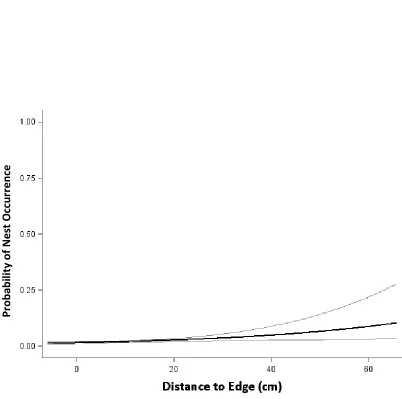
Coverboard Scale. One candidate model was supported at the coverboard scale of analysis. The best model included hydrology, substrate, and distance to board edge (Table 4). The Hosmer and Lemeshow goodness-of-fit statistic suggested that the global model fit the data (p = 0.22). Nests were negatively associated with saturated hydrology (β = -0.376 ± 0.157, p <0.01) and positively associated with standing hydrology (β = 0.327 ± 0.172, p <0.05. Nest location was also positively associated with the distance to the edge of the coverboard (β=0.040 ± 0.013, p<0.01) (Figure 2.4). We failed to detect a significant effect of “flowing” hydrology or substrate on nest-site selection at the
coverboard scale. These results suggest that during the nesting season (i.e. November to April) femalesare more likely to nest in areas of a coverboard that are slightly saturated with water and close to the interior of the coverboard. We tested for an effect of site (χ2= 0.56) using the Chi- squared test of independence before pooling data for analysis.
2.4 DISCUSSION
warmer water could be due to the fact that in the coastal of plain of South Carolina, nesting occurs during the coldest months of the year (i.e. December- April). Females of peripheral populations in the coastal plain may therefore prefer warmer coverboards (analogous to the warmer, spring-like conditions of mountain streams). Warmer temperatures increase development rate, influence incubation time, and can impact offspring metabolism and survival (Bachman, 1969; Salthe and Mechum, 1974; Bradford, 1990).
Female E. cirrigera also preferentially nested under coverboards with relatively shallow water depth. This suggests that E. cirrigera prefer to nest in areas that are moist but not fully inundated. Nest location selection based on water availability is strongly driven by the pressure to reduce the risk of egg desiccation (Figiel and Semlitsch, 1995; Marco, 2001), avoid stream turbidity (Jakubanis et al, 2008), maximize oxygen exposure (Seymour and Bradford, 1987; Warkentin, 2001), and reduce exposure to aquatic
predators (Barr and Babbitt, 2002; Lowe and Bolger, 2002; Petranka, 1983; Sih et al., 1992).
At the coverboard scale, female E. cirrigera used environmental cues to
discriminate against nesting locations with the microhabitat of the coverboard. Though we were unable to detect a direct effect of biotic stressors on nest-site selection at the coverboard scale, the tendency of salamanders to nest closer to the coverboard center suggests a predator avoidance mechanism, as locations at the interior may be less exposed to predators. In addition, nest-site selection at the coverboard scale was
deeper standing water or channels of flowing water. Nesting in the interior of the
coverboard on moist, saturated substrate could help protect nests from being dislodged in a high flow event or from drying out during a period of drought (Guy et al., 2004).
In conclusion, nest-site selection by E.cirrigera is driven by environmental cues across multiple spatial scales. Female E. cirrigera actively select nesting locations based upon temperature, hydrology, and additional biotic factors. Fluctuations in environmental parameters, like temperature and water availability, are known to affect nesting behavior in salamanders, as well as other aquatic amphibians (Brodman, 1995; Figiel et al., 1995; Resetartis, 1996; Snodgrass et al., 2007, and Wahl et al., 2008). Because amphibians are particularly sensitive to environmental change, understanding the factors that influence key life history processes, particularly oviposition site choice, are critical to the
conservation of amphibian populations and their habitats. Since female E. cirrigera
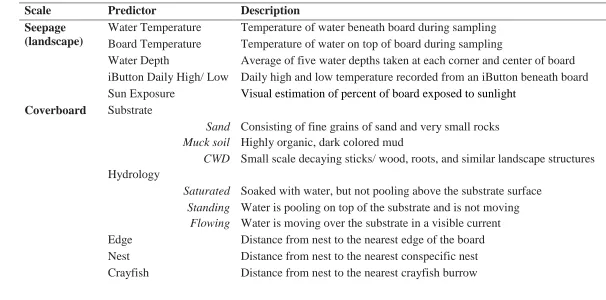
Table 2.1 Predictors and descriptions for E. cirrigera seepage- and coverboard-scale nest-site selection.
Scale Predictor Description
Seepage (landscape)
Water Temperature Temperature of water beneath board during sampling Board Temperature Temperature of water on top of board during sampling
Water Depth Average of five water depths taken at each corner and center of board iButton Daily High/ Low Daily high and low temperature recorded from an iButton beneath board Sun Exposure Visual estimation of percent of board exposed to sunlight
Coverboard Substrate
Sand Consisting of fine grains of sand and very small rocks Muck soil Highly organic, dark colored mud
CWD Small scale decaying sticks/ wood, roots, and similar landscape structures Hydrology
Saturated Soaked with water, but not pooling above the substrate surface Standing Water is pooling on top of the substrate and is not moving
Flowing Water is moving over the substrate in a visible current Edge Distance from nest to the nearest edge of the board Nest Distance from nest to the nearest conspecific nest Crayfish Distance from nest to the nearest crayfish burrow
Table 2.2 Logistic regression models, ranked according to statistical support, examining E. cirrigera nest-site selection at the Seep scale. Highest ranked logistic models using AICc model selection. The table shows model rank, number of estimated parameters (k); AICc differences (∆AICc) and Akaike weights (wi).
Rank Model k AICc ΔAICc wi
1 Water Temp and Water Depth 2 52.25 0.00 0.55 2 Water Temp 1 54.74 2.49 0.16 3 Water Temp and Board Temp 2 56.22 3.98 0.08 4 Water Temp and Sun Exposure 2 56.61 4.36 0.06 5 Board Temp 1 58.54 6.29 0.02 6 iButton Low 1 58.54 6.29 0.02 7 Water Depth 1 60.74 8.50 0.01 8 Sun Exposure 1 63.19 10.94 0.00
Table 2.3 Logistic regression models, ranked according to statistical support, used to examine E. cirrigera nest-site selection at the Coverboard scale. Highest ranked logistic models using AICc model selection. The table shows model rank,
number of estimated parameters (k); AICc differences (∆AICc) and Akaike weights
(wi).
Rank Model k AICc ΔAICc wi
1 Hydrology, Substrate, Distance 3 848.46 0.00 0.67 2 Hydrology 1 853.18 4.72 0.06 3 Substrate, Hydrology 2 855.38 6.93 0.02
4 Edge 1 857.23 8.77 0.01
Figure 2.2 The relationship between E. cirrigera nesting probability and water temperature, based on output from the top supported model. As water temperature increases, the probability of nest occurrence increases. Gray lines represent 95% confidence intervals.
(oC)
Pr
ob
ab
ili
ty
of
Nest
O
cc
u
rr
e
n
Figure 2.3 Relationship between E. cirrigera nesting probability and water depth (cm) underneath a coverboard, based on output from the top supported model. As water depth increases, the probability of nest occurrence decreases. Gray lines represent 95%
confidence intervals.
Pr
ob
ab
ili
ty
of
Nest
O
cc
u
rr
e
n
Figure 2.4 Relationship between E. cirrigera nesting probability and distance to the edge of a coverboard, based on output from the top supported model. As the distance to the edge of the board increases, the probability of nest occurrence increases. Dotted lines represent 95% confidence intervals.
Pr
ob
ab
ili
ty
of
Nest
O
cc
u
rr
e
n
L
ITERATUREC
ITEDAngilletta Jr., M. J., M.W. Sears, and R.W. Pringle. 2009. Spatial Dynamics of Nesting Behavior: Lizards Shirt Microhabitats to Construct Nests with Beneficial Thermal Properties. Ecology 90 (10): 2933- 2939.
Arnfield, H. R. Grant, C. Monk, and T. Uller. 2012. Factors Influencing the Timing of Spring Migrations in Common Toads (Bufo bufo). Journal of Zoology 288:112-118.
Bachmann, K. 1969. Temperature Adaptations of Amphibian Embryos. American Naturalist 103: 115-130.
Barr, G. E., K. J. Babbitt. 2002. Effects of Biotic and Abiotic Factors on the Distribution and Abundance of Larval Two-Lined Salamanders (Eurycea bislineata) Across Spatial Scales. Oecologia 133: 176-185.
Bernardo, J. 1996. Maternal Effects in Animal Ecology. American Zoologist 36(2): 83-105.
Blaustein, A. R., D. B. Wake, and W. P. Sousa. 1994. Global Amphibian Declines: Judging Stability, Persistence and Susceptibility to Local and Global Extinctions.
Conservation Biology 8:60- 71.
Bradford, D. F. 1990. Incubation Time and Rate of Embryonic Development in
Amphibians: The Influence of Ovum Size, Temperature, and Reproductive Mode.
Physiological Zoology 63(6):1157-1180.
Brodman, R. 1995. Annual Variation in Breeding Success of 2 Syntopic Species of
Ambystoma salamanders. Journal of Herpetology 29(1): 111-113.
Bruce, R. C. 2005. Theory of Complex Life Cycles: Application in Plethodontid Salamanders. Herpetological Monographs 19(1): 108-207.
Crawford, J. A. and R.D. Semlitsch. 2007. Estimation of Core Terrestrial Habitat for Stream Breeding Salamanders and Delineation of Riparian Buffers for Protection of Biodiversity. Conservation Biology 21(1): 152-158.
Dai, Z. H., C. C. Trettin, C.S. Li, D.M. Amatya, G. Sun, and H.B. Li. 2010. Sensitivity of Stream Flow and Water Table Depth to Potential Climatic Variability in a Coastal Forested Watershed. Journal ofAmerican Water Resources Association 46(5): 1036‐1048.
Davis, S.K. 2005. Nest-Site Selection Patterns and the Influence of Vegetation on Nest Survival of Mixed-Grass Prairie Passerines. The Condor 107 (3): 605-616. Ficetola, G.F., L. Marziala, B. Rossaro, F.D. Bernardi, and E. Padoa-Schioppa. 2011.
Landscape- Stream Interactions and Habitat Conservation for Amphibians.
Ecological Applications 21(4):1272-1282.
Figiel C.R. Jr, and Semlitsch R.D. 1995 Experimental Determination of Oviposition Site Selections in the Marbled Salamander, Ambystoma opacum. Journal of
Herpetology 29:452-454.
Forester, D.C. 1981. Parental Care in the Salamander Desmognathus ochrophaeus: Female Activity Pattern and Trophic Behavior. Journal of Herpetology 15(1): 29-34.
Grenfell, M.C., W.N. Ellery, and R.A. Preston‐Whyte. 2005. Wetlands as Early Warning (eco)systems Water Resource Management. Water SA 31(4): 465‐471.
Gottsberger, B and E. Gruber. 2004. Temporal Partitioning of Reproductive Activity in a Neotropical Anuran Community. Journal of Tropical Ecology 20: 271- 280.
Gustafson, M.P. 1993. Intraguild Predation among Larval Plethodontid Salamanders: A Field Experiment in Artificial Stream Pools. Oecologia 96(2):271- 275.
Guy, C. J., R.E. Ratajczak Jr., and G.D. Grossman. 2004. Nest- Selection by Southern Two-Lined Salamanders (Eurycea cirrigera) in Georgia Piedmont. Southeastern Naturalist 3(1):75-88.
Harder, S. V., D. M. Amatya, T. J. Callahan, C. C. Trettin, and J. Hakkila. 2007. Hydrology and Water Budget for a Forested Atlantic Coastal Plain Watershed, South Carolina. Journal of American Water Resources Association 43(3): 563‐ 575.
Hom, C.L. 1987. Reproductive Ecology of Female Dusky Salamanders, Desmognathus fuscus (Plethodontidae), in the Southern Appalachians. Copeia 1987(3): 768-777.
Houze, M, and Chandler, R. 2002. Evaluation of coverboards for sampling terrestrial salamanders in South Georgia. Journal of Herpetology36(1): 75-81.
Howard, R.D. 1978. The Influence of Male-Defended Oviposition Sites on Early Embryo Mortality in Bullfrogs. Ecology 59:789-798.
Jacobs, J.F. 1987. A Preliminary Investigation of the Geographic Genetic Variation and Systematics of the Two- Lined Salamander Eurycea Bislineata (Green).
Herpetologica 43(4):423- 446.
Jakubanis J., Dreslik M.J., Phillips C.A. 2008. Nest Ecology of the Southern Two-lined Salamander (Eurycea cirrigera) in Eastern Illinois. Northeastern Naturalist 15(1): 131-140.
Johnson, D.H. 1980. The Comparison of Usage and Availability Measurements for Evaluating Resource Preference. Ecology 61(1):65-71.
Juterbock, J.E. 1986. The Nesting Behavior of the Dusky Salamander, Desmognathus fuscus. I. Nesting Phenology. Herpetologica 42(4): 457- 471.
Keitzer, S.C. and R. R. Goforth. 2012. Response of Stream-breeding Salamander Larvae to Sediment Deposition in Southern Appalachian (U.S.A.) Headwater Streams.
FreshwaterBiology 57(8): 1535-1544.
Kozak, K.H., R.W. Mendyk, and J.J. Weins. 2009. Can Parallel Diversification Occur in Sympathy? Repeated Patterns of Body- Size Evolution in Coexisting Clades of North American Salamanders. Evolution 63 (7):1769-1784.
Kristan, William B., M.D. Johnson, and J.T. Rotenberry. 2007. Choices and Consequences of Habitat Selection for Birds. The Condor 109(3):485-488. Kolbe, J.J. and F.J. Janzen. 2002. Impact of Nest- Site Selection on Nest Success and
Nest Temperature in Natural and Disturbed Habitats. Ecology 83(1): 269-281. Liebezeit, J. R., and T. L. George. 2002. Nest Predators, Nest- Site Selection, and Nest
Success of the Dusky Flycather in a Managed Ponderosa Pine Forest. The Condor
104(3): 507-517.
Lowe, W.H., and D.T. Bolger. 2002. Local and Landscape- Scale Predictors of Salamander Abundance in New Hampshire Headwater Streams. Conservation Biology 16(1):183-193.
Lowe, W.H. 2012. Climate Change is Linked to Long- Term Decline in a Stream Salamander. Biological Conservation 145: 48-53.
Lowenborg, K., R. Shine, S. Karvemo, and M. Hagman. 2010. Grass Snakes Exploit Anthropogenic Heat Sources to Overcome Distributional Limits Imposed by Oviparity. Functional Ecology 24: 1095- 1102.
Macarthur, R and R. Levins. 1967. The Limiting Similarity, Convergence, and
Divergence of Coexisting Species. The American Naturalist 101(921): 377-385. Marco A.Q. 2001. Effects of Prolonged Terrestrial Stranding of Aquatic Ambystoma
gracile Egg Masses on Embryonic Development. Journal of Herpetology 35(3): 510-513.
Martin, T.E. 1993. Nest Predation Among Vegetation Layers and Habitat Types: Revising the Dogmas. The American Naturalist 141(6):897-913.
Means, D.B., R.C. Bruce, R.J. Jaeger, and L.D. Houck. 2000. The Biology of Plethodontidae (In Press), Plenum Publishing Corporation, New York, N.Y Møller, A.P. and T.A. Mousseau. 2007. Birds Prefer to Breed in Sites with Low
Radioctivity in Chernobyl. Proceedings of the Royal Society B: Biological Sciences 274(1616): 1443- 1448.
Mousseau, T.A. and C.W. Fox. 1998. The Adaptive Significance of Maternal Effects.
Trends in Ecology and Evolution 13(10):403- 407.
Mousseau, T.A. and N.C. Collins. 1987. Polygyny and Nest- Site Abundance in the Slimy Scuplin (Cottus cognatus). Canadian Journal of Zoology 65(11): 2827- 2829.
Niemiller, M.L. and B.T. Miller. 2007. Subterranean Reproduction of the Southern Two-Lined Salamander (Eurycea cirrigera) from Short Mountain, Tennessee.
Herpetological Conservation and Biology 2(2): 106- 112.
Oseen, K.L. and R.J. Wassersug. 2002. Environmental Factors Influencing Calling in Sympatric Anurans. Oecologia 133: 616-625.
Petranka J.W., J.G. Petranka. 1981. On the Evolution of Nest- Site Selection in the Marbled Salamander, Ambystoma opacum. Copeia (2): 387-391.
Petranka, J.W. 1983. Fish Predation: A Factor Affecting the Spatial Distribution of a Stream-Breeding Salamander. Copeia 1983(3): 624-628.
Petranka J.W. 1990. Observations of Nest- Site Selection, Nest Desertion, and Embryonic Survival in Marbled Salamanders. Journal of Herpetology 24(3):229-234.
Petranka, J.W. 1998. Salamanders of the United States and Canada. Smithsonian Institution Press, Washington, D.C., U.S.A.
Pike, D.A., J.K. Webb, and R.M. Andrews. 2011. Social and Thermal Cues Influence Nest- Site Selection in a Nocturnal Gecko, Oedura lesuerii. Ethology 117: 796- 801.
Prado, C.P de A., M. Uetanabaro, and C.F.B. Haddad. 2005. Breeding Activity Patterns, Reproductive Modes, and Habitat Use by Anurans (Amphibia) in a Seasonal Environment in the Pantanal, Brazil. Amphibia- Reptilia 26: 211- 221.
Resetarits, W.J. Jr. and Wilbur, H.M. 1989. Choice of Oviposition Site by Hyla chrysoscelis: Role of Predators and Competitors. Ecology 70:220-228
Resetarits, W.J. Jr. 1996. Oviposition Site Choice and Life History Evolution. American Zoology 36:205-215.
Rudolf, V.H.W., Rodel, M. 2005. Oviposition Site Selection in a Complex and Variable Environment; the Role of Habitat and Conspecifc Cues. Oecologia 142: 316-325. Salthe, S. N., and J.S. Mecham. 1974. Reproductive and courtship patterns. Physiology of
the Amphibia 2: 309-521.
Segev O., M. Mangel, N. Wolf, A. Sadeh , A. Kershenbaum, L. Blaustein. 2011. Spatiotemporal Reproductive Strategies in the Fire Salamander: A Model and Empirical Test. Behavioral Ecology 22(3): 670-678.
Semlitsch, R.D. 2000. Principles for Management of Aquatic- Breeding Amphibians.
Journal of Wildlife Management 64 (3): 615-631
Seymour, R.S. and D.F. Bradford. 1987. Gas Exchange Through the Jelly Capsule of the Terrestrial Eggs of the Frog, Pseudophryne bibroni. Journal of Comparative Physiology 157B: 477-481.
Snodgrass J.W., D.C. Forester, M. Lahti, and E. Lehman. 2007. Dusky Salamander (Desmognathus fuscus) Nest- Site Selection Over Multiple Spatial Scales.
Herpetologica 63(4): 441-449.
Soil Survey Staff, Natural Resources Conservation Service, United States Department of Agriculture. 2006. Land Resource Regions and Major Land Resource Areas of the United States, the Caribbean, and the Pacific Basin. Agricultural Handbook 296 digital maps and attributes. http://soils.usda.gov/survey/geography/mlra/index. html. Accessed [November/28/2012].
Southerland, M.T. 1986. Behavioral Interactions Among Four Species of the Salamander Genus Desmognathus. Ecology 67(1): 175-181.
Tufford, D.L. 2011. Shallow Water Table Response to Seasonal and Interannual Climate Variability. American Society of Agricultural and Biological Engineers 54 (6): 2079-2086.
Vredenburg, V.T., 2004. Reversing Introduced Species Effects Experimental Removal of Introduced Fish Leads to Rapid Recovery of a Declining Frog. Proceeding of the National Academy of Sciences USA 101:7646-7650.
Wahl G.W., III, R.N. Harris, and T. Nelms. 2008. Nest- Site Selection and Embryonic Survival in Four-toed Salamanders, Hemidactylium scutatum (Caudata :
Plethodontidae). Herpetologica 64(1): 12-19.
A
PPENDIXA
–
B
REEDINGE
VENTO
BSERVATIONSReference Location Species Breeding Event Time
Bahret, 1996 Lake Minnewaska, NY E. bislineata 1. Gravid
Females (8)
2. Nests (11)
1. March, April, June, July 2. Late May- Mid- July
Baumann and Huels, 1982
Pine Creek: Hocking County, OH
E. bislineata Nests (49) May
Beane, 2009 (Unpub.)
Wake County, NC E. cirrigera 1. Nest
2. Nest
1. January 2. February
Bishop, 1925 "the north" (New York)
P. ruber Nest Fall
Brimley, 1939 Pitt County, NC E. cirrigera Nest March- April
Bruce, 1974 SC Piedmont P. ruber Gravid
Females
August- early Autumn
Bruce,1978 Jackson, Macon,
Transylvania, NC and Oconee, SC
P. ruber Gravid
Females
Late Spring- Summer to Autumn
Bruce,1979 Jackson, Macon,
Transylvania, NC and Oconee, SC
P. ruber Males (11) July 15-
Sept. 19
Bruce, 1980 Jackson, Macon,
Transylvania, NC and Oconee, SC
P. ruber Breeding Summer
Bruce, 1981 Jackson, Macon,
Transylvania, NC and Oconee, SC
P. ruber Nests Fall
Bruce,1982 Tuckasegee River basin,
Jackson County, NC
E. bislineata Nests Late Winter,
Early Spring
Bruce, 1982 Sateetlah Creek,
Graham County, NC
Carr, 1940 Liberty and Jackson County, FL
E. cirrigera Gravid females/ Nest
November
Eaton, 1953 5 miles east of
Greenville, NC
D. auriculatus
Nest October
Enge, 1998 Havana, Gadsden
county, FL
E. cirrigera Breeding November –
mid-March
Goin, 1951 3 miles N Gainesville,
Alchua County, FL
D. auriculatus
Nest (10) October
Brophy and Pauley, 2002
Fitzpatrick's Branch, Huntington, Cabell County, WV and Beech Fork, Bowen, Wayne County, WV
E. cirrigera 1.Gravid (7), Males (30) 2. Breeding 3. Nest 4. Males 1.February – March 2. March 3. mid-March- early-April 4. February- March
Guy et al., 2004 Boscoe Creek and Lee Creek, Thompson Mill Forest, GA Piedmont
E. cirrigera Nest (37) April
Jakubanis et al., 2008
Vermilion River Observatory Research Area, IL
E. cirrigera Nests (441) Spring –
Summer
King, 1939 Elkmont, Gatlinburg, TN
(Little River) Great Smoky Mountains
E. bislineata 1. Gravid 2. Nests
1. March 2. April
Marshall, 1996 Poplar Cove Spring Uni. Miss. Biological Field Station Lafayette, MS
E. cirrigera Nests (7) April-
May
McDowell, 1995 11 km N of Glendale,
Pope County, IL
E. cirrigera Gravid (33) April
Miller and Niemiller, 2005
Caney Fork River, Dekalb County, TN
P. ruber Nest September
Neill and Rose, 1949
Coastal Plain side of Augusta, Richmond County, GA
D. auriculatus
Niemiller and Miller, 2007
SW slope of Short Mountain, near head of Mountain Creek, Camon County, TN
E. cirrigera Nest (9) January-
February
Robertson and Tyson, 1950
Little Contentnea Creek, 10 miles west of Greenville, Pope County, NC
D. auriculatus
Nest (6) September
Stewart, 1968 New York State, Finger
Lakes Region
E. bislineata Eggs April- May
Wilder,1924 Northampton, Western,
MA
E. bislineata Eggs May- June
Wood, 1949 Indian Gap, TN and
Wayah Bald, Hyatt Ridge and Mt. Mitchell, NC
E. bislineata Gravid Females (7)
April- May
Wood, 1949 Mt. Mitchell, NC E. bislineata Nest May
Wood, 1953 near Williamsburg,
James City County, VA
E. bislineata Nests (4) February
Thurow, 1997 Brown County, IN E. cirrigera Nests (8) April
Thurow, 1998 Central McDough
County, IN
E. cirrigera 1. Nests (1) 2. Nests (3)