Exploring dissipative processes at high
angular momentum in
58Ni+
60Ni reactions
E. Williams, D.J. Hinde, M. Dasgupta, I.P. Carter, K.J. Cook, D.Y. Jeung, D.H. Luong, S.D. McNeil, C.S. Palshetkar1,
D.C. Rafferty, K. Ramachandran2, C. Simenel, E.C. Simpson and A. Wakhle3
Department of Nuclear Physics, Research School of Physics and Engineering, Australian National University, Acton, ACT 2601 Australia
Abstract
Current coupled channels (CC) models treat fusion as a coherent quantum-mechanical process, in which coupling between the collec-tive states of the colliding nuclei influences the probability of fusion in near-barrier reactions. While CC models have been used to successfully describe many experimental fusion barrier distribution (BD) measure-ments, the CC approach has failed in the notable case of16O+208Pb. The reason for this is poorly understood; however, it has been pos-tulated that dissipative processes may play a role. Traditional BD experiments can only probe the physics of fusion for collisions at the top of the Coulomb barrier (L = 0¯h). In this work, we will present results using a novel method of probing dissipative processes inside the Coulomb barrier. The method exploits the predicted sharp onset of fis-sion atL∼60¯hfor reactions forming compound nuclei withA <160. Using the ANU’s 14UD tandem accelerator and CUBE spectrometer, reaction outcomes have been measured for the58Ni+60Ni reaction at a range of energies, in order to explore dissipative processes at high an-gular momentum. In this reaction, deep inelastic processes have been
1Present address: Department of Nuclear and Atomic Physics, Tata Institute of
Fun-damental Research, Mumbai 400005, India
2Present address: Bhabha Atomic Research Centre, Mumbai, India 400085, India 3Present address: National Superconducting Cyclotron Laboratory, Michigan State
found to set in before the onset fission at high angular momentum fol-lowing fusion. The results will be discussed in relation to the need for a dynamical model of fusion.
1
Introduction
In the study of nuclear reactions, one of the most elusive goals of the field has been to develop a comprehensive model of nuclear reactions: one which is capable of predicting the probabilities of the full range of possible reac-tion outcomes, for the complete range of nuclear collisions. The challenge in creating such a model arises from the complex dynamics of the nuclear re-actions process. For a given reaction, many degrees of freedom are at play, including nuclear shell structure, collective excitations, reaction kinemat-ics, energy damping, and angular momentum. Experimentally, we cannot vary one degree of freedom while holding all others fixed. At best, we can minimise the importance of one or two variables through clever tricks, or compare data with models reliant on different assumptions in an effort to tease out the physics behind any disagreement.
Unfortunately, no single answer exists for most experiment-model dis-agreements. One example of this can be found in the body of work sur-rounding16O+208Pb fusion cross sections. High precision cross section data below and well above the Coulomb barrier cannot be consistently reproduced with a coupled channels model of fusion, unless one is willing to use differ-ent nuclear potdiffer-ential parameters to reproduce the data below and above the Coulomb barrier [1]. Different methods of addressing this discrepancy have been put forth, ranging from altering the ion-ion potential [2,3] to a realistic representation of energy dissipation within the model [4]. For now, though, all explanations amount to adding another parameter or two into an already parameter-heavy model, in an effort to make the model fit the data.
Experimentally, partial fusion cross sections σL cannot be measured in-dependently, making it very difficult to get a sense of whether the means by which the coupled channels approach mocks up fusion irreversibility is a rea-sonable approximation. For reactions forming a compound nucleus of mass
Acn <160, the fission barrier becomes sufficiently low for fusion with
angu-lar momenta L > 60¯h. Fission can be used as a high-angular momentum fusion tag, providing us with a unique opportunity to study high angular momentum fusion outcomes.
In this paper, we present the first study to test this high angular mo-mentum separation method, for the58Ni+60Ni reaction. We will outline the preliminary findings, and discuss the possible implications of our findings on the 16O+208Pb problem and the coupled channels approach to fusion.
2
Experimental methods
The 58Ni+60Ni experiment was performed at Australian National Univer-sity’s Heavy Ion Accelerator Facility, using the 14UD tandem accelerator
and CUBE two-body fission spectrometer [7]. The 58Ni beam impinged
upon the 60μg/cm2-thick60Ni target for 22 separate beam energies ranging from Elab =198-266 MeV (E/VB ∼0.97−1.35). The CUBE spectrometer, consisting of two large-area multiwire proportional counters, was placed at forward angles 45◦ relative to the beam axis and a distance of 22.24 cm from the target. The detectors provided energy loss, time of flight, and (x, y) position information with a resolution of 1 mm.
Two calibration runs with a 58Ni beam at 160 MeV in the lab frame
bombarding 58,60Ni targets of thicknesses 50 and 60 μg/cm2, respectively were also carried out. The Mott scattering patterns for the former and Rutherford scattering data for the latter were both used to calibrate the geometry of the setup, define the resolution of the CUBE detector system, and provide a solid angle calibration for cross section determinations.
Using the position and time of flight information provided by the CUBE detector, a full kinematic reconstruction of each fission event was performed using the kinematic coincidence method [7,8], providing total kinetic energy, mass ratio,
MR= m m1
1+m2, (1)
and scattering angle information.
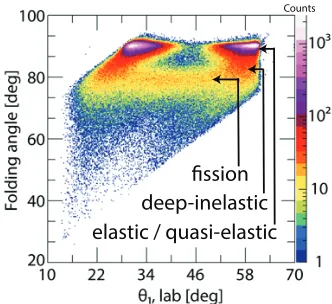
fission deep-inelastic elastic / quasi-elastic
Counts
Figure 1: Lab angle for one detector versus the folding angle (θ1 +θ2) for the
58Ni+60Ni reaction at 135.19 MeV.
In this work, our interest in studying the influence of dissipation on fusion reactions at high angular momentum led to a focus on the observed mass ratio versus total kinetic energy. Before producing the final mass versus total kinetic energy plots, gates were placed on (1) the detector positions and times to exclude unphysical events, (2) the folding angle to exclude heavy target impurities, and (3) on the out-of-plane velocity of the fission fragments, in order to exclude random coincidences. The TKE results are presented below, and full discussion of the analysis will be given in a forth-coming publication.
3
Results and discussion
The results of this work are summarized by the mass ratio versus total kinetic energy (TKE) plots shown in Fig. 2 for three representative above-barrier runs.
Figure 2: Mass ratio versus total kinetic energy for three representative above-barrier runs: (a) 98.35 MeV, (b) 116.72 MeV, and (c) 135.19 MeV. Note the excel-lent mass resolution of the CUBE detector; in the lowest energy dataset shown—the projectile-like and target-like species are distinguishable.
equilibration, very little change in the mass of the two fragments). While the intermediate energies are not shown here, the progression from (a) to (b) is smooth, with the onset of deep inelastic scattering appearing at progressively lower TKE values above∼105 MeV. From Fig. 2 (b) to (c), a third class of reaction outcomes appears with a threshold of∼125 MeV, corresponding to events with a wide spread in mass and full energy damping, consistent with expectations for fusion-fission.
The appearance of deep inelastic scattering before fission was an unex-pected outcome in this experiment. Traditionally, one might expect deep inelastic scattering to set in at high angular momentum, higher than fusion-fission. The early onset of deep inelastic scattering provides firm evidence of the role dissipation plays even at lower angular momenta.
4
Conclusions
however, provide further evidence [9, 10] for the need for a dynamical model of reactions, in which all possible reaction outcomes can be calculated within a single consistent framework.
Acknowledgments
The authors thank the Heavy Ion Accelerator Facility accelerator and tech-nical staff for their invaluable help with this project, and NCRIS for support for accelerator operations. This work was supported by the Australian Re-search Council, grant numbers DP130101569, DP140101337, FL110100098, FT120100760 and DE140100784.
References
[1] C. R. Mortonet al. Phys. Rev. C,60(1999) 044608.
[2] H. Esbensen and M. Serban, Phys. Rev. C,76 (2007) 054609.
[3] A. S. Umar, C. Simenel, and V. E. Oberacker,Phys. Rev. C,89(2014) 034611.
[4] M. Dasguptaet al. Phys. Rev. Lett.,99(2007) 192701.
[5] C. H. Dasso, S. Landowne, and A. Winther,Nucl. Phys.,A405(1983) 381.
[6] K. Hagino, N. Rowley, and A. T. Kruppa, Comp. Phys. Comm., 129
(1999) 143.
[7] D. J. Hindeet al.,Phys. Rev. C,53(1996) 1290.
[8] R. Rafieiet al.,Phys. Rev. C,77(2008) 024606.
[9] E. Williamset al.,Phys. Rev. C,88 (2013) 034611.