R E S E A R C H
Open Access
Lifetime maximization by partitioning
approach in wireless sensor networks
Mohammed Zaki Hasan
1*, Hussain Al-Rizzo
2and Melih Günay
1Abstract
Lifetime is a key parameter in the design of routing protocols in energy-constrained wireless sensor networks (WSNs). Conventional single-path routing schemes may not be optimal in maximizing network lifetime. In this paper, we present a new routing algorithm based on the optimal number of hops to partition the path from the source to the sink. The algorithm is based on energy consumption constrained routing method. The mathematical model uses mixed-integer programming (MIP), based on the Lagrangian relaxation (LR) method, to define critical parameters that control the adaptive hop-by-hop switching. LINGO is used to investigate the performance trade-offs between energy efficiency and quality of service (QoS). Simulation results revealed that our algorithm significantly improves the lifetime by 46.91, 73.00, and 80.00% as compared to the well-known node density control, upper-bound, and WSN optimization of network lifetime algorithms, respectively.
Keywords: Integer programming, Lagrangian relaxation, Lifetime, Quality of service, Wireless sensor networks
1 Introduction
Wireless sensor networks (WSNs) consist of self-organized sensor nodes, which suffer from limited power, computational capabilities, and bandwidth [1]. A WSN is a promising technology that offers a good solution for the design and development of real-time applications using traditional networking paradigms [2], in addition to new types of networks, such as the Internet of Things (IoTs) which has been a core research topic since the beginning of this century [3]. Each sensor node is equipped with a battery, a micro-controller, memory, and a transceiver, whereas the sink node collects data for processing and decision-making [4]. The sensor node monitors, collects, and sends information to an allocated area [5]. This means that sensor nodes should operate in a limited energy bud-get to provide support for applications with an affordable cost [6]. However, batteries possess a finite energy capac-ity, and this limitation has generated significant inter-est concerned with the use of many aspects of WSNs to increase battery life by selecting optimal paths with effective power management to maximize operational lifetime [7].
*Correspondence: [email protected]
1Department of Computer Engineering, Akdeniz University, Antalya, Turkey Full list of author information is available at the end of the article
Energy efficiency analysis is notoriously difficult due to the network lifetime that depends on several factors, including network architecture, routing protocols, data collection initiation, lifetime definition, channel charac-teristics, and power consumption [8–10]. To address these limitations, WSNs offer various types of routing proto-cols, such as single-hop or multihop to facilitate a route to the sink [11]. These routing protocols have been proposed to address energy efficiency in real-time applications [12]. Some of these algorithms aim at maximizing network utilization and QoS, while several routing and specific path selection mechanisms have been proposed to meet dynamic network topology and applications with specific QoS guarantees [13, 14]. Hence, network parameters such as node density, initial energy in sensor nodes, and data rate could be selected as metrics for the path selection mechanism to achieve the desired network lifetime [15].
Most existing routing protocols select the minimum energy single-path, whereby each source node transmits data to the sink via the shortest path [16]. The opti-mal single-path is selected based on metrics such as the gradient of information, distance to the sink or the node residual energy level [16]. Although the single-path approach is flexible, simple, and scalable, path breakage due to node failure requires initiation of a new route dis-covery process which increases energy consumption [17]
and leads to an early termination of the network and par-tition [13]. Therefore, single-path routing cannot meet the requirements of real-time applications [18]. Several routing protocols that use multipaths have been pro-posed based on either load balancing or network reliability [19–21]. Load balancing can be achieved by balancing energy utilization among the multipaths to improve net-work lifetime [22]. Data transmission relies mostly on the optimal path or number of hops. The alternative paths are used only when the nodes on the primary route fail [23].
In this paper, we present a mathematical model for an energy-consumption constrained multipath routing determination mechanism. The aim behind partitioning the multipath is to achieve higher reliability for a given total lifetime in the WSN, i.e., at each moment, every sen-sor node should have spent the same amount of energy for transmitting and receiving each data packet until deliv-ered by the sink. We highlight the novelties of our pro-posed algorithm by comparing the results against the node density control [24], the upper bounds of lifetime algo-rithms [25], and network lifetime optimization in [26, 27]. Most authors derived upper and lower bounds of the net-work lifetime considering the event detection as spatial behavior of data flow in the network [8]. Furthermore, the optimum length of hop and optimal number of hops in the selected path minimize the total energy consumed for the data transmission. They also eliminate the assumption of source concentrated on a point and assume that the source is distributed over an area.
The node density control algorithm [24] proposes a model to minimize energy consumption that depends on the distribution model of the sensor nodes in the network to explore the relationship of lifetime and the sensor den-sity distribution manner in the events area. However, all of the nodes should use the same transmission range, which causes exhaustion of the energy of the nodes. The model analyzes the network lifetime by deriving the optimum transmission ranges of the nodes.
Studies on the upper bound for the lifetime of data gathering have been reported for various WSNs routing protocols. In [25], a strategy is proposed for collaborative information in routing protocol. This strategy constructs a realistic network topology to simulate the gathering and processing of information to investigate the optimal life-time for some levels of deployment control. In this specific topology, there are several different multipaths that data packets originating at a specific source node can use to send to the sink node. Therefore, these multipaths also include paths with which the node does not necessar-ily communicate directly through single-hop. Instead, the node can transmit data packets directly to another node, which is two hops or a multihop away, by spending more energy. Thus, the total number of paths from the source node to the sink grows exponentially as the number of
sensor nodes in the network topology increases. How-ever, the implementation of such a strategy is difficult because it is necessary to determine the exact locations of all nodes in the network topology and then to coordinate all the nodes so that different collaborative strategies are sustained over different periods.
The authors in [26] developed a generalized power con-sumption model to address the optimization of network lifetime and resource allocation for wireless video sensor networks (WVSNs). The authors formulated an algorithm which jointly considered video coding rate, aggregate power consumption, and link rate allocation to maxi-mize the network lifetime. The approach in [27] combines power consumption, video compression power, and net-work coding power under multipath rate allocation con-straints. Unlike lifetime optimization in [26], the authors proposed a solution to provide convex lifetime optimiza-tion. Meanwhile, in [28] the authors added a new routing metric to optimize the network lifetime by exploiting the cooperative diversity and jointly considering routing and power allocation schemes. The authors developed flow augmentation algorithm to formulate the objective func-tion under specified constraints to reduce the complexity of nondeterministic polynomial (NP) maximization prob-lem. A collaborative protocol has been proposed in [29] which leads to an increase network lifetime. The authors in [29] extended the work reported in [25] by taking into account the network topology and the effects of aggrega-tion of data streams to permit derivaaggrega-tion of bounds for networks with arbitrarily complex capabilities.
As far as analytical studies addressing sensor constraints such as computational capabilities, limited battery power, and less memory in multihop transmission are concerned, the authors in [4] proposed a theoretical data collection transmission scheme from source node to a mobile sink. Currently, research focuses on developing algorithms for network route reconstruction in a multiple sink to min-imize energy consumption and to increase network life-time [30]. Fortunately, this leads to energy balancing through network restructuring and optimizes the network lifetime since the number of disconnected sensor nodes is also reduced. However, the authors in [30] utilized the advantage of having multiple sinks. Indeed, multiple sinks ensure shorter hops to reduce the hop distance [12]. The authors in [31] proposed a 3D grid-planned deployment for heterogeneous WSNs to maintain a prolonged lifetime of reliable WSNs. The problem is mathematically modeled as a mixed-integer linear program (MILP) optimization with the objective of maximizing the network lifetime by reducing energy consumption, while maintaining certain levels of fault tolerance and cost efficiency.
The proposed algorithm distributes the routing messages to under-utilized partitioning multipath and less load to over-committed paths. It should be noted that our pro-posed scheme is easy to implement and does not require exact knowledge of the node positions. We present sim-ulations for two scenarios through swapping the role of detecting the event from single-source to multi-source node to enhance the overall network lifetime. Simulation results revealed that our algorithm provides a higher node energy efficiency than the protocols reported in. The rest of the paper is organized as follows. The proposed pro-tocol in multipath data routing scheme is described in Section 2. The performance evaluation of the scheme as well as comparisons against existing protocols are pre-sented in Section 3. Conclusions are given in Section 5.
2 Partitioning algorithm for multipath routing protocol
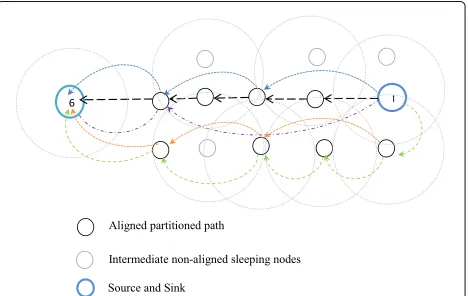
The communication paradigm of WSNs has its roots as self-organized in an ad hoc fashion, where the source node is a specific point and can communicate to the sink through intermediate nodes which are called upon to forward data packets and to form a multihop commu-nication route. They derive the optimum length of a hop and consequently the number of hops in the partition-ing path selected to minimize the energy consumption. The partitioning multipath routing approach is intended to optimize the number of hops between the sensor nodes in order to minimize power consumption, and it is con-ceptually illustrated in Fig. 1.
A magnified portion of the path shows that some sen-sor nodes are not aligned along the selected path. Thus, this suggests the use of the concept of integer optimiza-tion to partioptimiza-tion the nodes that are not aligned along the path. Partitioning is performed using the projection of sensors positions onto the path, to determine how close
Fig. 1Partition routing in WSNs
the packet is to the sink. The mathematical model uses mixed-integer programming (MIP) to develop the lower and upper bounds of network parameters using the cut-off method [32].
Critical parameters that control adaptive switching of a hop-by-hop QoS routing protocols are illustrated in Fig. 1. The criteria for each objective function as related to the decision constraints are used to determine the cut-off of the optimal number of hops, from which the path from the source to the sink is selected [33]. The main goal is to determine the optimal path that satisfies all QoS require-ments for an efficient routing protocol over a multihop route.
MIP defines a critical parameter to solve NP-time prob-lems [32]. The method is motivated by the need to find a plan to increase the capacity of multi-service internet pro-tocol networks [34], and it has been developed over recent years to account for new technologies and mechanisms that enable QoS parameters with different constraints to be satisfied, as well as to guarantee the optimal resource allocation for the task [35, 36].
2.1 Problem formulation
Vehicle monitoring using WSNs is a continuous prob-lem to detect an event straight away. This is a typical WSN application where the network compo-nents need more power with high deployment cost. Our model is close to the one described in [36], whereas vehicle monitoring can be modeled with a network topology and graph G = (V,E), as shown in Fig. 2. This topology is composed of n sensor nodes deployed with a centralized solution distributed
according to a two-dimensional Poisson distribution [37] with respect to the density, where |V| = n is the number of sensor nodes and|E| = link denotes the set of links in the network. Each node is characterized by a transmission range, and parameterseı which defines the initial energy in each node,Eelecrepresents the overhead
energy due to the sensing, receiving, and processing,εmp represents the loss coefficient related top-bit of informa-tion transmission, andξ3andξ4are constants coefficients of sensing. Moreover, each sensor node enters a sleep state without ongoing transmission; otherwise, it enters a wake-up state.
The existing link between two sensor nodes is defined ase = (sı,sı+1) from nodesı to nodesı+1, where ı =
1,. . .,n. Each linke ∈ Eis characterized by two integer values: energy consumption and delay. A decision vari-ablexj is defined as a variable with the value of 1 when two sensor nodes are connected, 0 otherwise. The source node consumesEtxamount of energy to transmitp-bit of
information with transmission range over a characteris-tic distance denoted bydwith a specified number of hops hop towards the sink. Each intermediate nodes consumes theErxof the amount energy of the receiving information
which is the signal propagated withεfsdαfor a single-path model and εmpdα for a multipath model for the
trans-mission amplifier, where α is the loss exponent of the signal.
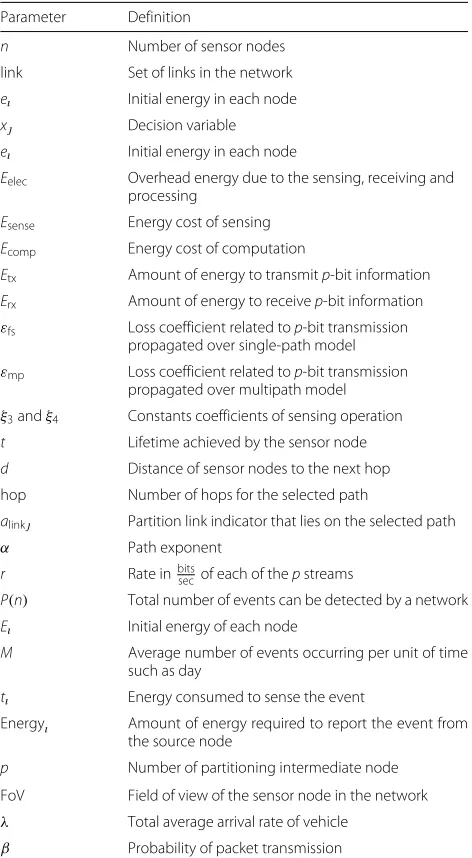
Given the set of network characteristics such as trans-mission range, node energy parameters, and initial energy in each node, we seek to answer the following fun-damental question. What is the optimal value of the active lifetime (t) of these partitioning multiple paths using these sensor nodes which gathers data from a source towards the sink? We will answer this question by solving the problem of transmitting a bit over opti-mal number of hops to minimize the overall energy consumed and then to derive network lifetime bounds. Solving this problem leads into insights on the funda-mental limits with respect to network performance and QoS gains using partitioning routing protocol. Table 1 provides a list of the parameters of the problem under consideration.
2.2 Energy consumption optimization
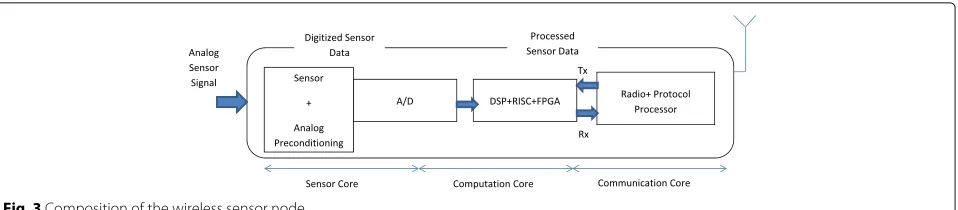
A new mathematical model is introduced in this paper to minimize energy consumption as well as to determine the optimal number of hops. In many implementation, the energy model for the sensor nodes is defined by assum-ing that a sensor node uses its power to carry out three primary functions: acquisition, communication, and data processing [38]. The composition of the WSN is illus-trated in Fig. 3. The communication function consumes more energy than the other two functions since it includes energy transmission and energy reception [39].
Table 1Parameters of the problem
Parameter Definition
n Number of sensor nodes link Set of links in the network eı Initial energy in each node xj Decision variable eı Initial energy in each node
Eelec Overhead energy due to the sensing, receiving and
processing
Esense Energy cost of sensing
Ecomp Energy cost of computation
Etx Amount of energy to transmitp-bit information
Erx Amount of energy to receivep-bit information εfs Loss coefficient related top-bit transmission
propagated over single-path model εmp Loss coefficient related top-bit transmission
propagated over multipath model ξ3andξ4 Constants coefficients of sensing operation
t Lifetime achieved by the sensor node d Distance of sensor nodes to the next hop hop Number of hops for the selected path
alinkj Partition link indicator that lies on the selected path
α Path exponent
r Rate inbits
secof each of thepstreams
P(n) Total number of events can be detected by a network Eı Initial energy of each node
M Average number of events occurring per unit of time such as day
tı Energy consumed to sense the event
Energyı Amount of energy required to report the event from the source node
p Number of partitioning intermediate node
FoV Field of view of the sensor node in the network λ Total average arrival rate of vehicle
β Probability of packet transmission
In most wireless sensor real-time applications, the fun-damental question that should be answered is how should the data be routed over a single-hop or multihops? There-fore, the answer that the data needs to be sent over a longer or a shorter hop is more energy efficient than longer single-hop transmission manner. However, it is not clear how to determine the corresponding intermediate nodes and how many hops are needed in particularly, when the source node is far away from the sink node [40]. Moreover, the most commonly used energy model is called first-order radio model [41]. According to this model, the energy Esense needed to sense ap-bit is
con-stant ξ3. Thus, for a sensing rate given byrbitssec, sensing
Fig. 3Composition of the wireless sensor node
50bitnJ. The computation core represents the energy dissi-pated which is accounted for separately [42]. We assume that the energy dissipated whenp-bits are aggregated into single stream is [25]
Ecomp=pξ4r (1)
whereris the rate inbitssec of each of thepstreams andξ4is
a constant.
The radio consumes an amount of energyEtxto
trans-mitp-bits of information over a specified distanced,Erx
to receivep-bits of information, andεfsandεmpare
trans-mitter amplification coefficient that the energy needed by the radio amplifier circuit to sendp-bits of information. Definition of these radio transmission model is listed in Table 2 [22].
where the amount of energy to receivep-bits of informa-tion is
Erx(p)=pEelec. (3)
The amount of energy required to forward p bits of information is
Table 2The definition of all the radio parameters
Parameter Definition Unit
EelecandEsense Energy dissipation rate to run the
radio
50 nJ/bit
εfs Single-path model for the transmitter
amplifier
10 pJ/bitm2
εmp Multipath model for the transmitter
amplifier
0.0013 pJ/bitm2
p Data length 2000 bits
α Path loss exponent for free space environment
4
To transmitpbits of information over hop-hops along the selected path, the total energy required is [32]
Esısı+1 =p
To minimize energy consumption with respect to energy dissipationPdiss, the optimization problem is formulated
as follows
Pdiss≥p{Etx+Erx}. (6)
Equation 5 is defined as the objective function, which is to minimize energy consumption for a linear array of nodes [22]. The two variables that must be defined are the number of hops and the intermediate distance between the two sensor nodes along the selected path. Theorem 1 of [24] proves that the distance is the optimal hop distance for anydand the optimal number of hops taken, hopoptimal is given either hopoptimal = dd
ı Thus, Eq. 5 can be rewritten as
Esısı+1 =p
Theorem 1The minimal number of sensor nodes Noptimalto supervise of an area A during unit of time T is
Noptimal=max(N∗,Nmin) (8)
where Nminis the minimum number of nodes that ensures
both network coverage and connectivity, and N∗= T∗M which is given by number of events M occurring per unit of time T.
Fig. 4Linear energy consumption modeling
d2=. . .=dn= numberofhopstotaldistance . Therefore, the optimal
the-oretical hop number can be obtained as an integer number for the multipath model when the path loss exponentα= 4 from
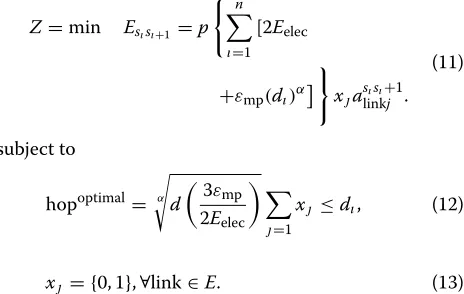
Finally, the objective function for minimizing the energy for the partitioning path is
Z=min Esısı+1 =p
The first constraint in Eq. 12 guarantees that the opti-mal number of hops between the selected paths can be obtained, whereas the second constraint in Eq. 13 defines a decision variable for the selection and partitioning. The optimization problem is solved by dualizing the side con-straint Eq. 12 on the objective function Eq. 11 using LR whose optimal value is a lower bound on the optimal value of Eq. 11. A critical parameter is defined to control the adaptive switching of the hop-by-hop QoS-routing pro-tocol. Thus, the embedded criteria based on the decision constraint used for each objective function decide the path from the source to the sink. Consequently,alinkj is the partitioned link which lies on the selected optimal
path; its value is 1 if the link that lies on the selected path and is 0 otherwise. Therefore,
Zd =max
The computation of the minimum accumulative energy Esısı+1 required to relay a bit over a certain distancedas referred to in Eq. 12, where the optimal distance is calcu-lated over all possible selected partitioned paths has been performed as shown in Fig. 5. This computation leads to deriving a lower bound on the expected energy dissipation in order to derive the upper-bound lifetime in partition-ing network topology. However, the bounds derived uspartition-ing the partitioning approach allow quick estimation of the maximum possible lifetime by embedding both energy consumption Eq. 12 and delay into the objective function Eq. 11 in Lagrangian dual fashion to solve integer pro-gramming. The resulting partitioning problem is usually easy to solve with this algorithm. The structure of the problem being solved must be understood for constraint relaxation to strengthen the upper and lower bounds of the objective functions.
The proposed model aims at designing and implement-ing a fast approximation algorithm that generates a fea-sible solution. It produces upper (i.e., a feafea-sible solution) and lower bounds on the optimal objective function Eq. 14 for QoS parameters in terms of energy consumption Eq. 12 and delay [36]. The control parameters, objective function, and constraints for the proposed model include the following:
(a) Control parameters for the network layer such as the partitioning path selection and the node’s lifetime of the selected path.
(b) The optimization goal is to minimize energy consumption.
(c) Constraint for the physical layer include limited energy.
The proposed model uses the sub-gradient method reported in [32] to find the global optimal solution of the objective function defined in Eq. 14 assuming that the sub-gradient of the objective function can be computed. This approach solve the optimization problem with fixed LR. Since, LR is the most attractive method among the few solution methods in optimization that cut across the domains of integer programming.
Algorithm 1 describes the steps of the Lagrangian method applied to find a closed-form optimal solution for the constrained optimization. The idea is to relax the explicit constraints by bringing them into the objective function defined by Eq. 11 with the associated Lagrange multiplierμ. Using the LR, the proposed algorithm can choose the optimalμfor a given two-node pair. The con-strained optimal path problem can be solved with respect to the modified objective functions of energy consump-tion (Eq. 11) and delay. We have added the delay constraint along with the energy consumption constraint in Eq. 12 to calculate upper bounds for the objective function in Eq. 14, since adding many constraints can lead to very good formulation. Even though, there is an integer solu-tion to the linear relaxasolu-tion of the expanded formulasolu-tion that is also feasible for the linear relaxation of the objec-tive function. This occurs by adaptation of the gradient method in which gradients are replaced by sub-gradient method by giving an initial value for Lagrangian mul-tiplier by dualizing the constraints with objective func-tion Eq. 14 for the power consumpfunc-tion and Eq. 12 for the delay.
LR enables the development of lower bound constraints for both energy consumption (Eqs. 10 and 12) and delay constraint parameters on the optimal length of a con-strained optimal path. These lower bounds are valuable when a specific path from the source to the sink is gen-erated by solving the sub-problems of partitioning link quality.
Algorithm 1Lagrangian Method
1: Formulate the objective functions for energy con-sumption Eq. 11.
2: Rewrite (Eq. 11) a Lagrangian multiplier as Eq. 14, whereμis the Lagrangian multiplier.
3: Calculate (Eq. 14) over the control parameterx, and then begin with μ at 0 with the step size being a certaink. ∂Energy∂x =0
4: Replaceμin the constraints to obtain current optimal solutionx.
5: For every constraint violated byx, increase the corre-spondingμbyk.
6: For every constraint with positive slack relative tox, decrease the correspondingμbyk.
7: If m iteration has passed since the best relaxation value has decreased, cut the objective function atkin half.
8: Go to 4.
2.3 Energy efficiency metric
Partitioning is performed through projecting the posi-tions of the sensors onto the route to determine how close the packet is to the sink. The sensor nodes are uni-formly distributed, and each knows the location and link quality of its neighbors. The lifetime of a sensor node depends basically on two factors: how much energy it consumes over time and how much energy is available for its use. Therefore, to clarify these factors, energy effi-ciency is defined as the number of data packets delivered from the percentage of alive source or intermediate nodes to sink with optimal spanning over the lifetime of the sensor node in the network [43]. Following this defini-tion, the predominant amount of energy is consumed by a sensor node during sensing, communication, and data processing activities as illustrated in Fig. 3. Indeed, we show that all parameters such as coverage, connectiv-ity, and node availability can be detrimental to lifetime considerations. From this definition, the key results with respect to this definition are established in the following theorem [43].
Theorem 2For fixed network sizes, the operational life-time of a wireless sensor network decreases in the order of
1
√
nas the number of nodes n grows.
Theorem 3For fixed node densities, the operational life-time of a wireless sensor network decreases in the order of1n.
needed to detect or sense the events continuously within a day, as shown by Eq. 16 [24].
Eeff= lim
E−→∞
eı E+tı
. (16)
Thus,
Eeff=
eı pnı=12Eelec+εmp(dı)α
xjaslinkısı+j1+tı .
(17)
eı is the initial energy available at the sensor node when traffic is generated in a random or distributed manner, as shown in Fig. 6. The energy spent to sense the event tı is proportional to the number of detected events dur-ing a day unitoftimemJ [44]. Each sensor node examines its neighbors along the partitioning paths then maximizes its energy efficiency when selected as the forwarder. There-fore, the end-to-end packet received ratio, and energy consumption are taken into account. Moreover, if some intermediate sensor nodes were not addressed in the packet header as unaligned partitioned path, it might temporarily turn the radio off and enter sleep mode to save energy. However, some other intermediate sensor nodes stay awake and forward the packet because they are addressed as aligned partitioned path. Intuitively, these intermediate sensor nodes may fail to continuously sup-port data transmissions long before the last sensor node fails. This will happen when the number of intermediate or failed nodes in the network reaches a certain critical threshold that allows it to perform its operations. From this point of view, the operational lifetime of a network should be defined such that after like lifetime expires, a certain percentage of data transmissions fail.
Let be a real number that satisfies 0< <1, we define the operational lifetime of a WSN as follows [43]:
Definition 1 The operational lifetime of a network is the expected time after which at least 100(1 − 2) data transmissions fail.
The understanding of the asymptotic behavior of life-times is essential to determining of sensor network whether or not a sensor network can function till the end of its operation.
3 Performance evaluation
Data traffic dynamics vary significantly in different WSN scenarios. Thus, WSNs traffic modeling and analysis depend on the network application and behavior of sensed events in the scenario [45]. However, the proposed rout-ing protocol is analytical in nature and its simulation is implemented using LINGO optimization module [46]. To illustrate the main concepts of the routing protocol, a uni-form linear WSN topology with an area(1000 m×1000 m) composed of n sensor nodes is considered. We assume that the current sensor node is iMote coupled with a cus-tom camera board that is represented in 2D, where the field of view (FoV) is triangular and denoted by a four-quadruple sensor(P, dist,−→V,ϑ),P is the position of the video sensor node, dist is the depth of view of the cam-era, −→V is the sensor line sight of the camera FoV that determines the sensing direction, and ϑ is the angle of the FoV on both sides of −→V. The dist varies according to the platform of the WSN, and it make sense to the behavior vehicle on the highway. Each node can be pow-ered by three AAA batteries 1150-mAh capacity [47].
The network topology is shown in Fig. 6 where energy consumption attribute is associated with each path. The concepts and assumptions are defined for a scenarios of vehicles that enter a highway under certain conditions
(a) The source and sink nodes are placed inside the wireless sensor area.
(b) The senor network architecture is considered homogeneous.
(c) Each sensor node has a connectivity that is associated with two positive QoS constraints in terms of energy consumption and average delivery delay.
(d) The total number of vehicles on the highway is very high.
(e) A single vehicle uses a certain percentage of the highway resources depending on the type of highway. (f) The decision to enter the highway is made
independently by each driver.
(g) Each sensor node is assumed to be aware of its geographic location with a transmission range of approximately 12.00 m, since a few sensor nodes are assumed to be video sensor nodes that have more constraints, such as the limitation on the sensing coverage and the FoV.
Under these assumptions and conditions, the number of vehicles entering to the highway follows a Poisson arrival process for packet generation. Furthermore, it is assumed that the distribution of number of events over the area follows a spatial-distribution Poisson distribution [48]. Poisson distribution is suitable to model the event occurrence [49, 50] and has been widely used in analyz-ing routanalyz-ing protocols to model events whose time/place of occurrence is random and independent from each other [51–53]. We assume that the events are independent both temporally and spatially and the behavior of data flow occur with homogeneous probability over the area. More-over, Poisson distribution can be used effectively to model the generation of data packets. The probability density function of having a number of vehicles in a specified time is given as
Whereτdefines the interval 0 toτ,xis the total number of vehicles arrivals during this interval, andλis the total average arrival rate of vehicle inarrivalssecond. Since the distribu-tion of packet generadistribu-tion obeys the Poisson model, there-fore, the time duration between two consequent packet transmissions,thas an exponential distribution with the mean number of packet arrival rate1λ:
ft(τ )=λexp−τ λu(τ ) (19)
whereu(τ )denotes the unit step function.
Suppose that an event is detected by source node 1 as depicted in Fig. 7 that should be transmitted to sink node 6 by finding the optimal partitioning path with probabil-ity of packet transmission denoted as β. Therefore, the multipath routing from node 1 to nodencan be stated as the level cut-off of number of hops which are determined based on different seeds for the probability of arrival λgenerated in different highway traffic monitoring. We study the behavior of vehicles passing along the highway through various degrees of periodicity in the traffic data flow and different environments which can be extended to other traffic distributions and data gathering scenarios as well. Therefore, the transmission between the source node and the sink can occur in a single-hop or multi-hop communication of the selected path according to the remaining intermediate nodes.
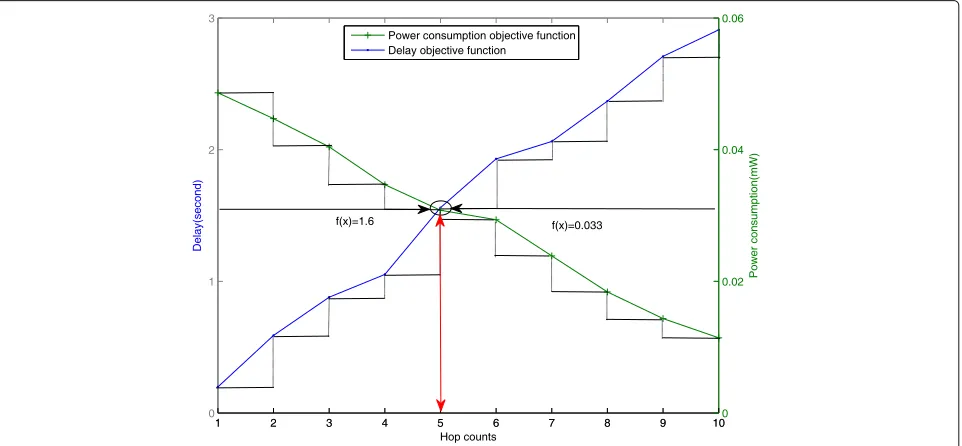
The key to find the optimal number of multipath hops from the source to the sink can be exposed to the con-vex envelope or the concon-vex hull of the objective function by adding an objective cut. Hence, the evolution of energy consumption and end-to-end delay can be generated for the multipath that adopts the objective functions for the power consumption and delay level cut-off at an opti-mal number of hops corresponding to a feasible solution. This evolution corresponds to feasible solution to the con-straints that are added together to produce values of the upper bounds. It is observed that the LRμpermits devel-oping lower and upper bounds on the optimal length of a constrained optimal multipath [33].
The lower and upper bounds are obtained by gener-alizing results of the optimal objective function value to minimize the energy consumption as illustrated in Fig. 8. These bounds can be useful in the optimization prob-lem to demonstrate that a particular solution generated can solve the partitioning optimization problem by mod-ifying the objective function of each path. Sub-gradient method is used to find the global optimal solution by
Fig. 8Multi-QoS constraints with modified objective function
seeking the optimal multiples μ on all constraints. The energy constraint is embedded into objective function in Lagrangian fashion to solve integer programming as depicted in Eq. 11. Thus, the estimate of the objective function value for a path can be obtained by successively adding and subtracting equality constraints to eliminate the variables and adding the inequality constraints in suitable non-negative multiples Eq. 14 as shown in Fig. 9.
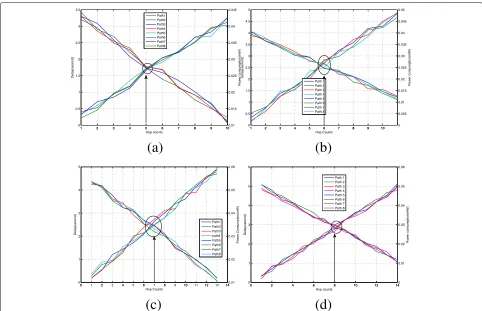
We remark that estimates of energy consumption and end-to-end delay for a path that adopts the objective function for power consumption can be verified through the level of cut-off at a specified number of hops. As depicted in Fig. 10, the evolution of energy consumption and average delay for multipath that adopts the level of cut-off at the optimal number of hops corresponding to the generated feasible solution.
Figure 11a depicts the network topology where the bold-lines denote the path of the constrained multipath routing whenμ=0. In Fig. 11b, the boldlines depict the modified optimal partitioning path of the constrained multipath routing with Lagrange multiplierμ=2, 3,. . .and so on.
After completing the discovery phase and constructing all multiple paths, the mechanism starts to select a set from the constructed paths to transfer the data packet. The selection phase of partitioning the multipath is based
on the routing metric in order to minimize energy con-sumption of the selected paths. However, the selection is based on the definition of critical parameters to control the adaptive switching of hop-by-hop until the sink node. The path selection is based on the critical parameters to control the adaptive hop-by-hop switching routing. It is also based on partitioning paths where the sensor nodes are distributed into partitioning. All sensor nodes inside the partitioning area can communicate with other each. Therefore, all sensor nodes in each partitioning area have equal link quality, i.e., transmission range. The exact par-titioning of multipath is used to optimize performance metrics such as energy balance and network lifetime. After constructing all multipath and data is received in the source node, the source selects an optimal path to its next most preferred neighbor by partitioning.
The parameters used in the proposed model are pre-sented in Table 3. The efficiency of the proposed model is compared against the node density control [24], the upper bounds of the lifetime [25], and network lifetime optimization in WVSNs [26, 27].
There are several factors that affect the lifetime of the energy-limited systems. These factors are network topol-ogy, detecting the event, and number of sources. However, our routing algorithm also provides results on the impact of these factors along with their variations (time/place) on the energy efficiency of the WSN when solving the optimization problem.
Usually, the lifetime of the wireless sensor node increases when the packet travels along many partition routes that are estimated with an efficient link quality [37]. Therefore, an increasing lifetime demonstrates that
Fig. 10Adopting the objective function with the level cut method for the multipath routing algorithm.aThe level cut at 5 hops.bThe level cut at 6 hops.cThe level cut at 7 hops.dThe level cut at 8 hops
each sensor node unaligned on the partition route enters a sleep state once because in/ongoing transmission is lack-ing; each sensor node aligned on the partition route enters the wake-up state.
The goal is to explore the optimal hop distance of the nodes that belongs to the partitioning selected path with sufficient energy to report the event to the sink. Unlike our proposed algorithm, the node density control
algorithm [24] defines the reporting of the lifetime as a non-cumulative function that depends on the total num-ber of events detected by a network composed ofnnodes. Supposing that the total number of events that can be detected by a network is denoted asP(n)and that each node has the initial energyEı. Then, to achieve a lifetime, the total energy consumed should not be greater than the initial energy at the node, that is [14],
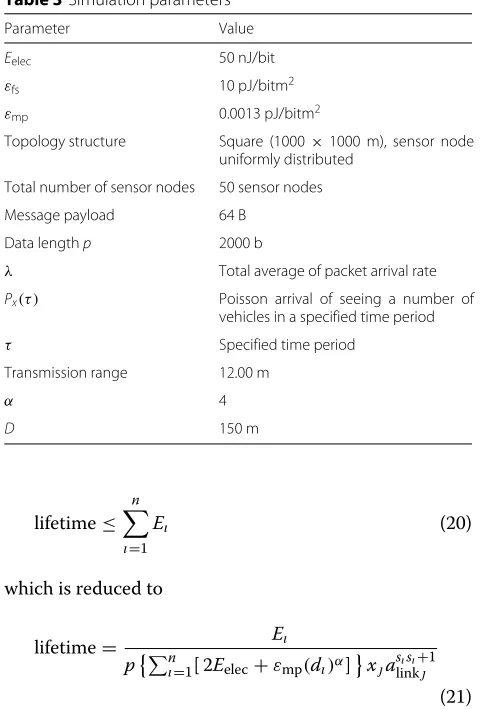
Table 3Simulation parameters
Parameter Value
Eelec 50 nJ/bit
εfs 10 pJ/bitm2
εmp 0.0013 pJ/bitm2
Topology structure Square (1000×1000 m), sensor node uniformly distributed
Total number of sensor nodes 50 sensor nodes Message payload 64 B
Data lengthp 2000 b
λ Total average of packet arrival rate Px(τ ) Poisson arrival of seeing a number of
vehicles in a specified time period
τ Specified time period
The total number of events that can be detected by the network is given by
Therefore, the lifetime of a network is expressed as
T(n)= P(n)
M (23)
whereMis the average number of events occurring per unit of time.
The node density control algorithm, on other hand, defines lifetime reporting as a non-cumulative function that depends on the total number of events detected by a network composed of n nodes. The node density explores the relationship between energy efficiency and the number of nodes. These nodes are dense nodes that are uniformly deployed to optimize the lifetime.
The node lifetime fornnodes and the average number of detected events per unit time in a given network can be expressed as
where Energyıis the amount of energy required to report the event from the source node along the multiple hops to the sink node calculated by Eq. 2,tı is the energy con-sumed to sense the event, andMis the average number of events detected during a day [28]. A total ofnnodes are deployed along a highway to monitor the traffic vehicles captured in the camera’s FoV. Processing is performed for a motion differentiating between consecutive frames. The location of the vehicle is defined as a complete trajectory of the vehicle centroid moving in the FoV. The duration of the detection is the time interval that a vehicle spends in the camera’s FoV [33]. A vehicle is detected when no cen-troid is overlooked during the event duration; otherwise, the event is overlooked [44].
The focus of the simulation is to evaluate various energy consumption optimization algorithms in [26, 27] by adjusting the number of hops from the source to the sink. For a given optimal number of hops, the optimal energy in the sensor network is obtained by jointly con-sidering the data rate and transmit power. Since nodes in the network are deployed among different partitioning selected paths, therefore, the node lifetime is propor-tional to the initial energy spent to detect the event at each node in a unit of time. The lifetime decreases as the time to detect the vehicles is prolonged because of the inefficiency of the regular deployment of nodes. This deployment is performed to monitor the events and to route the report of the occurring events. The proposed algorithm designs an efficient regular partitioning topol-ogy by performing link measurements when the nodes are awake for event transmission or reception with minimal extra energy expenditure.
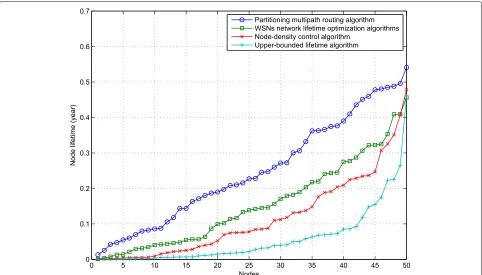
Fig. 12Partitioning multipath routing comparison among three well-known algorithms: upper-bounded lifetime, node-density control, and WSNs optimization algorithms
and decoding operation which means the higher quality video is achieved at the cost of network lifetime.
Finally, our proposed algorithm as revealed in Fig. 13 has consistently higher energy efficiency than the node density control for maximizing the node lifetime [24], the upper-bound lifetime algorithms [25], and WSNs optimization of network lifetime algorithms [26, 27] which perform at approximately 46.91, 73.00, and 80.00%, respectively. Generally, this percentage for all these algo-rithms clarifies Definition 1 which considers the amount of lifetime spent on the duty each sensor node per month and takes the same amount of lifetime for each week. The percentage of the node lifetime that this sensor node’s duty represents is calculated by dividing the number of hours spent per week or per day on the duty by number of hours.
Figure 13 shows the energy efficiency of the WSN when the optimization problem by is solved for energy con-sumption. The lifetime of the sensor node increases when the packet travels along a number of partition routes esti-mated with an efficient link quality that connects the sensor nodes in the network domain. This increasing life-time demonstrates that each sensor node unaligned on the partition route enters a sleep state once because of the lack of ongoing transmission; by contrast, each sensor node aligned on the partition mode enters a wake-up state.
It is important to address the average cost of rout-ing algorithm in order to understand its computational complexity. The cost of routing algorithm depends on searching the optimal selected path from the source to the sink. Usually, this depends on the number of effective fitness functions required to evaluate the objective func-tions in Eqs. 11 and 14 in terms of power consumption and delay, respectively, which encompass to the desired search space of the optimization problem. The percent-age of complexity is defined as the optimal value of μ required to obtain the optimal selected partitioning path as referred to in (Eqs. 11 and 14) withZd = Z. The
aver-age value of(Zd∗∗100)divided by the average value of Z(Eq. 11), whereZd∗denotes the number of actual lower
and upper bounds obtained from the determination of cut-off [54, 55].
Figure 14 compares the lifetimes of different partition-ing intermediate nodes with the spartition-ingle-source scenario in the network shown in Fig. 15. The network lifetime is defined as
Eeff(n)=
n
ı=1Energyı
pM (25)
Fig. 13Maximum lifetime under integer optimization (1) upper-bounded lifetime, (2) node-density control, (3) WSNs optimization algorithms, (4) partitioning multipath approach
detecting eventMin a unit of time multiplied by the num-ber of partitioning intermediate nodes denoted asp. This effect is understandable due to the increasing number of partitioning intermediate nodes. In other words, the more nodes involved to detect the event, the more energy is consumed in a unit of time, thus, decreasing the node lifetime.
Figure 16 illustrates the network lifetime for the case of multiple-source scenario depicted in Fig. 17 with the same assumptions as those of the single-source scenario. The only difference is that continuous events are detected by multiple sources and transmitted to the partition-ing intermediate nodes. This assumption makes is easier to illustrate the performance of the proposed algorithm.
Fig. 15The network topology with single-source node scenario
Practically, the network lifetime resulting from the pro-posed algorithm is longer than that in the single-source scenario.
This can be attributed to the fact that the network life-time is proportional to the ratioPpM(n). With the same num-ber of partitioning nodes, the network lifetime decreases when more than one source detects the event as seen in Fig. 16. Therefore, more nodes need to be involved for event detection, and more energy is consumed by the
network in a unit of time. Hence, the lifetime decreases when the number of sources increases. Similar to the single-source scenario in Fig. 15, the lifetime decreases when the number of initially partitioning nodes in the network increases. The proportionality of the network lifetime (Eq. 25) reasonably justifies this explanation. Therefore, our asymptotic analysis has been clarified based on Theorem 2 and Theorem 3 which state that for a fixed network density, network lifetime decreases in
Fig. 17Node lifetime for multi-source nodes scenario
the order ofP(1n)as the number of initially partition-ing deployed nodesnwhich aligned in select partitioning path. This analysis also shows that the network lifetime for multi-source nodes scenario is shorter than the case of single-source scenario by a certain factor, i.e., energy con-sumption depends on the hop distance that the data has been transmitted which supports our definition of net-work lifetime for both scenarios. More precisely, Fig. 14 for single-source scenario illustrates a better performance of the proposed routing protocol than multi-source sce-nario. Unfortunately, it seems that most existing multipath routing protocols are inherently ill-suited to perfom effi-ciently with multi-sources scenarios where the data needs to report to the sink as shown in Fig. 16. Indeed, to achieve multihop communication with the multi-sources scenario, more multipath routing have been constructed and selected independently (e.g., by flooding a control message from each source node and having each node remember the reverse selected paths to the sink) for data routing. However, by reducing the number of paths exploited, the amount of redundant information flowing in the network decreases and less nodes are involved in routing the messages. This increases the network life-time and reduces the contention on wireless medium and packet collision which ultimately increases the reliability of multipath routing.
4 Discussion
Multipath routing in WSNs provides efficient strategies to increase the bandwidth, improving the load balanc-ing, reliability, and fault-tolerance. It also provides path
resilience. The generation of multiple paths is com-pared between the single-source as shown in Fig. 15 and multiple-source scenarios as seen in Fig. 16. The trans-mission along multiple paths from multiple sources may interfere with the transmission along another path even when the discovered paths are node-disjoint. Therefore, the interference may limit the achievable network perfor-mance and lead to multiple paths, affecting data packet transmission. The multiple-source scenario is usually referred to as route coupling [56]. In other words, multiple paths are located physically close enough to interfere with each other during selection and data transmission. How-ever, the route coupling caused by interference among multiple paths may affect the performance of multipath routing protocols. It may even lead to worse results as depicted in Fig. 17 than routing over the single-source scenario shown in Fig. 14.
selection along the selected path does not interfere with each other. In most cases, this situation is difficult to achieve.
5 Conclusions
Lifetime maximization is considered a key challenge for energy-constrained WSNs. In this paper, we propose a mathematical model for an energy-constrained routing algorithm. The proposed routing is based on the determi-nation of cut-off for the optimal number of hops to par-tition the path from the source to the sink. We presented a LR method to maximize lifetime by defining critical parameters to control the adaptive hop-by-hop switching. Our results significantly improve the lifetime compared with the three well-known algorithms. The first com-parison was done with node density control algorithm, and our proposed algorithm has improved the lifetime by 46.91%. The second algorithm was the upper bounds of the lifetime protocol, and our algorithm has improved lifetime by 73.00 and 80.00% for WSNs optimization of network lifetime algorithms.
Author details
1Department of Computer Engineering, Akdeniz University, Antalya, Turkey. 2Systems Engineering Department, Donaghey College of Engineering and
Information Technology, University of Arkansas at Little Rock, Little Rock, AR, USA.
Received: 3 May 2016 Accepted: 19 December 2016
References
1. A Sutagundar, et al., Energy efficient multipath routing protocol for WMSNs. Int. J. Comput. Electr. Eng.2(3), 503–510 (2010)
2. K Nellore, G Hancke, A Survey on Urban Traffic Management System Using Wireless Sensor Networks. Sensors.16(2), 157 (2016)
3. HD Ma, Internet of things: Objectives and scientific challenges. J. Comput. Sci. Technol.26, 919–924 (2011)
4. A Ahmad, et al., Data Transmission Scheme Using Mobile Sink in Static Wireless Sensor Network. J. Sensors.8(2015). doi:10.1155/2015/279304 5. L Filipe, F Fdez-Riverola, N Costa, Ant #243, Pereira N, Wireless Body Area
Networks for healthcare applications: protocol stack review. Int. J. Distrib. Sen. Netw.2015, 1–1 (2015)
6. Z Chen, et al., Model-Checking Driven Design of QoS-Based Routing Protocol for Wireless Sensor Networks. J. Sensors.2015, 7 (2015). doi:10.1155/2015/716561
7. M McGrath, C Scanaill. Sensor technologies: healthcare, wellness, and environmental applications (Apress, New York, 2013). ISBN 978-1-4302-6014-12013
8. I Dietrich, F Dressler, On the lifetime of wireless sensor networks. ACM Trans. Sen. Netw.5, 1–39 (2009)
9. K Akkaya, M Younis, A survey on routing protocols for wireless sensor networks. Ad Hoc Netw.3, 325–349 (2005)
10. IF Akyildiz, IH Kasimoglu, Wireless sensor and actor? networks: research challenges. Ad Hoc Netw.2, 351–367 (2004)
11. J Yang, Design and implementation of large-scale wireless sensor networks for environmental monitoring applications (2010). University of North Texas, Denton, Texas, UNT Digital Library. http://digital.library.unt. edu/ark:/67531/metadc28493/
12. Y Chen, Q Zhao, On the lifetime of wireless sensor networks. IEEE Commun. Lett.9(11), 976–978 (2005)
13. P Gopi, Multipath routing in wireless sensor networks: a survey and analysis. IOSR Journal of Computer Engineering.16(4), 27–34 (2014)
14. HM Xin, K Yang, Routing Protocols Analysis for Internet of Things. 2nd International Conference on Information Science and Control Engineering (ICISCE), 447–450 (2015)
15. S Aswale, VR Ghorpade, Survey of QoS Routing Protocols in Wireless Multimedia Sensor Networks. J. Comput. Netw. Commun.2015, 29 (2015) 16. Y Ming Lu, VWS Wong, inIEEE 64th Proc. Vehicular Technology Conference,
VTC-2006 Fall. An Energy-Efficient Multipath Routing Protocol for Wireless Sensor Networks, (2006), pp. 1–5
17. A Jayashree, et al., Review of Multipath Routing Protocols in Wireless Multimedia Sensor Network-A Survey. Int. J. Sci. Stat. Eng. Res. Vohmm.
3, 1–9 (2012)
18. I Nikseresht, H Yousefi, A Movaghar, M Khansari, inProc. 32nd International Conference on Distributed Computing Systems Workshops (ICDCSW), 2012. Interference-aware multipath routing for video delivery in wireless multimedia sensor networks (IEEE, 2012), pp. 216–221
19. RC Shah, J Rabaey, inProc. Wireless Communications and Networking Conference, 2002. WCNC2002. 2002. Energy aware routing for low energy ad hoc sensor networks, vol. 351 (IEEE, 2002), pp. 350–355
20. A Nasipuri, SR Das, inProc.Eight International Conference on Computer Communications and Networks. On-demand multipath routing for mobile ad hoc networks, (1999), pp. 64–70
21. D Ganesan, et al., Highly-resilient, energy-efficient multipath routing in wireless sensor networks. SIGMOBILE Mob. Comput. Commun. Rev.5(4), 11–25 (2001)
22. SG Murthy, et al., Network lifetime analytical model for node-disjoint multipath routing in wireless sensor networks. Int. J. Commun. Netw. Distrib. Syst.10(2), 163–175 (2013)
23. M Xie, Y Gu, inProc.International Conference on Communications and Mobile Computing (CMC), 2010 IEEE. Multipath routing algorithm for wireless multimedia sensor networks within expected network lifetime, (2010), pp. 284–287
24. M Esseghir, N Bouabdallah, Node density control for maximizing wireless sensor network lifetime. Int. J. Netw. Manag.18(2), 159–170 (2008) 25. M Bhardwaj, T Garnett, AP Chandrakasan, inProc. IEEE International Conference on Communications, 2001. ICC 2001. Upper bounds on the lifetime of sensor networks, vol. 783, (2001), pp. 785–790
26. J Zou, C Tan, R Zhang, H Xiong, Modeling and optimization of network lifetime in wireless video sensor networks. IEEE Int. Conf. Commun. (ICC)., 1–6 (2010)
27. B Peng, J Zou, C Tan, M Wang, inCommunication Conference in Wireless Mobile and Computing (CCWMC 2009), IET Beihang University. Network lifetime optimization in wireless video sensor networks, (Beijing, 2009), pp. 172–175
28. Y Chen, Y Yang, W Yi, inIET International Conference on Wireless Sensor Network, 2010. IET-WSN. A cooperative routing algorithm for lifetime maximization in wireless sensor networks, (2010), pp. 167–172 29. M Bhardwaj, AP Chandrakasan, inProc. IEEE INFOCOM, INSTITUTE OF
ELECTRICAL ENGINEERS INC (IEEE). Bounding the lifetime of sensor networks via optimal role assignments, (2002), pp. 1587–1596 30. TK Jain, et al., Lifetime Optimization of a Multiple Sink Wireless Sensor
Network through Energy Balancing. J. Sensors.2015, 6 (2015). doi:10.1155/2015/921250
31. FM Al-Turjman, HS Hassanein, M Ibnkahla, Towards prolonged lifetime for deployed WSNs in outdoor environment monitoring. Ad Hoc Netw.24, 172–185 (2015)
32. HA Taha,Integer programming: theory, applications, and computations. (Academic Press New York, INC, 111 Fifth Avenue, New York 10003, 1975) 33. ZH Mohammed, Optimized Multipath Quality of Services Routing
Protocol Using Partitioning Approach For Wireless Sensor Networks. Ph.D. thesis, Universiti Sains Malaysia (2014)
34. I Bhakta, et al., A DiffServ Architecture for QoS-Aware Routing for Delay-Sensitive and Best-Effort Services in IEEE 802.16 Mesh Networks. J. Comput. Netw. Commun.2011, 13 (2011)
35. JYK Chow, IB Tapadar,Resource allocation in wireless networks, Series Resource allocation in wireless networks. (feds, ed.), (2004). Google Patents No. 6,748,220
36. MZ Hasan, T-C Wan, Optimized Quality of Service for Real-Time Wireless Sensor Networks Using a Partitioning Multipath Routing Approach. J. Comput. Netw. Commun.2013, 18 (2013)
38. W Qin, M Hempstead, W Yang, inProc. 3rd Annual IEEE Communications Society on Sensor and Ad Hoc Communications and Networks, SECON ’06. A Realistic Power Consumption Model for Wireless Sensor Network Devices, (2006), pp. 286–295
39. WR Heinzelman, A Chandrakasan, H Balakrishnan, inProceedings of the 33rd annual Hawaii international conference on System sciences. Energy-efficient communication protocol for wireless microsensor networks (IEEE, 2000) 40. J Wang, Y-K Lee,Determination of the Optimal Hop Number for Wireless
Sensor Networks, Book Determination of the Optimal Hop Number for Wireless Sensor Networks, Series Determination of the Optimal Hop Number for Wireless Sensor Networks, ed.(Springer-Verlag, 2009), pp. 408–418 41. S Fedor, M Collier, inProc. 21st International Conference on Advanced Information Networking and Applications Workshops, AINAW ’07. On the Problem of Energy Efficiency of Multi-Hop vs One-Hop Routing in Wireless Sensor Networks, (2007), pp. 380–385
42. F Shebli, I Dayoub, J Rouvaen, Minimizing energy consumption within wireless sensors network. Ubiquit. Comput. Commun. J. (UBICC), Special Issue on Ubiquitous Sensor Networks.2, 19–24 (2007)
43. H Zhihau, L Baochun, inReal-Time and Embedded Technology and Applications Symposium, 2004. Proceedings. RTAS 2004. 10th. On the fundamental capacity and lifetime limits of energy-constrained wireless sensor networks (IEEE, 2004), pp. 2–9
44. CT Vu,et al, inProc.Performance, Computing, and Communications Conference, 2007. IPCCC 2007. IEEE Internationa, IEEE. Composite event detection in wireless sensor networks, (2007), pp. 264–271 45. L Schrage,Optimization modeling with LINGO. LINDO Systems. (Inc,
Chicago, 1998)
46. K Sha, W Shi, Modeling the lifetime of wireless sensor networks. Sensor Lett.3(2), 126–135 (2005)
47. C Pham, A Makhoul,Performance study of multiple cover-set strategies for mission-critical video surveillance with wireless video sensors, (2010), pp. 208–216
48. M Noori, M Ardakani, Lifetime Analysis of Random Event-Driven Clustered Wireless Sensor Networks. IEEE Trans. Mob. Comput.10, 1448–1458 (2011) 49. M Mallinson, S Hussain, JH Park, Investigating Wireless Sensor Network
Lifetime Using a Realistic Radio Communication Model, International Conference on Multimedia and Ubiquitous Engineering, MUE, 433–437 (2008)
50. M Noori, M Ardakani, A Probability Model for Lifetime of Wireless Sensor Networks. Informal publication.abs/0710.0020(2007). http://arXiv.org/ abs/0710.0020v1/
51. R Soua, P Minet, “A survey on energy efficient techniques in wireless sensor networks,” in Wireless and Mobile Networking Conference (WMNC), 2011 4th Joint IFIP, 1-9 (2011)
52. Q Wang,Traffic analysis, (2010) modeling and their applications in energy-constrained wireless sensor networks, PhD thesis, (Mid Sweden University
53. P Zhang, I Nevat, GW Peters, G Xiao, HP Tan, Event Detection in Wireless Sensor Networks in Random Spatial Sensors Deployments. IEEE Trans. Signal Process.63, 6122–6135 (2015)
54. ML Fisher, The Lagrangian Relaxation Method for Solving Integer Programming Problems. Manag. Sci.50, 1861–1871 (2004)
55. R Forsati, AT Haghighat, M Mahdavi, Harmony search based algorithms for bandwidth-delay-constrained least-cost multicast routing. Comput. Commun.31, 2505–2519 (2008)
56. AA Anasane, RA Satao, A Survey on Various Multipath Routing Protocols
in Wireless Sensor Networks. Procedia Comput. Sci.79, 610–615 (2016)
Submit your manuscript to a
journal and benefi t from:
7Convenient online submission
7Rigorous peer review
7Immediate publication on acceptance
7Open access: articles freely available online
7High visibility within the fi eld
7Retaining the copyright to your article