University of South Carolina
Scholar Commons
Theses and Dissertations
1-1-2013
Diffusion of CSR in Global Business Networks: An
Embeddedness Perspective
Valentina Marano
University of South Carolina
Follow this and additional works at:https://scholarcommons.sc.edu/etd
Part of theBusiness Administration, Management, and Operations Commons
This Open Access Dissertation is brought to you by Scholar Commons. It has been accepted for inclusion in Theses and Dissertations by an authorized administrator of Scholar Commons. For more information, please [email protected].
Recommended Citation
Marano, V.(2013).Diffusion of CSR in Global Business Networks: An Embeddedness Perspective.(Doctoral dissertation). Retrieved from
DIFFUSION OF CSR IN GLOBAL BUSINESS NETWORKS:
AN EMBEDDEDNESS PERSPECTIVE
by
Valentina Marano
Bachelor of Arts
Università degli Studi di Roma Tre, 2003
Master of Arts
The George Washington University, 2006
Submitted in Partial Fulfillment of the Requirements
For the Degree of Doctor of Philosophy in
Business Administration
The Darla Moore School of Business
University of South Carolina
2013
Accepted by:
Tatiana Kostova, Committee Chair
Kendall Roth, Committee Member
Andrew Spicer, Committee Member
Satish Jayachandran, Committee Member
ii
iii
ACKNOWLEDGEMENTS
There are several people whose encouragement and guidance have allowed me to bring
this work to completion. To them all, I extend my deepest appreciation for helping me
achieve this important milestone.
My family has played an essential role throughout this long journey. My father Antonio,
my mother Stefania and my sister Gaia inspire me every day to do my best to conquer my
dreams. They are my best friends and fill my life with endless love, optimism and joy.
My extended American family, Jackie, Len and Nancy provided steadfast
encouragement: I am very lucky to have them in my life. Pete, my husband and one true
love, has been my constant friend and supporter. He has spent countless hours helping me
develop this work, discussing ideas, and solving problems. He has comforted me in times
of distress, brought a smile to my face when I most needed it, and always loved me
without reservation. I cannot wait for the rest of our life together.
My advisor, Tatiana Kostova, has infused this research with her outstanding scholarship,
and allowed me to find my own voice as a researcher. Now I can look back at how my
professional relationship with Tatiana has transformed me from a student to a scholar,
iv
Hildy Teegen and David Adoff have been unwavering friends throughout the Ph.D.
program. Had I not met Hildy about eight years ago, I would have not had the privilege
of becoming her friend, embarking on this academic adventure, nor would I have met the
love of my life, Pete.
I would also like to thank the member of my dissertation committee—Andrew Spicer,
Kendall Roth, and Satish Jayachandran, whose additional mentoring has been crucial in
guiding me through the program and transforming crude ideas into a potential
v
DEDICATION
vi
ABSTRACT
This dissertation examines the role of firm embeddedness in its global business
network with regards to the adoption of Corporate Social Responsibility (CSR) practices.
Global business networks refer to the nexus of inter-firm and intra-firm relationships, in
which focal actors are engaged. These networks are focal firm specific, span multiple
countries and involve different types of economic relationships between the focal actor
and its business partners. This study argues that global business networks affect a focal
organization’s CSR adoption decisions, since they provide access to resources and
information and also channel CSR-related institutional influences from the various
countries where the focal firm’s business partners are located.
The firm is exposed to a multiplicity of institutional forces concerning CSR
because of its ties to business partners located in countries with varying CSR institutional
requirements. Therefore, how should the firm prioritize these influences? In order to
answer this question, this dissertation considers two aspects of the environment in which
the firm operates, namely its institutional and its economic embeddedness in the global
business network. In the context of this study, institutional embeddedness refers to the
CSR-related norms rules, beliefs and the uniformity (or lack thereof) of these. Economic
vii
through a network and determine the degree of dependence of the focal firm on a specific
business partner. A firm’s institutional and economic embeddedness are considered
jointly because economic ties channel the institutional forces that are present within the
global business networks. Based on their strength and nature they also contribute to
shaping the intensity with which these forces are experienced by the focal actors.
Therefore, an actor’s economic and institutional embeddedness represent the building
blocks of the main constructs of interest of this study. These capture the strength of the
institutional requirements concerning CSR within the global business network, their
heterogeneity, and whether the firm operates in contexts with more stringent
requirements for CSR than those of its home country. Results indicate that these factors
are all important drivers of a firm’s decision to adopt CSR practices. They also show that
a focal firm’s foreign direct investment- (FDI-) based relationships are more effective
channels for the diffusion of institutional influences than trade-based relationships.
This dissertation makes several theoretical contributions. First, it contributes to
the international business research area by expanding the conceptualization of the global
space where MNCs operate. This has traditionally been analyzed in terms of its intra-firm
network (Ghoshal & Bartlett, 1990). This work extends the conceptualization of this
space to also include the organization’s inter-firm ties. It also contributes to the emergent
interest among international business scholars for considering both the “constraining” and
“enabling” effects of institutional forces (e.g., Kostova, Roth & Dacin, 2008;
Saka-Helmhout & Geppert, 2011). In addition, the dissertation contributes to organizational
theory by narrowing the existing gap between institutional and network perspectives
viii
for the diffusion of institutional practices (Owen-Smith & Powell, 2008). The second
contribution to organizational theory focuses on the embeddedness research area, by
answering recent calls to focus not only on the structure of network ties, but also on their
content, which are here explored in terms of the firm’s institutional and economic
embeddedness. This work also provides a nuanced investigation of the firm’s
embeddedness, by measuring and modeling the intensity and types of economic
exchanges between the focal firm and its business partners as constitutive elements of the
intensity with which the focal actor perceives these institutional influences that emerge
from the global business network. This dissertation also contributes to CSR research by
expanding the analytical focus in order to make sense of the firm’s CSR adoption
decisions beyond the traditional firm and national boundaries and to also consider the
complex composite of institutional forces that emerge from firm’s embeddedness in the
global business network.
To conduct the study, longitudinal data was collected from a diverse range of
sources. The sampling history extends from 2007 to 2011, and the number of sampled
corporations is 710. The sample in this study consists of publicly traded U.S. firms listed
on the Russell 3000 index, which includes the largest U.S. multinationals in terms of
market capitalization, with matching information from the Kinder, Lydenberg and
Domani (KLD), Port Import Export Report Service (PIERS), Corporate Affiliations and
ix
TABLE OF CONTENTS
ACKNOWLEDGMENTS ... iii
DEDICATION ... v
ABSTRACT ... vi
LIST OF TABLES ... xii
LIST OF FIGURES ... xv
CHAPTER 1: INTRODUCTION ………... 1
1.1 RESEARCH QUESTION …………... 2
1.2 RESEARCH FRAMEWORK …………... 4
1.3 CONTRIBUTIONS TO THEORY ... 7
1.4 MANAGERIAL IMPLICATIONS ... 8
1.5 ORGANIZATION OF THE DISSERTATION ... 9
CHAPTER 2: LITERATURE REVIEW... 10
2.1 CSR IN GLOBAL BUSINESS NETWORKS …... 11
2.2 DIFFUSION RESEARCH …………... 15
2.3 FIRM EMBEDDEDNESS ……….…………... 23
2.4 THE STUDY OF PRACTICE DIFFUSION IN INTERNATIONAL BUSINESS (IB) ……. 29
x
3.1 THEORETICAL BACKGROUND ... 36
3.2 GLOBAL BUSINESS NETWORKS …... 41
3.3 HYPOTHESES DEVELOPMENT …... 49
CHAPTER 4: RESEARCH DESIGN AND METHODOLOGY ... 61
4.1 SAMPLE …... 61
4.2 DATA SOURCES …... 63
4.3 MEASURES …... 65
4.3.1 DEPENDENT VARIABLE ……….………... 69
4.3.2 INDEPENDENT VARIABLES ……….…………... 75
4.4 METHOD OF ANALYSIS ……..………... 82
4.5 ALTERNATIVE MODEL SPECIFICATION ………..…... 89
CHAPTER 5: RESULTS …... 91
5.1 MAIN RESULTS ………..…….…... 91
5.2 ROBUSTNESS TESTS USING ALTERNATIVE MODEL SPECIFICATION …... 108
5.3 ROBUSTNESS TESTS USING ALTERNATIVE SPECIFICATION OF THE DEPENDENT VARIABLE ……... 121
CHAPTER 6: DISCUSSION AND CONCLUSION ... 139
6.1 SUMMARY ………...…... 139
6.2 IMPLICATIONS FOR RESEARCH ………... 144
6.3 IMPLICATIONS FOR PRACTICE ………... 148
6.4 LIMITATIONS AND FUTURE RESEARCH …... 151
6.5 NEXT STEPS ……….……... 152
REFERENCES ………...……..…... 155
xi
APPENDIX B – VALIDITY AND RELIABILITY TESTS BASED ON DIAMANTOPOULOS & WINKLHOFER (2001) ……...………...……..…... 189
APPENDIX C – LIST OF KLD SOCRATES RATINGS IN 2011…………..………... 194
APPENDIX D – LIST OF INDICATORS INCLUDED IN THE RESPONSIBLE COMPETITIVENESS INDEX & COUNTRY RANKINGS …...………..………... 203
APPENDIX E – ALTERNATIVE MODEL SPECIFICATION ………..………... 206
APPENDIX F – ADDITIONAL ROBUSTNESS TESTS WITH ALTERNATIVE SPECIFICATIONS OF THE DEPENDENT VARIABLE ………..………... 209
A.F.1 RESULTS ………...………..…... 210
A.F.2 DISCUSSION OF ADDITIONAL ROBUSTNESS TESTS RESULTS ..…………... 238
xii
LIST OF TABLES
Table 3.1 Typology of global business networks, based on the cases of General Mills,
FMC, Applied Materials and Acuity Brands ………..………...………... 45
Table 4.1 Definitions and Sample Breakdown by Industry …... 63
Table 4.2 Variables, Measures, and Sources of Data ... 66
Table 4.3 Top 5% Adopters of CSR Practices in 2011... 73
Table 4.4 Bottom 5% Adopters of CSR Practices in 2011... 74
Table 5.1 Descriptive Statistics and Correlations ... 92
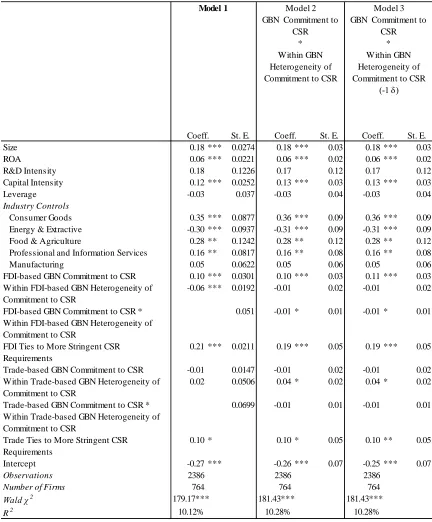
Table 5.2 OLS Regression with Huber-White Estimators (Hypotheses 1, 2a-b, and 3)....93
Table 5.3 Summary of Results from Models 2-9 using OLS Regression with Huber-White Estimators (Hypotheses 2a-b) ... 99
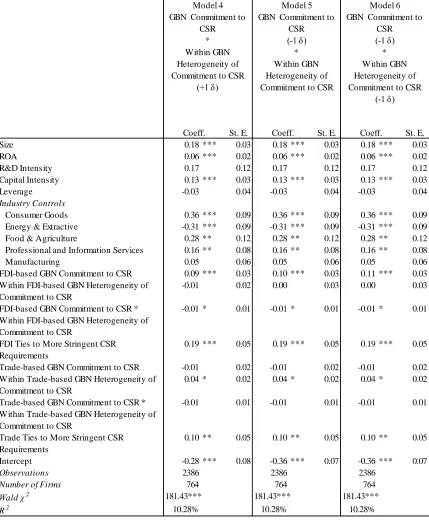
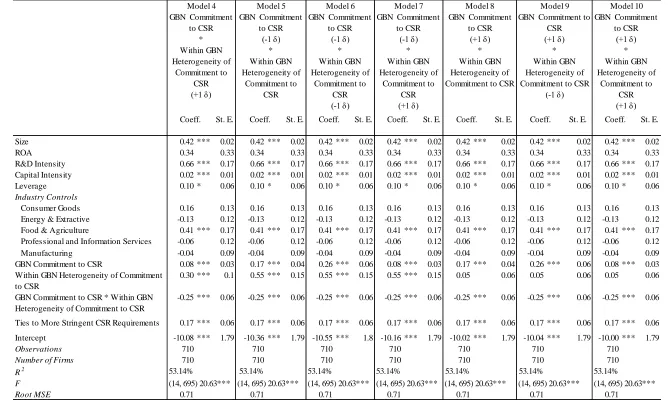
Table 5.4 OLS Regression with Huber-White Estimators (Hypotheses 4a, b, c, and d)………. 100
Table 5.5 Summary of Results from Models 2-9 using OLS Regression with Huber-White Estimators (Hypotheses 4b-c) ... 108
Table 5.6 Panel-Corrected Standard Error Regression with Panel-Specific Corrections for Autocorrelation and Heteroscedasticity (Hypotheses 1, 2a-b, and 3) …... 110
Table 5.7 Summary of Results from Models 2-9 using Panel-Corrected Standard Error Regression with Panel-Specific Corrections for Autocorrelation and Heteroscedasticity (Hypotheses 2a and b) ………... 112
Table 5.8 Panel-Corrected Standard Error Regression with Panel-Specific Corrections for Autocorrelation and Heteroscedasticity (Hypotheses 4a, b, c and d) …... 114
xiii
Table 5.10 OLS Regression with Huber-White Estimators and Alternative Specification of the Dependent Variable (Adoption of CSR Practices = Sum of All the Strength Components of Each KLD Category; Hypotheses 1, 2a-b, and 3) ... 124
Table 5.11 Summary of Results from Models 2-9 Using OLS Regression with Huber-White Estimators and First Alternative Specification of the Dependent Variable (Hypotheses 2a-b) …... 126
Table 5.12 OLS Regression with Huber-White Estimators and Alternative Specification of the Dependent Variable (Adoption of CSR Practices = Sum of All the Strength Components of Each KLD Category; Hypotheses 4a, b, c and d) ... 128
Table 5.13 Summary of Results from Models 2-9 Using OLS Regression with Huber-White Estimators and First Alternative Specification of the Dependent Variable (Hypotheses 4b and c) ... 136
Table 5.14 Summary of Main and Robustness Tests Results... 137
Table D.1 Areas and Indicators included in the Responsible Competitiveness Index (RCI) ... 203
Table D.2 The Responsible Competitiveness Index (RCI) country ranking ... 205
Table F.1 OLS Regression with Huber-White Estimators and Alternative Specification of the Dependent Variable (Adoption of Corporate Governance-Related CSR Practices; Hypotheses 1, 2a-b, and 3) ……….…… 211
Table F.2 Summary of Results from Models 2-9 Using OLS Regression with Huber-White Estimators and Adoption of Corporate Governance-Related CSR Practices as the Dependent Variable (Hypotheses 2a and b) ... 213
Table F.3 OLS Regression with Huber-White Estimators and Alternative Specification of the Dependent Variable (Adoption of Community-Related CSR Practices; Hypotheses 1, 2a-b, and 3) ... 216
Table F.4 Summary of Results from Models 2-9 Using OLS Regression with Huber-White Estimators and Adoption of Community-Related CSR Practices as the Dependent Variable (Hypotheses 2a-b) ... 218
xiv
Table F.6 Summary of Results from Models 2-9 Using OLS Regression with Huber-White Estimators and Adoption of Diversity-Related CSR Practices as the Dependent Variable (Hypotheses 2a and b) ... 222
Table F.7 OLS Regression with Huber-White Estimators and Alternative Specification of the Dependent Variable (Adoption of Employee-Related CSR Practices; Hypotheses 1, 2a-b, and 3) ... 225
Table F.8 Summary of Results from Models 2-9 using OLS regression with Huber-White estimators and Adoption of Employee-Related CSR Practices as the Dependent Variable (Hypotheses 2a and b) ... 227
Table F.9 OLS Regression with Huber-White Estimators and Alternative Specification of the Dependent Variable (Adoption of Environment-related CSR Practices; Hypotheses 1, 2a-b, and 3) ... 230
Table F.10 OLS Regression with Huber-White Estimators and Alternative Specification of the Dependent Variable (Adoption of Human Rights-Related CSR Practices; Hypotheses 1, 2a-b, and 3) ... 232
Table F.11 Summary of results from Models 2-9 Using OLS Regression with Huber-White Estimators and Adoption of Human Rights-Related CSR Practices as the Dependent Variable (Hypotheses 2a and b) ……... 234
Table F.12 OLS Regression with Huber-White Estimators and Alternative Specification of the Dependent Variable (Adoption of Product Quality-Related CSR Practices; Hypotheses 1, 2a-b, and 3) ... 237
Table F.13 Summary of Robustness Tests Results Using Individual Components of the Main Dependent Variable of Interest ... 238
Table G.1 OLS Regression with Huber-White Estimators and Adoption of CSiR Practices as the Dependent Variable (= Sum of all the Weaknesses Components of Each KLD Category) ... 243
xv
LIST OF FIGURES
Figure 3.1 Example of a Company Global Business Network ... 38
Figure 3.2 General Mills’ Global Business Network, 2010 ... 46
Figure 3.3 FMC’s Global Business Network, 2010 ... 47
Figure 3.4 Applied Materials’ Global Business Network, 2010 ... 48
Figure 3.5 Acuity Brands’ Global Business Network, 2010 ... 49
Figure 3.6 Summary of Hypotheses ... 52
Figure 3.7 Measurement approach to global business network commitment to CSR for a hypothetical focal firm………... 76
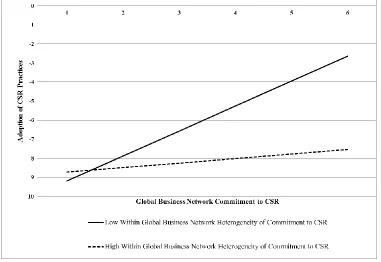
Figure 5.1 Interaction plot for the moderating effect of within global business network heterogeneity of commitment to CSR on the relationship between global business network commitment to CSR and firm’s adoption of CSR-related practices, using OLS regression with Huber-White estimators (Hypothesis 2a) …... 96
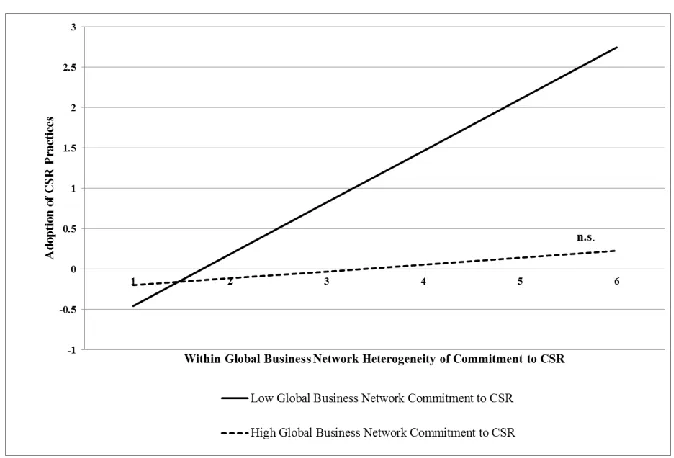
Figure 5.2 Interaction plot for the moderating effect of global business network commitment to CSR on the relation between within global business network heterogeneity of commitment to CSR and firm’s adoption of CSR-related practices, using OLS regression with Huber-White estimators (Hypothesis 2b) …... 98
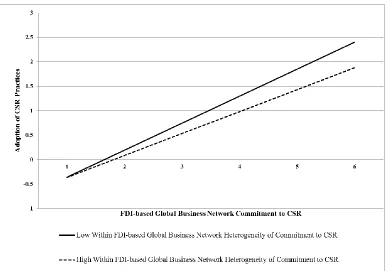
Figure 5.3 Interaction plot for the moderating effect of within FDI-based global business network heterogeneity of commitment to CSR on the relationship between FDI-based global business network commitment to CSR and firm’s adoption of CSR-related practices, using OLS regression with Huber-White estimators (Hypothesis 4b) ... 105
Figure 5.4 Interaction plot for the moderating effect of FDI-based global business network commitment to CSR on the relation between within FDI-based global business network heterogeneity of commitment to CSR and firm’s adoption of CSR-related practices, using OLS regression with Huber-White estimators (Hypothesis 4c) ... 107
xvi
network commitment to CSR and firm’s adoption of CSR-related practices, using
panel-corrected regression (Hypothesis 2a) ………... 113
Figure 5.6 Interaction plot for the moderating effect of global business network commitment to CSR on the relation between within global business network heterogeneity of commitment to CSR and firm’s adoption of CSR-related practices, using panel-corrected regression (Hypothesis 2b) ………... 113
Figure 5.7 Interaction plot for the moderating effect of within FDI-based global business network heterogeneity of commitment to CSR on the relationship between FDI-based global business network commitment to CSR and firm’s adoption of CSR-related practices, using panel-corrected standard error regression (Hypothesis 4b) ……... 119
Figure 5.8 Interaction plot for the moderating effect of within global business network heterogeneity of commitment to CSR on the relationship between global business network commitment to CSR and firm’s adoption of CSR-related practices, using OLS regression with Huber-White estimators and alternative specification of the dependent variable (Hypothesis 2a) ... 126
Figure 5.9 Interaction plot for the moderating effect of global business network commitment to CSR on the relation between within global business network heterogeneity of commitment to CSR and firm’s adoption of CSR-related practices, using OLS regression with Huber-White estimators and alternative specification of the dependent variable (Hypothesis 2b) ... 127
Figure 5.10 Interaction plot for the moderating effect of within FDI-based global business network heterogeneity of commitment to CSR on the relationship between FDI-based global business network commitment to CSR and firm’s adoption of CSR-related practices, using OLS regression with Huber-White estimators and alternative specification of the dependent variable (Adoption of CSR practices = Sum of all the strength components of each KLD category; Hypothesis 4b) ... 133
Figure 5.11 Interaction plot for the moderating effect of FDI-based global business network commitment to CSR on the relation between within FDI-based global business network heterogeneity of commitment to CSR and firm’s adoption of CSR-related practices, using OLS regression with Huber-White estimators and alternative specification of the dependent variable (Adoption of CSR practices = Sum of all the strength components of each KLD category; Hypothesis 4c) ... 135
Figure A.1 General Mills’ Global Business Network, 2007 ... 180
Figure A.2 General Mills’ Global Business Network, 2008 ... 181
Figure A.3 General Mills’ Global Business Network, 2009 ... 181
xvii
Figure A.5 FMC’s Global Business Network, 2007 ... 182
Figure A.6 FMC’s Global Business Network, 2008 ... 183
Figure A.7 FMC’s Global Business Network, 2009 ... 183
Figure A.8 FMC’s Global Business Network, 2010 ... 184
Figures A.9 Applied Materials’ global business network, 2007... 184
Figure A.10 Applied Materials’ global business network, 2008 ...185
Figure A.11 Applied Materials’ Global Business Network, 2009 ... 185
Figure A.12 Applied Materials’ Global Business Network, 2010 ... 186
Figure A.13 Acuity Brands’ Global Business Network, 2007 ... 186
Figure A.14 Acuity Brands’ Global Business Network, 2008 ... 187
Figure A.15 Acuity Brands’ global Business Network, 2009 ... 187
Figure A.16 Acuity Brands’ Global Business Network, 2010 ... 188
Figure F.1 Interaction plot for the moderating effect of within global business network heterogeneity of commitment to CSR on the relationship between global business network commitment to CSR and firm’s adoption of Corporate Governance-related CSR practices, using OLS regression with Huber-White estimators (Hypothesis 2a) ... 213
Figure F.2 Interaction plot for the moderating effect of global business network commitment to CSR on the relation between within global business network heterogeneity of commitment to CSR and firm’s adoption of Corporate Governance-related CSR practices, using OLS regression with Huber-White estimators (Hypothesis 2b)... 214
Figure F.3 Interaction plot for the moderating effect of within global business network heterogeneity of commitment to CSR on the relationship between global business network commitment to CSR and firm’s adoption of Community-related CSR practices, using OLS regression with Huber-White estimators (Hypothesis 2a) ...218
xviii
Figure F.5 Interaction plot for the moderating effect of within global business network heterogeneity of commitment to CSR on the relationship between global business network commitment to CSR and firm’s adoption of Diversity-related CSR practices, using OLS regression with Huber-White estimators (Hypothesis 2a) ... 229
Figure F.6 Interaction plot for the moderating effect of global business network commitment to CSR on the relation between within global business network heterogeneity of commitment to CSR and firm’s adoption of Diversity-related CSR practices, using OLS regression with Huber-White estimators (Hypothesis 2b) ... 223
Figure F.7 Interaction plot for the moderating effect of within global business network heterogeneity of commitment to CSR on the relationship between global business network commitment to CSR and firm’s adoption of Employee-related CSR practices, using OLS regression with Huber-White estimators (Hypothesis 2a) ... 228
Figure F.8 Interaction plot for the moderating effect of global business network commitment to CSR on the relation between within global business network heterogeneity of commitment to CSR and firm’s adoption of Employee-related CSR practices, using OLS regression with Huber-White estimators (Hypothesis 2b) ... 228
Figure F.9 Interaction plot for the moderating effect of within global business network heterogeneity of commitment to CSR on the relationship between global business network commitment to CSR and firm’s adoption of Human Rights-related CSR practices, using OLS regression with Huber-White estimators (Hypothesis 2a) ... 235
1
CHAPTER 1
INTRODUCTION
Increasingly, business organizations whether domestic companies or multinational
corporations (MNCs), are expected to demonstrate social responsibility, transparency,
and accountability in their operations to their global customers and other stakeholders
(Levy & Kaplan, 2008). This trend dates back to the early 1990s (World Bank, 2002,
2003) when a number of MNCs began addressing social and environmental conditions in
their global business networks, by developing codes of conduct that stipulate social,
environmental, and ethical requirements for their suppliers (Locke & Romis, 2007). Since
then, firms’ global networks of trade- and FDI-based relationships (i.e., their global
business networks) have increasingly been regarded as important channels for stimulating
the improvement of local suppliers’ social, environmental and ethical performance (e.g.,
Locke, Amengual, & Mangla, 2009). The concept of global business network is akin to
that of “global supply chain” (Ernst & Kim, 2002) or “global production network” (Levy,
2008), and refers to a firm’s multi-country nexus of foreign direct investment- (FDI-) and
2
While there is growing anecdotal evidence of the global diffusion of CSR-related
practices in general (e.g., Levy & Kaplan, 2008), there is only limited systematic
theorizing on this process (e.g. Guler, Guillén & Muir Macpherson, 1999). Furthermore,
there is little research on the diffusion of CSR practices within a firm’s global business
network. Only a handful of studies have focused on this context. This suggests that
certain characteristics of the economic networks in which the firm operates, such as asset
specificity, trust among network participants, and presence of socially responsible lead
multinational buyers, can be critical drivers in a firms’ decision to become more socially
responsible (see Locke & Romis, 2007; McKinsey, 2006, 2008). Nonetheless, scholars
have developed incomplete understandings of the drivers and barriers to CSR adoption
that firms might face within their global business networks. The objective of this
dissertation is to add to this line of research by providing an in-depth theoretical and
empirical examination of this phenomenon.
1.1 Research question
I am particularly interested in understanding the role of firm embeddedness in its
global business network, with regards to the decision to adopt CSR practices. CSR
practices include a broad range of actions “within the firm, such as changing methods of
production to reduce environmental impact or changing labor relationships both within
the firm and across the firm’s value chain, as well as actions outside the firm, such as
making infrastructure investments in local communities or developing philanthropic
community initiatives” (Aguilera, Rupp, Williams & Ganapathi, 2007: 836). For
example, these practices can include implementing codes of conduct (Kolk & Van
3
al., 2002), such as ISO 9000 or ISO 14000 (Christmann & Taylor, 2006; Delmas, 2002),
ethical product and purchasing specifications (Starcher, 2005), stakeholder engagement
routines, and philanthropic initiatives (Galaskiewicz, 1991).
As with most organizational practices, CSR is strongly influenced by the
institutional environment in which the firm is embedded, including its regulations, social
knowledge, and social norms (Busenitz, Gomez & Spencer, 2000; Kostova & Roth,
2002). Further, countries vary in the degree to which their institutional environments
enforce or facilitate CSR actions (Williams & Aguilera, 2008). An interesting question
related to practice adoption, which has been studied in international management,
concerns how firms, and MNCs in particular, respond to the complex institutional effects
of doing business in multiple national environments (Kostova, 1999; Kostova & Zaheer,
1999). I build on this research because the global business network context is somewhat
similar to the context of the MNC. Both expose firms to influences from multiple
countries. For example, while a firm might operate in a home country whose national
laws are not favorable for CSR, its top buyer might be embedded in a CSR-oriented
environment thus not only engaging in high levels of CSR but also expecting such
behaviors from their partners. In such a scenario, the firm is exposed to differing
CSR-related logics, which makes the decision to engage in CSR less straightforward. What
mechanisms explain which pressures this firm is likely to prioritize then? How does a
firm cope with the impediments to “resolve ambiguities and conflicts of what the
situation is and what experience is relevant; … and what the appropriate match and action
are?” (March & Olsen, 2004: 7). In this dissertation I begin unpacking the nature of the
4
business network. While similar to the context of the MNC, global business networks
have one notable theoretical distinction that entities in these networks are related to their
partners through both inter- and organizational ties, rather than only
intra-organizational ties.
1.2 Research framework
In order to capture the global business network context, I develop a model of CSR
adoption under conditions of complex embeddedness, where the firm is responding to
multiple and possibly divergent influences from the various institutional contexts that
make up its global business network. I propose that an organization facing such complex
influences concerning CSR prioritizes some over others (Oliver, 1991), based on the
pattern of the relationships within the network (Greenwood, Raynard, Kodeih, Micelotta
& Lounsbury, 2011).
I explore two types of firm embeddedness: institutional and economic
embeddedness. Institutional embeddedness refers to the institutional content of a firm’s
global business network, in particular its CSR-related beliefs, norms and rules, and the
uniformity (or lack thereof) of these forces among the various institutional contexts that
make up the firm’s business network. Economic embeddedness captures the intensity of
the trade and FDI-based economic relationships in which the focal firm is engaged and
make up the global business network (Ghoshal & Bartlett, 1990). Considering both
institutional and economic embeddedness facilitates the examination of the combined
effects of the multiple institutional environments where a firm does business and the
strength of the economic relationships with its business partners. It also allows for
5
surrounds firms within their global business network (Giddens, 1976). As the multiplicity
of institutional messages concerning the importance of CSR within the firm’s global
business network increases, I find that firms become less likely to adopt CSR practices
solely because of isomorphic-related reasons, and instead become more likely to rely on
an evaluation of the pros and cons associated with adoption. I posit that the complex
embeddedness experienced by firms within their global business network stimulates their
self-reflexivity, by forcing the firm to reflect upon alternative paths of action before
choosing one (Emirbayer & Mische, 1998). This view is consistent with recent advances
in institutional theory that point to the ability of organizations to learn by inferring the
“potential efficiency benefits for themselves,” based on the combined experiences of
those actors that have previously adopted a practice (Haunschild & Chandler, 2008: 640).
I argue that constraining and enabling institutional pressures can coexist within the same
field, and that certain field-level conditions facilitate their emergence and interactive
relationship towards a firm’s adoption of CSR practices.
In brief, my model suggests that as firms embedded in global business networks
face mounting levels of institutional diversity across their various operating contexts,
they also face ambiguity concerning what represents appropriate courses of action in
terms of CSR practice adoption. In order to operate legitimately, and thus effectively,
across these multiple institutional environments that make up the global business
network, the firm cannot simply conform to one set of CSR-related expectations and
requirements. If it did, it would risk alienating stakeholders in other institutional contexts.
Therefore, the firm needs to make sense of this complexity, and develop innovative
6
operates. As the firm tackles this complex institutional environment and tries to make
sense of it and develop an appropriate course of action, it can also learn from the variety
of institutional messages from which it is surrounded. In this context, I consider learning
as the firm’s ability to encode its understanding of the external environment into new
CSR-related routines (Levitt & March, 1988). Because of the institutional complexity
surrounding the firm, learning opportunities coexist with coercive influences. This is
most likely to be the case when the CSR-related messages emerging from within the
global business network have a high degree of consistency among them. Such a scenario
induces firms to conformity; they no longer prioritize certain pressures over others, as
they do when this consistency is lacking.
The presented model of a firm’s adoption of CSR practices is aligned with recent
developments in institutional theory focusing on the relationships between environmental
complexity and the “awareness, skill and reflexivity” of organizations (Lawrence &
Suddaby, 2006: 219; see also, Greenwood et al., 2011; Kostova, Roth & Dacin, 2008;
Kraatz & Block, 2008). It complements this area of theory by explaining how firms with
greater exposure to global markets, through their global business networks, do not seem
as constrained by their home country institutional environments in their adoption
decisions. Instead, many are able to transcend their home countries’ institutional
constraints as they adopt practices that are consistent with the requirements of other
institutional environments (see Hoskisson et al., 2000). Previously, scholars have
postulated that these dynamics are at play in emerging market firms (see Child &
Rodrigues, 2005) and multinational corporations (MNCs; see Kostova, Roth & Dacin,
7
1.3 Contributions to theory
This dissertation aims to make several theoretical contributions. First, it seeks to
contribute to the international business research area by expanding the conceptualization
of the global space in which MNCs operate; this is traditionally analyzed in terms of its
intra-firm network (Ghoshal & Bartlett, 1990). It does so by expanding the analytical
focus to the firm’s inter-firm relationships, in order to fully capture the institutional
forces to which it is exposed. It also seeks to contribute to the emergent interest among
international business scholars, considering both the “constraining” and “enabling”
effects of institutional forces (e.g., Kostova, Roth & Dacin, 2008; Saka-Helmhout &
Geppert, 2011). It does so by studying the concurrent importance of considering both
strength and heterogeneity of institutional forces within the firm’s global business
network, which can exercise separate as well as joint influences on the focal actor’s
adoption decisions.
In the organizational theory area, the dissertation aims at narrowing the gap
between institutional and network perspectives about organizational behavior by making
explicit the role that networks play as conduits for the diffusion of institutional practices,
as well as the co-constitutive relationship between networks and institutions
(Owen-Smith & Powell, 2008). It does so by investigating the diffusion of CSR-related practices
through the organizational network ties within global business networks in which firms
operate. It also suggests a more encompassing effect of these networks: relational as well
as structural characteristics, the quality of the type of economic ties in which the firm is
engaged, and their relative importance towards explaining the firm’s adoption of
8
The second contribution it attempts to make to organizational theory is in the
embeddedness research area. The dissertation answers recent calls to focus not only on
the structure of network ties, but also on their content (DiMaggio, 1992; Emirbayer &
Goodwin, 1994; Powell & Smith-Doerr, 1994). It does so by considering both the
economic and institutional content of networks. This work also responds to calls for
greater attention to “the complexity, strength, and intensity of embeddedness” (Dacin et
al., 1999: 337) by measuring and modeling the intensity and types of economic
exchanges between the focal firm and its business partners.
This dissertation also aims at contributing to the CSR research area. Past research
has examined the firm’s CSR adoption decisions as the result of forces located within the
traditional firm- and national-level boundaries. This study examines how the complex
composite of institutional forces that emerge from the firm’s embeddedness in the global
business network can shape decisions related to the adoption of CSR-related practices.
1.4 Managerial implications
This study has several practical implications. First, it identifies some of the
challenges and opportunities associated with making sense of institutional expectations
emerging from the firm’s business network. For example, this study suggests that the
intensity of the CSR-related institutional requirements, channeled through a firm’s global
network of business partners and the institutional heterogeneity among them, can drive
the firm’s decision to upgrade its CSR-related practices. However, this study’s findings
also show that these two forces can work at cross-purposes when the firm is
simultaneously exposed to the highest levels of commitment to CSR and the highest
9
less likely to adopt CSR practices. Therefore, conflicting demands from the firm’s
business network may make it difficult for the firm to correctly assess and internalize the
cues it receives from its external environment. Additionally, results suggest that certain
relationships tend to play a more influential role in decision-making in the CSR area,
regardless of the strength of the overall network pressures or heterogeneity. Results also
indicate that individual institutional environments with more stringent CSR-related
expectations tend to have significant influence on the focal firm’s adoption decisions in
the CSR area. Taken together, the results highlight the importance of careful selection of
business partners, given their contribution to the firm’s ability to absorb and integrate
information about specific sets of practices. They also indicate that successful CSR
management requires that the firm be concerned with what happens inside its “walls”, as
well as with the CSR trends that emerge from within its global business network. In
addition, the model presented in this work offers a useful set of analytical tools that can
be used to gauge the type of strategies and resources that the firm might need to deploy to
avoid CSR-related crises from within its global business network.
1.5 Organization of the dissertation
The dissertation consists of six chapters. Following this introduction, the second
chapter provides a review of the relevant literatures for the development of the theoretical
model presented in chapter three. Chapter four describes the study design and
methodology. Chapter five presents empirical results and robustness tests. Finally,
chapter six presents the discussion and conclusions, describes more extensively the
theoretical and practical implications associated with this research, its limitations, and
10
CHAPTER 2
LITERATURE REVIEW
This chapter reviews the relevant literatures for the development of the proposed
embeddedness approach to firm’s adoption of CSR practices. It starts by reviewing the
literature focused on the study of the global diffusion of CSR practices, which provides
growing evidence about the importance of global business networks as relevant contexts
for this process. These works emphasize the importance of firm characteristics, of the
quality of inter- and intra-firm organizational relationships, and of other network
characteristics such as asset specificity, power and dependence as important drivers of the
adoption of CSR practices by local firms. However, this literature often seems to
investigate CSR diffusion processes in a context-free manner, without taking into
consideration the complex forces from the wider social context that might contribute to
shaping firm’s adoption decisions. To address this gap, the presented model also draws
on those literatures that have developed useful analytical tools to make sense of the role
of context with regards to diffusion processes. Organizational institutionalism and the
embeddedness approach in organizational theory offer these conceptual tools and help
bringing context into the main analytical framework. Specifically, these literatures help to
11
adoption of CSR practices) is shaped by field level forces and their interaction with
important organizational filters such as firm’s economic dependence on the business
partners that make up the global business network. In addition, relevant contributions
from the embeddedness research area are reviewed because they have provided some of
the essential theoretical tools to conceptualize organizations as entities immersed in
networks of institutional forces and economic relationships, which contribute to shaping
firm’s behavioral outcomes (Emirbayer & Goodwin, 1994).
Because of the global nature of the forces considered in this study to explain
firm’s decision to adopt CSR practices, the model also draws on a number of theoretical
contributions from the field of international business that have provided effective
conceptualizations of the global space where multinational actors operate. As it is
suggested in the introductory chapter of the dissertation, the case of the global business
network is conceptually similar to that of the MNC network. However, it is also different,
because traditional conceptualizations of MNC networks include only intra-firm
relationship, while the global business network expands the analytical scope to also
include inter-firm relationships.
2.1 CSR in global business networks
There is a growing body of evidence concerning the global diffusion of CSR
(Levy & Kaplan, 2008). In addition, several practitioners and scholars identify global
FDI-based and trade-based networks as important channels through which these practices
can spread across countries (e.g., Lund-Thomsen & Nadvi, 2010; Locke & Romis, 2007;
Millington, 2008; McKinsey, 2006, 2008, 2009). In parallel, a growing body of research
12
diffusion of CSR across global supply chains, especially among local suppliers in
developing countries (e.g., Hughes, Wrigley & Buttle, 2008; Jørgensen,
Pruzan-Jørgensen, Jungk & Cramer, 2003; Jørgensen & Knudsen, 2006; Palpacuer & Tozanli,
2008; Pietrobelli & Saliola, 2008; Schmitz & Knorringa, 2000; Spencer, 2008; Studer,
Tsang, Welford & Hills, 2008). For example, Maignan and McAlister (2003) observe that
many global buyers develop programs for training/education of suppliers, monitoring,
ratings of suppliers’ practices, certifications of individual suppliers by an industry
association, labeling schemes (by the buying organization, industry association, and/or
government agencies), and various discretionary intercompany initiatives. While some
organizations do not engage in any of these activities, more proactive buyers can adopt
several of these initiatives simultaneously.
Scholars have paid a great deal of attention to the specific motivations that guide
the decision to adopt CSR practices by firms that are embedded in global business
networks. For example, Maignan and McAlister (2003) show that global buyers’
involvement in these initiatives can be driven by their own corporate values, if they
emphasize the importance of CSR; by a legitimacy seeking motive, if their primary
stakeholders demand compliance with certain social and environmental standards and can
exercise a certain amount of normative and coercive power to this end; and/or by a profit
motive, if they believe that there is an opportunity to increase profits by cutting costs
(e.g., via process innovation), avoid negative publicity and thus potential consumer
boycotts, or increase market share by appealing to more CSR-sensitive markets (Bansal
& Roth, 2000; Maignan, Hillebrand & McAlister, 2002). Research in this area has paid
13
motivating factor for engaging in CSR. Firms often adopt CSR practices to mitigate the
risk of being exposed to the criticisms and concerns from NGOs, the public and
customers that might perceive the firm as not being responsible or responsible enough
towards its stakeholders (Awaysheh & Klassen, 2010). Others point out that risk
management considerations to engage in CSR extend beyond the firm’s boundaries, to
also include their global business partners. This is because increasingly firms are
perceived to be responsible for what happens in their global business networks
(McKinsey, 2013). Therefore their engagement in CSR initiatives or their attempts at
spreading CSR among their business partners can also be motivated by the desire to
mitigate their exposure to legitimacy threats that might emerge from their global business
network (Druckman, 2005). Growing anecdotal evidence emphasizes the importance of
firms’ desire to meet customers’ expectations as a key motivating factor for the adoption
of CSR practices (e.g., Adriana, 2009; Forbes, 2012).
Scholars have also investigated multinational buyers’ contribution to the
emergence of the transnational institutional infrastructure concerning CSR in various
ways, including their participation in industry-level initiatives aimed at developing
coordinated standards-setting bodies and codes (Nadvi, 2008). For instance, the
Electronics Industry Code of Conduct (EICC, 2010) is an attempt by the leading brand
manufacturers, component producers and contract manufacturers in the computer-related
electronics sector to agree on a common code addressing health safety, labor and
environmental concerns. Multinational buyers have also played a major role in shaping
the global debate surrounding firms’ responsibilities about labor standards (e.g., Frenkel,
14
Levy and Pinkse (2008) indicate that by the mid-1990s many American MNCs directed
their energies towards contesting international regimes that would cap on greenhouse gas
(GHG) emissions through industry groups such as the Global Climate Coalition (GCC)
and the Climate Council. These associations played a major role in influencing the United
States’ decision not to join the Kyoto Protocol (Levy & Egan, 2003). Such efforts were
aimed at deterring policies that not only would have increased costs of managing GHG
emissions for the focal firms, but also for their suppliers, since these costs would have
been passed upstream. In contrast, European corporations were more receptive to climate
policy measures and therefore more actively contributed to their institutionalization in the
old continent. Wal-Mart offers another example of MNCs’ ability to influence suppliers’
behaviors around the globe in the area of green management initiatives. Since 2005, the
company has been proactively involved in an effort to motivate its suppliers to “race to
the top” (Plambeck, 2007) to improve the environmental sustainability of its supply
chain. In 2007, Wal-Mart’s 60,000 suppliers were asked to use a web-based scorecard
that calculates each product’s packaging against nine sustainability metrics (Plambeck,
2007). Beginning in 2008, Wal-Mart started to use this system to evaluate suppliers’
environmental performance, and thus their ability to contribute to the company’s stated
goal to reduce the packaging used by all of its suppliers by five percent between 2008 and
2013 (Plambeck, 2007).
All in all, this review of the literature on the global diffusion of CSR shows a
growing interest for this topic. The works reviewed in this section explain diffusion of
CSR practices based on certain characteristics of buyer-supplier relationships, certain
15
firm’s exposure to pressures from important stakeholders ranging from customers to the
governments and NGOs. However, most of this research fails to properly take into
consideration the complex forces from the wider social context in which these firms are
embedded. Moreover, scholars are yet to tackle the issue of how pluralistic institutional
environments (Kraatz & Block, 2008) might influence the diffusion of CSR practices
within global business networks; how managers of firms facing multiple and varying
institutional regimes concerning CSR might cope with this complexity in their decision
making processes; and which factors might be more likely to shape their decisions in this
area.
To develop a model that addresses these gaps, it is useful to turn to those
literatures that have focused on the role of context with regards to practice diffusion
processes. Diffusion and embeddedness approaches in organizational theory and the field
of international business offer such conceptual tools, and are thus reviewed in the
remainder of this chapter.
2.2 Diffusion research
The study of the spread of ideas and behaviors falls under the general heading of
the diffusion of innovation, which Rogers defined as the process by which innovation is
communicated through certain channels among the members of a social system (2005: 3).
While scholars trace the origins of diffusion research to Tarde’s 1903 book on The Laws
of Imitation, Ryan and Gross (1943) popularized this approach with their landmark study
on the spread of hybrid-corn use among Iowa farmers. Since then, several thousand
studies on the diffusion of innovation have appeared (Wejnert, 2002). For Rogers,
16
workers to persuade Andean villagers to boil water, and to convince Korean couples to
use birth control methods. In organizational sociology, classic diffusion studies include
Coleman, Katz and Mentzel’s (1966) study of the spread of tetracycline prescription
within four physician communities, and Hagerstrand’s (1967) investigation of the
diffusion of telephone technology across rural Sweden.
Diffusion processes have been discussed across a number of disciplines. In the
sociological subfield of organizational studies, Strang (2010) finds that three
complementary lines of inquiry shape existing discussions about diffusion, namely social
network, managerial cognition, and institutional approaches, briefly reviewed below. In
social network analysis, researchers have focused their studies on the impact of strong
social ties on the diffusion of innovation (Strang & Soule, 1998), given that frequent
interactions allow for effective information exchange about the character, motivations,
and effects of diffusing practices. In addition, when strong relationships are generated by
similarities among the actors involved, they tend to further reinforce pressures for
conformity (Strang & Soule, 1998). For example Morris (1981) shows that strong
relationships among black churches, colleges, and movement organizations such as the
Southern Christian Leadership Conference facilitated the diffusion of protest tactics in
the civil rights movement. However, while strong ties favor socialization, they also tend
to channel redundant information (Granovetter, 1973), and thus might slow the
emergence of new ideas. For example, Carpenter, Esterling and Lazer’s (2003) study of
the emergence of innovations within policy networks finds that friends within policy
networks share information with friends, before they share it with acquaintances. This
17
me, and I think their trust is well placed. Most of the things they tell me are not of a
secret nature; it’s just a development that they have discovered which they think I could
be interested in. It is very difficult to get information if you go out digging out for it…
Actually you get much better information from people who know you, know what your
interests are, and know that they can trust you” (1963: 260). Similarly, Friedkin (1982)
shows that strong ties are more important for promoting information flows about
organizational activities within an organizational subsystem, while weak ties are more
important than strong ties in promoting information flows about activities outside an
organizational subsystem. In a seminal article about the strength of weak ties,
Granovetter (1973) shows that weak ties can perform as powerful channels for new ideas,
as the related sources of information tend have little overlap. Strang and Soule (1998)
point to board interlocks as an example of relatively weak interpersonal ties that allow
managers to gain a glimpse into what other firms do (Useem, 1984), thereby facilitating
the diffusion of information about “high” corporate strategies. Board interlocks, however,
do not provide the kind of “mutual socialization” that is produced by “cohesive
interpersonal relations” (Strang & Soule, 1998). Burt (1987) identifies structural
equivalence within a network as another meaningful channel for the diffusion of
innovations. For example, Galaskiewicz and Burt (1991) find that corporate officers had
very similar perspectives on local charities. Competing firms tend to be very responsive
to each other’s efforts at innovation (Strang & Soule, 1998). Relatedly, Osterman (1994)
shows that Japanese managerial and production practices diffused more rapidly among
firms exposed to external competition. Others have shown that firms tend to imitate other
18
systems imitate each other’s policies (Zhou, 1993). Adopters of new practices are also
influenced by central actors’ prestige. For example, Fligstein (1990) posits that
managerial styles can flow from central firms to the larger business community as they
prove their usefulness in addressing new political and economic challenges.
Perhaps one of the most common findings in diffusion research is that spatial
proximity favors diffusion, as it facilitates all kinds of interactions and influence (Strang
& Soule, 1998). For example, Knoke (1982) demonstrated positive effects of geographic
proximity on municipal reform and Davis and Greve (1997) point to the diffusion of
golden parachutes via local business communities. Somewhat related to this stream is the
work in economic geography, whose findings also support the notion that geographic
proximity with competitors can be beneficial (e.g., Marshall, 1920; Krugman, 1991), as
local accumulation of knowledge and trained labor lead to information spillovers.
Famous examples include the Silicon Valley, which became the center of the technology
industry as a result of tight networks of local firms (Saxenian, 1994); Detroit, Michigan,
which became the capital of the auto industry by having fertile early training grounds (see
Klepper, 2002); and Akron, Ohio, which produced a successful tire industry (Buenstorf
and Klepper, 2005). Other relevant works in this tradition include Herrigel (1996), Locke
(1995), McDermott (2002), Piore and Sabel (1984).
2.2.1 Organizational institutionalism and diffusion
Organizational institutionalism (Meyer & Rowan, 1977; DiMaggio & Powell,
1983) makes sense of how organizations are influenced by their environments, broadly
interpreted as including a variety of legal and regulatory authorities, belief systems, and
19
heavily on the Carnegie School’s work in cognitive psychology (e.g., Simon, 1947;
March & Simon, 1958; Cyert & March, 1963), which argued that while actors strive to
make rational choices (i.e., fully informed), they often find themselves making decisions
with less than complete information. Simon and his colleagues showed how managers’
understanding of their organization’s external environment is often imprecise. Their
understanding of how changes to the external environment might influence their
organization can also be incomplete. Ambiguity and uncertainty are typical components
of the decision making process, and are particularly common in the interorganizational
arena, “inasmuch as the environment is made up of less than fully informed organizations
that are making strategic choices in light of the strategic choices of other uninformed
organizations” (Galaskiewicz & Wasserman, 1989: 454). Therefore, managers look for
direction outside their organization boundaries, trying to model their behaviors upon
those organizations they perceive as more successful, or based on societal expectations
and/or existing rules and regulations (DiMaggio & Powell, 1983).
From this vantage point, diffusion has a triple significance (Scott, 2008). First, the
extent to which a practice is diffused is also an indicator of the growing strength of an
institutional structure. From this point of view, studies of institutional diffusion may be
regarded as studies of increasing institutionalization. As a process, institutionalization
refers to “social patterns that, when reproduced, owe their survival to relatively
self-activating social processes” (Jepperson, 1991: 145). Selznick argues that
“institutionalization is the emergence of orderly, stable social integrating patterns out of
stable, loosely organized, or narrowly technical activities. The underlying reality—the
20
commitments. Most of what we do in everyday life is mercifully free and reversible. But
when actions touch important interests and salient values or when they are embedded in
networks of interdependence, options are more limited. Institutionalization constrains
conduct in two main ways: by bringing it within a normative order, and by making it
hostage to its own history” (1992: 232). For example, Tolbert and Zucker’s (1983) study
of the diffusion of municipal civil service reform in the United States at the turn of the
century finds that as growing numbers of organizations adopt a program or policy, it
becomes “progressively institutionalized, or widely understood to be a necessary
component of rationalized organizational structure” (35). They also show that civil
service procedures were adopted much more rapidly by cities when the state mandated
them and the process of adoption was directed by a single source. Second, studies of
diffusion are also studies of “institutional effects”, because early or late adoption is seen
as dependent upon the “changing strength of the institutions” and also because of the
“varying characteristics of the adopting organization” (Scott, 2008: 132). For example,
Mezias (1990) studies the adoption of new procedures for reporting income tax credits by
the 200 largest nonfinancial firms in the United States. He finds that a number of
organization-level factors influence adoption, including whether the firm is under
jurisdiction of the Interstate Commerce Commission. Casile and Davis-Blake (2002) find
that business schools located in public universities are more responsive to changes in
accreditation standards than those affiliated with private colleges. Also, numerous studies
find that size is an important organizational attribute, with larger organizations being
more prone to early adoption (e.g., Dobbin et al., 1988). In addition, several studies show
21
are more likely to be responsive to regulatory and normative pressures (e.g., Dobbin et
al., 1988). Third, the diffusion of a new form or practice is also an instance of
institutional change, usually convergent change (Greenwood & Hinings, 1996), although
in more recent times scholars have turned their attention to forms of divergent or
contested institutional change. For example, Kraatz and Zajac (1996) report that the trend
among liberal arts colleges toward offering professional programs, an innovation that
faced significant opposition among traditional liberal arts colleges, did not seem to fit
standard processes of institutionalization. Subsequently, Kraatz and Moore (2002) show
that this institutionally contested form of change was facilitated by the arrival of
organizational leaders with past involvement with similar contested practices at other
organizations that operated on the periphery of the field.
Together, network and neo-institutional perspectives provide interpenetrating
accounts of the process of diffusion (Strang, 2010). For example, Davis and Greve (1997)
find that the legitimacy of the diffusing practice influences the ability of an
interorganizational network to perform as a “transmission belt” (Strang, 2010: 8).
Galaskiewicz and Wasserman (1989) show that, under conditions of uncertainty,
managers are especially likely to mimic the behavior of organizations to which they have
some kind of network tie via boundary-spanning personnel. Similarly, Westphal, Gulati
and Shortell (1997) illustrate how the impact of network ties on organizational learning
depends on whether the diffusing practice has symbolic legitimacy.
In recent times, the passive imagery associated with much diffusion research in
organizational sociology has been called into question (Strang, 2010). Many critics have
22
written by others” (Strang, 2010: 10). The limitations of such an approach are all the
more evident when cross-country diffusion processes are considered, where practices and
ideas are transmitted through overlapping network of relations that often blur territorial
and jurisdictional boundaries (Djelic & Quak, 2008). In these contexts, actors are more
likely to be exposed to multiple and at time conflicting pressures, thus increasing the
level of uncertainty and ambiguity in their decision making processes and their levels of
self-reflexivity (Seo & Creed, 2002). Another point of criticism concerns the fact that
most diffusion studies tend to focus only on the formal adoption of an innovation, with
little attention paid to what follows (Strang, 2010). Indeed, most researchers do not
discriminate between short-lived efforts at change and institutionalized ones (Strang,
2010), with some important exceptions (e.g., Kostova, 1999; Kostova & Roth, 2002).
However, this focus would add to our understanding of diffusion processes because it
enables the identification of the different mechanisms and processes at play in these
scenarios – what drives the implementation of a new practice or idea does not always
coincide with what drives its institutionalization. Kostova (1999) and Kostova and Roth
(2002) argue this point and differentiate between drivers’ of a subsidiary’s practice
implementation and internalization. Additionally, while classic institutional theory
accounts of organizational change emphasize decoupling, whereby organizations publicly
affirm certain principles but do not implement them in their actual work (Meyer &
Rowan, 1977), they have tended to overlook the fact that ideas and practices change as
they diffuse (e.g., Czarniawska & Sevón, 1996, 2005). To counter some of these
tendencies, institutionalists have recently refocused their attention on issues of agency,
23
pressures (e.g., DiMaggio, 1988; Perrow, 1986). Some scholars investigate the field-level
conditions that enable actor’s agency. Examples include emphasis on jolts or crises that
precipitate action that diverges from a field’s existing institutions (e.g., Greenwood et al.,
2002). Such jolts can take the form of social upheaval, competitive discontinuities,
technological disruption and regulatory changes and thus contribute to agency in the form
of the introduction of new ideas (Oliver, 1992; Greenwood et al., 2002). Others
emphasize the importance of the field-level heterogeneity as a condition that enables an
actor’s exercise of agency (e.g., Sewell, 1992; Seo & Creed, 2002; Tolbert & Zucker,
1996; for a review see Dorado, 2005). At the organizational level, the marginalization of
organizations and social movements (e.g., Leblelici, Salancik, Copay, King, 1991;
Haveman & Rao, 1997) and organizations’ location at the interstices of fields (e.g., Levy
& Egan, 2003) are also likely to influence the likelihood they will act as an institutional
entrepreneurs, and introduce new, and possibly contested practices in their institutional
environments. Institutionalists have also developed new language to discuss the diffusion
phenomenon. As mentioned earlier, Czarniawska and Sevón (1996, 2005) propose the
concept of translation, with actors redesigning and adjusting global discourses rather than
passively adopting them. Sahlin-Andersson (1996), Djelic (1998), and Sahlin-Andersson
and Engwall (2002) develop the related constructs of editing, hybridization and
creolization.
2.3 Firm embeddedness
Karl Polanyi first introduced the concept of embeddedness, most famously in The
Great Transformation in 1944. However, it was only after Mark Granovetter’s 1985
24
the concept took firm root. Since then, the concept has not only emerged as the
organizing principle of economic sociology (Krippner & Alvarez, 2007), but it has also
spread to a variety of sociological subfields and other disciplines, including management,
economics, political science, economic geography, anthropology, and sustainability
(Krippner & Alvarez, 2007; Laville, 2007). In the following paragraphs, I review a subset
of contributions from the economic sociology and management areas that are particularly
relevant to understand firm embeddedness as it relates to firm’s practice adoption.
Granovetter (1985) proposes embeddedness as an antidote against the “extremes
of under- and oversocialized conceptions” of economic action, to indicate that the latter is
located within networks of social relations that make up the social structure. In
neoclassical economics, these tendencies are reflected in accounts of human behavior
where actors “behave or decide as atoms outside a social context,” and action is
explained based on individual preferences and resource endowments (Granovetter, 1985).
Once these elements are known, it is possible, in principle, to explain actor’s behavior
because “s/he will always try to maximize utility or profit in an economic setting” (Baum
& Dutton, 1996: 3). From this perspective, economic action is not influenced by social
structure, but governed by the competitive markets. These idealized markets that involve
“large numbers of price-taking anonymous buyers and sellers supplied with perfect
information… function without any prolonged human or social contact between the
parties. Under perfect competition there is no room for bargaining, negotiation,
remonstration or mutual adjustment and the various operators that contract together need
not enter into recurrent or continuing relationships as a result of which they would get to