University of South Carolina
Scholar Commons
Theses and Dissertations
1-1-2013
High Resistivity Amorphous Selenium Alloy
Semiconductors For Radiation Detection
Applications
Abhinav Mehta University of South Carolina
Follow this and additional works at:https://scholarcommons.sc.edu/etd
Part of theElectrical and Electronics Commons
This Open Access Thesis is brought to you by Scholar Commons. It has been accepted for inclusion in Theses and Dissertations by an authorized administrator of Scholar Commons. For more information, please [email protected].
Recommended Citation
HIGH RESISTIVITY AMORPHOUS SELENIUM ALLOY SEMICONDUCTORS FOR
RADIATION DETECTION APPLICATIONS
by Abhinav Mehta Bachelor of Technology Amity University, 2011
Submitted in Partial Fulfillment of the Requirements For the Degree of Master of Science in
Electrical Engineering
College of Engineering and Computing University of South Carolina
2013
Accepted by:
Krishna C. Mandal, Director of Thesis Guoan Wang, Reader
DEDICATION
ACKNOWLEDGEMENTS
I am thankful to my advising professor and supervisor, Prof. Krishna C. Mandal, who supported and taught me with great enthusiasm. Under his guidance I have learned new skills and acquired knowledge which will help me throughout my career as an electrical engineer. I would like to thank Prof. Guoan Wang, Electrical Engineering Department, for motivating and supporting my research and also for taking out time to oversee my work as a reader for this thesis.
I would like to express my gratitude to my fellow lab members Dr. Sandeep K. Chaudhuri, Mr. Sandip Das, Dr. Ramesh M. Krishna, Mr. Kelvin M. Zavalla and Mr. Mohamad A. Mannan who have been a source of nonstop guidance and support.
I am thankful to Prof. Arnold Burger and Mr. Michael Groza of Fisk University, Nashville, TN, for characterizing our a-Se alloy materials. I would also like to thank the Electron Microscopy Center of University of South Carolina for SEM studies and EIC Laboratories, Inc. Norwood, MA, USA, for their collaboration.
ABSTRACT
High resolution noninvasive tools of diagnosis has always derived and enabled scientific and medical research to probe and better understand subtleties of matter, intangible to the human eye. Radiation detection systems are highly dependent on advancements in materials and devices with front-end electronics. There are various discrete applications of these radiation detectors and each application imposes certain requirements so there is no single optimum radiation detector.
Flat panel x-ray imagers have gained high demand in the past decade because of exponential improvement in readout electronics. We have synthesized and investigated stabilized amorphous selenium (a-Se) alloys suitable for high resolution flat panel x-ray imagers for medical diagnostic applications, primarily in digital mammography and chest radiography systems. Also, in our pursuit to develop high energy physics radiation detectors, we present a novel method to detect neutrons by exploring alpha detection capabilities of isotopic boron doped a-Se alloys.
TABLE OF CONTENTS
DEDICATION... iii
ACKNOWLEDGEMENTS ... iv
ABSTRACT ... v
LIST OF TABLES ... x
LIST OF FIGURES ... xi
CHAPTER 1: INTRODUCTION ... 1
1.1 BACKGROUND ... 1
1.2 THESIS OVERVIEW ... 2
1.3 BACKGROUND OF X-RAY DETECTORS ... 3
1.4 INTRODUCTION TO FPXIS BASED ON AMORPHOUS SELENIUM ... 6
1.5 MATERIAL AND ELECTRICAL PROPERTIES OF AMORPHOUS SELENIUM ... 8
1.6 ALLOYING CONSIDERATIONS FOR STABILIZED AMORPHOUS SELENIUM ... 13
1.7 INTRODUCTION TO BORON DOPED AMORPHOUS SELENIUM ALLOYS ... 15
CHAPTER 2: PREPARATION OF AMORPHOUS SELENIUM ... 18
2.1 OVERVIEW ... 18
2.2 PURIFICATION OF SELENIUM PRECURSOR MATERIAL ... 19
2.3 AMORPHOUS SE (AS,CL)ALLOY SYNTHESIS ... 26
2.4 FABRICATION OF A-SE (AS 0.52%,CL 5PPM)ALLOY FILMS ... 33
3.2 X-RAY DIFFRACTION ... 38
3.3 SURFACE MORPHOLOGY STUDIES ... 41
3.4 RAMAN SPECTRSCOPY ... 43
3.5 DIFFERENTIAL SCANNING CALORIMETRY ... 47
3.6 OPTICAL ABSORPTION STUDIES ON A-SE (AS,CL)ALLOY FILMS ... 49
3.7 X-RAY PHOTOELECTRON SPECTROSCOPY SURVEY SCAN ... 50
3.8 ELECTRICAL CHARACTERIZATION ... 51
3.9 CONCLUSION ... 56
CHAPTER 4: BORON-DOPED SELENIUM ALLOY SYNTHESIS AND CHARACTERIZATION FOR NEUTRON DETECTION APPLICATION ... 57
4.1 OVERVIEW ... 57
4.2 PHASE DIAGRAM OF THE BORON-SELENIUM SYSTEM ... 57
4.3 SYNTHESIS OF BORON DOPED A-SE (AS,CL)ALLOYS ... 58
4.4 SYNTHESIS OF BORON DOPED A-SE (AS,CL)ALLOY FILMS ... 60
4.5 X-RAY PHOTOELECTRON SPECTROSCOPY ... 61
4.6 PHOTOCURRENT CHARACTERISTICS... 63
4.7 CURRENT-VOLTAGE MEASUREMENTS ... 64
4.8 CONCLUSIONS ... 66
CHAPTER 5: DETECTOR TESTING TO DEMONSTRATE THERMAL NEUTRON DETECTION CAPABILITIES ... 67
5.1 BACKGROUND ... 67
5.2 EXPERIMENTS WITH ALPHA PARTICLES ... 68
5.3 RESULTS ... 69
CHAPTER 6: CONCLUSION AND FUTURE WORKS ... 71
6.1 CONCLUSION ... 71
LIST OF TABLES
Table 1.1. Properties of prevalent x-ray detectors for large area applications. ... 6
Table 1.2. Physical properties of a-Se. ... 12
Table 1.3. Electrical properties of a-Se and stabilized a-Se alloyed with arsenic and chlorine as found in literature. ... 14
Table 2.1. A typical impurity analysis data by GDMS. ... 25
Table 2.2. Impurity analysis by GDMS showing reduction in elemental impurity (dopant) concentration in Se material after zone-purification. ... 26
Table 2.3. Compositions of Se-alloys by ICP/MS analysis. ... 33
Table 3.1. Resistivity of characterized a-Se alloys. ... 56
Table 4.1. Compositions of Se-alloy by ICP/MS analysis... 60
LIST OF FIGURES
Figure 1.1. Schematic diagram of read-out in a-Se based FPXIs. ... 8
Figure 1.2. Linear attenuation coefficient “α” and depth “δ” or “1/ α” to photon energy for respective photoconductors. ... 11
Figure 1.3. Structure of a-Se depicting Se chains valence alternation pair defects and triply bonded As in the Se chain. ... 13
Figure 1.4. Effect of Arsenic and Chlorine on the electronics properties of a-Se. ... 14
Figure 1.5. Conceptual design of a thermal neutron detector using B-doped a-Se (As, Cl) semiconductor films ... 16
Figure 2.1. A schematic of the zone refiner used to purify Se precursor materials. The heater ring slowly traverse the length of a sealed ampoule containing the Se precursor material to be zone refined. The heater ring melts Se material, each creating a 1” molten zone that moves through the feed material from one end to the other end (left to right). As the liquid Se re-solidifies, it becomes more pure, while the impurity moves with the molten zone. ... 20
Figure 2.2. Numerical calculations of specific impurity concentration (C/C0) vs. relative distance along the axial direction of the feed material for various distribution constants k = Cs/Cl with a single scan. Interfacial thermodynamic equilibrium has been assumed for this computation. ... 21
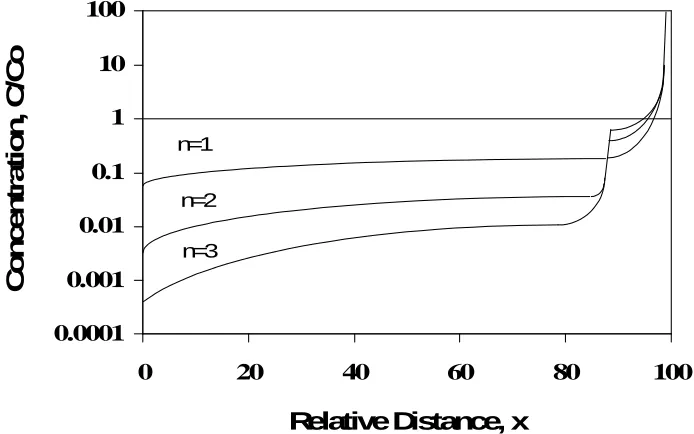
Figure 2.3. Numerical calculations of relative impurity concentrations (C/C0) vs. distance along the axial direction of the feed material for a hypothetical liquid zone refining process with distribution constant k = 0.05, n is the number of scans (passes). ... 21
Figure 2.4. Zone refined a-Se ampoule after 27 cycles. ... 24
Figure 2.5. Schematic diagram of a-Se alloying reactor. ... 27
Figure 2.6. Picture of an alloying reactor setup. ... 27
Figure 2.10. Synthesis of Se-Cl MS alloy... 30
Figure 2.11. Temperature profile of Se-Cl master alloy synthesis. ... 30
Figure 2.12. Sample#2 Se-Cl master alloy wet shots Cl-0.34%. ... 30
Figure 2.13. Synthesis of a-Se (As, Cl) bulk alloy ... 31
Figure 2.14. Sample #4 a-Se (As 0.52%, Cl 5 ppm) alloy pellets. ... 32
Figure 2.15. Sample #3 a-Se (As 10.2%, Cl 60 ppm) alloy pellets. ... 32
Figure 2.16. SEM image of prepared Al surface (a) at 175 x magnification and (b) at 5.54 K x magnification. ... 34
Figure 2.17. Thermal evaporator system and accessories. ... 36
Figure 2.18. Amorphous Se (As, Cl) alloy films on 1” x 1” Al substrates. ... 37
Figure 3.1. Standard Ground and pressed a-Se pellets (2mm thick and 13 mm in diameter) used for XRD characterization. ... 39
Figure 3.2. (a) XRD pattern of pure end of zone refined selenium. (b) XRD pattern of impure end of zone refined selenium. ... 39
Figure 3.3. XRD pattern of a-Se (As 0.52%, Cl 5 ppm) alloy. ... 40
Figure 3.4. XRD patterns of amorphous (top) and polycrystalline (bottom) a-Se (As 0.52%, Cl 5 ppm) alloy films. ... 41
Figure 3.5. SEM image of a-Se (As 0.52%, Cl 5 ppm) alloy surface on Al-substrate. .... 42
Figure 3.6. Room temperature raman spectra of amorphous selenium samples excited with 784 nm laser. ... 44
Figure 3.7. Temperature dependence Raman spectroscopy of the sample S 0727R - a-Se (As 0.52%, Cl 5ppm) alloy. ... 46
Figure 3.8. DSC trace scan at 10°C/min of a-Se alloys ... 48
Figure 3.9. Optical absorption studies. ... 49
Figure 3.10. XPS survey scan on a-Se (As, Cl) alloy wafer. ... 50
Figure 3.11. Al/a-Se(As,Cl) alloy/Au film #1. ... 51
Figure 3.13. Current (I)-voltage (V) characteristics and linear fit calculations of Arsenic-Selenium master alloy. ... 54 Figure 3.14. . Current (I)-voltage (V) characteristics of Chlorine-Selenium master alloy.
... 54 Figure 3.15. Current (I)-voltage (V) characteristics for a-Se (As 0.52%, Cl 5 ppm) alloy
device. No hysteresis were observed showing minimal charge recombination or trapping. ... 55 Figure 3.16. Current (I)-voltage (V) characteristics for a-Se (As 10.2%, Cl 60 ppm) alloy device. ... 55 Figure 4.1. The phase diagram of B-Se system. ... 58 Figure 4.2. Temperature profile (Temperature vs. time characteristics) for B-doped a-Se
(As, Cl) bulk alloy synthesis. ... 59 Figure 4.3. Enriched 10B-doped Se (As, Cl) alloy dry pellets... 60 Figure 4.4. High-resolution photoemission spectra of 10B-doped Se (As, Cl) alloy before
and after argon (Ar) etching for 15 minutes. ... 62 Figure 4.5. Photocurrent characteristics of B-doped samples biased at ±500 V. ... 63 Figure 4.6. Boron doped a-Se alloy detector with top gold contacts of 4.5 mm diameter.
... 64 Figure 4.7. Current (I)-voltage (V) characteristics of boron doped a-Se alloy at 20oC and
40oC... 65 Figure 5.1. Schematics of the experimental setup used for 241Am alpha signal detection.
... 68 Figure 5.2. A picture of alpha exposure setup. ... 69 Figure 5.3. Pulse Height Spectrum obtained by irradiating B-doped a-Se (As, Cl) alloy
CHAPTER 1:
INTRODUCTION
1.1
BACKGROUND
High resolution noninvasive tools of diagnosis has always derived and enabled scientific and medical research to probe and better understand subtleties of matter, intangible to the human eye. Radiation detection systems are important for medical, security and research applications.
Currently new materials are being pursued for advancement in detector technology. We need robust semiconductor materials which can offer better resolution, stopping power, detective quantum efficiency and at the same time are compatible with the advancements in electronics.
1.2
THESIS OVERVIEW
Amorphous selenium alloy materials were synthesized from purified starting materials to fabricate thin film and bulk alloy devices. Selenium starting materials were purified using the horizontal zone refining (HZR) technique. High quality a-Se-As (9.5%) and a-Se-Cl (50 ppm) master alloys, a-Se (0.52%As, 5 ppm Cl) bulk alloy, and boron-doped a-Se (0.52%As, 5 ppm Cl) bulk alloy were synthesized using a special alloying reactor. The physical, optical, and electrical properties were characterized, and the performances of the fabricated devices were evaluated.
There are six chapters to this thesis. In Chapter 1, evolution of x-ray detectors and a brief introduction to the prevalent techniques and terminologies have been discussed. Also theoretical understanding of flat panel x-ray imagers (FPXI) and a brief survey of the available photoconductors are also provided.
Chapter 2 describes the zone purification method used to purify starting Se precursor material. The efficacy of zone-purification was measured by impurity analysis of the zone-refined Se samples using glow discharge mass spectroscopy (GDMS) techniques. The chapter also elaborates on techniques used to synthesize good quality a-Se (As), a-a-Se (Cl) master (MS) alloys, a-a-Se (As, Cl) bulk alloys, and finally, boron-doped a-Se (As, Cl) bulk alloys. The results of composition analysis by mass-spectroscopy for different alloy materials are also discussed here. Finally, the fabrication process of the a-Se (As, Cl) alloy films on ITO/Al substrates are described in this chapter.
(SEM), x-ray diffraction (XRD), differential scanning calorimetry (DSC), Raman spectroscopy, x-ray photoelectron spectroscopy (XPS), and current-voltage (I-V) characteristics are explained here.
Chapter 4 describes the fabrication and characterization of heavily B-doped a-Se (As, Cl) alloy films for its use as thermal neutron detector. Current-Voltage characteristics of the boron doped alloy films are then obtained at different temperatures, resistivity is determined, and photosensitivity is recorded.
Chapter 5 describes the step involved in fabrication of single layer planar detectors based on B-doped a-Se alloys and device characterization with high energy alpha particles to demonstrate the device application for neutron detection.
Finally, Chapter 6 concludes our work and discusses avenues for future research.
1.3
BACKGROUND OF X-RAY DETECTORS
quality, requires cumbersome work and incurs more cost. For better image quality a higher radiation exposure is required, which poses a threat to human health.
Hence for the past 40 years, research has been geared towards digital x-ray imagers. Digital radiography allows the use of advanced imaging techniques over screen film technology. This technique has slowly evolved to give high detection efficiency, and better spatial, temporal, and energy resolution [1]. Also detection can be performed at lower radiation exposure, which is of key interest in medical applications. Images with better quality and display contrast are readily available for remote access and consultation. The digital x-ray detectors are primarily divided into two broad categories, storage-phosphor radiography (SPR) and digital radiography (DR) systems [2].
Radiation detectors based on SPR technique were made commercially available in the early 1980’s and primarily consists a phosphor system that captured the incident x-rays as a latent image, which is a distribution of electronic charges trapped in a metastable energy level in the phosphor. This latent image formed by the electrons is developed by illuminating the phosphor with red or near infrared laser. This expose and read process involves a mechanical scanning step (scanning of the phosphor plate) and hence results in poor efficiency and quality primarily because of noise [2].
Digital radiography (DR) has characteristic electrical readout capabilities and is subdivided into two techniques. Firstly, there are indirect conversion detectors in which the x-rays scintillating phosphors such as CsI(Tl), Gd2O2S(Tb) convert the incoming
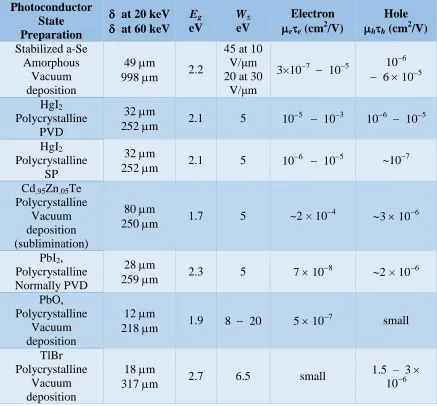
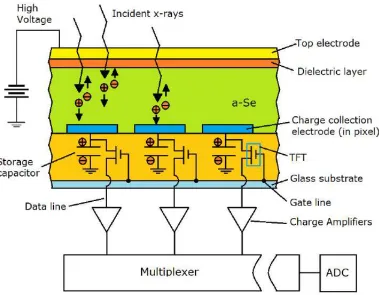
coupled devices (CCD) [2, 3]. These indirect conversion detectors have high detective quantum efficiency (DQE) at higher frequencies but have poor resolution because of light diffusion inside the scintillator. Secondly, there are direct conversion detectors which are more efficient as they use a photoconductor (primarily a-Se) to absorb the incident x-ray photons and directly convert them into charge carriers (electrons and holes) which are collected by an appropriately designed active matrix array (AMA). There are various discrete applications of these radiation detectors and each application will impose certain requirements so there is no single optimum radiation detector. Several photoconductors have been explored and investigated as x-ray detectors for large area applications. Properties, such as, attenuation depth (δ), bandgap energy (Eg), electron-hole pair
generation energy (W), and carrier range (mu-tau products) of electrons and holes, for some of these photoconductors for x-ray detector are compared in Table 1.1.
Practical constraint such as large area fabrication, charge collection efficiency, x-ray sensitivity, detective quantum efficiency (DQE) and unacceptable dark current (leakage current) limits potentially good photoconductors such as TlBr [4, 5], PbI2 [6, 7],
HgI2 [6, 7, 8, 9], CdZnTe [10, 11, 12, 13, 14] and PBO [15, 16]. Currently, only a-Se
Table 1.1. Properties of prevalent x-ray detectors for large area applications. Photoconductor State Preparation δ δ δ
δ at 20 keV
δ δ δ
δ at 60 keV Eg eV W± eV Electron µ µ µ
µeττττe (cm2/V)
Hole
µ µ µ
µhττττh (cm2/V)
Stabilized a-Se Amorphous
Vacuum deposition
49 µm
998 µm 2.2
45 at 10 V/µm 20 at 30
V/µm
3×10⁻⁷ − 10−5 10
−6 − 6 × 10⁻⁵ HgI2
Polycrystalline PVD
32 µm
252 µm 2.1 5 10
−5
− 10−3 10−6 − 10−5 HgI2
Polycrystalline SP
32 µm
252 µm 2.1 5 10
−6
− 10−5 ~10−7 Cd.95Zn.05Te
Polycrystalline Vacuum deposition (sublimination)
80 µm
250 µm 1.7 5 ~2 × 10
−4
∼3 × 10⁻⁶
PbI2,
Polycrystalline Normally PVD
28 µm
259 µm 2.3 5 7 × 10
−8
∼2 × 10⁻⁶ PbO,
Polycrystalline Vacuum deposition
12 µm
218 µm 1.9 8 − 20 5 × 10
−7 small
TlBr Polycrystalline
Vacuum deposition
18 µm
317 µm 2.7 6.5 small
1.5 – 3 ×
10−6
1.4
INTRODUCTION TO FPXIS BASED ON AMORPHOUS SELENIUM
Figure 1.1. Schematic diagram of read-out in a-Se based FPXIs.
1.5
MATERIAL AND ELECTRICAL PROPERTIES OF AMORPHOUS SELENIUM
• X-ray Photoconductivity: An ideal photoconductor will have high x-ray sensitivity. Ionization energy or electron-hole pair generation energy (W±) is defined as
the amount of radiation energy required to generate a single free electron-hole pair in the semiconductor. Usually semiconductors with narrow band-gap have high x-ray sensitivity and the follow Klien rule i.e. W± = 3Eg. Thus it is intuitive to conclude that W± should be as low as possible but more importantly this generated charge has to be
efficiently collected. Many polycrystalline semiconductors have lower W± as compared
to a-Se but currently lack the good charge collection efficiency [25].
• Low Dark Current: When a high bias is applied to photoconductor it leads to the generation of dark current. This current is typically from the thermal generation of carriers and/or injection of carriers from the biased contacts at high fields. This is called dark current because it is independent of the incoming photons. Semiconductors with wide band gaps have low thermal generation but have low photoconductivity. Blocking contacts are deposited to retard the injection of carriers but they have to be optimized so that they allow the charges generated by x-rays to exit the photoconductor, which will constitute the signal. Currently commercially available a-Se FPXIs solve this problem by depositing electron and hole blocking layers to the respective contacts. Our goal here at USC is to grow high resistivity a-Se alloys and make single-layer direct-readout planar detectors which can perform under high bias with low dark current.
the mean distance traveled by a carrier in a field before it is trapped and it is given by the product of µτE [21], where:-
µ is the drift mobility
τ is the lifetime
E is the applied field
Hence “µτE” for both electrons and holes should be greater than the detector thickness (L). In case of polycrystalline semiconductors carrier range (µτ) greatly depends on the purity and is affected by crystal defects. Whereas carefully alloyed a-Se (stabilized with As and Cl) has good charge collection efficiency for both electrons and holes [21, 26].
• Quantum Efficiency (AQ): The x-rays should be absorbed in the material and this
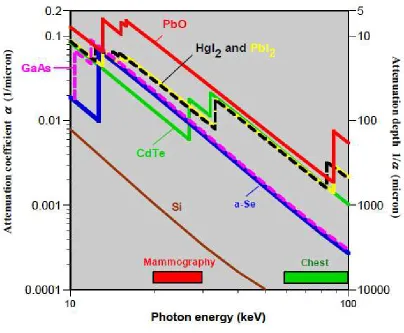
property is controlled by the absorption coefficient “α”, which depends on the energy of the incident x-rays and also on the atomic number “Z” and density “ρ” of the material. Ideally “Z” and “ρ” should be as high as possible. It is also of prime importance that the radiation is absorbed within the detector, limiting radiation exposure to patients. Photoconductor thickness “L” should be greater than attenuation depth “δ” or “1/ α”. From Figure 1.2 we can see that at around 20 keV a 200 µm a-Se the attenuation depth is 49 µm which corresponds to 98.3% AQ which is the case with commercially available
mammography systems. Also other photoconductors with high “Z” such as PbO, HgI2
Figure 1.2. Linear attenuation coefficient “α” and depth “δ” or “1/ α” to photon energy for respective photoconductors.
characteristics over large areas. Some prevalent physical properties of a-Se are listed in Table 1.2.
Table 1.2. Physical properties of a-Se.
Physical Properties a-Se
Atomic Weight 78.96
Atomic Number 34
Covalent Radius 1.16 A
Ionic Radius 1.98
Electronegativity 2.55
Electronic Structure [Ar] 3d10 4s2 4p4
Density 4.29 (gm-3)
Glass transformation temperature (Tg) 48-50°C
Crystallization temperature (Tc) 100-102°C
Melting Temperature 218°C
1.6
ALLOYING CONSIDERATIONS FOR STABILIZED AMORPHOUS SELENIUM
It can be observed from Table 1.1 that the hole range is almost an order of magnitude greater than that for electrons, and this is because a-Se is p type like all other chalcogenide glasses. Mostly, chalcogenide are unaffected by the addition of impurities as compared to crystalline semiconductors but a-Se is very sensitive to the addition of certain impurities and this behavior can be tuned to our advantage.
Pure amorphous selenium tends to crystallize over time, resulting in a sharp reduction of resistivity and hence leads to undesirable high dark current. When arsenic (As) is alloyed with a-Se, arsenic triply bonds with selenium making cross-links between Se-chains (Figure 1.3) [27]. This increases viscosity retarding crystallization.
Figure 1.3. Structure of a-Se depicting Se chains valence alternation pair defects and triply bonded As in the Se chain.
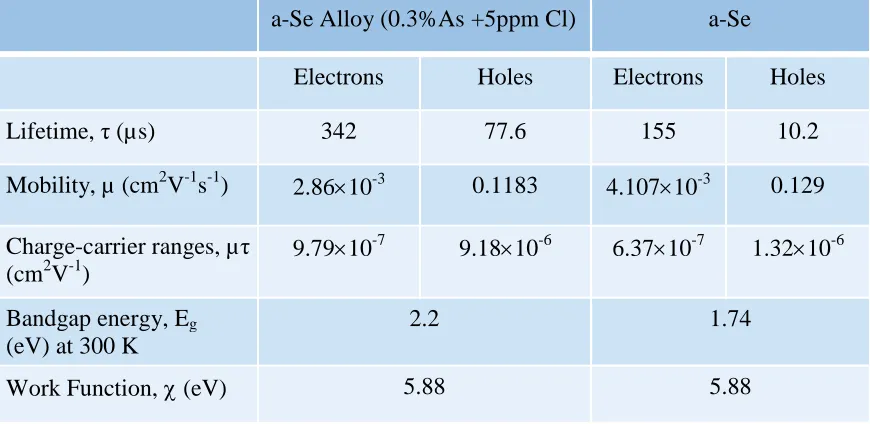
resulting in a net increase in electron transport. In order to improve hole transport chlorine (Cl) is added in the parts-per-million (ppm) range which counteracts this effect but negatively affects electron transport [28]. The effects on the electronics properties of a-Se due to arsenic and chlorine doping are summarized in Figure 1.4. Consequently, it has been found that arsenic and chlorine doping stabilizes the amorphous structure and significantly improves the electrical properties of a-Se as shown in Table 1.3 [29]. However, a careful control of alloying parameters is crucial [30].
Figure 1.4. Effect of Arsenic and Chlorine on the electronics properties of a-Se.
Table 1.3. Electrical properties of a-Se and stabilized a-Se alloyed with arsenic and chlorine as found in literature.
a-Se Alloy (0.3%As +5ppm Cl) a-Se
Electrons Holes Electrons Holes Lifetime, τ (µs) 342 77.6 155 10.2 Mobility, µ (cm2V-1s-1) 2.86×10⁻³ 0.1183 4.107×10⁻³ 0.129 Charge-carrier ranges, µτ
(cm2V-1)
9.79×10⁻⁷ 9.18×10⁻⁶ 6.37×10⁻⁷ 1.32×10⁻⁶ Bandgap energy, Eg
(eV) at 300 K
1.7
INTRODUCTION TO BORON DOPED AMORPHOUS SELENIUM ALLOYS
Thermal neutrons are among the most useful probes for investigation of the structural, magnetic and acoustic properties of materials. As a sustainable energy source, nuclear energy has become an important component of nations’ energy portfolio. With domestic and global expansion of nuclear power and development of nuclear fuel cycle processes, there are growing concerns about the nuclear proliferation and nuclear terrorism risk arising from potential access to special nuclear materials (SNMs) enrichment and reprocessing technologies. Thus deployment of portable, high performance, solid-state nuclear spectrometers are needed for international safeguards to monitor used fuel recycling activities, verification of nuclear non-proliferation treaty, and surveillance of nuclear terrorism activities. The demands of such detector are not fully covered by the current detection system
Current methods of thermal neutron detection by large cumbersome gas proportional counters or scintillator-photomultiplier tube combinations are limited by their detection efficiency, stability of response, speed of operation, and physical size. [31, 32, 33, 34] Furthermore, world-wide shortage of 3He gas has further prompted to design an alternative system. Therefore, a solid-state neutron detection system without the requirement of 3He will be highly desirable. To address these needs, our research group at USC is carrying out research to construct a large-area, lightweight, high-resolution, and very fast position sensitive thermal neutron detector based on a highly boron-doped amorphous selenium alloy film.
−−−− 1 n0 7 Li 4 He Ohmic Contacts 10
B-doped a-Se (As, Cl) Films
Thin Gold Film
Aluminum Contact V
+
+
+
+
temperature (tg ~84.6°C), a high thermal neutron cross-section (3840 barns, 1 barn = 10-24 cm2), low effective atomic number of Se for small gamma ray sensitivity, and high radiation tolerance due to its amorphous structure. Very large area neutron detectors (≥square meters) can be fabricated by tiling individual detectors using an already established technology from medical imaging field [35].
In pursuit of a neutron detector natural isotropic boron (10B) doped a-Se (As, Cl) alloy materials were prepared. The use of boron-doped a-Se (As, Cl) film as an efficient thermal neutron detector relies on the presence of 10B, which has a natural isotopic abundance of 19.9%, but is also available in an enriched form (≥95%). The 10B nucleus has a large cross section for thermal neutrons (3840 barns), and the neutrons when captured by the 10B nucleus undergo an (n, α) reaction, producing two energetic charged particles [33, 34].
_ _ _ _ _ _ _ _ _ _ _ _ _ + + + + + + + 10B + + + + + +
10
B + 1n0 11
B*
10
B + 1n0 7
Li + ααα + 2.79 MeV α
Figure 1.5. Conceptual design of a thermal neutron detector using B-doped
6%
94% 7Li*
7
Li
The released 2.79 MeV kinetic energy is shared by the two charged particles traveling in opposite directions (energy of 7Li = 1.014 MeV and Eα = 1.78 MeV). As with
any charged particles of this energy, they have relatively short path lengths in solid materials and would be readily stopped, depositing their kinetic energy. The kinetic energy of the charged particles excites electrons into the lattice conduction band and displaces atoms from their lattice sites. The general rule-of-thumb for energetic light ions in semiconductors is that for every two to three times the bandgap in energy deposited, one electron hole pair is created. The electrons excited into the conduction band (and holes in the valence band) are free to move and can produce a measurable electrical current upon application of an electric field across the a-Se film. The resulting signal pulse indicates the occurrence of a thermal neutron capture event. Standard nuclear-pulse type, charge-sensitive amplifier electronics are used to measure the current pulses.
CHAPTER 2:
PREPARATION OF AMORPHOUS SELENIUM
2.1
OVERVIEW
Commercially available selenium (Se) typically has a purity of 5N (99.999%). Amorphous selenium (a-Se), as discussed previously, is sensitive to the addition/presence of impurities even in the ppm range. We know a-Se based detectors are operated under high fields like 10V/µm. Now if impurities are present in the a-Se alloy they can create native point defects, which may act as trapping or recombination centers which limit carrier collection. Also their presence can lead to charge buildup and influence the uniformity of the electric field. This non-uniform distribution of electric field will produce a non-uniform electrical response across the detector which can seriously limit the device performance.
2.2
PURIFICATION OF SELENIUM PRECURSOR MATERIAL
2.2.1
Zone Refining Technique
Zone refining (ZR) was developed as a method of purifying various semiconductor materials in the 1950’s. [36] This refining method is based on the fact that most impurities distribute differently in solid and liquid phases at equilibrium. If a section of solid material is melted (a ‘zone’) and we maintain the molten zone while slowly passing through the feed material, in a continuous fashion, this will result in the re-distribution of impurities in the remaining solid. If this process is repeated many times (multi-pass zone refining) the resulting solid would become extremely pure at one end Figure 2.1. In general, the solubility of impurities is larger in the liquid than in the solid phase. Hence, impurities are transported with the molten zone and relatively pure material is left behind.
The extent of zone refining purification depends on the impurity segregation constant, k = CS/CL, between the solid and liquid states. At thermodynamic equilibrium,
CS is the impurity concentration in the solid phase and CL is the impurity concentration in
Top down view of single molten zone
Figure 2.1. A schematic of the zone refiner used to purify Se precursor materials. The heater ring slowly traverse the length of a sealed ampoule containing the Se precursor material to be zone refined. The heater ring melts Se material, each creating a 1” molten zone that moves through the feed material from one end to the other end (left to right). As
the liquid Se re-solidifies, it becomes more pure, while the impurity moves with the molten zone. . Ring Heater backed by Insulation Heater Covering Top Ampoule Molten Zone ‘C le a n ’ E n d ‘D ir ty ’ E n d Resolidified Ingot
Figure 2.2. Numerical calculations of specific impurity concentration (C/C0) vs. relative
distance along the axial direction of the feed material for various distribution constants k = Cs/Cl with a single scan. Interfacial thermodynamic equilibrium has been assumed for
this computation.
Figure 2.3. Numerical calculations of relative impurity concentrations (C/C0) vs. distance
along the axial direction of the feed material for a hypothetical liquid zone refining process with distribution constant k = 0.05, n is the number of scans (passes).
0.01 0.1 1 10
0 20 40 60 80 100
Relative Distance, x
C o n c e n tr a ti o n , C /C o K=0.5 K=0.1 K=0.05 K=0.01 0.0001 0.001 0.01 0.1 1 10 100
0 20 40 60 80 100
Relative Distance, x
2.2.2
Ampoule Preparation for Zone Refining
The preparation for the zone refining process involved cleaning the ampoule, filling it with the selenium material (shot form), removing water and other volatile contaminants by heating under a vacuum, and finally sealing the ampoule.
The quartz ampoule used for the zone refining process were manufactured by Quartz Scientific, Inc. (length = 50 cm, OD = 19 mm and ID = 16 mm). The first 30 cm was used to hold the Se and the remaining 20 cm was used as a 'handle' once the ampoule was sealed. The open ampoule was then thoroughly cleaned using the following successive cleaning process:
Soak with acetone one time for 5 minutes.
Soak with methanol one time for 5 minutes.
Etch with 10% HF (aqueous) for 5 to 10 minutes.
Rinse with de-ionized water (18 MΩ) at least 10 times and then dry with argon gas.
hydrogen-oxygen torch was used to seal the tube in preparation for the ampoule being loaded into a horizontal tube casting furnace.
A casting step melted the shot form of Se into a long polycrystalline ingot suitable for horizontal zone refining. The recrystallized ingot stayed at the bottom half of the ampoule and stretched almost the full 12" length. This required a furnace temperature of about 275-290oC (melting point of Se is 221oC) for 2 hours.
Next the zone refining process, which involved many passes and took several days, segregated impurities from one end of the bulk material to the other end. The ZR process for Se was conducted in a specifically designed horizontal zone refiner equipped with a single-zone furnace. One of the principal reasons for using horizontal zone refining was to provide room for expansion of the Se material upon melting and thereby eliminate the problem of cracking ampoules. The solid Se-ingot reached only half the radial width of the ampoule. Hence the material had enough room to expand without creating stresses in the quartz.
After a number of zone refining passes, the effect of purification is even evident to the naked eye. The material in the starting region looked shiny and pure, while the material at the end region (where impurities were segregated) looked dark and dull. After completing 27-45 passes, the purest part of the Se-ingot was removed, typically done in an argon-controlled glove-box environment. The ampoule was cut open by scribing and snapping, and the material was removed from the ampoule. For each ZR run, the impure end of the Se-ingot was cropped from the pure material by breaking the ingot material mechanically. The amount of ingot material determined as ‘cleaned’ was chosen by uniformity of shiny color. The removed ingots were then stored separately in argon-filled polyethylene bottles; each was labeled to keep track of the starting Se-material and ZR run number. The appearance of the zone refined Se ingots is shown in Figure 2.4.
Figure 2.4. Zone refined a-Se ampoule after 27 cycles.
2.2.3
Impurity Analysis of Zone Refined Selenium
presented in Table 2.1, which shows concentrations of elemental impurities in Se material before and after zone refining. The data clearly demonstrate that the impurities were segregated at ‘the impure end’ of the zone refined material, and the impurity concentrations in Se material were reduced up to 400% by ZR process after 27 passes. The impurity concentrations were further reduced after 40 ZR passes as shown in Table 2.2. The results confirmed that purification by ZR process reduced several dopant impurities in commercially bought Se precursor. This ‘zone-purified’ Se material was then used to make Se-alloys.
Table 2.1. A typical impurity analysis data by GDMS.
Impurity Elements
Concentration, ppmw Impurity Elements
Concentration, ppmw
Impure End Pure End Impure End Pure End
Se Major Major Mn 0.10 0.01
Li <0.05 <0.05 Fe 0.30 0.06
Be <0.05 <0.05 Co <0.01 <0.01
B 0.05 0.03 Ni 0.05 0.02
Na 0.95 0.22 Cu 0.20 <0.1
Mg 0.10 0.06 Zn <0.1 <0.1
Al 0.22 0.10 Zr <0.1 <0.1
Si 7.6 1.5 Mo <0.1 <0.1
P 0.11 0.045 Ag ≤1 ≤1
S 1.0 <0.5 Sn <0.5 <0.5
Cl 0.80 0.18 Sb 0.13 ≤0.1
K 0.20 0.08 Te <0.5 <0.5
Ca 0.50 0.1 Hf <0.1 <0.1
Ti 0.022 ≤0.01 W <0.1 <0.1
V <0.01 <0.01 Hg 7.5 <1
Table 2.2. Impurity analysis by GDMS showing reduction in elemental impurity (dopant) concentration in Se material after zone-purification.
Element Concentration before ZR
Concentration after ZR
Se Major Major
Hg 6-8 ppm <4 ppb
Pb 16 ppm <6 ppb
Sn 12 ppb Not Detected
Ag 4-6 ppm Not Detected
Cu 25 ppm 0.2 ppm
Fe 10 ppm Not Detected
Mg 6 ppm Not Detected
Si 4-6 ppm 0.4 ppm
Te 6-8 ppm 0.35 ppm
H2O 10-12 ppm Not Detected
2.3
AMORPHOUS Se (As, Cl) ALLOY SYNTHESIS
2.3.1
Introduction to Alloying Reactor
Figure 2.5. Schematic diagram of a-Se alloying reactor.
2.3.2
Master alloy synthesis
To prevent/retard crystallization rate of amorphous selenium, it was alloyed first with As. During our effort to make a-Se (As, Cl) alloys, we have found that a-Se with an As content of ~0.52% is totally resistant to crystallization. It has also been reported to improve the mobility-lifetime product for electrons and to reduce that of holes. A very small amount of Cl (~5 ppm) compensates the effect of As on the charge transport characteristics and drastically increases the lifetime of holes, while it decreases that of electrons [37].
In order to prepare a-Se (As, Cl) alloys, first adequate quantities of selenium arsenic master alloys (Se-As) and selenium chlorine master alloys (Se-Cl) were synthesized. For Se-As master alloys, zone refined selenium was crushed and mixed with 99.9999% pure commercially available arsenic. Similarly Se-Cl master alloy was made by mixing zone refined selenium and SeCl2. The flow sheet diagrams, the temperature
profiles of master alloy (Se-As and Se-Cl) synthesis and the pictures of alloy shots are presented below in Figures 2.7 to 2.12.
Figure 2.7. Synthesis of Se-As MS alloy.
ZR Se (540 gm) +
As (6N ) purity (51.3 gm)
Ar (15 scfh)
Impeller
R otation (325
- 350 rpm)
Figure 2.8. Temperature profile of Se-As master alloy synthesis.
Figure 2.10. Synthesis of Se-Cl MS alloy
Figure 2.11. Temperature profile of Se-Cl master alloy synthesis.
ZR Se (450 gm)
SeCl
2(0.048g)
Impeller Rotation
(120 rpm)
2.3.3
Alloy Synthesis a-Se (As 0.52%, Cl 5ppm)
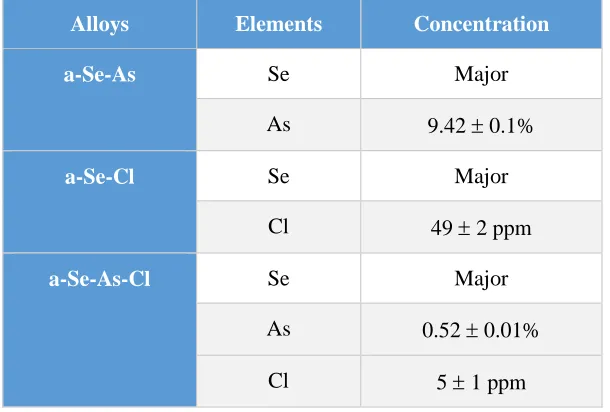
Zone refined Se was thoroughly mixed and crushed with previously synthesized 9.5% Se-As master alloy and 50 ppm of Se-Cl master alloy. The alloy-processing synthesis route was conducted in a tightly argon-controlled glove box. The alloy reactor was heated in a controlled manner to about 475oC (~ 5.5 hours) and homogenized by a rotating impeller (425 rpm). The melt was cooled to 340oC and the shotting performed with a SS 316 shotter maintained at 345oC on a shotter plate at 5oC. The flow sheet diagrams of a-Se (As, Cl) alloy synthesis are presented in the Figure 2.13. The pictures of a-Se (As, Cl) alloy shots with varying As and Cl concentrations are presented in Figure 2.14 and Figure 2.15. The compositions of the various synthesized alloys were determined by Inductively Coupled Plasma Mass Spectrometry (ICP/MS) analysis. In an ICP/MS system high-temperature ICP source converts the atoms of the elements in the sample to ions. These ions are then separated and detected by the mass spectrometer [38]. The composition determined by ICP/MS for different a-Se alloys are presented in Table 2.3.
Figure 2.13. Synthesis of a-Se (As, Cl) bulk alloy
Ar (15 scfh )
Impeller
Rotation (400
- 425 rpm)
Figure 2.14. Sample #4 a-Se (As 0.52%, Cl 5 ppm) alloy pellets.
Table 2.3. Compositions of Se-alloys by ICP/MS analysis.
Alloys Elements Concentration
a-Se-As Se Major
As 9.42 ± 0.1%
a-Se-Cl Se Major
Cl 49 ± 2 ppm
a-Se-As-Cl Se Major
As 0.52 ± 0.01%
Cl 5 ± 1 ppm
2.4
FABRICATION OF a-Se (As 0.52%, Cl 5ppm) ALLOY FILMS
After preparation and detailed analysis of the a-Se alloys, various alloy films of different thickness were deposited over aluminum and ITO coated glass substrates. It is very important to carefully control the thin film deposition process. Substrates have to be prepared before a-Se can be deposited. This preparation step insures surface uniformity and improved adhesion. We have used ITO coated TEC-8 glass substrates. (25 cm2) and aluminum oxide substrates. Oxidized aluminum (Al) substrates were used as aluminum oxide acts as p-like layer which blocks the injection of electrons from the respective negatively biased electrode.
2.4.1
Substrate preparation
The Al substrates were cut to desired sizes (1″ × 1″, 1.5″ × 1.5″, 2″ × 2″, and 4″ × 4″). To get rid of the unwanted impurities on its surface, the substrates were then ground, lapped and polished successively by fine emery paper, zirconium oxide powder, and fine alumina powder of various grain sizes down to 0.3 µm. At this point the Al surface had a near mirror finish. Then, the Al substrates were etched for 2 minutes with an etchant (H3PO4 : CH3COOH : HNO3 : H2O = 4:4:1:1 by volume) and rinsed with
Deionized water. After etching, most of surface defects were removed. Figure 2.16 shows the scanning electron microscopy (SEM) images of smooth surface of prepared Al substrates at different magnifications. Finally, the substrates were oxidized in a furnace by heating them at 350°C for 3 hours in air. After the subsequent etching and oxidation, the surface of the Al substrates became whitish instead of a dark gray color. This whitish color is representative of the presence of aluminum oxide. This substrate preparation step is critical because poorly prepared substrates result in large leakage currents.
Figure 2.16. SEM image of prepared Al surface (a) at 175 x magnification and (b) at
2.4.2
Film preparation
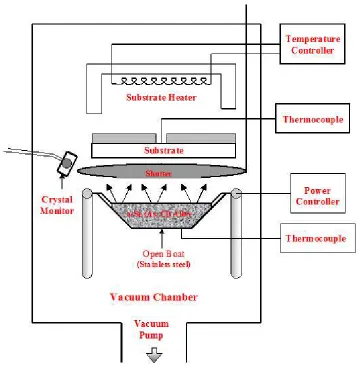
After substrate preparation, thin film deposition was carried out using our thermal evaporation facilities using a CHA SE 600 evaporator. Figure 2.17 shows the schematic of the thermal evaporator system used for a-Se (As,Cl) alloy film preparation. This evaporator is equipped with planetary rotation system and high vacuum pressure of 2x10⁻⁸ Torr can be achieved. Vacuum fixtures and substrate temperature accessories were installed within the thermal evaporation system. Deposition of a-Se necessitates a substrate temperature of 60-65oC so that the resulting film will be amorphous.
Film depositions in the thermal evaporator were monitored by a quartz crystal thickness monitor. Usually a test sample is placed with the depositions and the corresponding film thicknesses was measured by Dektak IIA surface profilometer.
First the substrate is loaded on to the planetary rotating discs where they are held by thin tungsten wires placed on the edges. The desired alloy is then measured and loaded in a molybdenum boat. Up to three different boats can be simultaneously loaded in the thermal evaporator but in our depositions we usually used a single boat.
The appearances of a-Se (As, Cl) alloy films are presented in Figure 2.18. The structural, physical, and electrical characterization of a-Se (As, Cl) films on ITO/Al substrates were carried out in details and described in Chapter 3. Evaluation of the surface morphology and composition was conducted using scanning electron microscopy (SEM) and X-ray diffraction (XRD) was used to confirm amorphous structure. The optical absorption study was conducted to estimate the bandgap energy (Eg). Resistivity and leakage current of the
film was estimated from the current-voltage analysis.
Figure 2.18. Amorphous Se (As, Cl) alloy films on 1” x 1” Al substrates.
2.5
CONCLUSION
CHAPTER 3:
CHARACTERIZATION OF AMORPHOUS SELENIUM
ALLOYS AND ALLOY FILMS
3.1
OVERVIEW
Various characterizations have been performed in order to study and verify the desired physical, electrical, optical and spectroscopic properties of the synthesized alloys. In order to understand the structural properties of the alloys they were characterized by x-ray diffraction and raman spectroscopy. Optical absorption study was performed to obtain band gap of the alloys. The a-Se alloys were surveyed by x-ray photoelectron spectroscopy to examine for any compound formation and impurities. Finally current-voltage measurements were performed to find the electrical resistivity of the alloys.
3.2
X-RAY DIFFRACTION
In order to get a diffraction pattern, the ground a-Se powder is bombarded with x-rays. When these x-rays interact with the material they either get diffracted or transmitted. Now because of unique physical properties like composition, lattice spacing and arrangement, the incoming beam gets diffracted at characteristic angles. Intensity versus angle plot is measured to determine the corresponding material. The wavelengths of the x-rays used in these experiments vary from 10 to 100 angstrom.
obtained using a Rigaku D/MAX 2100 Powder X
0.15406 nm). XRD study was first carried out for zone Samples from both ends – pure and impure
the Figure 3.2. The data shows that the precursor Se material was polycrystalline in nature as evident from the characteristic diffraction peaks.
Figure 3.1. Standard Ground and pressed a
diameter) used for XRD characterization.
Figure 3.2. (a) XRD pattern of pure end of zone refined selenium. (b) impure end of zone refined selenium.
(a)
obtained using a Rigaku D/MAX 2100 Powder X-ray diffractometer (CuKα radiation, XRD study was first carried out for zone-refined Se precursor material.
pure and impure – were analyzed and the data are presented in . The data shows that the precursor Se material was polycrystalline in as evident from the characteristic diffraction peaks.
. Standard Ground and pressed a-Se pellets (2mm thick and 13 mm in diameter) used for XRD characterization.
. (a) XRD pattern of pure end of zone refined selenium. (b) XRD pattern of impure end of zone refined selenium.
(b)
α radiation, λ = refined Se precursor material. were analyzed and the data are presented in . The data shows that the precursor Se material was polycrystalline in
Se pellets (2mm thick and 13 mm in
Powdered a-Se (As, Cl) alloys were then characterized by X-ray diffraction. A typical XRD pattern of the powdered a-Se (As, Cl) alloy is shown in Figure 3.3. From the X-ray diffraction pattern is can be observed that diffraction peaks because of compound formation, extraneous phases or segregation are not present [39]. Hence the XRD confirms the amorphous structure of the stabilized a-Se (As 0.52%, Cl 5 ppm) alloy.
Figure 3.3. XRD pattern of a-Se (As 0.52%, Cl 5 ppm) alloy.
Figure 3.4. XRD patterns of amorphous (top) and polycrystalline (bottom) a-Se (As 0.52%, Cl 5 ppm) alloy films.
3.3
SURFACE MORPHOLOGY STUDIES
3.4
RAMAN SPECTRSCOPY
Raman spectroscopy is a spectroscopic technique used to observe vibrational, rotational, and other low-frequency modes in a system. It relies on inelastic scattering, or Raman scattering, of monochromatic light, usually from a laser in the visible, near infrared, or near ultraviolet range. The laser light interacts with molecular vibrations, phonons or other excitations in the system, resulting in the energy of the laser photons being shifted up or down. The shift in energy gives information about the vibrational modes in the system.
Typically, a sample is illuminated with a laser beam. Light from the illuminated spot is collected with a lens and sent through a monochromator. Wavelengths close to the laser line due to elastic Rayleigh scattering are filtered out while the rest of the collected light is dispersed onto a detector.
Raman spectra were recorded in a Horiba-Yvon LabRam HR800 system in backscattering geometry and confocal configuration. A 784-nm diode laser with a power density of 1 W/cm2 was used as the light source. Amorphous Se samples with different doping concentrations of As and Cl were analyzed by the Raman Spectroscopy. The details of these samples are specified in the following list.
Sample ID Sample Specifications S 0727O a-Se-As master alloy S 0727G a-Se-Cl master alloy
Figure 3.6 shows room temperature Raman spectra of a-Se related samples. It is seen that the spectra of a-Se-As master alloy (S 0727O) and a-Se (As 0.52%, Cl 5ppm) alloy (S 0727R) are almost identical. Seven vibrational modes located at 40(41), 59(60), 77, 110, 133, 228 and 251 cm-1 are found. Compared with the spectrum of S 0727R, spectrum of a-Se (As 10.2%, Cl 60 ppm) alloy S0727Y possesses one more peak and one more shoulder located at 216 and 205 cm-1. The spectrum a-Se-Cl master alloy (S 0727G) seems to be different from others. Only two vibrational modes located at 142 and 234 cm
-1
were found.
The Raman spectra of a-Se in metastable monoclinic form were reported by Lukovsky [41] and Gorman [42]. Lukovsky found characteristic vibrational modes at 50, 80, 112, 138, 235 and 250 cm-1; while Gorman gave the corresponding modes at 80, 110, 132, 234 and 250 cm-1. Among them the 112 cm-1 was regarded as Se8 ring and ring like
species in the amorphous structure [43, 44].
The 235 cm-1 mode, was linked to the trigonally crystalline Se chain structure. Thus the absence of the 235 cm-1 mode in the samples S 0727O and S 0727R , which are a-Se (As,Cl) alloy materials, indicates that trigonally crystalline Se chain structure is not present. Peak at 251cm-1 is related to helical and string chains of the structure present in amorphous selenium. This peak was present in both S 0727O and S 0727R a-Se (As,Cl) alloy samples and agrees with the published literatures [45, 46]. Therefore, amorphous state was confirmed for the samples S 0727O and S 0727R. The sample S0727 G (a-Se-Cl master alloy) was unstable form of trigonal structure as confirmed by other researchers [47, 48].
3.5
DIFFERENTIAL SCANNING CALORIMETRY
Differential Scanning Calorimetry (DSC) measurements were performed in TA Q200 system. DSC measures the temperatures and heat flows associated with transitions in materials as a function of time and temperature in a controlled atmosphere. These measurements provide quantitative and qualitative information about physical and chemical changes that involve endothermic or exothermic processes, or changes in heat capacity. We have used this technique to determine the melting points and the heat of fusion (HF) for the a-Se alloy samples [49].
Figure 3.8. DSC trace scan at . DSC trace scan at 10°C/min of a-Se alloys
Sample ID Sample Specifications
S 0727G a-Se-Cl master alloy
S 0727O a-Se-As master alloy
S 0727R a-Se (As 0.52%, Cl 5ppm) alloy
S0727Y a-Se (As 10.2%, Cl 60 ppm) alloy
Sample Specifications
master alloy
As master alloy
Se (As 0.52%, Cl 5ppm)
3.6
OPTICAL ABSORPTION STUDIES ON a-Se (As,Cl) ALLOY FILMS
The analysis of optical spectra over a wide range of photon energy has been one of the most productive tools for understanding and developing the theory of electronic structure in crystalline and amorphous solids. The optical absorption studies were conducted on B-doped a-Se (As, Cl) alloy films on ITO glass substrate. Figure 3.9 shows a typical optical absorption (ħαυ) vs. incident photon energy (ħυ, eV) curve. An ITO coated glass slide was used as the reference, and the values of optical absorption coefficient (α) were not corrected for the reflection of the alloy surface. The energy bandgap (Eg) was estimated by extrapolating the linear region of the curves to
(ħαυ)1/2 = 0 [50], and the value of Eg was estimated to be about 2.21 eV at 300K which is
in close agreement with other a-Se based alloys [17, 25].
3.7
X-RAY PHOTOELECTRON SPECTROSCOPY SURVEY SCAN
The XPS survey scans on a-Se (As, Cl) alloy material was carried out to examine As, and Cl concentrations at the surfaces and to examine presence of any compound formation and other impurities. The XPS investigations were carried out using a Vacuum Generator ESCALAB MKII equipped with XPS/Auger spectrometer with a MgKα
3.8
ELECTRICAL CHARACTERIZATION
Current-voltage measurements were performed to evaluate the resistivity of various a-Se alloys in order to determine t
3.8.1
Device Fabrication
The a-Se (As, Cl) alloy films
used for device fabrication. Metal contacts were deposited on the top surfaces of the alloy films using metallization shadow mask technique. The bottom contact was oxidized aluminum and the top contact was semitransparent gold of thickness 6
by DC sputtering. Thin copper wires were attached with silver epoxy and the contact area (0.03 cm2) was encapsulated with very thin epoxy adhesives.
different sizes of top gold contact are presented in
Figure
HARACTERIZATION
voltage measurements were performed to evaluate the resistivity of oys in order to determine their usability as radiation detectors.
abrication
Se (As, Cl) alloy films of 6.25 cm2 in area on aluminum substrate were Metal contacts were deposited on the top surfaces of the alloy films using metallization shadow mask technique. The bottom contact was oxidized aluminum and the top contact was semitransparent gold of thickness 6-10 nm deposited er wires were attached with silver epoxy and the contact area ) was encapsulated with very thin epoxy adhesives. The fabricated devices with different sizes of top gold contact are presented in Figure 3.11 and Figure 3.12
Figure 3.11. Al/a-Se(As,Cl) alloy/Au film #1.
voltage measurements were performed to evaluate the resistivity of usability as radiation detectors.
substrate were Metal contacts were deposited on the top surfaces of the alloy films using metallization shadow mask technique. The bottom contact was oxidized 10 nm deposited er wires were attached with silver epoxy and the contact area The fabricated devices with
Figure 3
3.8.2
Current-Voltage Measurements
In order to perform the I
shielded aluminum box was used to hold the samples and protect them from electrical interferences. As shown below the box contains a connector to interface the sample with Keithley 237. The sample is placed on top of a conducting stage which contains a bottom contact and a thin strip of copper
contact.
3.12. Al/a-Se (As, Cl) alloy/Au film #2.
Voltage Measurements
When a voltage is applied, current flows through the a-Se alloy film device. This relationship is used to measure the dark current i.e. the current flowing through the alloy in the absence of irradiation. This experiment was performed at room temperature and on a vibration free table. From Ohm’s Law resistance of the sample is determined which is the inverse of the calculated slope of the I-V plot. The resistivity is calculated using the following equation:
·
Where ρ is the resistivity of the a-Se alloy in Ohm-cm, R is the resistance in Ohms, A is the contact area (cm2), and L is the thickness (cm) of the a-Se alloy.
Figure 3.13. Current (I)-voltage (V) characteristics voltage (V) characteristics and linear fit calculations of Selenium master alloy.
Arsenic-Figure 3.15. Current (I)-voltage (V) characteristics for a-Se (As 0.52%, Cl 5 ppm) alloy device. No hysteresis were observed showing minimal charge recombination or trapping.
Table 3.1. Resistivity of characterized a-Se alloys.
Sample Voltage
range (V) Current range (pA) Mean Resistance (Ω) Resistivity (Ω-cm)
Se-As master alloy wet shots (As: 9.5%)
Min=-500 Max=500
Min=-29.6 Max=21.16
2.236× 10¹³ 5.3 × 10¹³
Se-Cl master alloy wet shots (Cl: 0.37%)
Min=-0.05 Max=0.05
Min=-13.37 Max=13.61
3.72× 10³ 15.7
a-Se (As 0.52%, Cl 5 ppm) alloy
Min=-500 Max=500
Min=-27.41 Max=14.63
2.725× 10¹³ 1.96 × 10¹⁴
a-Se (As 10.2%, Cl 60 ppm) alloy
Min=-10 Max=10
Min=-266 Max=419
2.864× 10¹⁰ 6.52 × 10¹⁰
3.9
CONCLUSION
CHAPTER 4:
BORON-DOPED SELENIUM ALLOY SYNTHESIS AND
CHARACTERIZATION FOR NEUTRON DETECTION APPLICATION
4.1
OVERVIEW
After extensive characterization of a-Se alloys, highly resistive and amorphous in nature a-Se (As 0.52%, Cl 5ppm) alloy material were chosen for boron (B) doping in order to develop a new room temperature direct-readout solid-state thermal neutron detector. The synthesis of natural isotropic boron (10B) doped a-Se (As, Cl) alloy materials were carried out using a special pelletizing apparatus designed and constructed for this purpose. After synthesis, the compositions of the alloy material were determined by ICP/MS analysis. B-doped alloy films were then characterized for their morphological (SEM studies), optical (XPS and photosensitivity), and electrical (current-voltage) properties. These results provided the data required to demonstrate the benefits of this new neutron detector and identify the areas that require further research in future.
4.2
PHASE DIAGRAM OF THE BORON-SELENIUM SYSTEM
The phase diagram of the B-Se system as presented in Figure 4.1 shows that the thermodynamics of B alloy formation has a major problem associated with:
1. An immiscibility-gap on the selenium rich side,
2. Formation of B2Se3 which is very stable and has a very low vapor pressure, and
Figure 4.1. The phase diagram of B-Se system.
We have overcome these problems by: (i) heat treating the alloy melt at elevated temperature of 475oC for a short period of time (15 min.), and (ii) by preparing two different concentrated alloys of mono-dispersed boron in a-Se (As, Cl) matrix to increase the activity coefficient of boron. The key was to avoid the reaction of boron and selenium and successively increase boron concentrations in pre-synthesized alloys.
4.3
SYNTHESIS OF BORON DOPED A-SE (AS, CL) ALLOYS
shotting was performed with Stainless Steel 316 shotter maintained at 360oC on a shotter plate at 5oC. When the melt reached the shotting plate, it was quenched due to rapid decrease of temperature and it formed an amorphous phase. The alloying parameters such as height (dynamic relaxation effect) of a-Se (B, As, Cl) liquid melt in the shotter, synthesis temperature vs. time, and shotting plate temperature are very important and were observed closely.
A typical temperature profile with alloying time for one process run is presented in Figure 4.2, and the physical appearance of the synthesized B-doped a-Se (As, Cl) alloy is shown in Figure 4.3. The synthesized alloy has a dark color with shiny surface on one side. The preparation conditions of B-doped (natural isotopic boron) a-Se (As, Cl) alloy shots were optimized to obtain a-Se alloy with B up to 28 a/o. The compositions of the various synthesized alloys were determined by ICP/MS analysis and are presented in Table 4.1.
Figure 4.2. Temperature profile (Temperature vs. time characteristics) for B-doped a-Se (As, Cl) bulk alloy synthesis.
1 0 0 2 0 0 3 0 0 4 0 0 5 0 0 6 0 0
0 1 2 0 2 4 0 3 6 0 4 8 0
T i m e ( M i n s )
T em p er a tu re ( °C )
Figure 4.3. Enriched 10B-doped Se (As, Cl) alloy dry pellets.
Table 4.1. Compositions of Se-alloy by ICP/MS analysis.
Alloys Elements Concentration
a-Se (B, As, Cl) Se Major
B 18.4 ± 0.8 a/o As 0.51± 0.04% Cl 5 ± 2 ppm
4.4
SYNTHESIS OF BORON DOPED A-SE (AS, CL) ALLOY FILMS
solution of sodium phosphate carbonate solution (for 3 min), and then dipped in concentrated nitric acid (for 2 min). The substrates were finally rinsed thoroughly with DI water. Then substrates were dried under a constant flow of N2 gas.
B-doped a-Se (As, Cl) alloy films (≥ 300 µm thick) were prepared under a vacuum pressure of less than 10-6 Torr. Both the source (boat) and substrate temperatures were electronically controlled by microprocessor based temperature controller and the substrate temperature was maintained at 68oC ± 0.5oC. The source controller allowed temperature-time profile to be programmed for the evaporation cycle. The source was preheated to 280oC at a rate of about 15oC/min, and then kept at 280oC, while the evaporation rate was adjusted to ~3.5 µm per minute. K-type thermocouples were used to read the temperatures of both source and substrate, which were maintained constant during the alloy film deposition process. The film deposition rate was precisely monitored using a quartz crystal thickness monitor. After synthesis to desired film thickness, the samples were allowed to cool-down to 30oC before being removed from the evaporator.
4.5
X-RAY PHOTOELECTRON SPECTROSCOPY
The x-ray photoelectron spectroscopy (XPS) experiments were conducted using a Vacuum Generator ESCALAB MKII equipped with XPS/Auger spectrometer with a MgKα source (E=1253.6 eV) with 300 W power at 15 KV. Data acquisition and analysis
for XPS used a Physical Electronics multiple technique analytical computer system with Physical Electronics Version 6 software.
in binding energy, which indicates clearly the absence of any compound (e.g., B2Se3 or
B2SeO4) formations. High-resolution XPS studies were conducted to identify structural
coordinates. From the high-resolution XPS scan presented in Figure 4.4, the binding energy for Se 3d was found to be 55.4 eV and for As 3p3/2 and 3p1/2 was found to be
141.7 eV and 146.4 eV, respectively. These binding energies are in the correct range for a-Se (As, Cl) alloy as found in the literature [51]. Argon ion etching (5.0 KV; rate of sputtering 48 nm/min for Se) for 15 mins was conducted to determine the compositions along the cross-section of the films. Argon ion etching (Figure 4.4) also confirms the uniform distribution of alloying elements (B, As & Cl) from the surface towards the bulk depth up to 0.15 µm.
4.6
PHOTOCURRENT CHARACTERISTICS
Photocurrent characteristics were measured to observe the photo-response of B-doped a-Se (As, Cl) alloy materials to lights of varying wavelengths. B-doped samples were tested for photosensitivity to wavelengths between 200 nm to 1000 nm, and the respective current was plotted at 5µW illumination for both polarities. The observed photocurrent characteristics are presented in Figure 4.5, which shows that B-doped a-Se samples were photosensitive at about 450 nm.
4.7
CURRENT-VOLTAGE MEASUREMENTS
For this experiment, aluminum (Al) substrate used to deposit B-doped a-Se (As, Cl) film was first oxidized by heating at 220°C for about two hours. The aluminum oxide layer is important for the growth of B doped a-Se (As, Cl) films as it prevents dark current injection from the substrate as the aluminum oxide acts as a good blocking layer [52] and also aids the growth of uniform amorphous selenium layers. Semitransparent top gold contact was deposited by radio frequency sputtering (RF) process. Thin wires (copper or palladium) were attached with silver epoxy and the contact area was encapsulated with readily available epoxy adhesives (Dupont). A typical device based on B-doped a-Se(As, Cl) alloy is shown in Figure 4.6.
Figure 4.6. Boron doped a-Se alloy detector with top gold contacts of 4.5 mm diameter.
high field tolerance. The measured resistivity was estimated to be about 1.2x10¹⁴ Ω.cm and dark current density ranges between pA/cm2 to a fraction of few nA/cm2.
Figure 4.7. Current (I)-voltage (V) characteristics of boron doped a-Se alloy at 20oC and 40oC.
Table 4.2. Resistivity of characterized B-doped a-Se alloy.
B-doped a-Se(As-0.52%, Cl-5ppm) alloy
Voltage range (V)
Current range (pA)
Mean Resistance (Ω)
Resistivity (Ω-cm)
@40oC Min=-1000 Max=1000
Min=-186.3 Max=204.7
5.38× 10¹² 1.53 × 10¹³
@20oC Min=-1000 Max=1000
Min=-40.9 Max=38.6