University of South Carolina
Scholar Commons
Theses and Dissertations
1-1-2013
The Relevance of Sarcasm In Resolving Ambiguous
References In Spoken Discourse
Sara Ann Peters
University of South Carolina - Columbia
Follow this and additional works at:https://scholarcommons.sc.edu/etd Part of thePsychology Commons
This Open Access Dissertation is brought to you by Scholar Commons. It has been accepted for inclusion in Theses and Dissertations by an authorized administrator of Scholar Commons. For more information, please [email protected].
Recommended Citation
THE RELEVANCE OF SARCASM IN RESOLVING AMBIGUOUS REFERENCES IN
SPOKEN DISCOURSE
by
Sara Peters
Bachelor of Arts
University of South Carolina, 2006
Master of Arts
University of South Carolina, 2010
Submitted in Partial Fulfillment of the Requirements
For the Degree of Doctor of Philosophy in
Experimental Psychology
College of Arts and Sciences
University of South Carolina
2013
Accepted by:
Amit Almor, Major Professor
Anne Bezuidenhout, Committee Member
Fernanda Ferreira, Committee Member
Douglas Wedell, Committee Member
DEDICATION
To Mom, for her emotional support; to Dad, for his emotional and financial.
ABSTRACT
Sarcasm, or sarcastic irony, involves expressing a message that is often opposite
of the literal meaning of what is being said, in a way that may sound bitter, or caustic
(Gibbs, 1986). In the past, sarcasm has been viewed as a method of introducing the
possibility of alternative interpretations of a discourse, by creating ambiguity as to the
intended discourse interpretation. The current series of experiments sought to
demonstrate that sarcasm could be viewed as beneficial in resolving ambiguity in
conversation, by highlighting particular interpretations and thus ease processing,
dependent on other available contextual information. Two Visual World studies are
reported in which this theory is tested. First, the variables associated with the social
contexts represented in the conversations were normed in Experiment 1. Second, spoken
conversations involving two speakers discussing events that were occurring within a
town were presented to participants in Experiments 2 & 3. Experiment 2 presented a
two-sentence conversation in which the first speaker introduced an ambiguous homophone in
their utterance, and a second speaker followed with a comment made using Sarcastic
Prosody. Experiment 3 also presented a two-sentence discourse, with the first speaker
making a generic comment, and the second speaker following with a homophone
reference spoken with Sarcastic Prosody. Within the experiments, sarcasm increased the
processing of alternative interpretations of the homophones differently depending on the
than all possible interpretations. Theories such as Relevance Theory would predict this
effect of sarcasm, such that given the proper conversational and contextual constraints,
TABLE OF CONTENTS
DEDICATION ... iii
ABSTRACT ... iv
TABLE OF CONTENTS ... vi
LIST OF TABLES ... viii
LIST OF FIGURES ... x
CHAPETER 1:INTRODUCTION ... XI CHAPTER 2:SARCASM ... 7
2.1BEING NORMAL ... 7
2.2THEORIES OF SARCASM USE ... 9
2.3DISCOURSE FUNCTIONS OF SARCASM ... 20
CHAPTER 3:AN INTRODUCTION TO AMBIGUOUS WORDS &HOMOPHONES ... 24
CHAPTER 4:THE VISUAL WORLD PARADIGM ... 32
CHAPTER 5:GENERAL AIMS ... 36
CHAPTER 6:EXPERIMENT 1:NORMING STUDIES ... 38
6.1VERIFICATION STUDIES ... 40
6.2COVARIATE ANALYSIS ... 55
CHAPTER 7:EXPERIMENT 2 ... 66
7.1INTRODUCTION ... 67
7.2COMMON METHOD FOR EYE-MOVEMENT EXPERIMENTS 2&3 ... 69
7.3METHODS FOR EXPERIMENT 2 ... 73
7.4LINKING HYPOTHESIS &THEORETICAL PREDICTIONS ... 75
7.5RESULTS FOR EXPERIMENT 2 ... 84
7.6DISCUSSION FOR EXPERIMENT 2 ... 109
CHAPTER 8:EXPERIMENT 3 ... 115
8.1INTRODUCTION ... 115
8.2METHODS FOR EXPERIMENT 3 ... 116
8.3LINKING HYPOTHESIS &THEORETICAL PREDICTIONS ... 117
8.4RESULTS FOR EXPERIMENT 3 ... 122
8.5DISCUSSION FOR EXPERIMENT 3 ... 135
CHAPTER 9:GENERAL CONCLUSIONS ... 140
REFERENCES ... 148
APPENDIX A:HOMOPHONE INFORMATION ... 159
APPENDIX B:EXPERIMENT DISCOURSES ... 163
LIST OF TABLES
Table 3.1 Sample homophones divided by Dominance and Frequency. ... 27
Table 6.1 Sample prime with all associated targets from Experiment 1A. ... 45
Table 6.2 Results for Experiment 1A. ... 48
Table 6.3. Rating means and standard errors by Experiment and Condition. ... 54
Table 6.4 Sample “how-to” instructions for online social norming study. ... 64
Table 7.1. Experiment 2 Sample discourse. ... 74
Table 7.2. Models of fixations to Biased homophones in Sentence 1. ... 86
Table 7.3. Models of fixations to Balanced homophones in Sentence 1. ... 90
Table 7.4. Models of fixations to Biased Homophones in Sentence 2. ... 94
Table 7.5. Models of fixations to Balanced Homophones in Sentence 2. ... 97
Table 7.6. Models of Experiment 2 reaction time data by Bias. ... 104
Table 7.7. Experiment 2 final choice proportions by factor Sarcasm. ... 109
Table 8.1. Experiment 3 Sample discourse. ... 117
Table 8.2. Models of fixations to Biased homophones in Sentence 2, full 750 ms. ... 124
Table 8.3. Models of first fixations to Biased homophones in Sentence 2. ... 127
Table 8.4. Models of fixations to Balanced homophones in Sentence 2, full 750 ms. .. 129
Table 8.5. Models of first fixations to Balanced homophones in Sentence 2. ... 130
Table 8.6. Models of Experiment 3 reaction time data by Bias. ... 132
LIST OF FIGURES
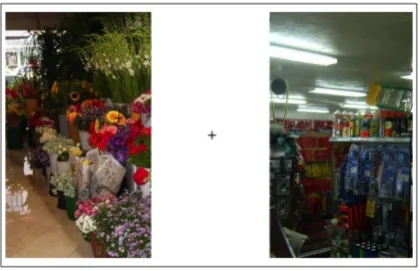
Figure 6.1 Sample visual display for “flower” screen for bulb in Experiment 1B. ... 49
Figure 6.2. Sample experimental visual display for Experiments 1D, 2 & 3. ... 57
Figure 7.1. Mean Sentence 1 fixation durations in ms at homophone onset to Biased
homophones by Dominance and Frequency. Standard error of mean depicted. ... 88
Figure 7.2. Mean Sentence 1 first fixation durations in ms at homophone onset to Biased homophones by Dominance and Frequency. Standard error of mean depicted. ... 89
Figure 7.3. Mean Sentence 1 fixation durations in ms at homophone onset to Balanced
homophones by Frequency. Standard error of mean depicted. ... 91
Figure 7.4. Mean Sentence 1 first fixation durations in ms at homophone onset to
Balanced homophones by Frequency. Standard error of mean depicted. ... 92
Figure 7.5. Mean Sentence 2 fixation durations by conditions Frequency and
Dominance. ... 95
Figure 7.6. Mean Sentence 2 fixation durations for first 2000 ms. Fixations to Balanced homophones by Sarcasm and Change. Standard error of mean depicted. ... 99
Figure 7.7. Mean Sentence 2 fixation durations for second 2000 ms. Fixations to
Balanced homophones by Sarcasm. Standard error of mean depicted. ... 100
Figure 7.8. Mean reaction times in ms for responses to Biased homophones in the
Sincere versus Sarcastic Prosody conditions of Experiment 2, according to Frequency and Dominance. Sarcasm factor not significant. Standard error of mean depicted. ... 106
Figure 7.9. Mean reaction times in ms for responses to Biased homophones according to
Frequency and Dominance. Significant effect of Dominance (p < 0.05), and Frequency
by Dominance interaction, such that in the Subordinate condition, the difference between High and Low Frequency Response times was different (p < 0.05). Standard error of mean depicted. ... 107
Figure 7.10. Mean reaction times in ms for responses to Balanced homophones in the
Figure 8.1. Mean Sentence 2 fixation durations in ms at homophone onset to Biased homophones by Sarcasm and Frequency. Standard error of mean depicted. ... 125
Figure 8.2. Mean Sentence 2 fixation durations in ms at homophone onset to Biased
homophones by Sarcasm, Frequency, and Dominance. Standard error of mean
depicted. ... 126
Figure 8.3. Mean first fixation duration to Biased homophones by Prosody and
Frequency at homophone onset in Sentence 2. Standard error of mean depicted. ... 128
Figure C.1. Spectrogram of Experiment 2, Sentence 2, Sincere, phrase “Maybe they require more care than you realized.” ... 166
Figure C.2. Spectrogram of Experiment 2, Sentence 2, Sarcastic, phrase “Maybe they require more care than you realized.” ... 166
Figure C.3. Spectrogram of Experiment 3, Sentence 2, Sincere, phrase “Maybe you just don’t know how to take care of a bulb properly.” ... 167
CHAPTER 1
INTRODUCTION
Spoken language messages offer information to listeners both through the
composition of the message, and in additional speech, speaker, word and discourse-level
information that may be relevant. Examples include the prosody used to impart the
message (particularly the intonation of particular utterances), the emotion portrayed by
the speaker, and the surrounding situational context for the information. Utilized
successfully by a listener, this additional information may provide indirect information on
a speaker's attitudes and beliefs about a current topic, as well as information regarding
any underlying meaning of the message (Kreuz & Glucksberg, 1989; Capelli, Nakagawa,
& Madden, 1990; Weingartner & Klin 2005; 2009). According to Grice’s Cooperative
Principle, conversation interlocutors choose what they say so as to further the purpose of
the conversation, and we expect this principle to be understood by both parties as they
engage in the act (Grice, 1975). This is the case even when an utterance from one of the
parties may at first seem out of place with the preceding context, as is often the case with
sarcasm, or sarcastic irony.
When defining sarcastic irony, Gibbs (1986) uses the definition offered in the
Oxford English Dictionary, in which irony is “the use of words to express something
other than and especially the opposite of the literal meaning of a sentence”, and sarcastic
consideration of sarcasm as a linguistic device actively chosen by writers and speakers
for use during conversation and text to serve a specific purpose in the discourse, to alter
the interpretation further from the literal meaning toward an intended meaning. This
suggests that when sarcasm is chosen by a speaker and used in a spoken language
context, it can be geared toward providing information for the conversational partner, or
other party in a specific situation. For example, if a word such as “bulb” was used in a
conversation, which is a homophone with multiple meanings, sarcasm may be used to
highlight the meaning of “flower bulb”, rather than “light bulb”. Thus, in a given context
or conversation, if sarcasm is being used as a linguistic device in this manner, we should
find that the use of sarcasm is highly dependent on the preceding context as well as the
situation, and highlights a particular interpretation given these constraints. We should
also expect that theories of sarcasm use should be able to account for this contextual
(situational) sensitivity.
Multiple theories have been put forth to explain the use and resolution of irony in
discourse and in general, with a few paying special attention to the use of sarcastic irony,
or sarcasm (Kreuz & Glucksberg, 1989; Dews & Winner, 1995; Giora, 1995, 1997;
Gibbs, 1984, 1989, 1994, from Gibbs 2002; Sperber & Wilson, 1986). The current
project is unique in that it aimed to examine theories based on their ability to account for
data related to one purpose that sarcasm can serve during a discourse, which is the use of
sarcasm to aid in resolving an ambiguity created by a homophone in spoken discourse.
Another way of describing this goal is that the current project aimed to demonstrate that
sarcasm could be viewed as beneficial from the point of a speaker, if it highlights the
shown that sarcasm itself can successfully introduce ambiguity into a discourse by
creating possible alternative interpretations for listeners (Weingartner & Klin, 2009; Klin
& Drumm, 2010). In this previous work, the sarcasm served to delay processing by
introducing competing interpretations. However, work examining prosody changes in
spoken language has found that listeners take stress information to indicate that the
phrase or word is important, and that the stress information can alter lexical processing
(Cutler, Dahan, & van Donselaar, 1997; Blutner & Sommer, 1988). Since one of the
components that can indicate sarcasm during spoken language is the prosody (cues such
as intensity changes, duration changes, etc. (Rockwell, 2002; Cheang & Pell, 2008)), if
the cues are taken to indicate a stress on an important phrase, listeners may utilize this
information and change their interpretation of a discourse. The current work predicts that
this effect of sarcasm can be observed systematically, such that the increased processing
will lead particular discourse interpretations to become prominent, and more likely to be
considered.
Theories of sarcasm resolution currently in the field exist on a spectrum. Some
work presents arguments for theories of a specific sarcasm resolution mechanism, while
alternatives place sarcasm in the context of more general language processing (Dews &
Winner, 1995; Kreuz & Glucksberg, 1989; Gibbs, 1986, Giora, 1997; Sperber & Wilson,
1986, 1995). Theories such as the Echoic Reminder Theory and the Tinge/Muting
Hypothesis suggest that sarcasm either echoes a violated social norm, or mutes criticism
or praise, respectively (Kreuz & Glucksberg, 1989; Dews & Winner, 1995).
Another theory of the processing of irony - and therefore sarcasm - the Direct
additional cognitive load for a listener (Gibbs, 1984; Gibbs, 1989). This view suggests
that the processing of sarcastic versus sincere statements should have similar time frames,
with irony simply a different way of transmitting the message (Gibbs, 1986). The Graded
Salience Hypothesis (Giora, 1997) is an integrated language processing account,
suggesting that the salience of a particular interpretation of an utterance is weighted when
resolving whether the utterance is meant literally or not. In this approach, it is aspects of
the message including the conventionality (Gibbs, 1980 from Giora, 1997), familiarity of
the expression (Blasko & Connine, 1993 from Giora, 1997), and the frequency
(Hogaboam & Perfetti, 1975; Neill, Hilliard, & Cooper, 1988, both from Giora, 1997)
and status of the message within the context, that affect the salience of each meaning
(literal versus nonliteral, in cases such as “The grass is greener on the other side.”), and
the final interpretation of the utterance.
A last approach placing sarcasm processing in a general language-processing
framework, that is able to account for more than just sarcasm and other forms of irony is
Relevance Theory (Sperber & Wilson, 1986, Sperber & Wilson, 1995). Relevance
Theory expands upon Grice’s previously mentioned Cooperative Principle, and outlines
further assumptions regarding the expectations of both parties as they engage in speech
(Sperber & Wilson, 1986; Sperber & Wilson, 1995). While some information may be
provided by speakers in a straightforward manner, Relevance Theory postulates that all
aspects of utterance chosen by speakers are typically meant to offer listeners cues
relevant to the speaker’s message, and yet still, that this is understood by both parties.
This is the case even when a message at first appears ambiguous, or contrary to
Wilson, 1986; Sperber & Wilson, 1995) supports the notion that the speaker deems any
additional processing used to resolve a sarcastic utterance worth the effort when the
utterance is chosen.
Alternatively, some work on the process of conversational adaptation by partners
has shown that a speaker may not always be mindful of the interlocutor’s view and needs
during conversation. In these cases, it is hypothesized that the information maintenance
of common ground expends too much effort (Pickering & Garrod, 2004). Thus, listeners
may not always take advantage of the information offered by speakers. However, it’s
noted that the speaker does have some tools to highlight important information for
interlocutors, such as accentuation and deaccentuation of salient information using
prosody, as previously mentioned (see Cutler, Dahan, & van Donselaar, 1997 for review
of work). Thus, using a Relevance Theory approach, it may still be possible that the
contradictory effects of sarcasm use (the use of sarcasm by a speaker, even though it may
appear to introduce ambiguity, and to violate the Cooperative Principle) could be justified
if prosody cues are given to highlight the information, suggesting it is important. This
assumption allows us to consider that sarcasm is chosen for a specific purpose, to perhaps
identify a particular interpretation, or increase processing of an alternative.
Each of the approaches described above will be further explored in the current
work. For a subset of the theories, namely Graded Salience and Relevance Theory,
generalized predictions for outcomes in the current set of experiments will be generated
and evaluated. For this subset, particular attention is paid to how well each approach
accounts for the findings in the wider literature. The remainder of the study is outlined as
to resolve sarcastic utterances, with a more in-depth exploration of the theories
introduced above. The manipulation that the current work examines, the effect sarcasm
contributes to ongoing discourse interpretations that necessitate resolving ambiguity
generated by a homophone reference, is also introduced. Following, the methodology the
current work utilized is discussed. Additionally, since sarcasm was explored as
contributing information for successful ambiguity resolution, Chapter 3 describes a
method to introduce ambiguity into the discourse, namely the use of homophones.
Chapter 4 provides information on the final aspect of the chosen methodology, the Visual
World Paradigm, with the remainder of the work focused on reporting the specific
CHAPTER 2
SARCASM
As previously mentioned, sarcasm is typically defined as “bitter, caustic, and
other ironic language directed at an individual” (Gibbs, 1986). The approach taken in the
current work is that sarcasm is a linguistic device chosen by speakers for specific
purposes determined by the context of the conversation or discourse. It is noted that
contexts vary greatly, with variables such as different social settings (situational
contexts), and the frequency of the words used to describe the context, etc. contributing
to how effective sarcasm will be as a manipulation. Additionally, here sarcasm is
operationalized by the use in an utterance containing prosody cues previously identified
by native English speakers as indicating sarcasm (Rockwell, 2002). It follows that if
speakers have access to the use of sarcasm, in order for it to be an efficient choice for
communication, we must also have the ability to rapidly resolve sarcastic utterances and
utilize the information they offer during the discourse interpretation process. In order to
support this assumption, the ability of native speakers to detect sarcasm must be verified,
and questions regarding individual differences noted.
2.1BEING NORMAL
Readers and listeners can describe specific characteristics of sarcasm that allow
for identification and detection. In particular, previous work in the spoken language
Bryant & Fox Tree, 2002). For example, when children are asked to explain how they
detected sarcasm during a spoken discourse, they may report that the speaker “sounded
mean” (Capelli, Nakagawa, & Madden, 1990; Nakassis & Snedeker, 2002). In addition,
sarcasm is apparently more difficult for younger children than older children, and the
ability to detect it properly thus seems to develop with age (Sullivan, Winner, &
Hopfield, 1995).
In terms of prosody in particular, work by Rockwell (2000) identifies that sarcasm
is typically indicated by a slower tempo (speech rate), spoken with greater intensity
(amplitude), and at lower pitch level. More recently, work by Cheang & Pell (2008)
affirmed these cues, noting that in their work, intensity appeared to be the most important
cue. Work by Peters, Wilson & Almor (2012) has also confirmed native speakers’ ability
to detect sarcasm using both prosodic and contextual cues, within the available South
Carolina participant pool that the current work utilized. The prosody cues were
manipulated in sentences that were recorded in sincere tones, and the same procedure was
used in the current experiment to achieve this effect with the cues noted above.
Thus, previous research shows that normal, native adult English speakers appear
to have gained the knowledge necessary to aid them in resolving the true meaning of a
sarcastic utterance. In particular, native English speakers will use both the context and
prosody information present when the utterance is presented as spoken language (Bryant
& Fox Tree, 2002). Additional work (beyond the scope of the current study) suggests
that this knowledge may exist in the form of abilities that individuals obtain on a normal
developmental trajectory, including the ability to take another’s perspective and to
Chevallier et al., 2011). Because both context and prosody are used by many types of
comprehension processes besides the detection of sarcasm (Cutler, Dahan, & van
Donselaar, 1997; Wilson & Wharton, 2006), the conclusion of this brief review of
“normality” suggests that theories of sarcasm use should strive to place it in the context
of a language mechanism that relies on general (rather than specific) processing abilities
to resolve.
2.2THEORIES OF SARCASM USE
Theories of sarcasm use and resolution are situated in several different areas in
the existing literature, including the study of social norms and their violations, work on
Theory of Mind, and work on non-literal language processing. Each of these areas
emphasizes different mechanisms and reasons for the use of sarcasm in discourse, and is
impacted when there are impairments in the ability to detect sarcasm (or irony) (Happé,
1993; Chevallier et al., 2011; Dews & Winner, 1995; Kreuz & Glucksberg, 1989; Gibbs,
1986; Giora, 1995, 1997; Sperber & Wilson, 1986). Sarcasm is often found to refer to
social norms, current situational processes, and the actions of others within a negative (or
positive) context, and failure to detect it has practical implications both in specific
conversational settings, and for the development of language processing abilities.
Research in each of these areas is generally focused on the issues central to the area, thus
leaving the role of general linguistic mechanisms largely unaddressed. For the purpose of
the current work, sarcasm as a linguistic mechanism is further defined as a mechanism
that has the ability to enhance discourse processing by offering particular alternative
interpretations, given that participants recognize the relevant information (such as
to do so. Therefore, any processing costs of sarcasm are mediated by the addition of this
additional information, which may or may not be activated for a listener or reader in the
same timeframe as a (series of) sincere statement(s). Although the focus here is on
theories of resolution, these theories may also be considered from the speaker’s initial
viewpoint: that successful resolution is offering additional information, which is why
sarcasm is chosen. This definition will aid in clarifying the placement of the current
work using existing theoretical accounts of sarcasm use.
Before examining these approaches more thoroughly, several main assumptions
underlying the current work are explicitly stated, which have been previously hinted.
The first is that (1) sarcasm is one of many available choices of mechanisms speakers
may utilize when preparing and executing an utterance. Speakers can theoretically
convey their message either through sarcasm or literal, sincere statements, and have a
similar outcome in terms of the information transmitted by utterances. Therefore,
sarcasm, or sarcastic irony, must be chosen by speakers for a particular reason. The
second assumption is that (2) there need not be dedicated mechanisms for explaining its
use, rather that theories of sarcasm use and resolution should fit in broader language
processing theories. Therefore, this work postulates that sarcasm is a device chosen by
speakers because it serves the discourse function with the best return of effort for the
current context. This assumption will also aid in clarifying the placement of sarcasm
within the upcoming theoretical accounts, such that it should be beneficial in some cases,
and irrelevant in others. This is not, however, a new approach, and is clearly not the only
approach. Several theories of sarcasm use have already examined different reasons why
resolution of the utterance (examples include: Tinge/Muting Hypothesis, Echoic
Reminder Theory, Mention Theory of Irony (Dews & Winner, 1995; Pexman & Olineck,
2002Kreuz & Glucksberg, 1989; Jorgensen, Miller, & Sperber, 1984). Finally, once
again (3) sarcasm is operationally defined as being identifiable by the prosody cues,
particularly those previously noted by Rockwell (2000) & more recently Cheang & Pell
(2008), and also through social contextual effects, which will be further outlined in
section 6.10.
Echoic Reminder Theory (Kreuz & Glucksberg, 1989) broadly suggests that
speakers choose sarcasm to remind an interlocutor that a social norm is being violated. In
this way, sarcasm is meant to echo the social norm being violated, and is phrased as
referring to such. For example, in a situation in which one friend (Person B) is late
meeting another (Person A) at the movies, utterance [1] delivered in a Sarcastic Prosody
is meant to convey to the interlocutor of Person A that norm [2] has been violated by
Person B, and that Person A is not appreciative of that fact. In order to resolve this
message, A’s interlocutor must realize that [1] is meant as sarcasm by placing the
sarcasm in the context offered against a background of social norms.
[1] He sure is punctual.
[2] It’s not okay to be late to a meeting.
In this way, Echoic Reminder Theory begins to address the social aspect of the
use of sarcasm, introduced in the discussion of context above. It requires the assumption
that there are social contexts in which sarcasm may be perceived as more appropriate.
These contexts could include variable subjects of discussion in a conversation, and not
statement regarding someone else’s clothing, or hairstyle). Here, the Echoic Reminder
Theory becomes less useful, particularly when sarcastic utterances move beyond the
scope of reflecting social norms, and are reduced to simply a speaker’s personal judgment
of another, or individual differences of humor style. For example, previously sarcasm
was described as being in part “bitter...directed against an individual” (from Gibbs,
1986). This definition does not suggest there always need be a social norm against which
the judgments of the individual are tested. If a speaker does not like a coworker, he
might refer to the individual’s work as “just amazing” using sarcasm to an interlocutor,
and the work may actually be amazing by conventional standards. Here, in order to
understand the speaker’s sarcastic intent, the listener would need to realize that the
speaker does not like the subject of the utterance, which is the information leading to the
sarcastic interpretation. So while the Echoic Reminder Theory (Kreuz & Glucksberg,
1989) may be useful in specific contexts, it does not appear to be able to handle the full
range of social contexts in which sarcasm can be successfully employed. In order to do
so, we would have to consider that the statements being echoed could be very distant and
broad.
A second echoic theory, the Mention Theory of Irony (Jorgensen, Miller, &
Sperber, 1984) also appeals to echoes of statements or sentiments made by a previous
speaker as a method of intending an ironic, or in this case sarcastic, utterance. Jorgenson
and colleagues (1984) suggest that the echoes themselves could seem remote from the
statements that triggered them, and thus not necessarily appear as a straightforward echo
of a previous utterance (e.g., they could include echoes of emotion, etc. leaving further
locating the expression the speaker’s echo referred to, and then determining the speaker's
attitude toward the topic (Jorgensen, Miller, & Sperber, 1984; Bryant & Fox Tree, 2002).
From this perspective, [1] may appear remote because [2], while a known social rule,
may not have been mentioned during conversation at any point that night. Nonetheless,
the sentiment of [2] would likely be recognized and [1] resolved. However, this too
involves knowledge of what we could refer to as “social” contextual knowledge norms in
conversation, although not the “social norms” of the Echoic Reminder Theory.
Another theory that could explain [1] is the Tinge, or Muting Hypothesis (Dews
& Winner, 1995; Pexman & Olineck, 2002). Using the Muting Hypothesis, sarcasm
mutes what would otherwise come across from a speaker as outright negativity (or in
other words, “tinges” it with the opposite emotion, positivity in this case). In addition,
the Muting Hypothesis also suggests that when a compliment is given, the positive tone
of the compliment is also muted. Therefore, sarcasm serves to mute the emotional aspect
of either censure or praise. In this case, instead of indicating a direct reference to [2],
Person A is muting [3] when conveying their feelings to their interlocutor.
[3] Being late is extremely rude, and I am upset with Person B.
Once again, while the Muting Hypothesis may apply in some contexts, it is
possible to conceive of a situation in which, for example, a boss uses sarcasm to censure
an employee in front of a group. When social dynamics are entered into the resolution of
the message, the group may perceive that the censure is actually harsher than an outright
censure that is not veiled in meaning, introducing the emotion of shame into the subject
of the utterance. Social dynamics are mentioned repeatedly here, as they provide cues for
boss was being sarcastic by viewing the subject of the utterance’s response to the
comment). Thus, we are left with a theory that may provide useful information about
sarcasm resolution in a specific context, but does not have the flexibility needed to
account for the wide range of situations in which sarcasm can hypothetically be used.
A theory considered in more depth in the predictions of the experiments offered in
this study, is Direct Access View (Gibbs, 1986; Gibbs & O’Brien, 1991, Gibbs, 2002).
The Direct Access View offers information on the time course of the resolution of what
would appear to be non-literal, or figurative interpretations of an utterance. Oftentimes, a
sarcastic utterance can be detected because it is the opposite of what a speaker actually
feels. In this situation, the opposite meaning of the phrase needs to be accessed and
understood to interpret and resolve the utterance as the speaker originally intended. The
Standard Pragmatic view of processing these types of messages suggests that listeners
first interpret the literal statement before converting it to a non-literal interpretation
(Grice 1989, from Gibbs, 2002). The Direct Access View (Gibbs, 1984, Gibbs, 1989),
however, claims that there are situations in which listeners and readers can understand the
figurative interpretations directly, and do not require time to reevaluate the utterance
(Gibbs, 2002). Thus, the interlocutor of Person A may be able to identify [1] as sarcasm
immediately, particularly if they have been waiting on Person B for five or ten minutes.
Thus, Direct Access View does begin to address the social contextual information that
appeared to be lacking in the previous approaches.
The previous explanations discussed view sarcasm as a choice made by speakers
to convey their attitude to an interlocutor. In contrast, the Indirect Negation View of
speaker, and also suggests processing cost as a factor involved in resolution of utterances.
This allows the Indirect Negation View to take into account the social dynamics involved
in the production and comprehension of sarcasm, without requiring additional processing
mechanisms.
The Indirect Negation View of Irony is different from the Direct Access View
previously discussed, which suggests the processing of an ironic statement may take no
longer than that of a literal statement (Gibbs, 2002; Gibbs & O’Brien, 1991). The
Indirect Negation view asserts that both the literal and intended meaning in an ironic
statement are activated, and that statement is resolved by processing the difference
between the two meanings, and that this involves an additional processing load. Giora
(1995) views direct negations as offering different information than indirect negation;
further suggesting that indirect negation may not refer to the opposite of the literal
meaning of a statement, as direct negation would. Returning to the example of a boss
censuring an employee in front of others, if he (as the speaker) comments “That was
some great work,” using sarcasm may indicate more than just it was poor work, but
instead that it was horrible work, the worst he has ever seen. Thus, Indirect Negation can
account for a context that the Muting Hypothesis had difficulty explaining. This view of
Indirect Negation is supported when considering that in sarcasm processing, additional
information such as the emotion or attitude of the speaker is conveyed with the utterance
when it is resolved as the speaker intended, and this information is not simply the
opposite of the literal statement.
Giora’s (1995) approach is based on situations in which her Conditions for
Well-Formedness, the ironic statement must: (1) Introduce information about accessible
discourse topics, (2) Violate graded informativeness, and introduce a less probable
message than the one expected in the given context, and (3) Make the addressee evoke an
implicature between the marked and unmarked messages, whereby they can note the
difference between them and conclude that the statement is ironic (Giora, 1995). The
Indirect Negation View of Irony also suggests that irony may be used in situations where
norm violations of all types are apparent (not limited to social norms). Thus, this theory
has more explanatory power than the Echoic Reminder Theory (which pertains to social
norms), and can account for data supporting both the Mention Theory of Irony (where
echoes can be remote) and the Tinge/Muting Hypothesis (by situating the experimental
items such that the contexts fall in situations benefiting from a Tinge/Muting of praise or
criticism). Thus, it is general enough to be applied to multiple contexts, yet specific
enough to provide predictions and reasoning for sarcasm usage by a speaker.
An evolution of sorts of Giora’s Indirect Negation View of Irony, the Graded
Salience Hypothesis (Giora, 1997), suggests that the salient meanings of figurative
language statements are processed first, regardless if it is the literal interpretation or the
figurative one, and that additional meanings are only processed after this is completed. In
terms of sarcasm, this view suggests that [1] may first be processed as indicating that the
person is punctual, before it is reevaluated to the sarcastic meaning that is meant.
Additionally, other information already considered a salience cue (such as written
frequency of a word) cannot be influenced or bypassed in processing by a context (Giora,
2002). Additionally, the order of processing is dependent on the other information
that the sarcastic meaning should be taken as having more salience, it may be processed
first. The information to direct this decision may come in the form of a variety of cues
offered by the context and the statement itself. As the Graded Salience view is an
extension of the Indirect Negation approach, the work here will only evaluate the Graded
Salience view.
Finally, a last alternative, the aforementioned Relevance Theory (Sperber &
Wilson, 1986; Sperber & Wilson, 1995), can account for sarcasm and also offer
predictions for additional aspects of conversation and language processing. This makes
Relevance Theory at least as flexible as the Graded Salience Hypothesis in terms of the
predictions it can offer regarding the contribution of sarcasm to discourse processing.
Again, the origin of Relevance Theory can be traced back to Grices' Maxim of
Relevance, which states that speakers chose their utterances so as they remain relevant to
the listener and the conversation (Grice, 1975).
Relevance Theory establishes conditions for the relevance of new information,
which can be summed as having a purpose during the discourse (Sperber & Wilson,
1986; Sperber & Wilson, 1995). One of the most “essential” conditions for relevance as
defined by this theory is what Sperber and Wilson (1995) refer to as “contextual effects”.
A contextual effect is based on the concept of what is considered a modification to the
context of a situation or conversation. Sperber and Wilson (1995) refer to information
that does not completely overlap with previously known information, yet is also not
completely unrelated to the previous context, as the types of information likely to be able
to modify a context enough to allow contextual effects. When new information meets
previously held, (and thus also weakens the linked assumptions) a contextual effect has
occurred (Sperber & Wilson, 1986; Sperber & Wilson, 1995). While multiple types of
contextual effects have been suggested, the use of sarcasm would appear to fall under two
main categories: 1) Strengthening of previous information, or 2) Contradiction of
previously held assumptions (Sperber & Wilson, 1986; Sperber & Wilson, 1995). It is
likely that other factors of the context and information determine when sarcasm can serve
these contextual effects.
Broadly, current versions of Relevance Theory suggest instances of sarcasm used
during a discourse are expected to serve a purpose, or more loosely, be seen as “relevant”
only given certain contextual constraints. This follows from the assumption that people
have intuition regarding relevant versus irrelevant information related to the context
(Sperber & Wilson, 1986; Sperber & Wilson, 1995). The finding that marked prosody is
interpreted as information that may be important to the discourse (once again, see Cutler,
Dahan, & van Donselaar, 1997 for review of work in this area), may serve as a
mechanism for explaining this apparent “intuition”.
While research on the time to resolve non-literal, or figurative utterances is
controversial, Relevance Theory provides a method of explaining the apparent
contradictions within the literature (Gibbs, 1986; Gibbs, 2002). The return on cognitive
effort investment issue is addressed in Relevance Theory by the notion of degrees of
relevance. When determining the relevance of information, multiple factors are taken
into consideration, including the benefit of the information (in terms of the contextual
effects on the previously held assumptions) and the mental effort expanded. In the case
with greater processing cost will in turn yield a smaller value for the relevance of the
information (Sperber & Wilson, 1986; Sperber & Wilson, 1995). We see then, that the
intuitive balance that users of sarcasm may seek to strike between cost and benefit is
supported in this framework using the “amount” of relevance sarcasm has (Sperber &
Wilson, 1986; Sperber & Wilson, 1995).
Returning to the example introduced above, under Relevance Theory, either [2] or
[3] may have motivated Person A to say [1], but as long as Person A’s interlocutor
resolves that [1] is sarcasm, the conversation can continue with the intended meaning of
the speaker identified by the listener; interlocutor will realize that Person A is upset with
Person B. The longer Person A has waited with his interlocutor before issuing utterance
[1], the more generally “relevant” the information may become. The usefulness of this
approach extends to metaphor or to ambiguity resolution, insofar as if the ambiguity is
resolved, productive conversation continues, although this is not to dismiss the possibility
of conversation continuing without a correct resolution. However, if resolution is
incorrect, the possibility exists that the listener’s discourse interpretation may remain
functionally incorrect, although it may not hinder the conversation from being “carried
out”.
The theories reviewed above all describe sarcasm resolution in the greater context
of discourse or conversation processing. These theories, to differing extents, suggest that
the resolution of the sarcasm is intended to have effects on the expectations of readers or
interlocutors, whether it be in how they view a particular action or viewpoint (e.g., “He
did some great work.”), or character (e.g., “Joe is such a hard worker.”) (Sarcastic
utilized sarcasm in experimental designs, less is known about how the resolution of the
sarcasm itself affects interpretations of the overall discourse or conversation beyond the
utterance. For example, there is a question of whether the use of sarcasm changes a
listener’s or comprehender’s more global interpretation of a discourse. In other words, is
the use of sarcasm during a discourse powerful enough to overcome other discourse
information? Examples of this information include possible inherent bias in the
conversation, with which the topics discussed are more reliably linked to a particular
interpretation (e.g., perhaps “Joe” from above, is really a clown around the office, but
still a hard worker.), or the frequency with which the topics are encountered in everyday
language differs such that one interpretation is preferred. To examine this, we can briefly
look to discourse functions of sarcasm that have been studied, to determine the extent to
which they have thus far informed overall knowledge regarding the resolution process.
2.3DISCOURSE FUNCTIONS OF SARCASM
While some discourse functions of sarcasm have been identified, and are used
during studies as discourse manipulations (Weingartner & Klin, 2009; Klin & Drumm,
2010), the limits of these functions are not well understood. That is, the focus of these
studies was not the discourse function of sarcasm per se, but rather what these
manipulations offer in terms of creating situations in which participants or listeners must
draw inferences and give responses based on those inferences. Another way of
considering this is to state that sarcasm has previously been used to create, rather than
resolve, ambiguity by being responsible for introducing alternative discourse
interpretations. (Weingartner & Klin, 2009; Klin & Drumm, 2010). Within this creation,
which is the approach taken here. Instead, it was assumed that differences would be
created in situations where sarcasm was used because alternative interpretations would be
considered, versus situations where it was not.
Weingartner & Klin (2009) used sarcastic statements within a text-based study
involving discourse processing to determine whether or not readers would interpret
sarcastic statements based on the knowledge available to them about the character’s
feelings (as the reader), or the knowledge available to other characters in the story (which
was limited). In this way, sarcastic statements were used to introduce ambiguity into a
character’s statement, and observe whether readers interpreted it as such, or deferred to
previous information. Hypothesizing why a speaker would choose to employ sarcasm to
create alternative explanations, or introduce ambiguity, is beyond the scope of the current
work, but the use of sarcasm by Weingartner & Klin (2009) serves as a another
demonstration of its flexibility as a mechanism that can aid in our understanding of
normal language processing.
In the studies reviewed above, although sarcasm had a functional purpose in the
experimental designs, it is difficult to determine the impact sarcasm alone had on the
readers’ resolution of the characters’ statements (Weingartner & Klin, 2009). Some of
the contexts were likely more socially favorable to the use of sarcasm. In addition, the
study looked at how information was attributed, whether or not readers understood that a
given character might not have access to another’s motivations. The goal was to create
differences in interpretation, not explain why they were occurring.
Basic research, regarding how sarcasm affects discourse interpretations in the
effect sarcasm presents as a discourse manipulation, or informational component in a
discourse or utterance, should an author or speaker choose this method of delivery.
Essentially, additional control is needed over the discourses to determine how sarcasm
influences resolution processes: information regarding both the sarcastic statement itself,
and in turn the discourse that it is a part of. Another way of phrasing this, is noting that
we need to examine how sarcastic statements lead to the resolution of ambiguity within
discourse and conversation; speakers and writers (often) mean for sarcasm to lead to a
fixed interpretation when utilized. Thus, within the design employed, which includes
homophones to create ambiguity and possible alternative interpretations, we should
expect certain differences of the effect of sarcasm given characteristics of the homophone
itself, and the context it is placed within. This question then also allows the application
of the previously reviewed theories of sarcasm use and resolution to be applied to the
results.
Individual Differences?
In terms of sarcasm processing, individual differences have not been extensively
studied beyond work looking to identify gender differences in irony usage (Colston &
Lee, 2004). Data reported in a second study was correlational and self-reported,
pertaining to usage and humor style (Ivanko, Pexman, & Olineck, 2004), and both studies
had effects that were not considered stable. However, the impact of (at this point)
hypothesized individual differences in sarcasm processing, has been noted in the sarcasm
literature. One example is areas that aim to use the differences to explain differences in
normal versus abnormal processing of language in special populations (Happé, 1993;
Since the current work provided an opportunity to collect data on some aspects of
individual differences, data from a task measuring social contextual awareness was
collected. This is important when considering sarcasm processing as a “normal” ability.
Gender information was collected as well, but due to the high female to male ratio within
the data, the effects were not analyzed.
Summary
The current project aims to look at sarcasm in situations where it was intended as
beneficial in conversation; an added piece of useful information when resolving the
ambiguity created by the use of a homophone. That sarcasm can ease comprehension is
compatible with Relevance Theory, which emphasizes the function of various forms of
language, not just their processing cost (Sperber & Wilson, 1995). It is also compatible
with Graded Salience, which suggests that information that can affect salience is likely to
be considered during ongoing discourse processing (Giora, 1997). As such, these two
theories will receive the majority of the focus within the current work. As previously
stated, this function of sarcasm that has not been studied extensively: the use of sarcasm
as a method contributing to resolution of ambiguity in a discourse, by activating a
particular interpretation, or increasing the salience of a particular alternative
interpretation. By examining this question using a paradigm involving spoken language,
we can clarify the constraints that create a context in which sarcasm successfully
highlights particular alternatives. This investigation aids in discerning the full impact of
sarcasm during discourse processing, and offers additional information on the wide range
CHAPTER 3
AN INTRODUCTION TO AMBIGUOUS WORDS & HOMOPHONES
In order to examine sarcasm as contributing to ambiguity processing, or more
specifically homophone processing, several points need to be clarified in terms of what is
meant by “ambiguity” within this work. Here, there is considered to be “ambiguity”
within a discourse when the possibility of multiple working interpretations of a discourse
is present. Ambiguous words, or words that can be interpreted as having multiple
meanings, have a variety of properties that make them ideal for introducing this type of
an ambiguity in the current work.
Ambiguous words such as “bank” can refer to multiple meanings of the same
word (e.g., either a financial bank or a river bank). Additionally, when a homophone
(one of a pair of words that share a phonological representation, but may differ in
spelling, or orthography) is spoken, different words such as “fir” and “fur” can be
interpreted as referring to the intended or opposing meanings, depending on the context
provided (Kerswell et al., 2007). Thus, when spoken, both of these types of words can
create an ambiguity in how a discourse should be interpreted, given that no additional
context is provided. The current design utilized a spoken language methodology to
control manipulation of both the prosodic and contextual cues that individuals have
reported lead to a sarcastic interpretation of a statement (Cheang & Pell, 2008; Rockwell,
2002; Bryant & Fox Tree, 2002). Since the stimuli were spoken, both ambiguous words
were used to generate an ambiguity resulting in multiple possible discourse
interpretations (Kerswell et al., 2007). As both versions of ambiguous stimuli described
previously fall under “homophone” in terms of sharing phonological codes corresponding
to multiple meanings, the word “homophone” will be used to refer to both groups.
The use of homophones provided a context in which there were multiple possible
interpretations of an utterance in a conversation, yet given the different characteristics of
the homophone itself, some were more likely than others. Before the effect of sarcasm
on resolving a homophone in a discourse can be evaluated, the likelihood of one
interpretation of a homophone (and therefore a given discourse) (e.g., light bulb) versus
another (e.g., flower bulb) must be understood. While measures of factors termed here
as Dominance (which homophone meaning is more likely to be ascribed with no prior
context) and Frequency (written corpus Frequency) are available for homophones, the
process of how these multiple lexical and discourse level factors interact to resolve a
homophone independently, as opposed to when sarcasm is utilized within a discourse, has
not been studied. A baseline needs to be established as to the likely interpretation of a
homophone given the interaction of the Dominance of one meaning of the homophone,
the Frequency of the critical homophone in the statement, as well as the Social Context
(an additional factor of the conversation), before the additional effect of sarcasm on this
processing can be analyzed. Accounting for these characteristics of the homophones, and
thus the possible interpretations of a discourse, allows us this baseline for comparison
when Sarcastic Prosody is added to an utterance. Further introduction of each of the
Dominance
Homophones can have corresponding representations that are either Balanced in
the amount with which the multiple meanings are used within language (e.g., “pitcher”
referring to a baseball player or device to pour drinks, both occur relatively as often), or
Biased, with one representation and corresponding meaning (or more meanings)
encountered and suggested in norming studies more often than another (e.g., “ball”,
where a round toy is more common than a dance), (Swinney, 1979, Rayner & Duffy,
1986, & MacDonald et al., 1994; all from Mason & Just, 2007).
To clarify, if a homophone is Biased, we refer to one meaning of the homophone
as Dominant (more likely) and the other, less likely, as the Subordinate. Previous work
has used a familiarity rating process to establish dominance in sets of homophones
(Kreuz, 1987; Morris (unpublished norms), 1995 - ongoing) within the populations of
interest to the current work (college students, and the University of South Carolina
participant pool). Here, measures of Dominance were combined from the two corpora to
generate them for experimental items, as a full set did not exist from either source.
Dominance of a meaning typically creates an initially higher level of salience for one
meaning (given an unbiased context), that can either be affirmed with continuing cues
(such as with a visual representation of the meaning), or not. Given that cues reinforcing
more than one meaning, (e.g., pictures, or contextual representations of both the
Dominant and Subordinate meaning in biased homophones) are present within the current
work, it is expected that there will be differences in the effect of Dominance on discourse
processing within the current experimental paradigm compared to previous work. It is
Frequency effects (explained below), when discourse interpretations are generated. For
this reason, homophones that are Biased (and therefore contain initial Dominance
differences) will be analyzed separately for effects than those that are Balanced (where
meanings are equally available initially). An example of this division of homophones
into categories can be viewed in Table 3.1.
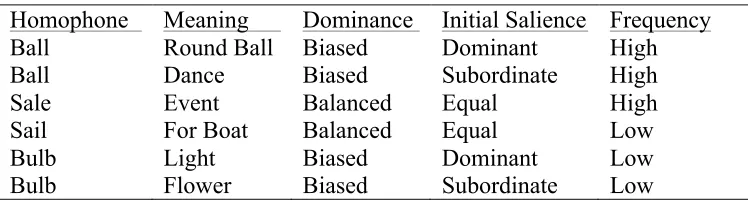
Table 3.1 Sample homophones divided by Dominance and Frequency.
Homophone Meaning Dominance Initial Salience Frequency
Ball Round Ball Biased Dominant High
Ball Dance Biased Subordinate High
Sale Event Balanced Equal High
Sail For Boat Balanced Equal Low
Bulb Light Biased Dominant Low
Bulb Flower Biased Subordinate Low
Frequency
Frequency of usage in language of a particular word can be measured by the
number of appearances of the word within a corpus. For example, just because when the
word “jeans” is pronounced aloud, the Dominant meaning is blue jeans, and the
Subordinate is genes as in genetics, this does not mean that either is common in general
language usage. In the current study, Frequency is measured by frequency of occurrence
in the Kucera & Francis corpus (1967). Effects based on the Frequency with which a
term appears in language have been widely reported in the literature pertaining to both
words are typically fixed on longer in reading paradigms (Rayner & Duffy, 1986). The
addition of homophones which do not share corresponding orthographic representations
offers the ability to estimate the Frequency of use of both words appearing in a standard
corpus while being sure of their intended meanings (e.g., jeans vs. genes), which is
impossible with strictly ambiguous words (e.g., ball). In the second case, Dominance
information is combined with the Frequency categorization of the ambiguous word in a
regressive design across items to better estimate the frequency of meanings (Griffin,
1999; Lucas, 1987). While Frequency estimates are corpus based written estimates,
Dominance effects are thought to contain a listener’s judgment of both frequency and
appropriateness. Thus, while the effects are separated within the current design, the
regressive nature allows the utilization of Balanced and Biased homophones, with written
frequencies that are high or low (see Frequency category of Table 3.1). This process is
further detailed in Chapters 6 & 7.
Other Information on Homophone Processing
While these two aspects of a homophone are expected to heavily impact
processing within a discourse, there are additional effects that need to be considered as
well. Evidence from behavioral studies has indicated that in terms of processing time, it
takes readers longer to read sentences with an ambiguous word than those without (Duffy
et al., 1988, Miyake et al., 1994, Rayner & Duffy, 1986; all from Mason & Just, 2007).
This evidence suggests that during a reading paradigm, individuals are sensitive to
polysemous homophones as they are encountered, and resolving the meanings delays the
time course of processing. Additional work on homophone processing has noted that
work, multiple meanings were activated if the words are placed in focus using accent
patterns; also, the focused parts receive a more detailed semantic processing of their
lexical meaning (Blunter & Sommer, 1988, from Cutler, Dahan, & van Donselaar, 1997).
Thus, the search for the meaning of the full word and sentence is related to the interaction
of the prosody with the information that becomes available during with lexical access of
an ambiguous word.
In further work using spoken sentences combined with visual representations,
participants have also shown sensitivity to the activation of multiple meanings of a
homophone (Mirman et al., 2008b; Chen & Boland, 2008). Visual World Paradigm
(hereafter VWP) experiments, which combine spoken language stimuli with a visual
display, have been used to demonstrate the effect. Participants have been found to fixate
on pictures corresponding to both meanings of an ambiguous word in nonrestrictive
contexts (the effects are brief), and fixate more on one meaning when the context was
restricted appropriately (Mirman et al., 2008b). In addition, both frequency and context
effects have been noted to have a role in homophone resolution in the VWP as well
(Chen & Boland, 2008).
The Current Work
Utilizing previous work, within the current study, the effect of sarcasm on
resolving a homophone reference assumes an effect on the combined result of the
Dominance and Frequency interaction present within each homophone, as the two are
difficult to disentangle. The other effects of mention on homophone processing must be
considered as well, such as the increased lexical processing (Blunter & Sommer, 1988,
2008). However, when this information is considered, the framework of the Graded
Salience (Giora, 1997) and Relevance Theory perspectives (Sperber & Wilson, 1995)
presented in Chapter 2 can then be used to generate hypotheses which favor different
homophone interpretations, when sarcasm is present or absent in an utterance.
If the effect of sarcasm interacts with the Dominance and Frequency of a
particular homophone within a discourse that offers no additional contextual information,
sarcasm may be preferred in one level the interaction (highlighting it), and it may have a
negative impact in another, resulting in a processing delay that mimics those noted in
other figurative language research (Giora, 1995; Giora, 1997). In this case, to evaluate
differences in a Graded Salience versus Relevance Theory approach to the effect of
sarcasm on discourse interpretation, we can examine whether sarcasm affects
interpretation by slowly building salience towards a particular interpretation of the
discourse (through additional processing of the meaning), or highlights a particular
interaction of information, and thus rapidly changes the interpretation of the discourse
(Giora, 1997, Sperber & Wilson, 1986; Sperber & Wilson, 1995).
One way of examining the interactions of these multiple variables is by using an
eye-movement study paradigm, such the VWP. This paradigm allows the visual
depiction of the different contexts of the homophones, and the online tracking of the
processing of competing interpretations by examining attention as measured by
eye-movements to the depictions. If Dominance and Frequency affect the interpretation of a
homophone early on and persist, it’s possible that sarcasm will have no effect on
changing a listener’s interpretation of a discourse, if it does not occur with the
spoken sincerely, there are changes in eye-movement patterns, an argument can be made
that the sarcasm is able to affect discourse processing, and perhaps interpretation as well.
CHAPTER 4
THE VISUAL WORLD PARADIGM
The Visual World Paradigm allows for the study of spoken language
comprehension using an online method in which stimuli are spoken, and eye-movements
to items related (or not) in the visual display are tracked (Cooper, 1974; Tanenhaus et al,
1995). Three important aspects of this paradigm: the discourse, visual display, and a
linking hypothesis that connects the two for the current study, (Tanenhaus et al., 2000)
can be manipulated adequately for use in the current study.
Because sarcasm is identified by adults using both context and prosody
information, a task utilizing spoken language processing provide a valid area in which to
study how well sarcasm functions to contribute to ambiguity resolution because both
pieces of information can be utilized (Capelli, Nakagawa, & Madden, 1990; Nakassis &
Snedeker, 2002; Rockwell, 2000). Spoken language can be studied using the VWP,
which allows prosody and visual context to interact, and offers an eye-movement record
as a measure of the online time course of processing. In addition, the ambiguity,
frequency, and dominance effects introduced in the previous chapter have all been
established to exist within the VWP (Mirman et al., 2008b; Chen & Boland, 2008).
In terms of discourses used in VWP studies, the paradigm has adapted very well
to the testing of multiple processing components. Many versions of this paradigm have
been used since it was first created, with the discourse serving a variety of functions. It
a word (Allopenna, Magnuson, & Tanenhaus, 1998), when semantic information is
accessed (Cooper, 1974; Huettig & Altmann, 2005; Huettig et al., 2006; Yee & Sedivy,
2006; Yee, Overton, & Thompson-Schill, 2009), the influence of shape and color
information on the processing of competitors of the same type (Huettig & Altmann,
2007), and reference tracking of possible antecedents (Dahan, Tanenhaus, & Chambers,
2002). This has been accomplished by varying the target items mentioned within the
discourse, or manipulating the referent that is referred to: whether it is a onset cohort,
rhyme, or semantic competitor to an item depicted in the visual scene shown with the
spoken language (Tanenhaus et al., 1995; Allopenna, Magnuson, & Tanenhaus, 1998;
Yee & Sedivy, 2006).
In addition, there have been varying experimental discourse configurations
previously studied. Some versions of the paradigm use the discourse aspect to require an
action on the part of the participant (e.g., “Click on the bed.”; Tanenhaus et al., 1995; Yee
& Sedivy, 2006), others passive listening (e.g., “Eventually the man agreed...then he
looked at the piano and appreciated that it was beautiful.”; Huettig et al., 2006), and in
some cases, an eventual response to a comprehension question. These different
discourse-processing requirements have been used to address questions regarding
integration and access (Dahan, Tanenhaus, & Chambers, 2002; Tanenhaus et al., 1995;
Allopenna, Magnuson, & Tanenhaus, 1998; Huettig & Altmann, 2005; Huettig et al.,
2006; Yee & Sedivy, 2006). The VWP was flexible enough to test the use of sarcasm in
discourse, when considering previous prosody manipulations, and the addition of a
question or movement task at the end of a stimulus assured participant attention was on
The second portion of the VWP that is necessary is the visual display. It is
eye-movements to the scenes portrayed in this portion of the paradigm that serve as the
dependent variable of analysis. The visual scene itself has taken a variety of different
forms in the paradigm since its inception. It has consisted of words typed out (McQueen
& Viebahn, 2007), a blank screen while the discourse is played (Altmann, 2004), and
most commonly, a display containing approximately four items, of which some are
simply distractors and some are related to the spoken discourse (Allopenna, Magnuson, &
Tanenhaus, 1998; Huettig et al., 2005; Huettig & Altmann, 2006; Yee & Sedivy, 2006).
The placement of the items in the display is usually randomized, and participants are not
specifically directed to focus their attention to any particular item. Nevertheless, this can
vary according to the instructions given in a particular version of the VWP. Attention is
then considered to be a consequence of the linguistic input the participant is receiving
that accompanies the display. Although the display contains only a closed set of possible
referents, the paradigm is considered to be able to address the questions regarding lexical
access and processing through the final portion necessary in the VWP, the linking
hypothesis. By altering the items in the display to represent the referents from the
multiple meanings activated by the homophones, or items closely related to those
meanings, eye-movements to the display offer time course information on the processing
of the homophones.
A linking hypothesis (Tanenhaus et al., 2000) is also required for any VWP
experiment. Within the linking hypothesis for the study, is the implication that
eye-movements to items depicted in the display, when time-locked to the spoken language
research question of interest (Tanenhaus et al., 2000; Allopenna, Magnuson, &
Tanenhaus, 1998). Thus, this hypothesis is specific to a set of experimental conditions
that are considered valid and reliable by the experimenter. Multiple methods of
analyzing the data from this paradigm have recently become available, and are utilized