MODELING TO COMPILING: DESIGN AND
IMPLEMENTATION FOR WIRELESS SENSOR NETWORK
SYSTEM
1BO HUANG, 2MENGTING YUAN, 3GUOQING WU, 4XIANG LING, 5CHAO WAN
1
School of Computer, Wuhan University, Hubei, CHN
2
Assoc. Prof., School of Computer, Wuhan University, Hubei, CHN
3Prof., School of Computer, Wuhan University, Hubei, CHN 4School of Computer, Wuhan University, Hubei, CHN 5School of Computer, Wuhan University, Hubei, CHN
E-mail: [email protected], [email protected], 3 [email protected],
4[email protected], 5[email protected]
ABSTRACT
Based on the characteristics of the Wireless Sensor Network (WSN), researchers tend to ignore the system modeling of the complex system which is built by WSN and the central processor. Actually, the complex modeling method and code generation tool will cause a lot of manpower and time costs. Different from the existing methods and techniques, this paper presents a system behavior modeling method and code generation technique based on WSN. The method of model validation and system simulation is also proposed on this basis.
Keywords: Wireless Sensor Network (WSN), Behavioral Models, Code Generation, Behavior Description
Language (BDL),Simulation
1. INTRODUCTION
WSN is constructed by many randomly distribution tiny nodes which using a self-organized manner to form the network. Each node has an integrated sensor, a data processing unit and a communications module. The different kind of sensors in the node measure the surrounding environment by means of heat, infrared, sonar, radar and seismic wave signals, thereby to detect the temperature, humidity, noise, light intensity, pressure, soil composition, the size of the moving object, the speed and direction, and many other physical phenomena that we are interested in [1][2]. However, the sensor, as the surrounding environment data collection and transmission device, the data transmitted to the central processor is large and cumbersome. Meanwhile, the processing for data to drive and assist the central processor for the follow-up event is not visible. For customers, the actual users of the system, in the early stages of the project development, requirement which they put forward is not complete [3]. Therefore, the developer of the system is obliged to establish a model that can be able to accurately express requirement to enhance the practicality of the sensor network system.
A new hot spot of software engineering is to compile requirement model to code [4]-[6]. The current study is basically from traditional formal model (such as Statechart) to code generation. But no one focuses on the system modeling and code compilation for WSN. This work includes a study of two elements: 1. Requirements modeling is based on WSN system. The model must help users to understand the target system will "do-what" on one hand. And on the other hand, the model should have formal semantics for developers to validate some features of the model. 2. The code generated from the model means that a completed model which is validated is a best blueprint to generate the target system code [7].
modeling method to communicate and validate effectively for WSN [15].
In this paper, the research which is WSN-based is elaborated from the three parts to design and implement: Section 2, requirements modeling for the behavioral model-based WSN system and checking and validation of the model; Section 3, the code generation from the model to the target system; Section 4, a factory production line sample
which is using the sensor's data to control a assembly robot in a simulation experiment.
2. MODELING AND MODEL VALIDATION
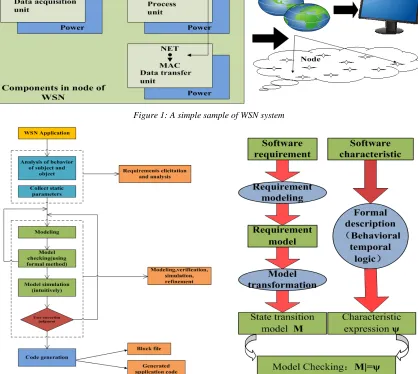
[image:2.612.93.517.224.350.2]A WSN system is constituted by a number of specific network nodes and network servers. Each network node of a sensor has four components: data acquisition, data processing, data transmission and power supply. Figure 1 shows a simple sample of WSN system.
Figure 1: A simple sample of WSN system
Figure 2: The Basic Steps Of The Modeling Method And The Model Validation Steps Of WSN System
In each network node, data and instructions are transmitted between components. In the areas of software engineering, these instructions are, in fact, the internal behaviors of the system that is the software behaviors. Data is the parameter which is generated and transmitted by software behaviors. Modeling method mentioned in this paper uses a
[image:2.612.97.515.248.622.2]modeling method and the model validation steps of WSN system.
The software behaviors in WSN system are defined as atomic behavior, empty behavior, simple behavior and composite behavior. Composite behavior in different logical environments needs to express different logical interaction. In this paper, the definition of these relationships has four kinds: sequence relationship, parallel relationship, non-deterministic choice relationship and non-deterministic choice relationship. Therefore, as a modeling language, BDL fully equips to describe the semantics foundation of a WSN system. At the same time, due to the dynamic semantics of BDL for descripting the change of behavioral expressions, and close to the dynamic semantics expressed by communication calculus system (CCS) [17], the operation semantics of systems and viewpoints behavior model can be available. All of these can provide a better basis for validating various characteristics of the target system [18].
See Figure 2. Developers still unable to determine the correctness of a model after established a preliminary model. There are two ways to validate the model: a formalization method, and the other way is to demonstrate simulation animation to users to check the correctness of system. In author's article (which can be seen in ref [19]), there is a detailed description of the second method. The formalization method to verify the correctness of the model is always the mainstream method in software engineering. This article introduces how to validate the effectiveness of system.
In Figure 2, dynamic semantics of requirements model, similar to the dynamic semantics of CCS model, can be converted into CCS model. At the same time, the user-defined characteristics of the system (such as consistency, non-termination, credibility, etc.) can be described by formal behavioral temporal logic and get the corresponding characteristic expression. This paper argues that, when a model M meeting the expected running trail (the behavioral temporal logic formulas), the established model is valid.
3. COMPILING AND CODE GENERATION
As mentioned earlier, BDL is used for describing the behaviors of a WSN system itself. Then a certain rule of composite behavior sequence, can be regarded as a function module of the WSN system logically. The establishment of a scene for the WSN system actually is establishing a particular module. This module may be a function module or a non-functional module. At the executional level,
the behavioral requirements model of the system is similar to a flow chart describing the process, which has a programming style in WSN system.
The concept of the scene in the introduction of the code generation mechanism, in fact, can help users to analyze and to decompose the internal modules\components relationships of the system [20]. The structure of the scene in the WSN system which is involved in development process, can effectively describe the interactive behaviors and the external behaviors between users and systems. Further, according to the relationship between scenes, such as expansion, invocation, hierarchy, parallel and sequential, in accordance with the descriptive content of the behavior itself, it is necessary to provide a template or a subroutine file to encode program. Meanwhile, the code can be debugged and compiled in development platform, and finally formed the tested source code file.
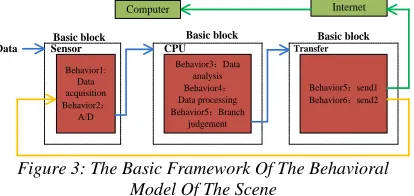
This paper takes the assembly robot system in factory production line as an example, and discusses the widely implementation of method. The specific instance will be involved in next section. Here, paper takes the internal behaviors of the sensor node which is running under normal operating conditions as a basic scenario, and models it. The basic framework of the behavioral model of the scene can be seen in Figure 3:
Behavior1: Data acquisition Behavior2:
A/D
Behavior3:Data analysis Behavior4: Data processing Behavior5:Branch
judgement
Behavior5:send1 Behavior6:send2
Sensor CPU Transfer
Data
Internet Computer
[image:3.612.316.523.429.527.2]Basic block Basic block Basic block
Figure 3: The Basic Framework Of The Behavioral Model Of The Scene
BDL Modeling
Determine scene relationship
Determine the input/output behavior under the
scene
Define parameters(within
behavior)
Analysis before coding
Coding
Testing
WSN Application
Figure 4: The Implementation Process Of WSN Application
Obtained from Figure 3 and Figure 4, the three basic components of the sensor node are seen as three basic blocks in a scene. When the sensor is running, data transferring occurs inside\between the components in each basic blocks. And the transfer and occurrence of these data are in fact the results of the behaviors. Each atom behavior which is corresponding into the program is a function which is invoked and processed by objects (the basic components). Meanwhile, the parameters in atom behavior are the variables containing the sensing data. The variables are transferred, modified and used between functions. The value of parameters
even can be enforced as constraints of behaviors for being the conditions of the follow-up behaviors.
4. SAMPLE AND SIMULATION
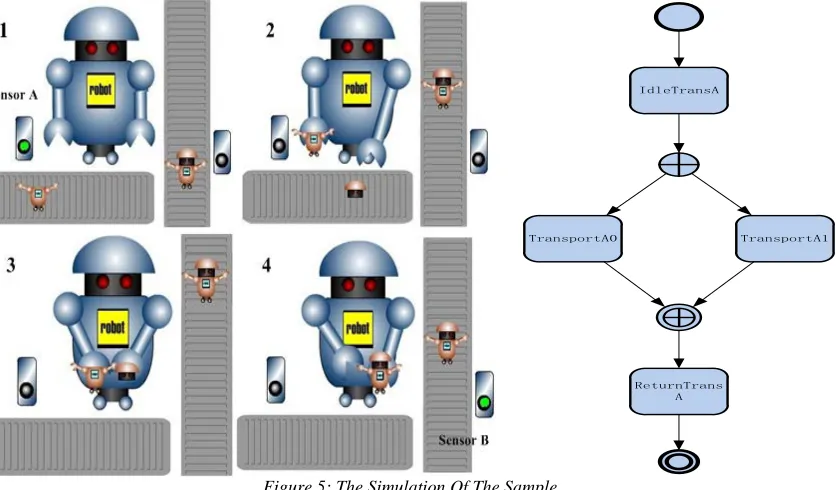
[image:4.612.90.292.67.219.2] [image:4.612.101.519.391.636.2]The robot in the production line exemplified by this paper is to demonstrate how a wireless sensor networks, which is based on the abstract level of whole system, is applied in actual production and daily life. There are two types of wireless sensors in Figure 5. These sensors are in differences of functions. Sensor A is provided in the parts transfer line. It judges the types of the parts by sizes, and transmits the results to robots which assemble. Besides, sensor B is set in the finished product transmission band to judge whether there is no vacancy. And when robots finish assembling, they are allowed that put the finished product on the vacancy on the transmission band. The left part of Figure 5 is a simulation of the process (visualization of requirements model). The simulation could help the users to determine whether "requirement" are properly express their needs further. The simulation system can be found in ref [19], which is developed by our project team.
IdleTransA
TransportA0 TransportA1
ReturnTrans A
Figure 5: The Simulation Of The Sample
Sensor A and B transmit the signals to robots, and according to parameter values assembling robots determine how to drive operations. The right part of Figure 5 describes the assembling robot based on state diagram.
As the left of Figure 5, the simulation of the factory production line is very clear. The simulation
process is implemented based on the BDL model-driven method. More details about the entire simulation process can be seen in ref [19]. At the same time, we realize more than one sample, involving a wide range of application types.
process of the robot picks part A and B, which acts are according to signals of the wireless sensor.
Meanwhile, the right part of Figure 6 is a C code fragment referred to BDL.
BEGIN ABEH:
TransportA1:transportA1 (Conveyer-belt A,Component) OutTo ()(Component A)
TransportA2:transportA2(Conveyer-belt A,Component) OutTo ()(Component B)
SensorA0 :Check A (Sensor A,Conveyer-belt A) When ( ) InFrom () (Component on Conveyer-belt A ) OutTo (Sensor,Robot) (Type of the Component on Conveyer-belt A)
Robot_ReceiveM:Receive (Robot,Sensor A) InFrom() (Type of the Component on Conveyer-belt A)
Robot_GetPartA:Get A (Robot,Conveyer-belt A)
Robot_GetPartB:Get B (Robot,Conveyer-belt A) InFrom () (Component B) Robot_Assembly:Assembly(Robot,Component A and Component B) OutTo (Robot,Sensor B) (Position Message)
BEH:
Scenario_A = TransportA | SensorA | Robot | SensorB | TansportB TransportA =(TransportA1 + TransportA2); Return (TransportA).
Robot_A =Robot_ReceiveM;
If (Robot_Lhand = null) and (Type of the Component =A) then Robot_GetPartA
Else
If (Robot_Rhand = null) and (Type of the Component =B) then Robot_GetPartB ;
Else
Idle; // Waiting if there is no property component Fi
Fi
If (Robot_Lhand != null) and (Robot_Rhand != null) then Robot_Assembly;
Fi; END
int WaitMessage(int channel);
void SendMessage(int channel, int message); enum ComponentType {NoComponent, ComponentA, ComponentB};
void Robot_ReciveveM() {
SensorA_Component = WaitMessage(SencorA_Robot); }
void Robot_A() {
Robot_ReciveveM();
if (Robot_Lhand == NoComponent && SensorA_Component == ComponentA) {
Robot_GetPartA(); }
else if(Robot_Rhand == NoComponent && SensorA_Component == ComponentB) {
Robot_GetPartB(); }
else {
idle(); }
if (Robot_Lhand != NoComponent && Robot_Rhand != NoComponent) {
Robot_Assembly(); }
}
void SensorA0() {
int temp = WaitMessage(ConveyerbeltA_SensorA); SendMessage(SencorA_Robot, temp);
}
void SensorA() {
while(true) SensorA0(); }
Figure 6: The BDL Model And C Code Fragment Of The Sample
0 20 40 60 80
Modeling Verication Coding Testing
H
um
a
n C
os
t
[image:5.612.87.516.64.465.2]Tranditional method Our method
Figure 7: the feedback research
Feedback research about the completion of the samples from student users in the use of our system modeling method has some specific details in Figure 7. We had two teams. One team was using the traditional modeling tools and development approaches to achieve the sensor network system (Statechart and DevC); And the other team was using our method. Based on users' feedback, our tools can effectively reduce the time and cost of development.
[image:5.612.87.529.497.586.2]5. CONCLUSIONS
This paper presents a new way of thinking to design and implement the system based on wireless sensor networks. Set up a semi-formal modeling approach to such a system modeling and model validation. Among them, model validation method is based on formal verification for professionals and system simulation for users. The model of the target system is developed as a blueprint for generating the code which is scenes and components oriented, and the establishment of the target system ultimately. Compared to some other tools, our requirements modeling work is sound and effective. But our tool is weak in compiling code for automated level. Future work will deepen the research mainly on the part of code generation.
ACKNOWLEDGEMENTS
This research is supported by National Natural Science Foundation of China (91118003, 61003071), Fundamental Research Funds for the Central Universities (3101046, 201121102020006), and Special Funds for Shenzhen Strategic New Industry Development (JCYJ20120616135936123).
REFRENCES:
[1] Ren FengYuan, Huang HaiNing, Lin Chuang, “Wireless Sensor Networks”, Journal of Software, Vol. 14, No. 7, 2003, pp.1282-1291.
[2] Cui Li, Ju Hailing, Miao Yong, Li Tianpu, Liu Wei, Zhao Ze, “Overview of Wireless Sensor Networks”, Journal of Computer Research and Development, Vol. 42, No. 1, 2005, pp.163-174. [3] Hande Alemdar, ,Cem Ersoy, “Wireless sensor networks for healthcare: A survey”, Computer Networks, Vol. 54 , No. 15, 2010, pp.2688-2710.
[4] Shahar Maoz, David Harel, “From Multi-Modal Scenarios to Code: Compiling LSCs into AspectJ”, Proceedings of the 14th ACM SIGSOFT international symposium on Foundations of Software Engineering, ACM, 2006, pp.219-230.
[5] Grechanik. M, Chen Fu, Qing Xie, McMillan. C, Poshyvanyk. D, Cumby.C, “Exemplar: EXEcutable exaMPLes ARchive”, Proceedings of the 32nd ACM/IEEE International Conference on Software Engineering, ACM, 2010, pp.259-262.
[6] Betty.H.C. Cheng, Joanne.M. Atlee, “Current and Future Research Directions in
Requirements Engineering”, Lecture Notes in Business Information Processing, Springer, Vol.14, No.1, 2009, pp. 11-43.
[7] Wu Hao, Wu Guoqing, “Dynamical integrity of codes: Model and method”, Journal of Computer Research and Development, Vol. 49, No. 9, 2009, pp. 1874-1882.
[8] Yuan Honglin, Xu Chen, Zhang Guoan, “Researches on simulation method of wireless sensor networks based on embedded operation system”, Control & Automation, Vol. 22 , No. 19, 2006, pp.154-156.
[9] Satya Murty S.A.V, Baldev Rajb, Krishna.M.Sivalingamc, Jemimah Ebenezera, Chandran.T, Shanmugavel M, Rajan K.K, “Wireless sensor network for sodium leak detection”, Nuclear Engineering and Design, Vol. 249, August, 2012, pp.432-437.
[10] Xianghui Cao, Jiming Chen, Yan Zhang, Youxian Sun, “Development of an integrated wireless sensor network micro-environmental monitoring system”, ISA Transactions, Vol. 47 , No. 3, 2008, pp.247–255.
[11] Weichao Wang, Bharat Bhargava, “Visualization of wormholes in sensor networks”, Proceedings of the 3rd ACM workshop on Wireless security, ACM, 2004, pp. 51-60.
[12] Mozumdar.M.M.R, Gregoretti.F, Lavagno.L, Vanzago.L, Olivieri.S, “A Framework for Modeling, Simulation and Automatic Code Generation of Sensor Network Application”,
Proceedings of the 5th Annual IEEE Communications Society Conference on Sensor, Mesh and Ad Hoc Communications and Networks, IEEE, June 16-20, 2008, pp. 515-522. [13] F.Fummi, D.Quaglia, F.Ricciato, M.Turolla,
“Modeling and Simulation of Mobile Gateways Interacting withWireless Sensor Networks”, Proceedings of the conference on Design, automation and test in Europe: Designers' forum, ACM, 2006, pp. 106-111 [14] G.Q. Wu, Z.P. Liang, M.T. Yuan, Y.H. Li,
Software Requirements Engineering, China Machine Press, 2008, CHN.
[15] D. Harel, R. Marelly, Come, Let’s play: Scenario-Based Programming Using LSCs and the Play-Engine, Springer-Verlag, 2003, GER. [16] Yao Yu, Wu Guoqing, Wan Li, Wu Huaiguang,
[17] Li Wan, Bo Huang, Huangguang Wu, Xiang Ling, “BRM—A Behavior Based Requirements Modeling Method”, Software Engineering and Knowledge Engineering: Theory and Practice, Springer, Vol.1, 2012, pp. 1139-1147.
[18] Wu Huaiguang, Wan Li, Wu Guoqing, Ling Xiang, Liang ZhengPing, “Behavior- oriented Software Requirements Model and Logical Properties”, Proceedings of 2nd International Workshop on Intelligent Systems and Applications (ISA), IEEE, May 22-23, 2010, pp.1-5.
[19] B. Huang, G.Q. Wu, L. Wan, L. Li, J. Wang, “A visualization method of requirement checking based on software behavior”, Wuhan University Journal of Natural Sciences, Springer-Verlag, Vol.16, No.6, 2011, pp. 507-512.