* Corresponding author.
E-mail: [email protected] (A.-M. Golmohammadi) © 2016 Growing Science Ltd. All rights reserved.
doi: 10.5267/j.ijiec.2016.3.004
International Journal of Industrial Engineering Computations 7 (2016) 607–614 Contents lists available at GrowingScience
International Journal of Industrial Engineering Computations
homepage: www.GrowingScience.com/ijiecA genetic algorithm for preemptive scheduling of a single machine
Amir-Mohammad Golmohammadia*, Hamid Bani-Asadib, Hamed Jafar Zanjanic and Hamid Tikanid
aPh.D Student of Industrial Engineering, Department of Industrial Engineering, University of Yazd, Yazd, Iran
bGraduate student of Industrial Engineering, Department of Industrial Engineering, Naragh Branch, Islamic Azad University, Naragh, Iran cAssistant Professor, Department of Industrial Engineering, Naragh Branch, Islamic Azad University, Naragh, Iran
dGraduate student of Industrial Engineering, Department of Industrial Engineering, University of Yazd, Yazd, Iran C H R O N I C L E A B S T R A C T
Article history:
Received November 4 2015 Received in Revised Format February 21 2016
Accepted March 21 2016 Available online March 22 2016
This paper presents a mathematical model for scheduling of a single machine when there are preemptions in jobs. The primary objective of the study is to minimize different objectives such as earliness, tardiness and work in process. The proposed mathematical problem is considered as NP-Hard and the optimal solution is available for small scale problems. Therefore, a genetic algorithm (GA) is developed to solve the problem for large-scale problems. The implementation of the proposed model is compared with GA for problems with up to 50 jobs using three methods of roulette wheel sampling, random sampling and competition sampling. The results have indicated that competition sampling has reached optimal solutions for small scale problems and it could obtain better near-optimal solutions in relatively lower running time compared with other sampling methods.
© 2016 Growing Science Ltd. All rights reserved Keywords:
Preemption
Single machine scheduling Work in process Genetic algorithm
1. Introduction
Nowadays, there is a growing trend on shortage of resources, equipment, investments and facilities. Therefore, it is necessary to have optimal allocation of resources using different scheduling techniques
(Liao & Cheng, 2007). In fact, a good scheduling plays essential role on development of more efficient
608
Szwarc and Mukhopadhyay (1996) presented an efficient technique to solve an earliness-tardiness single
machine n job scheduling model where idle times was allowed and the earliness and tardiness penalties
were proportional to the processing times of the jobs. Lenstra et al. (1997) showed that a single job
scheduling problem is NP-Hard. Ahmadizar and Farhadi (2015) considered a single-machine scheduling problem in which jobs were released in various times but delivered in batches and a due window was related to each job. They aimed to schedule the jobs, to form them into batches and to select the delivery
date of each batch to minimize the sum of earliness, tardiness, holding as well as delivery costs. Bülbül
et al. (2007) investigated a single machine earliness/tardiness scheduling problem with general weights, ready times and due dates and the method is based on a time-indexed preemptive relaxation of the problem.
Hendel et al. (2009) studied the concept of preemption in scheduling, with earliness and tardiness penalties where the earliness costs was dependent on the start times of the jobs. They proposed an efficient representation of dominant schedules to measure the most appropriate schedule for a given representation. Sourd and Kedad-Sidhoum (2003) addressed the one-machine problem where the jobs had distinct due dates, earliness costs, and tardiness costs. Sun et al. (1999) investigated the NP-hard
problem of scheduling N independent jobs on a single machine with release dates, due dates, sequence
dependent setup times, and no preemption to minimize the weighted sum of squared tardiness. Valente (2008) presented an exact method for the single machine scheduling problem with linear early and quadratic tardy penalties.
Valente and Gonçalves (2009) propsoed a genetic algorithm method for the single machine scheduling problem with linear earliness and quadratic tardiness penalties. Khorshidian et al. (2011) is associated with the concept of preemption in just-in-time single machine scheduling problem, with permissible machine idle time. Runge and Sourd (2009) investigated a new technique for the one-machine earliness– tardiness scheduling problem where jobs could be interrupted. They also proposed a timing method and a local search algorithm based on this timing to reach a good feasible solutions. M’Hallah (2007) proposed a hybrid heuristic to minimize total earliness and tardiness on a single machine. Kazemi et al. (2012) considered preemption and idle time in a single machine scheduling problem with just-in-time (JIT) approach. Wang et al. (2011) considered a single-machine scheduling problem with linear decreasing deterioration in which the due dates were determined by the equal slack method.
2. The proposed study
In this paper, we propose a single machine job preemptive scheduling with earliness tardiness constraints. In addition, we also consider the cost of work in process.
Assumption
1. Preemption and interruption are permitted.
2. At any time up to one work can be assigned to each machine. 3. Processing time of each job is deterministic.
4. There are certain number of jobs at each time.
5. Work in process and its cost are considered during the scheduling. 6. Start time, processing time and due dates are known in advance.
7. If operations of a job is interrupted, a cost of work in process is considered. 8. There is machine breakdown.
9. There is a cost for job preemption.
Indices
Parameters
Processing time of job i Due date of job i
Penalty of earliness of job i Penalty of tardiness of job i Penalty for maintaining job i
Penalty for facing preemption of job i Penalty of earliness of each earliness job i Penalty of tardiness of each tardiness job i
M A big number
Variables
Completion time of job i Starting time of job i j = 2
" Starting time of job i j = 1
Starting time of job i Earliness permitted for job i Tardiness permitted for job i
A binary variable, which is one if job i is processed at period j, and zero, otherwise
A binary variable, which is one if 1 and zero, otherwise
A binary variable, which is one if there is earliness on job i, and zero, otherwise A binary variable, which is one if there is tardiness on job i, and zero, otherwise
Mathematical model
(1)
1
2 , 2
subject to
(2)
∀ 1, … ,
max 0,
(3)
∀ 1, … ,
max 0,
(4)
∀ 1, … ,
1
(5)
∀ 1, … ,
(6)
∀ 1, … ,
.
(7)
∀ 1, … ,
.
(8)
∀ 1, … ,
max .
(9)
∀ 2, … ,
∀ 1, … ,
610
(11)
∀ 2, … ,
∀ 1, … ,
min , "
(12)
∀ 2, … ,
∀ 1, … ,
1 1
(13)
∀ 2, … ,
∀ 1, … ,
, , ∈ 0,1
∀ 2, … ,
∀ 1, … ,
, , , , , ", 0
The objective function given in Eq. (1) consists of five parts of earliness, tardiness, job preemption, work in process, the number of earliness and the number of tardiness. Eq. (2) and Eq. (3) are associated with jobs with earliness and tardiness, respectively. According to Eq. (4), in each period, only one job needs to be processed and according to Eq. (5), each job is divided into Piprocess in each period. Eq. (6) and
Eq. (7) indicate the number of earliness and tardiness for each job. Eq. (8) shows the time the process of each job ends. Eqs. (9-11) demonstrate the starting time of jobs. Eq. (12) determines the relationship
between and and finally Eq. (13) determines the nature of variables in terms of binary/continuous.
Note that max , ∑
,
which makes the set of feasible solution to be non-empty andTable 1 presents the input data used for the next section.
Table 1
The input data
1 20 82 9 17 16
2 65 126 6 8 11
3 15 162 12 3 6
4 5 135 1 19 7
5 50 112 18 11 10
3. Genetic algorithm
As explained earlier, the proposed model of this paper is formulated as mixed integer programming and
is classified as an NP-Hard problem (Lenstra et al., 1997). Therefore, we use genetic algorithm (GA) to
solve the resulted model for problems in large-scales. GA is known as the most famous metaheuristic
algorithm in the world. Holland (1992) is believed to be the first who introduced GA and it has been
widely implemented in different classes of problems. GA is considered as a metaheuristic search, which mimics the process of natural selection. The processed is routinely implemented to generate useful solutions to optimization and search problems. It belongs to the bigger class of evolutionary algorithms (EA), which create solutions to optimization problems based on techniques inspired by natural evolution, including inheritance, mutation, selection, and crossover. The chromosome of the proposed GA method is a string where each cell represents a job as follows,
1 3 2 5 4
Fig. 1. The chromosome
The population of the proposed GA method consists of J elements with ∑ . The
fitness function is evaluated based on Eq. (1). In addition, the earliness and tardiness are computed as follows,
(14) max 0,
In addition, the number of preemption is evaluated by ∑ , 2 , time for
maintaining work in process is computed by , and finally, .
and
. are used to compute the earliness and tardiness. To select the parents, we use three methods of
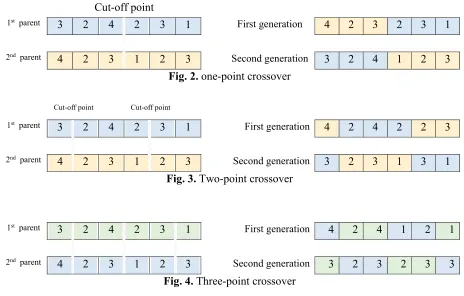
roulette wheel sampling, random sampling and competition sampling. Moreover, we use three methods of one-point, two-point and three-point crossover operators shown in Fig. 2, Fig. 3 and Fig. 4 as follows,
Cut-off point 1 3 2 3 2 4 First generation 1 3 2 4 2 3 parent st 1 3 2 1 4 2 3 Second generation 3 2 1 3 2 4 parent nd 2
Fig. 2. one-point crossover Cut-off point Cut-off point 3 2 2 4 2 4 First generation 1 3 2 4 2 3 parent st 1 1 3 1 3 2 3 Second generation 3 2 1 3 2 4 parent nd 2
Fig. 3. Two-point crossover
1 2 1 4 2 4 First generation 1 3 2 4 2 3 parent st 1 3 3 2 3 2 3 Second generation 3 2 1 3 2 4 parent nd 2
Fig. 4. Three-point crossover
The operations of the mutation operator is performed to escape from local solutions. Fig. 5 demonstrates the process of mutation operation used in this paper.
*
*
1 2
2
4
3 3 After
1 2 3
4
2
3
Before
*
*
2 2
3
4
1 3 After
1 2 3
4
2
3
Before
*
*
2 3
4
1
2 3 After
1 2 3
4
2
3
Before
Fig. 5. Mutation operation
612
6, and 8 jobs are considered small size, problems with 10, 15 and 20 jobs are considered medium size and problems with 30, 40 and 50 jobs are considered as large scale problems.
The processing time follows a uniform distribution with [1 20], earliness and tardiness times also follow uniform distribution with [1 10] and finally, due dates are defined as follows,
, 1
2
Here, TEF and RDD are considered for suitable delivery time and the values of 0.2 and 0.5 are considered for TEF and 0.5 and 0.8 are considered for RDD.
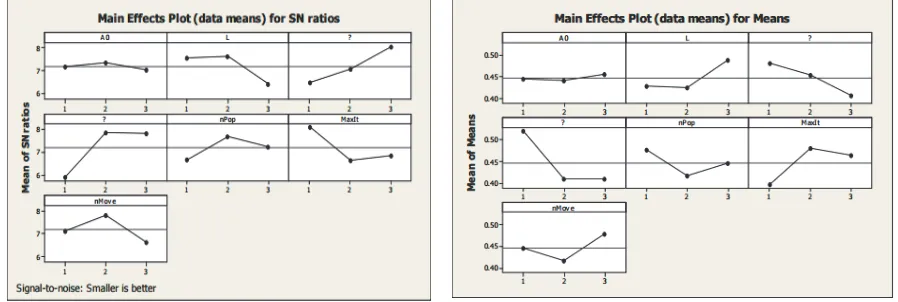
Parameter tuning
In order to improve the performance of the proposed study, we use Taguchi method (Montgomery, 2008).
For crossover probability ( we use three levels of 0.8, 0.85 and 0.9. In addition, for mutation
probability ( we use three levels of 0.03, 0.06 and 0.09. Number of population is considered in
two levels of 100 and 200. Moreover, number of generation is considered in one level with 100.
Finally, 0.8, 0.06, 100 are considered as default values. Fig. 6 shows details of the
implementation of the Taguchi method.
Fig. 6. The results of Taguchi method
All computations for the implementation of GA have been coded in MATLAB2011
and
GAMS2 23.9(CPLEX) on a personal computer with AMD 4600 GHz with one gigabyte memory.
4. Results
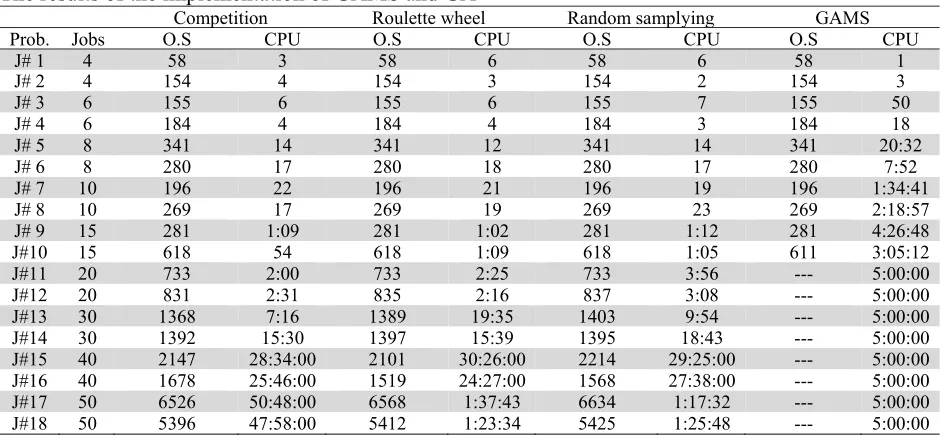
solution are also presented in the last two columns in terms of objective function and CPU time. All times are given in minutes and hours.
Table 2
The results of the implementation of GAMS and GA
Competition Roulette wheel Random samplying GAMS
Prob.
Jobs O.S CPU O.S CPU O.S CPU O.S CPU
J# 1
4 58 3 58 6 58 6 58 1
J# 2 4 154 4 154 3 154 2 154 3
J# 3 6 155 6 155 6 155 7 155 50
J# 4 6 184 4 184 4 184 3 184 18
J# 5 8 341 14 341 12 341 14 341 20:32
J# 6 8 280 17 280 18 280 17 280 7:52
J# 7 10 196 22 196 21 196 19 196 1:34:41
J# 8 10 269 17 269 19 269 23 269 2:18:57
J# 9 15 281 1:09 281 1:02 281 1:12 281 4:26:48
J#10 15 618 54 618 1:09 618 1:05 611 3:05:12
J#11 20 733 2:00 733 2:25 733 3:56 --- 5:00:00
J#12 20 831 2:31 835 2:16 837 3:08 --- 5:00:00
J#13 30 1368 7:16 1389 19:35 1403 9:54 --- 5:00:00
J#14 30 1392 15:30 1397 15:39 1395 18:43 --- 5:00:00
J#15 40 2147 28:34:00 2101 30:26:00 2214 29:25:00 --- 5:00:00
J#16 40 1678 25:46:00 1519 24:27:00 1568 27:38:00 --- 5:00:00
J#17 50 6526 50:48:00 6568 1:37:43 6634 1:17:32 --- 5:00:00
J#18 50 5396 47:58:00 5412 1:23:34 5425 1:25:48 --- 5:00:00
As we can observe from the results of Table 2, both GA and GAMS could solve the problems in small and medium sizes, successfully and they reached optimal solutions. However, for large-scale problems, only GA could solve the problem. The other observation from the results of Table 2 is that competition method used in GA to generate intial population could reach better solution in less amount of time compared with other two samplying techniques.
4. Conclusion
In this paper, we have presented a mathematical model for scheduling of a single machine when there were preemptions in jobs. The primary objective of the study was to minimize different objectives such as earliness, tardiness, work in process, etc. The proposed mathematical problem was NP-Hard and the optimal solution was available for small scale problems. Therefore, a genetic algorithm (GA) has been developed to solve the problem for large-scale problems. The implementation of the proposed model was compared with GA for problems with up to 50 jobs using three methods of roulette wheel sampling, random sampling and competition sampling. The results have indicated that competition sampling has reached optimal solutions for small scale problems and it could obtain better near-optimal solutions in relatively lower running time compared with other sampling methods.
Acknowledgement
The authors would like to thank the anonymous referees for constructive comments on earlier version of this paper.
References
614
Bülbül, K., Kaminsky, P., & Yano, C. (2007). Preemption in single machine earliness/tardiness scheduling. Journal of Scheduling, 10(4-5), 271-292.
Davis, J. S., & Kanet, J. J. (1993). Single‐machine scheduling with early and tardy completion costs. Naval Research Logistics (NRL), 40(1), 85-101.
Hendel, Y., Runge, N., & Sourd, F. (2009). The one-machine just-in-time scheduling problem with preemption. Discrete Optimization, 6(1), 10-22.
Holland, J., (1992). Adaptation in natural and artificial systems: MIT Press. Cambridge, MA.
Kazemi, M., Nikoofarid, E., Aalaei, A., & Kia, R. (2012). Just-in-time preemptive single machine
problem with costs of earliness/tardiness, interruption and work-in-process. International Journal of
Industrial Engineering Computations, 3(3), 321-336.
Khorshidian, H., Javadian, N., Zandieh, M., Rezaeian, J., & Rahmani, K. (2011). A genetic algorithm for
JIT single machine scheduling with preemption and machine idle time. Expert Systems with
Applications, 38(7), 7911-7918.
Lenstra, J. K., Kan, A. R., & Brucker, P. (1977). Complexity of machine scheduling problems. Annals
of Discrete Mathematics, 1, 343-362.
Liao, C. J., & Cheng, C. C. (2007). A variable neighborhood search for minimizing single machine
weighted earliness and tardiness with common due date. Computers & Industrial Engineering, 52(4),
404-413.
M’Hallah, R. (2007). Minimizing total earliness and tardiness on a single machine using a hybrid heuristic. Computers & Operations Research, 34(10), 3126-3142.
Montgomery, D. C. (2008). Design and analysis of experiments. John Wiley & Sons.
Runge, N., & Sourd, F. (2009). A new model for the preemptive earliness–tardiness scheduling problem. Computers & Operations Research, 36(7), 2242-2249.
Sourd, F., & Kedad-Sidhoum, S. (2003). The one-machine problem with earliness and tardiness penalties. Journal of scheduling, 6(6), 533-549.
Sun, X., Noble, J. S., & Klein, C. M. (1999). Single-machine scheduling with sequence dependent setup to minimize total weighted squared tardiness. IIE transactions, 31(2), 113-124.
Szwarc, W., & Mukhopadhyay, S. K. (1996). Earliness and tardiness single machine scheduling with proportional weights. Journal of Global Optimization, 9(3-4), 227-238.
Valente, J. M. (2008). An exact approach for the single machine scheduling problem with linear early and quadratic tardy penalties. Asia-Pacific Journal of Operational Research, 25(02), 169-186. Valente, J. M., & Gonçalves, J. F. (2009). A genetic algorithm approach for the single machine
scheduling problem with linear earliness and quadratic tardiness penalties. Computers & Operations Research, 36(10), 2707-2715.