International Journal of Advanced Research in Computer Science
RESEARCH PAPER
Available Online at www.ijarcs.info
Implementation of Earliest Deadline First Algorithm for Wireless Sensor Network
Ms.P. B. Lohiya M.E (2nd yr CSE) PRMCEAM Amravati, India
Dr. D.G.Harkut Associate professor PRMCEAM Amravati, India
Dr. M.S.Ali Principal
PRMCEAM Amravati, India
Abstract: This paper presents the implementation of an earliest deadline first (EDF) scheduling mechanism for Wireless Sensor Network (WSN). In this paper we are monitoring and scheduling the sensor values in real time by embedding wireless sensor nodes. We use the LPC2148 ARM7TMDI based microcontroller which is used as core control module and design the overall structure of the system according to the basic need of wireless sensor network. We design the hardware system structure and software system structure where we implement EDF algorithm for scheduling aperiodic task of the WSN in a real time way.
Keywords:Wireless Sensor Network, EDF algorithm, Rate monotonic, Deadline Monotonic.
I. INTRODAUCTION
A WSN is a network of wireless interconnected sensors. These are usually small autonomous devices that monitor some physical conditions or other values with their sensors and use short range wireless link for communication between them and between higher level systems. The measured values typically are temperature, humidity, light intensity, etc [1] [2] [3].Compare to other networks, a WSN has its own design and resource constraints. Resource constraints include a limited amount of energy, short communication range, low bandwidth, limited processing and storage in each node and also battery power, program memory available. Design constraints are application dependent and are based on the monitored environment. The environment plays an important role in determining the size of the network, the deployment scheme, and the network topology [4] [5]. The size of the network varies with the monitored environment. Consider we are building a network for indoor then fewer nodes are required to form a wireless network in a limited amount of space whereas outdoor environments may require more nodes to cover a larger area. When network is composed of hundreds or thousands of nodes then humans cannot access this deployment so better to prefer an ad hoc network. [6] [7].
Wireless sensor network is found in a great variety of applications, such as environmental monitoring, military surveillance and personal medical systems. These applications interface with the real world environments and the delivery of data is subject to certain timing constraints. It is a special type of embedded systems where deadline is one of the critical concerns. Applications in embedded systems are usually domain-specific. WSN applications consist of several tasks that are assumed to be independent, periodic and pre-emptible. The nature of a task is depending on the domain. In some applications the task may be periodic or
To attain each and every task, there is need to use better scheduling algorithm. The most popular online scheduling algorithm was introduced by Liu and Layland in 1973. According to EDF which is pre-emptive and dynamic priority driven, a ready job with the earliest deadline is executed first. Dertouzos proved that EDF is optimal among all scheduling algorithms on a uniprocessor machine [9] [10]. Consequently, if a set of jobs cannot be scheduled by EDF, then this set cannot be scheduled by any other algorithm. EDF scheduling policy is better to use so that we can attain the entire task as per their deadline value [11] [12] [13]. As part of this paper, we intend to implement an EDF scheduler for WSN.
The remainder of this paper is organized as follows: Section 2 introduces related works of different real time scheduling algorithms. Section 3 discusses the implementation of hardware. Section 4 elaborates the software implementation. Section 5 is all about the results with advantages of used technique. Finally, section 6 concludes this paper with some suggestions for further improvement.
II. RELATEDWORK
A. Real Time System:
deadlines further classifies real-time systems into hard and soft real-time systems.
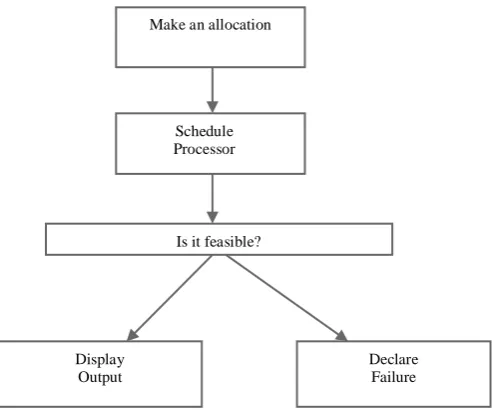
In hard one, application may be considered to have failed, if it does not complete function within the allocated time [17]. Airplane control systems, Nuclear reactor control systems and components of pacemakers are some of the examples of hard real-time systems. In soft real-time system must process request in reasonable time. As example to turn ON AC or audio, in a car control system [18] [19]. As real time systems execute critical tasks, therefore it must be designed very carefully. For that, many scheduling policy has been already designed [20] [21] [22]. Scheduling is technique for allocating tasks on processors to ensure that deadlines are to meet. In traditional real-time embedded systems, deadline is one of the critical concerns. There are basic two types of scheduling policy: offline and online. Offline scheduling involves scheduling in advance of the operation. In online scheduling, the tasks are scheduled as they come into the system and tasks are assigned to processor based on their relative priority. The algorithm keeps task priority constant called static–priority algorithms. In dynamic-priority, algorithm, priority of tasks will change with time [23] [24] [25] [26] [27]. Figure 2.1 shows the basic scheduling algorithm function.
Figure 2.1: Basic Function of Scheduling Algorithm
B. Real Time Scheduling Algorithms:
In Real-time systems scheduling algorithms are classified into two categories: Static algorithm and Dynamic algorithm. Based on execution attributes of tasks, dynamic algorithm assigns priorities at runtime [28] [29] [30]. This algorithm allows switching of priorities between tasks. In contrast with dynamic algorithm, a static algorithm assigns priorities at design time. All assigned priorities remain fixed throughout the execution of task. Figure 2.2 gives the classification of available scheduling algorithms for real-time systems [31] [32].
Figure 2.2: Real time scheduling algorithms
Following table 2.1 shows the comparison between the available real time algorithms.
Table 2.1: Comparison of Real time algorithms
Algorithms
Parameters
RM DM LST EDF
Priority Static Static Dynamic Dynamic
CPU utilization Average Low Low High
No. of context
switches High Less High Less
Optimal No No No Yes
Deadline miss
chances Average Average High Less
Response time Average Less Less Average
The EDF algorithm is optimal compared with the other real-time algorithms and if task is not scheduled by EDF then all other algorithms will fail to schedule that task [33] [34] [35] [36]. As compared to other algorithms EDF is simple to implement and gives much better utilization of processor and also EDF having dynamic nature with less number of context switches. The deadline miss chances are less in EDF algorithm [37] [38] [39] [40].
III. HARDWAREIMPLEMENTATION
In this work we use hardware components like ARM LPC 2148 microcontroller, Radio Frequency (RF) modem, USB device, Temperature sensor, humidity sensor, moisture sensor, light sensor. Following figure gives the brief structure of hardware system.
Make an allocation
Schedule Processor
Is it feasible?
Display Output
Declare Failure
Scheduling Algorithms
Static Priority-Driven
Fixed Priority Dynamic Priority
RM DM E
D F
Figure 3.1: Block diagram of WSN
The above figure shows the working module of wireless sensor network. ARM LPC 2148is the widely used Integrated Circuit (IC) from ARM-7 family. It is manufactured by Philips and it is pre-loaded with many inbuilt peripherals making it more efficient and a reliable option for the beginners as well as high end application developer. The LPC2148 microcontroller has 512KB of internal flash and 32+8K RAM.
A Universal Asynchronous Receiver Transmitter (UART) is usually an individual (or part of an) integrated circuit used for serial communications over a computer or peripheral device serial port. Radio modem can be used for applications that need two way wireless data transmission. It transfers data wirelessly across a range of up to tens of kilo meters’. It features adjustable data rate and reliable transmission distance. The communication protocol is self controlled and completely transparent to user interface. This module works in half-duplex mode. Means it can either transmit or receive but not both at same time.
a. Temperature Sensor: The measurement of temperature is one of the fundamental requirements for environmental control, as well as certain chemical, electrical and mechanical controls. Temperature sensors are vital to a variety of everyday products.
b. Humidity Sensor: Humidity is the presence of water in air. Humidity sensing is very important, especially in the control systems for industrial processes and human comfort. Controlling or monitoring humidity is of paramount importance in many industrial & domestic applications.
c. Moisture Sensor: Moisture refers to the presence of a liquid, especially water, often in trace amounts. Small amounts of water may be found, for example, in the air (humidity), in foods, and in various commercial products. Moisture also refers to the amount of water vapour present in the air.
d. Light Sensor: Visible light is electromagnetic radiation that is visible to the human eye, and is responsible for the sense of sight. Applications include smoke detection, automatic lighting control, and batch counting and burglar alarm systems.
IV. SOFTWAREIMPLEMENTATION
A. EDF Scheduling Algorithm:
EDF scheduler still remains an efficient option for
a. Main Definitions:
a) Definition 1: A scheduling algorithm is optimal if it finds a valid schedule (where all deadlines are satisfied) whenever one exists.
b) Definition 2: A scheduling algorithm is online if it makes its decision at run-time.
EDF is an optimal scheduling algorithm on preemptive uniprocessor, in the following sense: if a collection of independent jobs, each characterized by an arrival time, an execution requirement and a deadline, can be scheduled (by any algorithm) in a way that ensures all the jobs complete by their deadline, the EDF will schedule this collection of jobs so they all complete by their deadline. While developing EDF algorithm we assume that all the tasks are having aperiodic nature means they can arrive at any instant of time. We implement this algorithm for uniprocessor where deadline is one of the important parameter because we assume those aperiodic tasks are hard real time.
(a). EDF with Array: Here we use an array for storing deadline values of task. When any parameter crosses threshold then at that time task arrives with their arrival time, execution time and deadline time. Now scheduler takes the decision which task will get service first using EDF scheduling policy which says that task having least deadline value will get service first. Hence there is a need to sort deadline array so that we can assign a priority to the task depending on their deadline value. For sorting we are using algorithm which is given below:
i. Quick Sort ii. Merge Sort iii. Bubble Sort
With the help of this algorithm we can sort the deadline array and then assign priority to the task as per the EDF policy i.e. task having less deadline value will get highest priority.
Now in real time system the priority of task changes dynamically. For this reason there is a need to keep a track of deadline values. If any task changes deadline then we call sorting algorithm and assign priorities to the task. In array inserting a new deadline value of task is expensive; because existing elements have to shift. To overcome this problem a better method is to use a link list data structure.
Figure 4.1: Representation of Link List with EDF scheduler
Figure 4.2: Representation of Link List with flag set
Binary search algorithm minimizes the comparison required to arrange the link list and also time required to sort is get minimized. Algorithm of binary search for insertion in link list is given below:
Step 1: Beg=LB
Step 2: End=UB
Step 3: MID = (Beg+End/2)
Step 4: If Item<Data (MID)
Step 5: Then End=MID-1
Step 6: Else Beg=MID+1
The algorithm divides the list and get middle index of the element. Now check that middle value is greater than or less than the Item that we want to insert. If item is greater than middle value, then right left part of list is get skipped and in second iteration the search starts on half of the list. This random access is possible only when we know the Upper bound (UB) and the Lower bound (LB) of the list. Here Item is nothing but the element that we want to insert in list at its proper position. After getting an index then we will insert our new element at its proper position.
V. RESULTSANDDISCUSSION
A. EDF algorithm for aperiodic task:
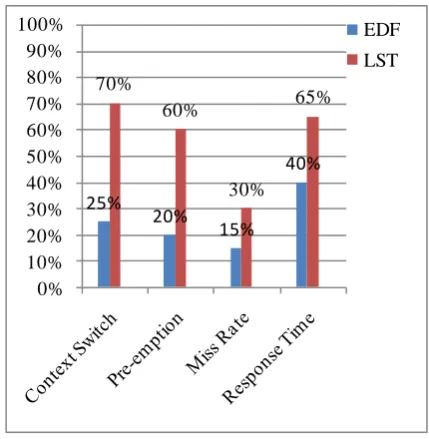
The experimentation result is considered after simulating number of task sets with variation in arrival time, deadline value and execution time. Finally after scheduling set of tasks we got the graph given below in figure 5.1. As all tasks are having aperiodic nature with hard deadline so main aim was to schedule task before deadline with minimum value of context switches, pre-emptions, miss rate and also minimized the response time of tasks. After scheduling number of task samples, we observed that in aperiodic system EDF algorithm performs well as compare to LST algorithm. Aperiodic task are schedulable with EDF algorithm so mostly all the tasks meet their deadline.
25% 20%
15% 40%
70% 60%
30% 65%
0% 10% 20% 30% 40% 50% 60% 70% 80% 90%
100% EDF
LST
Figure 5.1: Graph shows the performance of EDF algorithm
B. Sorting Mechanism:
In this work we have used four sorting algorithms and compared their simulation results depend on their performance indicator parameter i.e., the number of memory references and required time to sort. Following figure 5.2 shows the comparison with running time required and the number of memory references. We found that quick sort algorithm is very efficient as compared to other sorting algorithm and also we have used this quick sort with binary insertion sort to get better results.
0% 10% 20% 30% 40% 50% 60% 70% 80% 90% 100%
Running Time
Figure 5.2: Comparison of sorting algorithm w.r.t. Running time and Counter
a. Comparisons of Time Complexity of Sorting Algorithms
In this table, n is the number of records to be sorted.
The columns “Average”, “Best” and “Worst” give the time
Table 5.1 Comparison of sorting algorithm
Algorithms Time Complexity
Average Best Worst
Quick Sort O(n log n) O(n log n) O(n2)
Binary Insertion
Sort O(log n) O(1) O(log n)
Merge Sort O(n log n) O(n log n) O(n log n)
Bubble Sort O(n2) O(n2) O(n2)
VI. CONCLUSIONANDFUTURESCOPE
This work discussed the feasibility of EDF algorithm for aperiodic task of hard real time system. With the help of EDF algorithm scheduler schedules the entire set of aperiodic tasks with minimum number of context switches, pre-emptions, miss rate and at some level EDF helps to minimize the response time of task. The major part of this work concerned with the implementation of EDF scheduler using Link List with Binary Insertion Sort algorithm which helps to speed up the scheduler. We have compared sorting algorithms on the basis of their performance indicator parameters. With the help of binary insertion sort algorithm we can arrange the link list with in minimum time. The presented experimental results demonstrate the effectiveness of the implementation. This work can be extended in various directions. First, the proposed algorithm can be modified for multiprocessors. Second, there is need to use RTOS where we can actually implement EDF to schedule the task with their deadline value and burst time. This work assumed the set of aperiodic task with hard deadline; there are some applications in WSN which demand schedulability with periodic and sporadic task. Also practical implementation issues could be a subject of future work. Further study is required to improve efficiency of the proposed algorithm.
VII. ACKNOWLEDGMENT
It gives me immense pleasure to express my gratitude to Dr. D. G. Harkut, who provided me constructive criticism and a positive feedback during this work. I also express my sincere gratitude to respected Principal Dr. M. S. Ali for providing me necessary facilities.
VIII. REFERENCES
[1] Adi Mallikarjuna Reddy, V AVU Phani Kumar, D Janakiram, and G Ashok Kumar, 2007. Operating Systems for Wireless Sensor Networks: A Survey Technical Report.
[2] Andre´ Rodrigues, Tiago Camilo, Jorge SaSilva, Fernando Boavida, 2012. Diagnostic Tools for Wireless Sensor
[3] Benitha Christinal.J, 2013. A Survey on Priority based Packet Scheduling in Wireless Sensor Networks, International Journal of Scientific Research in Computer Science (IJSRCS), vol. 1, Issue 4, pp. 18-21.
[4] Bhatti, S.; Carlson, J.; Dai, H.; Deng, J.; Rose, J.; Sheth, A.; Shucker, B.; Gruenwald, C.; Torgerson, H.R., 2005. Mantis OS: An Embedded Multithreaded Operating System for Wireless Micro Sensor Platforms. Mobile. Network, pp. 563-579.
[5] Cao, Q.; Abdelzaher, T.; Stankovic, J.; He, T., 2008. The LiteOS Operating System: Towards Unix Like Abstraction for Wireless Sensor Networks. In Proceedings of the 7th International Conference on Information Processing in Sensor Networks (IPSN 2008), St. Louis, MO, USA, pp. 22– 24.
[6] Chi-Tsun Cheng, Chi K. Tse, and Francis C. M. Lau, 2010. An Energy-Aware Scheduling Scheme for Wireless Sensor Networks, IEEE transaction on vehicular technology, vol. 59, no. 7.
[7] Dunkels, A.; Gronvall, B.; Voigt, T., 2004. Contiki a Lightweight and Flexible Operating System for Tiny Networked Sensors. In Proceedings of the 9th Annual IEEE International Conference on Local Computer Networks, Washington, DC, USA; pp. 455-462.
[8] Edwin Prem Kumar Gilbert, Baskaran Kaliaperumal, Elijah Blessing Rajsingh, 2012. Research Issues in Wireless Sensor Network Applications: A Survey, International Journal of Information and Electronics Engineering, vol. 2, no. 5, pp. 702-706.
[9] Eswaran, A.; Rowe, A.; Rajkumar, R., 2005. Nano-RK: An Energy-Aware Resource-Centric RTOS for Sensor Networks. In Proceedings of the 26th IEEE Real-Time Systems Symposium, Miami, FL, USA, pp. 5–8.
[10] Fengxiang Zhang, Alan Burns, 2009. Schedulability Analysis for Real-Time Systems with EDF Scheduling IEEE transactions on computers, vol. 58,
[11] Frederic Ridouard, Pascal Richard, Francis Cottet, 2004. Negative results for scheduling independent hard real-time tasks with self-suspensions, Proceedings of the 25th IEEE International Real-Time Systems Symposium, pp. 1-10.
[12] Giorgio C. Buttazzo, 2005. Rate Monotonic vs. EDF: Judgment Day, Real-Time Systems, Springer Science + Business Media, Inc. Manufactured in the Netherlands, pp. 5-26.
[13] Haiying Zhou, Feng Wu, Kun-mean Hou, 2008. An Event-driven Multi-threading Real-time Operating System dedicated to Wireless Sensor Networks. The 2008 International Conference on Embedded Software and Systems (ICESS2008) IEEE,
[14] Jane W.S. Liu, 2001. Real-Time Systems, Pearson Education, India, pp. 121 & 26.
[15] Jennifer Yick, Biswanath Mukherjee, Dipak Ghosal, 2008. Wireless sensor network survey, Elsevier B.V. Computer Networks, pp. 2292-2230.
[17] Karsten Albers, Frank Slomka, 2005. Efficient Feasibility Analysis for Real-Time Systems with EDF scheduling, Proceedings of the Design, Automation and Test in Europe Conference and Exhibition, IEEE.
[18] Kathleen Baynes, Chris Collins, Eric Fiterman, Brinda Ganesh, Paul Kohout, Christine Smit, Tiebing Zhang, and Bruce Jacob,2003. The Performance and Energy Consumption of Embedded Real-Time Operating Systems,IEEE transactions on computers, vol. 52, no. 11, pp. 1454-1469.
[19] Kayvan Atefi, Mohammad Sadeghi, Arash Atefi, 2011. Real-Time Scheduling Strategy for Wireless Sensor Networks O.S, International Journal of Distributed and Parallel Systems (IJDPS) vol.2, no.6, pp. 63-78.
[20] Leo Ordinez, David Donari, Rodrigo Santos, Javier Orozco, 2008. An Application-Based Real-Time Scheduler for Wireless Sensor Networks, XXXIV Conferencia Latinoamericana de Informática. pp. 1239-1248.
[21] Levis, P.,Madden, S. Polastre, J., Szewczyk, R.,Whitehouse, K.Woo, A. Gay, D. Hill, J. Welsh, M.Brewer, E. Culler, D.,2011. Tinyos: An Operating System for Sensor Networks, pp. 115-147.
[22] Liang Dai, Yilin Chang, Zhong Shen, 2011. An Optimal Task Scheduling Algorithm in Wireless Sensor Networks, Int. J. of Computers, Communications & Control, ISSN 1841-9836, E-ISSN 1841-9844 vol.6, no. 1, pp. 101-112.
[23] LiteOS. LiteOS [online], 2011[cit.2012-05-28]. Available from: http://www.liteos.net
[24] M. Sirisha, S.Swetha, 2013. A Survey On WSN OS Using Real-Time Scheduling Strategy, International Journal of Technology Enhancement and Emerging Engineering Research, vol. 1, no.5, pp. 13-19.
[25] M.Kaladevi, Dr.S.Sathiyabama, 2010. A Comparative Study of Scheduling Algorithms for Real Time Task, International Journal of Advances in Science and Technology, vol. 1, no. 4, pp. 8-14.
[26] Maryline Chetto, 2013. Optimal Scheduling for Real-Time Jobs in Energy Harvesting Computing Systems, IEEE Transactions on Emerging Topics in Computing, pp. 1-13.
[27] Myunggwon Hwang, Dongjin Choi, Pankoo Kim, 2011. Least Slack Time Rate First: an Efficient Scheduling Algorithm for Pervasive Computing Environment, Journal of Universal Computer Science, vol. 17, no. 6, pp. 912-925.
[28] Octav Chipara, Chenyang Lu, Gruia-Catalin Roman, 2013. Real-Time Query Scheduling for Wireless Sensor Networks, IEEE Transactions on Computers, vol. 62, no. 9, pp. 1850-1865.
[29] Pankaj Sareen, 2013. Comparison of Sorting Algorithms (On the Basis of Average Case), International Journal of Advanced Research in Computer Science and Software Engineering,
[30] Rowe, A.; Lakshmanan, K.; Yhu, H.; Rajkumar, R., 2008. Rate-Harmonized Scheduling for Saving Energy, In Proceedings of the 29th IEEE Real-Time Systems Symposium, Barcelona, Spain,
[31] Rym Chéour, Sébastien Bilavarn, Mohamed Abid, 2011. Exploitation of the EDF Scheduling in the Wireless Sensors Networks, International Journal of Measurement Technologies and Instrumentation Engineering, 1(2), pp.14-27.
[32] Sangho Yi, Hong Min, Junyoung Heo, Boncheol Gu, Yookun Cho, Jiman Hong, Jinwon Kim, Kwangyong Lee, and Seungmin Park, 2006. Performance Analysis of Task Schedulers in Operating Systems for Wireless Sensor Networks M. Gavrilova et al., LNCS 3983, Springer-Verlag Berlin Heidelberg, pp. 499–508.
[33] Sumit Kumar, Siddhartha Chauhan, 2011. A Survey on Scheduling Algorithms for Wireless Sensor Networks, International Journal of Computer Applications (0975 – 8887), vol. 20, no.5, pp. 7-13.
[34] Swati Pandit, Rajashree Shedge, 2013. Survey of Real Time Scheduling Algorithms, OSR Journal of Computer Engineering, vol. 13, Issue 2, pp. 44-51.
[35] Tarek M. Salem, Sherine M., Abd E-kader, 2013.Mapping Wireless Sensor Network Applications Requirements to Existing Operating Systems, IJCSI International Journal of Computer Science vol. 10, Issue 5, no 1, pp. 258-267.
[36] TinyOS Network Working Group; Tutorials, Network Protocols (accessed on 17 April 2011).
[37] TinyOS [EB/OL], http:// www.tinyos.net, 2007-6-1. vol 3, Issue 3, pp. 522-532.
[38] Wei Dong, Chun Chen, Xue Liu, Yunhao Liu, Jiajun Bu, Kougen Zheng, 2011. SenSpire OS: A Predictable, Flexible, and Efficient Operating System for Wireless Sensor Networks, IEEE Transactions on Computers, vol. 60, no. 12, pp. 1788-1800.
[39] Yingwei Yao, Georgios B. Giannakis, 2005. Energy-Efficient Scheduling for Wireless Sensor Networks, IEEE Transactions on Communications, vol. 53, no. 8, pp. 1333-1342.