Exploiting Multiply Annotated Corpora in Biomedical Information Extraction
Tasks
Barry Haddow and Beatrice Alex
School of Informatics University of Edinburgh
2 Buccleuch Place Edinburgh, EH8 9LW
Scotland, UK
{bhaddow,balex}@inf.ed.ac.uk
Abstract
This paper discusses the problem of utilising multiply annotated data in training biomedical information extraction systems. Two corpora, annotated with entities and relations, and containing a number of multiply annotated documents, are used to train named entity recognition and relation extraction systems. Several methods of automatically combining the multiple annotations to produce a single annotation are compared, but none produces better results than simply picking one of the annotated versions at random. It is also shown that adding extra singly annotated documents produces faster performance gains than adding extra multiply annotated documents.
1
Introduction
When annotating a corpus for an information extraction (IE) task, it is normal to annotate at least part of it multiple times in order to measure inter-annotator agreement (IAA) and thereby monitor the quality of the annotation and quan-tify the difficulty of the task. These multiply annotated doc-uments can then be reconciled to produce a gold standard which is used to train and test a machine-learning basedIE
system. In our experience in the biomedical domain, how-ever, this reconciliation process is very time-consuming, and therefore costly, with the reconciliation of a pair of an-notated documents taking much longer than annotating the document for a third time. But if reconciliation is too ex-pensive, and the corpus is to be used as training data, can one make better use of the multiply annotated data? This paper will set out to answer two questions with em-pirical evidence presented from biomedical IEtasks. The first question is how best to use the multiply annotated data in training machine learning systems; whether to try to automatically reconcile the documents using some type of combination algorithm, or whether to provide all copies to the machine learning algorithm and leave it to “recon-cile” the documents. The second question concerns how best to spend annotation budget, on multiple annotation of documents already in the corpus, or on annotating new doc-uments. To the best of our knowledge, these questions have not previously been addressed in the literature.
This paper is organised as follows: after reviewing related work in the following section, the corpora and experimental system are described in Section 3. An account of the exper-iments performed is provided in Section 4, with the results presented in Section 5 and discussed in Section 6.
2
Background
The experiments described in this papers make use of a text mining pipeline which was developed as part of the TXM
project and integrated into a biomedical curation tool to enable assisted curation for biomedical literature (Alex et al., 2008). In order to train the machine learning
compo-nents of the system, and to test the system, a collection of full-text biomedical articles were annotated with items of biomedical interest. The decision to annotate full-text ar-ticles instead of abstracts as training data for a biomedical text mining system is supported by previous work of Shah et al. (2003) and McIntosh and Curran (2007) who argue that paper abstracts do not always contain sufficient infor-mation.
In the pilot data annotation phase ofTXM, multiply anno-tated papers were reconciled to create one gold standard an-notation for each paper. However, this process was found to be very time-consuming, particularly as dealing with full-text articles. In order to obtain good machine learning re-sults, a further decision was made to invest valuable annota-tion time to annotate more papers rather than reconcile mul-tiple annotations. Consequently, the two corpora that were finally annotated as training material for the TXMpipeline were not reconciled and therefore contain multiple anno-tations for a proportion of papers (see Section 3). These multiple annotations were used to calculateIAAin order to monitor annotation consistency over time.
The collection ofIAAduring annotation has also been ad-vocated by Lu et al. (2006) and Inderjeet et al. (2005). Fur-thermore, annotation consistency is an aspect that was high-lighted as important in experiments carried out by Alex et al. (2006). Measures ofIAAare also used to get a better un-derstanding of how difficult it is to extract such information automatically.
3
Corpora and System
The two corpora used in the experiments in this paper ad-dress protein-protein interactions (the PPIcorpus) and
tis-sue expression (the TE corpus), and consist of full-text biomedical papers from PubMed and PubMedCentral. The
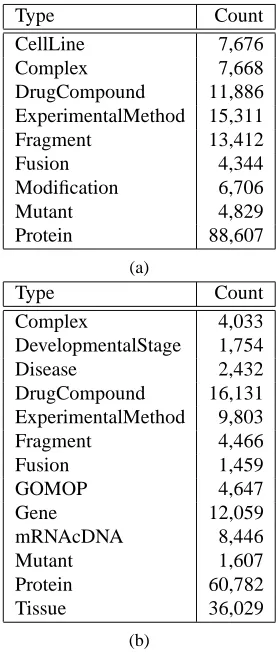
PPI corpus contains approximately 75,000 sentences and theTEcorpus around 63,000.
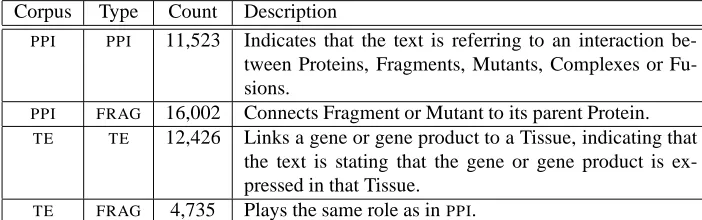
Corpus Type Count Description
PPI PPI 11,523 Indicates that the text is referring to an interaction be-tween Proteins, Fragments, Mutants, Complexes or Fu-sions.
PPI FRAG 16,002 Connects Fragment or Mutant to its parent Protein.
TE TE 12,426 Links a gene or gene product to a Tissue, indicating that the text is stating that the gene or gene product is ex-pressed in that Tissue.
TE FRAG 4,735 Plays the same role as inPPI.
Table 2: The relation types in the corpora
PPI TE
Annotations TRAIN DEVTEST TEST TRAIN DEVTEST TEST
1 65 25 35 82 34 34
2 48 9 8 68 7 11
3 20 5 2 1 0 1
Total documents 133 39 45 151 41 46
Total annotations 221 58 57 221 48 59
Table 3: Counts of numbers of papers with 1, 2 or 3 annotations in each section of each corpus.
all Multiply annotated versions of the same documents are
not combined at all, but all versions are included in the training set. The machine learner is, in effect, used to reconcile the different versions on its own.
union Each set of annotations on the same document
is combined by including all entities and relations marked by each annotator. For entity annotation there is a problem combining annotations in this way if en-tities cross (in other words, overlap but do not nest in the sense of Alex et al. (2007)), since crossing entities cannot be represented in theNERsystem. Crossing en-tities are resolved by removing the one with the later starting point.
intersection Annotations are combined by only choosing
the entities and relations which are common to all an-notated versions of a multiply anan-notated document.
one-random For each multiply-annotated document, one
annotated version is chosen at random and the rest are discarded.
best-ner An NER model is trained using the all
configu-ration. For each multiply annotated document in the training set, this NERmodel is then applied to all an-notated versions inTRAIN and the version on which the model achieves the highest score is chosen. The rationale behind this method is that the system will do better on annotated versions which are more con-sistent with the rest of the corpus, so the combined corpus will be more consistent, and therefore provide better training data.
best-re The same as best-ner, except the annotated
ver-sion is chosen by considering performance on relation extraction.
consistent An arbitrary order of preference is applied to
the annotators, and for each multiply annotated doc-ument, the annotation corresponding to the annotator which came highest in the order of preference was se-lected. This combination method may create a more consistent corpus by favouring certain annotators.
Notice that intersection and union create a new version of the annotated document by combining annotations from each version, whereas one-random, best-ner, best-re and
consistent simply choose one of the annotated versions,
based on some criteria. We considered using a voted strat-egy, but since most of the multiply annotated documents only have two annotations, voted would just collapse to
in-tersection or union, depending on how ties were resolved.
Note that the variation in the training corpora produced by each combination strategy will be higher for relations than for entities, since theIAA(Table 4) is much lower for rela-tions. The combinedIAAscore is relevant here, as it shows the overall difference between different annotators’ views of the relations in the same document.
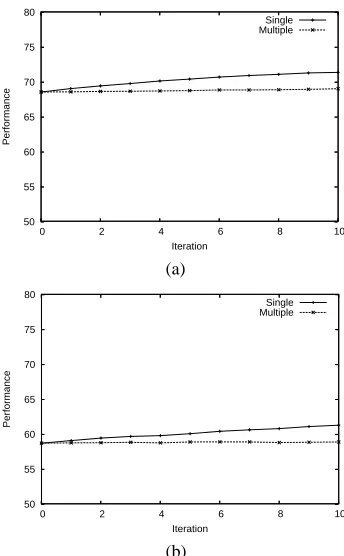
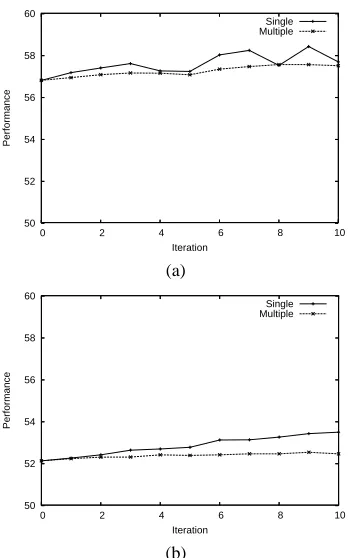
To compare the effect of adding extra multiply annotated data versus extra single annotated data, learning curves for each of these two configurations were produced. Firstly, all but one version of each multiply annotated document was removed from the original training set (DEVTESTand
TRAINcombined), and a matching number of singly an-notated documents was also removed. A model was then trained on the remaining training documents, and tested on
50 52 54 56 58 60
0 2 4 6 8 10
Performance
Iteration
Single Multiple
(a)
50 52 54 56 58 60
0 2 4 6 8 10
Performance
Iteration
Single Multiple
(b)
Figure 2: Comparison of the improvement gained from adding further singly annotated data, versus further mul-tiply annotated data, for (a) PPIand (b)TErelation extrac-tion.
and RE performance, but annotations of new documents will offer a faster rate of improvement. Whilst multiply annotated versions of documents may be required to mea-sure IAAand to monitor annotation quality, it is better to keep the multiple annotation to the minimum required for these purposes, in order to maximise the budget available for extra singly annotated documents.
Acknowledgements
This work was carried out as part of an ITI Life Sci-ences Scotland (http://www.itilifesciences. com) research programme with Cognia EU (http:// www.cognia.com) and the University of Edinburgh. The authors are grateful to Claire Grover and Ben Hachey for their comments.
7
References
Beatrice Alex, Malvina Nissim, and Claire Grover. 2006. The impact of annotation on the performance of pro-tein tagging in biomedical text. In Proceedings of LREC, pages 595–600, Genoa, Italy.
Beatrice Alex, Barry Haddow, and Claire Grover. 2007. Recognising nested named entities in biomedical text. In
Proceedings of BioNLP, pages 65–72, Prague, Czech
Re-public.
Beatrice Alex, Claire Grover, Barry Haddow, Mijail Kabad-jov, Ewan Klein, Michael Matthews, Stuart Roebuck, Richard Tobin, and Xinglong Wang. 2008. Assisted cu-ration: Does text mining really help? In Russ B. Altman,
A. Keith Dunker, Lawrence Hunter, Tiffany Murray, and Teri E. Klein, editors, Proceedings of the Pacific
Sym-posium on Biocomputing 2008, pages 556–567, Kohala
Coast, Hawaii, USA.
Thorsten Brants. 2000. Inter-annotator agreement for a German newspaper corpus. In Proceedings of LREC, pages 1435–1439, Athens, Greece.
James Curran and Stephen Clark. 2003. Language inde-pendent NER using a maximum entropy tagger. In
Pro-ceedings of CoNLL, pages 164–167, Edmonton, Canada.
Barry Haddow and Michael Matthews. 2007. The ex-traction of enriched protein-protein interactions from biomedical text. In Proceedings of BioNLP, pages 145– 152, Prague, Czech Republic.
Mani Inderjeet, Hu Zhangzhi, Jang S. Bae, Samuel Ken, Krause Matthew, Phillips Jon, and Wu. 2005. Protein name tagging guidelines: lessons learned. Comparative
and Functional Genomics, 6(1-2):72–76.
Zhiyong Lu, Michael Bada, Philip V. Ogren, K. Bretonnel Cohen, and Lawrence Hunter. 2006. Improving biomed-ical corpus annotation guidelines. In Proceedings of the
Joint BioLINK and 9th Bio-Ontologies Meeting, pages
89–92, Fortaleza, Brasil.
Tara McIntosh and James Curran. 2007. Challenges for extracting biomedical knowledge from full text. In
Pro-ceedings of BioNLP, pages 171–178, Prague, Czech
Re-public.
Leif Arda Nielsen. 2006. Extracting protein-protein inter-actions using simple contextual features. In Proceedings
of BioNLP, pages 120–121, New York, USA.
Parantu K. Shah, Carolina Perez-Iratxeta, Peer Bork, and Miguel A. Andrade. 2003. Information extraction from full text scientific articles: where are the keywords?
BMC Bioinformatics, 4(20).
Erik F. Tjong Kim Sang and Fien De Meulder. 2003. In-troduction to the CoNLL-2003 shared task: Language-independent named entity recognition. In Proceedings