Volume 2007, Article ID 26123,12pages doi:10.1155/2007/26123
Research Article
Transmit Delay Structure Design for Blind Channel
Estimation over Multipath Channels
Tongtong Li,1Qi Ling,1and Zhi Ding2
1Department of Electrical and Computer Engineering, Michigan State University, East Lansing, MI 48824, USA 2Department of Electrical and Computer Engineering, University of California, Davis, CA 95616, USA
Received 20 April 2006; Revised 16 October 2006; Accepted 11 February 2007
Recommended by Alex Gershman
Wireless communications often exploit guard intervals between data blocks to reduce interblock interference in frequency-selective fading channels. Here we propose a dual-branch transmission scheme that utilizes guard intervals for blind channel estimation and equalization. Unlike existing transmit diversity schemes, in which different antennas transmit delayed, zero-padded, or time-reversed versions of the same signal, in the proposed transmission scheme, each antenna transmits an independent data stream. It is shown that for systems with two transmit antennas and one receive antenna, as in the case of one transmit antenna and two receive antennas, blind channel estimation and equalization can be carried out based only on the second-order statistics of symbol-rate sampled channel output. The proposed approach involves no preequalization and has no limitations on channel-zero locations. Moreover, extension of the proposed scheme to systems with multiple receive antennas and/or more than two transmit antennas is discussed. It is also shown that in combination with the threaded layered space-time (TST) architecture and turbo coding, significant improvement can be achieved in the overall system performance.
Copyright © 2007 Tongtong Li et al. This is an open access article distributed under the Creative Commons Attribution License, which permits unrestricted use, distribution, and reproduction in any medium, provided the original work is properly cited.
1. INTRODUCTION
Aiming for high spectral efficiency, recent years have wit-nessed broad research activities on blind channel estima-tion and signal detecestima-tion. Although second-order statis-tics of symbol rate sampled channel output alone can-not provide enough information for blind channel estima-tion, it is possible with second-order statistics of fractionally spaced/sampled channel output or baud-rate channel out-put samples from two or more receive antennas [1–6]. These are, in fact, early examples of blind channel identification by exploiting space-time diversity techniques, the fraction-ally spaced sampling takes advantage of time diversity, while multiple receive antennas indicate spatial diversity at the re-ceiver end.
Receive diversity has been widely used in mobile com-munications (especially in the uplink) to obtain good system performance while minimizing the power consumption at the mobile handset. Exploitation of the transmit diversity, on the other hand, is more challenging, mainly because signals from multiple transmit antennas are mixed before they reach the receiver, and special consideration needs to be taken to separate these signals while allowing low-complexity receiver
design. In [7,8], it is proved that for memoryless channels, increasing the number of receive antennas in a SIMO system only results in a logarithmic increase in the average capacity, but the capacity of a MIMO system roughly grows linearly with the minimum number of antennas placed at both sides of the communication link. With the fundamental works in [9–11], space-time coding and MIMO signal processing have evolved into a promising tool in increasing the spectral effi-ciency of broadband wireless systems.
diversity order of the system [15]. Space-time Trellis codes were first developed in [11], and then refined by others, see [16], for example. The layered space-time codes, represented by the BLAST series, have been proposed in [10] and further developed in [17,18].
Most existing space-time diversity techniques have been developed for flat fading channels. However, due to multi-path propagation, wireless channels are generally frequency-selective fading instead of flat fading. Extensions of space-time diversity techniques suited for flat fading channels, es-pecially the Alamouti scheme, to frequency-selective fading channels can be briefly summarized as follows: (i) apply gen-eralized delay diversity (GDD) [19] or the time reversal tech-nique [20]; (ii) convert a frequency-selective fading chan-nel into a flat fading chanchan-nel using equalization techniques, and then design space-time codes for the resulted flat fading channel(s), see [21] for example; (iii) convert the frequency-selective channels into a number of flat fading channels using OFDM scheme, see [22] and references therein; (iv) reformu-late the multipath frequency-selective fading system into an equivalent flat fading system by regarding each single path as a separate channel, see [23] for example.
Space-time coded systems, which generally fall into the MIMO framework, bring significant challenges to channel identification. In fact, in order to fully exploit the space-time diversity, the channel state information generally needs to be estimated for all possible paths between the transmitter and receiver antenna pairs. Training-based channel estimation may result in considerable overhead. To further increase the spectral efficiency of space-time coded system, blind chan-nel identification and signal detection algorithms have been proposed. In [24], blind and semiblind equalizations, which exploit the structure of space-time coded signals, are pre-sented for generalized space-time block codes which employ redundant precoders. Subspace-based blind and semiblind approaches have been presented in [25–28], and a family of convergent kurtosis-based blind space-time equalization techniques is examined in [29]. Blind algorithms based on the MUSIC and Capon techniques can be found in [30,31], for example. Blind channel estimation for orthogonal space-time block codes (OSTBCs) has also been explored in liter-ature, see [32–34], for example. In [33], based on specific properties of OSTBCs, a closed-form blind MIMO chan-nel estimation method was proposed, together with a simple precoding method to resolve possible ambiguity in channel estimation.
Note that for frequency-selective fading channels, guard intervals are often put between data blocks to prevent interblock-interference, such as in the OFDM system [35], the chip-interleaved block-spread CDMA [36], and the gen-eralized transmit delay diversity scheme [19]. In this paper, a simple two-branch transmission scheme, which is indepen-dent of modulation (OFDM or CDMA) format, is proposed to exploit the guard intervals for blind channel estimation and equalization. The generalized delay diversity proposed in [19] is perhaps the closest to our approach, but unlike [19], and also [24,27,28], in which different antennas transmit the delayed, zero-padded, or time-reversed versions of the same
signal, the proposed transmission scheme promises higher data rate since each antenna transmits an independent data stream.
Through the proposed approach, we show that with two transmit antennas and one receive antenna, blind channel estimation and equalization can be carried out based only on the second-order statistics (SOS) of symbol-rate sampled channel output. This result can be regarded as a counterpart of the blind channel estimation algorithm proposed by Tong et al. [6], which exploits receive diversity. However, unlike [6], the proposed approach has no limitations on channel-zero locations. This is because we have more control over the data structure at the transmitter than at the receiver end, and a properly structured transmitter design can bring more flex-ibility to the corresponding receiver design.
With the proposed dual-branch transmitter design, when more than one receive antennas are employed, the data rate (in symbols/s/Hz, excluding training symbols or dummy ze-ros) can be increased by a factor of 2N/(N+L+ 1) (hereN is the length of the data block andLis the maximum multi-path delay spread, generally,NL+ 1) compared with that of the corresponding SIMO system (under the same mod-ulation scheme and with no training symbols transmitted). A direct corollary of the proposed approach is that for SISO systems, blind channel estimation based only on the second-order statistics of the symbol-rate sampled channel output is possible as long as the actual data rate (in symbols/s/Hz, ex-cluding training symbols or dummy zeros) is not larger than N/(N+L) times of the channel symbol rate. Theoretically, as long as the channel coherence time is long enough, we can chooseN Lso thatN/(N+L) can be arbitrarily close to 1.
The proposed scheme involves no preequalization, and does not rely on the OFDM framework to convert the frequency-selective fading channels to flat fading chan-nels. Furthermore, in this paper, extension of the proposed scheme to systems with more than two transmit antennas is discussed, and it is also shown that in combination with the threaded space-time (TST) architecture [17] and turbo cod-ing, significant improvement can be achieved in the overall system performance.
2. THE PROPOSED STRUCTURED TRANSMIT DELAY SCHEME
The block diagram of the proposed two-branch structured transmit delay scheme with one receive antenna is shown inFigure 1. The input symbols are first split by a serial-to-parallel converter (S/P) into two serial-to-parallel data streams; Each data stream then forms blocks with specific zero-padding structure. The data block structure depends on the channel model and will be explained subsequently.
The structured data blocks,ak andbk, are transmitted
Input symbols
Figure1: Two-branch transmit diversity with one receiver.
xkandyk, from each transmit antenna, and the additive
noisenk.
We assume that the two branches are synchronous and the initial transmit delay is known in this section and in the following two sections. We will discuss the extension of the proposed transmitter design to the synchronous and asyn-chronous cases with unknown delays, as well as the general MIMO systems inSection 5.
LetLdenote the maximum multipath delay spread for bothhandg. When the initial transmission delays are known while the two branches are synchronous, without loss of gen-erality, the channel impulse responses can be represented as
h=h(0),h(1),. . .,h(L),
g=g(0),g(1),. . .,g(L), (1)
withh(0)=0,g(0)=0.
Partition the data stream from each branch into N-symbol blocks (N≥L+1), denote thekth block from branch 1 and branch 2 byak = [ak(0),ak(1),. . .,ak(N −1)] and
bk=[bk(0),bk(1),. . .,bk(N−1)], respectively. Zero-padding
is performed for each data block according to the following structure. Define
and assume that there are M blocks in a data frame and the channel is time-invariant within each frame. Trans-mit [a1,a2,. . .,aM] from antenna 1 through channelh, and
3. BLIND CHANNEL IDENTIFICATION
(A1) The input information sequence is zero mean, mu-tually independent, and i.i.d., which implies that E{ak(m)al(n)} =δk−lδm−n,E{bk(m)bl(n)} =δk−lδm−n,
andE{ak(m)bl(n)} =0.
(A2) The noise is additive white Gaussian, independent of the information sequences, with varianceσ2.
Note that we imposeno limitation on channel zeros. In what follows, blind channel identification is addressed for systems with the proposed structured transmit delay and with either one receiver or multiple receivers.
3.1. Systems with single-receive antenna
Consider the autocorrelation matrix of the received signal blockzk,Rz = E{zkzHk}. It follows from (7) that for k =
1,. . .,M,
Rz= ⎡ ⎢ ⎢ ⎢ ⎢ ⎢ ⎢ ⎢ ⎢ ⎢ ⎢ ⎢ ⎣
X02
+σ2 X
0X1∗ · · · X0XL∗
X1X0∗ a · · · · · · X0XL∗+Y0YL∗
. .. . .. . .. . .. . .. . ..
· · · · · · · · · · · · b YL−1YL∗
YLY0∗ · · · YLYL∗−1 YL2+σ2
⎤ ⎥ ⎥ ⎥ ⎥ ⎥ ⎥ ⎥ ⎥ ⎥ ⎥ ⎥ ⎦
,
(8)
where
X0=h(0), X1=h(1), XL=h(L)
Y0=g(0), YL=g(L), YL−1=g(L−1)
a= 1
l=0 h(l)2
+g(0)2+σ2,
b=h(L)2+
L
l=L−1 g(l)2
+σ2.
(9)
Based on (5), (6), and assumption (A2), it follows that
Rz=HHH+GGH+σ2IN+L+1, (10)
whereIN+L+1denotes the (N+L+ 1)×(N+L+ 1) identity
matrix.
In the noise-free case,
Rz=HHH+GGH. (11)
Note that when h(0) = 0, h = [h(0),h(1),. . .,h(L)] can be determined up to a phase ejθ from the first row of R
z.
Similarly, wheng(0) = 0,g = [g(0),g(1),. . .,g(L)] can be determined up to a phase from the second row ofGGH =
Rz−HHH.
Noise variance estimation. In the noisy case, good estima-tion of the noise variance can improve the accuracy of chan-nel estimation significantly, especially when the SNR is low. Here we provide two methods for noise variance estimation. (a) Recalling that M is the number of blocks in a frame, without loss of generality, assume that M is
even. We transmit [a1,a2,. . .,aM/2,| bM/2+1,bM/2+2,. . .,bM]
from antenna 1 through channel h, and [b1,b2,. . .,bM/2,|
aM/2+1,aM/2+2,. . .,aM] from antenna 2 through channel g.
Then fork =1,. . .,M/2,Rzis the same as in (8). And for
k=M/2 + 1,. . .,M,
Rz= ⎡ ⎢ ⎢ ⎢ ⎣
g(0)2
+σ2 g(0)g(1)∗ g(0)g(2)∗ · · · g(0)g(L)∗· · ·
g(1)g(0)∗ c d · · · · · ·
. .. . .. . .. . .. . ..
⎤ ⎥ ⎥ ⎥ ⎦,
(12)
wherec=1
l=0|g(l)|2+|h(0)|2+σ2,d= 1
l=0g(l)g(l+ 1)∗+
h(0)h(1)∗.
Define r01 = g(0)g(1)∗, r02 = g(0)g(2)∗, and r12 =
g(1)g(2)∗. Denoting byA(i,j) the (i,j)th entry of a matrix
A, it follows from (8) and (12) that
g(1)g(2)∗=Rz(2, 3)−Rz(1, 2)−Rz(1, 2). (13)
Thereforer01,r02,r12are all available, and
r12=g(1)g(2)∗= r ∗ 01
g(0)∗ r02
g(0). (14)
Whenr12=0, we obtain the noise-free estimation|g(0)|2=
r01∗r02/r12and the noise variance can be calculated from
σ2=R
z(1, 1)−g(0)
2
. (15)
Whenr12=0, theng(1)=0 and/org(2)=0. Ifg(1)=0,
Rz(2, 2)=g(0)2+h(0)2+σ2. (16)
Note that from (8),Rz(1, 1)= |h(0)|2+σ2, therefore,
σ2=Rz(1, 1)−Rz(2, 2)−Rz(1, 1)
. (17)
Ifg(1)=0 butg(2)=0, then
Rz(3, 3)=g(0)
2
+g(1)2+h(0)2+h(1)2+σ2,
(18)
thus
g(1)2=Rz(3, 3)−Rz(2, 2). (19)
Again, we obtain
σ2=R
z(1, 1)−g(0)
2
, g(0)2= r012
g(1)2. (20)
Substituting the estimated noise variance into (8), the noise-free estimation of|h(0)|2is obtained. It then follows directly
thathandgcan be estimated up to a phase difference.
Note that in practice,RzandRzare generally estimated
through time-averaging,
Rz=
2 M
M/2
k=1
zkzHk, Rz=
2 M
M
k=M/2+1
This method requires thatMbe large enough to obtain an ac-curate estimation of the correlation matrices. As an alterna-tive, we may insert zeros and obtain noise variance estimate from a frame with almost half the length.
(b) If we insert a zero after each block, that is, we transmit [a1, 0,a2, 0,. . .,aM, 0] throughh and [b1, 0,b2, 0,. . .,bM, 0]
throughg, then the new correlation matrixRzof the channel
output is
Rz=
Rz 0
0 σ2
. (22)
The noise varianceσ2 can then be estimated and used for
noise-free channel estimation in combination with Rz, as
discussed above. It should be noted that the transmission scheme in (b) has lower symbol rate compared to that in (a).
Discussion on SISO system. Consider a special case of the two-branch structured transmit delay scheme, in which an-tenna 2 is shut down, then it reduces to a SISO system. And the related autocorrelation matrix of the channel output is
ˇ
Rz=HHH+σ2IN+L+1, (23)
andhcan easily be obtained following our discussion above. It should be pointed out that for SISO system, instead of paddingL+ 1 zeros to eachakas in (2), we can define
ak= ⎡ ⎢
⎣ak(0),ak(1),. . .,ak(N−1), 0, . . ., 0 L
⎤ ⎥
⎦, (24)
and still perform blind channel identification with noise variance estimation as discussed above. This implies that as long as the data rate (in symbols/s/Hz, excluding training symbols and the padded zeros) is not larger thanN/(N+L) times that of the channel symbol rate, blind channel identi-fication based on SOS of the symbol-rate sampled channel output is possible. Theoretically, as long as the channel co-herence time is long enough, we can chooseN Lso that N/(N+L) can be arbitrarily close to 1.
We observe that in [37], it is shown that with noncon-stant modulus precoding, blind channel estimation based only on the SOS of symbol-rate sampled output can be performed for SISO system by exploiting transmission-induced cyclostationarity. Taking into consideration that transmitter-induced cyclostationarity through nonconstant modulus precoding generally implies slight sacrifice on spec-tral efficiency, as it may reduce the minimum distance of the symbol constellation, our result is consistent with that in [37]. Some related results on transmitter precoder design can be found in [38,39].
3.2. Systems with multiple receive antennas
For systems with two or more receive antennas, channel es-timation can be performed at each receiver independently or from more than one receiver jointly. The major advantage of joint channel estimation is that accurate noise variance es-timation becomes possible without inserting extra zeros or extending the frame length.
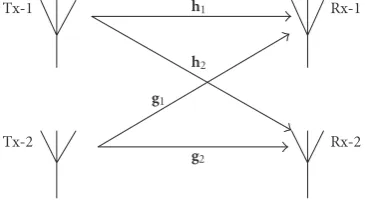
Tx-1
Tx-2
h1
h2
g1
g2
Rx-1
Rx-2
Figure2: Two-branch transmit diversity with two receive antennas.
Take a synchronous 2×2 system as an example (see Figure 2). DefineH1,H2as in (5) andG1,G2as in (6),
cor-responding toh1,h2,g1,g2, respectively. If [a1,a2,. . .,aM] is
transmitted throughh1,h2, and [b1,b2,. . .,bM] is
transmit-ted throughg1,g2, the received signal at receivers 1 and 2 can
be expressed as
z1 k=
H1,G1 ak
bk
+n1
k, z2k=
H2,G2 ak
bk
+n2 k,
(25)
where z1k,z2k,n1k,n2k are defined in the same manner as in Section 2. Stackingz1
k,z2kinto a 2(N+L+1)-vector, we obtain
zLk=
z1 k
z2k
=
H1 G1
H2 G2
F
ak
bk
sk
+
n1 k
n2k
. (26)
Considering the correlation matrix ofzLk, it follows that
RLz =E
zLkzLkH=FFH+σ2I
2(N+L+1). (27)
Note thatFis a 2(N+L+1)×2Ntall matrix, the noise variance σ2can be estimated through the SVD ofRL
z, by averaging the
least 2(L+ 1) eigenvalues ofRL z.
4. EQUALIZATION
Once channel estimation has been carried out, equalization can be performed in several ways. Take the 2×2 as an exam-ple, definesk=[aTk,bTk]Tas before, it follows from (26) that
the information blocksakandbkcan be estimated by
min
sk z
L
k−Fsk, (28)
either using the least-squares (LS) method, the zero-forcing (ZF) equalizer, or through the maximum-likelihood (ML) approach based on the Viterbi algorithm. More specifically, if finite alphabet constraint is put onsk, then (28) can be solved
using the Viterbi algorithm; if this constraint is relaxed, then skcan be obtained through the LS or ZF equalizer. In the
sim-ulations, we choose to use the ZF equalizer.
For systems with two transmit antennas and one receiver, it follows from (5), (6), and (7) that
and [H,G] is (N +L+ 1)×2N. The necessary condition for [H,G] to be of full-column rank isN+L+ 1 ≥ 2N, that is, N ≤ L+ 1. Here we chooseN = L+ 1 to maxi-mize the spectral efficiency. This implies that the overall data rate (in symbols/s/Hz) of the two-branch transmission sys-tem with one receiver will be the same as that of the corre-sponding single-transmitter and single-receiver system un-der the same modulation scheme. While in the 2×2 system,
Fis 2(N+L+ 1)×2N, obviouslyNis no longer constrained byL, and can be chosen as large as possible, as long as the frame length is within the channel coherence time range and the computational complexity is acceptable.
With the proposed dual-branch structured transmit de-lay scheme, blind channel identification and signal detection can be performed with the overall data rate much higher than that of the corresponding SISO system. For a 2×2 system in a slow time-varying environment, for example, blind chan-nel identification and signal detection can be achieved with a data rate (in symbols/s/Hz, excluding training symbols and dummy zeros) of 2N/(N+L+ 1) times that of the corre-sponding SIMO system under the same modulation scheme and with no training symbols transmitted.
5. EXTENSION OF THE STRUCTURED TRANSMIT DELAY SCHEME TO GENERAL MIMO SYSTEMS
In this section, extension of the proposed structured trans-mit delay scheme to general MIMO systems is discussed. We start with the dual-branch transmission systems where the two branches are either synchronous or asynchronous, with unknown transmission delays, and then consider the exten-sion to systems with multiple-(more than two) transmit an-tennas.
5.1. Dual-branch transmitter with unknown initial transmission delays
Assume that the maximum transmission delay isdsymbol intervals and the maximum multipath delay spread isL sym-bol intervals, the channel impulse responses corresponding to the two air links can be represented with two (L+d+1)×1 vectors,
(i)Initial transmission delays are unknown, and the two branches are synchronous(0≤d1=d2≤d).
through channelg, please refer toFigure 1. For simplicity of the notation, we consider the system with a single-receive an-tenna. In this case, following our notations inFigure 1, we have
manner as that inSection 2. The only difference is that due to the unknown delays,L+d+ 1 zeros are inserted to each block instead ofL+ 1 zeros as in the delay known case, in order to ensure that there is no interblock interference. At the same time, this design guarantees that inzk, there is an
interference-free itemh(0)ak(0), which plays a critical role
in blind channel estimation, please refer toSection 3. Delay estimation will be discussed later on.
Again, transmitting [a1,a2,. . .,aM] from antenna 1 through
channelh, and transmitting [b1,b2,. . .,bM] from antenna 2
through channelg, it turns out that
xk(n)=
An insight into the design in (34) is provided through two extreme cases. First, consider the case where d1 = d,
d2=0. It turns out that
Second, exchange the role in the previous example and consider the case whered1=0 andd2=d, then we have
From the above two extreme cases, we can see that struc-tured transmit delay is elaborately designed in (34) to ensure that there is no interblock interference and that there is an interference-free term to allow simple blind channel estima-tion. At the receiver end, to retrieve the channel status in-formation, we still rely on the covariance matrixRz. In the
absence of noise, the first d1 rows of Rz are all zeros. The
(d1+ 1)th row contains all the information needed to
esti-mateh, that is, [. . .,|h(0)|2,h(0)h(1)∗,. . ., h(0)h(L)∗,. . .].
Clearly, delay d1 can be estimated from the first (d1+ 1)
rows ofRz since|h(0)|2+σ2 > σ2. Similarly, delay d2 can
is the number of blocks in a frame, without loss of gener-ality, assume thatM is even. We transmit [a1,a2,. . .,aM/2,|
bM/2+1,bM/2+2,. . .,bM] from antenna 1 through channelh,
and [b1,b2,. . .,bM/2,| aM/2+1,aM/2+2,. . .,aM] from antenna
2 through channelg. After the transmission delays are esti-mated, noise variance estimation and channel estimation for systems with either one or more receive antenna(s) follow di-rectly from our discussion inSection 3.
5.2. Extension to systems with more than two transmit antennas
Extension to systems with multiple-(more than two) trans-mit antennas is not unique. Here we illustrate one possibility by taking a three-branch transmitter as an example. First, we convert the input sequence into three parallel data streams and partition each data stream intoN-symbol blocksak,bk,
ck. In the case when the system is synchronous and the
trans-mission delay is known (other cases can be extended simi-larly), define
ak= ⎡ ⎢
⎣ak(0),ak(1),. . .,ak(N−1), 0, . . ., 0 L+1
⎤ ⎥ ⎦,
bk= ⎡ ⎢
⎣0,bk(0),bk(1),. . .,bk(N−1), 0, . . ., 0 L
⎤ ⎥ ⎦,
ck= ⎡ ⎢
⎣0,ck(0),ck(1),. . .,ck(N−1), 0, . . ., 0 L
⎤ ⎥ ⎦.
(42)
Assume that there are 2Mblocks in a frame, transmit
a1,. . .,aM,|bM+1, ,. . .,b2M
,
b1,. . .,bM,|aM+1, ,. . .,a2M
,
c1,. . .,cM,|cM+1, ,. . .,c2M
,
(43)
from three antennas, through channels h1, h2,h3,
respec-tively. Again, our transmit delay structure here is designed to avoid interblock interference and to ensure that there is an interference-free item for simple blind channel estimation. Channel h1 can be estimated through the covariance
ma-trix of the received signal obtained from the firstMblocks in the frame, and channelsh2andh3can be estimated from
the second half of the frame. Compared with the two-branch case, the block sizeN needs to be kept small enough such that a 2M-block interval is less than the channel coherence time. In view of the computational complexity and the essen-tial improvement on spectral efficiency, the number of trans-mit antennas to be used in the system would be channel-and application-dependent.
6. SIMULATION RESULTS
In this section, simulation results are provided to illustrate the performance of the proposed approach. In the
simula-tion examples, each antenna transmits BPSK signals and the channel impulse response between each transmitter-receiver pair is generated randomly and independently. The channel is assumed to be static within each frame consisting of M blocks. Systems with different block sizes are tested. It will be seen that as the block size gets larger, we get more accurate approximation of desired statistics, and hence obtain better results.
In the simulation,
normalized channel estimation MSE
1
I
I
i=1
hi−hi 2
hi 2
, (44)
wherehi andhi denote the estimated channel and the true
channel in the ith run, respectively. I is the total number of Monte Carlo runs. At each receive antenna, SNR is de-fined as the ratio between the total received signal power and the noise power, and it is assumed that the receive antennas have the same SNR level. For systems with a single-receive antenna, we chooseN =L+ 1, resulting in an overall data rate of 1. For systems with two receive antennas, we choose N = 3(L+ 1) so that the overall data rate is 1.5 times that of the corresponding SISO system over the same bandwidth. In all examples, the zero-forcing equalizer is used for signal detection. As it is well known, blind equalization can only be achieved up to an unknown constant phase and delay. In the simulation, the phase ambiguity is resolved by adding one pilot symbol for everyMblock at each transmit antenna. All the simulation results are averaged overI=500 Monte Carlo runs. In the following, three examples are considered.
Example 1(synchronous two-branch transmission with a single receiver). The multipath channels are assumed to have 6 rays, the amplitude of each ray is zero-mean complex Gaussian with unit variance, the first ray has no initial delay, and the delays for the remaining 5 rays are uniformly distributed over [1, 5] symbol periods.Figure 3shows the MSE of blind chan-nel estimation both with and without noise variance estima-tion, and resulted BER (with noise variance estimation only) for various block sizes. It can be seen that (i) good noise vari-ance estimation results in significantly more accurate chan-nel estimation, (ii) when the number of blocks,M, increases, better results are achieved as the time-averaged statistics ap-proach their ensemble values, (iii) BER is not satisfying even if the channel estimation is good, as there is only one-receive antenna.
0
−5
−10
−15
−20
−25
MSE
o
f
channel
estimation
(dB)
0 5 10 15 20 25
SNR (dB)
M=40 without noise variance estimation M=200 without noise variance estimation M=500 without noise variance estimation M=40 with noise variance estimation M=200 with noise variance estimation M=500 with noise variance estimation
(a)
100
10−1
10−2
10−3
BER
0 5 10 15 20 25
SNR (dB) M=40
M=200 M=500 Perfect channel
(b)
Figure3:Example 1, synchronous two-branch transmission with a single receiver,N=L+1, data rate=1, (a) normalized channel estimation MSE versus SNR, (b) BER versus SNR (with noise variance estimation).
5 0 −5
−10
−15
−20
−25
MSE
o
f
channel
estimation
0 5 10 15 20 25
SNR (dB) M=40, overall
M=200, overall M=500, overall
M=40, power of the first tap lower than average power M=200, power of the first tap lower than average power M=500, power of the first tap lower than average power M=40, power of the first tap higher than average power M=200, power of the first tap higher than average power M=500, power of the first tap higher than average power
Figure4: Performance sensitivity of the proposed channel estima-tion method to the relative power of the first tap.
Example 2(synchronous two-branch transmission with two re-ceivers). In this example, the channels have the same charac-teristics as inExample 1, channel estimation is carried out at each receive antenna independently with and without noise variance estimation, and noise variance estimation is per-formed as described inSection 3.2. It should be noted that although it is possible to obtain good channel estimation re-sults with one-receive antenna, two-receive antennas are nec-essary to recover the original inputs when we are transmit-ting at a higher data rate (1.5 times that of the corresponding SISO system).
We also consider to improve the system performance by combining the threaded layered space-time (TST) ar-chitecture [17] with the proposed transmission scheme, as shown in Figure 5. Here “SI” stands forspatial interleaver, and “Int” for interleaver. Turbo encoder is chosen for for-ward error control. At the receiver, hard decisions are made on the equalizer outputs, and there is no iteration between the receiver front end and the turbo decoder. The decod-ing algorithm is chosen to be log-MAP [40]. The number of decoding iterations is set to be 5, and no early termina-tion scheme is applied. The rate of the turbo code is 1/2. The block length is 6000. The generation matrix of the con-stituent code is given by [1, (7)octal/(5)octal], where (7)octal
and (5)octal are the feedback and feedforward polynomials
Input bits S/P
Encoder Encoder
MAP MAP
SI
Int. Int.
ak
bk Zero padding
Zero padding
¯ak
¯bk
Channel
h
Channel
g xk
yk +
nk
zk
Figure5: Space-time diversity with the threaded layered space-time (TST) architecture.
−2 −4 −6 −8 −10 −12 −14 −16 −18 −20
MSE
o
f
channel
estimation
(dB)
0 5 10 15 20 25
SNR (dB)
M=40 without noise variance estimation M=200 without noise variance estimation M=500 without noise variance estimation M=40 with noise variance estimation M=200 with noise variance estimation M=500 with noise variance estimation
(a)
100 10−1 10−2 10−3 10−4 10−5 10−6
BER
0 5 10 15 20 25
SNR (dB) M=40, BPSK without turbo coding M=200, BPSK without turbo coding M=500, BPSK without turbo coding M=20, QPSK with turbo coding M=100, QPSK with turbo coding M=250, QPSK with turbo coding
(b)
Figure6:Example 2, synchronous two-branch transmission with two receivers,N =3(L+ 1), data rate=1.5, (a) normalized channel estimation MSE versus SNR, (b) BER versus SNR (with noise variance estimation).
The proposed transmission scheme, therefore, can be directly concatenated with the TST structure. FromFigure 6, it can be seen that the 2-by-2 systems can achieve much better BER at a higher data rate. Significant improvement can be observed when turbo coding and TST structure are employed. For fair comparison, when turbo encoder is added, the system trans-mits QPSK signals instead of BPSK signals, which are used for the systems without turbo coding.
Example 3(asynchronous two-branch transmission with two receivers). In this example, system performance is tested in two cases: (i) transmission delays are known, (ii) transmis-sion delays are unknown. The channels are assumed to have three rays, the initial delays are uniformly distributed over [0, 2] symbols, the direct path amplitude is normalized to 1, and the two successive paths have relative delays (with respect to the first arrival) uniformly distributed over [1,5] sym-bols with complex Gaussian amplitudes of zero mean and standard deviation 0.3. That is, the maximum initial delay is d=2, and the maximum multipath delay spread isL=5. We
use the same turbo encoder as inExample 2. As can be seen fromFigure 7, when the delays are unknown, for the first ar-rival to be detected, the signal power of the first path should be sufficiently large in comparison with the noise power. And when SNR ≥10 dB, channel estimation with unknown de-lays is as good as that with known dede-lays.
7. CONCLUSIONS
5 0 −5 −10 −15 −20 −25
MSE
o
f
channel
estimation
(dB)
0 5 10 15 20 25
SNR (dB) M=200, known delay M=500, known delay M=200, unknown delay M=500, unknown delay
(a)
100 10−1 10−2 10−3 10−4 10−5 10−6 10−7
BER
0 5 10 15 20 25
SNR (dB)
BPSK withM=200, delay known without turbo coding BPSK withM=200, delay unknown without turbo coding QPSK withM=100, delay known with turbo coding QPSK withM=100, delay unknown with turbo coding
(b)
Figure7:Example 3, asynchronous two-branch transmission with two receivers,N=3(L+1), data rate=1.5, with noise variance estimation, (a) normalized channel estimation MSE versus SNR, (b) BER versus SNR whenM=200.
regarded as a counterpart of [6] which exploitsreceive diver-sity. The proposed approach involves no preequalization and has no limitations on channel-zero locations. Higher system capacity can be achieved with better performance when more than one-receive antennas are available. It is also shown that in combination with the TST structure and turbo coding, sig-nificant improvement can be observed in the overall system performance.
ACKNOWLEDGMENTS
This paper is supported in part by MSU IRGP 91-4005 and NSF Grants CCR-0196364 and ECS-0121469.
REFERENCES
[1] G. B. Giannakis and S. D. Halford, “Asymptotically optimal blind fractionally spaced channel estimation and performance analysis,”IEEE Transactions on Signal Processing, vol. 45, no. 7, pp. 1815–1830, 1997.
[2] H. H. Zeng and L. Tong, “Blind channel estimation using the second-order statistics: algorithms,”IEEE Transactions on Sig-nal Processing, vol. 45, no. 8, pp. 1919–1930, 1997.
[3] H. H. Zeng and L. Tong, “Blind channel estimation using the second-order statistics: asymptotic performance and limita-tions,”IEEE Transactions on Signal Processing, vol. 45, no. 8, pp. 2060–2071, 1997.
[4] L. L. Mazet, P. Ciblat, and P. Loubaton, “Fractionally spaced blind equalization: CMA versus second order based methods,” inProceedings of the 2nd IEEE Workshop on Signal Processing Advances in Wireless Communications (SPAWC ’99), pp. 231– 234, Annapolis, Md, USA, May 1999.
[5] E. Moulines, P. Duhamel, J.-F. Cardoso, and S. Mayrargue, “Subspace methods for the blind identification of multichan-nel FIR filters,”IEEE Transactions on Signal Processing, vol. 43, no. 2, pp. 516–525, 1995.
[6] L. Tong, G. Xu, and T. Kailath, “Blind identification and equal-ization based on second-order statistics: a time domain ap-proach,” IEEE Transactions on Information Theory, vol. 40, no. 2, pp. 340–349, 1994.
[7] G. J. Foschini and M. J. Gans, “On limits of wireless commu-nications in a fading environment when using multiple an-tennas,”Wireless Personal Communications, vol. 6, no. 3, pp. 311–335, 1998.
[8] E. Telatar, “Capacity of multi-antenna Gaussian channels,” Eu-ropean Transactions on Telecommunications, vol. 10, no. 6, pp. 585–595, 1999.
[9] S. M. Alamouti, “A simple transmit diversity technique for wireless communications,”IEEE Journal on Selected Areas in Communications, vol. 16, no. 8, pp. 1451–1458, 1998. [10] G. J. Foschini, “Layered space-time architecture for wireless
communication in a fading environment when using multi-element antennas,”Bell Labs Technical Journal, vol. 1, no. 2, pp. 41–59, 1996.
[11] V. Tarokh, N. Seshadri, and A. R. Calderbank, “Space-time codes for high data rate wireless communication: performance criterion and code construction,”IEEE Transactions on Infor-mation Theory, vol. 44, no. 2, pp. 744–765, 1998.
[12] V. Tarokh, H. Jafarkhani, and A. R. Calderbank, “Space-time block codes from orthogonal designs,”IEEE Transactions on Information Theory, vol. 45, no. 5, pp. 1456–1467, 1999. [13] N. Seshadri and J. H. Winters, “Two signaling schemes for
[14] A. Wittneben, “A new bandwidth efficient transmit antenna modulation diversity scheme for linear digital modulation,” in
Proceedings of IEEE International Conference on Communica-tions (ICC ’93), vol. 3, pp. 1630–1634, Geneva, Switzerland, May 1993.
[15] J. H. Winters, “The diversity gain of transmit diversity in wire-less systems with Rayleigh fading,”IEEE Transactions on Vehic-ular Technology, vol. 47, no. 1, pp. 119–123, 1998.
[16] B. Vucetic and J. Yuan,Space-Time Coding, John Wiley & Sons, New York, NY, USA, 2003.
[17] H. El Gamal and A. R. Hammons Jr., “A new approach to lay-ered space-time coding and signal processing,” IEEE Trans-actions on Information Theory, vol. 47, no. 6, pp. 2321–2334, 2001.
[18] P. W. Wolniansky, G. J. Foschini, G. D. Golden, and R. A. Valenzuela, “V-BLAST: an architecture for realizing very high data rates over the rich-scattering wireless channel,” in Pro-ceedings of URSI International Symposium on Signals, Sys-tems, and Electronics (ISSSE ’98), pp. 295–300, Pisa, Italy, September-October 1998.
[19] D. Gore, S. Sandhu, and A. J. Paulraj, “Blind channel identi-fication and projection receiver determination for multicode and multirate situations in DS-CDMA systems,” in Proceed-ings of IEEE International Conference on Communications (ICC ’02), vol. 3, pp. 1949–1953, New York, NY, USA, April-May 2002.
[20] E. Lindskog and A. Paulraj, “A transmit diversity scheme for channels with intersymbol interference,” inProceedings of IEEE International Conference on Communications (ICC ’00), vol. 1, pp. 307–311, New Orleans, La, USA, June 2000. [21] W.-J. Choi and J. M. Cioffi, “Space-time block codes over
frequency selective Rayleigh fading channels,” inProceedings of the 50th IEEE Vehicular Technology Conference (VTC ’99), vol. 5, pp. 2541–2545, Amsterdam, The Netherlands, Septem-ber 1999.
[22] S. Zhou and G. B. Giannakis, “Single-carrier space-time block-coded transmissions over frequency-selective fading chan-nels,”IEEE Transactions on Information Theory, vol. 49, no. 1, pp. 164–179, 2003.
[23] Y. Ding, T. N. Davidson, and K. M. Wong, “Orthogonal block code design for frequency-selective multiple antenna chan-nels,” inProceedings of IEEE Sensor Array and Multichannel Signal Processing Workshop, pp. 279–283, Barcelona, Spain, July 2004.
[24] A. L. Swindlehurst and G. Leus, “Blind and semi-blind equal-ization for generalized space-time block codes,”IEEE Transac-tions on Signal Processing, vol. 50, no. 10, pp. 2489–2498, 2002. [25] N. Ammar and Z. Ding, “On blind channel identifiability un-der space-time coded transmission,” inProceedings of the 36th Asilomar Conference on Signals, Systems and Computers, vol. 1, pp. 664–668, Pacific Groove, Calif, USA, November 2002. [26] N. Ammar and Z. Ding, “Frequency selective channel
esti-mation in time-reversed space-time coding,” in Proceedings of IEEE Wireless Communications and Networking Conference (WCNC ’04), vol. 3, pp. 1838–1843, Atlanta, Ga, USA, March 2004.
[27] J. Choi, “Equalization and semi-blind channel estimation for space-time block coded signals over a frequency-selective fad-ing channel,”IEEE Transactions on Signal Processing, vol. 52, no. 3, pp. 774–785, 2004.
[28] S. Zhou, B. Muquet, and G. B. Giannakis, “Subspace-based (semi-) blind channel estimation for block precoded
space-time OFDM,”IEEE Transactions on Signal Processing, vol. 50, no. 5, pp. 1215–1228, 2002.
[29] C. B. Papadias, “Unsupervised receiver processing techniques for linear space-time equalization of wideband multiple in-put/multiple output channels,” IEEE Transactions on Signal Processing, vol. 52, no. 2, pp. 472–482, 2004.
[30] H. Li, X. Lu, and G. B. Giannakis, “Capon multiuser receiver for CDMA systems with space-time coding,”IEEE Transac-tions on Signal Processing, vol. 50, no. 5, pp. 1193–1204, 2002. [31] S. Shahbazpanahi, A. B. Gershman, and G. B. Giannakis,
“Semiblind multiuser MIMO channel estimation using capon and MUSIC techniques,”IEEE Transactions on Signal Process-ing, vol. 54, no. 9, pp. 3581–3591, 2006.
[32] W.-K. Ma, B.-N. Vo, T. N. Davidson, and P.-C. Ching, “Blind ML detection of orthogonal space-time block codes: effi -cient high-performance implementations,”IEEE Transactions on Signal Processing, vol. 54, no. 2, pp. 738–751, 2006. [33] S. Shahbazpanahi, A. B. Gershman, and J. H. Manton,
“Closed-form blind MIMO channel estimation for orthogonal space-time block codes,”IEEE Transactions on Signal Process-ing, vol. 53, no. 12, pp. 4506–4517, 2005.
[34] S. Shahbazpanahi, A. B. Gershman, and J. H. Manton, “A lin-ear precoding approach to resolve ambiguity of blind decoding of orthogonal space-time block codes in slowly fading chan-nels,” inProceedings of the 5th IEEE Workshop on Signal Pro-cessing Advances in Wireless Communications (SPAWC ’04), pp. 228–232, Lisbon, Portugal, July 2004.
[35] R. V. Nee and R. Prasad,OFDM for Wireless Multimedia Com-munications, Artech House Publishers, Norwood, Mass, USA, 2000.
[36] S. Zhou, G. B. Giannakis, and C. L. Martret, “Chip-interleaved block-spread code division multiple access,”IEEE Transactions on Communications, vol. 50, no. 2, pp. 235–248, 2002. [37] E. Serpedin and G. B. Giannakis, “Blind channel identification
and equalization with modulation-induced cyclostationarity,”
IEEE Transactions on Signal Processing, vol. 46, no. 7, pp. 1930– 1944, 1998.
[38] A. Scaglione, G. B. Giannakis, and S. Barbarossa, “Redun-dant filterbank precoders and equalizers—part I: unification and optimal designs,”IEEE Transactions on Signal Processing, vol. 47, no. 7, pp. 1988–2006, 1999.
[39] A. Scaglione, G. B. Giannakis, and S. Barbarossa, “Redundant filterbank precoders and equalizers—part II: blind channel estimation, synchronization, and direct equalization,” IEEE Transactions on Signal Processing, vol. 47, no. 7, pp. 2007–2022, 1999.