R E S E A R C H
Open Access
DOA estimation of spectrally overlapped
LFM signals based on STFT and Hough
transform
Xiaofa Zhang, Weike Zhang
*, Ye Yuan, Kaibo Cui, Tao Xie and Naichang Yuan
Abstract
Traditional subspace methods which are based on the spatial time-frequency distribution (STFD) matrix have been investigated for direction-of-arrival (DOA) estimation of linear frequency modulation (LFM) signals. However, the DOA estimation performance may degrade substantially when multiple LFM signals are spectrally overlapped in time-frequency (TF) domain. In order to solve this problem, this paper proposes single-source TF points selection algorithm based on Hough transform and short-time Fourier transform (STFT). Firstly, the signal intersections in TF domain can be solved based on the Hough transform, and multiple-source TF points around the intersections are removed, so that the single-source TF points set is reserved. Then, based on the Euclidean distance operator, the single-source TF points set belonging to each signal can be obtained according to the property that TF points of the same signal have same eigenvector. Finally, the averaged STFD matrix is constructed for each signal, and DOA estimation is achieved based on multiple signal classification (MUSIC) algorithm. In this way, the proposed algorithm exhibit remarkable superiority in estimation accuracy and angular resolution over the state-of-the-art schemes and can achieve DOA estimation in the underdetermined cases. In addition, the proposed algorithm can still perform DOA estimation when multiple LFM signals intersect at one point. Numerical simulations demonstrate the validity of the proposed method.
Keywords:DOA estimation, LFM signals, TF analysis, STFT, Hough transform, Single-source TF points
1 Introduction
Direction-of-arrival (DOA) estimation is widely applied in array signal processing field, such as radar, wireless communications, sonar, and seismic sensing [1–4]. For the single-frequency signal, traditional subspace-based algorithms and their improved methods have been verified as efficient estimation techniques [5, 6]. With the rapid development of signal processing technologies, the linear frequency modulation (LFM) signal has many good characteristics, such as carrying a large amount of information and possessing better detection performance, which makes it being widely used in electronic counter-measures. Nevertheless, subspace-based algorithms have limitations to deal with LFM signals which are wideband and nonstationary; thus it is very important to study the
DOA estimation of LFM signals. The time-frequency (TF) analysis tools can deal with LFM signals, because they can make full use of the TF energy aggregation property of LFM signals. Belouchrani and Amin proposed the concept of STFD [7], and then a series of DOA estimation algorithms based on the STFD matrix have been proposed [8–14]. These algorithms mainly use the STFD matrix to replace the covariance matrix in the multiple signal classi-fication (MUSIC) algorithm, which forms the TF-MUSIC algorithm. Compared with subspace-based algorithms, the TF-MUSIC algorithm can provide better DOA estimation performance because the noise power is spread while localizing the source energy in TF domain. In order to construct the STFD matrix, it is necessary to select the single-source TF points belonging to each signal in TF domain.
When LFM signals are TF-disjoint in TF domain, there exists efficient single-source TF points selection algorithms [15, 16]. The reference [15] obtained the
© The Author(s). 2019Open AccessThis article is distributed under the terms of the Creative Commons Attribution 4.0 International License (http://creativecommons.org/licenses/by/4.0/), which permits unrestricted use, distribution, and reproduction in any medium, provided you give appropriate credit to the original author(s) and the source, provide a link to the Creative Commons license, and indicate if changes were made.
* Correspondence:[email protected]
single-source TF points based on the improved cluster-ing algorithm. In [16], Heidenreich firstly applied the morphological image processing method to detect in-stantaneous frequency (IF) segments. Then, multiple de-tected IF segments of each signal are combined together for DOA estimation based on a bootstrap resampling technique. Unfortunately, these two methods only can be used in the situation that the signals are TF-disjoint. When the signals are non-disjoint (i.e., spectrally over-lapped) in TF domain, the studies of single-source TF points selection algorithms are not very full. In [17–19], the single-source TF points selection algorithms are pro-posed based on the Wigner-Ville distribution (WVD). However, considering that the WVD has higher compu-tational complexity and generates cross-term TF points in TF domain, it is very difficult to apply the WVD in practice. The reference [20] proposes the short-time Fourier transform (STFT) distribution model for DOA estimation of LFM signals, which greatly reduces imple-mentation cost. Based on the STFT distribution, many DOA estimation algorithms have also been proposed [21–25] when LFM signals are non-disjoint in TF do-main. However, all of them have some limitations. The single-source TF points selection algorithms in [21] are only suitable for real-valued array manifold matrix, but the array manifold vector in the DOA estimation is complex-valued. In [22, 23], the signals are required to satisfy the W-disjoint distribution in TF domain. Zhang proposes single-source TF points selection algorithm based on the TF points intensity information [24]. Although it can successfully realize the DOA estimation when two LFM signals are non-disjoint, the algorithm will fail when multiple LFM signals intersect at one point. In [25], the author uses the forward-backward spatial smoothing (FBSS) algorithm to eliminate the effect of multiple-source TF points and then perform DOA estimation. Although this method can achieve DOA estimation, the DOA estimation accuracy is poor.
In order to ease the limitations of existing algorithms for spectrally overlapped LFM signals, this paper propose the single-source TF points selection algorithm based on Hough transform and STFT when multiple LFM signals are non-disjoint in TF domain. Theoretic-ally, the TF distribution of LFM signal is the straight line in TF domain. However, since the sampling data is discrete and finite, the TF distribution of each LFM sig-nal under STFT has somewhat wide, which is called the TF ridgeline. Therefore, based on the Hough transform in TF domain, two line segments can be detected for every LFM signal. By traversing the TF domain, all line segments of LFM signals can be detected, and the line segments intersections can be calculated according to the endpoint coordinates. The area which is surrounded by these intersections is the multiple-source TF points
set. Therefore, by removing multiple-source TF points around the intersections, the single-source TF points set is reserved. Then, based on the Euclidean distance oper-ator, single-source TF points set belonging to each signal can be obtained according to the property that TF points of the same signal have same eigenvector. Finally, the av-eraged STFD matrix for every signal is computed, and DOA estimation can be achieved based on the MUSIC algorithm. In this way, the proposed algorithm has lower computational complexity and can achieve DOA estima-tion in the underdetermined cases. In addiestima-tion, when there exists multiple signals at the intersections (i.e., greater than two), the accurate DOA estimation can still be achieved. Due to automatically select single-source TF points set of each signal, the proposed algorithm ex-hibits remarkable superiority in estimation accuracy and angular resolution over the state-of-the-art schemes.
The remainder of this paper is organized as follows. Section 2 formulates the STFT model of LFM signal based on the ULA and illustrates how to select single-source TF points in detail. Section 3 carries the numer-ical simulations, and the proposed algorithm is discussed referring to the simulation results. Section 4 concludes the paper.
2 Methods
2.1 STFT model of LFM signal
In this paper, a uniform linear array (ULA) withM sen-sors is considered, and the inter-element spacing is d. Furthermore,NLFM signals are assumed to impinge on the ULA fromθ1, θ2, ⋯, θN. The array output at time t can be modeled as
Xð Þ ¼t Að Þt Sð Þ þt Nð Þt ; ð1Þ
where X(t) = [x1(t),x2(t),⋯,xM(t)]T is the array observa-tion vector,S(t) = [s1(t),s2(t),⋯,sN(t)]Tis the LFM signal vector, and N(t) = [n1(t),n2(t),⋯,nM(t)]T is the additive white Gaussian noise vector. A(t) = [a1(t),a2(t),⋯,aN(t)] is the M×N array manifold matrix, and an(t) = [ exp(−jfn(t)τn1),⋯, exp(−jfn(t)τnM)]Tis the steering vector of thenth signal at timet, wherejis the imaginary unit. τnm=−2π(m−1)dcos(θn)/crepresents the time delay of thenth signal on the mthelement respecting to the ref-erence element, where c is the speed of light. The in-stantaneous frequencyfn(t) is denoted as
fnð Þ ¼t fn0þγnt; ð2Þ
wherefn0andγnare initial frequency and modulated fre-quency of the nth signal, respectively. When γn= 0, the LFM signal becomes narrowband single-frequency signal.
the LFM signal. The STFT distribution of X(t) in the free of noise can be expressed as
SXðt;fÞ ¼Að Þt SSðt;fÞ ¼Að Þt
SS1ðt;fÞ
⋮
SSNðt;fÞ 2
4
3
5; ð3Þ
whereSSnðt;fÞis the STFT value of thenthLFM signal. Then, the STFD matrix can be calculated through the correlation operation ofSX, namely,
DXXðt;fÞ ¼SXSHX ¼Að Þt DSSðt;fÞAHð Þt ; ð4Þ
where DXX and DSS are array output STFD matrix and signal STFD matrix, respectively.
The STFT distribution of LFM signals in TF domain can be described as Fig. 1. Figure 1a denotes that the LFM signals are TF-disjoint in TF domain, which means that signals are independent of each other, and the refer-ence [15] has proposed efficient single-source TF points selection method.
This paper mainly studies that LFM signals are tiny spectrally overlapped in TF domain. That is to say, mul-tiple signals only have a small number of same TF points in TF domain, as is shown in Fig.1b. In the TF domain, there exist noise-term TF points and auto-term TF points, and auto-term contains single-source TF points and multiple-source TF points. Based on the proposed algorithm, we can remove noise-term TF points and multiple-source TF points in turn and obtain the single-source TF points set of each signal. Finally, the STFD matrix can be constructed, and subsequent DOA estima-tion can also be achieved.
In TF domain, the LFM signals have obvious energy aggregation effect. According to [15], DXX is very large at the TF ridgeline, andDXXis close to zero at other TF points. LetΩXbe the TF support domain, we can obtain
DXXðt;fÞ≫0 ðt;fÞ∈ΩX
DXXðt;fÞ≈0 ðt;fÞ∉ΩX: ð5Þ
In order to filter out the noise and obtain the TF points which have enough energy in TF domain, we can set an empirical threshold value and perform following criterion at each sampling time instant (t,f) ofDXX
DXXðt;fÞ
k kF
max
f kDXXðt;fÞkF
>ε1 ðt;fÞ∈ΩX; ð6Þ
where ‖·‖Fis the Frobenius norm and ε1is a small em-pirical threshold value and is related to noise. Typically, ε1= 0.05 when SNR = 10 dB [18].
Then, the new TF points set ΩA which includes single-source TF points ΩS and multiple-source TF pointsΩMcan be obtained.
2.2 Extracting single-source TF points
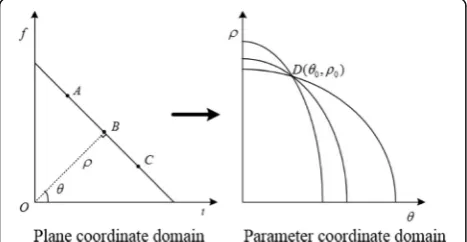
At the signal intersections, LFM signals are coherent owing to same frequency, which brings the rank defi-ciency of the signal subspace matrix. If these intersected TF points are selected to construct the STFD matrix, then subsequent DOA estimation will fail. Therefore, our goal is to remove multiple-source TF points and ob-tain single-source TF points set belonging to each signal. In theory, two LFM signals only have an intersection in TF domain. However, since the sampling data is discrete and finite, the TF ridgeline of LFM signals under STFT has somewhat wide. Therefore, there exist multiple TF points around the intersections when LFM signals are non-disjoint in TF domain. By converting the TF distribution of LFM signals into ordinary grayscale image, we can use the Hough transform method to de-tect straight lines in the grayscale image [26]. Hough transform is a parameter estimation technique using the voting principle in TF domain. The basic principle is to map the straight line detecting problem in the plane co-ordinate domain into the parameter coco-ordinate domain
(a) TF-disjoint LFM signals (b) TF non-disjoint LFM signals
by using the point-line duality property, so that the mapped result is easier to be detected. It is assumed that the curve satisfies the following equation
F t;ðð fÞ;ða1;a2;⋯;amÞÞ ¼0: ð7Þ
In the plane Cartesian coordinates, the curve satisfies specific parameters (a1,a2,⋯,am), and (t,f) is located at the curve.ρdenotes the distance between the curve and the coordinate origin, and θ is the angle betweenρ and the sampling time axis. After mapping into the param-eter domain, we use the polar coordinates to describe the parameters, and there exists following relationship
ρ¼tcosð Þ þθ f sinð Þθ : ð8Þ
Equation (8) shows that a point in the plane nates corresponds to a curve in the parameter coordi-nates. The different points of the same curve in the plane coordinates intersect at a point in the parameter coordinates, as is shown in Fig.2.
Figure 2 shows that the three points A, B, C of the same line in the plane coordinate domain can be mapped into three curves and curves intersect at the point D. By integrating along with different θ, we can obtain the Hough transform. As a consequence, the Hough transform is a kind of projection integral essentially.
Firstly, we convert the TF distribution into the gray-scale image. Then, by performing Hough transform on the grayscale image, we can obtain the corresponding curves of each TF points in the parameter domain. These curves exist multiple intersections, and each inter-section corresponds to a detected line segment in the plane coordinate domain. For N LFM signals in TF do-main, 2N peak points (θ1,ρ1), (θ2,ρ2),⋯, (θ2N,ρ2N) can be searched by setting appropriate threshold value and carrying accumulation statistics; this is because the TF distribution of LFM signal under STFT has somewhat wide. The 2N peak points correspond to 2N line seg-ments of the plane coordinate domain, and the
mathematical equation of these lines can be calculated based on the endpoint coordinates, namely,
f
f1¼k1tþb1
f2¼k2tþb2
⋮
f2N¼k2Ntþb2N
; ð9Þ
where k1, k2, ⋯, k2N and b1, b2, ⋯, b2N are slopes and intercepts of lines, respectively.
Since the noise in TF domain has been removed, the energy value in the TF ridgeline is much stronger than other TF points. Therefore, based on the Hough trans-form, we can precisely extract the line segments where TF distribution boundary of LFM signals is located in TF domain. Assuming that there existQ (Q≤N(N−1)/ 2) intersections betweenNsignals, then the detected 2N
line segments which corresponds to N signals will have
P (P≥4Q) intersections. If NLFM signals only pairwise intersect, the detected line segments have 4Q intersec-tions. However, when there exists the situation that mul-tiple signals intersect at one point, the number of intersections among 2Nline segments will be more than 4Q. For any intersection in TF domain, we can calculate all intersections (t1,f1), (t2,f2),⋯, (tP,fP) according to the line equation in the grayscale image. Then the minimum min(t1,t2,⋯tP) and maximum max(t1,t2,⋯tP) of the sampling time axis can be obtained in all intersections. In addition, the corresponding min(f1,f2,⋯fU) and max(f1,f2,⋯fU) can also be solved based on the (9), wheref1, f2,⋯fUare all frequency values that min(t1,t2,
⋯tP) and max(t1,t2,⋯tP) correspond to detected line segments. If multiple-source TF points cannot be com-pletely removed, these TF points are selected to estimate DOAs, which will result in the failure of DOA estima-tion. So we remove multiple-source TF points corre-sponding to the region of (min(t1⋯tP), max(t1⋯tP)) and (min(f1⋯fU), max(f1⋯fU)) and then obtain single-source TF points set ΩS= ∪ Ωn for n= 1, 2, ⋯, N, where Ωn denotes single-source TF points set of thenthsignal.
2.3 Constructing STFD matrix
In this subsection, we firstly calculate the single-source TF points set belonging to each signal and then con-struct the STFD matrix for subsequent DOA estimation. According to reference [15], for the signal STFD matrix DSS(t,f), the diagonal elements have a larger value, and the remaining elements are close to zero at the single-source TF points. As a result, based on the (4), the single-source TF points of thenthsignal inΩnsatisfies
DXXðt;fÞ ¼DSSðt;fÞanð Þt anHð Þt ∀ðt;fÞ∈Ωn: ð10Þ
For any two single-source TF points (ti,fi) and (tj,fj) in Ωn, (10) can be rewritten as
DXXðti;fiÞ ¼DSSðti;fiÞanð Þt aHnð Þt : ð11Þ main eigenvalueλ(tp,fp) and the corresponding principal eigenvectore(tp,fp) from the STFD matrix. Without loss
For single-source TF points set ΩS, mathematically, (ti,fi) and (tj,fj) belong to the same signal if they have
whered(·) is the Euclidean distance operator between ~eð
ti;fiÞ and ~eðtj;fjÞ. ε2 is an empirical threshold value, which is greater than 0. Typically,ε2= 0.05 when SNR = 10 dB [15]. By traversing entire set ΩS, we can obtain single-source TF points setΩnof thenthsignal.
In order to reduce the calculation error and make full use of single-source TF points, we can compute the av-eraged STFD matrix of all TF points. For the nth signal, the averaged STFD matrix is expressed as
Dnðt;fÞ ¼ΣΩ1 subspace-based algorithm and ΣΩndenotes the number of single-source TF points.
Therefore, based on the MUSIC algorithm, we can carry eigendecomposition on the matrixDnðt;fÞand ob-tain the signal subspace and noise subspace. Finally, we can construct the spectrum peak searching function and perform DOA estimation
Pð Þ ¼θ 1
bHð Þθ UnUnHbð Þθ ; ð16Þ
where b(θ) is the steering vector and Un is the noise subspace.
For the readers’convenience, the procedure of single-source TF points selection algorithm based on Hough transform and STFT is summarized as follows:
(1) Filter out noise according to empirical threshold
valueε1in TF domain.
(2) Based on Hough transform, remove multiple-source TF points, and obtain all single-source TF points set
ΩS.
(3) Classify signals according to the Euclidean distance
operator, and get single-source TF points setΩnof
each signal.
(4) For every signal, calculate the averaged STFD
matrixDnðt;fÞin the setΩn, and then construct
the spectrum peak search functionP(θ) = 1/
bH(θ)UnUnHb(θ) based on the MUSIC algorithm.
3 Results and discussion
In order to verify the performance of the proposed algo-rithm, the following simulations are carried. Here, we set some general simulation parameters. The ULA hasM= 8 sensors, and the array element spacing is the half of the wavelength which corresponds to the lowest fre-quency of LFM signals. The sampling rate is 360 MHz and snapshots are 1024. Since the STFT distribution can obviously gather the signal energy in TF domain and the SNR of signals is improved in TF domain by filtering the noise, we select SNR = 10 dB in the following analyses. Meanwhile, this paper involves the selection of two em-pirical threshold values. The threshold value ε1 elimi-nates the effect of noise in TF domain, which is related to the SNR. We take ε1= 0.05 when SNR = 10 dB, and ε1 has been verified by [18]. Similarly, ε2= 0.05 when SNR = 10 dB, which is also verified by [15]. In addition, we proceed with the comparison simulations among STFT-MUSIC algorithm [20], STFT-FBSS-MUSIC algo-rithm [25], the reference [24], and the proposed algo-rithm. Firstly, the general performance of the proposed algorithm is verified, which includes the DOA estimation precision, the spatial resolution, and underdetermined DOA estimation, as is shown in Sections 3.1 and 3.2. Then, we verify the new property of the proposed algo-rithm, i.e., the DOA estimation performance when mul-tiple LFM signals intersect at one point, as is shown in Section 3.3. In Section 3.4, the computational complexity of different algorithms is analyzed.
3.1 DOA estimation accuracy analysis
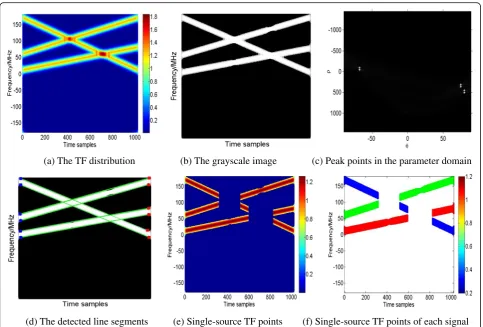
method. Figure 3a displays the TF distribution of three LFM signals after filtering noise, whose grayscale image is showed in Fig.3b. Based on Hough transform, we can search six peak points which is indicated by white in Fig. 3c, and Fig. 3d shows the detected six line seg-ments. After removing multiple-source TF points, the single-source TF points set is shown in Fig. 3e. Ac-cording to the Euclidean distance operator, we can
classify signals and get single-source TF points set of each signal, as is shown in Fig. 3f.
Based on the abovementioned analysis, Fig. 4a plots ten typical independent estimated spatial spectra of the proposed algorithm, where the dashed lines represent the true DOAs. It can be seen that the proposed algo-rithm can accurately achieve DOA estimation. In order to quantitatively analyze the DOA estimation accuracy
(a) The TF distribution (b) The grayscale image (c) Peak points in the parameter domain
(d) The detected line segments (e) Single-source TF points (f) Single-source TF points of each signal
Fig. 3The single-source TF points selection method, (a) the TF distribution, (b) the grayscale image, (c) peak points in the parameter domain, (d)
the detected line segments, (e) single-source TF points, (f) single-source TF points of each signal
-50 0 50
-20 -10 0 10 20 30 40 50 60
DOA(degree)
S
p
at
ia
l
S
pec
trum(dB
)
True DOAs The proposed algorithm
0 5 10 15 20 25
10-2 10-1 100 101
SNR(dB)
R
M
S
E
(degree)
STFT-FBSS-MUSIC [25] STFT-MUSIC [20] The reference [24] The proposed algorithm
(a) The spatial spectra distribution (b) The DOA estimation RMSE versus SNR
of different algorithms, the root-mean-square error (RMSE) is introduced, which is denoted as
RMSEθ¼
where M is the number of Monte Carlo trials,N is the number of signals, and ^θmn is the estimated value ofθn in themthsimulation.
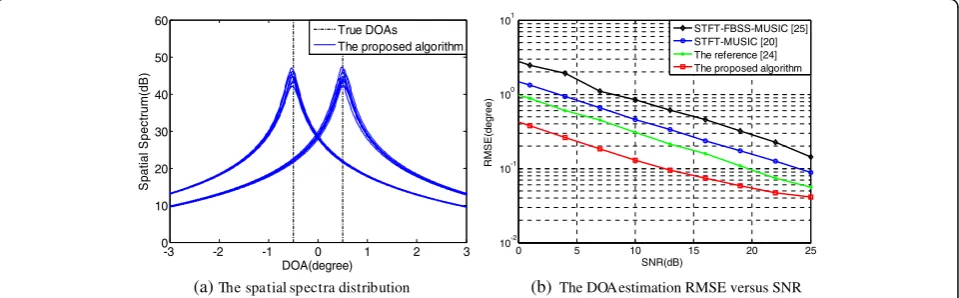
By carrying 1000 times independent Monte Carlo tri-als, Fig. 4b shows that the DOA estimation RMSE of 4 algorithms vary with the SNR. From Fig. 4b, we can see that DOA estimation RMSE of four algorithms decreases rapidly with the increase of SNR. In general, the STFT-FBSS-MUSIC algorithm has the worst DOA estimation accuracy, and the estimation precision is 0.7594 ° when SNR is 10 dB. Because of performing the spatial smooth-ing operation, the array aperture of the STFT-FBSS-MUSIC algorithm is reduced. As a result, the estimation precision is reduced. Then, it is followed by the STFT-MUSIC algorithm, and the estimation precision is 0.3970 ° when SNR is 10 dB. The STFT-MUSIC algo-rithm performs DOA estimation by using the TF points at the TF ridgeline, and only few TF points are used to estimate DOAs, which results in low estimation preci-sion. In addition, it is not realistic to assume that the TF points are available at the TF ridgeline. By removing multiple-source TF points, the reference [24] and the proposed algorithm can obtain single-source TF points set belonging to each signal. Then, by computing the av-eraged STFD matrix of all TF points for every signal, the DOA estimation precision of these two methods is im-proved. Compared with the [24], the proposed algorithm removes multiple-source TF points based on Hough transform and reserves as many single-source TF points as possible. Therefore, the proposed algorithm possesses
the best estimation precision, which can achieve 0.1474 ° when SNR is 10 dB.
3.2 The angular resolution analysis and underdetermined DOA estimation
In order to verify the angular resolution of the proposed algorithm, we consider two spectrally overlapped LFM signals coming from−0.5 ° and 0.5 °. The frequency dis-tribution of two signals are [170, 10] MHz and [10, 170] MHz, respectively. Figure 5a plots ten typical independ-ent estimated spatial spectra of the proposed algorithm, which shows that the proposed algorithm can achieve DOA estimation when the spatial spacing of signals is 1 °. By performing 1000 times Monte Carlo trials, Fig. 5b displays that the DOA estimation RMSE of LFM signals at different SNR, which can be seen that the proposed algorithm has better DOA estimation accuracy when the DOA spacing is 1 °. Although the spatial spacing is very close, they are still distinctly distributed in TF domain. Therefore, the proposed algorithm has better angular resolution.
It is known that conventional subspace-based algo-rithms will fail in the underdetermined cases. However, the TF analysis can solve this problem. Based on the abovementioned simulation condition, we assume that four spectrally overlapped LFM signals come from− 15 °,−5 °, 5 °, and 15 °. Figure6a plots ten typical independ-ent estimated spatial spectra of this case. Then, we re-duce the number of sensors to M= 3, and the incident signals remain unchanged; ten independent estimated spatial spectra is plotted in Fig. 6b. It is seen that the proposed algorithm can correctly estimate DOAs in the underdetermined cases. The reason is that the proposed algorithm separately handles each signal in TF domain. Although the number of signals is more than that of sensors, the proposed algorithm can still achieve DOA estimation.
(a)The spatial spectra distribution (b)The DOA estimation RMSE versus SNR
Fig. 5The angular resolution of the proposed algorithm (DOA spacing: 1 °), (a) the spatial spectrum distribution, (b) the RMSE of DOA estimation
According to Sections 3.1 and 3.2, we know that the STFT-MUSIC algorithm is not practical in the engineer-ing applications and the DOA estimation precision of the STFT-FBSS-MUSIC algorithm is poor. Although the reference [24] has good DOA estimation accuracy, it is only applicable to the case that two LFM signals inter-sect at one point. When multiple signals interinter-sect at one point, the algorithm will fail. However, the proposed al-gorithm is not restricted by this case. Based on the Hough transform, the proposed algorithm can achieve
DOA estimation when multiple signals intersect at one point. The following experiment will illustrate this property.
3.3 The DOA estimation analysis when multiple LFM signals intersect at one point
We consider that three spectrally overlapped LFM sig-nals come from− 30 °, 0 °, and 30 °, and these signals intersect at one point in TF domain. The frequency dis-tribution of three signals are [170,10] MHz, [90,90] MHz
-30 -20 -10 0 10 20 30
-10 0 10 20 30 40 50 60 70 80
DOA(degree)
S
p
ati
a
l
S
pec
trum(
dB
)
True DOAs The proposed algorithm
-30 -20 -10 0 10 20 30
-10 0 10 20 30 40 50 60 70 80
DOA(degree)
S
pati
a
l
S
pec
trum(
d
B
)
True DOAs The proposed algorithm
(a) M=8, N=4 (b) M=3, N=4
Fig. 6The DOA estimation in the underdetermined cases, (a) M = 8, N = 4, (b) M = 3, and N = 4
Time samples
Frequency/MHz
detected result based on Hough transform
-50 0 50
-10 0 10 20 30 40 50 60
DOA(degree)
Spatial Spectrum(dB)
True DOAs The proposed algorithm
0 5 10 15 20 25
10-2 10-1 100 101
SNR(dB)
RMSE(degree)
STFT-FBSS-MUSIC [25] STFT-MUSIC [20] The proposed algorithm (a) The TF distribution of three signals (b) The
(c) The spatial spectra distribution (d) The DOA estimation RMSE versus SNR
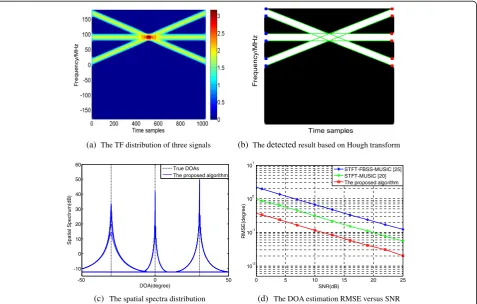
Fig. 7The DOA estimation results analysis, (a) the TF distribution of three signals, (b) the detected result based on Hough transform, (c) the
, and [10,170] MHz, respectively. Other settings remain unchanged; the TF distribution of three signals is shown in Fig.7a when SNR = 10 dB, and Fig.7b shows the de-tected results by using the Hough transform. Based on the proposed algorithm, the DOA estimation results are shown in Fig.7c and d. It can be seen that the proposed algorithm has higher DOA estimation precision and the estimation precision can reach 0.1153 ° when SNR = 10 dB. Therefore, the proposed algorithm can achieve DOA estimation when multiple LFM signals intersect at one point.
3.4 The computational complexity analysis
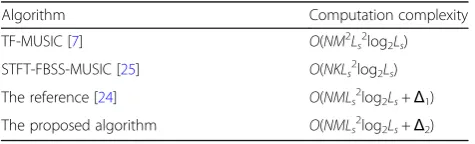
The computational complexity comparison among the proposed algorithm and three existing methods are pre-sented in Table.1. We consider a ULA with M sensors and N far-field LFM signals imping on the ULA. Ls snapshots are used. In the STFT-FBSS-MUSIC algo-rithm, assuming that sub-array elements are K(K<M). Considering that the TF-MUSIC algorithm is based on the quadratic TF operation, it has the highest computa-tional complexity O(NM2Ls2log2Ls). Due to performing the FBSS algorithm, the STFT-FBSS-MUSIC algorithm possesses the lowest computational complexity
O(NKLs2log2Ls). However, its estimation precision is poor. The reference [24] and the proposed algorithm have similar computational complexities, where Δ1 and Δ2 denote the increased calculation burden due to extract single-source TF points, respectively. Δ1 and Δ2 are similar and are much smaller than
O(NMLs2log2Ls). Therefore, the proposed algorithm has better estimation performance and acceptable computational complexity, which will have broad ap-plication prospects in the engineering.
4 Conclusion
Conventional DOA estimation algorithms will fail when LFM signals are spectrally overlapped in TF domain. In order to solve this problem, this paper proposes single-source TF points selection algorithm based on Hough transform. For the purpose of reducing computational complexity, we select the STFT to analyze LFM signals. The proposed algorithm not only has higher DOA esti-mation precision and angular resolution but also can achieve DOA estimation in the underdetermined cases. In addition, the proposed algorithm can achieve DOA
estimation when multiple signals intersect at one point compared with existing algorithms. Although the current algorithm is only applicable to LFM signals which satisfy the straight line distribution in TF domain, generalized Hough transform can detect other forms of signals with different shapes in TF domain, such as si-nusoidal FM signal and frequency-shift-keying signal. Therefore, the proposed algorithm has a broad applica-tion prospect in the electronic countermeasures.
Abbreviations
DOA:Direction-of-arrivalLFMLinear frequency modulationSTFTShort-time
Fourier transformSTFDSpatial time-frequency distributionTFTime-frequencyMUSICMultiple signal classificationFBSSForward-backward spatial smoothingULAUniform linear array
Acknowledgements
The authors would like to thank all anonymous reviewers and editors for their helpful suggestions for the improvement of this paper.
Authors’contributions
WZ and KC proposed the original idea of the full text; WZ and YY designed and implemented the simulation experiments; WZ and TX wrote the manuscript under the guidance of NY; WZ and NY revised the manuscript; XZ revised the manuscript and made great contribution to the final manuscript. All authors read and approved the final manuscript.
Authors’information
State Key Laboratory of Complex Electromagnetic Environment Effects on Electronics and Information System, National University of Defense Technology. No. 109, Deya Road, Kaifu District, Changsha, 410073, China.
Funding
This research received no specific grant from any funding agency in the public, commercial, or not-for-profit sectors.
Availability of data and materials
Data and materials are not possible to share publicly. If you have any interest in our data and materials, please contact the corresponding author by e-mail.
Ethics approval and consent to participate
The manuscript does not study human and animals.
Consent for publication
The authors agree to publish the final manuscript.
Competing interests
The authors declare that they have no competing interests.
Received: 11 October 2018 Accepted: 20 November 2019
References
1. R. Schmidt, Multiple emitter location and signal parameter estimation. IEEE
Trans. Antennas Propag.34(3), 276–280 (1986)
2. R. Roy, T. Kailath, Direction-of-arrival estimation by subspace rotation
methods-ESPRIT. IEEE Trans. Acoust. Speech. Signal Process.37(7), 984–995
(1989)
3. SH Liu, YD Zhang, T Shan, Detection of weak astronomical signals with
frequency-hopping interference suppression. Digit Signal Process. 72, 1–8
(2018)
4. WK Zhang, X Chen, K Cui, T Xie, NC Yuan, DOA estimation for coprime
linear array based on MI-ESPRIT and lookup table. Sennsors. 18(9), 3043 (2018)
5. SH Liu, T Shan, YD Zhang, R Tao, Y Feng, A fast algorithm for
multi-component LFM signal analysis exploiting segmented DPT and SDFrFT.
In: Proceedings of the 2015 IEEE Radar Conference (RadarCon). 1139–
1143 (2015)
Table 1Comparison of computation complexity
Algorithm Computation complexity
TF-MUSIC [7] O(NM2Ls2log2Ls)
STFT-FBSS-MUSIC [25] O(NKLs2log2Ls)
The reference [24] O(NMLs2log2Ls+Δ1)
6. T. Shu, X. Liu, Robust and computationally efficient signal-dependent method for joint DOA and frequency estimation. EURASIP J. Adv. Signal Process.2008(1), 1–16 (2008)
7. A. Belouchrani, M.G. Amin, Time-frequency MUSIC. IEEE Signal Process Lett.
6(5), 109–110 (2002)
8. A. Belouchrani, M.G. Amin, Blind source separation based on time–
frequency signal representations. IEEE Trans. Signal Process.46(11), 2888– 2897 (1998)
9. M.G. Amin, Y.D. Zhang, Direction finding based on spatial time-frequency
distribution matrices. Digit Signal Process.10(4), 325–339 (2000)
10. Y.D. Zhang, W.-K. Ma, M.G. Amin, Subspace analysis of spatial time–
frequency distribution matrices. IEEE Trans. Signal Process.49(4), 747–
759 (2001)
11. A.B. Gershman, M. Pesavento, M.G. Amin, Estimating parameters of multiple
wideband polynomial-phase sources in sensor arrays. IEEE Trans. Signal Process.49(12), 2924–2934 (2001)
12. KB Cui, WW Wu, JJ Huang, X Chen, NC Yuan, DOA estimation of LFM signals
based on STFT and multiple invariance ESPRIT. AEU-Int J Electron Commun. 77, 10–17 (2017)
13. J. Yu, L. Zhang, K. Liu, Coherently distributed wideband LFM source
localization. IEEE Signal Process Lett.22(4), 504–508 (2015)
14. A. Belouchrani, M.G. Amin, N. Thirion-Moreau, Y.D. Zhang, Source separation
and localization using time-frequency distributions: an overview. IEEE Signal Process. Mag.30(6), 97–107 (2013)
15. N. Linh-Trung, A. Belouchrani, K. Abed-Meraim, B. Boashash, Separating
more sources than sensors using time-frequency distributions. EURASIP J. Appl. Signal Process.2005(17), 2828–2847 (2005)
16. P. Heidenreich, L.A. Cirillo, A.M. Zoubir, Morphological image processing
for FM source detection and localization. Signal Process.89(6), 1070–
1080 (2009)
17. E.M. Fadaili, N.T. Moreau, E. Moreau, Nonorthogonal joint diagonalization/
zero diagonalization for source separation based on time-frequency distributions. IEEE Trans. Signal Process.55(5), 1673–1687 (2007)
18. A. Aissa-El-Bey, N. Linh-Trung, K. Abed-Meraim, A. Belouchrani, Y. Grenier,
Underdetermined blind separation of nondisjoint sources in the time-frequency domain. IEEE Trans. Signal Process.55(3), 897–907 (2007)
19. Y.D. Zhang, M.G. Amin, Blind separation of nonstationary sources based on
spatial time-frequency distributions. EURASIP J. Adv. Signal Process.2006(1), 1–13 (2006)
20. S.G. Kim, D.Y. Chang, Underdetermined blind source separation based on
subspace representation. IEEE Trans. Signal Process.57(7), 2604–2614 (2009)
21. Y. Li, S. Amari, A. Cichocki, D.W.C. Ho, S. Xie, Underdetermined blind source
separation based on sparse representation. IEEE Trans. Signal Process.54(2), 423–437 (2006)
22. A Jourjine, S Rickard, O Yilmaz, Blind separation of disjoint orthogonal
signals: demixing sources from 2 mixtures. In: Proceedings of IEEE
Interna-tional Conference on Acoustics, Speech, and Signal Processing. 5, 2985–
2988 (2002)
23. O. Yilmaz, S. Rickard, Blind separation of speech mixtures via time-frequency
masking. IEEE Trans. Signal Process.52(7), 1830–1847 (2004)
24. H.J. Zhang, G. Bi, Y. Cai, S.G. Razul, M.S.S. Chong, DOA estimation of
closely-spaced and spectrally-overlapped sources using a STFT-based MUSIC algorithm. Digital Signal Process.52, 25–34 (2016)
25. K.B. Cui, X. Chen, J.J. Huang, N.C. Yuan, DOA estimation of multiple LFM
sources using a STFT-based and FBSS-based MUSIC algorithm.
Radioengineering.26(4), 1126–1137 (2017)
26. R. Duda, E. Peter, Use of the Hough transformation to detect lines and
curves in pictures. Graphics and W. Newman Image Processing.15(1),
11–15 (1972)
Publisher’s Note