ANALYTICAL METHOD DEVELOPMENT AND VALIDATION OF
CLOXACILLIN AND CEFIXIME SIMULTANIOUS IN TABLET
DOSAGE FORM BY RP-HPLC
1
Dr. M. Prasadarao and 2S. Lakshmi Sumanoja*
1
Department of Pharmaceutical Sciences, Acharya Nagarjuna University, Nagarjuna Nagar,
Guntur, Andhra Pradesh- 522 510.
2
M.A.M. College of Pharmacy, Kesanupalli, Narsaraopet, Guntur, A.P.
ABSTRACT
A simple reverse phase high perfomence liquid chromatographic
method has been developed and subsequently validatedfor
simultaneous determination of cefixime and cloxacillin in combined
dosage form. The separation was carried out using a mobile phase
consisting of methanol and mono basic potassium phosphate buffer in
the ratio of 60:40 v/v. The column used was Inertsil –ODS C18 (250 ×
4.6 mm, 5μ) with flow rate of1.0ml/min using PDA detection at
272nm. The described method was linear over a concentration range of
20ppm to 80ppm for the assay of cefixime and cloxacillin respectively.
The retention times of cefixime and cloxacillin were found to be
2.955min and 3.532min respectively. Results of analysis were validated statistically and by
recovery studies. The limit of quantification (LOQ) for cefixime and cloxacillin were found
to be 0.77mg/ml and 1.05mg/ml respectively. Then the limit of detection (LOD) for cefixime
and cloxacillin were found to be 0.25 mg/ml and 20.34 mg/ml respectively. The results of the
study showed that the proposed RP-HPLC method is simple, rapid, precise and accurate
which is useful for the routine determination of cefixime and scloxacillin bulk drug and in its
pharmaceutical dosage form.
KEYWORDS: cefixime, cloxacillin, methanol.
INTRODUCTION
Cefixime and cloxacillin is a combintion drug isa, often consisting of 200mg cefixime with
Volume 4, Issue 8, 2549-2564. Research Article ISSN 2277– 7105
Article Received on 17 June 2015,
Revised on 08 July 2015, Accepted on 29 July 2015
*Correspondence for Author
S. Lakshmi Sumanoja
M.A.M. College of
Pharmacy, Kesanupalli,
third-generation cephalosporin like ceftriaxone and cefotaxime. Cefixime is highly stable in
the presence of beta-lactamase enzymes. As a result, many organisms resistant to penicillins
and some cephalosporins due to the presence of beta-lactamases, may be susceptible to
cefixime. The antibacterial effect of cefixime results from inhibition of mucopeptide
synthesis in the bacterial cell wall.[2] Cloxacillin is a semisynthetic antibiotic in the same class
as penicillin. Cloxacillin is for use against staphylococci that produce beta-lactamase.[3]
Cefixime Cloxacillin
MATERIALS AND METHOD
Chemicals and solvents: Cefixime, Cloxacillin as gift samples from Mylan Laboratories Limited, Hyderabad, India. The commercial Pharmaceutical tablet formulation of Ceftas
containing 200mg cefixime, 500mg Cloxacillin (manufactured by Intas laboratories) were
procured from local pharmacy. Potassium dihydrogen phosphate – AR grade (SD.Fine chem.
Ltd, mumdai), Acetonitrile-HPLC grade (Merck India), Methanol – HPLC grade (Merck
India).
INSTRUMENTATION
The chromatographic separations were performed using HPLC-Waters alliance
(Model-2690/5) consisting of an in-built auto sampler, a column oven and Waters 996 PDA detector.
The data was acquired through Empower-2-software. The column used was Inertsil ODS
(250×4.6 mm, 5μ). Meltronics sonicator was used for enhancing dissolution of the
compounds. Elico pH meter was used for adjusting the pH of buffer solution. All weighing
was done on Sartorious balance (model AE-160).
60:40 v/v to the column in the flow rate of 1.0 ml/min whereas run time set was 10 min. The
separation was performed on Inertsil ODS-3V 250mm x 4.6mm, 5μm column and the column
was maintained the temperature ambient and the volume of each injection was 20µl. Prior to
injection, the column was equilibrated for at least 30 min with mobile phase flowing through
the system. The eluents were monitored at 272 nm.
OPTIMISED METHOD
Mobile Phase: Degassed Methanol and Buffer in the ratio of 60:40 V/V.
Preparation of(KH2PO4 0.1M) buffer:Weight 3.8954g of di-sodium hydrogen phosphate and 3.4023 of potassium dihydrogen phosphate in to a beaker containing 1000ml of distilled
water and dissolve completely. Then ph is adjusted with orthophosphoric acid and then
filtered through 0.45µm membrane filter.
Preparation of stock solution: Reference solution: The solution was prepared by dissolving 20.0 mg of accurately weighed Cefixime and 25.0 mg Cloxacillin in Mobile phase, in two
100.0 mL volumetric flasks separately and sonicate for 20min. From the above solutions take
10.0 mL from each solution into a 50.0 mL volumetric flask and then makeup with mobile
phase and sonicate for 10min.
Preparation of working standard solution: The stock solutions equivalent to 20ppm to 80ppm with respect to both drugs were prepared in combination of Cefixime and Cloxacillin
above, sonicated and filtered through 0.45µ membrane.
Optimized chromatographic conditions
Parameters Method
Stationary phase (column) Inertsil -ODS C18(250 x 4.6 mm, 5 µ)
Mobile Phase Methanol : Buffer (60:40)
Flow rate (ml/min) 1.0 ml/min
Run time (minutes) 10 min
Column temperature (°C) Ambient
Volume of injection loop (l) 20
Detection wavelength (nm) 272nm
C
e
f
ix
im
e
-2
.
9
5
5
C
lo
x
a
c
il
li
n
-3
.
5
3
8
AU
0.00 0.02 0.04 0.06 0.08 0.10 0.12 0.14 0.16 0.18
Minutes
0.50 1.00 1.50 2.00 2.50 3.00 3.50 4.00 4.50 5.00 5.50 6.00 6.50 7.00
Fig 1: Chromatogram of standard
Inference: Got chromatogram at RT’s of 2.955min to Cefixime and 3.522min to Cloxacillin.
METHOD VALIDATION
The developed method was validated as per the ICH (International Conference on
Harmonization) guidelines with respect to System suitability, Specificity,
Linearity,presission, Accuracy, Limit of detection and Limit of quantification.
1. SYSTEM SUITABILITY
A Standard solution was prepared by using Cefixime and Cloxacillin working standards as
per test method and was injected Five times into the HPLC system.The system suitability
parameters were evaluated from standard chromatograms by calculating the % RSD from five
replicate injections for Cefixime and Cloxacillin , retention times and peak areas.
ACCEPTANCE CRITERIA
1. The % RSD for the retention times of principal peak from 5 replicate injections of each
Standard solution should be not more than 2.0 %
2. The % RSD for the peak area responses of principal peak from 5 replicate injections of
each standard Solution should be not more than 2.0%.
3. The number of theoretical plates (N) for the Cefixime and Cloxacillin peaks is NLT 3000.
4. The Tailing factor (T) for the Cefixime and Cloxacillin
[image:4.595.136.460.74.288.2]Table- 1: Data of System Suitability for cefixime and cloxacillin
Cefixime Cloxacillin
Injection RT Peak area USP plate count
USP
tailling RT
Peak area USP platecount USP trailling
1 2.955 1139272 5890.964069 1.238915 3.522 797564 8676.113795 1.099100
2 2.955 1140892 5915.423628 1.230637 3.532 795138 8803.641669 1.103929
3 2.954 1136301 5934.796986 1.240858 3.529 795685 8616.937115 1.111477
4 2.953 1141067 5976.253744 1.238995 3.526 800569 8820.182543 1.117660
5 2.954 1136024 5953.814152 1.241073 3.525 797049 8735.115629 1.119004
MEAN 2.954218 1138711 5934.251 1.236496 3.527241 797201 8730.398 1.110234
SD 0.000837 57540.015 --- --- 0.002683 2124.413 --- ---
%RSD 0.028363 0.213538 --- --- 0.064022 0.266484 --- ---
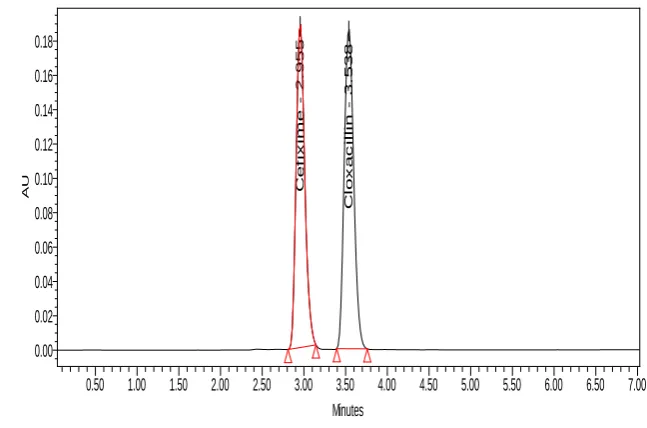
C e f ix im e -2 . 9 5 5 C lo x a c il li n -3 . 5 3 8 AU 0.00 0.02 0.04 0.06 0.08 0.10 0.12 0.14 0.16 0.18 Minutes
0.50 1.00 1.50 2.00 2.50 3.00 3.50 4.00 4.50 5.00 5.50 6.00 6.50 7.00
Inference: System suitability Chromatogram for standard – 1
C e f ix im e -2 . 9 5 5 C lo x a c il li n -3 . 5 3 2 AU 0.00 0.02 0.04 0.06 0.08 0.10 0.12 0.14 0.16 0.18 Minutes
0.50 1.00 1.50 2.00 2.50 3.00 3.50 4.00 4.50 5.00 5.50 6.00 6.50 7.00
C e f ix im e -2 . 9 5 4 C lo x a c il li n -3 . 5 2 9 AU 0.00 0.02 0.04 0.06 0.08 0.10 0.12 0.14 0.16 0.18 Minutes
0.50 1.00 1.50 2.00 2.50 3.00 3.50 4.00 4.50 5.00 5.50 6.00 6.50 7.00
Inference: System suitability Chromatogram for standard – 3
C e f ix im e -2 . 9 5 3 C lo x a c il li n -3 . 5 2 6 AU 0.00 0.02 0.04 0.06 0.08 0.10 0.12 0.14 0.16 0.18 Minutes
0.50 1.00 1.50 2.00 2.50 3.00 3.50 4.00 4.50 5.00 5.50 6.00 6.50 7.00
Inference: System suitability Chromatogram for standard - 4
C e fi x im e - 2 .9 5 4 C lo x a c il li n 3 .5 2 5 AU 0.00 0.02 0.04 0.06 0.08 0.10 0.12 0.14 0.16 0.18 Minutes
0.50 1.00 1.50 2.00 2.50 3.00 3.50 4.00 4.50 5.00 5.50 6.00 6.50 7.00
OBSERVATION
The %RSD for retention times and peak areas were found to be within the limit. Refer table:
1 As shown in fig 1 – 5.
2. SPECIFICITY
Cefixime and Cloxacillin
Solutions of standard and sample were prepared as per the test method are injected into
chromatographic system.
ACCEPTENCE CRITERIA
Chromatograms of standard and sample should be identical with near Retention time.
C
e
f
ix
im
e
-2
.
9
5
3
C
lo
x
a
c
il
li
n
-3
.
5
2
3
AU
0.00 0.02 0.04 0.06 0.08 0.10 0.12 0.14 0.16 0.18
Minutes
0.50 1.00 1.50 2.00 2.50 3.00 3.50 4.00 4.50 5.00 5.50 6.00 6.50 7.00
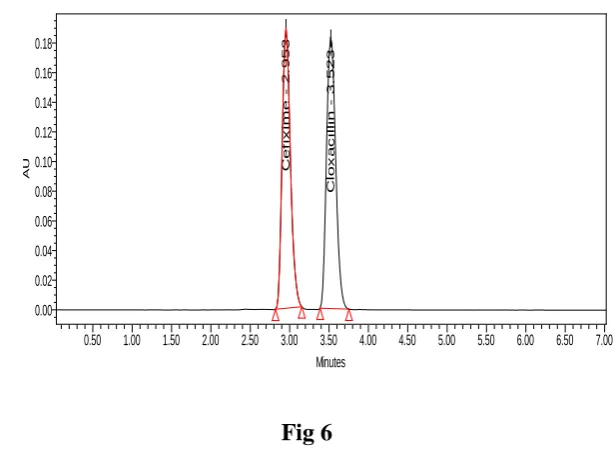
Fig 6
Inference: Got a peak for sample at an Rt of 2.953min for Cefixime and 3.523min for Cloxacillin.
OBSERVATION: The chromatograms of Standard and Sample were same identical with same retention time. As shown in fig: 6.
3. LINEARITY OF TEST METHOD
A Series of solutions are prepared using Cefixime and Cloxacillin working standards at
concentration levels from 20ppm to 80 ppm of target concentration .Measure the peak area
[image:7.595.144.452.298.528.2]ACCEPTANCE CRITERIA
Correlation Coefficient should be not less than 0.9990.
% of y- Intercept should be ±2.0.
% of RSD for level 1 and Level 6 should be not more than 2.0%.
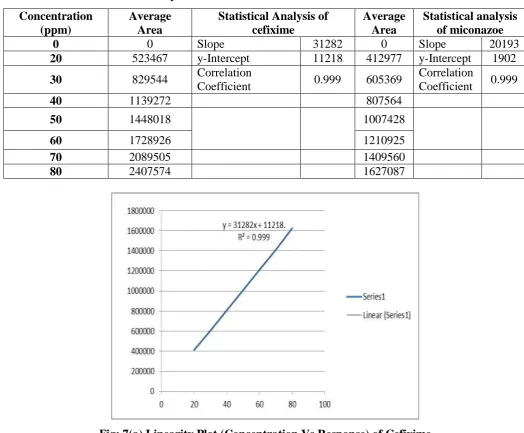
Table 2: Data of Linearity cefixime and cloxacillin Concentration
(ppm)
Average Area
Statistical Analysis of cefixime
Average Area
Statistical analysis of miconazoe
0 0 Slope 31282 0 Slope 20193
20 523467 y-Intercept 11218 412977 y-Intercept 1902
30 829544 Correlation
Coefficient 0.999 605369
Correlation
Coefficient 0.999
40 1139272 807564
50 1448018 1007428
60 1728926 1210925
70 2089505 1409560
80 2407574 1627087
[image:8.595.32.557.181.614.2]Fig: 7(b) Linearity Plot (Concentration Vs Response)ofCloxacillin
OBSERVATION
The linear fit of the system was illustrated graphically. The results are presented in table2.
4. PRECISION 4.1Repeatability
a. precision: Standard solution prepared as per test method and injected five times.
b. Method precision: Prepared six sample preparations individually using single as per test
method and injected each solution.
ACCEPTANCE CRITERIA: The % relative standard deviation of individual Cefixime and Cloxacillin, from the six units should be not more than 2.0%.
The individual assays of Cefixime and Cloxacillin should be not less than 98% and not more
than 102.0%.
OBSERVATION
Test results are showing that the test method is precise. Refer tables 3and 4 for system
Table 3: Data of Repeatability (System precision) for cefixime and cloxacillin
Concentration 40ppm
injection Peak area of
cefixime %Assay
Peak area of
cloxacillin %Assay
1 1146923 99.65 801690 98.84
2 1143596 99.08 797631 99.69
3 1158293 99.98 805783 100.05
4 1147283 100.04 801496 101.11
5 1152490 100.16 806432 100.96
Statistical
Analysis
Mean 1149717 99.78 802606.4 100.13
SD 5754.015 0.435569 3590.034 0.937203
b) Method precision
Concentration 40ppm
Injection Peaks areas
of cefixime %Assay
Peaks areas
of cloxacillin %Assay
1 1152293 99.55 805783 99.85
2 1146923 99.88 801690 99.96
3 1147283 99.40 801496 100.53
4 1152490 99.56 806432 100.30
5 1139272 99.85 797564 100.08
6 1147283 99.40 801496 100.53
Statistical Analysis
Mean 1147591 99.67 801593 100.20
SD 4815.615 0.250093 3262.714 0.290477
%RSD 0.419628 0.250913 0.406614 0.289873
4.2 Intermediate precision (analyst to analyst variability)
A study was conducted by two analysts as per test method
ACCEPTENCE CRITERIA
The individual assays of Cefixime and Cloxacillin should be not less than 98% and not more
than 102% and %RSD of assays should be NMT2.0% by both analysts.
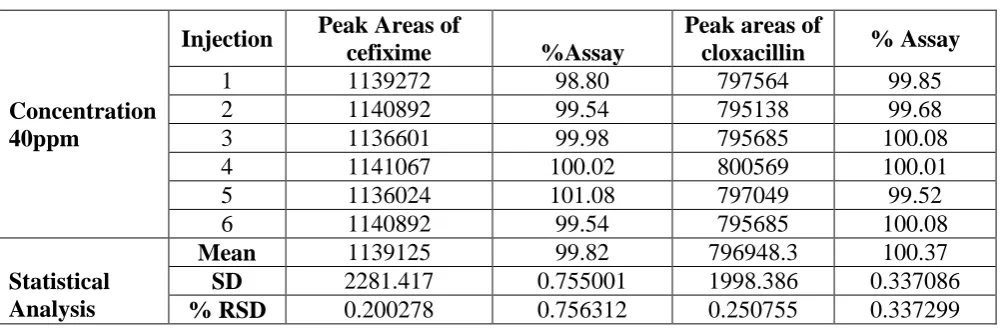
Table 5: Data of Intermediate precision (Analyst 2) for cefixime and cloxacillins
Concentration 40ppm
Injection Peak Areas of
cefixime %Assay
Peak areas of
cloxacillin % Assay
1 1139272 98.80 797564 99.85
2 1140892 99.54 795138 99.68
3 1136601 99.98 795685 100.08
4 1141067 100.02 800569 100.01
5 1136024 101.08 797049 99.52
6 1140892 99.54 795685 100.08
Statistical Analysis
Mean 1139125 99.82 796948.3 100.37
SD 2281.417 0.755001 1998.386 0.337086
[image:10.595.49.552.574.738.2]OBSERVATION
Individual %assays and %RSD of Assay are within limit and passes the intermediate
precision, Refer table: 5
5. ACCURACY (RECOVERY)
A study of Accuracy was conducted. Drug Assay was performed in triplicate as per test
method with equivalent amount of Cefixime and Cloxacillin into each volumetric flask for
each spike level to get the concentration of Cefixime and Cloxacillin equivalent to 50%,
100%, and 150% of the labeled amount as per the test method. The average % recovery of
Cefixime and Cloxacillin were calculated.
ACCEPTANCE CRITERIA
The mean % recovery of the Cefixime and Cloxacillin at each spike level should be not less
than 98.0% and not more than 102.0% for both the drugs separately.
OBSERVATION
Amount found
%Recovery = --- × 100 Amount added
The recovery results indicating that the test method has anacceptable level of accuracy. Refer
table: 5
Table-6: (i) Data of Accuracy for cefixime Concentration
% of spiked level
Amount added (ppm)
Amount found (ppm)
% Recovery
Statistical Analysis of % Recovery
50% Injection 1 20 19.85 99.25 MEAN 99.88
50% Injection 2 20 19.96 99.80
50% Injection 3 20 20.12 100.6 %RSD 0.67
100 % Injection 1 40 39.74 99.35 MEAN 99.81
100 % Injection 2 40 40.08 100.2
100% Injection 3 40 40.24 100.6 %RSD 0.399
150%
Injection 1 60 59.04 98.40 MEAN 99.19
150%
Injection 2 60 59.62 99.36
150%
(ii)Data of Accuracy for Cloxacillin Concentration
% of spiked level
Amount added (ppm)
Amount found (ppm)
% Recovery
Statistical Analysis of % Recovery
50% Injection 1 20 19.86 99.30 MEAN 99.46
50% Injection 2 20 19.98 99.90
50% Injection 3 20 19.84 99.20 %RSD 0.38
100 % Injection 1 40 39.54 98.85 MEAN 99.76
100 % Injection 2 40 39.82 99.55
100% Injection 3 40 39.96 99.9 %RSD 0.189
150% Injection 1 60 59.92 99.86 MEAN 100.0067
150% Injection 2 60 60.08 100.13
150%Injection3 60 60.02 100.03 %RSD 0.136
6. RUGGEDNESS OF TEST METHOD a) System to system variability
System to system variability study was conducted on different HPLC systems, under similar
conditions at different times. Six samples were prepared and each was analyzed as per test
method.
Comparison of both the results obtained on two different HPLC systems, shows that the assay
test method are rugged for System to system variability.
ACCEPTANCE CRITERIA
The % relative standard deviation of Cefixime and Cloxacillin from the six sample
preparations should be not more than 2.0%
The % assay of Cefixime and Cloxacillin should be between 98.0%-102.0%.
OBSERVATION: The % RSD was found within the limit. Ref tables: 3 &7.
b) column to column variability: Column to column variability study was conducted by using different columns. Six samples were prepared and each was analysed as per test
method.
ACCEPTANCE CRITERIA
The %RSD of Cefixime and Cloxacillin tablets should be NMT2.0%. The %assay of
Cefixime and Cloxacillin should be between 98.0% and 102.0% for individual drugs.
Table 7: Data of system to system variability (cefixime and cloxacillin) System-2
OBSERVATION: The results obtained by comparing with both two types were within limit.
7. ROBUSTNESS
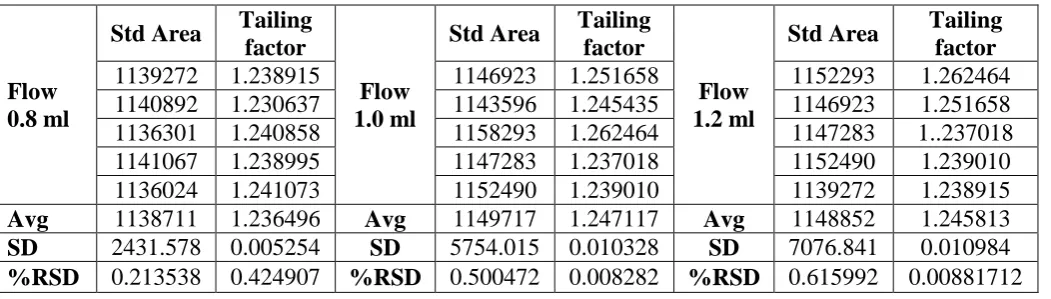
a) Effect of variation of flow rate: A study was conducted to determine the effect of variation in flow rate. Standard solution prepared as per the test method was injected into the
HPLC system using flow rates, 1.0ml/min and 1.2ml/min. The system suitability parameters
were evaluated and found to be within the limits for 1.0ml/min and 1.2ml/min flow. Cefixime
and cloxacillin and was resolved from all other peaks and the retention times were
comparable with those obtained for mobile phase having flow rates 1.0ml/min.
ACCEPTANCE CRITERIA
The Tailing Factor of Cefixime and cloxacillin standards should be NMT 2.0 for Variation
in Flow.
Table: 8(i) Data for Effect of variation in flow rate (cefixime)
Flow 0.8 ml
Std Area Tailing factor
Flow 1.0 ml
Std Area Tailing factor
Flow 1.2 ml
Std Area Tailing factor
1139272 1.238915 1146923 1.251658 1152293 1.262464
1140892 1.230637 1143596 1.245435 1146923 1.251658
1136301 1.240858 1158293 1.262464 1147283 1..237018
1141067 1.238995 1147283 1.237018 1152490 1.239010
1136024 1.241073 1152490 1.239010 1139272 1.238915
Avg 1138711 1.236496 Avg 1149717 1.247117 Avg 1148852 1.245813
SD 2431.578 0.005254 SD 5754.015 0.010328 SD 7076.841 0.010984
%RSD 0.213538 0.424907 %RSD 0.500472 0.008282 %RSD 0.615992 0.00881712
S.NO Peak area Assay % of
Cefixime Peak area
Assay % of Cloxacillin
1 634360 98.65 1203625 99.98
2 634098 98.63 1202225 99.30
3 635696 98.86 1202840 98.60
4 633289 98.52 1204283 99.30
5 634147 98.63 1202735 98.55
6 633495 98.55 1203110 98.73
Mean 634180.8 98.64 1203136.3 99.07667
[image:13.595.39.565.539.688.2]Table: 8(ii) Data for Effect of variation in flow rate (Cloxacillin)
Flow 0.8 ml
Std Area
Tailing factor
Flow 1.0 ml
Std Area
Tailing factor
Flow 1.2 ml
Std Area
Tailing factor
797564 1.099100 801690 1.122813 805783 1.121321
795138 1.103929 797631 1.112181 801690 1.122813
795685 1.111477 805783 1.121321 801496 1.124805
800569 1.117660 801496 1.124805 806432 1.123373
797049 1.119004 806432 1.123373 797564 1.099100
Avg 797201 1.110234 Avg 802606.4 1.120899 Avg 801593 1.118282
SD 2124.413 0.008622 SD 3590.034 0.00503 SD 3613.298 0.047969
%RSD 0.500472 0.77655 %RSD 0.447297 0.004488 %RSD 0.450203 0.965376
OBSERVATION: The tailing factor for Cefixime and cloxacillin was found to be within the limits. As shown in table 8.
8. LIMIT OF DETECTION AND QUANTITATION (LOD and LOQ)
Cefixime: From the linearity plot the LOD and LOQ are calculated LOD = 3.3 σ
S
3.3×2431.578
= --- = 0.25 31282
LOQ = 10 σ S
10×2431.578
= --- = 0.77 31282
Cloxacillin
LOD = 3.3 σ S
3.3×2124.413
= --- = 0.34 20193
LOQ = 10 σ S
10×2124.413
SOMMARY AND CONCLUSSION
The analytical method was developed by studying different parameters. First of all, maximum
absorbance was found to be at 288nm Cefixime for and 225nm for Cloxacillin.Common
wavelength will be 225nm and the peaks purity was excellent. Injection volume was selected
to be 20µl which gave a good peak area. The column used for study was Inertsil C18, ODS
chosen good peak shape. Ambient temperature was found to be suitable for the nature of drug
solution. The flow rate was fixed at 1.0ml/min because of good peak area, satisfactory
retention time and good resolution. Different ratios of mobile phase were studied, mobile
phase with ratio of 60:40 Methanol: Buffer was fixed due to good symmetrical peaks and for
good resolution. So this mobile phase was used for the proposed study.
The present recovery was found to be 98.0-101.50 was linear and precise over the same
range. Both system and method precision was found to be accurate and well within range.
Detection limit was found to be 0.25 Cefixime and 0.34 for Cloxacillin. Linearity study was,
correlation coefficient and curve fitting was found to be. The analytical method was found
linearity over the range of 20-80ppm of the target concentration for both the drugs. The
analytical passed both robustness and ruggedness tests. On both cases, relative standard
deviation was well satisfactory.
REFERENCE
1. www. Drugbank.ceftas.brands.html
2. http://www.drugs.com/cdi/cefixime-tablet.html
3. http://www.drugs.com/cdi/cloxacillin-tablet.html
4. .Pranaykumar Deekonda and Malladi Srinivas Reddy* ISSN 0975-413XCoden (usa):
pchhax der pharma chemica, 2014; 6 (2):31-37
5. Mehul Patel*, Jagdish Kakadiya, Nehal Shah development and validation of first order
derivative spectrophotometric method for simultaneous estimation of cefixime trihydrate
and moxifloxacin hydrochloride in combined tablet dosage form Vol 3|Issue 1|
2013|19-24.
6. Ajit R. Wankhede*1, Prashant Y. Mali2, Vikram Karne3, Anubha R. Khale1, C. S.
Magdum4Estimation of Cefixime and Cloxacillin in Tablet Dosage Form IJPBA, July –
7. Jigar a goswami1*, nehal j shah review of drugs and itsanalytical methods to treat allergic
rhinitis in combination with other drugs in different dosage form J Int J Pharm Pharm Sci,
5(3): 966-975
8. Bharat G. Chaudhari 1, Heena J. Patel1*Development and Validation of Dual
Wavelength UVSpectrophotometric Method for Simultaneous Estimation of Cefixime
and Dicloxacillin Sodium in Pharmaceutical Dosage Form 2(3):148-154
9. Pranaykumar Deekonda and Malladi Srinivas Reddy*Method development and validation
for the quantitative estimation ofcefixime and ofloxacin in Pharmaceutical preparation by
RP- HPLCDer Pharma Chemica, 2014; 6(2) :31-37
10.Dhoka, Madhura V.; Gawande, Vandana T.; Joshi, Pranav P. Validated HPTLC Method
for Determination of Cefixime Trihydrate and Erdosteine in Bulk and combined
Pharmaceutical Dosage FormEurasian Journal of Analytical Chemistry; 2013; 8(2) 99.
11.Tushar .G. Barot* , Kanhaiyalal Patidar, Nayan Kshartri And Niranjan Vyas
Development and Validation of LC Method for the Determination of Ampicillin and
Dicloxacillin in Pharmaceutical Formulation Using an Experimental Design E-Journal of
Chemistry 2009; 6(4): 955-964
12.Chigozie C. Ezeanokete[a], Kenneth Gerald Ngwoke[a]*, Festus Basden C. Okoye[a],
Patience O. Osadebe[b] Spectrophotometric Determination Of Ampicillin AndCloxacillin
In Pure And Fixed Dosage Forms Through Charge Transfer Complexation Eur. Chem.
Bull., 2013; 2(12): 1009-1012
13.Ajit R Wankhededevelopment And Validation Of Rp-Hplc Method For Simultaneous
Estimation Of Cefixime And Cloxacillin In Tablet Dosage Form Vol1,No3,2010
14.Angshuman Biswas* 1 , A Rajendiran2 , Inder Singh Rawat3 , Asit Kumar De1 , Ayan
Kumar Dey1Validated estimation procedure of Amoxycillin Trihydrate, Cloxacillin
sodium in Pharmaceutical Formulation by RP-HPLC MethodOctober – December 2010
RJPBCS, 2010; 1(4): 344
15.Ch. Ravikumar*1 , V. Valli Kumari2 , G. Tuljarani3method Development And Validation
For The Simultaneous Estimation Of Cefixime And Ofloxacin In A Pharmaceutical
Formulation By Rp-Hplc Method, 2014; 2(1): 1 - 14.
16.Tuani YT* 1 , Kissi FA 2 , Sackey J1,3, Gordon AJ 4 , Akanji O5Development and
Validation of RP-HPLC Method for the Simultaneous Determination of Ampicillin and
Cloxacillin in Oral Suspension Dosage FormInt. J. Pharm. Sci. Rev. Res., September –