2405
©IJRASET: All Rights are Reserved
Comparative Study on the Production of
β
-Glucosidase by Fungi under Solid State and
Submerged Fermentation
Final D Patel1, Krishpa B Shah2
1,2First-second Microbiology department of Dolat Usha Istitue of applied Science and Dhiru Sarla Institute of Management and
Commerce, Valsad, Gujarat, India.
1,2Veer Narmad South Gujarat University, Surat, Gujarat, India
Abstract— β-glucosidase is diverse group of enzyme with great functional importance to biological system. An enzyme catalyzes the hydrolysis of p-nitrophenyl-β-D-glucopyranoside (pNPG) which act as a substrate. β-Glucosidase enzyme (β -D-glucosidase glucohydrolase, EC 3.2.1.21) was extracted from filamentous fungi. Filamentous fungi were isolated from soil and cultivated on saboraud’s agar medium. Total 4 isolates were obtained by isolation procedure, which were able to produce β-glucosidase (BGL) enzyme. Production of extracellular β-glucosidase enzyme under both solid state (SSF) and submerged fermentation (SmF) method was studied for better medium for fungal growth and enzyme activity. An extracellular β-glucosidase was partially purified by ammonium sulphate precipitation Test and further purified by Dialysis.
Keywords—β-glucosidase, p-nitrophenyl-β-D-glucopyranoside(pNPG), Fermentation.
I. INTRODUCTION
β-Glucosidase enzyme (β-D-glucopyrranoside glucohydrolase) [E.C.3.2.1.21] is an ubiquitous enzyme produced by all life domains: bacteria, fungi, plants and animal including non-cellulolytic organisms such as human. For the industrial utilization, microorganisms are considered the best choice for enzyme production. The preference of microorganisms as source of industrial enzymes is attributed to many reasons such as 1) microorganisms grow rapidly speeding up the production of enzyme, 2) microorganisms are easier to handle than animals and plants since they require less space making the process cost effective, 3) microorganisms can be easily manipulated with help of genetic engineering, mutagenesis and direct evolution, 4) furthermore, some microorganisms produce enzyme with special characteristics such as thermostability and alkalophilicity which can be utilize in many industries requiring such harsh condition [12]. It hydrolyzes β-D-glucosidic bonds of various compounds comprising of alkyl- β-D-glucosides, aryl- β-D-glucosides, cynogenic glucosides, disaccharides and short chain of oligosaccharides liberating glucose from their non reducing end. β-Glucosidases are widely distributed in the living world and they play pivotal roles in many biological processes. The physiological roles associated with this enzyme are diverse and depend on the location of the enzyme and the biological system in which these occur[5]. β-Glucosidases are the essential part of cellulose system and catalyzed the last and final step in cellulose hydrolysis. In nature, cellulose degradation is mediated by combined action of three individual enzymes named as endoglucanase (1,4-β-D-glucan hydrolase; EC 3.2.1.4), exoglucanase (1,4-β-D- glucan glucohydrolase EC 3.2.1.74) and β-Glucosidase. Cellulase enzymes hydrolyze the cellulose to produce cellobiose and other short oligosachharides which are finally hydrolyzed to glucose by β-Glucosidase. β-Glucosidases also plays important role in the treatment of Gaucher’s disease (resulting from a deficiency of β-Glucosidase) in which accumulation of glycoceramides takes place in the lysosomal tissues [6]. β-Glucosidases are widely used in the various biotechnological processes, including the production of biofuel and ethanol from cellulosic wastes and play an important role in flavouring industry, they release aromatic compounds from glucosidic precursors present in food and fermenting products. They are also used to hydrolyze isoflavaone glycosides thus increasing their absorption from small intestine positively affecting human health, also utilized for detoxification of cassava and deinking of waste paper. These compounds have wide range of uses in medical sciences as therapeutic agents, diagnostics tools, and as a growth promoters for probiotics bacteria. Alkyl glycosides have anionic surfactant properties and can be used as antimicrobial agents, and in pharmaceutical, cosmetics, detergent and food industries [12].
II. MATERIALANDMETHOD
A. Collection of Sample:
2406
©IJRASET: All Rights are Reserved
B. Isolation of β-Glucosidase producing Fungi:
β-Glucosidase producing fungi were isolated by serial dilution and direct streaking method. An aliquot of 0.1ml of the serially diluted soil samples (10ˉ1 to 10ˉ6 dilutions) were transferred to potato-dextrose agar and sabouruad’s agar plates using direct streaking method. The plates were incubated at room temperature for 3-5 days. The fungal growth obtained through direct streaking method were sub-cultured in sabouraud’s agar slants and incubated at room temperature for 3-5 days and the stored at 4ºC. The fungal growth was further confirmed by mounting technique using Lactophenol (picric acid). The fungi was identified by characteristics microscopic morphology such as shape, size, arrangements of spores and hyphae.
C. Preparation of Fermentation Medium :
Fermentation was carried out by 2 different ways to check and compare the most appropriate method for production of β -Glucosidase [2].
1) Solid-State Fermentation (SSF): Wheat bran (WB) and Rice bran (RB) was used as a substrate for solid-state fermentation (SSF). WB and RB were purchased locally from a flour mill and was dried overnight at 60 °C in a hot air oven to remove moisture. 5 g of the substrate was weighed into 250 ml Erlenmeyer flasks and was moistened with a specific amount of mineral salt medium. Distilled water was added to the medium to attain the appropriate initial moisture content wherever applicable. The basal mineral salts solution used for the experiment for β-glucosidase production contained g/L : Urea - 0.3, (NH4)2SO4 - 1.4, KH2PO4 - 0.4, MgSO4.7H2O - 0.3, Peptone - 0.75, Yeast extract - 0.25, FeSO4.7H2O - 0.05, MnSO4.7H2O - 0.01, ZnSO4.7H2O - 0.01, CoCl2 - 0.01 (Mandels & Weber, 1969). The initial pH of the medium was 5.8-6.0. The pH of the media was adjusted with 1N HCl or 1N NaOH wherever required. The moistened bran was mixed well and was sterilized by autoclaving at 121 °C for 15 min at 15lbs pressure.
2) Sub-Merged Fermentation (SMF): Mandel and Weber medium supplemented with 1% of an additional carbon sources (WB and RB) were used for the production of β-glucosidase. 100ml of medium was taken in 250ml Erlenmeyer flasks and sterilized by autoclaving at 121 °C, 15lbs pressure for 15 min and pH of the medium was 5.8-6.0.
D. Enzyme Production :
1) Solid-State Fermentation (SSF): Medium prepared for SSF in 250ml Erlenmeyer flasks containing 100ml of the sterile growth medium was inoculated with 1 х 106 spores of the fungus suspended in 0.05% (w/v) Tween 80 solution. The contents were mixed properly and were incubated under controlled conditions of temperature (Room temperature) and humidity for 5-6 days. At the end of incubation period, enzyme was recovered by extraction with 100ml of 0.05M citrate buffer (pH 4.8). The buffer was added to each flask and the flasks were kept on a rotary shaker for 1h at 200 rpm. After 1hr, the entire slurry was recovered and was filtered using cheese cloth. Centrifuge the filtrate containing enzyme at 6000 rpm at 4ºC for 10 min to remove cell debris and supernatant was used as a crude enzyme preparation [2].
2) Sub-Merged Fermentation (SmF): Mandel and Weber medium was inoculated with 1 х 106 spores of the fungus suspended in 0.05% (w/v) Tween 80 solution and the flasks were incubated for 120hr at 30°C and flasks were kept on rotary shaker at 200 rpm for agitation [2]. At the end of fermentation, the entire slurry was filtered using cheese cloth. Filtrate was centrifuged at 6000 rpm for 10 min at 4ºC. supernatant was used as a crude enzyme.
E. β-Glucosidase (BGL) Enzyme Activity:
β-glucosidase assay was performed using p-nitrophenyl β-D glucopyranoside (pNPG) as a substrate (Ghose & Bisaria, 1987). The reaction mixture which consists of 0.5ml of enzyme sample, 0.5ml of 10mM pNPG (p-nitrophenyl β-D glucopyranoside) and 1ml of citrate buffer (0.05M, pH 4.8) was incubated at 40 ºC for 15 min. The reaction was terminated by adding 0.2M Na₂CO₃. Appropriate blanks lacking of enzyme or substrate were also run in parallel to the enzyme assay [5]. Yellow color developed due to liberation of p-Nitrophenol (pNP) was read in a UV-Visible spectrophotometer at 410nm. The amount of pNP liberated was calculated by comparing the reading corrected for blanks against a standard curve generated using varying concentrations of pNP. One unit of BGL activity was defined as the amount of enzyme required to releasing 1µM of pnitrophenol (pNP) per minute under the standard assay conditions and was expressed as U/ml.
Activity can be calculated by using the following formula ( Grover et.al., 1977):
2407
©IJRASET: All Rights are Reserved
=ΔOD Χ 0.0295 where,
Vt : total volume (4.0ml) Vs : sample volume (0.5ml)
18.1: Milimolar extinction coefficient of p- nitrophenol under the assay condition (cm²/micromole) 1.0 : light path lenght (cm)
t : Reaction time (15min)
F. Protein Estimation by Folin-Lowry’s Method:
Protein assays were done using the Folin-Ciocalteau reagent according to Lowry’s Method (Lowry et.al., 1951) and were expressed as mg/ml. Bovine serum albumin (BSA) was used as a standard protein (200µg/ml).
III. RESULTS AND DISCUSSION
primary screening of β-glucosidase producing fungi
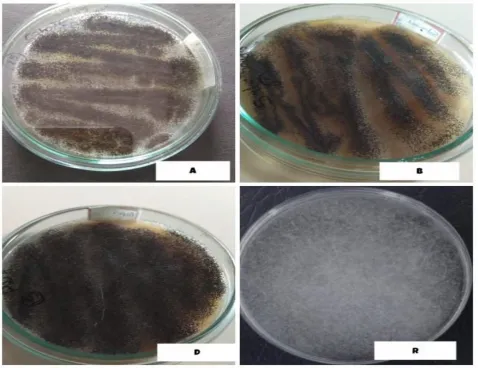
Fig. 1 Fungal isolates on sabouraud’s agar plates.
[image:3.595.60.538.300.668.2]2408
©IJRASET: All Rights are Reserved
[image:4.595.169.435.117.272.2]
Fig 2. Results of Solid-state fermentation (SSF)
[image:4.595.170.453.315.490.2]
Fig 3. Results of Submerged- fermentation (SmF)
Fig .2 Shows the results of Solid-state fermentation (SSF) and Fig.3 shows the results of submerged fermentation (SmF). From these isolates, solid state fermentation (SSF) and submerged fermentation (SmF) procedures were carried out by using Wheat bran (WB) and Rice bran (RB) as a substrate, which were purchase locally from flour mill [2]. The basal mineral salt solution was used for production of β-glucosidase (Mandel and weber ,1969).
[image:4.595.129.496.582.754.2]
2409
©IJRASET: All Rights are Reserved
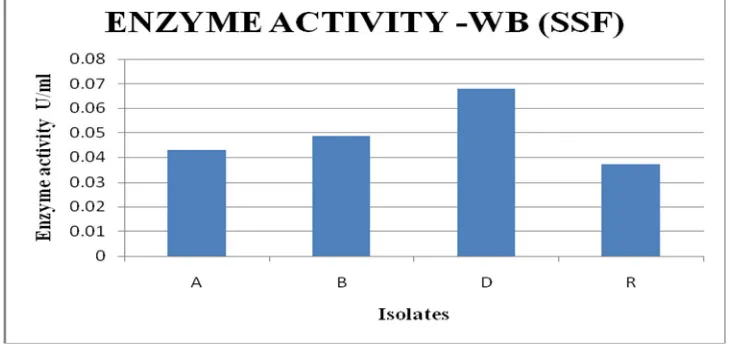
[image:5.595.120.488.132.372.2]The β-Glucosidase (BGL) activities of 4 isolates are shown in ( Fig. 4 ), which reveale Isolate-D giving highest enzyme activity of 0.0678 Units/ml whereas Isolate-A and Isolate-R show least enzyme activity of 0.0418 , 0.0376 Units/ml respectively by using Wheat bran (WB) as a substrate.
Fig 5. Enzyme activity of selected isolates under SSF using Rice bran as a substrate.
The BGL activities of 4 isolates are shown in ( Fig. 5 ), which revealed Isolate-B giving higest activity of 0.0514 units/ml whereas, Isolate-D gave modrate enzyme activity of 0.0447 units/ml. Isolate–R show least enzyme activity of 0.0375 Units/ml respectively by using Rice bran (RB) as a substrate.
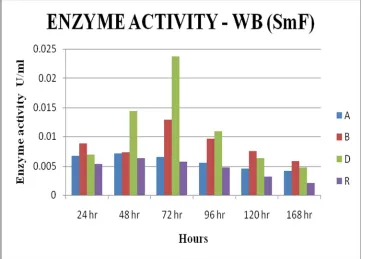
Fig 6. Enzyme activity of selected iaolates under submerged fermentation (SmF) using wheat bran as a substrate.
[image:5.595.114.479.445.704.2]2410
©IJRASET: All Rights are Reserved
[image:6.595.116.479.106.325.2]
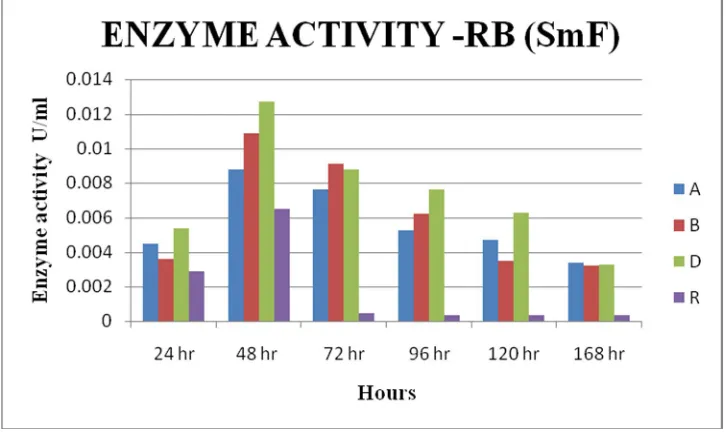
Fig 7. Enzyme activity of selected iaolates under submerged fermentation Using rice bran as a substrate.
Fig 7. Represents graph of Enzyme activity at the different time intervals of 24, 48, 72, 96, 120, and 168 hours and it shows the enzyme activity decreases with the increasing time period under SmF using Rice bran as substrate. Results revealed that Isolate-D shows highest enzyme activity of 0.0127 unit/ml at 48 hour followed by Isolate-B and Isolate –A shows modrate enzyme activity of 0.0109 and 0.0036 at 48 hour. Isolate-R shows least enzyme activity at 72 hr
IV. CONCLUSION
The results of enzyme activity from solid-state fermentaion (SSF) and submerged fermentation (SmF) using 2 different substrates, such as Wheat bran (WB )and Rice bran (RB). Isolate-D gave the highest Enzyme activity of 0.0678 Unit/ml, respectively with Wheat bran (WB ) as a substrate than Rice bran in solid-state fermentation (SSF). Whereas, in submerged fermentation (SmF) Isolates –D were also give highest enzyme activity of 0.0237 U/ml at 72 hr, comparative study on the production of β-Glucosidase by fungal isolates under solid-state and submerged fermentation, it can be stated that high production of β-Glucosidase enzyme in Solid-state fermentation using Wheat bran (WB) as substrate. For the production of β -Glucosidase, Wheat bran suggesting one of the best substrate when both the methods ( soild-state and sub-merged fermentation ) were compare.
V. ACKNOWLEDGMENT
I would like to express my sincere appreciation to my Guide, Mrs. Krishpa B Shah, Assistant professor , department of microbiology, Dolat-Usha Institute of Applied Sciences and Dhiru Sarla Institute of Management & Commerce, Valsad, for her countless help, assistance and guidance in every stage of my research.
REFERENCES
[1] Andrić P., Meyer A. S., Jensen P. A., Dam-Johansen K., “Effect and modeling of glucose inhibition and in situ glucose removal during enzymatic hydrolysis of pretreated wheat straw,” Appl Biochem Biotechnol 160(1):280-297, 2010.
[2] Singhania, R. R, “Beta-Glucosidase from Aspergillus niger NII 08121-Molecular characterization and applications in Bioethanol production.,” 2011. [3] Grover, A. K., MacMurchie, D. D., & Cushley, R. J., “Studies on almond emulsin βd-glucosidase I. Isolation and characterization of a bifunctional
isozyme,” Biochimica et Biophysica Acta (BBA)-Enzymology, 482(1), 98-108, 1997.
[4] Barnett CC, Berka RM, Fowler T,“Cloning and amplification of the gene encoding an extracellular beta-glucosidase from Trichoderma reesei: evidence for improved rates of saccharification of cellulosic substrates,” Bio/Technology 9:562–56, 1991.
[5] Maguinsay, C. S., & Teves, F. G, “β-Glucosidase production by Aspergillus niger van Tieghem using submerged fermentation of pineapple waste,”
Advances in Environmental Sciences, 5(1), 23-29, 2013.
[6] Singh, G., Verma, A. K., & Kumar, V, “Catalytic properties, functional attributes and industrial applications of β-glucosidases,” 3 Biotech, 6(1), 3, 2016. [7] Takó, M., Farkas, E., Lung, S., Krisch, J., Vágvölgyi, C., and Papp, T, “Identification of acid- and thermotolerant extracellular bglucosidase activities in
2411
©IJRASET: All Rights are Reserved
[8] karnchanatat, A., Petsom, A., Sangvanich , P., Piaphukiew, J., Whalley, Colin D. Reynolds, and Prakitsin Sihanonth. “ purification and biochemical
characterization of an extracellular β-glucosidase from wood-decaying fungus Daldinia eschscholzii (Ehrenb.: Fr) Rehm,” FESM Microbiology Letters
270, no. 1: 162-170, 2007.
[9] Jäger, Szilvia, Anikó Brumbauer, Erika Fehér, Kati Réczey, and László kiss. “ Production of and characterization of β-glucosidase from different Aspergillus strains,” : 455-461, 2001.
[10] Takii , Yukio, Kimiko Ikeda, Chihiro Sato, Megumu Yano, Tsutomu Sato, and Hiroshi Konno, “ Production and characterization of β-glucosidase from Rhizopus oryzae MIBA348,” J. Biol. Macromol 5, no. 1 :11-16, 2005.
[11] Yan, Tsong-Rong, Yi-Hui Lin, and Chun-Leih Lin, “ Purification and characterization of an extracellular β-glucosidase Ⅱ with high hydrolysis and transglycosylation activities from Aspergillus niger,” Jornal of agricultural and food chemistry, 46, no. 2 : 431-437, 1998.