Improving the Delivery of Building
Performance using Building Information
Modelling (BIM)
Mohammad Adnan Amin Mayouf
Doctor of Philosophy
i
Acknowledgements
First and foremost, I am mostly grateful to my god Allah whose mercy and blessings have supported me to through my PhD journey. Followed by that, there a number of people without whom this thesis might not have been possible, and to whom I am greatly indebted.
I would like to express my sincere gratitude to my PhD supervisor and director of studies Professor David Boyd who has provided valuable experience, continuous support and advice throughout my PhD journey. My PhD journey with Professor Boyd was richer than I can describe using words or summarised in sentences; all I can say is that it showed me that life is not about what you achieve, but it is about what you learn and develop. Professor Boyd was not only a supervisor, but definitely someone who I would strive to be like in the future. I am also very thankful to my PhD second supervisor
Professor Sharon Cox who inspired and encouraged me with her words and motivation towards success. Again, words are not enough to describe an inspiring person and an idol for success such as Professor Cox who used my strengths to overcome my weaknesses and always cheered me up during stressful times. I would also like to thank Dr. Niraj Thurairajah who supervised me during the initial stages of my PhD research. My experience as a PhD Candidate with the supervisory team has been exceptional and supported me to construct a solid foundation, preparing me to face the challenging world of academia, which I would say that it just started.
I am very thankful to my dearest family who remained encouraging, supporting and always willing to engage during my PhD journey and through my life. To my respectful father Eng. Adnan Amin Mayouf, my idol, and whose advice, support and care have been invaluable throughout my life from childhood all the way to higher education. To my respectful mother Huda Al-Junaid, whose kindness, warm words and continuous care have made me stronger and calmed me during my most stressful times. I would also like to thank my brothers Abdullah, Ali and Amin and my sister Huda who kept encouraging me to try and do my best. I would also like to thank many of my friends whose cheerful words and encouragement made me stronger.
I would like to thank Professor Peter Larkham who always engaged with me and had the willingness to listen to our different issues and concerns as PhD candidates within the school. I would also like to thank Professor Hanifa Shah who is always engaged with us and always try to address our needs and concerns to have the best experience while doing research. A very special thanks and Mr. Ian McDonald, who was not only a mentor, but a friend and trustworthy individual who I have known since I started my PhD journey. I would also like to thank Mrs. Sue Witton whose kindness and support during the different stages of my PhD can never be forgotten. I would also like to express my gratefulness to all my colleagues from the School of Built Environment who always kept encouraging me to stay cheerful and made me believe that all challenges can be overcome.
ii
Abstract
Purposefully-designed buildings are complex by nature, because they are host to a variety of human activities that require them to perform adequately and be well suited to their intended functions. Building ‘performance’ has been an area of major research interest, so that efficient
buildings are constructed that operate effectively to support the functional purposes for which they are being used. It is a complex concept that has been difficult to measure and incorporate into building design. Many methods and approaches have been developed to assess ‘performance’ for the purpose of addressing the gap between predicted – and actual –
performance. However, it is acknowledged that these methods/approaches lack accuracy, are time consuming and do not provide a holistic view of the complex procedures and processes involved during the design and physical construction of the building.
Building Information Modelling (BIM) provides a new way of integrating information technology within the construction industry. Its capability as a digital platform has supported managing, sharing and exchanging interdisciplinary information between multi-disciplinary stakeholders. BIM has supported some aspects of assessing building ‘performance’ by
emphasising energy consumption, sustainable design and building behaviour. BIM technology excels in situations that have quantitative-based aspects, which often are derived from those involved in the building delivery process. However, the design of successful buildings-in-use, through concepts like building performance, requires incorporating information from multiple perspectives, which requires going beyond the consideration of the characteristics that are quantitative.
iii
from the building delivery team, facility management team and building occupants. The research journey was developed through three case studies where one case study influenced the direction of the next case study. Initial findings showed that ‘space’ as one of the building aspects was used as a reference concept for building performance because it provided a way for situating different meanings of building performance by different stakeholders. Thematic analysis was used to analyse the findings for each case study. The key finding from the case studies showed that there is a gap between data and experience. ‘Systems thinking’ analysis was used to investigate this gap, as it concerns the complexity, the handling of information modelling and supports addressing ‘softer’ human aspects. It showed that the reason for the
gap between data and experience is that different stakeholders see the parts and the whole differently. Soft systems analysis was then used to explore this gap, as it provides a holistic approach to the situation being investigated. The use of this approach allowed the opportunity to understand the problems and possible conflicts within a particular situation. Wilson’s approach of ‘soft systems’ was also used, as it goes beyond conceptual models to information
categories, which can support bridging the gap between data and experience.
An overview of the problem, emphasising its complexity through proposed themes is presented. The delivery of building performance requires richer representation that acknowledges the significance of different parts in a construction project and how they influence stakeholders. Using the information requirements identified through soft systems analysis, a ‘space strategy model’ was proposed, which suggests that space designs in BIM
iv
Table of Contents
Acknowledgements ... i
Abstract ... ii
Table of Contents ... iv
List of Tables ... viii
List of Figures ... ix
Chapter One - Introduction ... 1
1.1. Introduction ... 1
1.2. Research background ... 1
1.3. Rationale ... 3
1.4. Research gaps ... 4
1.5. Research aim and objectives ... 7
1.6. Overview of the thesis chapters ... 7
Chapter two - Literature review ... 10
2.1. Introduction ... 10
2.2. Building performance ... 10
2.2.1. Concepts and theories ... 10
2.2.2. Evaluation methods ... 12
2.2.3. Aspects of building performance ... 16
2.2.4. Space aspects ... 18
2.3. Space ... 19
2.3.1. Experience and perception ... 19
2.3.2. Inherent and representation qualities ... 22
2.3.3. Buildings in use: performance gap ... 24
2.3.4. Buildings in use: change ... 26
2.4. Information modelling ... 27
2.4.1. Information in Building Information Modelling (BIM) ... 27
2.4.2. Information for simulation ... 28
2.4.3. Information for design ... 29
2.4.4. Information management ... 30
2.5. Design ... 31
2.5.1. Digital design methods... 31
v
2.5.3. Experiential design methods ... 34
2.6. Summary of the chapter ... 35
Chapter Three - Research Methodology... 37
3.1. Introduction ... 37
3.2. Research design ... 37
3.3. Philosophical positioning ... 38
3.3.1. Exploring how BIM can support the delivery of better building performance for buildings, a critical realist approach ... 39
3.4. Critical realist methodology ... 39
3.4.1. Qualitative methods ... 40
3.4.2. Choice of research design ... 43
3.5. The Case Study Method for exploring how BIM can support the delivery of better building performance ... 44
3.5.1. Reasons for the case study approach ... 45
3.5.2. Critical realism and case study research method ... 45
3.6. Research process ... 46
3.6.1. Research design stage ... 47
3.6.2. Data collection ... 49
3.6.3. Case Study selection process ... 51
3.6.4. Research Journey ... 53
3.6.5. Data analysis process ... 54
3.7. Ethical considerations ... 63
Chapter Four - Case Studies and Results ... 65
4.1. Introduction ... 65
4.2. Educational Building 1 Case study ... 67
4.2.1. Rationale for selection ... 67
4.2.2. Research participants ... 68
4.2.3. Data collection and scope ... 68
4.2.4. Results and findings ... 69
4.2.5. Data Analysis ... 70
4.2.6. Conclusion for the Educational Building 1 case study ... 89
4.3. The Office Building Case study ... 90
4.3.1. Rationale for selection ... 90
4.3.2. Research participants ... 91
4.3.3. Data collection and scope ... 92
4.3.4. Results and findings ... 92
vi
4.3.6. Conclusion for the Office Building case study ... 111
4.4. The Educational Building 2 Case Study ... 111
4.4.1. Rationale for selection ... 112
4.4.2. Research participants ... 112
4.4.3. Data collection and scope ... 113
4.4.4. Results and findings ... 113
4.4.5. Data analysis ... 114
4.4.6. Conclusions of the Educational Building 2 case study ... 130
4.5. Conclusion ... 130
Chapter Five - Soft Systems Analysis... 133
5.1. Introduction ... 133
5.2. Educational Building 1 soft systems analysis ... 140
5.2.1. Introduction ... 140
5.2.2. Rich pictures ... 140
5.2.3. CATWOE Analysis and Root Definitions ... 144
5.2.4. Conceptual Models and Consensus Model ... 147
5.2.5. Activities and Information Categories ... 151
5.2.6. Maltese Cross ... 154
5.2.7. Conclusion for Educational Building 1 soft systems analysis ... 156
5.3. Office Building Soft systems analysis ... 157
5.3.1. Introduction ... 157
5.3.2. Rich pictures ... 157
5.3.3. CATWOE Analysis and Root Definitions ... 161
5.3.4. Conceptual Models and Consensus Model ... 164
5.3.5. Activities and Information Categories ... 167
5.3.6. Maltese Cross ... 170
5.3.7. Conclusion for Office Building soft systems analysis ... 172
5.4. Educational Building 2 soft systems analysis ... 173
5.4.1. Introduction ... 173
5.4.2. Rich pictures ... 173
5.4.3. CATWOE Analysis and Root Definitions ... 178
5.4.4. Conceptual Models and Consensus Model ... 181
5.4.5. Activities and Information Categories ... 183
5.4.6. Maltese Cross ... 186
5.4.7. Conclusion for Educational Building 2 soft systems analysis ... 188
vii
Chapter Six - Discussions ... 192
6.1. Introduction ... 192
6.2. Abstractions of performance ... 194
6.3. Representations of performance... 197
6.4. Space as a reference concept for performance ... 200
6.5. Space as information ... 205
6.5.1. Model development... 207
6.5.2. Richer representations of the emergent characteristics ... 211
6.5.3. Stakeholders’ Feedback on the Space Strategy Model ... 212
6.5.4. Concepts of space as information ... 225
6.5.5. Framing informating perspectives of space ... 226
6.5.6. Informating performance of space in design ... 227
Chapter Seven - Conclusions and Future Work ... 229
7.1. Introduction ... 229
7.2. Research Objectives ... 230
7.2.1. The theory and practice of building performance ... 231
7.2.2. The perspectives of the building delivery team, facility management team and building occupants on performance and different performance aspects ... 231
7.2.3. The role of BIM in the delivery of different performance aspects from the perspectives of the building delivery team, facility management team and building occupants ... 232
7.2.4. To synthesise an approach that informs data requirements in BIM to support the delivery of better performance for buildings ... 233
7.3. Research Contributions ... 233
7.3.1. Information strategy for building performance that supports richer understanding of experience and data ... 234
7.3.2. Innate challenges of building design to meet expectations of building performance ... 234
7.3.3. Greater understanding of the cognitive and perceptual views of stakeholders in building performance ... 235
7.3.4. Proposing a richer way to tackle complexities in delivery of the built environment ... 235
7.4. Limitations and future work ... 236
List of References ... 238
Appendices ... 252
Educational Building 1 Case Study Data ... 253
Office Building Case Study Data ... 264
Educational Building 2 Case Study Data ... 275
viii
List of Tables
Table 3.1: Guideline for the choice of qualitative research method (Yin, 2013) ... 43
Table 3.2: Framework for characterising the philosophical assumption of soft systems methodology adapted from Mingers (2003). ... 60
Table 3.3: Stages in Wilson’s Soft Systems Method (Wilson, 1990). ... 63
Table 4.1: The coding used to represent the responses in the tables provided by the interviewed parties of Educational Building 1 case study. ... 69
Table 5.1: CATWOE analysis based on the three stakeholder parties Involved in Educational Building 1 Case Study with respect to their worldviews on building performance. ... 145
Table 5.2: Root definition derived from the CATWOE analysis based on worldviews on Building Performance from the Three Parties Involved in the Educational Building 1 Case Study. ... 146
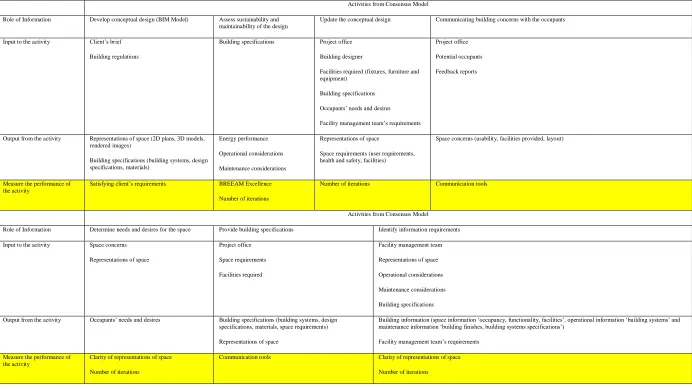
Table 5.3: Activities from the consensus model and their inputs and outputs in the Educational Building 1 case study. ... 152
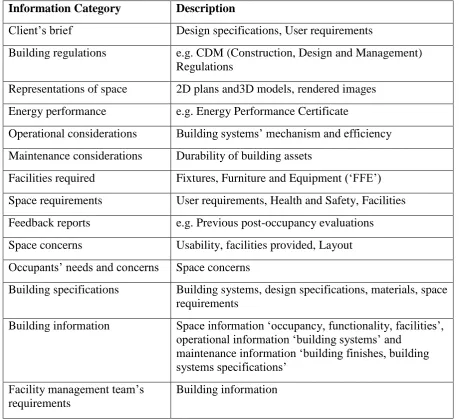
Table 5.4: Information categories and their descriptions representing the inputs and outputs of activities in the Educational Building 1 case study. ... 153
Table 5.5: CATWOE analysis based on the three stakeholder parties involved in the Office Building case study with respect to their worldviews on space... 162
Table 5.6: Root definitions derived from the CATWOE analysis based on worldviews on space from the three stakeholder parties involved in the Office Building case study. ... 163
Table 5.7: Activities from the consensus model and their information categories. ... 168
Table 5.8: Information categories derived from activities from the consensus model in the Office Building case study. ... 169
Table 5.9: CATWOE analysis based on the three stakeholder parties Involved in the Educational Building 2 case study with respect to their worldviews on space. ... 178
Table 5.10: Root definitions derived from the CATWOE analysis based on worldviews on space from the three stakeholder parties involved in the Educational Building 2 case study. ... 180
Table 5.11: Activities from the consensus model and their information categories. ... 184
Table 5.12: Information categories derived from activities from the consensus model. ... 185
Table 6.1: Identified information categories and their descriptions from Chapter 5. ... 207
ix
List of Figures
Figure 2.1: Performance concept in the building Delivery Process (Preiser, 1995) ... 13
Figure 2.2: Building Performance Evaluation (BPE) process model (Preiser and Vischer, 2005) ... 14
Figure 2.3: Total building performance compared with other performances (Douglas, 1996) ... 15
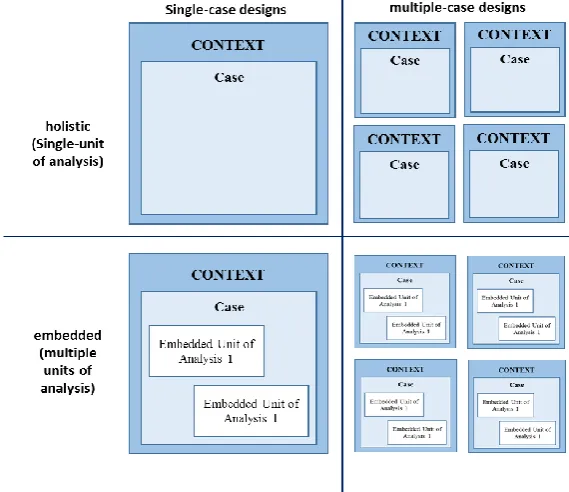
Figure 3.1: Types of case study research designs (Yin, 2014) ... 42
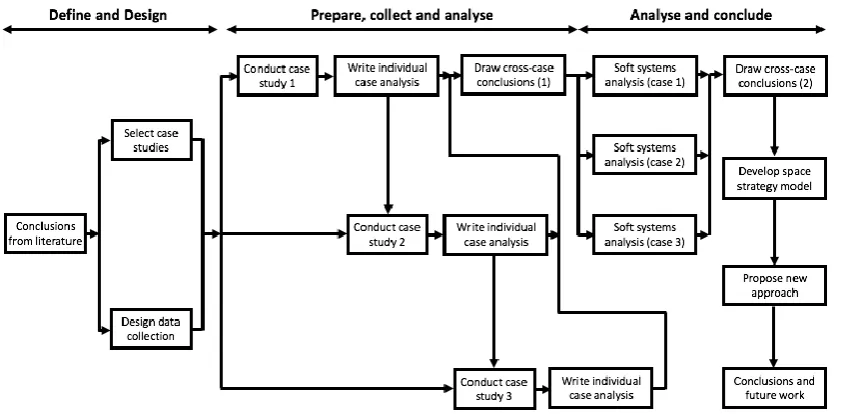
Figure 3.2: Multiple case- study research design. ... 47
Figure 3.3: Types of systems proposed by Peter Checkland (Checkland, 1981) ... 57
Figure 4.1: Summary of the outputs from the Educational Building 1 Case Study. ... 88
Figure 4.2: Summary of the outputs from Office Building Case Study ... 109
Figure 4.3: Summary of the outputs from the Educational Building 2 case study. ... 128
Figure 5.1: The framework that demonstrates the attempt of soft systems to bridge the gap between data and experience, the parts and the whole. ... 134
Figure 5.2: Levels of complexity when viewing building as a system. ... 136
Figure 5.3: A Rich Picture representing the building delivery team Views on building performance in the Educational Building 1 case study. ... 141
Figure 5.4: A Rich Picture representing the Facility Management Team views on building performance in the Educational Building 1 case study. ... 142
Figure 5.5: A Rich Picture representing the Building Occupants views on building performance in the Educational Building 1 case study. ... 143
Figure 5.6: Conceptual model to provide building specifications based on the building delivery team’s worldview of building performance. ... 148
Figure 5.7: Conceptual model to provide building information based on the facility management team’s worldview of building performance. ... 149
Figure 5.8: Conceptual model to provide means for participation based on the building occupants’ worldview of building performance. ... 149
Figure 5.9: The consensus model combining the three conceptual models in the Educational Building 1 case study. ... 150
Figure 5.10: A ‘Maltese Cross’ using activities from the consensus model and information categories for the Educational Building 1 case study. ... 155
Figure 5.11: A Rich Picture representing the Building Client’s view on space in the Office Building case study. ... 158
x
Figure 5.13: A Rich Picture representing the Building Occupants’ views on space in the
Office Building case study. ... 160
Figure 5.14: Conceptual model based on the building client’s worldview of space in the Office Building case study. ... 164
Figure 5.15: Conceptual model based on the facility manager’s worldview of space in the Building Office case study. ... 165
Figure 5.16: Conceptual model to account for usability and desirability based on the building occupants’ worldview of space in the Building Office case study. ... 166
Figure 5.17: The consensus model combining the three conceptual models in the Office Building case study. ... 167
Figure 5.18: A ‘Maltese Cross’ using activities from the consensus model and information categories in the Building Office case study. ... 171
Figure 5.19: A Rich Picture representing the Building Designer view on space for the Educational Building 2. ... 174
Figure 5.20: A Rich Picture representing the Facility Management Team’s views on space in the Educational Building 2... 175
Figure 5.21: A Rich Picture representing the Building Occupants’ views on space in the Educational Building 2. ... 176
Figure 5.22: Conceptual model to provide space characteristics based on the building designer’s worldview of space in the Educational Building 2 case study. ... 181
Figure 5.23: A conceptual model to provide information based on the facility management team’s worldview of space in the Educational Building 2 case study. ... 182
Figure 5.24: A conceptual model to specify usability and desirable concerns based on the building occupants’ worldview of space in the Educational Building 2 case study. ... 182
Figure 5.25: The consensus model combining the three conceptual models in the Educational Building 2 case study. ... 183
Figure 5.26: A Maltese Cross using activities from the consensus model and information categories. ... 187
Figure 6.1: Space accountancy in BIM (Hagan, 2014)... 199
Figure 6.2: Semantic and articulatory distances, adopted from Cox (2014). ... 204
Figure 6.3: The proposed Space Strategy Model ... 210
Figure 6.4: HVAC system entity (extracted from Figure 6.2) ... 215
1
Chapter One - Introduction
1.1. Introduction
This chapter introduces the proposal for the research, with background information on the subject area, followed by the rationale, research aims and objectives and finally a summary of the thesis chapters. The research background outlines the complexity of the area of building ‘performance’, and supporting role the Building Information Modelling (BIM) role offers. The
research rationale emphasizes the value and importance of exploring the capabilities of BIM in terms of enhancing building performance of buildings. The research gaps addressed by the present thesis require consideration of the complexity and the importance of incorporating multiple perspectives to enhance the ‘performance’ of a space.
1.2. Research background
Constructing new buildings is complex art because they could be considered as highly fragmented ‘environments’. This is because of the involvement of multi-disciplinary
stakeholders, who require intensive data-sharing in order to deliver a well-performing building. Building performance has been an area of major research interest where methods and approaches have been developed to apply the concept of ‘performance’ in buildings (Gross, 1996). The inherent issue of building performance is based on terms of generalising a definition of it, because various interdisciplinary views are involved, which makes it highly dependent on stakeholders’ different perspectives (Davis, 1990). Traditionally, building ‘performance’ has been evaluated by the perception of measurable factors (e.g. design awards for the architect) while other approaches have required observing the behaviours of the product in use (Duffy, 1990; Douglas, 1996). Holistically, covering various building aspects and approaches such as
post-occupancy evaluation (Preiser et al., 1988), building performance evaluation (Preiser,
2
Jan, 2003; Low et al., 2008) have been developed to accommodate the whole building life
cycle. The focus of these models can vary, but generally centres on aspects such as energy (thermal performance), spatial performance, and acoustics, depending on what the building is designed for. However, factors such as the quantity of the data produced in a construction project that requires time to process, complexities associated with the involvement of many stakeholders, accuracy issues and additional costs, have resulted in lack of practicality of these
approaches. In addition, Persson et al. (2009) pointed out that large volumes of information are
generated during the building-design process where often time is wasted searching for sharing it, and sometimes recreating it. Conversely, the growing importance of Information Technology (IT) in the construction industry offers potential towards overcoming these issues providing simpler and more-structured ways to solve the problems and manage information allowing different stakeholders to work in real-time environment (Gleick, 2011). One of the more-recent technologies that accelerated the use of information technology in the construction
industry in an economic and manageable form (Yan et al., 2011) is Building Information
Modelling (BIM). According to Aranda-Mena et al. (2009), BIM emanates from Computer
Aided Design (CAD), but provides more-intelligent and interoperable information. BIM can be defined as a set of interacting policies, processes and technologies, which form a methodology that aims to manage the essential design and project data in a digital format throughout the life cycle of a building (Penttilä, 2006). BIM provides a full design model by integrating all systems (structural, architectural, ‘mechanical, electrical and plumbing (MEP)’ and ‘heat, ventilation and air conditioning (HVAC)’) within one single model (Porwal and
Hewage, 2012). BIM has improved project coordination, enhanced collaboration among project stakeholders and allowed better visualization of a given project.
3
design, and building actualisation. It is important to acknowledge that the use of Computer Aided Design (CAD) methods have been employed to assess building performance. According
to Nguyen et al. (2010), prior to BIM, mathematical models and CAD methods had been used
in the assessment of life-cycle building performance in order to increase the efficiency of building design and construction. However, the functions of these methods cannot satisfy all users’ needs when there is a need to share complex information. BIM has extended the
application of geometric objects to parametric objects where ‘objects’ can store semantic information allowing for better consistency and accuracy. Furthermore, BIM captures information from multidisciplinary sources to realise 3D visualisation, rather than fragmented drawings (Meridian Systems, 2008). It is claimed by Motawa and Carter (2013) that BIM can transform the way that the built environment operates by storing, linking and exchanging the project- based technical information for use over the whole project life-cycle and in so doing, benefit all stakeholders. In support of building performance, BIM supports some aspects of building performance such as energy efficiency (Yuan and Yuan, 2011), potential to achieve sustainable design (Barlish and Sullivan, 2012) and building behaviour. BIM capabilities allow for the extension of BIM-based packages, which aim to analyse different building performance aspects.
1.3. Rationale
4
an approach to inform data requirements in BIM in order to overcome complexities of building performance representation in BIM.
1.4. Research gaps
BIM’s contribution to building performance focuses on factors that require quantitative
geometrical based data. Most research efforts in BIM and building performance, tend to focus on energy performance. However, the design of a good operational building requires not only
calculable based data, but also indeterminate judgements (expert opinion). This means that
some characteristics, which influence experience when the building is occupied, need to be considered and incorporated as part of the design and build process. Based on the performance
standards defined by the Hartkopf et al. (1986), there are six performance mandates: spatial
performance, thermal performance, air quality, acoustical performance, visual performance and building integrity. Each of these types of performance form a certain ‘comfort zone’ and
setting their limits of acceptability has arisen from the physiological, psychological, sociological and economic requirements of the occupancy (Rush, 1986). For instance, privacy and psychological comfort are part of the sociological and psychological considerations in
performance criteria affecting all human senses. This aligns with Hartkopf et al.’s (1986) claim
that buildings do not perform, but it is the people who design, build and use them that actually do. Although to some extent, BIM has the capability to provide quantitative analysis of most of the six performances mentioned above (e.g. energy performance), many other characteristics are involved (e.g. privacy) that BIM cannot address neither evaluate. Therefore, for this reason and many others, it is still realised that buildings do not always perform as intended.
Inevitably, the performance of a building becomes more obvious with time (Brand, 1994) especially considering those aspects that are subjected to constant change. This can ultimately be done by measuring satisfaction of the building users in terms of comfort, efficiency or even
5
performance mandate that most significantly affected by interior system design - and is often subjected to change - is the spatial performance. Spatial performance aims to achieve maximum
satisfaction through the ergonomic arrangements of the space (Low et al., 2008). It involves
individual space layout, conveniences and services, amenities and occupancy factors and control (Rush, 1986). Among other performances, it is claimed that spatial performance is the top priority for various building types (Rush, 1986). This is because all design decisions regarding the interior of the building affect the layout of various spaces, which impact ergonomic comfort, accessibility, way-finding and communication for example. Like other performances, there are limits of acceptability (discussed in detail in chapter 2) based on the physiological, psychological, sociological and economical requirements; these limits have been standardised and translated into codes to be incorporated in building design in order to respond to human needs (Rush, 1986). Although it may seem that spatial requirements within buildings have been well-defined over the last three decades ago, satisfying space requirements for different users within the building still remains an obstacle (Dovey, 2010). Forty (2000) pointed out that architects deliver designed space according to representations (abstract space), rather than immersing themselves within that space (lived space). CADD (Computer Aided Design and Drafting) and other 3D modelling systems have represented the space implicitly, which means that its representation is defined by any object (walls, slabs, etc.) that is used to
set its boundary (Lee et al. 2012). BIM has enhanced the affording of suitable space in a design
by integrating interdisciplinary systems into one single model providing better visualisation,
accuracy and consistency (Volk et al. 2014). Many applications have been proposed using
semantic information from BIM such as evaluating design solutions (Jeong and Ban, 2011),
improving performance (Kim et al., 2012) and many others. Currently, most architectural
programs include one that specifies the space requirements where this shows that ‘space
6
are defined on the building type (e.g. school, office, or hospital), the intended use of the space (Borrmann and Rank, 2009). The extensive research into ‘space’ using BIM has allowed for the exploration of several problems, which can be related to the type of space, its uniqueness
and the fact that different users have different experiences of space (Lee et al., 2012). In
the BIM environment, ‘space’ is experienced visually and referred to as ‘perception’, where the observer tends to have an internal representation of a surrounding physical space, and then attempts to measure the properties of visual space. This establishes how various properties of
physical space are preserved in the mapping to visual space (Loomis et al., 1992).
Currently, although BIM as a tool is gaining more momentum worldwide, stakeholders such as building owners and facility managers are only just beginning to integrate the BIM development and implementation process with their work (Becerik-Gerber and Rice, 2010). BIM could and should act as a socio-technical system, where humans can provide essential input to inform the social aspects of construction design, desire and build, where they interact with building forms the technical aspects (Ruppel and Schatz, 2011). However, the current
applications of BIM do not support the integration of a wide variety of information (Ding et
al., 2014). For such a complex concept as ‘optimal space’ requirements, it is essential to
highlight that performance of a particular space depends on the intended needs of the users of that space, which means that different types of space must satisfy different needs, thus demand a different way of perceiving them. Therefore, the importance of inquiring into different properties and priorities for different types of spaces from multiple perspectives is required. For the purpose of this research, Freeman’s commonly accepted (Freeman, 1984) definition of ‘stakeholder’ (“any or individual that can affect or is affected by the achievement of a corporation’s purpose”) has been adapted. Therefore in this study, stakeholders refers to those
who influence (building delivery team) or are influenced (facility management team and
7
1.5. Research aim and objectives
This research aims to explore how Building Information Modelling (BIM) can support the
delivery of better building performance. The objectives are:
To review the theory and practice of building performance.
To determine the perspectives of the building-delivery team, facility-management team
and building occupants on performance and different performance aspects.
To explore the role of BIM in the delivery of different performance aspects from the
perspectives of the building delivery team, facility-management team and building occupants.
To synthesise an approach that informs data requirements in BIM to support the
delivery of better performance for buildings.
1.6. Overview of the thesis chapters
This research aims to explore how to enhance the delivery of better performance for buildings through the use of BIM. The first chapter provided an insight into the complex nature of building ‘performance’, and showed the need to investigate different views on it from different
stakeholders. It also showed that BIM in its current form excels in quantitative representations, but they do not support a holistic view of performance. The second chapter reviews different theories and evaluations of building performance, the role of BIM in the delivery of building performance, theories and concepts of space, information modelling and design. The second chapter concludes that as well as the need to inquire into different meanings of performance from different stakeholders, the role of BIM in the delivery of performance needs to be explored, and the value of different stakeholders’ involvement to inform the design process
8
approach, as it supports inquiring into both the social and technical sides of a problem. The nature of this research is qualitative and uses a case-study approach. Three case studies were used in the evolving research ‘journey’. The journey showed that the output of a case study
was an input for the next case study. Chapter 3 also elaborated on the role of soft systems methodology in addressing the gap identified by the research journey, as it provides a holistic approach to the problem and seeks to identify information requirements that supports informing data in BIM. The fourth chapter shows the reviewed outputs gathered from the three case studies. The first case study showed that different stakeholders associate different meanings for buildings and building performance, and showed the need to inquire into performance through looking into experiences of space. The second case study showed that inquiring into experiences of space can help encapsulate experiential issues that are faced in a space, and showed the need to further look into the role of representations of space in experiential issues that influence performance of space. The third case study showed that current representations of space lack the capability of representing experiential concerns. Although the main inquiry for each case study was different, each case study has looked into definitions of building performance and the role of BIM in the delivery of performance from the three targeted stakeholders: building delivery team, facility management team and building occupants. The chapter concludes by highlighting the gap between data and experience. The fifth chapter (soft systems analysis) explores the gap between data and experience and showed that this gap is a
problem of the parts and the whole originating from different stakeholders’ views of the
building. The building delivery team tends to have a reductionist view, where the parts drive
9
proposed information requirements that can be used to bridge the gap between data and experience. The sixth chapter provides an overview of the problem, which looked at different abstractions of performance, representations of performance, space as a reference for performance, and space as information. The space strategy model proposed suggests that space designs in BIM should be ‘informated’ in order to identify the significance of different parts
10
Chapter two - Literature review
2.1. Introduction
This chapter overviews the existing literature related to the research investigation area. Primarily, four areas are reviewed: building performance, space, information modelling and finally design. In relation to building performance, the review focuses on concepts and theories, evaluation methods, different aspects of building performance and the space aspect. Followed by, it will be looked at the experiential and inherent aspects of space. This includes reviewing ‘space’ in relation to building performance and change when buildings are in use. The third
area views information modelling where it will be looked into information for BIM, information for simulation, information for design and information management. The final area, design, focuses on aspects such as collaboration, digital design methods, architectural design and experiential design methods.
2.2. Building performance
2.2.1. Concepts and theories
Over the years, the concept of building performance has been undertaken by many researchers (Wong and Jan, 2003). Moreover, performance for buildings is claimed to be an important issue in design, and has a major significance in architectural design (Oxman, 2009). According to Dino and Stouffs (2014), there is a growing interest in the area of building performance to ensure that the intended performance and operation of buildings extends beyond the service-life of buildings. Davis (1990) claimed that it is critical to create a generalized definition of ‘building performance’ which can address the various interdisciplinary views encountered by
11
occupancy requirements, including elements of ‘comfort’. ‘Building enclosure integrity’ includes protecting the building’s visual, mechanical and physical properties from
environmental degradation such as temperature, air movement, radiation and natural disasters. The other mandates in Davis’ scheme include thermal, acoustic, visual, air quality and spatial
comfort in which all are dependent on psychological, physiological, sociological and economic values.
Although the above mentioned mandates have been acknowledged (CIB Report Publication, 1982; Blanchere, 1972), it has been claimed that ‘performance’ is merely a reflection of the
building’s designer, builder and user performance (Hartkopf et al., 1986). But having a
sufficient level of communication is a vital key in shaping the future performance of a building.
Thus, and complying with Hartkopf et al. (1986), performance can fundamentally be viewed
as the measurement of achievement against intention. Wright (1972) claimed that having a performance approach for buildings is similar to systems analysis, where both demand a broad view in terms of problem definition, and a routine for the evaluation of selected solutions. He added that many approaches to ‘performance’ have followed a problem-solving agenda such
as the performance requirements for health and safety proposed by the British Building Research Station during the 1930s and France’s performance-based agreement system (Wright,
1972), which was established during 1950s (Wright, 1972). In 1968, the National Bureau of Standards conceptualised performance to comprise three parts: Requirement, Criteria and Test and an optional fourth part called Commentary. Thus, there is a long-established relationship between ‘performance’ and ‘evaluation’, because evaluation acts as the representation of the
desired/predicted performance during design. According to Oxman (2009), in the context of design, the term ‘performance’ has many implications and represents various roles. However,
12
One of the major causes of inefficient building operations is inaccurate evaluation of building
performance at the design stage (O’Donnell et al., 2013). This is because building performance
can be interpreted in many different ways such as evaluating it against the identified requirements for the building or how the building is being perceived by users, and thus it is an interdisciplinary concept (Alexander, 2011). According to Duffy (1990), buildings are typically evaluated on the perception of measuring output (e.g. design awards for the architect) where another perception of evaluating performance is observing the behaviour of the product in use (Douglas, 1996). It is argued by Cooper (2001) that performance of the building can only be evaluated after it has been occupied to understand if the building is truly effective.
2.2.2. Evaluation methods
There are many approaches that have been developed to measure/evaluate performance for buildings. In support of this, approaches like Post-occupancy evaluation (POE) have been developed where its aim is to deliver an ideal building that can satisfy occupants (Khan and Kotharkar, 2012). However, although this approach has successfully been implemented, a need for pro-active approaches was necessary like Building Performance Evaluation (BPE) and Total Building Performance (TBP). This section will review these techniques as the most commonly used for evaluating building performance.
Post-Occupancy Evaluation (POE)
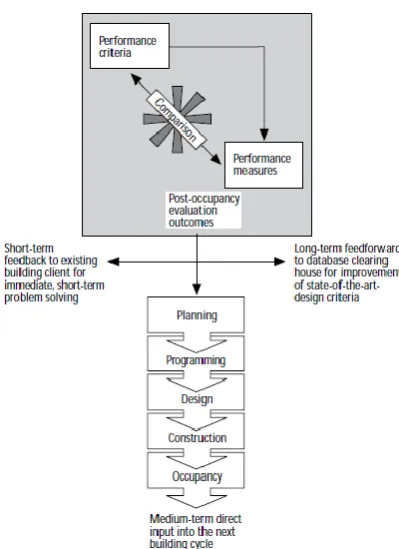
Preiser, (1989) claimed that POE was introduced in response to significant problems faced by building performance in 1960s, and emphasised the occupants’ perspective as shown in Figure
2.1 (Preiser, 1995). The concept of POE is based on the assumption that buildings are built to enhance and support occupants’ goals and activities. Figure 2.1 also demonstrates a traditional
process of performance measurement. According to Preiser et al. (1988) POE can be defined
13
Figure 2.1: Performance concept in the building Delivery Process (Preiser, 1995)
“Post-occupancy evaluation is the process of systemically comparing actual building
performance i.e., performance measures, with explicitly stated performance criteria. These are typically documented in a facility program, which is a common pre-requisite for the design phase in the building delivery cycle. The comparison constitutes the evaluation of both positive and negative performance aspects”.
14
Figure 2.2: Building Performance Evaluation (BPE) process model (Preiser and Vischer, 2005)
Building Performance Evaluation (BPE)
BPE has evolved from POE (Preiser et al., 1988). The basic approaches of BPE were presented
by Preiser (1989) in his book Building Evaluation. Preiser (1989) believed that there was a
need to broaden the range of decision makers and improve quality of decisions in buildings by providing an evaluation which has interfaces with all phases of building delivery (Preiser and Schramm, 1997). BPE is defined as the systematic approach to comparing the actual performance of buildings, places and systems to their expected performance (Preiser and Vischer, 2005). It adopts a process-oriented approach that accommodates relational concepts. This implies that it can be applied to any type of building or environment (Preiser and Vischer, 2005).
15
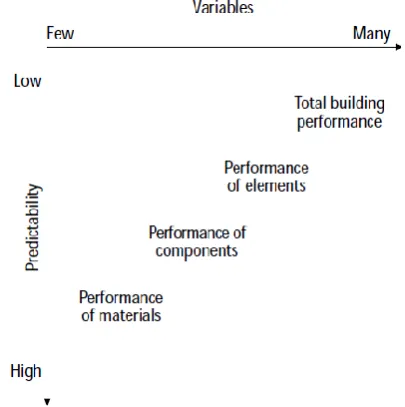
Figure 2.3: Total building performance compared with other performances (Douglas, 1996)
Total Building Performance (TBP)
According to Douglas (1996), Total Building Performance (TBP) is the most comprehensive tool for evaluating buildings in use, and considers performances on many different levels. This approach drove an expanded understanding of the importance of the critical balance that is required to fulfil successful building performance (Douglas, 1996). In addition, total building performance addressed a growing need for an effective future prediction of the performance of a building. Figure 2.3 illustrates the inclusion of TBP in comparison to other performances in terms of having more variables.
The TBP framework identifies and evaluates all performance areas (Wong and Jan, 2003). It consists of six performance measurements: spatial performance, acoustic performance, thermal performance, indoor air quality, visual performance and building integrity. In addition, each of these types of performance is defined by psychological, sociological, physiological and
economic needs for users’ satisfaction (Low et al., 2008). TBP provides the needs of the users
by considering several building mandates simultaneously, in order to achieve a healthy
environment which will facilitate the functioning of the space for the occupants (Low et al.,
16 2.2.3. Aspects of building performance
According to the CIB (1982), there are six performance mandates (also known as TBP): spatial performance, thermal performance, air quality, acoustic performance, visual performance and building integrity. With reference to these mandates, this section overviews these performances. It is also important to mention that each of these mandates have their limits of
acceptability (Hartkopf et al., 1986), which are physiological, psychological, sociological and
economic. Moreover, it is often that the building function dictates these limits. It is claimed by
Hartkopf et al. (1986) that these limits aim to establish what can be described as ‘comfort zone’
for occupants. Furthermore, often these limits are translated into standards and codes, which should correspond to the intended function of the building.
Thermal Performance
The building’s ability to provide thermal comfort to the occupants in the indoor environment
is outlined here. There are a number of design factors that can influence the satisfactory performance of thermal comfort, such as air temperature, relative humidity, number of
occupants within a space and air movement (Hartkopf et al. 1986). Thermal performance has
also been described as heat transfer between a building and its surroundings, which is concerned about the heat loss from a building (Communities and Local Government, 2008), and also known as the energy performance. The energy performance-related literature is extensive, as most (if not all) new buildings aim to be energy efficient. Standards such the Energy Performance Certificate (EPC) demand an energy rating for the building.
Visual Performance
As part of the six building mandates, it is an absolute necessity a building is able to provide a
comfortable and healthy visual environment, which supports the occupants’ activities. A
17
the indoor environment (Hartkopf et al. 1986). This performance mandate can be influenced
by various factors including quality of lighting and visual contact with the exterior environment and availability of natural daylight (Roetzel, 2008). Currently, this aspect is assessed using
simulation applications (Bellia et al, 2015), or quantitative analysis (Ochoa and Capeluto,
2006).
Acoustic Performance
According to Paradis (2014), one of the major factors that influence occupants’ comfort within
buildings is the acoustic considerations. Acoustics can be defined as the physical properties of
sound, which affect human being in everyday life. Hartkopf et al. (1986) pointed out that
acoustics within a building can be influenced by many factors such as materials, structure, mechanical appliances and space division. Furthermore, as being an aspect that influences human health and well-being, acoustic performance is part of BREEAM (Building Research Establishment Environmental Assessment Method) to ensure meeting standards, according to the purpose of the building (BREEAM, 2015).
Air Quality Performance
18
Building Integrity
This performance mandate is mainly concerned with sustaining the material, component, and assembly properties to resist both internal and external forces over time (Rush, 1986).
According to Low et al. (2008), there are three properties that must be sustained. First, the
mechanical properties for the stability of overall geometry where this includes structural strength and stability. Second, the physical properties of water and air tightness, including reflection and absorption of heat, light and sound. Finally, the visible properties including colour, texture and surface finish.
Spatial Performance
According to Robertson and Courtney (2001), spatial performance is concerned with the ergonomic arrangement of the space in order to achieve maximum satisfaction to the occupier. It is claimed this performance mandate is always subject to change and the one that is most
significantly influenced by the indoor environment (Hartkopf et al. 1986). All design decisions
regarding interior components, including their assembly, affect various aspects such as way-finding, comfort, accessibility and communication. More importantly, it has been demonstrated that spatial performance remains a top priority for different buildings (Rush, 1986).
2.2.4. Space aspects
The study of building ‘space’ is complex where form and function of the building plays the main role in determining how space should function, be laid out and utilised. Over the years, many theories and concepts have evolved over the years (Alexander, 1977; Malpas, 1999; Lefevbre, 2000; Massey, 2007) attempting to overcome the complexities associated with space such use of space and user experience within the space. According to Fayard (2012), space is
not an empty area to be filled, but instead, it is constantly constructed, emerging from
19
The special use of the term ‘space’ in construction began to emerge in the discipline of
architecture at the end of the 19th century with volumetric theories and continued with aesthetic theories (Dovey 2010). In volumetric theories, space is described as ‘enclosure space’ (Hensel et al. 2009) and aesthetic theories describe space as the ‘aesthetic effect of architecture on subjects’ (Holt-Damant 2005). In modern architecture, it is claimed by Forty (2000) that space
appears to be a homogeneous concept, partly because architects consider space via representations (abstract space) rather than experiencing space by living it (lived space). Therefore, it can be realised that the concept of ‘space’ is complex and its trans-disciplinary
nature increases its complexity.
2.3. Space
2.3.1. Experience and perception
It is important to acknowledge the philosophical transitions of space before becoming a theme that primarily belong to architects (Forty, 2000). Although the philosophical views of space are such that it does not directly feed into the scope of this thesis, they provide rich insights into the meanings of ‘space’, and how this may have influenced the creation of a performance
gap for buildings.
Tschumi (1996) argued that by definition, architectural concepts were absent from the experience of space. He added that it is overly complex to question the nature of space and at the same time experience a real space. In an attempt to define what is called ‘the life of space’,
Ven (1978) quoted:
“The human being creates, with his body, what the architect and painter call space. This
20
of architecture as the corporeal members, the facades, the columns, the ornaments. But all that is secondary. Essential is not the form, but its reversal, space; the void that expands rhythmically between the walls, and is defined by the walls”
According to Tuan (1977), space is experienced directly as having a room in which to move. In addition, the human mind tends to discern geometric designs and principles of spatial organisation in an environment. Also, human beings embody their feelings, images and thoughts in tangible material, naturally. However, philosophers such as Heidegger and Lefebvre have gone beyond this view of space. Heidegger (1971) claimed that space is neither an external nor an inner experience, but instead, space is defined by the personal location. In fact, Suvanajata (2001) has described experiential aspects of space as being related to passage, junction and place. This approach was reasoned by claiming that often people describe the space according to their movement. According to Lefebvre’s (1991) view, his focus was upon social space, where it is argued that space is not an inert, neutral, and a pre-existing given, but instead, an on-going production of spatial relations. Furthermore, he argued that:
“Space is a product of something that is produced materially while at the same time “operate[s] … on processes from which is cannot separate itself because it is a product
of them” (Lefebvre, 1991: 66).
21
“It is necessary for the interactions between the triadic elements to be appropriate and
in balance if an [spatial] event was to be persuasive and effect. What he tries to say, it seems to me, is the understanding of an event rather than an event by itself”.
It is argued by Hillier (2007) that space, in an important sense is an objective property of buildings. He quoted:
“Most our common notions of space do not deal with space as an entity in itself but tie
it in some way of entities that are not space. For example, even amongst those with an interest in the field, the idea of ‘space’ will usually be transcribed as the ‘use of space’, the ‘perception of space’, the ‘production of space’ or as ‘concepts of space’. In all
these common expressions, the idea of space is given significance by linking it directly to human behaviour or intentionality. All these concepts confirm the difficulty of conceptualising space as a thing in itself” (Hillier, 2007: 19).
The root to the above view is, perhaps, the structural view of space, which was introduced by Hillier and Hanson (1984). The phrase ‘structure’ refers to the methodology used to analyse space that is known as ‘Space Syntax’. According to Hillier (2007), in Space Syntax theory,
each space is described in relation to its social structure, which in turn makes any spatial configuration of the built environment. It is important to acknowledge that the main foundations of Space Syntax originated in Alexander’s work, which concern with social activities and their relation to the structure of space (Alexander, 1977).
22
only possible in the presence of perceptible objects, and thus, space is the relationship between objects. Space perception can be composed from the properties and relationships of objects in space with respect to direction, size, distance, and orientation. In an environment, object relations can be described in terms of a Euclidean coordinate system (Richards 1975). The complexity of visual space can be looked at using in-depth psychophysical procedures, but this approach does not serve the scope of the research aim defined for the present thesis.
2.3.2. Inherent and representation qualities
Defining and describing ‘space’ now it is a well-established concept in architecture, allows understanding the problematic nature about this elusive concept. According to Forty (2000),
there are different senses of ‘space’, which have been adopted by architects: space as enclosure,
space as a continuum and space as an extension of the body. Space as enclosure is perhaps the
most commonly understood sense of space. Space as a continuum suggests that spaces are continuous and infinite. Space as an extension of the body defines perceiving the space in terms of the body’s imagined extension within a volume. It is important to consider space planning
and its representations, as this provides a richer understanding when discussing the performance gap (see below).
23
unique or defined based on the client’s requirements to perform a particular function. Bitrafan
et al. (2013) described space based on functionality where spaces are divided into three different types: flexible spaces, adaptive spaces and single functional space. It is important to emphasize that space planning is a major attribute of facilities management within buildings
(Best et al., 2003). In addition, within facilities management, space planning incorporates both
planning and management sides of workspace features in many business operations, which can be as diverse as process engineering, retail, office buildings, and so forth (McGregor and Then, 1999). It is claimed that effective planning of space has a direct impact on how space is managed both efficiently and effectively. The NAO (1996) outlined various factors that affect the management of space: forming a management committee; a model/technique to manage the space; and ensuring that employees understand the operation of space.
In terms of space representations, Allen (2009) described representation as an entire
intellectual and social construct, which allows the possibility of imagining and constructing new fragments of reality. Some theories regard representations as the mental result of thinking about an activity, which to some extent corresponds to reality (Zhang and Norman, 1994). Others have considered representation as an integral part of an activity itself, based on its
communicative role (Lorino et al., 2011). Hatfield (2003) pointed out that the visual experience
aims to represent a visual space in relation to the physical space. In relation to space experience, Luck (2007) argued that architects recognise the difficulty to predict the experience of space by relying on representations of space. This has led to research to investigate how designers
can deliver experience of the space designed for the end users (Dunston et al., 2007; Maftei
24 2.3.3. Buildings in use: performance gap
The holistic nature of performance implies the importance of considering its significance at an early design stage (Kalay, 2004). Also, it was highlighted that previous evaluations have not been widely adopted, since they are time consuming, costly and are difficult to understand because of the complexity and amount data. As a response to that, the use of information technology in the construction industry has accelerated with the availability of BIM (Building
Information Modelling) in an economic and manageable form (Yan et al., 2011). BIM can
transform the way that the built environment operates by storing, linking and exchanging project-based technical information for use over the whole project life-cycle and in so doing, benefits all stakeholders (Motawa and Carter, 2013). Furthermore, BIM is a collaborative tool where divergent perspectives can be accommodated to achieve better design solutions (Sabol,
2008). In relation to performance, many studies have been conducted (e.g. Cho et al., 2010;
Yuan and Yuan, 2011; Azhar et al, 2011), but most (if not all) of these studies have focused on
measurable attributes of performance, and hence, it can be realised why energy performance has received a great attention.
Most approaches to building performance recognise that it requires calculative aspects associated with the building form and fabric in its location and indeterminate aspects associated with the way the people in the building perceive it and experience it in their activities (Mayouf
et al. 2014). This can be evidenced when recognising that current focus on delivering
sustainable and efficient buildings, thus, it can be argued that the concept of performance has
become adjacent to energy performance. According to Hunn et al. (2012), in many countries
such as the United Kingdom, the United States, Canada, common measurements of building performance aim to achieve ‘green’, ‘low energy’ and ‘high performance’ credentials.
25
information has remained an issue, and thus tools such as POE and BPE (explained in section 2.2.2) are not widely used. More importantly, often performance is based on measurable
attributes, which tends to avoid subjective considerations (Ibem et al., 2013). Users’
satisfaction can be considered as one of the subjective evaluations of performance for users
(Hanif et al., 2010). It is argued that on the part of both users and community, the crucial aspect
is that buildings should meet their expectations and support their daily activities (Davara et al.,
2006), which is difficult to outline and be limited by performance indicators, as they are often
assigned to measurable attributes (Kim et al., 2005).
26
He also added “We are trying to give technology the benefit of judicious application and to
encourage the further development of a technology suited to human needs”.
With relation to space, Dovey (2010) pointed out that although it may seem that spatial requirements within buildings have been well-defined, satisfying space requirements for different users within the building still remains an obstacle. Perhaps, one of the reasons for that is employing the digital tools (such as BIM) within the traditional sequential model of performance-evaluated design, which often is pre-determined (Oxman, 2009).
2.3.4. Buildings in use: change
In reasoning why buildings perform poorly, Oxman (2009) pointed out that limited research efforts have focused on understanding users’ changing needs and expectations. Whilst this has
not been an issue for other industries where professionals inquire into actual functionality and user-satisfaction to deliver better services and products, professionals in the building industry
have concentrated lesson incorporating users’ needs (Meir et al., 2009). It is argued that
‘change within space’ is one of the strategic aspects that should considered when planning the
space (McGregor and Then, 1999). According to Brand (1994), space-use changes occur approximately every 3 years. The space change can be in terms of facilities provided per individual, standards of space, the times that the space is used, its functionality and users (McGregor and Then, 1999). The complexity of change within space can vary from one building to another, and thus it has led to the development of many computerised systems to manage and maintain the spaces within buildings (Lai and Yik, 2012). BIFM (2012) claimed that current technologies do not accommodate the necessary information to manage building operations as well as understanding users’ different concerns.
One of the ways to improve the overall performance of buildings is to understand users’ needs
27
preferences in the architectural, engineering and construction (AEC) project is gaining
importance (Jensen et al., 2011), as this will help to reduce the potential gaps in understanding
between what is planned and what is expected. For example, BIFM (2012) claimed that showing a 3D visualisation of the plant room to building maintenance people using BIM could offer the opportunity for better training and avoid maintenance access problems.
2.4. Information modelling
2.4.1. Information in Building Information Modelling (BIM)
According to Eastman et al. (2011), BIM is part of the advancements in information technology
(IT) that has dramatically changed the way that information is managed, exchanged and transformed in the construction industry, allowing more-efficient ways to collaborate among stakeholders. Moreover, BIM is underpinned by digital technologies which unlock more-efficient methods of designing, creating and maintaining building assets, providing a collaborative way of working among project stakeholders (HM Government, 2012). An asset can be described as any item, thing or entity that has a potential value or actual value to an organisation (IAM, 2013). Assets in buildings involve the physical building, systems (mechanical, electrical and plumbing) and facilities (Fallon and Palmer, 2007). Although BIM provides a collaborative information exchange platform, it is not yet clear how this information can be perceived by other stakeholders who are not directly involved in the design process, such as facility managers and end-users (i.e. the building occupants) who need information about the building and should contribute to the building design process. In relation to information in BIM, it is emphasized that it comprises three types of design information:
28 2.4.2. Information for simulation
BIM can be seen as an evolution of Computer Aided Design (CAD) systems, but provides more interoperable and intelligent information (Aranda-Mena et al., 2009). According to Oxman (2009), for a CAD model, it is anticipated that simulations in relation to performance and analysis are performed on a geometric model that has already been formulated. Moreover, it is argued that, typically, within an architectural design, performance aspects such as structural stability, acoustic performance and energy performance can be formulated as performance simulations, which can inform decisions related to users, environment and formation (Rahim, 2005). Oxman (2009) emphasized that existing CAD-based performance simulation programs are not programmed to integrate processes of design generation based on the selection of specific performances. More importantly, integrating a certain logic is essential to support a particular simulation for a digital design. With response to that, the reason behind BIM replacing CAD models can be seen, as it allows solving complex problems by integrating information from different disciplines in the architecture, engineering and construction
(Eastman et al., 2011).
When looking at the space aspect, within the BIM environment, often it is realised that spaces
are merely generative features of floors and walls (Aksamija et al., 2010). It can, however, be
argued that research efforts have tried incorporating different information to represent design concepts within buildings. One of the potential methods is the use of algorithms to represent
different solutions. Dzeng et al. (2013) developed an algorithm to optimize the function space
assignment based on activity simulation. One of the potential methods for representing design concepts is the use of algorithm-based parametric (BIM-based) design tools such as the Rhinoceros’ Grasshopper plugin, which can assist architects’ geometric possibilities (Lin,
29
algorithms use existing information, which tends to be derived by those involved in the creation and completion of buildings.
2.4.3. Information for design
Conceptually, the term ‘information’ is considered to be ambiguous owing to the variety of ways it can be interpreted or used (Buckland, 1991). In fact, humanity has been living and
experiencing various kinds of information since the 4th millennium BCE (also called “the
Bronze Age”) when writing emerged as a means of communication (Floridi, 2010). According to (Buckland, 1991), there are two traditional meanings of ‘information’: the process of telling
something, and the thing that is being told. In addition, he identified three uses of the word ‘information’: information-as-process, information-as-knowledge and information-as-thing.
Buckland emphasized the logic behind considering information-as-thing is that communicating knowledge, beliefs, and opinions are subjective, conceptual and even personal. Therefore, the representation, expression, or description would be ‘information-as –thing’ (Buckland, 1991). Historically, information is considered as a thing (e.g. a drawing) and is communicated
between architects, different construction parties and stakeholders (Khatib et al., 2007). Today,
building architects, apart from their primary design skills, need to create and communicate information in a way that previous generations never had to (Race, 2012). Architects have to be increasingly cautious in obtaining and filtering the information they require because of the increasing complexity of buildings. In other words, the information that the architects generate is subject to immense scrutiny by all members of the project team. Another reason is that information is changing because of the continual update of processes and software, as the industry’s understanding of BIM evolves (Race, 2012).
In the construction industry, large volumes of information are generated during the building design process, and often time is wasted searching for, sharing and sometimes recreating