Superimposed Training Sequence
*Bilal Amin, §Babar Mansoor,§Syed Junaid Nawaz, †Shree K. Sharma and ‡Mohmammad N. Patwary.
*Department of Electrical Engineering, COMSATS Institute of Information Technology, Lahore, Pakistan.
§Department of Electrical Engineering, COMSATS Institute of Information Technology, Islamabad, Pakistan.
†SnT - securityandtrust.lu, University of Luxembourg, Luxembourg ‡
Faculty of Computing Engineering and Sciences, Staffordshire University, Stoke-on-trent, UK.
Email: [email protected], babar [email protected], [email protected], [email protected], and [email protected].
Abstract
Recent advances in multiple-input multiple-output (MIMO) systems have renewed the interests of researchers to further explore this area for addressing various dynamic challenges of emerging radio communication networks. Various measurement campaigns reported recently in the literature show that physical multipath MIMO channels exhibit sparse impulse response structure in various outdoor radio propagation environments. Therefore, a comprehensive physical description of sparse multipath MIMO channels is presented in first part of this paper. Superimposing a training sequence (low power, periodic) over the information sequence offers an improvement in the spectral efficiency by avoiding the use of dedicated time/frequency slots for the training sequence, which is unlike the traditional schemes. The main contribution of this paper includes three superimposed training (SiT) sequence based channel estimation techniques for sparse multipath MIMO channels. The proposed techniques exploit the compressed sensing (CS) theory and prior available knowledge of channel’s sparsity. The proposed sparse MIMO channel estimation techniques are named as, SiT based compressed channel sensing (SiT-CCS), SiT based hardlimit thresholding with CCS (SiT-ThCCS), and SiT training based match pursuit (SiT-MP). Bit error rate (BER) and normalized channel mean square error (NCMSE) are used as metrics for the simulation analysis to gauge the performance of proposed techniques. A comparison of the proposed schemes with a notable first order statistics based SiT least squares (SiT-LS) estimation technique is presented to establish the improvements achieved by the proposed schemes. For sparse multipath time-invariant MIMO communication channels, it is observed that SiT-CCS, SiT-MP, and SiT-ThCCS can provide an improvement up to2 dB,3.5 dB, and5.2 dBin the MSE at signal to noise ratio (SNR) of 12 dB when compared to SiT-LS, respectively. Moreover, for BER = 10−1.9, the proposed SiT-CCS, SiT-MP, and SiT-ThCCS, compared to SiT-LS, can offer a gain of about1 dB, 2.5 dB, and 3.5 dB in the SNR, respectively. The performance gain in MSE and BER is observed to improve with an increase in the channel sparsity.
Keywords: MIMO, superimposed training, first-order statistics, compressed sensing, channel estimation
Corresponding author: Syed Junaid Nawaz, Department of Electrical Engineering, Academic Block-I, COMSATS Institute of Information Technology (CIIT), Chak-Shahzad, Park Road, Islamabad, 44000, Pakistan. Mob: +92 300 9119472, Email: [email protected].
I. INTRODUCTION
The channel impulse response (CIR) of several outdoor radio propagation environments tends
to be sparse in nature [2–4]. A particular cellular communication environment with distant
dominant scatterers, as shown in Fig. 1a exhibits a sparse CIR [4]. In aeronautical communication
channels, as illustrated in Fig. 1b, we not only have a line-of-sight (LoS) path but also a cluster
of scattered multipath components due to reflection from large scattering objects. Therefore,
impulse response of an aeronautical communication channel is sparse in nature. The wideband
high frequency (HF) communication channel is also sparse in time domain due to long delay
spread and very fewer multipath components [5], as shown in Fig. 1c. The sparse impulse
response is also exhibited in underwater acoustic communication channels [6], as depicted in
Fig. 1d. Similarly, in high-definition television (HDTV) broadcast scenario, as shown in Fig. 1e,
there are only a few dominant echoes but the CIR comprises of manifolds of symbol duration
[7, 8]. Such sparse propagation channels have only certain dominant multipath components that
are largely separated in delay domain, which makes channel estimation a challenging task [9].
In the literature, several sparse channel estimation techniques have been proposed - see e.g.,
[10–16]. In [16], authors have established the fact that during estimation of sparse channels, use
of mean squared error (MSE) criterion along with `1-norm outperforms the Wiener filter results
and conventional estimation methods. In [11], the authors have proposed a matching pursuit
(MP) algorithm in order to estimate a sparse channel. In [13], orthogonal matching pursuit
(OMP) algorithm have been proposed to overcome the convergence issues of MP algorithm. In
[14], compressed channel sensing (CCS) theory has been used for sparse channel estimation that
exploits sparsity of the channel and outperforms the conventional least squares based methods.
In [12], the authors have proposed sparse cognitive matching pursuit (SCMP) algorithm for the
estimation of sparse channel for MIMO orthogonal frequency division multiplexing
(MIMO-OFDM). Furthermore, the authors claim that SCMP requires no prior knowledge of the channel
sparsity in order to obtain an accurate estimate of CIR. In conventional training based channel
estimation approaches, a known training sequence is multiplexed with the information sequence
Fig. 1: Sparse multipath channel propagation environments. (a) Land cellular communications, (b)Aeronautical communications, (c) HF communications, (d) Underwater acoustic communica-tion, (e) Terrestrial television broadcast
by exploiting this known training sequence and its corresponding received signal. This scheme
imposes an overhead on the spectral efficiency of the system. In blind channel estimation
techniques, the receiver explicitly estimates the channel by only using the known statistical
properties of the transmitted information sequence, thus, avoiding any overhead of training
sequence. However, in case of blind channel estimation, long data sequences are needed at
the receiver resulting in slow convergence [17]. In superimposed training based (SiT) channel
estimation methods, a known training sequence is superimposed over the data sequence. This
avoids overhead on speed by preventing any use of dedicated time/frequency slots for training
sequence [18]. SiT based techniques are not only spectrally efficient but also effectively track
the channel variations. An SiT based technique was first proposed by Frahang Boroujeny in
[19] for single antenna systems. In [20], a channel estimation technique, based on first order
statistics of the information sequence, has been proposed for single-input multiple-output (SIMO)
time-invariant channels. In [18], authors have proposed a SiT sequence based approach for time
based channel estimation technique is proposed in [9]. In [21], a genetic algorithms (GA) based
sparse multipath channels estimation technique with SiT sequence has been presented. In [4],
authors have proposed a compressed sampling based technique for sensing of sparse multipath
channels with SiT for single-input single-output (SISO) systems.
Large scale MIMO systems are thought to be a potential candidate to address various dynamic
challenges of fifth generation (5G) communication networks [22]. This has, thus, renewed
the interest of the researchers in the MIMO systems. Various recently conducted outdoor
measurement campaigns show that physical multipath MIMO channels exhibit sparse impulse
response structure. Therefore, it is now highly desirable to develop channel estimation techniques
for sparse MIMO channels. To the best of authors’ knowledge, no such technique for the
estimation of sparse MIMO communication channels with SiT sequence is available in the
literature. Nevertheless, this paper thus proposes SiT based compressive channel sensing
techniques for time invariant sparse MIMO channels. This paper first presents a new analytical
model for sparse MIMO channels in Section II. The considered communication system model is
presented in Section III. The proposed SiT based sparse MIMO channel estimation techniques are
presented in Section IV. The simulation results along with a comprehensive performance analysis
of the proposed techniques is presented in Section V. Section VI presents the conclusion.
Notations:Boldface uppercase italic letters, e.g.,H represent matrices. Boldface lowercase italic
letters represent vectors, e.g., h. Scalar quantities are denoted with small case italic letters, e.g.,
h. Hermitian transpose of a vector is represented as [.]∗.
II. PHYSICAL CHANNEL MODEL FORMIMO SYSTEMS
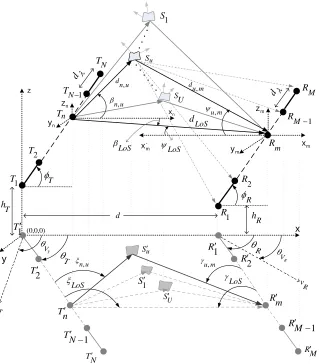
The proposed physical model for sparse MIMO communication channels is illustrated in Fig. 2.
The transmitter and receiver antenna arrays consist of N andM antenna elements, respectively.
The horizontal and vertical orientation of both the antenna arrays are modeled as flexible to be
independently rotatable. The transmitter and receiver antenna arrays are considered as mobile
with velocity vT m/s and vR m/s and the direction of their motion as θvT and θvR, respectively.
x y z T h 1 T 2 T n T N T T R T 1 R 2 R m R 1 M R u S U S R h R m x n x 1 N
T RM
u n d
,
LoS d u,m
LoS 1 S LoS m u d , u n, LoS m u, u n, LoS 1 R 2 R m R 1 M R M R 1 T 2 T n T 1 N T N T 1 S u S U S d d d ) 0 , 0 , 0 ( n z n y m z m y -m x R v T v R V T V
Fig. 2: Physical model for sparse MIMO communication channels.
The origin of coordinate system is assumed at the base of first element of the transmit antenna
array. The coordinates of the first elements of the transmit and receive antenna arrays can thus
be represented by(0,0, hT)and(d,0, hR), respectively. The elevation of transmitter and receiver
arrays is denoted byhT andhR, respectively. Subsequently, the coordinates of thenth transmitter
antenna element can be obtained as below,
xn= (n−1)dλ cosφT cosθT,
yn= (n−1)dλ cosφT sinθT,
zn= (n−1)dλ sinφT +hT.
(1)
xm = (m−1)dλ cosφR cosθR+d,
ym = (m−1)dλ cosφR sinθR,
zm = (m−1)dλ sinφR+hR.
(2)
where θT and φT represent the rotation angles of transmitter antenna array in azimuth and
elevation planes, respectively. Similarly, θRand φR are the angles of rotation of receiver antenna
array in azimuth and elevation planes, respectively.
The distances from nth transmitter and mth receiver antenna element to a uth scattering object
are denoted bydn,u anddu,m, respectively. These distances can be expressed in generalized form
as below,
dn,u=
p
(xu −xn)2+ (yu−yn)2+ (zu −zn)2, (3)
du,m =
p
(xn−xu)2+ (yn−yu)2+ (zn−zu)2, (4)
where the coordinates of a uth arbitrary scattering object are denoted by (x
u, yu, zu). For simulation of the proposed channel model, the coordinates of scattering objects may be drawn
from a certain distribution within the defined entire scattering region or a subregion [23]. The
number of scattering objects, within a defined region, may be drawn from a Poisson distribution
[23]. The distribution and the number of scattering objects can be tuned according to the
available empirical measurements. Various distinct types of distributions have been used in the
literature for modelling the physical location of scattering objects in different types of propagation
environment, e.g., uniform [24], Gaussian [25, 26], and hyperbolic [26], etc. The length of
multipath corresponding to uth scattering object can be calculated as, d
n,u,m = dn,u +du,m. The length of LoS path from nth transmitter to mth receiver is given as follows,
dn,m =
p
(xm−xn)2+ (ym−yn)2+ (zm−zn)2. (5)
Azimuth and elevation angles of departure (AoD) from the nth transmitter to the uth scatterer
ξn,u=π−arctan
yu−yn xu−xn
−θT, (6)
βn,u= arctan
zu xu
. (7)
Similarly, azimuth and elevation angles of arrival (AoA) from uth scatterer to the mth receiver
antenna element are represented by γu,m and ψu,m, respectively; and are given as below,
γu,m =π−arctan
ym−yu xm−xu
−θR, (8)
ψu,m = arctan
zu xm−xu
. (9)
The azimuth and elevation angles formed at nth transmitter element along the LoS direction
towardsmth receiver element are denoted byξ
n,m andβn,m, respectively; which can be obtained as below,
ξn,m =π−arctan
ym−yn xm−xn
−θT, (10)
βn,m = arctan
zm−zn dLoS
. (11)
Similarly, the LoS angles formed at the receiver side can be expressed as below,
γn,m =π−arctan
ym−yn xm−xn
−θR, (12)
ψn,m = arctan
zm−zn xm−xn
. (13)
In the case of no mobility, the delay τn,u,m of a certain propagation path from nth transmitter
to mth receiver associated with uth scatterer, can be found as below,
τn,u,m = dn,u,m
c , (14)
where c represents the velocity of electromagnetic waves’ propagation, i.e., c = 3×10⁸m/s.
exhibited by the LoS path, and is given by,
τmin = dLoS
c , (15)
while the maximum path delay τmax is exhibited by the scatterer having the longest path. In
the proposed channel model, both the ends of communication link are taken as mobile, which
imposes time variability in the channel characteristics. The length of a certain propagation path,
from nth transmitter to mth receiver corresponding to uth scattering object, thus changes with
time, depending upon the direction and velocity of mobility. The length of a portion of the
multipath, i.e., from nth transmitter to uth scatterer, can be expressed as,
´
dn,u,m(t) =
q
2 d2
n,u+vT2 t2−2 vT t dn,u cosβn,u cos (θT +ξn,u−θvT). (16)
Similarly, the length of the other portion of the multipath, i.e., from uth scatterer to the mth
receiver, can be obtained as below,
´
du,m(t) =
q
2 d2
u,m+vR2 t2−2 vR t du,m cosψu,m cos (θR+γu,m−θvR). (17)
Thus, the total path length from the nth transmitter to themth receiver after observation time of
t seconds becomes as, d´n,u,m(t) = ´dn,u(t) + ´du,m(t). Therefore, the path delay associated with
´
dn,u,m(t) can be found as below,
´
τn,u,m(t) =
´
dn,u,m(t)
c . (18)
The time-variant impulse response of the multipath fading channel, comprising of U paths,
between nth transmitter and mth receiver, can be written as,
hnm(τ;t) = U
X
u=1
χu(t)e−j2πfcτ´n,u,m(t) δ(τ−τ´n,u,m(t)), (19)
where fc is the carrier frequency and δ(.) denotes the standard Kronecker delta function. The
attenuation factor associated with uth path is represented byχ
u(t), such that, E{
P
to time t. For the scenario when the scattering environment also has certain fixed contributing
scattering objects (or LoS component), the envelope |h(τ;t)| has a Rice distribution. When the
differential path delay is smaller than a symbol duration, the channel exhibits a flat response
in frequency domain and channel impulse response given in (19) can be written independent
of τ [23, 27]. The path delay is modeled as a multiple of the symbol duration and the total
number of resolvable propagation paths is denoted by L, such that U ≥L. Moreover, when the
communication nodes are static, the channel exhibits a time independent behaviour and impulse
response vector in (19) can be written independent of t.
As discussed earlier, in various realistic propagation environments, when the scattering
environ-ment has only a few largely distant dominant scattering objects, the channel exhibits a sparse
impulse response. In such scenario, when the channel impulse response vector from nth
trans-mitter to mth receiver has only Q non-zero values at delay positions p˘
nm = [˘p0,p˘1,· · · ,p˘Q−1].
The sparse channel impulse response vector can thus be represented as,
hlnm =
6
= 0 ; l ∈p˘nm
= 0 ; otherwise.
(20)
The impulse response vector of a channel is said to be Q sparse, if {Q =khnmk`0} L. For
MIMO systems where the separation among transmitter antennas and receiver antennas (i.e.,
dλ) is a fraction of the distance travelled by an electromagnetic wave within a symbol duration,
the channel support may only differ by an unresolvable amount of delay among the channels
between adjacent elements of antenna arrays [28]. For such scenario, the support vectors P˘nm
may be same for all the values of n and m. The channel impulse response vector from nth
transmitter to mth receiver can be written as, h
nm = [h0nm, h1nm,· · · , h
L−1
nm ] ∗
. MIMO channel
matrix for a certain delay l can be written as,
Hl =
hl11 hl12 · · · hl1N
hl
21 hl22 · · · hl2N
..
. · · · . .. ...
hl
M1 hlM2 · · · hlM N
MIMO channel convolutional matrix can be expressed as,
H =
H0 · · · HL−1 0
..
. . .. . .. ...
0 H0 · · · HL−1
. (22)
III. PROPOSEDCOMMUNICATIONMODEL FORMIMO SYSTEMS
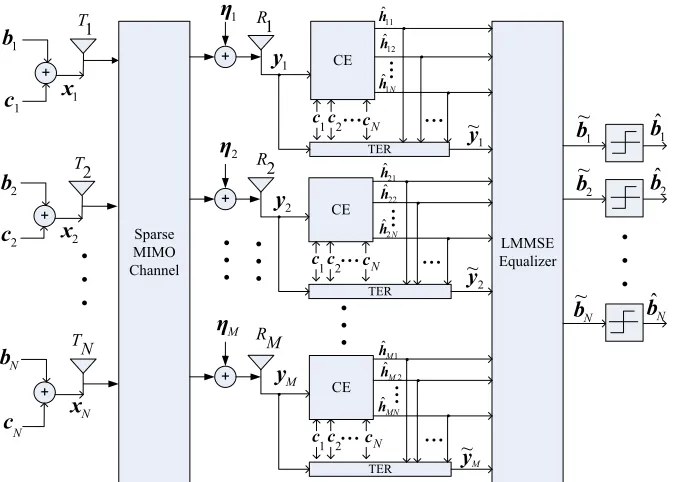
The proposed MIMO communication system model has a block diagram as shown in Fig. 3.
Let N and M be the number of transmit and receive antenna array elements, respectively. The
signal transmitted from a transmit antenna propagates through a sparse MIMO communication
channel with Q non-zero taps. Channel estimator (CE) is implemented with various first-order
statistics based techniques, which are; SiT based compressed channel sensing (SiT-CCS), SiT
based hardlimit thresholding with CCS (SiT-ThCCS), and SiT training based match pursuit
(SiT-MP). The training-sequence effect remover (TER) eliminates the contribution of training
sequence after estimation of the channel’s impulse response and feeds the equalizer with a
regularized version of the received signal. A linear minimum mean square equalizer (LMMSE)
is implemented to estimate the information sequence. Let bn = [bn(0), bn(1),· · · , bn(K −1)]∗
represent zero-mean information sequence such that bn is mutually independent for each of the
nth user. A known deterministic and periodic training sequence c
n= [cn(0), cn(1),· · · , cn(K−
1)]∗, having periodP such thatcn(k) =cn(k+aP)fork anda be any integers, is superimposed
(arithmetically added) over the information sequence bn. The superimposed information and
training sequences for a specific nth transmitter is given as below,
xn =bn+cn. (23)
The sequence xn = [xn(0), xn(1),· · · , xn(K − 1)]∗ is transmitted over the jointly sparse
MIMO channel such that the impulse response between nth transmitter and mth receiver is
given by hnm= [h0nm, h1nm,· · · , hL−nm1]∗, whereL is length of the channel. The signal received at
Sparse MIMO Channel 1 y 2 y LMMSE Equalizer 1 ~ b 1 ~y 2 ~y + 1 b 1 x 1 T 1 c + 2 b 2 x 2 T 2 c + N b N x N T N c 11 ˆ h N 1 ˆ h 12 ˆ h N c 2 c 1 c TER 1 R 21 ˆ h N 2 ˆ h 22 ˆ h N c 2 c 1 c CE TER 2 R 1 ˆ M h MN hˆ 2 ˆ M h N c 2 c 1 c CE TER M R M y M y ~
...
...
...
...
...
...
...
...
...
CE.
.
.
.
.
.
.
.
.
.
.
.
...
...
...
+ + + 1 η 2 ~ b N b~ 1 ˆ b 2 ˆ b N bˆ... ...
2 η M ηFig. 3: Block Diagram of the Proposed MIMO Communication System.
ym(k) = N X n=1 L−1 X l=0
hlnmxn(k−l) +ηm(k), (24)
where ηm(k) denotes kth sample of zero mean complex-valued additive white Gaussian noise
(AWGN) with variance σ2
η. The signal received by all the antenna elements of receiver at time
instant k is y(k) = [y1(k), y2(k),· · · , yM(k)]∗ and given by,
y(k) =
L−1
X
l=0
Hlx(k−l) +η(k), (25)
wherex(k−l) = [x1(k−l), x2(k−l),· · · , xN(k−l)] ∗
and η(k) = [η1(k), η2(k),· · · , ηM(k)] ∗
.
Temporal sampling yields following representation of the received signal,
˘
y(k) =Hx˘(k) +η˘(k), (26)
where
˘
y(k) = [y∗(k+L−1),y∗(k+L−2),· · ·,y∗(k)]∗, ˘
x(k) = [x∗(k+L−1), x∗(k+L−2), · · · ,x∗(k)]∗, ˘
IV. MIMO CHANNEL ESTIMATION BASED ON FIRST-ORDER STATISTICS WITHSIT.
For a given MIMO communication system if each user is assigned with a specific training
sequence which is added with the information sequence, then, first order statistics of the received
signal can be used to estimate the channel outlined in [20]. In this section, the SiT based channel
estimation technique of [18] is extended for the estimation of sparse MIMO channels. In this
technique, each user is assigned with a distinct cycle frequency. Suppose for a specific transmitter
nthe training sequence cn(k)is periodic. The period of the training sequence isP = ˜P N, where
˜
P is a positive integer. The training sequence cn(k) is given as below,
cn(k) = P−1
X
i=0
ci,n ej(2πi/P)k, ∀k, (27)
where, j =√−1 and
ci,n=
1
P P−1
X
k=0
cn(k) e−j(2πi/P)k, (28)
Choose cn(k) in such a way that only P˜ coefficients out of total P are non zero, so cn(k) can
be written as follows,
cn(k) =
˜
P−1
X
i=0
c0i,n ejαi,nk, ∀k, (29)
where αi,n = 2π(iN +n−1)/P, and c0i,n are suitably chosen coefficients for 1 ≤n ≤ N and
0≤i≤P˜−1. In order to design cn(k), first choose a periodic base sequence c¯o(k) that has a
period of P˜ [18] in such a way that,
¯
ci,o =
1 ˜
P
˜
P−1
X
k=0
¯
co(k) e−j(2πi/
˜
P)k. (30)
The periodic training sequence c¯1(n), with period P, is generated by replicating c¯o(k) for N
times. The training sequence of a specific transmitter n can, therefore, be defined as follows
[18],
cn(k) = σcn ¯c1(k) ej(2π/P)(n−1)k for n = 1,2, ..., N. (31)
E{ym(k)}= N
X
n=1 ˜
P−1
X
i=0
" L
X
l=0
c0i,nhlnme−jαi,nl #
ejαi,nk. (32)
For n1 6= n2, we have αi1,n1 6= αi2,n2 for any {i1, i2} ∈ 0,1, ...,P˜−1. Let dnm =
[dnm,0, dnm,1,· · · , dnm,( ˜P−1)]
∗
, where dnm,i is given by,
dnm,i= L
X
l=0
c0i,nhlnme−jαi,nl (33)
The mean square consistent estimate dˆnm = [ ˆdnm,0,dˆnm,1,· · · ,dˆnm,( ˜P−1)]
∗
of dnm can be
obtained by computing its coefficient as given in [18], which is as follows,
ˆ
dnm,i =
1
T T−1
X
k=0
ym(k) e−jαi,nk (34)
where T represents the number of received symbols, as T → ∞ , dˆnm,i → dnm,i. The
relationship given in (34) can also be written vector form as below,
ˆ
dnm=Cnhnm (35)
where Cn can be obtained as
Cn =diag {c00,n, c 0
1,n,· · · , c
0
( ˜P−1),n}Vn (36)
where Vn can be found as,
Vn =
1 1 · · · 1
1 e−jα1,n · · · e−jα1,nL
1 e−jα2,n · · · e−jα2,nL
..
. ... ... ...
1 e−jα( ˜P−1),n · · · e−jα( ˜P−1),nL
A. SiT based least squares (SiT-LS)
The least squares estimate of the channel between nth transmitter and mth receiver can be
obtained from the linear model in ((35)), as proposed in [20], and is given below,
ˆ
hSiTnm−LS = arg min
˜
hnm
kˆhnm −Cn˜hnmk2`2 (38)
The above estimate can also be obtained as,
ˆ
hSiTnm−LS= (C∗nCn)−1C∗ndˆnm (39)
To obtain the channel estimate for non-zero mean noise, setP˜ ≥L+ 1, omit first row from Cn
and dˆnm,0 from dˆnm.
B. Proposed SiT based MIMO Channel Estimation
The error in the estimate dˆnm,i of dnm,i can be realized by substituting ym(k) from (24) in
(34). The simplified solution for dˆnm,i can be expressed as under,
ˆ
dnm,i=dnm,i+εnm,i (40)
where εnm,i represents the error in the estimate of dnm,i. The estimation error εnm,i contains
contribution from additive noise (η˜nm,i), interference from superimposed information sequence
of all the transmitters (˜bnm,i), and interference from training sequence of cross channels (˜c˜nm,i).
The estimation error is thus given by, εnm,i= ˜c˜nm,i+ ˜bnm,i+ ˜ηnm,i; where,
˜
cnm,i˜ =
1
T T−1
X
k=0
N−1
X
˜ n= 1 ˜ n6=n
L
X
l=0
hl˜nmcn˜(k−l)
e−jαi,n˜k, (41)
˜bnm,i = 1
T T−1
X
k=0
"N−1
X
n=1
L
X
l=0
hlnmbn(k−l)
#
˜
ηnm,i=
1
T T−1
X
k=0
ηm(k)e−jαi,nk. (43)
Ignoring the inherent errorεnm,i leads to a non-realistic estimate of the channels. Moreover, the
first order statistics based technique presented in previous section is not optimized for the case of
sparse multipath channel. This section, thus, presents three extensions of the first-order statistics
based MIMO channel estimation model in (35) for the case of sparse multipath channels by
incorporating a compensation for the inherent estimation error εnm,i. The proposed techniques
include SiT-CCS, SiT-ThCCS, and SiT-MP.
1) SiT based CCS: During the past few years, compressed sensing has emerged as a new
paradigm for sampling and reconstruction of sparse signals. It has been established in [29–
32] that a finite-dimensional sparse signal can be exactly reconstructed from fewer, linear, and
nonadaptive measurements by solving a well-defined convex optimization problem. In literature
CS approach has been established as an efficient solution to estimate sparse multipath channels
-see e.g., [4, 33–35]. To ensure exact reconstruction of the received signal, a measurement matrix
should satisfy restricted isometry property (RIP), [29, 30]. For the linear model given in (35),
the condition for RIP is given by,
(1−δQ)khnmk2`2 ≤ kCnhnmk
2
`2 ≤(1 +δQ)khnmk
2
`2 (44)
where 0 < δQ <1 is the restricted isometry constant of the measurement Cn. If the condition
given in (44) holds then Cn satisfies RIP of order Q and is sufficient for exact recovery of the
sparse channel. In order to estimate SiT based sequence of MIMO channel, the `1 minimization
problem can be recast from the model in (35), as given below,
ˆ
hSiTnm−CCS = arg
˜
hnm
minkh˜nmk`1 subject to kCh˜nm−dˆnmk`2 ≤ (45)
where the parameteris proportional to magnitude of the errorεnm, i.e.,∝ kεnmk2`2. The convex
optimization problem given in (45) can be solved using a compressed sensing based technique
efficiency and improved recovery accuracy.
2) SiT based Hard-limit Thresholded CCS: The estimated channel impulse response, obtained
by using CCS, consists of some nominal non-zero values , whereas, the correct estimate of the
taps is a zero value. Hard limiting on the estimated channel impulse response vector according
to a predefined threshold (ζ) level ensures a sparse vector. Such hard-limit thresholding can be
applied as follows,
ˆ
hl,nmSiT−ThCCS=
ˆ
hl,nmSiT−CCS ; ˆhl,nmSiT−CCS > ζ
0 ; otherwise
(46)
where hˆl,nmSiT−CCS represents the estimate of lth tap of the channel from nth transmitter to mth
receiver obtained by the CCS technique presented in previous section.
3) MP based SiT Sparse Multipath MIMO Channel Estimation : Since the channel under
consideration is sparse, a large number of taps in the channel vector hnm is either zero or
below the noise floor. Thus, an MP algorithm can be employed to estimate the sparse channel as
proposed in [11]. Hence, to estimate the channels from the model in (35), the positions of
non-zero taps are first determined and channel estimation is then carried out only for these specific
non-zero positions. We describe the proposed SiT-MP algorithm in the following paragraphs. In
(35), both Cn and dˆnm are known, therefore, dˆnm can be expanded as,
ˆ
dnm =¯cn,oh0 +c¯n,1h1 +¯cn,2h2+. . .+c¯n,P˜−1h ˜
P−1. (47)
where c¯n,i is the ith column vector of Cn. First, find columns in matrix
Cn = [c¯n,0,c¯n,1, . . . ,¯cn,( ˜P−1)] that are best aligned with output vector dˆnm; let this vector be
denoted by c¯qp. Let Q be the number of non-zero taps among a total of L channel taps. The
output vector dˆnm is spanned by totalQ columns of Cn that actually correspond to Q non-zero
entries of the sparse channel hnm. By projecting all columns of Cn on dˆnm, we can find the
best aligned column of Cn withdˆnm that will correspond to the position of one of the non-zero
channel hnm in each iteration. Once the non-zero tap position of hnm is determined, the value
at that tap position can be found. The algorithm proceeds in the same way for each iteration. In
order to find the non-zero tap positions of hnm in the pth iteration, the projection of Cn along
ˆ
dnm is found as,
qp = arg
¯
cn,j 6={¯cn,q1,...,¯cn,qp−1}
max|¯c
∗ n,jd˜nm
p−1
|2
kc¯n,j k2`2
, (48)
where qp represents the index of best aligned column of Cn with dˆnm and corresponds to one
of the non-zero tap hnm. The projection of Cn in each iteration is computed along the residual
error vector of previous iteration d˜p−nm1. For the very first iteration the residual error vector is
˜
donm =dˆnm and in the preceding iterations its value is attained as,
˜
dpnm =d˜p−nm1 − c
∗ qp
˜
dp−nm1
kc∗qp k2`
2
cqp. (49)
where c∗qp denotes the best aligned column vector of Cn with residual error vector d˜ p−1
nm for a
specific pth iteration that corresponds to the non-zero entry of sparse channel. The estimate of
a non-zero tap of the channel ˆhqp
nm at position qp can thus be obtained as,
ˆ
hqnmp, SiT−MP = c
∗ qpd˜nm
p−1
kc∗qp k2`
2
. (50)
The iterations continue until all the non-zero taps in ˆhSiTnm−MP are determined, or when the error
residual in a specific iteration becomes smaller than a predefined threshold, i.e., kd˜pnm k < .
The cost of computing the basic model presented in equation (35) is same for all the proposed
techniques. However, the additional computational cost to estimate the channels from (35)
varies for each of the proposed techniques i.e., SiT-LS, SiT-MP, SiT-CCS, and SiT-ThCCS.
Each iteration of the matching pursuit algorithm for computing a particular channel’s estimate
ˆ
hnm implies a cost of O( ˜P log( ˜P)) in addition to the cost of computing (35). The proposed
SiT-CCS estimation technique is implemented using Dantzig selector solution to (45). The
Dantzig selector implemented by using primal-dual method, which incurs a computational cost
of OpP˜log(P˜)
estimate extends an additional computational cost, proportional to the length of channel L, over
the cost implied by SiT-CCS.
C. Minimum Mean Square Error (MMSE) Equalizer
Since the training sequence assigned to each of the transmitter in MIMO system is also known
at their corresponding receivers so we have to cancel out the effect of training sequence that also
gets convolved with channel when superimposed with information sequence. Thus before passing
the signal to equalizer input we must have to cancel out the effect of convolved training sequence
of the receiver whose information sequence is to be determined along with the convolved training
sequence of other users as well. Once the effect of training sequence is omitted we can input
that signal at equalizers input. The following steps are required to equalize the superimposed
training based information sequence,
˜
ym(k) = ym(k)− N
X
n=1
L
X
l=0
ˆ
hlnm cn(k−l), (51)
where ˆhlnm represents the estimate of lth tap of channel from nth transmitter to mth receiver.
The estimate of channel may be taken from any of the estimation techniques discussed in the
previous sections, i.e., ˆhnm ={ˆh
SiT−LS
nm ,ˆh
SiT−CCS
nm ,ˆh
SiT−MP
nm , or ˆh
SiT−ThCCS
nm }. For the equalizer
at the mth receiver, the optimal equalizer’s weights w
m can be obtained as in [37], given as
under,
wnm= HˆHˆ ∗
+ 2σm2I−1 Hˆ |(m−1)(Le+L−1)+(τd+1), (52)
where m is the receiver index such that 1 ≤m ≤M, Le denotes length of equalizer, τd is the
decision delay of equalizer’s mappers, I denotes the (N ×Le)×(N ×Le) identity matrix and
ˆ
H|i is theith column of Hˆ. The convolutional matrix Hˆ having dimensionsLe×(Le+L−1)
is given by,
ˆ Hn,m=
ˆ
h0
n,m ˆh1n,m · · · ˆhL−1n,m 0 · · · 0 0 ˆh0n,m ˆh1n,m · · · ˆhL−1n,m . .. ...
..
. . .. . .. . .. . .. . .. 0 0 . . . 0 ˆh0n,m ˆh1n,m · · · ˆhL−1n,m
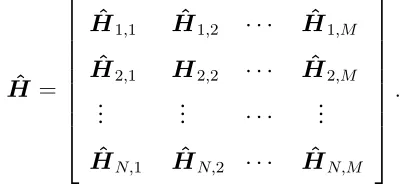
The overall convolutional matrix Hˆ of the MIMO system is give as,
ˆ
H =
ˆ
H1,1 Hˆ1,2 · · · Hˆ1,M
ˆ
H2,1 H2,2 · · · Hˆ2,M
..
. ... · · · ...
ˆ
HN,1 HˆN,2 · · · HˆN,M
. (54)
The estimate of transmitted information sequence from the nth transmitter can thus be obtained
from the following equation followed by a decision mapper, as shown in Fig. 3.
˜b
n(k) = M
X
m=1
Le−1 X
i=0
winmy˜m(k−i). (55)
The output of the equalizer, ˜bn, is then fed as an input to a decision mapper, as shown in
Fig. 3, that performs mapping of the symbols according to the used modulation scheme with
the decoded symbols represented by ˆbn.
V. RESULTS ANDDISCUSSION
In this section, we present the computer simulations along with an analysis of the obtained
results. The performance metrics used for the analysis are NCMSE and BER, which are well
established metrics. The BER quantifies reliability of the radio channel, which can be defined
as the ratio between the amount of corrupted bits and total number of transmitted bits. The
normalized channel mean square error (NCMSE) of the estimated channel is defined as,
NCMSE =
PM
m=1
PN
n=1
PL−1
l=0
ˆ
hl
nm−hlnm
2
PM
m=1
PN
n=1
PL−1
l=0 |hlnm|
2 , (56)
A2×2MIMO communication system is considered for the simulations, i.e.,N = 2 andM = 2.
The simulations are performed for time-invariant and frequency selective MIMO channels. The
realization of all the channels hnm is independently generated for each Mote Carlo run, by
keeping a certain fixed level of sparsity, Q/L. The amount of scatterers within a certain range
the location of scatterers within each subregion is drawn from uniform distribution. To ensure
a certain level of sparsity, all the scatterers except the scatterers corresponding to the selected
positions (P˘nm) of non-zero taps are discarded. However, the support (non-zero delay positions’
vectors P˘nm) of impulse response vector for all the channels is drawn independently from
uniform distribution. The values of non-zero taps of a channel hnm follow zero-mean Gaussian
distribution. The number of resolvable multipath components are taken equal for all the channels,
fixed atL= 14with variance1/(M(L+1)). A periodic training sequence is generated following
the m−sequence approach presented in [18]. A periodic base sequence with period P˜ = 15 is
taken fixed as, {-1,-1,-1,1,1,1,1,-1,1,-1,1,1,-1,-1,1}, for all the simulation results. Zero mean
white Gaussian noise is independently generated at each receiver satisfying a certain
signal-to-noise (SNR) ratio. The SNR atmth receiver is defined as the ratio between variance of received
signal σ2
ym and variance of noise σ
2
m, i.e., SNRm = σ2ym/σ
2
m. The zero mean BPSK modulated
information sequences (bn ∈ {1,−1}) is generated mutually independent for each transmitter.
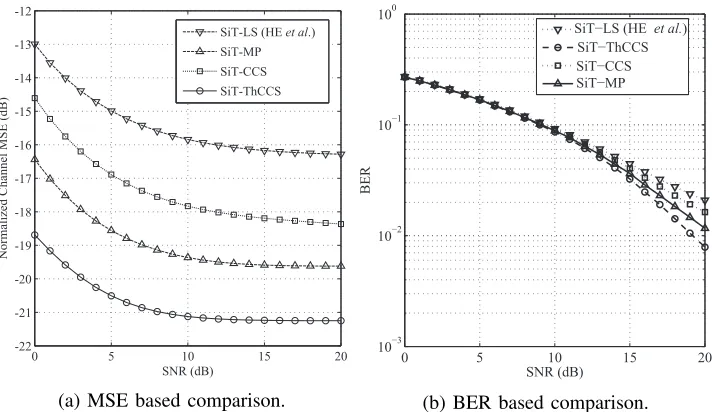
Performance comparison of the proposed techniques and the first order statistics based
technique (SiT-LS) in [18] is presented in Fig. 4a and Fig. 4b for NCMSE and BER against
SNR, respectively. The message length and sparsity level for this plot are taken asK = 900 bits
andQ/L= 3/14, respectively. In Fig. 4a it can be observed that the proposed channel estimation
techniques (i.e., SiT-CCS, SiT-MP, and SiT-ThCCS) outperforms the first order statistics based
channel estimation technique (i.e., SiT-LS). When compared to SiT-LS, the proposed techniques
SiT-CCS, SiT-MP, and SiT-ThCCS provide an improvement of 2dB, 3.5dB, and 5.2dB in MSE
at an SNR = 12dB, respectively. This improvement in the plots from the proposed techniques
is due to the consideration of a compensation parameter for the inherent estimation error εnm
and use of prior available knowledge of channels’ sparsity. The proposed techniques provide,
better performance compared to the first order statistics based technique for the case of sparse
channels, and similar performance for the case of non-sparse channels. Fig. 4b present BER
based comparison of the proposed and SiT-LS estimation techniques. It can be observed that a
performance gain of about1dB, 2.5dB, and3.5dBin SNR can be achieved by SiT-CCS, SI-MP,
0 5 10 15 20 -22 -21 -20 -19 -18 -17 -16 -15 -14 -13 -12 SNR (dB) N o rm al iz ed C h an n el M S E ( d B )
SiT-LS (HE et al.) SiT-MP SiT-CCS SiT-ThCCS
(a) MSE based comparison.
! " "! # " $%
" $# " $" " &'()*+,-, . ( ) ) &/0$1&)*2.) et al.
!"#$#%&&! !"#$&&! !"#$'(
(b) BER based comparison.
Fig. 4: MSE and BER based comparative analysis between SiT-LS and the proposed SiT-CCS, SiT-ThCCS, and SiT-MP for 900 bits message signal length.
0 5 10 15 20
−16 −15 −14 −13 −12 −11 −10 −9 SNR(dB) N orm al iz ed Cha nne l M S E (dB)
Q/L = 2/14
Q/L = 3/14
Q/L = 4/14
(a) Effect of sparsity level Q on SiT-MP performance.
0 5 10 15 20
−15 −14 −13 −12 −11 −10 −9 SNR(dB) N orm al iz ed Cha nne l M S E (dB)
Q/L = 2/14
Q/L = 3/14
Q/L = 4/14
(b) Effect of Sparsity level Q on SiT-CCS performance.
Fig. 5: Effect of variation of sparsity level Qon the MSE Performance of the proposed SiT-MP and SiT-CCS techniques.
be enhanced by employing the iterative algorithm proposed in [4].
To demonstrate the effect of channel’s sparsity level (i.e., Q/L), the MSE is plotted against
SNR for different values of sparsity (i.e., Q/L= 2/14,3/14, and 4/14) in Fig. 5a and Fig. 5b
0 5 10 15 20 −17 −16 −15 −14 −13 −12 −11 −10 −9 −8 −7 SNR(dB)
Normalized Channel MSE(dB)
σc2
/σ
b 2
= 0.5
σc2/σ b 2 = 1
σc2/σ b 2 = 1.5
σc2
/σ
b 2
= 2
(a) Effect of TIR (σ2
c/σ2b) on SiT-MP.
0 5 10 15 20
−17 −16 −15 −14 −13 −12 −11 −10 −9 −8 SNR(dB)
Normalized Channel MSE(dB)
σc2
/σ
b 2
= 0.5
σc2/σ b 2 = 1
σc2
/σ
b 2
= 1.5
σc2/σ b 2 = 2
(b) Effect of TIR (σ2
c/σ2b) on SiT-CCS.
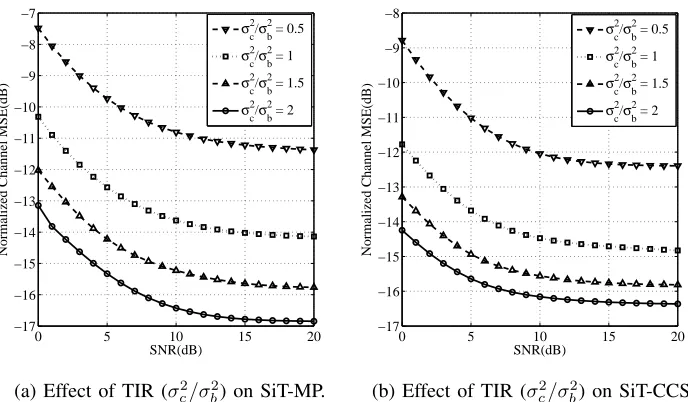
Fig. 6: Effect of the variation of TIR (σc2/σb2) on MSE performance of the proposed SiT-MP and SiT-CCS techniques.
0 5 10 15
-18 -17 -16 -15 -14 -13 -12 -11 SNR (dB) N o rm al iz ed C h an n el M S E ( d B
) SiT-CCS, 2x2 MIMO
SiT-CCS, 3x3 MIMO
(a) MSE performance of SiT-CCS.
0 5 10 15
-26 -24 -22 -20 -18 -16 -14 SNR (dB) N o rm al iz ed C h an n el M S E ( d B
) SiT-MP, 2x2 MIMO
SiT-MP, 3x3 MIMO
(b) MSE performance of SIT-MP.
Fig. 7: MSE performance comparison of SiT-CCS and SiT-MP for 2× 2 and 3×3 MIMO system.
sequence power ratio σ2
c/σb2 is set to unity. It can be observed that by decreasing number of non-zero taps, i.e., by decreasing Q for a fixed L, the MSE performance improves for all SNR
values obtained from both the SiT-CCS and SiT-MP estimation techniques. Thus, the performance
of the proposed schemes further improve with an increase in the channel’s sparsity. The gain
in performance improvement with an increase in the channel’s sparsity is higher for SiT-MP
0 5 10 15 20 -18
-16 -14 -12 -10 -8
SNR (dB)
N
o
rm
al
iz
ed
C
h
an
n
el
M
S
E
(
d
B
)
SiT-ThCCS,1= max( SiT!CCS)/5 SiT-ThCCS,1= max( SiT!CCS)/10 SiT-ThCCS,1= max( SiT!CCS)/15 SiT-ThCCS,1= max( SiT!CCS)/20 SiT-CCS
^
h
^
h^
h
^
h
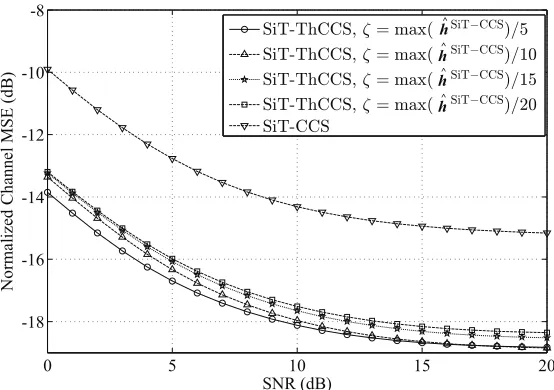
Fig. 8: Effect of hard-limit threshold ζ on the MSE performance of the proposed SiT-ThCCS technique.
To elucidate the effect of TIR (i.e., σ2c/σb2) on the performance of the proposed SiT-MP and
SiT-CCS channel estimation techniques, the MSE is plotted against SNR for different values of
TIR, ranging from 0.5 to 2 with uniform difference of 0.5, in Fig. 6a and Fig. 6b, respectively.
These graphs are obtained for channel’s sparsity levelQ/Lset to3/14. It can be noted that with
an increase the training sequence’s power (i.e., σ2
c) for fixed information sequence’s power (i.e.,
σ2
b ), the MSE performance of channel estimator is observed to improve. However, decreasing
the contribution of information sequence has an adverse effect on the BER performance of the
system in decoding of information sequence. Therefore, choice of an optimum value for TIR is
highly resaleable to satisfy a good tradeoff between MSE and BER performance.
In order to prove the validity of the proposed channel estimation techniques for higher order
MIMO systems, the MSE performance analysis for a3×3MIMO systems have been performed
in comparison with a 2×2 MIMO system in Fig.7. This graph is obtained for the TIR taken
as σ2
c/σb2 = 0.4 and sparsity of the channels set toQ/L= 4. To demonstrate the effect of hard-limiting threshold parameter,ζ, on the proposed SiT-ThCCS estimation technique, MSE is plotted
against SNR for different values of ζ in Fig. 8. This plot is obtained for the channel’s sparsity
level Q/L set to 3/14 and TIR σ2
of limiting threshold, viz: 1/5,1/10,1/15,and1/20 times the highest value of channel impulse
response vector; where, the initial channel estimate is obtained through SiT-CCS technique. It
is evident in the plot that MSE performance improves with a decrease in the value of ζ up
to a certain optimum value, and the plot shows a converse behaviour for a further decrease in
ζ beyond a certain optimum value. Based on the simulation analysis, it is observed that the
MSE performance is optimum for ζ equal to 1/5 times the strongest multipath component in
the channel.
VI. CONCLUSION
A channel model for the implementation of sparse MIMO channels has been proposed. Three
SiT compressed channel sensing based estimation techniques has been proposed for
frequency-selective time-invariant sparse MIMO communication channels. A thorough analysis based on
the simulation results has been presented. The MSE and BER have been used for the performance
analysis. Effect of various parameters, such as, the channels’ sparsity level, training to information
power ratio,threshold coefficient, and message length, has thoroughly been investigated. It has
been established that the proposed SiT-CCS, SiT-ThCCS, and SiT-MP techniques outperform the
traditional SiT-LS technique for the case of sparse MIMO channels. It has been shown that the
proposed SiT-CCS, SiT-MP, and SiT-ThCCS can provided an improvement of 2dB, 3.5dB, and
5.2dBin the MSE at SNR of12dBwhen compared to SiT-LS in [18], respectively. Consequently,
a gain of about 1dB, 2.5dB, and 3.5dB in SNR has been observed at BER = 10−1.9 by the
proposed SiT-CCS, SiT-MP, and SiT-ThCCS when compared to SiT-LS [18], respectively. This
performance gain in MSE and BER has been observed to increase with an increase in the
channels’ sparsity.
VII. ACKNOWLEDGEMENT
The first three authors would like to acknowledge the partial support by EU ATOM-690750
research project approved under the call H2020-MSCA-RISE-2015. The fourth author would
like to acknowledge the partial financial support by the National Research Fund, Luxembourg
REFERENCES
[1] B. Mansoor, S. J. Nawaz, B. Amin, S. K. Sharma, and M. N. Patwary. Superimposed training based estimation of sparse
mimo channels for emerging wireless networks. Inproc. of International Conference on Telecommunications, pages 1–6,
May 2016.
[2] S. F. Cotter and B. D. Rao. Sparse channel estimation via matching pursuit with application to equalization. IEEE
Transactions on Communications, 50(3):374–377, Mar. 2002.
[3] S. Ariyavisitakul, N. R. Sollenberger, and L. J. Greenstein. Tap-selectable decision-feedback equalization. IEEE
Transactions on Communications, 45(12):1497–1500, Dec. 1997.
[4] S. J. Nawaz, K. I. Ahmed, M. N. Patwary, and N. M. Khan. Superimposed training-based compressed sensing of sparse
multipath channels. IET Communications, 6(18):3150–3156, Dec. 2012.
[5] J. Ying, J. Zhong, M. Zhao, and Y. Cai. Turbo equalization based on compressive sensing channel estimation in wideband
HF systems. InProc. of International Conference on Wireless Communications Signal Processing, pages 1–5, Oct. 2013.
[6] M. Kocic, D. Brady, and M. Stojanovic. Sparse equalization for real-time digital underwater acoustic communications. In
Proc. of OCEANS Conference, 1995.
[7] W. Schreiber. Advanced television systems for terrestrial broadcasting: Some problems and some proposed solutions.
Proceedings of the IEEE, 83(6):958–981, Jun. 1995.
[8] I. J. Fevrier, S. B. Gelfand, and M. P. Fitz. Reduced complexity decision feedback equalization for multipath channels
with large delay spreads. IEEE Transactions on Communications, 47(6):927–937, Jun. 1999.
[9] J. Zhao, W. Meng, and S. Jia. Sparse underwater acoustic OFDM channel estimation based on superimposed training.
Journal of Marine Science and Application, 8(1):65–70, 2009.
[10] G. Gui, A. Mehbodniya, and F. Adachi. Adaptive sparse channel estimation for time-variant MIMO communication
systems. InProc. of IEEE Vehicular Technology Conference, pages 1–5. IEEE, Sep. 2013.
[11] S. F. Cotter and B. D. Rao. Sparse channel estimation via matching pursuit with application to equalization. IEEE
Transactions on Communications, 50(3):374–377, 2002.
[12] N. Wang, G. Gui, Z. Zhang, T. Tang, and J. Jiang. A novel sparse channel estimation method for multipath MIMO-OFDM
systems. InProc. of IEEE Vehicular Technology Conference, pages 1–5. IEEE, 2011.
[13] G. Z. Karabulut and A. Yongacoglu. Sparse channel estimation using orthogonal matching pursuit algorithm. InProc. of
IEEE Vehicular Technology Conference, volume 6, pages 3880–3884. IEEE, 2004.
[14] J. Haupt, W. U. Bajwa, G. Raz, and R. Nowak. Toeplitz compressed sensing matrices with applications to sparse channel
estimation. IEEE Transactions on Information Theory, 56(11):5862–5875, 2010.
[15] G. Gui, Q. Wan, W. Peng, and F. Adachi. Sparse multipath channel estimation using compressive sampling matching
pursuit algorithm. arXiv preprint arXiv:1005.2270, 2010.
[16] D. Han, S. Kim, and J. C. Principe. Sparse channel estimation with regularization method using convolution inequality for
entropy. InProc. of IEEE International Joint Conference on Neural Networks, volume 4, pages 2359–2362. IEEE, 2005.
[17] F. Mazzenga. Channel estimation and equalization for M-QAM transmission with a hidden pilot sequence. IEEE
[18] S. He, J. K. Tugnait, and X. Meng. On superimposed training for MIMO channel estimation and symbol detection.IEEE
Transactions on Signal Processing, 55(6):3007–3021, 2007.
[19] B. Farhang-Boroujeny. Pilot-based channel identification: proposal for semi-blind identification of communication channels.
IET Electronics Letters, 31(13):1044–1046, 1995.
[20] J. K. Tugnait and W. Luo. On channel estimation using superimposed training and first-order statistics. InProc. of IEEE
International Conference on Acoustics, Speech, and Signal Processing, volume 4, pages IV–624. IEEE, 2003.
[21] S. J. Nawaz, M. I. Tiwana, M. N. Patwary, N. M. Khan, M. I. Tiwana, and A. Haseeb. GA based sensing of sparse
multipath channels with superimposed training sequence. In Press, Elektronika ir Elektrotechnika.
[22] V. Jungnickel, K. Manolakis, W. Zirwas, B. Panzner, V. Braun, M. Lossow, M. Sternad, R. Apelfrojd, and T. Svensson.
The role of small cells, coordinated multipoint, and massive MIMO in 5G.IEEE Communications Magazine, 52(5):44–51,
2014.
[23] Ming Lu, Titus Lo, and J. Litva. A physical spatio-temporal model of multipath propagation channels. InProc. of IEEE
Vehicular Technology Conference, volume 2, pages 810–814, May 1997.
[24] S. J. Nawaz, B. H. Qureshi, and N. M. Khan. A generalized 3-D scattering model for a macrocell environment with a
directional antenna at the BS. IEEE Transactions on Vehicular Technology, 59(7):3193–3204, Sep. 2010.
[25] R. Janaswamy. Angle and time of arrival statistics for the gaussian scatter density model. IEEE Transactions on Wireless
Communications, 1(3):488–497, Jul. 2002.
[26] K. N. Le. On angle-of-arrival and time-of-arrival statistics of geometric scattering channels.IEEE Transactions on Vehicular
Technology, 58(8):4257–4264, Oct. 2009.
[27] N. M. Khan.Modeling and characterization of multipath fading channels in cellular mobile communication systems. Ph.d.,
Faculty of Engineering, University of New South Wales, 2006.
[28] Y. Barbotin, A. Hormati, S. Rangan, and M. Vetterli. Estimating sparse MIMO channels having common support. InProc.
of IEEE International Conference on Acoustics, Speech, and Signal Processing, pages 2920–2923, May 2011.
[29] E. J. Candes and T. Tao. Decoding by linear programming.IEEE Transactions on Information Theory, 51(12):4203–4215,
Dec. 2005.
[30] E. J. Candes, J. Romberg, and T. Tao. Robust uncertainty principles: exact signal reconstruction from highly incomplete
frequency information. IEEE Transactions on Information Theory, 52(2):489–509, Feb. 2006.
[31] E.J. Candes and T. Tao. Near-optimal signal recovery from random projections: Universal encoding strategies? IEEE
Transactions on Information Theory, 52(12):5406–5425, Dec. 2006.
[32] D. L. Donoho. Compressed sensing. IEEE Transactions on Information Theory, 52(4):1289–1306, Apr. 2006.
[33] W. U. Bajwa, J. Haupt, A. M. Sayeed, and R. Nowak. Compressed channel sensing: A new approach to estimating sparse
multipath channels. Proceedings of the IEEE, 98(6):1058–1076, Jun. 2010.
[34] G. Taubock, F. Hlawatsch, D. Eiwen, and H. Rauhut. Compressive estimation of doubly selective channels in multicarrier
systems: Leakage effects and sparsity-enhancing processing. IEEE Journal of Selected Topics in Signal Processing,
4(2):255–271, Apr. 2010.
communication: From subspace methods to compressed sensing. IEEE Transactions on Signal Processing, 58(3):1708–
1721, Mar. 2010.
[36] E. Candes and T. Tao. The Dantzig selector: Statistical estimation when p is much larger than n.Ann. Statist., 35(6):2313–
2351, Dec. 2007.
[37] S. Chen, A. Livingstone, and L. Hanzo. Minimum bit-error rate design for space-time equalization-based multiuser
detection. IEEE Transactions on Communications, 54(5):824–832, 2006.
Bilal Aminreceived his B.Sc. degree in Electrical Engineering having specialization in
Telecommunica-tions from COMSATS Institute of Information Technology, Lahore Campus in 2013 and M.Sc. degree in
Electrical Engineering from COMSATS Institute of Information Technology, Islamabad Campus in 2015.
He has an experience of more than one year in academia regarding research and teaching. He is currently
working as Lecturer with the Department of Electrical Engineering, CIIT Lahore.
His research interest include spread spectrum, channel estimation and equalization, compressed channel
sensing, massive MIMO communication systems, signal processing, and adaptive signal processing.
Babar Mansoor received the B.Sc. degree in Computer Engineering from COMSATS Institute of
Information Technology (CIIT), Abbottabad, Pakistan, in 2005 and M.Sc. degree in Microelectronic
Systems in 2007 from The University of Liverpool, UK. He is currently pursuing his Ph.D. research
work in the Department of Electrical Engineering, CIIT, Islamabad, Pakistan. His research areas include
Syed Junaid Nawaz received the B.Sc. and M.Sc. degrees in computer engineering from COMSATS
Institute of Information Technology (CIIT) Abbottabad, in Aug. 2005 and Feb. 2008, respectively. He
received the Ph.D. degree in electronic engineering from Mohammad Ali Jinnah University Islamabad,
in Feb. 2012. Since Sep. 2005, he has worked on several research and teaching positions with CIIT
Abbottabad, CIIT Islamabad, Federal Urdu University Pakistan, Staffordshire University UK, and Aristotle
University of Thessaloniki Greece. He is currently working as an Assistant Professor with the Department
of Electrical Engineering, CIIT Islamabad. He has an active presence in the research community through publications in reputed
international journals and conferences in different areas of wireless communications. He is currently working on development
of stochastic geometry based solutions for various challenging aspects of emerging 5G communication networks.
His current research interests include physical channel modeling and characterization, interference modeling, channel
estimation and equalization, massive MIMO systems, compressive sensing, vehicle-to-vehicle communications, airborne internet,
and adaptive signal processing.
Shree Krishna Sharma received the M.Sc. degree in information and communication engineering
from the Institute of Engineering, Pulchowk, Nepal, in 2010; the M.A. degree in economics from
Tribhuvan University, Nepal; the M.Res. degree in computing science from Staffordshire University,
Staffordshire, U.K., in 2011; and the Ph.D. degree in Wireless Communications from University of
Luxembourg, Luxembourg in 2014. Since November 2014, he has been working as a Research Associate in
Interdisciplinary Centre for Security, Reliability and Trust (SnT), University of Luxembourg, Luxembourg.
In the past, Dr. Sharma was also involved with Kathmandu University, Dhulikhel, Nepal, as a Teaching Assistant, and he
worked as a Part-Time Lecturer for eight engineering colleges in Nepal. He was with Nepal Telecom for more than four years
as a Telecom Engineer in the field of information technology and telecommunication. He is the author of more than 50 technical
papers in refereed international journals, scientific books, and conferences. He received an Indian Embassy Scholarship for his
B.E. study, an Erasmus Mundus Scholarship for his M. Res. study, and an AFR Ph.D. grant from the National Research Fund
(FNR) of Luxembourg. He received Best Paper Award in CROWNCOM 2015 conference held in Doha, Qatar and for his Ph.D.
thesis, he received FNR award for outstanding PhD Thesis 2015 from FNR, Luxembourg. He has been involved in EU FP7
CoRaSat project, EU H2020 project SANSA, ESA project ASPIM, and Luxembourgish national projects Co2Sat, and SeMIGod.
He has been serving as a reviewer for several international journals and conferences, and also as a TPC member for a number of
conferences. His research interests include cognitive wireless communications, satellite communications, and signal processing
Mohammad Patwary is Professor of Wireless Systems & Digital Productivity with the Institute for
Technological and Environmental Wellbeing and Chair for the Centre of Excellence on Digital Productivity
with Connected Services (DiPConS) at Staffordshire University, UK. He received his Ph.D. degree in
Telecommunication Engineering from The University of New South Wales, Sydney, Australia in 2005
and BEng(Hons). in Electrical and Electronic Engineering from Chittagong University of Engineering
and Technology, Bangladesh in 1998. He was with the General Electric Company of Bangladesh from
1998 to 2000 and with Southern-Poro Communications, Sydney Australia from 2001-2002 as R & D Engineer. He worked at the
University of New South Wales, Sydney Australia as Lecturer from 2005-2006; then at Staffordshire University, UK as Senior
Lecturer from 2006-2010. Current research interests of DiPConS include future generation of cellular network architecture;
signal detection, estimation and optimisation for future generation of wireless receivers; joint source-channel characterisation