Volume 7, Issue 1, Jan-Feb 2016, pp. 87-100, Article ID: IJECET_07_01_009 Available online at
http://www.iaeme.com/IJECETissues.asp?JType=IJECET&VType=7&IType=1 Journal Impact Factor (2016): 8.2691 (Calculated by GISI) www.jifactor.com ISSN Print: 0976-6464 and ISSN Online: 0976-6472
© IAEME Publication
DESIGN AND IMPLEMENTATION OF FPGA
BASED G CODE COMPATIBLE CNC LATHE
CONTROLLER
Mufaddal A. Saifee
M.Tech. by Research Student, Institute of Technology, Nirma University, Ahmedabad, Gujarat, India
Dr. Usha S. Mehta
Associate Professor, Institute of Technology, Nirma University, Ahmedabad, Gujarat, India ABSTRACT
The conventional machining done in the past like lathe and milling operations were done manually. Accuracy and consistency between two produced parts vary tremendously due to human errors and limitations. With the advent of processor and controllers, came the Computerized Numerically Controlled (CNC) machines, having the advantage of using universally accepted G code machining language to machine the parts. It became really easy to produce the parts with same accuracies and consistency on different machines with the same G code being used. G codes are CNC machine assembly language having various Interpolation Instructions G codes, Tool Instruction T codes, Feed-rate Instruction F codes, Principal Axis Speed Instruction S codes and various Controlling and Input - Output Instructions M codes.
G code based CNC systems available till date, are implemented using controllers and processors using software interpolation. Software implementation of complex interpolation algorithms by serial pipelined processors is time consuming, difficult and impractical for real time applications. Thus the efficient, real time complex computation approach is only feasible with hardware logic circuits like FPGA or ASIC having parallel and low power processing architectures. In the presented work, for the first time a G code based, CNC Lathe controller is designed and implemented in a FPGA. It is implemented and validated on Xilinx Artix 7, 7a100tcsg324-1 FPGA based kit, with its heart being a 4 stage Multi InstructionMulti Data (MIMD) Complex Instruction Set computers (CISC) G code processor. The Rapid Positioning Controller, Linear Interpolation Controller and Circular Interpolation Controller are also designed as a co-processor for the G Code
processor to perform rapid positioning (G00), linear 2d (G01) and circular 2d arc clockwise (G02) and anticlockwise (G03) interpolated movements respectively of the CNC Lathe machine.
The simulation and hardware results of the integrated CNC controller with its central CISC G code Processor and its interpolation controllers shows the efficient and precise operation for the CNC Lathe machines. Implemented CNC lathe Controller was able to achieve the maximum frequency of 52.35 MHz while utilizing 3277 LUTs and 1580 Flip Flops of Artix 7 FPGA, proving it to be performance and hardware efficient.
Keywords: CNC, 3D Linear Interpolation, 2D Circular Interpolation, FPGA, CISC Processor, MIMD Processor.
Cite this Article: Mufaddal A. Saifee and Dr. Usha S. Mehta. Design and Implementation of FPGA Based G Code Compatible CNC Lathe Controller.
International Journal of Electronics and Communication Engineering & Technology, 7(1), 2016, pp. 75-86.
http://www.iaeme.com/IJECET/issues.asp?JType=IJECET&VType=7&IType=1
1. INTRODUCTION
The conventional machining done in the past like lathe and milling operations were done manually. With the advent of processor and controllers, came the CNC machines, with the advantage of using universally accepted G code machining language to machine the parts. It became really easy to produce the parts with same accuracies and consistency on different machines with the same G code being used. The Heart of Industrial Automation Devices like CNC Machines are Motion Controllers, which sequentially executes G codes to machine the parts. Motion controllers control the motion conveyed through G code in a predetermined direction through motors. The circular motion of the motor is translated to the CNC tool linearly in small steps. A motor each is required for motion in one particular axis. Therefore, for a 3D motion, the tool is controlled by providing varying rate of pulses to each of the three motors, corresponding to an axis. The controlled motion (line/arc) along the required path trajectory is achieved through various interpolation algorithms run in 2D or 3D space, which are responsible for providing varying rate of pulses to corresponding axis.
Till date available CNC systems are implemented using controllers and processors. These processors implement CNC motions using software interpolation. Most of the interpolation algorithm uses complex parametric function like sine and cosine for necessary calculations. Software implementation of such algorithms by serial pipelined processors is time consuming and as well as difficult and impractical for real time applications. As employment with single CPU in traditional control system, the CPU is busy with kinds of tasks; in this case, the high requirement for real time in interpolation is impractical and difficult. Thus the efficient, real time complex computation approach is only feasible with hardware logic circuits like FPGA or ASIC having parallel and lower power processing architectures. As compared to ASIC, FPGAs have lower time to market and simpler design cycle making it an excellent solution for the implementation of motion controllers.
The FPGA-based implementation of control algorithm offers advantages such as high speed computation, complex functionality and real-time processing capabilities. Takahashi and Goetz presented the design and implementation of FPGA based
high-performance ac servo system. A new motion control hardware architecture was presented by Shao etal. where FPGA was used for position and velocity control, and for dynamic compensation, inverse kinematics, and trajectory generation a DSP was utilized. The design and implementation of a motor control IC for the permanent magnet ac (PMAC) servo was presented by Tzou and Kuo. For system initialization and parameter setting DSP was used. Oldknow and Yellowley presented FPGA based 3-D dynamic interpolation motion controller and proved the implementation on a two axis test stand. Park and Oh presented the hardware realization of straight line interpolation using inverse kinematics for robot manipulators. An FPGA-based motion controller was developed by Yau et al. in order to realize the real-time non-uniform rational B-spline (NURBS) interpolator and CNC controller in an FPGA. The NURBS interpolation algorithm and the infinite impulse response filter algorithm were implemented to control an XY table using an FPGA-based motion controller. Kung et al. used a soft-core embedded processor to perform motion trajectory and position control of a servo control IC for the XY table. Chan et al. used distributed arithmetic (DA) to implement a PID controller. This DA-based PID controller offers the advantage of optimal resource utilization and power consumption when implemented in an FPGA.
In the research listed to date, FPGAs were used to realize only the logic circuits of motion control systems or particular functions of the motion control systems such as interpolation, velocity profile generator, PID controller, and inverse kinematics calculator. Moreover the controllers implemented were propriety and none targeted the universally accepted G code base motion controller implementation. The work presented over here implements a FPGA based G code - motion controller, which implements all the G codes required for a Lathe operations. To achieve this 4 stage Multi Instruction Multi Data (MIMD) Complex Instruction Set computers (CISC) G code processor is designed and implemented. It is capable of executing Interpolation Instructions G codes, Tool Instruction T codes, Feed-rate Instruction F codes, Principal Axis Speed Instruction S codes and various Controlling and Input - Output Instructions M codes, required for controlling a Lathe Machine. To support various G codes conveying the interpolated motion of the tool for machining, Linear Interpolation, Circular Interpolation and Rapid Positioning Controllers are implemented as co-processors to the G code processor. G codes are written to the Block Ram of the FPGA through UART, for which a UART controller is implemented. G code Processor fetches the G codes sequentially from the Block Ram and executes the machining operations. For G codes requiring the linear, circular or rapid interpolation movements, the G code processor communicates the coordinates to the respective co-processors which then does the corresponding machining operations. Thus the hardware interpolation performed by the respective co-processors - controllers highly improves the motion controller performance.
The proposed motion controller is implemented using Verilog HDL in Xilinx Artix 7 FPGA. Simulation is performed using Modelsim 10.1 simulator and hardware is implemented using Xilinx ISE 14.4 in Digilent Nexus4 Artix 7 FPGA based board. Hardware results are validated using Xilinx ChipScope Pro on chip debugging tool. The paper is organized as follows: Section 2 briefs the proposed CNC Lathe Controller, Section 3 explains implementation of CNC Motion Controller, briefs the Proposed FPGA based CNC Lathe Controller, its heart Application Specific G Code Processor, its different co-processor interpolation controllers. It also explains implementation and verification of Application Specific G Code CISC processor with
its G, M, T, F and S codes instructions. and Section 4 describes Synthesis, Simulation and Hardware results. Conclusions are detailed in Section 5.
2. PROPOSED CNC LATHE CONTROLLER
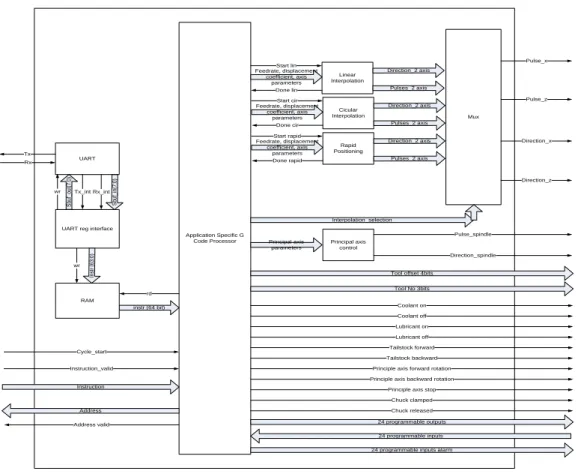
Proposed FPGA-based G code compatible, 2-axis motion controller will be capable of controlling 2 axes of either stepper motor or pulse type servo drivers for position, speed, and interpolation controls. The overall structure of the proposed CNC controller is modularized with different functional modules as shown in figure 1 below.
2.1. UART
UART (Universal Asynchronous Receiver Transmitter) is used for asynchronous serial data communication to configure the G code Processor and its instruction memory. It’s a generic UART supporting all baud rates. Our design uses the 115200 baud rate. A moving average low pass filter is used to remove noise samples from data samples at receiver. Reference 4 gives more detail on the implementation.
2.2. UART Register Interface
UART Register Interface appropriately interprets and writes data to the 32 bit displacement coefficient registers. These registers provide data like displacement coefficients in X, Y and Z axes for the respective servo drives. UART Register Interface writes the 128 bit G Code instructions for the ASSP G code processor in a 128 bit x 512 Block RAM. The heart of the UART Register Interface is the Finite State Machine (FSM) which has 3 states and controls the configuring of above registers and RAM. The states are 1) Idle, 2) reg write and 3) RAM write.
Linear Interpolation Application Specific G Code Processor rd instr (64 bit) UART
UART reg interface
RAM Tx Rx wr Tx_intRx_int S bu f_ ou t( 7: 0) S bu f_ in (7:0 ) wr In str (6 3: 0) Start lin Feedrate, displacement coefficient, axis parameters Done lin Direction_2 axis Pulses_2 axis Cicular Interpolation Start cir Feedrate, displacement coefficient, axis parameters Done cir Direction_2 axis Pulses_2 axis Rapid Positioning Start rapid Feedrate, displacement coefficient, axis parameters Done rapid Direction_2 axis Pulses_2 axis Mux Pulse_x Pulse_z Direction_x Direction_z Interpolation_selection Principal axis control Principal axis parameters Pulse_spindle Direction_spindle
Tool offset 4bits
Tool No 3bits Coolant on Coolant off Lubricant on Lubricant off Tailstock forward Tailstock backward Principle axis forward rotation Principle axis backward rotation
Principle axis stop Chuck clamped Chuck released 24 programmable outputs 24 programmable inputs 24 programmable inputs alarm Cycle_start
Instruction_valid
Address valid Address Instruction
2.3. RAM
RAM used is a simple dual port RAM with one side read only and other write only. It's a 128 bit width and 512 deep synchronous block RAM of Artix 7 FPGA. It is used to hold instructions. Instructions are written in RAM by UART register interface through UART, while they are read by G code processor. G code processor fetches the next bunch after it has positioned the two servo motors according to the instruction fetched previously.
2.4. Linear Interpolation
It performs the linear interpolation algorithm, to cause the tool to cut in straight line from current position to the specified end point. It is called by G code processor for G01, G90 and G94 G codes processing. Reference 2 gives more detail on the implementation.
2.5. Circular Interpolation
It performs the Circular interpolation algorithm, to cause the tool to cut in circular arc from current position to the specified end point with the provided radius. It is called by G code processor for G02 and G03 G codes processing. Reference 3 gives more detail on the implementation.
2.6. Rapid Positioning
It performs the rapid positioning to cause the tool to move at maximum speed from current position to the specified end point. It is called by G code processor for G00, G28, G90 and G94 G codes processing. Implementation similar to Linear interpolation.
2.7. Principal axis Control
Depending on the S code parameters used in G98 and G99 G codes, it controls the speed of the principal axis rotation.
2.8. Application Specific G code Processor
It is the heart of the CNC controller. It is a 4 stage pipelined 32 bit application specific CISC processor. It fetches the instruction from the RAM, decodes them and accordingly either controls the outputs, or provides data to various interpolation modules to drive the servo motors according to the interpolated motion required. It then waits for the interpolated motion to get completed after which it fetches the next instruction.
3. G CODE PROCESSOR
Application G code processor is designed to support the G, M, S and T codes used in a standard lathe machines. It is a 32 - bit, 4 stage pipeline, CISC (Complex Instruction Set Computers) processor. It is implemented on Xilinx Artix 7 FPGA.
Its basic features are:
16 - bit Program Counter. 128 bit Instruction Register. Four stage pipeline architecture:
Instruction Fetch: 128 bit instructions are fetched from the external memory in this stage.
Instruction Decode: Fetched instruction is accordingly decoded into M, T or G code Execute: Instructions depending on their type are executed in single clock or multiple
clock.
Current position update: If the instructions are any of the G code interpolation or M code program end then depending on the motion executed the current position is updated.
3.1. G Code Processor Block Diagram
In s tr u c ti o n F e tc h In s tr u c ti o n D e c o d e In s tr u c ti o n E x e c u te In s tr u c ti o n w ri te b a c k
Current position register update Wait complete operation ` Pipeline Registers Adder 32 bit PC mux D clr Q Instruction Decoder Instruction register(63:0) b ra n c h _ ta k e n branch_taken X “0000 0001” Program Counter clk reset Sig_Program Counter Im m e d _ d a ta (3 1 :0 ) Start lin
Feedrate, displacement coefficient, axis parameters Start cir
Feedrate, displacement coefficient, axis parameters Start rapid
Feedrate, displacement coefficient, axis parameters
Interpolation_selection
Principal axis parameters
o p c o d e Coolant on Coolant off Lubricant on Lubricant off Tailstock forward Tailstock backward Principle axis forward rotation Principle axis backward rotation
Principle axis stop Chuck clamped Chuck released 24 programmable outputs T im e r p a ra m e t e rs Done lin Done cir Done rapid Timer Current position Current position 24 programmable inputs Timer_up o p c o d e done
24 programmable inputs alarm Cycle start
Non_restoring_divider Pricipal axis rotation/
min calculation
Feedrate mm/min calculation
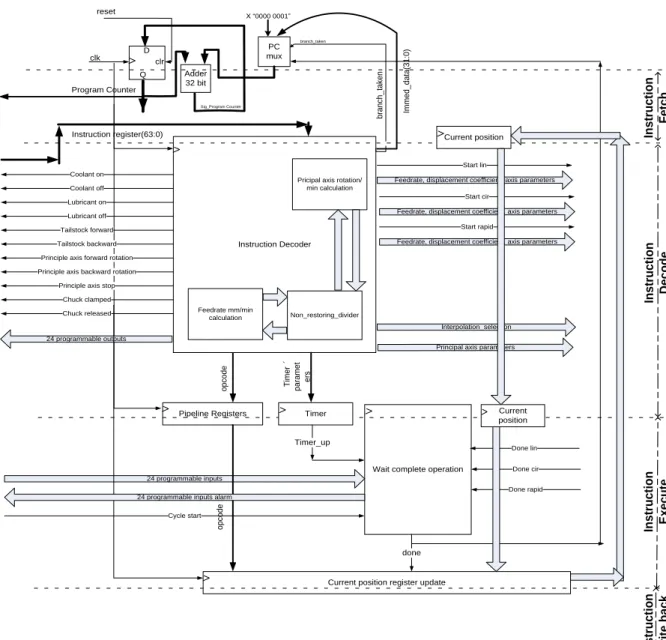
Figure 2 G Code Processor Block Diagram
Block diagram of 4 stage pipeline G code processor is shown in figure 2. Program counter is incremented and given out to the external ram, which then returns with the instruction back. Instruction is then decoded. Axis parameters, feedrate, coordinates are decoded and given out to external interpolation modules to do the machining. Once they are finished with the machining process they send a done signal. Processor
waits for the done signals and accordingly updates the current position register. The program counter increments by 1 to fetch the next instruction. If there is block change instruction, it is decoded in the instruction decode stage and accordingly instruction is fetched from the next decoded address. For the M codes depending on whether they are control instructions or programmable input output instructions they are executed in single or multiple clock cycles. Tool selection and offset instruction is executed in single clock.
3.2. G Code Instructions Supported
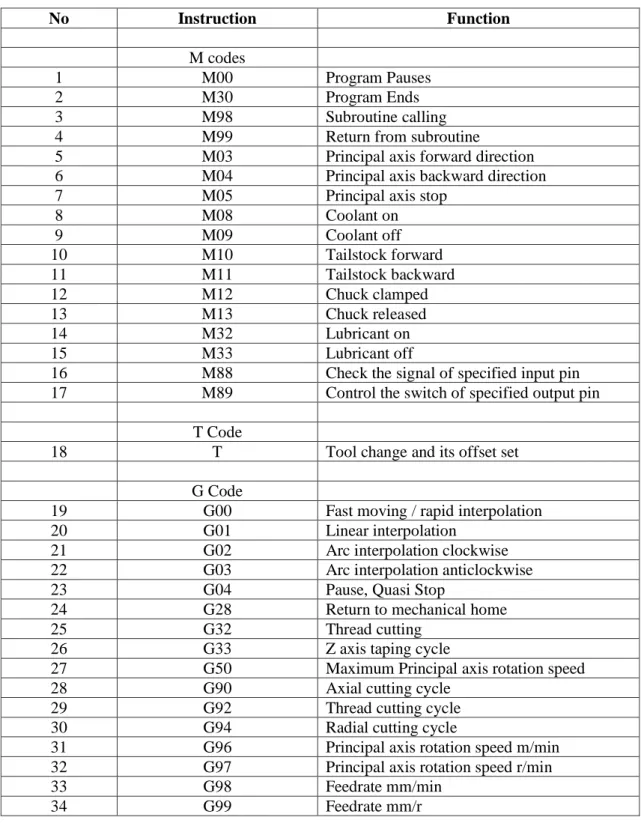
Table 1 G Codes Supported
No Instruction Function
M codes
1 M00 Program Pauses
2 M30 Program Ends
3 M98 Subroutine calling
4 M99 Return from subroutine
5 M03 Principal axis forward direction
6 M04 Principal axis backward direction
7 M05 Principal axis stop
8 M08 Coolant on 9 M09 Coolant off 10 M10 Tailstock forward 11 M11 Tailstock backward 12 M12 Chuck clamped 13 M13 Chuck released 14 M32 Lubricant on 15 M33 Lubricant off
16 M88 Check the signal of specified input pin 17 M89 Control the switch of specified output pin
T Code
18 T Tool change and its offset set
G Code
19 G00 Fast moving / rapid interpolation
20 G01 Linear interpolation
21 G02 Arc interpolation clockwise
22 G03 Arc interpolation anticlockwise
23 G04 Pause, Quasi Stop
24 G28 Return to mechanical home
25 G32 Thread cutting
26 G33 Z axis taping cycle
27 G50 Maximum Principal axis rotation speed
28 G90 Axial cutting cycle
29 G92 Thread cutting cycle
30 G94 Radial cutting cycle
31 G96 Principal axis rotation speed m/min
32 G97 Principal axis rotation speed r/min
33 G98 Feedrate mm/min
3.3. Instructions Formats 3.3.1. M00/30/03/04/05/08/09/10/11/12/13/32/33 126 125 124 123 122 121 120 119 118 ……... Opcode M - 00 117 0 127
M-Code No. Unused
Bits 3.3.2. M88 1 2 7 1 2 6 1 2 5 1 2 4 1 2 3 1 2 2 1 2 1 1 2 0 1 1 9 1 1 8 1 1 7 1 1 6 1 1 5 1 1 4 1 1 3 1 1 2 1 1 1 1 1 0 1 0 9 1 0 8 1 0 7 1 0 6 1 0 5 1 0 4 1 0 3 1 0 2 1 0 1 1 0 0 9 9 9 8 9 7 9 6 9 5 9 4 9 3 9 2 …….. Unused Bits 9 1 0 Op Code M 00 M-Code No. 88 Input Port Address Input Value To Wait For Q Op Code Millisecond Value For Waiting 3.3.3. M89 127 126 125 124 123 122 121 120 119 118 117 116 115 114 113 112 …….. Unused Bits Opcode M 00 M-Code No. 89 Output Port Address Out-put Value 111 0 3.3.4. M98 1 2 7 1 2 6 1 2 5 1 2 4 1 2 3 1 2 2 1 2 1 1 2 0 1 1 9 1 1 8 1 1 7 1 1 6 1 1 5 1 1 4 1 1 3 1 1 2 1 1 1 1 1 0 1 0 9 1 0 8 1 0 7 1 0 6 1 0 5 1 0 4 1 0 3 1 0 2 1 0 1 1 0 0 9 9 9 8 9 7 9 6 9 5 9 4 9 3 9 2 …….. Unused Bits 9 1 0 Op Code M 00 M-Code No. 98 Repeat Subroutine Value Subroutine Address 3.3.5. M99 1 2 7 1 2 6 1 2 5 1 2 4 1 2 3 1 2 2 1 2 1 1 2 0 1 1 9 1 1 8 1 1 7 1 1 6 1 1 5 1 1 4 1 1 3 1 1 2 1 1 1 1 1 0 1 0 9 1 0 8 1 0 7 1 0 6 1 0 5 1 0 4 1 0 3 1 0 2 1 0 1 1 0 0 9 9 9 8 …….. Unused Bits 9 7 0 Op Code M 00 M-Code No. 99 P Opcode 1010 Subroutine Address 3.3.6. T 126 125 124 123 122 121 120 119 118 ……... Opcode T - 00 117 0 127 Tool Number Unused Bits Tool Offset
3.3.7. G97/50 1 2 7 1 2 6 1 2 5 1 2 4 1 2 3 1 2 2 1 2 1 1 2 0 1 1 9 1 1 8 1 1 7 1 1 6 1 1 5 1 1 4 1 1 3 1 1 2 …….. Unused Bits Op code G 01 G-Code No. 97/50
G97 - Principal Axis Value In Rotation/min G50 - Principal Axis Max Allowed Value In Rotation/min
1 1 1 0 1 1 0 1 0 9 1 0 8 1 0 7 1 0 6 1 0 5 1 0 4 1 0 3 3.3.8. G98/99 1 2 7 1 2 6 1 2 5 1 2 4 1 2 3 1 2 2 1 2 1 1 2 0 1 1 9 1 1 8 1 1 7 1 1 6 1 1 5 1 1 4 1 1 3 1 1 2 …….. Unused Bits Op code G 01 G-Code No. 98/99 G99 - Feedrate in mm/min
G99 - Feedrate in mm/r => prin axis r/min x given mm/r = mm/min 1 1 1 0 1 1 0 1 0 9 1 0 8 1 0 7 1 0 6 1 0 5 1 0 4 1 0 3 3.3.9. G04 1 2 7 1 2 6 1 2 5 1 2 4 1 2 3 1 2 2 1 2 1 1 2 0 1 1 9 1 1 8 1 1 7 1 1 6 1 1 5 1 1 4 1 1 3 1 1 2 …….. Unused Bits Op code G 01 G-Code No. 04 Timer Value 1 1 1 0 1 1 0 1 0 9 1 0 8 1 0 7 1 0 6 1 0 5 1 0 4 1 0 3 1 0 2 1 0 1 3.3.10 G00/28 1 2 7 1 2 6 1 2 5 1 2 4 1 2 3 1 2 2 1 2 1 1 2 0 1 1 9 1 1 8 1 1 7 1 1 6 1 1 5 1 1 4 1 1 3 1 1 2 1 1 1 1 1 0 1 0 9 1 0 8 1 0 7 1 0 6 1 0 5 1 0 4 1 0 3 1 0 2 1 0 1 1 0 0 9 9 9 8 9 7 9 6 9 5 9 4 9 3 9 2 …... Unused Bits 8 5 0 Op Code G 01 G-Code No. 00/28 x/u Opcode Value z/w Op Code Value 9 1 9 0 8 9 8 8 8 7 8 6 3.3.11. G01 1 2 7 1 2 6 1 2 5 1 2 4 1 2 3 1 2 2 1 2 1 1 2 0 1 1 9 1 1 8 1 1 7 1 1 6 1 1 5 1 1 4 1 1 3 …... 1 0 2 1 0 1 1 0 0 9 9 9 8 9 7 …... Unused Bits 6 7 0 Op Code G 01 G-Code No. 01 x/u Opcode Value z/w Op Code f Value …... 8 6 Value 8 5 8 4 8 3 8 2 8 1 …... 6 8 F Op Code 3.3.12. G02/03/90/94 1 2 7 1 2 6 1 2 5 1 2 4 1 2 3 1 2 2 1 2 1 1 2 0 1 1 9 1 1 8 1 1 7 1 1 6 1 1 5 1 1 4 1 1 3 …... 1 0 2 1 0 1 1 0 0 9 9 9 8 9 7 Op Cod e G 01 G-Code No. 02/03/90/ 94 x/u Opcode Value z/w Op Code Value …... 86 Value 8 5 8 4 8 3 8 2 8 1 …... 7 0 R …... Unused Bits 5 1 0 f Value 6 9 6 8 6 7 6 6 6 5 …... 5 2 F Op Code
4. RESULTS
4.1. Synthesis Report - Device utilization summary:
Selected Device: 7a100tcsg324-1
Slice Logic Utilization:
Number of Slice Registers: 1489 out of 126800 1%
Number of Slice LUTs: 3111 out of 63400 4%
Number used as Logic: 3111 out of 63400 4%
IO Utilization:
Number of bonded IOBs: 38 out of 210 4% Specific Feature Utilization:
Number of Block RAM/FIFO: 2 out of 135 1% Number of BUFG/BUFGCTRLs: 1 out of 32 12% Number of DSP48A1s: 26 out of 240 37%
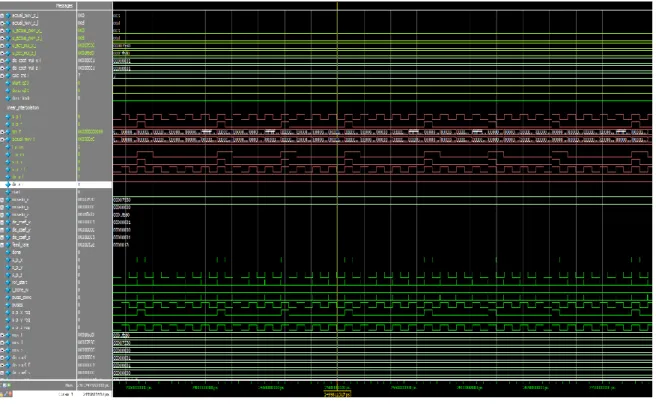
4.2. Simulation Results 4.2.1. M03
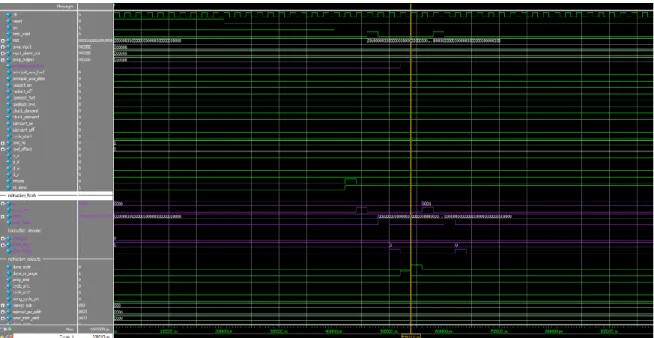
Test Case
M03 - Principal axis forward direction M00 - Pause
Figure 3 M03 Waveform
4.2.2. G01
Test Case
G98 500 Feedrate 500 mm/min
G01 X 3 Z 13 Linear interpolation to coordinates 3, 13 with above feedrate G01 X 5 Z 9 F 1000 Linear interpolation to coordinates 5, 9 with feedrate 1000
Figure 4 G01 Waveform
4.3. Hardware Setup
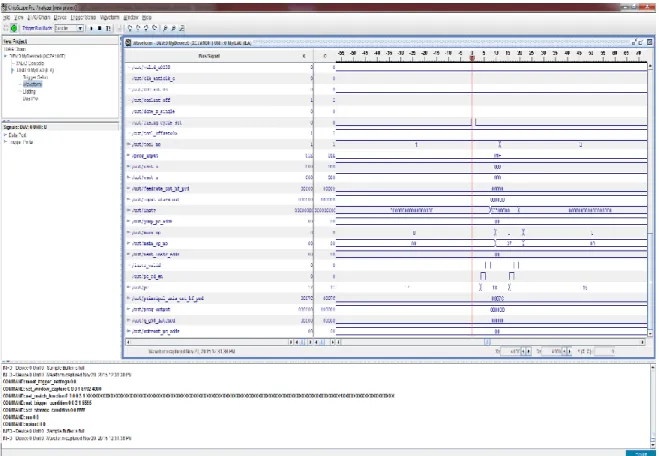
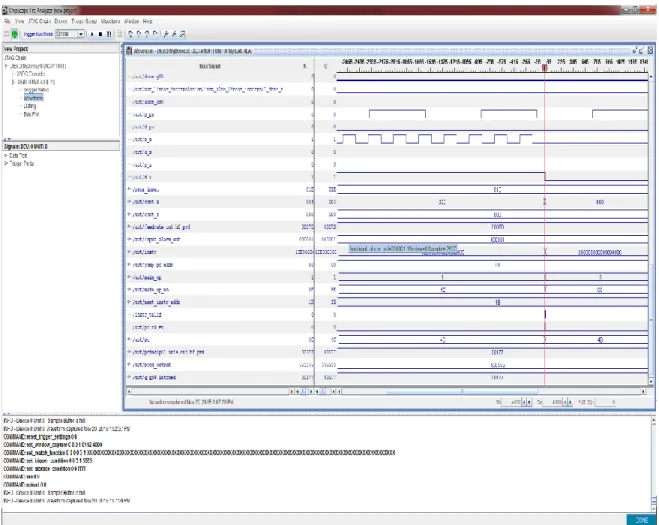
The Hardware setup shown in figure --- consists of Artix 7 FPGA based Digilent Nexus 4 kit, JTAG cable, UART cable, Power cable and a PC having Xilinx 14.4 ISE and Chipscope Analyzer installed. The various G codes are dumped into FPGA block RAM memory. The processor on getting enable signal from the enable switch on kit, starts fetching and executing M, T and G instructions. The in chip FPGA signals are viewed and verified for each instructions using Chipscope analyzer.
4.4. Hardware Results
4.4.1. T - Tool Change and its Offset Set
Figure 6 T - Tool change and its offset set
4.4.2. M88 - Check the Signal of Specified Input Pin
4.4.3. G94 - Radial Cutting Cycle
Figure G94 - Radial Cutting Cycle
5. CONCLUSION
A G Code based motion controller was implemented to control a multiple-axis motion system for a CNC Lathe machine for the first time in FPGA, with its heart being a 4 stage Multi Instruction Multi Data (MIMD) Complex Instruction Set computers (CISC) G code processor. The G Code Processor supports most of the G codes, M codes, T code, F code and S code required for performing Lathe machining operation. It was designed using Verilog and implemented on Xilinx Artix 7, 7a100tcsg324-1 FPGA. It consumed 3277, 6 input LUTs and 1580 Flip Flops and was able to achieve maximum frequency of 52.35 MHz. The feasibility to realize reconfigurable G code based CNC system within FPGA were validated.
Simulation results show the precision and performance to be excellent. Synthesis report also shows it to be hardware efficient by consuming fewer Flip Fops and LUTS. Excellent real time operation, good precision and optimum hardware resources makes the FPGA-based CNC Lathe controller have excellent performance and useful for any motion controller for CNC machines.
REFERENCES
[1] Weihai Chen, Zhaojin Wen, ZhiyueXu and Jingmeng Liu, Implementation of 3-axis Linear Interpolation in a FPGA-based 4-3-axis Motion Controller.
[2] Mufaddal A. Saifee and Dr. Usha S. Mehta, Design and Implementation of 3 Axis Linear Interpolation Controller in FPGA for CNC Machines and Robotics, International Journal of Advanced Research in Engineering and Technology, Volume 5, Issue 9, Sept 2014, pp. 52-62
[3] Mufaddal A. Saifee and Dr. Usha S. Mehta, Design and Implementation of 2-Axis Circular Interpolation Controller in Field Programmable Gate Array (FPGA) for Computer Numerical Control (CNC) Machines and Robotics, International Journal of Computer Applications 106(13):1-7, November 2014 [4] Himanshu Patel, Sanjay Trivedi, R. Neelkanthan, V. R. Gujraty, A Robust UART
Architecture Based on Recursive Running Sum Filter for Better Noise Performance, Conference Proceedings: 20th VLSI Design - 6th Embedded Systems, The Institute of Electrical and Electronics Engineers, Inc. January 2007, pp 819-823.
[5] K Goldberg, and M Goldberg, XY interpolation algorithms, ROBOTICS AGE, No 5, May 1983, pp.104-105
[6] Z. Zhang, C. W. Peng, and L. G. Yin, Motion Controller Introduction and Application of MCX314, Electronics World, No. 5, 2005, pp. 45-46
[7] J. L. Liu, W. Liu, and C. Y. Yu, Complete Numeric CNC System and Its Kernel Chip MCX314, Electronic Design & Application World,no.8, 2004, pp.104-106 [8] P. Q.Yue, and J. S. Wang, Motion Controller IC MCX314 and Numerical Control
System Design, Beijing: Beihang University Press .Nov.2002
[9] Fengge Li, Jiaxin You and Weiming Tong, A Design of Full-Digital CNC Interface Based on FPGA, 2009 International Conference on Information Technology and Computer Science
[10] G.Prasad and N.Vasantha. Design and Implementation of Multi Channel Frame Synchronization in FPGA. International Journal of Electronics and
Communication Engineering & Technology, 4(1), 2013, pp. 189-199.
[11] Prof. Abhinav v. Deshpande. System Designing and Modelling Using FPGA.
International Journal of Electronics and Communication Engineering & Technology, 5(11), 2014, pp. 47-52.
[12] Devanshi S. Desai and Dr. Nagendra P. Gajjar. Low Bitrate Modulator Using.
International Journal of Electronics and Communication Engineering & Technology, 5(4), 2014, pp. 89-94.
[13] Jung Uk Cho, Quy Ngoc Le, and Jae WookJeon, An FPGA-Based Multiple-Axis Motion Control Chip, IEEE Transactions on Industrial Electronics Vol. 56, No. 3, Mar. 2009