2017 2nd International Conference on Artificial Intelligence and Engineering Applications (AIEA 2017)
ISBN: 978-1-60595-485-1
SAR Image Target Detection Method Based on
Sparse Representation
JIE SONG, FUQING CAI, HENGYAN LIU and JING ZHANG
ABSTRACT
An image target detection algorithm based on sparse representation theory is proposed in this paper for the problem of SAR target detection platform, such as noise, geometric distortion and cover effect. This algorithm is constructing an over-complete dictionary by using SVD Dictionary Learning Method based on the idea of vector clustering. With the completeness of the dictionary, important information in the image can be captured by extracting a small amount of image features, which makes the complex background noise of SAR images generated in the high-speed motion state more robust. On the other hand, the algorithm has the ability of reconstruction, and can reconstruct the test sample by using the sparse coefficient selected by the characteristic function, and select the class with the least reconstruction error as the category of the test sample. The algorithm occlusion has good robustness in target occlusion, rotation and complex background. The detection accuracy and computing speed have improved compared to similar classic algorithms.
KEYWORDS
SAR; Radar; Detection; Sparse Representation.
INTRODUCTION
In recent years, many experts at home and abroad hammer to find a method to present the result of signal processing and image processing results as simple as possible. A new research field is opened up when Mallet proposed the idea of sparse representation in 1993. In recent years, the research of sparse representation is becoming more and more prevalent. Now many of the traditional signal representation theory based on non-redundant orthogonal linear transformation, such as discrete cosine transform, wavelet transform. While DCT cannot effectively extract the features of the signal with time-frequency local characteristics. The wavelet transform is not good for linear singularity and does not have directional sensitivity. The basic idea of the new signal sparse representation theory is to make the over-complete
_________________________________________
Corresponding author: Jie Song, [email protected], Hengyan Liu, Research Institute of Information fusion, Naval Aeronautical and Astronautical University, Yantai 264001, China.
dictionary as close as possible to the structure of the sparse approximation signal. The dictionary can be constructed arbitrarily to find the optimal combination of several columns to express the signal as a sparse approximation or highly nonlinear approximation [1-4].
SIGNAL SPARSE REPRESENTATION ANALYSIS
Firstly, the target over-complete dictionary is constructed, the input test image is divided into blocks, and then the coefficients of each image sub-block are calculated, and the difference of the representation coefficients of each sub-block is quantitatively compared to determine whether the image sub-block contains small target to complete the target detection task. The task can be divided into three: the structure of over-complete dictionary, the solution of sparse representation coefficient and the reconstruction of test sample to calculate the reconstruction error.
Construction Of Over-Complete Dictionary
The research methods of dictionary construction problems can be divided into two types: one is the theory of harmonic analysis which is represented by wavelet transform and the other is adaptive algorithm, a typical method of which is SVD dictionary learning. SVD dictionary learning algorithm is based on vector clustering quantification idea which apply the optimization method to the construction of over-complete dictionary, with the original image data remain to be decomposed to train the dictionary atoms, to obtain the ultra-complete dictionary which can effective reflect the image characteristics. Compared with the theory of harmonic analysis represented by wavelet transform, SVD dictionary learning algorithm has low computational complexity and short computation time.
In this project, the training samples are divided into two classes, one is the target, and the other is the combination of background and the noise which will be referred to as the background. Because of the few training samples of military targets in SAR images, the background sample images is generated by a normal random distribution matrix [4]. And a small target image is generated by the two-dimensional Gaussian model [5-8] which is superimposed with the background image to generate small target sample image. And then use the small target samples and background samples to construct the over-complete dictionary. The two-dimensional Gaussian model for small target modeling is as follows:
]} ) ( ) ( [ 2 1 exp{ ) , ( 2 2 0 2 2 0 max y x t y j x i I j i I
(1)
Among them, Imaxis the gray value of the center pixel of the target, and(x0,y0) is
the center point coordinate of the target area, xand yare the horizontal and vertical
spread parameters, respectively, which control the dispersion characteristics of the target pixel. By adjusting the above parameters, a small target image with different brightness, different position and different shape can be generated [4].
by a large number of training samples, and the classification of the test sample is determined. The element that constructs the over-complete dictionary can be either the direct image pixel or the transformed characteristic data. If the image pixels are directly used, they are usually sampled by Gaussian random projection because of the large number of image pixels. However, there are some differences between SAR image classification and other optical image classification due to the coherent speckle noise and other factors. On the one hand, non-target regions in SAR images contain a large amount of noise, on the other hand, the target which is affected by speckle noise has a large fluctuation on the radar incident waves. If the SAR image is directly classified, it will affect the recognition performance.
In this paper, the target region is segmented by image segmentation, the non-target region is set to zero value and the segmented target slice is cut out to chips. Then PCA feature is extracted from the chips. PCA is a linear transformation, the transformation of the principal components is mutually orthogonal. The target information in the original image can be represented by the former principal components. By selecting certain feature dimensions, the influence of noise in the image can be reduced to reduce the influence of the speckle noise on the performance of the algorithm. These eigenvectors obtained by PCA can be used as column vector combination to generate super complete dictionary.
Solution of Sparse Coefficient
When sparsity is used as the regularization condition, Equation 2 can be transformed to the solving of the following problem:
. . , || ||
min x 0 st
x yx (2)
Among them, ||x||0 means the 0 norm of x and the value is the number of
nonzero entries in the vector. To solve the problem of indefinite equation under the condition of minimizing the norm is a NP problem, the researcher develops a series of greedy algorithms to solve it.
Although the greedy algorithm can solve the above problem, but its numerical solution is not stable. The results of sparse representation and compression sensing theory show that when x is sufficiently sparse, the solution of sparse solution can be equivalent to the problem of minimizing the1 norm:
. . , || ||
min x 1 st
x yx (3)
The1 norm denotes the sum of the absolute values of the vector x non-zero
coefficients. The equation in Equation 3 can be relaxed by introducing a smaller amount of noise, so that an approximate solution of the sparse coefficient vector can be obtained by minimizing the norm by solving the convex optimization method:
. . , || ||
min x 1 st
x ||yx|| (4)
SOCP algorithm has less complexity. In this paper, the SOCP algorithm is used to solve the sparse vector.
Detector Design
Given the observation samples belonging to the target, n
i Y
y i=1, 2... n, we can get the sparse representation vector n
i X
x . In theory, only when corresponding to
the target, the coefficient of xi is non-zero, so thatyi can be easily identified. In
reality, however, the non-zero terms of xi do not only correspond to a single
category because of the noise and the error in solution process. In this case, the class information of yi determined based on the distribution of non-zero terms in
the sparse representation vectorxi. A classification strategy based on minimum
reconstruction error is designed in this paper, which makes full use of linear structure information of sparse representation vectors.
For each targetiyi, define its characteristic function:
n n i:R R
.Given a
sparse representation vector n
i R
x , the nonzero entry in n
i(x)R
corresponds only
to the target i, and the coefficients for the other classes are all zero. Reconstruction of the observed sample yiusing the target training sample, that is, yˆii(x). The
classification of yi can be obtained by finding the minimum reconstruction error.
2
|| ) ( ||
) (
minri y y i x
i (5)
Among them ri(y) is the reconstruction error of the target training sample for
the observed sampleyi.
SIMULATION RESULT
The size of detection window for sparse representation is 30 * 30, and the moving step of the detection window is set to 5 pixels.
Simulation Experiment of Sea Target
[image:5.612.192.402.50.286.2]
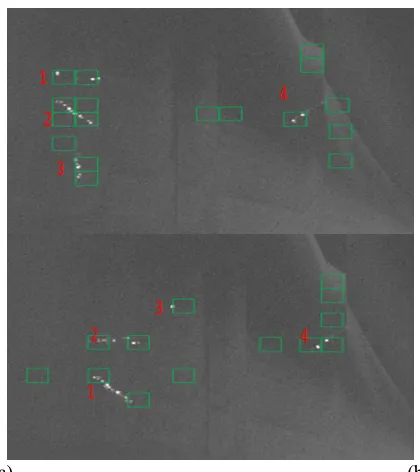
(a) (b) Figure 1. Sea target detection results based on sparse representation.
In Fig.1(a), Target 1 is the Washington aircraft carrier (180° attitude, HH polarization), Target 2 is the Burke Cruiser (45 °attitude, HH polarization), Target 3 is the Burke Cruiser (90°attitude, HH polarization), and Target 4 for the Burke cruiser (145°attitude, HH polarization).
In Fig.1(b), Target 1 is the Burke cruiser at (25° pitching, 45°attitude, VV polarization), Target 2 is the Burke Cruiser (20° pitching, 0°attitude, HH polarization), Target 3 is the Washington aircraft carrier (20 ° pitching, 90°attitude, HH polarization), and Target 4 is a Burke cruiser (25° pitching, 145°attitude, VV polarization).
CONCLUSION
It can be seen from Fig.1 (a), (b) that the target detection results based on the sparse representation have some false alarm. However, in the SAR image, the amplitude and intensity information of the pixel are more important in the target detection process, which is the main reason for the leak detection and the false-alarm. In the SAR image, the sparse representation method is used to detect the target. Police the main reason. On the other hand, the number of positive and negative samples is small, so that the training of the classifier is not complete, resulting in the low target detection accuracy. Meanwhile, the accuracy of the target detection is affected by the detection window size that is fixed and the step size that is too large.
ACKNOWLEDGMENTS
Corresponding author: Jie Song, [email protected], Research Institute of Information fusion, Naval Aeronautical and Astronautically University, Yantai 264001, China.
REFERENCES
1. Engan K., Aase S.O., Husoy J.H. Method of optimal dkeetions for frame design [C]. IEEE International Conference on Proeeedings of the Acoustics, Speeeh, and Signal Professing, 5(10): pp.2 443-2446 (1999).
2. Aharon M., Elad M., Bruckstein A.K-SVD: An algorithm for designing overcomplete dictionaries for sparse representation [J]. IEEE Transactions on Signal Processing, 54(11): pp. 4311-4322 (2006).
3. Yang M., Zhang G. SAR Image Despeckling Using Over-complete Dictionary [J]. Electronics Letters, 48(10): 596-597(2012).
4. Chen q Liu X, Zhou Z. Modified frost speckle filter based on anisotropic diffusion [C]. IET International Conference on Radar Systems, 4(6): pp. 1-4 (2007).
5. Lee S.J. Digital image enhancement and noise filtering by use of local statisties [J]. IEEE Transactions on Pattem Analysis and Machine Intelligence, 2(2): pp. 165-168 (1980).
6. Curlander J., McDonough R. Synthetic aperture radar: systems and signal processing [M], New York: John Wiley&Sons, 1991.
7. Carrara G., Goodman R.S. Majewski RM, Spotlight synthetic aperture radar [M]. Norwood MA: Artech House, 1995.