Shift-Reduce CCG Parsing with a Dependency Model
Wenduan Xu
University of Cambridge Computer Laboratory
Stephen Clark
University of Cambridge Computer Laboratory
Yue Zhang
Singapore University of Technology and Design
Abstract
This paper presents the first dependency model for a shift-reduceCCGparser. Mod-elling dependencies is desirable for a num-ber of reasons, including handling the “spurious” ambiguity ofCCG; fitting well with the theory of CCG; and optimizing for structures which are evaluated at test time. We develop a novel training tech-nique using a dependency oracle, in which all derivations are hidden. A challenge arises from the fact that the oracle needs to keep track of exponentially many gold-standard derivations, which is solved by integrating a packed parse forest with the beam-search decoder. Standard CCGBank tests show the model achieves up to1.05
labeled F-score improvements over three existing, competitiveCCGparsing models.
1 Introduction
Combinatory Categorial Grammar (CCG; Steed-man (2000)) is able to derive typed dependency structures (Hockenmaier, 2003; Clark and Curran, 2007), providing a useful approximation to the un-derlying predicate-argument relations of “who did what to whom”. To date, CCG remains the most competitive formalism for recovering “deep” de-pendencies arising from many linguistic phenom-ena such as raising, control, extraction and coordi-nation (Rimell et al., 2009; Nivre et al., 2010).
To achieve its expressiveness, CCG exhibits so-called “spurious” ambiguity, permitting many non-standard surface derivations which ease the recovery of certain dependencies, especially those arising from type-raising and composition. But this raises the question of what is the most suit-able model forCCG:should we model the deriva-tions, the dependencies, or both? The choice for some existing parsers (Hockenmaier, 2003; Clark
and Curran, 2007) is to model derivations directly, restricting the gold-standard to be the normal-form derivations (Eisner, 1996) from CCGBank (Hock-enmaier and Steedman, 2007).
Modelling dependencies, as a proxy for the se-mantic interpretation, fits well with the theory of CCG, in which Steedman (2000) argues that the derivation is merely a “trace” of the underlying syntactic process, and that the structure which is built, and predicated over when applying con-straints on grammaticality, is the semantic inter-pretation. The early dependency model of Clark et al. (2002), in which model features were defined overonlydependency structures, was partly moti-vated by these theoretical observations.
More generally, dependency models are desir-able for a number of reasons. First, modelling dependencies provides an elegant solution to the spurious ambiguity problem (Clark and Curran, 2007). Second, obtaining training data for de-pendencies is likely to be easier than for syn-tactic derivations, especially for incomplete data (Schneider et al., 2013). Clark and Curran (2006) show how the dependency model from Clark and Curran (2007) extends naturally to the partial-training case, and also how to obtain dependency data cheaply from gold-standard lexical category sequences alone. And third, it has been argued that dependencies are an ideal representation for parser evaluation, especially for CCG(Briscoe and Car-roll, 2006; Clark and Hockenmaier, 2002), and so optimizing for dependency recovery makes sense from an evaluation perspective.
In this paper, we fill a gap in the literature by developing the first dependency model for a shift-reduce CCG parser. Shift-reduce parsing applies naturally toCCG(Zhang and Clark, 2011), and the left-to-right, incremental nature of the decoding fits withCCG’s cognitive claims. The discrimina-tive model is global and trained with the structured perceptron. The decoder is based on beam-search
(Zhang and Clark, 2008) with the advantage of linear-time decoding (Goldberg et al., 2013).
A main contribution of the paper is a novel tech-nique for training the parser using a dependency oracle, in which all derivations are hidden. A challenge arises from the potentially exponential number of derivations leading to a gold-standard dependency structure, which the oracle needs to keep track of. Our solution is an integration of a packed parseforest, which efficiently stores all the derivations, with the beam-search decoder at training time. The derivations are not explicitly part of the data, since the forest is built from the gold-standard dependencies. We also show how perceptron learning with beam-search (Collins and Roark, 2004) can be extended to handle the ad-ditional ambiguity, by adapting the “violation-fixing” perceptron of Huang et al. (2012).
Results on the standard CCGBank tests show that our parser achieves absolute labeled F-score gains of up to0.5over the shift-reduce parser of Zhang and Clark (2011); and up to1.05and0.64
over the normal-form and hybrid models of Clark and Curran (2007), respectively.
2 Shift-Reduce with Beam-Search
This section describes how shift-reduce tech-niques can be applied to CCG, following Zhang and Clark (2011). First we describe the determin-istic process which a parser would follow when tracing out a single, correct derivation; then we describe how a model of normal-form derivations — or, more accurately, a sequence of shift-reduce actions leading to a normal-form derivation — can be used with beam-search to develop a non-deterministic parser which selects the highest scor-ing sequence of actions. Note this section only de-scribes a normal-form derivation model for shift-reduce parsing. Section 3 explains how we extend the approach to dependency models.
The shift-reduce algorithm adapted to CCG is similar to that of shift-reduce dependency parsing (Yamada and Matsumoto, 2003; Nivre and Mc-Donald, 2008; Zhang and Clark, 2008; Huang and Sagae, 2010). Following Zhang and Clark (2011), we define each item in the parser as a pairhs, qi, whereqis a queue of remaining input, consisting of words and a set of possible lexical categories for each word (withq0being the front word), andsis
the stack that holds subtreess0, s1, ...(withs0 at the top). Subtrees on the stack are partial
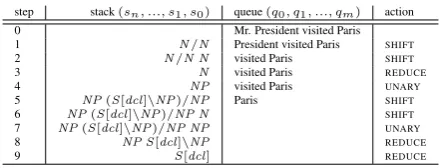
deriva-0 Mr. President visited Paris 1 N/N President visited Paris SHIFT
2 N/N N visited Paris SHIFT
3 N visited Paris REDUCE
4 NP visited Paris UNARY
5 NP(S[dcl]\NP)/NP Paris SHIFT
6 NP(S[dcl]\NP)/NP N SHIFT
7 NP(S[dcl]\NP)/NP NP UNARY
8 NP S[dcl]\NP REDUCE
[image:2.595.306.526.60.144.2]9 S[dcl] REDUCE
Figure 1: Deterministic example of shift-reduce CCGparsing (lexical categories omitted on queue).
tions that have been built as part of the shift-reduce process.SHIFT,REDUCEandUNARYare the three types of actions that can be applied to an item. A SHIFT action shifts one of the lexical categories ofq0 onto the stack. AREDUCE action combines s0 ands1 according to a CCG combinatory rule,
producing a new category on the top of the stack. A UNARY action applies either a type-raising or type-changing rule to the stack-top categorys0.1
Figure 1 shows a deterministic example for the sentenceMr. President visited Paris, giving a sin-gle sequence of shift-reduce actions which pro-duces a correct derivation (i.e. one producing the correct set of dependencies). Starting with the ini-tial itemhs, qi0(row 0), which has an empty stack
and a full queue, a total of nine actions are applied to produce the complete derivation.
Applying beam-search to a statistical shift-reduce parser is a straightforward extension to the deterministic example. At each step, a beam is used to store the top-khighest-scoring items, re-sulting from expanding all items in the previous beam. An item becomes a candidate output once it has an empty queue, and the parser keeps track of the highest scored candidate output and returns the best one as the final output. Compared with greedy local-search (Nivre and Scholz, 2004), the use of a beam allows the parser to explore a larger search space and delay difficult ambiguity-resolving de-cisions by considering multiple items in parallel.
We refer to the shift-reduce model of Zhang and Clark (2011) as the normal-form model, where the oracle for each sentence specifies a unique se-quence of gold-standard actions which produces the corresponding normal-form derivation. No de-pendency structures are involved at training and test time, except for evaluation. In the next sec-tion, we describe a dependency oracle which con-siders all sequences of actions producing a gold-standard dependency structure to be correct.
Mr. President visited Paris
N/N N (S[dcl]\NP)/NP NP
> >
N S[dcl]\NP
>TC NP
<
S[dcl]
(a)
Mr. President visited Paris
N/N N (S[dcl]\NP)/NP NP
>
N
>TC NP
>T S[dcl]/(S[dcl]\NP)
>B S[dcl]/NP
>
S[dcl]
[image:3.595.89.488.61.168.2](b)
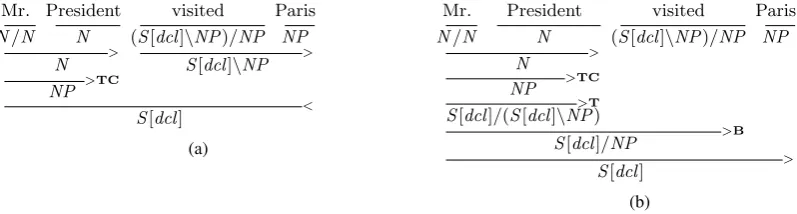
Figure 2: Two derivations leading to the same dependency structure.TCdenotes type-changing.
3 The Dependency Model
Categories in CCG are either basic (such as NP andPP) or complex (such as(S[dcl]\NP)/NP). Each complex category in the lexicon defines one or more predicate-argument relations, which can be realized as a predicate-argument dependency when the corresponding argument slot is con-sumed. For example, the transitive verb category above defines two relations: one for the subject NP and one for the object NP. In this paper a CCGpredicate-argument dependency is a 4-tuple: hhf, f, s, hai wherehf is the lexical item of the
lexical category expressing the relation; f is the lexical category;sis the argument slot; andhais
the head word of the argument. Since the lexical items in a dependency are indexed by their sen-tence positions, all dependencies for a sensen-tence form a set, which is referred to as a CCG depen-dency structure. Clark and Curran (2007) contains a detailed description of dependency structures.
Fig. 2 shows an example demonstrating spu-rious ambiguity in relation to a CCG depen-dency structure. In both derivations, the first two lexical categories are combined using for-ward application (>) and the following depen-dency is realized: hMr.,N/N1,1,Presidenti. In the normal-form derivation (a), the dependency
hvisited,(S\NP1)/NP2,2,Parisi is created by
com-bining the transitive verb category with the ob-jectNP using forward application. One final de-pendency, hvisited,(S\NP1)/NP2,1,Presidenti, is
re-alized when the root node S[dcl] is produced through backward application (<).
Fig. 2(b) shows a non-normal-form derivation which uses type-raising (T) and composition (B) (which are not required to derive the correct de-pendency structure). In this alternative derivation, the dependency hvisited,(S\NP1)/NP2,1,Presidenti
is realized using forward composition (B), and
hvisited,(S\NP1)/NP2,2,Parisi is realized when the
S[dcl]root is produced.
The chart-based dependency model of Clark and Curran (2007) treats all derivations as hid-den, and defines a probabilistic model for a de-pendency structure by summing probabilities of all derivations leading to a particular structure. Features are defined over both derivations and CCG predicate-argument dependencies. We fol-low a similar approach, but rather than define a probabilistic model (which requires summing), we define a linear model over sequences of shift-reduce actions, as for the normal-form shift-shift-reduce model. However, the difference compared to the normal-form model is that we do not assume a sin-gle gold-standard sequence of actions.
Similar to Goldberg and Nivre (2012), we de-fine an oracle which determines, for a gold-standard dependency structure,G, what the valid transition sequences are (i.e. those sequences cor-responding to derivations leading to G). More specifically, the oracle can determine, givenGand an itemhs, qi, what the valid actions are for that item (i.e. what actions can potentially lead toG, starting withhs, qi and the dependencies already built on s). However, there can be exponentially many valid action sequences forG, which we rep-resent efficiently using a packed parse forest. We show how the forest can be used, during beam-search decoding, to determine the valid actions for a parse item (Section 3.2). We also show, in Section 3.3, how perceptron training with early-update (Collins and Roark, 2004) can be used in this setting.
3.1 The Oracle Forest
Algorithm 1(Clark and Curran, 2007)
Input: A packed foresthC, D, R, γ, δi, with dmax(c)
anddmax(d)already computed 1: functionMAIN
2: for each dr∈R s.t.dmax. (dr) =|G|do
3: MARK(dr)
4: procedureMARK(d)
5: markdas a correct node 6: for eachc∈γ(d) do
7: if dmax(c) ==dmax(d)then 8: markcas a correct node 9: for eachd0∈δ(c)do 10: ifd0has not been visitedthen 11: MARK(d0)
nodes andDis a set of disjunctive nodes.2
Con-junctive nodes are individualCCGcategories inΦ, and are either obtained from the lexicon, or by combining two disjunctive nodes using aCCGrule, or by applying a unary rule to a disjunctive node. Disjunctive nodes are equivalence classes of con-junctive nodes. Two concon-junctive nodes are equiv-alent iff they have the same category, head and un-filled dependencies (i.e. they will lead to the same derivation, and produce the same dependencies, in any future parsing). R ⊆ Dis a set of root dis-junctive nodes. γ : D → 2C is the conjunctive
child function andδ : C → 2D is the disjunctive
child function. The former returns the set of all conjunctive nodes of a disjunctive node, and the latter returns the disjunctive child nodes of a con-junctive node.
The dependency model requires all the conjunc-tive and disjuncconjunc-tive nodes ofΦthat are part of the derivations leading to a gold-standard dependency structure G. We refer to such derivations as cor-rect derivations and the packed forest containing all these derivations as theoracle forest, denoted asΦG, which is a subset ofΦ. It is prohibitive to
enumerate all correct derivations, but it is possible to identify, from Φ, all the conjunctive and dis-junctive nodes that are part ofΦG. Clark and
Cur-ran (2007) gives an algorithm for doing so, which we use here. The main intuition behind the algo-rithm is that a gold-standard dependency structure decomposes over derivations; thus gold-standard dependencies realized at conjunctive nodes can be counted whenΦis built, and all nodes that are part ofΦG can then be marked out ofΦby traversing
it top-down. A key idea in understanding the
algo-2Under the hypergraph framework (Gallo et al., 1993; Huang and Chiang, 2005), a conjunctive node corresponds to a hyperedge and a disjunctive node corresponds to the head of a hyperedge or hyperedge bundle.
rithm is that dependencies are created when dis-junctive nodes are combined, and hence are asso-ciated with, or “live on”, conjunctive nodes in the forest.
Following Clark and Curran (2007), we also define the following three values, where the first decomposes only over local rule productions, while the other two decompose over derivations:
cdeps(c) = (
∗ if∃τ ∈deps(c), τ /∈G
|deps(c)| otherwise
dmax(c) =
∗ if cdeps(c) ==∗
∗ if dmax(d) ==∗for somed∈δ(c) P
d∈δ(c)dmax(d) +cdeps(c) otherwise
dmax(d) = max{dmax(c)|c∈γ(d)}
deps(c) is the set of all dependencies on con-junctive node c, andcdeps(c) counts the number ofcorrectdependencies onc.dmax(c)is the max-imum number of correct dependencies over any sub-derivation headed by c and is calculated re-cursively; dmax(d) returns the same value for a disjunctive node. In all cases, a special value ∗ indicates the presence of incorrect dependencies. To obtain the oracle forest, we first pre-compute dmax(c)anddmax(d)for alldandcinΦwhenΦ
is built usingCKY, which are then used by Algo-rithm 1 to identify all the conjunctive and disjunc-tive nodes inΦG.
3.2 The Dependency Oracle Algorithm
We observe that the canonical shift-reduce algo-rithm (as demonstrated in Fig. 1) applied to a sin-gle parse tree exactly resembles bottom-up post-order traversal of that tree. As an example, con-sider the derivation in Fig. 2a, where the corre-sponding sequence of actions is:shN/N,shN,
re N, un NP, sh (S[dcl]\NP)/NP, sh NP,
reS[dcl]\NP,reS[dcl].3 The order of traversal
is left-child, right-child and parent. For a single parse, the corresponding shift-reduce action se-quence is unique, and for a given item this canoni-cal order restricts the possible derivations that can be formed using further actions. We now extend this observation to the more general case of an oracle forest, where there may be more than one gold-standard action for a given item.
Definition 1. Given a gold-standard dependency
3The derivation is “upside down”, following the conven-tion used forCCG, where the root isS[dcl]. We usesh,re
Mr. President visited Paris
N/N N (S[dcl]\NP)/NP NP
> >
N S[dcl]\NP (a)
Mr. President visited Paris
N/N N (S[dcl]\NP)/NP NP
> S[dcl]\NP
[image:5.595.89.466.60.115.2](b)
Figure 3: Example subtrees on two stacks, with two subtrees in (a) and three in (b); roots of subtrees are in bold.
structure G, an oracle forest ΦG, and an item
hs, qi, we say s is a realization of G, denoted
s'G, if|s|= 1,qis empty and the single deriva-tion onsis correct. If|s|>0and the subtrees on
scan lead to a correct derivation inΦGusing
fur-ther actions, we saysis apartial-realization of
G, denoted ass ∼ G. And we define s∼ Gfor |s|= 0.
As an example, assume that ΦG contains only
the derivation in Fig. 2a; then a stack containing the two subtrees in Fig. 3a is a partial-realization, while a stack containing the three subtrees in Fig. 3b is not. Note that each of the three sub-trees in Fig. 3b is present in ΦG; however, these
subtrees cannot be combined into the single cor-rect derivation, since the corcor-rect sequence of shift-reduce actions must first combine the lexical cat-egories forMr. andPresident before shifting the lexical category forvisited.
We denote an action as a pair (x, c), where
x ∈ {SHIFT,REDUCE,UNARY} andcis the root of the subtree resulting from that action. For all three types of actions, c also corresponds to a unique conjunctive node in thecompleteforestΦ; and we usecsi to denote the conjunctive node in
Φ corresponding to subtree si on the stack. Let
hs0, q0i=hs, qi ◦(x, c)be the resulting item from
applying the action (x, c) to hs, qi; and let the set of all possible actions for hs, qi be Xhs,qi =
{(x, c)|(x, c)is applicable tohs, qi}.
Definition 2. GivenΦGand an itemhs, qis.t.s∼
G, we say an applicable action(x, c)for the item is valid iffs0 ∼ G ors0 ' G, where hs0, q0i =
hs, qi ◦(x, c).
Definition 3. Given ΦG, the dependency oracle
functionfdis defined as:
fd(hs, qi,(x, c),ΦG) =
true ifs0∼Gors0'G
false otherwise
where(x, c)∈ Xhs,qiandhs0, q0i=hs, qi ◦(x, c).
The pseudocode in Algorithm 2 implementsfd.
It determines, for a given item, whether an appli-cable action is valid inΦG.
It is trivial to determine the validity of aSHIFT action for the initial item,hs, qi0, since theSHIFT
action is valid iff its category matches the gold-standard lexical category of the first word in the sentence. For any subsequent SHIFT action (SHIFT, c) to be valid, thenecessarycondition is c ≡ clex0, whereclex0 denotes the gold-standard
lexical category of the front word in the queue,q0
(line 3). However, this condition is not sufficient; a counterexample is the case where all the gold-standard lexical categories for the sentence in Fig-ure 2 are shifted in succession. Hence, in general, the conditions under which an action is valid are more complex than the trivial case above.
First, suppose there is only one correct deriva-tion inΦG. ASHIFTaction(SHIFT, clex0)is valid
whenever cs0 (the conjunctive node in ΦG
cor-responding to the subtree s0 on the stack) and
clex0 (the conjunctive node inΦG corresponding
to the next gold-standard lexical category from the queue) are both dominated by the conjunctive node parentp ofcs0 in ΦG.4 A REDUCE action (REDUCE, c)is valid ifcmatches the category of the conjunctive node parent ofcs0 andcs1 inΦG.
AUNARYaction(UNARY, c)is valid ifcmatches the conjunctive node parent ofcs0 inΦG. We now
generalize the case where ΦG contains a single
correct parse to the case of an oracle forest, where each parentp is replaced by a set of conjunctive nodes inΦG.
Definition 4. The left parent set pL(c) of
con-junctive nodec ∈ ΦGis the set of all parent
con-junctive nodes ofcinΦG, which have the
disjunc-tive nodedcontainingc (i.e. c ∈ γ(d)) as a left child.
Definition 5. The ancestor setA(c)of conjunc-tive nodec∈ΦGis the set of all reachable
ances-tor conjunctive nodes ofcinΦG.
Definition 6. Given an itemhs, qi, if|s| = 1we saysis afrontier stack.
Algorithm 2The Dependency Oracle Functionfd
Input:ΦG, an itemhs, qis.t.s∼G,(x, c)∈ Xhs,qi Lets0be the stack ofhs0, q0i=hs, qi ◦(x, c) 1: functionMAIN(hs, qi,(x, c),ΦG)
2: ifxisSHIFTthen
3: ifc6≡clex0then .c not gold lexical category 4: return false
5: else ifc≡clex0and|s|= 0then .the initial item 6: return true
7: else ifc≡clex0and|s| 6= 0then 8: computeR(cs0
1,cs00) 9: returnR(cs0
1,cs00)6=∅
10: ifxisREDUCEthen . sis non-frontier 11: ifc∈ R(cs1,cs0)then
12: computeR(cs0
1,cs00) 13: return true
14: else return false 15: ifxisUNARYthen
16: if|s|= 1then . sis frontier 17: returnc∈ΦG
18: if|s| 6= 1andc∈ΦGthen . sis non-frontier
19: computeR(cs0
1,cs00) 20: returnR(cs0
1,cs00)6=∅
A key to defining the dependency oracle func-tion is the nofunc-tion of a shared ancestor set. In-tuitively, shared ancestor sets are built up through shift actions, and contain sets of nodes which can potentially become the results of reduce or unary actions. A further intuition is that shared ances-tor sets define the space of possible correct deriva-tions, and nodes in these sets are “ticked off” when reduce and unary actions are applied, as a single correct derivation is built through the shift-reduce process (corresponding to a bottom-up post-order traversal of the derivation). The following defi-nition shows how the dependency oracle function builds shared ancestor sets for each action type.
Definition 7. Let hs, qi be an item and let hs0, q0i=hs, qi ◦(x, c). We define theshared
an-cestor setR(cs0
1,cs00)ofcs00, after applying action (x, c), as:
• {c0 | c0 ∈ p
L(cs0)∩ A(c)}, ifsis frontier andx =
SHIFT
• {c0 | c0 ∈ p
L(cs0)∩ A(c) and there is some c00 ∈
R(cs1,cs0)s.t.c00 ∈ A(c0)}, ifsis non-frontier and
x=SHIFT
• {c0|c0∈ R(c
s2,cs1)∩ A(c)}, ifx=REDUCE
• {c0|c0∈ R(c
s1,cs0)∩ A(c)}, if s is non-frontier andx=UNARY
• R(,c0
s0) =∅wherec0s0 is the conjunctive node cor-responding to the gold-standard lexical category of the
first word in the sentence (is a dummy symbol indi-cating the bottom of stack).
The base case for Definition 7 is when the gold-standard lexical category of the first word in the sentence has been shifted, which creates an empty shared ancestor set. Furthermore, the shared an-cestor set is always empty when the stack is a fron-tier stack.
The dependency oracle algorithm checks the va-lidity of applicable actions. A SHIFT action is valid if R(cs0
1,cs00) 6= ∅ for the resulting stack s0. A valid REDUCE action consumes s1 and
s0. For the new node, its shared ancestor set is the subset of the conjunctive nodes inR(cs2,cs1)
which dominate the resulting conjunctive node of a valid REDUCE action. The UNARY case for a frontier stack is trivial: any UNARY action ap-plicable to s in ΦG is valid. For a non-frontier
stack, the UNARY case is similar to REDUCE ex-cept the resulting shared ancestor set is a subset of R(cs1,cs0).
We now turn to the problem of finding the shared ancestor sets. In practice, we do not do this by traversingΦG top-down from the conjunctive
nodes inpL(cs0)on-the-fly to find each member of
R. Instead, when we buildΦGin bottom-up
topo-logical order, we pre-compute the set of reachable disjunctive nodes of each conjunctive node c in
ΦGas:
D(c) =δ(c)∪(∪c0∈γ(d),d∈δ(c)(D(c0)))
Each Dis implemented as a hash map, which allows us to test the membership of one potential conjunctive node in O(1) time. For example, a conjunctive nodec ∈ pL(cs0) is reachable from clex0 if there is a disjunctive node d ∈ D(c) s.t. clex0 ∈γ(d). With this implementation, the
com-plexity of checking each validSHIFTaction is then O(|pL(cs0)|).
3.3 Training
Algorithm 3Dependency Model Training Input:(y, G)and beam sizek
1: w←0;B0← ∅;i←0
2: B0.push(hs, qi0) .the initial item
3: cand← ∅ .candidate output priority queue 4: gold← ∅ .gold output priority queue 5: whileBi6=∅do
6: for eachhs, qi ∈ Bido
7: if|q|= 0then .candidate output 8: cand.push(hs, qi)
9: ifs'Gthen . sis a realization ofG
10: gold.push(hs, qi)
11: expandhs, qiintoBi+1
12: Bi+1← Bi+1[1 :k] .apply beam
13: ifΠG6=∅,ΠG∩ Bi+1=∅ and cand[0]6'Gthen
14: w←w+φ(ΠG[0])−φ(Bi+1[0]) .early update
15: return
16: i←i+ 1 .continue to next step 17: if cand[0]6'Gthen .final update 18: w←w+φ(gold[0])−φ(cand[0])
one of these gold items falls outside the beam. However, this may not be a true violation of the gold-standard (Huang et al., 2012). Thus, we use a relaxed version of early update, in whichall gold-standard actions must fall outside the beam before an update is performed. This update mechanism is provably correct under the violation-fixing frame-work of Huang et al. (2012).
Let(y, G)be a training sentence paired with its gold-standard dependency structure and letΠhs,qi
be the following set for an itemhs, qi:
{hs, qi ◦(x, c)|fd(hs, qi,(x, c),ΦG) =true}
Πhs,qicontains all correctitems at stepi+ 1
ob-tained by expandinghs, qi. Let the set ofall cor-rect items at a stepi+ 1be:5
ΠG=
[
hs,qi∈Bi
Πhs,qi
Algorithm 3 shows the pseudocode for training the dependency model with early update for one input(y, G). The score of an itemhs, qiis calcu-lated as w·φ(hs, qi) with respect to the current modelw, whereφ(hs, qi)is the feature vector for the item. At step i, all items are expanded and added onto the next beamBi+1, and the top-k
re-tained. Early update is applied when all gold items first fall outside the beam, and any candidate out-put is incorrect (line 14). Since there are poten-tially many gold items, and one gold item is re-quired for the perceptron update, a decision needs
5In Algorithm 3 we abuse notation by usingΠ
G[0]to
de-note the highest scoring gold item in the set.
to be made regarding which gold item to update against. We choose to reward the highest scoring gold item, in line with the violation-fixing frame-work; and penalize the highest scoring incorrect item, using the standard perceptron update. A fi-nal update is performed if no more expansions are possible but the final output is incorrect.
4 Experiments
We implement our shift-reduce parser on top of the coreC&Ccode base (Clark and Curran, 2007) and evaluate it against the shift-reduce parser of Zhang and Clark (2011) (henceforthZ&C) and the chart-based normal-form and hybrid models of Clark and Curran (2007). For all experiments, we use CCGBank with the standard split: sections 2-21 for training (39,604 sentences), section 00 for de-velopment (1,913 sentences) and section 23 (2,407 sentences) for testing.
The way that theCCGgrammar is implemented in C&C has some implications for our parser. First, unlikeZ&C, which uses a context-free cover (Fowler and Penn, 2010) and hence is able to use all sentences in the training data, we are only able to use 36,036 sentences. The reason is that the grammar in C&C does not have complete cover-age of CCGBank, due to the fact that e.g. not all rules in CCGBank conform to the combinatory rules ofCCG. Second, our parser uses the unifica-tion mechanism fromC&Cto output dependencies directly, and hence does not need a separate post-processing step to convert derivations intoCCG de-pendencies, as required byZ&C.
this parser 86.29 84.09 85.18 34.40 92.75 100
Z&C 87.15 82.95 85.00 33.82 92.77 100 C&C(normal-form) 85.22 82.52 83.85 31.63 92.40 100
this parser 86.76 84.90 85.82 34.72 93.20 99.06 (C&Ccoverage)
Z&C 87.55 83.63 85.54 34.14 93.11 99.06 (C&Ccoverage)
C&C(hybrid) – – 85.25 – – 99.06 (C&Ccoverage)
[image:8.595.111.483.62.148.2]C&C(normal-form) 85.22 84.29 84.76 31.93 92.83 99.06 (C&Ccoverage) Table 1: Accuracy comparison on Section 00 (autoPOS).
60 65 70 75 80 85 90
0 5 10 15 20 25 30
Precision %
Dependency length (bins of 5) C&C
Z&C this parser
(a) precision vs. dependency length
50 55 60 65 70 75 80 85 90
0 5 10 15 20 25 30
Recall %
Dependency length (bins of 5) C&C
Z&C this parser
(b) recall vs. dependency length
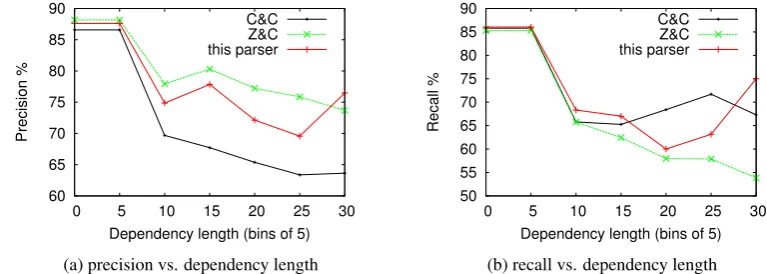
Figure 4: Labeled precision and recall relative to dependency length on the development set. C&C normal-form model is used.
are realized. Detailed descriptions of all the tem-plates in our model can be found in the respective papers. We run 20 training iterations and the re-sulting model contains 16.5M features with a non-zero weight.
We use 10-fold cross validation forPOStagging and supertagging the training data, and automat-ically assigned POS tags for all experiments. A probability cut-off value of 0.0001 for theβ pa-rameter in the supertagger is used for both train-ing and testtrain-ing. Theβ parameter determines how many lexical categories are assigned to each word;
β = 0.0001is a relatively small value which al-lows in a large number of categories, compared to the default value used in Clark and Curran (2007). For training only, if the gold-standard lexical cat-egory is not supplied by the supertagger for a par-ticular word, it is added to the list of categories.
4.1 Results and Analysis
The beam size was tuned on the development set, and a value of 128 was found to achieve a rea-sonable balance of accuracy and speed; hence this value was used for all experiments. SinceC&C al-ways enforces non-fragmentary output (i.e. it can only produce spanning analyses), it fails on some sentences in the development and test sets, and thus we also evaluate on the reduced sets,
follow-ing Clark and Curran (2007). Our parser does not fail on any sentences because it permits fragmen-tary output (those cases where there is more than one subtree left on the final stack). The results for Z&C, and the C&C normal-form and hybrid mod-els, are taken from Zhang and Clark (2011).
Table 1 shows the accuracies of all parsers on the development set, in terms of labeled precision and recall over the predicate-argument dependen-cies in CCGBank. On both the full and reduced sets, our parser achieves the highest F-score. In comparison with C&C, our parser shows signif-icant increases across all metrics, with 0.57%
and 1.06% absolute F-score improvements over the hybrid and normal-form models, respectively. Another major improvement over the other two parsers is in sentence level accuracy, LSent, which measures the number of sentences for which the dependency structure is completely correct.
[image:8.595.89.473.188.325.2]category LP % (o) LP % (z) LP % (c) LR % (o) LR % (z) LR % (c) LF % (o) LF % (z) LF % (c) freq. N/N 95.53 95.77 95.28 95.83 95.79 95.62 95.68 95.78 95.45 7288 NP/N 96.53 96.70 96.57 97.12 96.59 96.03 96.83 96.65 96.30 4101 (NP\NP)/NP 81.64 83.19 82.17 90.63 89.24 88.90 85.90 86.11 85.40 2379 (NP\NP)/NP 81.70 82.53 81.58 88.91 87.99 85.74 85.15 85.17 83.61 2174 ((S\NP)\(S\NP))/NP 77.64 77.60 71.94 72.97 71.58 73.32 75.24 74.47 72.63 1147 ((S\NP)\(S\NP))/NP 75.78 76.30 70.92 71.27 70.60 71.93 73.45 73.34 71.42 1058 ((S[dcl]\NP)/NP 83.94 85.60 81.57 86.04 84.30 86.37 84.98 84.95 83.90 917 PP/NP 77.06 73.76 75.06 73.63 72.83 70.09 75.31 73.29 72.49 876 ((S[dcl]\NP)/NP 82.03 85.32 81.62 83.26 82.00 85.55 82.64 83.63 83.54 872 ((S\NP)\(S\NP)) 86.42 84.44 86.85 86.19 86.60 86.73 86.31 85.51 86.79 746
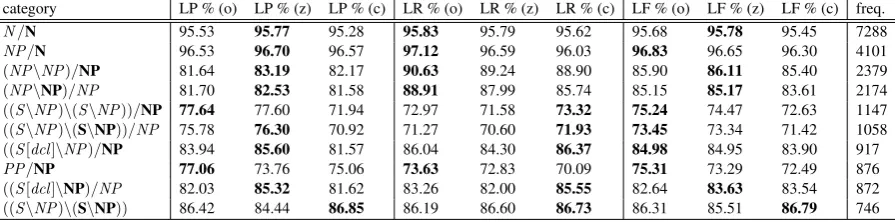
Table 2: Accuracy comparison on most frequent dependency types, for our parser (o),Z&C(z) andC&C hybrid model (c). Categories in bold indicate the argument slot in the relation.
LP % LR % LF % LSent. % CatAcc. % coverage % our parser 87.03 85.08 86.04 35.69 93.10 100
Z&C 87.43 83.61 85.48 35.19 93.12 100
C&C(normal-form) 85.58 82.85 84.20 32.90 92.84 100
our parser 87.04 85.16 86.09 35.84 93.13 99.58 (C&Ccoverage) Z&C 87.43 83.71 85.53 35.34 93.15 99.58 (C&Ccoverage) C&C(hybrid) 86.17 84.74 85.45 32.92 92.98 99.58 (C&Ccoverage) C&C(normal-form) 85.48 84.60 85.04 33.08 92.86 99.58 (C&Ccoverage)
Table 3: Accuracy comparison on section 23 (autoPOS).
terms of recall (Fig. 4b), our parser outperforms Z&C over all dependency lengths, especially for longer dependencies (x ≥ 20). When compared with C&C, the recall of the Z&C parser drops quickly for dependency lengths over 10. While our parser also suffers from this problem, it is less severe and is able to achieve higher recall at
x≥30.
Table 2 compares our parser with Z&C and the C&C hybrid model, for the most frequent depen-dency relations. While our parser achieved lower precision thanZ&C, it is more balanced and gives higher recall for all of the dependency relations ex-cept the last one, and higher F-score for over half of them.
Table 3 presents the final test results on Section 23. Again, our parser achieves the highest scores across all metrics (for both the full and reduced test sets), except for precision and lexical category assignment, whereZ&Cperformed better.
5 Conclusion
We have presented a dependency model for a shift-reduceCCGparser, which fully alignsCCGparsing with the left-to-right, incremental nature of a shift-reduce parser. Our work is in part inspired by the dependency models of Clark and Curran (2007) and, in the use of a dependency oracle, is close in spirit to that of Goldberg and Nivre (2012). The difference is that the Goldberg and Nivre parser
builds, and scores, dependency structures directly, whereas our parser uses a unification mechanism to create dependencies, and scores theCCG deriva-tions, allowing great flexibility in terms of what dependencies can be realized. Another related work is Yu et al. (2013), which introduced a sim-ilar technique to deal with spurious ambiguity in MT. Finally, there may be potential to integrate the techniques of Auli and Lopez (2011), which cur-rently represents the state-of-the-art in CCGBank parsing, into our parser.
Acknowledgements
We thank the anonymous reviewers for their help-ful comments. Wenduan Xu is help-fully supported by the Carnegie Trust and receives additional fund-ing from the Cambridge Trusts. Stephen Clark is supported by ERC Starting Grant DisCoTex (306920) and EPSRC grant EP/I037512/1. Yue Zhang is supported by Singapore MOE Tier2 grant T2MOE201301.
References
Michael Auli and Adam Lopez. 2011. A compari-son of loopy belief propagation and dual decompo-sition for integrated CCG supertagging and parsing. InProc. ACL 2011, pages 470–480, Portland, OR.
PARC DepBank. InProc. of COLING/ACL, pages 41–48, Sydney, Australia.
Stephen Clark and James R. Curran. 2006. Partial training for a lexicalized-grammar parser. InProc. NAACL-06, pages 144–151, New York, USA. Stephen Clark and James R. Curran. 2007.
Wide-coverage efficient statistical parsing with CCG and log-linear models. Computational Linguistics, 33(4):493–552.
Stephen Clark and Julia Hockenmaier. 2002. Evalu-ating a wide-coverage CCG parser. InProc. of the LREC 2002 Beyond Parseval Workshop, pages 60– 66, Las Palmas, Spain.
Stephen Clark, Julia Hockenmaier, and Mark Steed-man. 2002. Building deep dependency structures with a wide-coverage CCG parser. In Proc. ACL, pages 327–334, Philadelphia, PA.
Michael Collins and Brian Roark. 2004. Incremental parsing with the perceptron algorithm. In Proc. of ACL, pages 111–118, Barcelona, Spain.
Michael Collins. 2002. Discriminative training meth-ods for hidden Markov models: Theory and ex-periments with perceptron algorithms. In Proc. of EMNLP, pages 1–8, Philadelphia, USA.
Jason Eisner. 1996. Efficient normal-form parsing for Combinatory Categorial Grammar. In Proc. ACL, pages 79–86, Santa Cruz, CA.
Timothy AD Fowler and Gerald Penn. 2010. Accu-rate context-free parsing with Combinatory Catego-rial Grammar. InProc. ACL, pages 335–344, Upp-sala, Sweden.
Giorgio Gallo, Giustino Longo, Stefano Pallottino, and Sang Nguyen. 1993. Directed hypergraphs and applications. Discrete applied mathematics, 42(2):177–201.
Yoav Goldberg and Joakim Nivre. 2012. A dynamic oracle for arc-eager dependency parsing. In Proc. COLING, Mumbai, India.
Yoav Goldberg, Kai Zhao, and Liang Huang. 2013. Efficient implementation for beam search incremen-tal parsers. InProceedings of the Short Papers of ACL, Sofia, Bulgaria.
Julia Hockenmaier and Mark Steedman. 2007. CCG-bank: A corpus of CCG derivations and dependency structures extracted from the Penn Treebank. Com-putational Linguistics, 33(3):355–396.
Julia Hockenmaier. 2003. Data and Models for Sta-tistical Parsing with Combinatory Categorial Gram-mar. Ph.D. thesis, University of Edinburgh. Liang Huang and David Chiang. 2005. Better
k-best parsing. In Proceedings of the Ninth Interna-tional Workshop on Parsing Technology, pages 53– 64, Vancouver, Canada.
Liang Huang and Kenji Sagae. 2010. Dynamic pro-gramming for linear-time incremental parsing. In
Proc. ACL, pages 1077–1086, Uppsala, Sweden. Liang Huang, Suphan Fayong, and Yang Guo. 2012.
Structured perceptron with inexact search. InProc. NAACL, pages 142–151, Montreal, Canada. Yusuke Miyao and Jun’ichi Tsujii. 2002. Maximum
entropy estimation for feature forests. In Proceed-ings of the Human Language Technology Confer-ence, San Diego, CA.
Joakim Nivre and Ryan McDonald. 2008. Integrat-ing graph-based and transition-based dependency parsers. In Proc. of ACL/HLT, pages 950–958, Columbus, Ohio.
J. Nivre and M Scholz. 2004. Deterministic depen-dency parsing of English text. In Proceedings of COLING 2004, pages 64–70, Geneva, Switzerland. Joakim Nivre, Laura Rimell, Ryan McDonald, and
Car-los Gomez-Rodriguez. 2010. Evaluation of depen-dency parsers on unbounded dependencies. InProc. of COLING, Beijing, China.
Laura Rimell, Stephen Clark, and Mark Steedman. 2009. Unbounded dependency recovery for parser evaluation. InProc. EMNLP, pages 813–821, Edin-burgh, UK.
Nathan Schneider, Brendan O’Connor, Naomi Saphra, David Bamman, Manaal Faruqui, Noah A. Smith, Chris Dyer, and Jason Baldridge. 2013. A frame-work for (under)specifying dependency syntax with-out overloading annotators. InProc. of the 7th Lin-guistic Annotation Workshop and Interoperability with Discourse, Sofia, Bulgaria.
Mark Steedman. 2000. The Syntactic Process. The MIT Press, Cambridge, Mass.
H Yamada and Y Matsumoto. 2003. Statistical depen-dency analysis using support vector machines. In
Proc. of IWPT, Nancy, France.
Heng Yu, Liang Huang, Haitao Mi, and Kai Zhao. 2013. Max-violation perceptron and forced decod-ing for scalable mt traindecod-ing. InProc. EMNLP, Seat-tle, Washington, USA.