Stack-based Multi-layer Attention
for Transition-based Dependency Parsing
Zhirui Zhang1, Shujie Liu2, Mu Li2, Ming Zhou2, Enhong Chen1 University of Science and Technology of China, Hefei, China1
Microsoft Research Asia, Beijing, China2 [email protected] [email protected]
{shujie,muli,mingzhou}@microsoft.com2
Abstract
Although sequence-to-sequence (seq2seq) network has achieved significant success in many NLP tasks such as machine trans-lation and text summarization, simply ap-plying this approach to transition-based dependency parsing cannot yield a compa-rable performance gain as in other state-of-the-art methods, such as stack-LSTM and head selection. In this paper, we propose a stack-based multi-layer atten-tion model for seq2seq learning to bet-ter leverage structural linguistics informa-tion. In our method, two binary vectors are used to track the decoding stack in transition-based parsing, and multi-layer attention is introduced to capture multiple word dependencies in partial trees. We conduct experiments on PTB and CTB datasets, and the results show that our pro-posed model achieves state-of-the-art ac-curacy and significant improvement in la-beled precision with respect to the baseline seq2seq model.
1 Introduction
Deep learning models have been proven very ef-fective in solving various NLP problems such as language modeling, machine translation and syn-tactic parsing. For dependency parsing, one line of research aims to incrementally integrate dis-tributed word representations into classic depen-dency parsing (Chen and Manning, 2014; Weiss et al.,2015;Andor et al.,2016;Cross and Huang,
2016;Kiperwasser and Goldberg,2016;Dozat and Manning, 2016). Another line of research at-tempts to leverage end-to-end neural network to perform dependency parsing, such as stack-LSTM and sequence-to-sequence (seq2seq) model (Dyer
et al., 2015; Zhang et al., 2017; Wiseman and Rush,2016). Recently seq2seq model has made significant success in many NLP tasks, such as machine translation and text summarization (Cho et al., 2014; Sutskever et al., 2014; Rush et al.,
2015). Unfortunately, to our best knowledge, sim-ply apsim-plying seq2seq model to transition-based dependency parsing cannot achieve comparable results as in other state-of-the-art methods like stack-LSTM and head selection (Dyer et al.,2015;
Zhang et al.,2017).
One issue with the simple seq2seq neural net-work for dependency parsing is that structural lin-guistic information, which plays a key role in clas-sic transition-based or graph-based dependency parsing models, cannot be explicitly employed. For example, classic transition-based parsing al-gorithm utilizes a stack to manage the heads of partial sub-trees and leverages these evidents for action selection, while such information is missing from current seq2seq models. Another problem is related to the limit of the conventional attention network being used in seq2seq network, which is unable to capture dependencies between words in the input. As a matter of fact, various types of fea-tures (word unigram, bigram, trigram, . . . ) tradi-tionally adopted by transition-based parsing algo-rithm are usually ignored by the current attention mechanism, but they are very important to capture word dependencies in generated partial trees.
In this paper, we propose a stack-based multi-layer attention mechanism to solve the above problems. To simulate the stack used in the transition-based dependency parsing, we intro-duce two binary vectors, one indicates whether a word is pushed into the stack, and another indi-cates whether a word is popped out from it. To model the complex structural information, we pro-pose a multi-layer attention based on the stack information, previous action and input sentence.
The multi-layer attention aims to capture multiple word dependencies in partial trees for action pre-diction.
We evaluate our model on English and Chinese datasets. Experimental results show that our pro-posed model can significantly outperform the ba-sic seq2seq model with 1.87 UAS (English) and 1.61 UAS (Chinese), matching the state-of-the-art parsing performance. With 4 models ensembled, we obtain further improvements with accuracies of 94.16 UAS (English) and 87.97 UAS (Chinese).
2 Neural Model for
Sequence-to-Sequence Learning
In this work, we follow the encoder-decoder archi-tecture proposed by Bahdanau et al.(2015). The whole architecture can be divided into three com-ponents: encoder, decoder and attention.
Encoder: The encoder reads in the source sen-tenceX = (x1, x2, ... , xT)and transforms it into
a sequence of hidden statesh = (h1, h2, ... , hT),
using a bi-directional recurrent neural network that is usually implemented as Gated Recurrent Unit (GRU) (Cho et al., 2014) or Long Short-Term Memory (LSTM) networks (Hochreiter and Schmidhuber,1997).
Attention Mechanism: The context vec-tor ci is a weighted sum of the hidden
states (h1, h2, ... , hT) with the coefficients
αi,1, αi,2, ... , αi,T computed by
αi,t= Pexp (ei,t)
kexp (ei,k) (1) ei,t=v>atanh(Wazi−1+Uaht) (2)
whereva,Wa,Uaare the weight matrices.
Decoder: The decoder uses another recurrent neural network to generate a corresponding target sequence Y = (y1, y2, ... , yT0) based on the en-coded sequence of hidden stateh. At each timei, the conditional probability of target symbol yi is
computed by
zi=RNN([yi−1;ci], zi−1) (3)
p(yi|y<i, h) =softmax(g(yi−1, zi, ci)) (4)
wheregis a non-linear function,zi is theith
hid-den state of the decoder, and it is calculated condi-tional on the previous hidden statezi−1, previous target symbolyi−1and source context vectorci.
ℎ1 ℎ2 ℎ𝑇
ℎ1 ℎ2 … ℎ𝑇
…
[w1, 𝑡1]
encoder decoder
attention
start 𝑧1 … 𝑧𝑖−1 𝑧𝑖
𝑦1 𝑦𝑖−1 𝑦𝑖
[w2, 𝑡2] … [w𝑇, 𝑡𝑇]
𝑟1 𝑟2 … 𝑟𝑇
𝑠1 𝑠2 … 𝑠𝑇
𝛼11 𝛼21 … 𝛼𝑇1 𝛼12 𝛼22 … 𝛼𝑇2
…
𝛼1𝑙 𝛼2𝑙 … 𝛼𝑇𝑙
…
𝑐𝑖1 𝑐𝑖2 𝑐𝑖𝑙
…
𝑆𝐻 𝐿𝑅(𝑑) 𝑅𝑅(𝑑)
[image:2.595.324.507.65.323.2]John/NNP eat/VBP food/NN stack
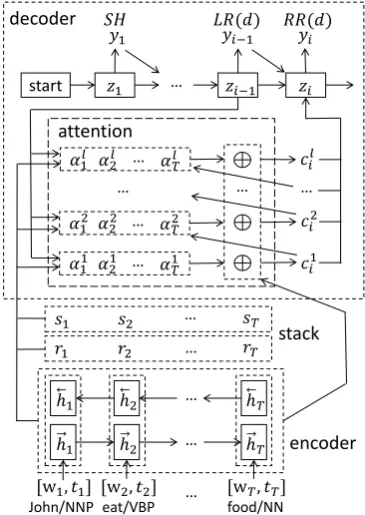
Figure 1: The architecture of sequence-to-sequence parsing model. SH, LR(d), RR(d) de-note the SHIFT, LEFT-ARC(d), RIGHT-ARC(d) transitions in standard algorithm and d is arc-label.
3 Sequence-to-Sequence Parsing Model Transition-based dependency parsing conceptual-izes the process of transforming a sentence into a dependency tree as a sequence of actions. It can be formulated as a sequence-to-sequence problem, and seq2seq framework can be applied. Compared with other tasks, such as machine translation, de-pendency parsing not only considers the previous action and input sentence, but also requires many structure information, such as the subtree structure during the parsing. Such information plays an im-portant role in transition-based dependency pars-ing, so traditional methods adopt a stack to save structure information and design different type of features (word unigram, bigram, trigram, . . . ) to model them. However, vanilla seq2seq models have no explicit structure to model these neces-sary structure information. To better leverage the structure information, we extend the basic seq2seq architecture with a simulated stack and multi-layer attention, as illustrated in Figure 1. The main structure (encoder, decoder and attention part in Figure1) of our parsing model is detailed below.
Fig-ure 1, to utilize POS tag information, each word
wi is additionally represented byxi, the
concate-nation of two vectors corresponding towi’s lexical and POS tagtiembedding:xi = [We∗e(wi);Wt∗ e(ti)], where e(wi) and e(ti) are one-hot vector
representations of tokenwiand its POS tagti,We
and Wt are embedding matrices. The rest part
of the encoder is the same with the basic seq2seq model.
Attention Mechanism: We improve the atten-tion part in two aspects: introducatten-tion of stack in-formation and multi-layer attention structure.
Stack information, which plays an essential role in the conventional algorithm, is simulated with two binary vectors s = (s1, . . . , sT) and r =
(r1, . . . , rT) to record the state of each word wi
and initialized to zero. When parser pushes word
wi into stack, si is assigned to 1, while ri is as-signed to 1 only if wordwiis removed from stack.
Intuitively, at each time step i in the decoding phase, stack information serves as an additional input to the attention model, which provides com-plementary information of that the source words is in the stack or not. We expect the stack infor-mation would guide the attention model to focus more on words in the stack. More formally, the coefficientsα1, α2, ... , αT used in attention mech-anism can be rewritten as
αi,t = Pexp (ei,t)∗(1−rt)
kexp (ei,k)∗(1−rk) (5) ei,t =v>atanh(Wazi−1+Uaht+Sast) (6)
whereSais the weight matrix.
To extract complex structure information to help action prediction, we apply a l-layers net-work structure for attention mechanism as shown in the attention part of Figure 1. To further en-hance connection between adjacent layers, we re-place the statezi−1 in Equation 6 by the concate-nation of zi−1 and context vector cmi −1 at each
layerm(m >1). The Equation 6 can be rewritten as:
em
i,t =v>atanh(Wam[zi−1;cmi −1] +Uaht+Sast)
(7) where Wm is the weight matrix. With this
net-work structure, we obtain different context vec-tors (c1
i, c2i, . . . , cli), and the final context vector ci, which is considered as complex context
infor-mation, is replaced by the concatenation of those vectors:ci= [c1i;c2i;. . .;cli].
Decoder: Unlike machine translation and text summarization in which seq2seq model is widely applied, a sequence of action in dependency pars-ing must satisfy some constraints so that they can generate a dependency tree. Following the arc-standard algorithm (Nivre,2004), the precondition can be categorized as 1) SHIFT(SH): There exists at least one word that is not pushed into the stack; 2) LEFT-ARC(LR(d)) and RIGHT-ARC(RR(d)): There are at least two words in the stack. These two constraints can be defined as indicator func-tions
I(yi) =
0 yi=SH, Wc≤0
0 yi=LR(d) or RR(d), Sc<2
1 otherwise
(8) where Sc represents the number of words in the
stack and Wcis the number of source words that are not pushed into the stack. To introduce these constraints, the conditional probability of each tar-get symbolyican be rewritten as
p(yi|y<i, h) = Pexp (gi)∗I(yi)
kexp (gk)∗I(yk) (9)
wheregiis theith element ofg(yi−1, zi, ci). 4 Experiments
In this section, we evaluate our parsing model on the English and Chinese datasets. FollowingDyer et al. (2015), Stanford Dependencies (de Marn-effe and Manning, 2008) conversion of the Penn Treebank (PTB) (Marcus et al.,1993) and Chinese Treebank 5.1 (CTB) are adopted. We leverage the arc-standard algorithm for our dependency pars-ing. In addition, we limit the vocabulary to con-tain up to 20k most frequent words and convert remaining words into the<unk>token.
4.1 Setup
For our model, 3-layers GRU is used for encoder and decoder. The dimension of word embedding is 300, the dimension of POS-tag/action embed-ding is 32, and the size of hidden units in GRU is 500. 3-layers attention structure is adopted in our model. FollowingChen and Manning(2014);
Parser Dev PTB-SD Test Dev CTB Test
UAS LAS UAS LAS UAS LAS UAS LAS
Z&N11 - - 93.00 90.95 - - 86.00 84.40
C&M14 92.20 89.70 91.80 89.60 84.00 82.40 83.90 82.40
ConBSO - - 91.57 87.26 - - -
-Dyer15 93.20 90.90 93.10 90.90 87.20 85.90 87.20 85.70
Weiss15 - - 93.99 92.05 - - -
-K&G16 - - 93.99 91.90 - - 87.60 86.10
[image:4.595.121.479.61.249.2]DENSE 94.30 91.95 94.10 91.90 87.35 85.85 87.84 86.15 seq2seq 92.02 89.10 91.84 88.84 86.21 83.80 85.80 83.53 Our model 93.65 91.52 93.71 91.60 87.28 85.30 87.41 85.40 Ensemble 94.24 92.01 94.16 92.13 88.06 86.30 87.97 86.18
Table 1: Results of various state-of-the-art parsing systems on English dataset (PTB with Stanford De-pendencies) and Chinese dataset (CTB). The numbers reported from different systems are taken from: Z&N11 (Zhang and Nivre,2011); C&M14 (Chen and Manning,2014); ConBSO (Wiseman and Rush,
2016); Dyer15 (Dyer et al.,2015); Weiss15 (Weiss et al., 2015); K&G16 (Kiperwasser and Goldberg,
2016); DENSE (Zhang et al.,2017).
p
6/(drow+dcol), where drow and dcol are the
number of rows and columns (Glorot and Ben-gio, 2010). Our models are trained on a Tesla K40m GPU and optimized with vanilla SGD algo-rithm with mini-batch size 64 for English dataset and 32 for Chinese dataset. The initial learning rate is set to 2 and will be halved when unlabeled attachment scores (UAS) on the development set do not increase for 900 batches. To alleviate the gradient exploding problem, we rescale the gradi-ent when its norm exceeds 1. Dropout (Srivastava et al.,2014) is applied to our model with the strat-egy recommended inZaremba et al.(2014) and the dropout rate is 0.2. For testing, beam search is em-ployed to find the best action sequence with beam size 8. For evaluation, we report unlabeled (UAS) and labeled attachment scores (LAS) on the devel-opment and test sets. Following Chen and Man-ning(2014), the punctuation is excluded from the evaluation.
4.2 Main Results
Table 1 lists the accuracies of our parsing mod-els, compared to other state-of-the-art parsers. For the baseline, seq2seq model employs the same encoder and decoder network structure with our model. We can see that our proposed model can significantly outperform the basic seq2seq model with 1.87 UAS (English) and 1.61 UAS (Chinese) improvements on the test set. This demonstrates the effectiveness of our proposed
multi-layer attention mechanism. Besides, our model achieves better UAS accuracy than Z&N11, C&M14, ConBSO and Dyer15 on development and test set, while slightly lower than Weiss15, K&G16 and DENSE. Weiss15 adopts a structured training procedure which can be easiely applied to our model as well, and it will further improve the performance of our model. K&G16 uses 11 bidi-rectional LSTM vectors as features, which will be fed to a transition-based parser. It suggests a new direction that combines our model with feature en-gineering of the traditional transition-based parser to gain better performance. DENSE formalizes dependency parsing as head selection and applies MST algorithms to correct non-tree outputs, while our model doesn’t require any post-processing at test time. Dozat and Manning(2016) use deep bi-affine attention instead of traditional attention in the graph-based architectures of K&G16, achiev-ing 95.74 UAS and 89.30 UAS on PTB-SD and CTB datasets respectively. For ensemble, we train 4 models using the same network with different random initialization. When we ensemble these 4 models, we simply average the output probabil-ities from different models and obtain the better result with accuracies of 94.16 UAS (English) and 87.97 UAS (Chinese) as shown in the Table1.
4.3 Impact ofl
mech-Dev Test
UAS LAS UAS LAS
seq2seq 92.02 89.10 91.84 88.84
l= 1 92.85 90.44 92.70 90.40
l= 2 93.30 91.13 93.21 90.98
l= 3 93.65 91.52 93.71 91.60
[image:5.595.307.525.61.164.2]l= 4 93.49 91.29 93.42 91.24
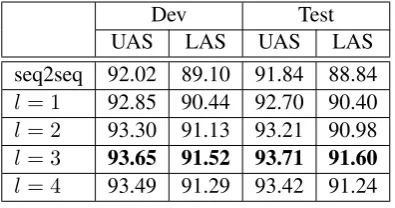
Table 2: Impact oflon English PTB dataset.
anism. Larger l would bring more capacity, but lead to more computational complexity and aggra-vate the risk of over-fitting.
We conduct a group of experiments to investi-gate the impact ofl. The results are shown in Ta-ble2. Seq2seq model can be viewed as a special case of our model without any stack information. With l = 1, we can see that the introduction of stack information can strongly improve the pars-ing performance, especially for LAS. When l is small (l < 4), the general trend is that larger l
leads to better result. However, further increasingl
bring slightly damages to the parsing performance due to the over-fitting problem.
Although larger l would bring more capacity, multiple layers structure will double the training time compared with the vanilla seq2seq. In our implementation, our model costs about 500 sec-onds for a round of training data on English PTB dataset, while the vanilla costs about 260 seconds.
4.4 Additional Results
We perform some ablation experiments in order to quantify the effect of the different components on our models. As shown in Table 3, the POS-tag information plays the most important role in our model. We note that, different from Dyer et al.
(2015), we don’t utilize an external word embed-ding to tackle OOV problem, and it may cause our model to be more dependent on the POS-tag infor-mation. Forsandrvectors, same as discussion in last section, we find that the introduction of stack information can strongly improve the parsing per-formance.
5 Conclusion
In order to leverage structure information for seq2seq based dependency parsing, in this pa-per, we propose a stack based multi-layer atten-tion method, in which, stack is simulated with two binary vectors, and multi-layer attention is
in-Dev Test
UAS LAS UAS LAS
Our model 93.65 91.52 93.71 91.60 –pretraining 93.19 90.92 93.22 91.11 –POS 92.73 89.86 92.57 90.05 –svector 93.18 90.68 93.02 90.89 –rvector 93.16 90.90 93.27 91.02 Table 3: Impact of the different components on English PTB dataset.
troduced to capture multiple word dependencies in partial trees. Experimental results demonstrate that our proposed model significantly outperforms the basic seq2seq model, and achieves a state-of-the-art parsing performance.
In the future, we plan to apply our approach in more languages and other transition-based system, such as arc-eager or arc-hybrid. Another direction we are interested in is to train our model with com-plex training approaches proposed inWeiss et al.
(2015) andAndor et al.(2016). Acknowledgments
We appreciate Dongdong Zhang, Nan Yang, Shuangzhi Wu and Qingyu Zhou for the fruitful discussions. We also thank the anonymous re-viewers for their careful reading of our paper and insightful comments.
References
Daniel Andor, Chris Alberti, David Weiss, Aliaksei Severyn, Alessandro Presta, Kuzman Ganchev, Slav Petrov, and Michael Collins. 2016. Globally
nor-malized transition-based neural networks. CoRR,
abs/1603.06042.
Dzmitry Bahdanau, Kyunghyun Cho, and Yoshua Ben-gio. 2015. Neural machine translation by jointly
learning to align and translate. InProceedings of the
Third International Conference on Learning Repre-sentations (ICLR).
Danqi Chen and Christopher D. Manning. 2014. A fast and accurate dependency parser using neural
net-works. InEMNLP.
Kyunghyun Cho, Bart van Merrienboer, Caglar Gul-cehre, Dzmitry Bahdanau, Fethi Bougares, Holger Schwenk, and Yoshua Bengio. 2014. Learning phrase representations using rnn encoder–decoder
for statistical machine translation. InProceedings of
[image:5.595.83.281.62.166.2]James Cross and Liang Huang. 2016. Incremental parsing with minimal features using bi-directional
lstm. InProceedings of the 54th Annual Meeting of
the Association for Computational Linguistics (Vol-ume 2: Short Papers), pages 32–37, Berlin, Ger-many. Association for Computational Linguistics. Timothy Dozat and Christopher D. Manning. 2016.
Deep biaffine attention for neural dependency
pars-ing. CoRR, abs/1611.01734.
Chris Dyer, Miguel Ballesteros, Wang Ling, Austin Matthews, and Noah A. Smith. 2015. Transition-based dependency parsing with stack long
short-term memory. InACL.
Xavier Glorot and Yoshua Bengio. 2010. Understand-ing the difficulty of trainUnderstand-ing deep feedforward neural
networks. InAistats, volume 9, pages 249–256.
Sepp Hochreiter and J¨urgen Schmidhuber. 1997.
Long short-term memory. Neural computation,
9(8):1735–1780.
Eliyahu Kiperwasser and Yoav Goldberg. 2016. Sim-ple and accurate dependency parsing using
bidi-rectional lstm feature representations. CoRR,
abs/1603.04351.
Mitchell P. Marcus, Beatrice Santorini, and Mary Ann Marcinkiewicz. 1993. Building a large annotated
corpus of english: The penn treebank.
Computa-tional Linguistics, 19:313–330.
Marie-Catherine de Marneffe and Christopher D. Man-ning. 2008. Stanford typed dependencies manual. Joakim Nivre. 2004. Incrementality in deterministic
dependency parsing. In Proceedings of the
Work-shop on Incremental Parsing: Bringing Engineering and Cognition Together, pages 50–57. Association for Computational Linguistics.
Jeffrey Pennington, Richard Socher, and Christo-pher D. Manning. 2014. Glove: Global vectors for
word representation. InEMNLP.
Alexander M. Rush, Sumit Chopra, and Jason Weston. 2015. A neural attention model for abstractive
sen-tence summarization. InEMNLP.
Nitish Srivastava, Geoffrey E. Hinton, Alex Krizhevsky, Ilya Sutskever, and Ruslan Salakhutdi-nov. 2014. Dropout: a simple way to prevent neural
networks from overfitting. Journal of Machine
Learning Research, 15:1929–1958.
Ilya Sutskever, Oriol Vinyals, and Quoc V Le. 2014. Sequence to sequence learning with neural
net-works. InAdvances in neural information
process-ing systems, pages 3104–3112.
David Weiss, Chris Alberti, Michael Collins, and Slav Petrov. 2015. Structured training for neural network
transition-based parsing. InACL.
Sam Wiseman and Alexander M. Rush. 2016. Sequence-to-sequence learning as beam-search
opti-mization. InProceedings of the 2016 Conference on
Empirical Methods in Natural Language
Process-ing, pages 1296–1306, Austin, Texas. Association
for Computational Linguistics.
Wojciech Zaremba, Ilya Sutskever, and Oriol Vinyals.
2014. Recurrent neural network regularization.
CoRR, abs/1409.2329.
Xingxing Zhang, Jianpeng Cheng, and Mirella Lapata. 2017. Dependency parsing as head selection. In
Proceedings of the 15th Conference of the European Chapter of the Association for Computational Lin-guistics: Volume 1, Long Papers, pages 665–676, Valencia, Spain. Association for Computational Lin-guistics.
Yue Zhang and Joakim Nivre. 2011. Transition-based dependency parsing with rich non-local features. In