Efficient Dynamic Programming Search Algorithms for Phrase-Based SMT
Christoph Tillmann
IBM T.J. Watson Research Center
Yorktown Heights, NY 10598
[email protected]
Abstract
This paper presents a series of efficient dynamic-programming (DP) based algorithms for phrase-based decoding and alignment computation in statistical machine translation (SMT). The DP-based decoding algorithms are analyzed in terms of shortest path-finding al-gorithms, where the similarity to DP-based decoding algorithms in speech recognition is demonstrated. The paper contains the follow-ing original contributions: 1) the DP-based de-coding algorithm in (Tillmann and Ney, 2003) is extended in a formal way to handle phrases and a novel pruning strategy with increased translation speed is presented 2) a novel align-ment algorithm is presented that computes a phrase alignment efficiently in the case that it is consistent with an underlying word align-ment. Under certain restrictions, both algo-rithms handle MT-related problems efficiently that are generally NP complete (Knight, 1999).
1
Introduction
This paper deals with dynamic programming based de-coding and alignment algorithms for phrase-based SMT. Dynamic Programming based search algorithms are be-ing used in speech recognition (Jelinek, 1998; Ney et al., 1992) as well as in statistical machine translation (Tillmann et al., 1997; Niessen et al., 1998; Tillmann and Ney, 2003). Here, the decoding algorithms are de-scribed as shortest path finding algorithms in regularly structured search graphs or search grids. Under certain restrictions, e.g. start and end point restrictions for the path, the shortest path computed corresponds to a rec-ognized word sequence or a generated target language translation. In these algorithms, a shortest-path search
({1},1)
({1,3},3) ({1,2},2)
({1,4},4)
({1,5},5)
({1,2,4},4)
({1,2,3},3)
({1,2,5},5)
({1,3,4},4)
({1,2,3},2)
({1,3,5},5)
({1,3,4},3) ({1,2,4},2)
({1,4,5},5)
({1,3,5},3) ({1,2,5},2)
({1,4,5},4)
({1,2,3,5},5)
({1,2,4,5},5)
({1,3,4,5},5)
({1,2,3,4},4)
({1,2,4,5},4)
({1,3,4,5},4)
({1,2,3,4},3)
({1,2,3,5},3)
({1,3,4,5},3)
({1,2,3,4},2)
({1,2,3,5},2)
({1,2,4,5},2)
({1,2,3,4,5},2)
({1,2,3,4,5},3)
({1,2,3,4,5},4)
({1,2,3,4,5},5) Final
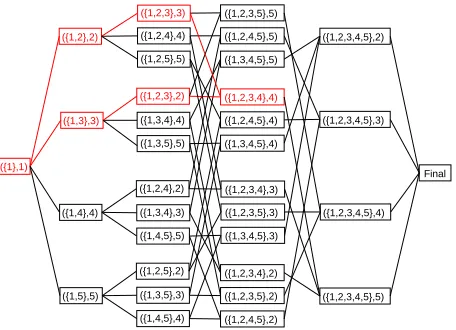
Figure 1: Illustration of a DP-based algorithm to solve a traveling salesman problem with cities. The visited cities correspond to processed source positions.
is carried out in one pass over some input along a spe-cific ’direction’: in speech recognition the search is time-synchronous, the single-word based search algorithm in (Tillmann et al., 1997) is (source) position-synchronous or left-to-right, the search algorithm in (Niessen et al., 1998) is (target) position-synchronous or bottom-to-top, and the search algorithm in (Tillmann and Ney, 2003) is so-called cardinality-synchronous.
Taking into account the different word order between source and target language sentences, it becomes less ob-vious that a SMT search algorithm can be described as a shortest path finding algorithm. But this has been shown by linking decoding to a dynamic-programming solution for the traveling salesman problem. This algorithm due to (Held and Karp, 1962) is a special case of a shortest path finding algorithm (Dreyfus and Law, 1977). The regularly structured search graph for this problem is il-lustrated in Fig. 1: all paths from the left-most to the right-most vertex correspond to a translation of the
put sentence, where each source position is processed ex-actly once. In this paper, the DP-based search algorithm in (Tillmann and Ney, 2003) is extended in a formal way to handle phrase-based translation. Two versions of a phrase-based decoder for SMT that search slightly dif-ferent search graphs are presented: a multi-beam decoder reported in the literature and a single-beam decoder with increased translation speed1. A common analysis of all
the search algorithms above in terms of a shortest-path finding algorithm for a directed acyclic graph (dag) is presented. This analysis provides a simple way of ana-lyzing the complexity of DP-based search algorithm.
Generally, the regular search space can only be fully searched for small search grids under appropriate restric-tions, i.e. the monotonicity restrictions in (Tillmann et al., 1997) or the inverted search graph in (Niessen et al., 1998). For larger search spaces as are required for con-tinuous speech recognition (Ney et al., 1992)2or
phrase-based decoding in SMT, the search space cannot be fully searched: suitably defined lists of path hypothesis are maintained that partially explore the search space. The number of hypotheses depends locally on the number hy-potheses whose score is close to the top scoring hypothe-sis: this set of hypotheses is called the beam.
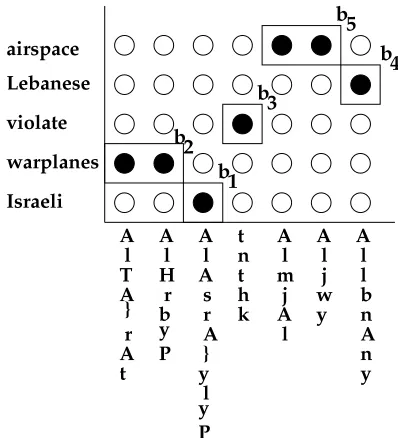
The translation model used in this paper is a phrase-based model, where the translation units are so-called blocks: a block is a pair of phrases which are transla-tions of each other. For example, Fig. 2 shows an Arabic-English translation example that uses blocks. During decoding, we view translation as a block segmentation process, where the input sentence is segmented from left to right and the target sentence is generated from bottom to top, one block at a time. In practice, a largely mono-tone block sequence is generated except for the possibil-ity to swap some neighbor blocks. During decoding, we try to minimize the score of a block sequence under the restriction that the concatenated source phrases of the blocks yield a segmentation of the input
sen-tence:
is $ -dimensional feature vector with
real-valued features and
is the corresponding weight vector as described in Section 5. The fact that a given block covers some source interval%&'
&( is implicit in this
notation.
1The multi-beam decoder is similar to the decoder presented
in (Koehn, 2004) which is a standard decoder used in phrase-based SMT. A multi-beam decoder is also used in (Al-Onaizan et al., 2004) and (Berger et al., 1996).
2
In that work, there is a distinction between within-word and between-word search, which is not relevant for phrase-based decoding where only exact phrase matches are searched.
)*
Figure 2: An Arabic-English block translation example, where the Arabic words are romanized. A sequence of blocks is generated.
This paper is structured as follows: Section 2 intro-duces the multi-beam and the single-beam DP-based de-coders. Section 3 presents an analysis of all the graph-based shortest-path finding algorithm mentioned above: a search algorithm for a directed acyclic graph (dag). Section 4 shows an efficient phrasal alignment algorithm that gives an algorithmic justification for learning blocks from word-aligned training. Finally, Section 5 presents an evaluation of the beam-search decoders on an Arabic-English decoding task.
2
Beam-Search Decoding Algorithms
In this section, we introduce two beam-search algorithms for SMT: a multi-beam algorithm and single-beam algo-rithm. The multi-beam search algorithm is presented first, since it is conceptually simpler.
2.1 Multi-Beam Decoder
For the multi-beam decoder makes use of search states that areN -tuples of the following type:
%PO RQTSVU
(W# (2)
Q is the state history, that depends on the block generation
model. In our case,Q X %&
the interval where the most recent block matched the in-put sentence, and%[
\
( are the final two target words of
the partial translation produced thus far.O is the so-called
Table 1: Multi-beam (] -Beam) decoding algorithm,
which is similar to (Koehn, 2004). The decoders differ in their pruning strategy: here, each state list^V_ is pruned
only once, whereas the decoder in (Koehn, 2004) prunes a state list every time a new hypothesis is entered.
input: source sentence with words 22
a`
^cbedfhgiWbWj and^Vkldfnm for oprq
Prune state set^v_
for each statei in^v_ do
matcher: for eachi'vdwixzy{i'
updatei' for^ _"|c}~ end
end
output: translation from lowest cost state in^
`
can be carried out efficiently. It keeps track of the already processed input sentence positions. U is the cost of the
shortest path (distance) from some initial state i b to the
current state i . The baseline decoder maintains s
q
state lists with entries of the above type, wheres is the
number of input words. The states are stored in lists or stacks that support lookup operations to check whether a given state tuple is already present in a list and what its scoreU is.
The use of a coverage vectorO is related to a DP-based
solution for the traveling salesman problem as illustrated in Fig. 1. The algorithm keeps track of sets of visited cities along with the identity of the last visited city. Cities correspond to source sentence positions& . The vertexes
in this graph correspond to set of already visited cities. Since the traveling salesman problem (and also the trans-lation model) uses only local costs, the order in which the source positions have been processed can be ignored. Conceptually, the re-ordering problem is linearized by searching a path through the set inclusion graph in Fig. 1. Phrase-based decoding is handle by an almost identical algorithm: the last visited position& is replaced by an
interval%&'
&(.
The states are stored in lists or stacks that support lookup operations to check whether a given state tuple is already present in a list and what its scoreU is. Extending
the partial block translation that is represented by a state
i with a single block' generates a new statei'. Here, %o
o' ( is the source interval where block' matches the
input sentence. The state transition is defined as follows:
%O
The i' state fields are updated on a
component-by-component basis. O-'O%o
o'f( is the coverage
vec-Table 2: Single-beam ( -Beam) decoding algorithm
(re-lated to (Lowerre and Reddy, 1980)).
input: source sentence with words a2
matcher: for eachi'vdwixzyi'
else
scanner: for singlei'vdwixzi'
updatei' for^'
output: translation from lowest cost state in^
tor obtained by adding all the positions from the inter-val %o
oM'f(. The new state history is defined as
Q
get words of the target phrase' of '. Some special
cases, e.g. where' has less than two target words, are
taken into account. The path costU
' is computed as
U
'R UU
i
i', where the transition cost
U
is computed from the historyQ and the matching block '
as defined in Section 5.
The decoder in Table 1 fillss
q state sets^vkdeo gt
a2 as
j . All the coverage vectorsO for states in the set ^Vk cover the same number of source positionso . When
a state set^vk is processed, the decoder has finished
pro-cessing all states in the sets^ } whereo . Before
ex-panding a state set, the decoder prunes a state set based on its coverage vector and the path costs only: two different pruning strategies are used that have been introduced in (Tillmann and Ney, 2003): 1) coverage pruning prunes states that share the same coverage vectorO , 2) cardi-nality pruning prunes states according to the
cardinal-ity
O of covered positions: all states in the beam are
compared with each other. Since the states are kept in
s
q separate lists, which are pruned independently of
each others, this decoder version is called multi-beam decoder. The decoder uses a matcher function when ex-panding a state: for a statei it looks for uncovered source
positions to find source phrase matches for blocks.
Up-dating a state in Table 1 includes adding the state if it is
state is already in^V_ only the state with the lower path
cost U is kept. This inserting/updating operation is also
called recombination or relaxation in the context of a dag search algorithm (cf. Section 3). The update proce-dure also stores for each statei ' its predecessor state in a
so-called back-pointer array (Ney et al., 1992). The final block alignment and target translation can be recovered from this back-pointer array once the final state set^
`
has been computed. i' is the source phrase length of
the matching block' when going fromi toi'. This
al-gorithm is similar to the beam-search alal-gorithm presented in (Koehn, 2004): it allows states to be added to a stack that is not the stack for the successor cardinality.i b is the
initial decoder state, where no source position is covered:
O¡m . For the final states in^
`
all source positions are covered.
2.2 Single-Beam Implementation
The second implementation uses two lists to keep a single beam of active states. This corresponds to a beam-search decoder in speech recognition, where path hypotheses corresponding to word sequences are processed in a time-synchronous way and at a given time step only hypothe-ses within some percentage of the best hypothesis are kept (Lowerre and Reddy, 1980). The single-beam de-coder processes hypotheses cardinality-synchronously, i.e. the states at stageo generate new states at position
o
q . In order to make the use of a single beam possible,
we slightly modify the state transitions in Eq. 3:
%O
Here, Eq. 5 corresponds to the matcher definition in Eq. 3. We add an additional field that is a pointer keeping track of how much of the recent source phrase match has been covered. In Eq. 5, when a block is matched to the input sentence, this pointer is set to position k where the most recent block match starts. We use a dot
to indicate that when a block is matched, the matching position of the predecessor state can be ignored. While the pointer is
not yet equal to the end position of the matcho', it is
in-UT¦ , where¦ is the state transition cost
U
i
i'< divided by the source phrase length of block':
we evenly spread the cost of generating' over all source
positions being matched. The new coverage vector O'
is obtained from O by adding the scanned position ':
O-'cuOgM'"j . The algorithm that makes use of the above
definitions is shown in Table 2. The states are stored in only two state sets^ and^': ^ contains the most
prob-able hypotheses that were kept in the last beam pruning step all of which covero source positions.^c' contains all
the hypotheses in the current beam that covero
q source
positions. The single-beam decoder in Table 2 uses two
procedures: the scanner and the matcher correspond to the state transitions in Eq. 4 and Eq. 5. Here, the matcher simply matches a block to an uncovered portion of the input sentence. After the matcher has matched a block, that block is processed in a cardinality-synchronous way using the scanner procedure as described above. The predicate CLOSED§¨i is used to switch between
match-ing and scannmatch-ing states. The predicate CLOSED§©i is
true if the pointer is equal to the match end position
o' (this is stored in
Q
'). At this point, the
position-by-position match of the source phrase is completed and we can search for additional block matches.
3
DP Shortest Path Algorithm for dag
This section analyzes the relationship between the block decoding algorithms in this paper and a single-source shortest path finding algorithm for a directed acyclic graphs (dag). We closely follow the presentation in (Cor-men et al., 2001) and only sketch the algorithm here: a dagª«r¬
2
is a weighted graph for which a
topolog-ical sort of its vertex set¬ exists: all the vertexes can be
enumerated in linear order. For such a weighted graph, the shortest path from a single source can be computed in®e¯f¬T¯
¯
¯Z time, where¯f¬¯ is the number of
ver-texes and ¯
¯ number of edges in the graph. The dag
search algorithm runs over all vertexesi in topological
order. Assuming an adjacency-list representation of the dag, for each vertexi , we loop over all successor
ver-texes i', where each vertexi with its adjacency-list is
processed exactly once. During the search, we maintain for each vertexi ' an attribute
U
%i '(, which is an upper
bound on the shortest path cost from the source vertex
to the vertex i'. This shortest path estimate is updated
or relaxed each time the vertexi' occurs in some
adja-cency list. Ignoring the pruning, the] -Beam decoding
algorithm in Table 1 and the dag search algorithm can be compared as follows: states correspond to dag vertexes and state transitions correspond to dag edges. Using two loops for the multi-beam decoder while generating states in stages is just a way of generating a topological sort of the search states on the fly: a linear order of search states is generated by appending the search states in the state lists^ b ,^
, etc. .
The analysis in terms of a dag shortest path algorithm can be used for a simple complexity analysis of the pro-posed algorithms. Local state transitions correspond to an adjacency-list traversal in the dag search algorithm. These involve costly lookup operations, e.g. language, distortion and translation model probability lookup. Typ-ically the computation time for update operations on lists
^ is negligible compared to these probability lookups.
So, the search algorithm complexity is simply computed as the number of edges in the search graph: ®e<¯¬l¯
¯
¯ z°®e¯
2001)). Without proof, for the search algorithm in Sec-tion 2.1 we observe that the number of states is finite and that all the states are actually reachable from the start state iWb . This way for the single-word based search in
(Tillmann and Ney, 2003), a complexity of®e<¯¬
cabulary ands is the length of the input sentence. The
complexity is dominated by the exponential number of coverage vectorsO that occur in the search, and the
com-plexity of phrase-based decoding is higher yet since its hypotheses store a source interval%&'
&Y( rather than a
sin-gle source position& . In the general case, no efficient
search algorithm exists to search all word or phrase re-orderings (Knight, 1999). Efficient search algorithms can be derived by the restricting the allowable coverage vec-tors (Tillmann, 2001) to local word re-ordering only. An efficient phrase alignment method that does not make use of re-ordering restriction is demonstrated in the following section.
4
Efficient Block Alignment Algorithm
A common approach to phrase-based SMT is to learn phrasal translation pairs from word-aligned training data (Och and Ney, 2004). Here, a word alignment ´ is a
subset of the Cartesian product of source and target posi-tions:
Here,¸ is the target sentence length ands is the source
sentence length. The phrase learning approach in (Och and Ney, 2004) takes two alignments: a source-to-target alignment´
and a target-to-source alignment
´
²
. The intersection of these two alignments is computed to ob-tain a high-precision word alignment. Here, we note that if the intersection covers all source and target positions (as shown in Fig. 4), it constitutes a bijection between source and target sentence positions, since the intersect-ing alignments are functions accordintersect-ing to their definition in (Brown et al., 1993)3. In this paper, an algorithmic
jus-tification for restricting blocks based on word alignments is given. We assume that source and target sentence are given, and the task is to compute the lowest scoring block alignment. Such an algorithm might be important in some discriminative training procedure that relies on decoding the training data efficiently.
To restrict the block selection based on word aligned training data, interval projection functions are defined as follows4:
is a source interval and is an target
inter-3(Tillmann, 2003) reports an intersection coverage of about
º¨»
% for Arabic-English parallel data, and a coverage of¼a½
% for Chinese-English data. In the case of uncomplete cov-erage, the current algorithm can be extended as described in Section 4.1.
4
(Och and Ney, 2004) defines the notion of consistency for the set of phrasal translations that are learned from
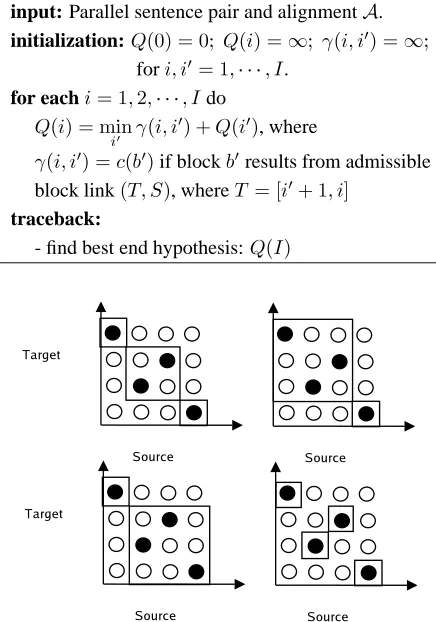
word-Figure 3: Following the definition in Eq. 6, the left pic-ture shows three admissible block links while the right picture shows three non-admissible block links.
val.¾W¿À&
Á is the set of target positions such that the
alignment point Â
&Ã occurs in the alignment set´ and&
is covered by the source interval .¾W¿7À&
Ä is defined
accordingly. Formally, the definitions look like this:
¾M¿7À&
In order to obtain a particularly simple block alignment algorithm, the allowed block links
l are restricted
by anADMISSIBILITYrestriction, which is defined as fol-lows:
Á is admissible iff (6)
¾M¿7À&
lvµh and¾W¿7À&
vµ
Admissibility is related to the word re-ordering problem: for the source positions in an interval and for the target
positions in an interval , all word re-ordering involving
these positions has to take place within the block defined by and . Without an underlying alignment´ each
pair of source and target intervals would define a possi-ble block link: the admissibility reduces the number of block links drastically. Examples of admissible and non-admissible blocks are shown in Fig. 3.
If the alignment´ is a bijection, by definition each
tar-get position is aligned to exactly one source position&
and vice versa and source and target sentence have the same length. Because of the admissibility definition, a target interval clumping alone is sufficient to determine the source interval clumping and the clump alignment. In Fig. 4, a bijection word alignment for a sentence pair that consists ofs
rÊ source and
¸
rÊ target words is
shown, where the alignment links that yield a bijection are shown as solid dots. Four admissible block align-ments are shown as well. An admissible block alignment is always guaranteed to exist: the block that covers all source and target position is admissible by definition. The underlying word alignment and the admissibility restric-tion play together to reduce the number of block align-ments: out of all eight possible target clumpings, only
Table 3: Efficient DP-based block alignment algorithm using an underlying word alignment´ . For simplicity
reasons, the block score
' is computed based on the
block identity ' only.
input: Parallel sentence pair and alignment´ .
initialization:ËtÌRt
S
Ë ÂaRhÍ SÎ
Â
Â'RnÍ
S
forÂ
Â'chq
a2 ¸ . for eachÂÏhq
³
2a ¸ do
Ë ÂaRuÐTÑ Ò
Î
Â
 '
ËT Â', where
Î
ZÂ
Â'"
<' if block' results from admissible
block link
Á , whereXr%Â'
q
Â( traceback:
- find best end hypothesis:Ë
¸
Figure 4: Four admissible block alignments in case the word alignment intersection is a bijection. The block alignment which covers the whole sentence pair with a single block is not shown.
five yield segmentations with admissible block links. The DP-based algorithm to compute the block sequence with the highest scoreËZÂa is shown in Table 3. Here, the
following auxiliary quantity is used:
ËT Âa := score of the best partial segmentation
that covers the target interval%fq
Â(.
Target intervals are processed from bottom to top. A target intervalÓÔ%Â'
Â( is projected using the word
alignment´ , where a given target interval might not yield
an admissible block. For the initialization, we setË Âav
Í and the final score is obtained asËÖÕ ×
} ËT
¸
. The
complexity of the algorithm is ØT ¸ ²
where the time to
compute the cost
<' and the time to compute the
inter-val projections are ignored. Using the alignment links´ ,
the segmentation problem is essentially linearized: the
Figure 5: An example for a block alignment involving a non-aligned column. The right-most alignment is not allowed by the closure restriction.
target clumping is generated sequentially from bottom-to-top and it induces some source clumping in an order which is defined by the word alignment.
4.1 Incomplete Bijection Coverage
In this section, an algorithm is sketched that works if the intersection coverage is not complete. In this case, a given target interval may produce several admissible block links since it can be coupled with different source intervals to form admissible block links, e.g. in Fig. 5, the target interval%t
q( is linked to two source intervals and
both resulting block links do not violate the admissibility restriction. The minimum score block translation can be computed using either the one-beam or the multi-beam algorithm presented earlier. The search state definition in Eq. 2 is modified to keep track of the current target posi-tion the same way as the recursive quantityËT Âa does
this in the algorithm in Table 3:
%O QÙ
Â
SVU
(7# (7)
Additionally, a complex block historyQ as defined in
Sec-tion 2 can be used. Before the search is carried out, the set of admissible block links for each target interval is pre-computed and stored in a table where a simple look-up for each target interval %Â'
Â( is carried out during
align-ment. The efficiency of the block alignment algorithm depends on the alignment intersection coverage.
5
Beam-Search Results
In this section, we present results for the beam-search algorithms introduced in Section 2. The MT03 Arabic-English NIST evaluation test set consisting ofÚMÚMN
sen-tences with qÚ
³
$Û Arabic words is used for the
experi-ments. Translation results in terms of uncased BLEU us-ingÊ reference translations are reported in Table 4 and
Table 5 for the single-beam ( -Beam) and the
multi-beam (] -Beam) search algorithm. For all re-ordering
Table 4: Effect of the skip parameter for the two search strategies.Ü_Ý
³
#
Ü<ÞrqY#t and window width
uÚ .
Skip BLEU CPU BLEU CPU
-Beam [secs] ] -Beam [secs]
re-ordering takes place in a window of size
Ú , such
that only local block re-ordering is handled.
The following block bigram scoring is used: a block pair
S
<'" with corresponding source phrase
matches<%&
o' ( is represented as a feature-vector
S
'âÇ ã ä . The feature-vector components are
the negative logarithm of some probabilities as well as a word-penalty feature. The real-valued features in-clude the following: a block translation score derived from phrase occurrence statistics qM, a trigram language
model to predict target words ³på
NÌ, a lexical
weight-ing score for the block internal words ÊÌ , a distortion
model Ïå
Ú as well as the negative target phrase length <$W. The transition cost is computed as
ä is a weight vector that sums
up to qY#t :
ä
Ùçq#t . The weights are trained
us-ing a procedure similar to (Och, 2003) on held-out test data. A block set ofáÆ# million blocks, which are not
filtered according to any particular test set is used, which has been generated by a phrase-pair selection algorithm similar to (Al-Onaizan et al., 2004). The training data is sentence-aligned consisting ofNÆ#N million training
sen-tence pairs.
Beam-search results are presented in terms of two pruning thresholds: the coverage pruning thresholdÜ Þ
and the cardinality pruning thresholdÜ _ (Tillmann and
Ney, 2003). To carry out the pruning, the minimum cost with respect to each coverage setO and cardinality
are computed for a state set ^ . For the coverage pruning,
states are distinguished according to the subset of cov-ered positionsO . The minimum cost ËÏéOè is defined
as:ËÝéZOàÐlÑ ÒÆêëgè
U
¯Á%O 2Q-SU
(cÇ^Áj . For the cardinality
pruning, states are distinguished according to the cardi-nality
O of subsetsO of covered positions. The
min-imum cost Ëè é
is defined for all hypotheses with the
same cardinality
Statesi in^ are pruned if the shortest path cost
U
i is
greater than the minimum cost plus the pruning threshold:
U
The same state set pruning is used for the -Beam and
Table 5: Effect of the coverage pruning thresholdÜ<Þ on
BLEU and the overall CPU time [secs]. To restrict the overall search space the cardinality pruning is set toÜ_Ï
qtÆ#t and the cardinality histogram pruning is set to ³M
the ] -Beam search algorithms. Table 4 shows the
ef-fect of the skip size on the translation performance. The pruning thresholds are set to conservatively large values:
Ü _
³
# andÜ Þ óqY#t . Only if no block re-ordering
is allowed (¨oYÂ"¾¤Xt ), performance drops significantly.
The -Beam search is consistently faster than] -Beam
search algorithm. Table 5 demonstrates the effect of the coverage pruning threshold. Here, a conservatively large cardinality pruning threshold ofÜ_uôqtÃ#t and the
so-called histogram pruning to restrict the overall number of states in the beam to a maximum number of ³M
tMt
are used to restrict the overall search space. The
-Beam search algorithm is consistently faster than the]
-Beam search algorithm for the same pruning threshold, but performance in terms of BLEU score drops signifi-cantly for lower coverage pruning thresholdsÜ<ÞàtÃ# as
a smaller portion of the overall search space is searched which leads to search errors. For larger pruning thresh-oldsÜ Þõ tÆ# , where the performance of the two
algo-rithms in terms of BLEU score is nearly identical, the
-Beam algorithm runs significantly faster. For a
cover-age threshold ofÜ Þ tÆ#Zq , the -Beam algorithm is as
fast as the] -Beam algorithm atÜ<ÞÈtÃ#tÌq , but obtains a
significantly higher BLEU score ofÊ
³
#Ú versusÊÌq#t for
the] -Beam algorithm. The results in this section show
that the -Beam algorithm generally runs faster since the
beam search pruning is applied to all states simultane-ously making more efficient use of the beam search con-cept.
6
Discussion
include an estimate of the path completion cost which can easily be included into this work as well ((Tillmann, 2001)). (Knight, 1999) shows that the decoding problem for SMT as well as some bilingual tiling problems are NP-complete, so no efficient algorithm exists in the gen-eral case. But using DP-based optimization techniques and appropriate restrictions leads to efficient DP-based decoding algorithms as shown in this paper.
The efficient block alignment algorithm in Section 4 is related to the inversion transduction grammar approach to bilingual parsing described in (Wu, 1997): in both cases the number of alignments is drastically reduced by in-troducing appropriate re-ordering restrictions. The list-based decoding algorithms can also be compared to an Earley-style parsing algorithm that processes list of parse states in a single left-to-right run over the input sentence. For this algorithm, the comparison in terms of a shortest-path algorithm is less obvious: in the so-called comple-tion step the parser re-visits states in previous stacks. But it is interesting to note that there is no multiple lists vari-ant of that parser. In phrase-based decoding, a multiple list decoder is feasible only because exact phrase matches occur. A block decoding algorithm that would allow for a ’fuzzy’ match of source phrases, e.g. insertions or dele-tions of some source phrase words are allowed, would need to carry out its computations using two stacks since the match end of a block is unknown.
7
Acknowledgment
This work was partially supported by DARPA and mon-itored by SPAWAR under contract No. N66001-99-2-8916. The author would like to thank the anonymous reviewers for their detailed criticism on this paper.
References
Yaser Al-Onaizan, Niyu Ge, Young-Suk Lee, Kishore Pa-pineni, Fei Xia, and Christoph Tillmann. 2004. IBM Site Report. In NIST 2004 MT Workshop, Alexandria, VA, June. IBM.
Adam L. Berger, Peter F. Brown, Stephen A. Della Pietra, Vincent J. Della Pietra, Andrew S. Kehler, and Robert L. Mercer. 1996. Language Translation Ap-paratus and Method of Using Context-Based Trans-lation Models. United States Patent, Patent Number 5510981, April.
Peter F. Brown, Vincent J. Della Pietra, Stephen A. Della Pietra, and Robert L. Mercer. 1993. The Mathematics of Statistical Machine Translation: Parameter Estima-tion. Computational Linguistics, 19(2):263–311.
Thomas H. Cormen, Charles E. Leiserson, Ronald L. Rivest, and Clifford Stein. 2001. Introduction to Al-gorithms. MIT Press, Cambridge Massachusetts.
Stuart E. Dreyfus and Averill M. Law. 1977. The Art and Theory of Dynamic Programming (Mathematics in Science and Engineering; vol. 130). Acadamic Press, New York, N.Y.
Held and Karp. 1962. A Dynamic Programming Ap-proach to Sequencing Problems. SIAM, 10(1):196– 210.
Fred Jelinek. 1998. Statistical Methods for Speech Recognition. The MIT Press, Cambridge, MA.
Kevin Knight. 1999. Decoding Complexity in Word-Replacement Translation Models. CL, 25(4):607–615.
Philipp Koehn. 2004. Pharaoh: a Beam Search Decoder for Phrase-Based Statistical Machine Translation Mod-els. In Proceedings of AMTA 2004, Washington DC, September-October.
Bruce Lowerre and Raj Reddy. 1980. The Harpy speech understanding system, in Trends in Speech Recogni-tion, W.A. Lea, Ed. Prentice Hall, EngleWood Cliffs, NJ.
H. Ney, D. Mergel, A. Noll, and A. Paeseler. 1992. Data Driven Search Organization for Continuous Speech Recognition in the SPICOS System. IEEE Transac-tion on Signal Processing, 40(2):272–281.
S. Niessen, S. Vogel, H. Ney, and C. Tillmann. 1998. A DP-Based Search Algorithm for Statistical Machine Translation. In Proc. of ACL/COLING 98, pages 960– 967, Montreal, Canada, August.
Franz-Josef Och and Hermann Ney. 2004. The Align-ment Template Approach to Statistical Machine Trans-lation. Computational Linguistics, 30(4):417–450.
Franz Josef Och. 2003. Minimum error rate training in statistical machine translation. In Proceedings of ACL’03, pages 160–167, Sapporo, Japan.
Christoph Tillmann and Hermann Ney. 2003. Word Re-ordering and a DP Beam Search Algorithm for Statis-tical Machine Translation. CL, 29(1):97–133.
Christoph Tillmann, Stefan Vogel, Hermann Ney, and Alex Zubiaga. 1997. A DP-based Search Using Monotone Alignments in Statistical Translation. In Proc. of ACL 97, pages 289–296, Madrid,Spain, July.
Christoph Tillmann. 2001. Word Re-Ordering and Dy-namic Programming based Search Algorithm for Sta-tistical Machine Translation. Ph.D. thesis, University of Technology, Aachen, Germany.
Christoph Tillmann. 2003. A Projection Extension Al-gorithm for Statistical Machine Translation. In Proc. of EMNLP 03, pages 1–8, Sapporo, Japan, July.
![Table 1: Multi-beam (]only once, whereas the decoder in (Koehn, 2004) prunes-Beam) decoding algorithm,which is similar to (Koehn, 2004)](https://thumb-us.123doks.com/thumbv2/123dok_us/742013.1084486/3.612.325.527.94.312/table-multi-decoder-koehn-prunes-decoding-algorithm-similar.webp)