University of South Carolina
Scholar Commons
Theses and Dissertations
1-1-2013
Applications of the Lopsided Lovász Local Lemma
Regarding Hypergraphs
Austin Tyler Mohr
University of South Carolina
Follow this and additional works at:https://scholarcommons.sc.edu/etd
Part of theMathematics Commons
This Open Access Dissertation is brought to you by Scholar Commons. It has been accepted for inclusion in Theses and Dissertations by an authorized administrator of Scholar Commons. For more information, please [email protected].
Recommended Citation
Mohr, A. T.(2013).Applications of the Lopsided Lovász Local Lemma Regarding Hypergraphs.(Doctoral dissertation). Retrieved from
Applications of the Lopsided Lovász Local Lemma
Regarding Hypergraphs
by
Austin Mohr
Bachelor of Science
Southern Illinois University at Carbondale, 2007
Master of Science
Southern Illinois University at Carbondale, 2008
Submitted in Partial Fulfillment of the Requirements
for the Degree of Doctor of Philosophy in
Mathematics
College of Arts and Sciences
University of South Carolina
2013
Accepted by:
László Székely, Major Professor
Joshua Cooper, Committee Member
Linyuan Lu, Committee Member
George McNulty, Committee Member
Peter Nyikos, Committee Member
Edsel Peña, External Examiner
Dedication
Dedicated to the memory of Professor Thomas D. Porter,
Acknowledgments
I give my sincere thanks to the Department of Mathematics and the Graduate School
of the University of South Carolina at Columbia, whose combined generosity made
this endeavor possible.
I am grateful to Dr. Linyuan Lu, whose expertise has touched many of the results
contained herein.
I am endlessly indebted to my advisor, Dr. László Székely. He has guided me
through this thicket with patience and skill. In so doing, he has enabled me to begin
exploring on my own.
Finally, I offer much love to my wife, Mary, who gives me courage when I have
Abstract
The Lovász local lemma is a powerful and well-studied probabilistic technique useful
in establishing the possibility of simultaneously avoiding every event in some
collec-tion. A principle limitation of the lemma’s application is that it requires most events
to be independent of one another. The lopsided local lemma relaxes the
require-ment of independence to negative dependence, which is more general but also more
difficult to identify. We will examine general classes of negative dependent events
involving maximal matchings of uniform hypergraphs, partitions of sets, and
span-ning trees of complete graphs. The results on hypergraph matchings (together with
the configuration model of Bollobás) yield asymptotically the number of regular,
uni-form hypergraphs avoiding small cycles. Finally, we work toward a characterization
of hypergraphs for which the matching paradigm is guaranteed generate negative
Table of Contents
Dedication . . . ii
Acknowledgments . . . iii
Abstract . . . iv
List of Figures . . . vii
Chapter 1 The Lopsided Local Lemma . . . 1
1.1 Dependency Graphs and the Local Lemma . . . 1
1.2 2-Coloring Hypergraphs . . . 3
1.3 Negative Dependency Graphs and the Lopsided Local Lemma . . . . 4
1.4 Counting Derangements . . . 7
1.5 Asymptotic Enumeration with the Lopsided Local Lemma . . . 10
Chapter 2 Lopsided Local Lemma for Hypergraph Matchings . . 14
2.1 Introduction . . . 14
2.2 Example Conflict Graph . . . 15
2.3 Negative Dependency Graph . . . 16
2.4 Positive Dependency Graph . . . 16
2.5 Asymptotics for Avoiding Matchings . . . 17
Chapter 3 Negative Dependency Graphs for Set Partitions . . . 19
3.1 Introduction . . . 19
3.2 Example Conflict Graph . . . 20
3.4 Results . . . 22
3.5 Failed Attempt via Injection . . . 27
3.6 Further Research . . . 31
Chapter 4 Negative Dependency Graphs for Spanning Trees . . 33
4.1 Introduction . . . 33
4.2 Example Conflict Graph . . . 34
4.3 Results . . . 36
Chapter 5 Enumeration of Regular Uniform Hypergraphs. . . . 42
5.1 Configuration Model for Hypergraphs . . . 42
5.2 Cycles in Hypergraphs . . . 43
5.3 Applying the Lopsided Local Lemma . . . 44
5.4 Further Research . . . 46
Chapter 6 Perfect Matching Hosts . . . 47
6.1 General Results . . . 47
6.2 2-Uniform Perfect Matching Hosts via Random Matchability . . . 52
6.3 2-Uniform Perfect Matching Hosts via Corollary 6.3 . . . 54
6.4 Further Research . . . 57
Bibliography . . . 59
Appendix A Details for Hypergraph Matchings . . . 62
A.1 Preliminaries . . . 62
A.2 Proofs of Theorems 2.2 and 2.3 . . . 64
Appendix B Useful Facts About Bell Numbers . . . 72
List of Figures
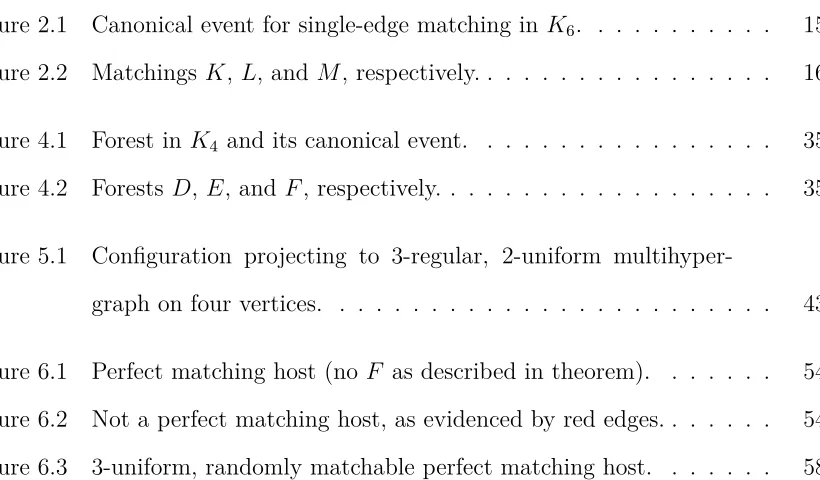
Figure 2.1 Canonical event for single-edge matching in K6. . . 15
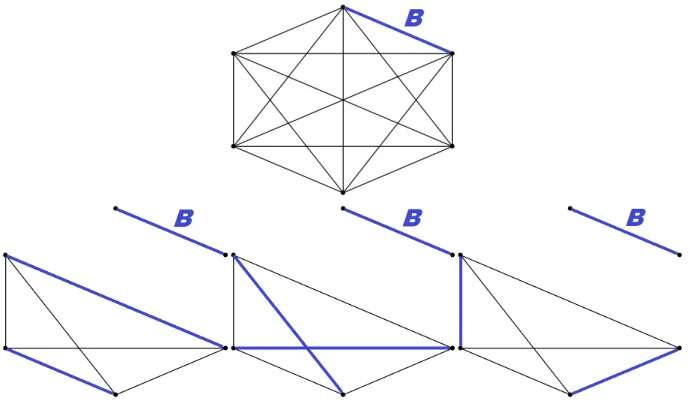
Figure 2.2 Matchings K, L, andM, respectively. . . 16
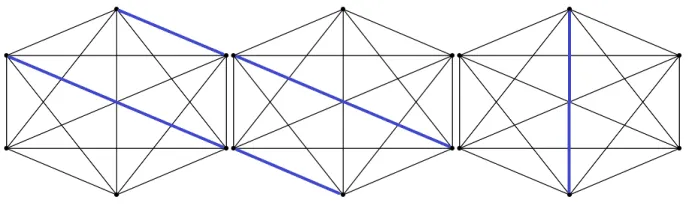
Figure 4.1 Forest inK4 and its canonical event. . . 35
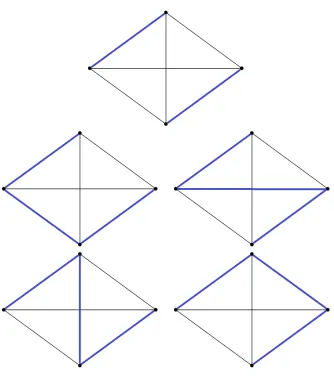
Figure 4.2 Forests D,E, and F, respectively. . . 35
Figure 5.1 Configuration projecting to 3-regular, 2-uniform multihyper-graph on four vertices. . . 43
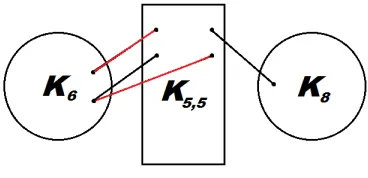
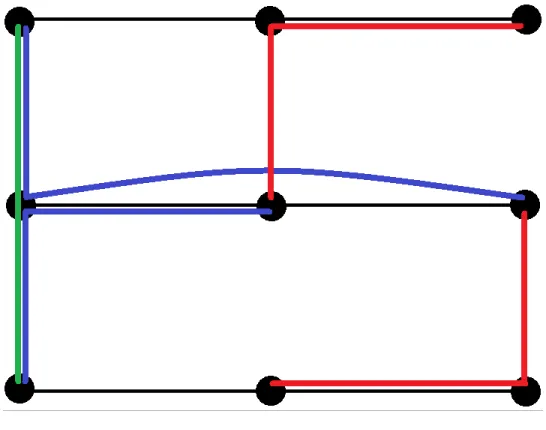
Figure 6.1 Perfect matching host (noF as described in theorem). . . 54
Figure 6.2 Not a perfect matching host, as evidenced by red edges. . . 54
Chapter 1
The Lopsided Local Lemma
1.1 Dependency Graphs and the Local Lemma
A collection of events is avoidable whenever the probability that no event in the
collection occurs is nonzero. In the language of probability, a collection of events A1,
. . ., An is avoidable precisely when Pr
Vn
i=1Ai
>0.
Any finite collection of mutually independent events is avoidable (provided, of
course, no event occurs with probability 1); the probability of avoiding the collection
is Qn
i=1Pr
Ai
, which is greater than zero.
The requirement of mutual independence is quite stringent. We might expect the
collection can still be avoided as long as the events do not depend strongly on one
an-other. The Lovász local lemma makes this intuition precise by providing restrictions
on the interdependence of events sufficient to guarantee the possibility of avoiding
the collection. Erdős and Lovász [13] first introduced this idea to establish the
exis-tence of a certain hypergraph coloring. Subsequent generalizations culminated in the
customary version appearing, for example, in Alon and Spencer [2].
A key component in the lemma is the dependency graph, which is a simple
graph ([n], E) whose edges are situated such that the each event Ai is independent
of the event algebra generated by the collection {Aj |ij /∈E}.
The dependency graph is a convenient way to organize information about possible
dependencies among the events. For example, suppose we want to know the
edge between A1 and another event, the graph contains no information about their
relationship. If we consider a collection of non-neighbors of A1, however, the graph
tells us thatA1 is independent of the event algebra generated by the non-neighboring
events.
Trivially, a complete graph is always a dependency graph. Such a graph is useless,
however, since it contains no information about the events. At the other extreme, a
dependency graph with no edges tells us we are dealing with a collection of mutually
independent events. In practice, therefore, we hope to produce a dependency graph
that is as sparse as possible, since this tells us the collection in question is very much
like a collection of mutually independent events.
The Lovász local lemma asserts a collection is avoidable whenever there is a
corre-sponding dependency graph together with an intricate upper bound on the probability
of each individual event. In fact, it provides an explicit lower bound on the probability
of avoiding the collection. Asymmetric version (that is, one in which the probability
of every event is given the same upper bound) of the lemma was first introduced by
Erdős and Lovász [13] to address a question about hypergraph 2-colorability, which
we will discuss later. Subsequently, Spencer [26, 27] presented various generalizations
of the lemma in his work on Ramsey numbers. Presented below is a slight weakening
of the customary version appearing in Alon and Spencer [2]. (In that text, the local
lemma and the lopsided version to come are both written in terms of digraphs rather
than graphs. The topics herein will not require this additional generality.)
Lemma 1.1(Lovász Local Lemma). LetA1, . . ., Anbe events with dependency graph
([n], E). If there are numbers x1, . . . , xn ∈[0,1) such that
Pr (Ai)≤xi
Y
ij∈E
(1−xj)
for all i, then
Pr
n
^
i=1 Ai
!
≥ n
Y
i=1
1.2 2-Coloring Hypergraphs
Erdős and Lovász [13] provide an upper bound on the maximum degree of a properly
2-colorable hypergraph can contain. Their idea was to color the vertices uniformly at
random with two colors and impose conditions under which the random process would
produce a proper coloring with nonzero probability. They developed the symmetric
version of the local lemma as a tool to aid in the analysis of the resulting probability
space.
Lemma 1.2 (Lovász Local Lemma, Symmetric Version). Let A1, . . ., An be events
with dependency graph of maximum degree d. If
• Pr (Ai)≤p for all i and
• ep(d+ 1)≤1,
then
Pr
n
^
i=1 Ai
!
>0.
(The symmetric version follows from the Lemma 1.1 by setting eachxi = d+11 and
using the fact that 1− 1
d+1
d
> 1e.)
Let H be a hypergraph in which every edge contains at least k vertices and
color the vertices uniformly at random with two colors. Our ambient probability
space will therefore contain all possible 2-colorings (both proper and improper) of
the vertices of H weighted uniformly. For each edge f ∈E(H), define the event Af
to be the collection of all 2-colorings in which the edge f is monochromatic. The
event V
f∈E(H)Af thus contains all 2-colorings in which no edge is monochromatic.
That is, it contains all proper 2-colorings. We are therefore interested in determining
when PrV
f∈E(H)Af
>0, which can be approached via the local lemma.
First, notice the events in the collection {Af | f ∈F} are mutually independent
and
E(G) ={f g |f and g share a vertex in H}
is therefore a dependency graph whose maximum degree is the same as the maximum
degree of H.
By hypothesis, every edge ofHhas at leastkvertices, so Pr (Af)≤ 2k1−1, which we
take as our value for pin the lemma. It remains to maximize d under the constraint
ep(d+ 1)<1, which works out to d=j2k−1
e −1
k
.
Theorem 1.3. LetH be a hypergraph in which every edge contains at leastkvertices.
If H has maximum degree at most 2ke−1 −1, then H is 2-colorable.
Before leaving this problem behind, notice we could only apply the local lemma
by ensuring that “most” events were independent. We will see later that the lopsided
local lemma can be applied in spaces where there is no independence among the
events.
1.3 Negative Dependency Graphs and the Lopsided Local Lemma
The Lovász local lemma allows us to detect avoidability if there is onlysome
indepen-dence among the events (provided we can discover a dependency graph and suitable
numbers xi). Erdős and Spencer [14] analyzed the proof and determined that one
can still detect avoidability even if there is no independence among the events.
In the following definition, let N(v) denote the set of neighbors of the vertex v
together withv itself. Anegative dependency graphfor a collection of eventsA1,
. . ., An is a simple graph ([n], E) whose edges are situated such that the inequality
Pr
Ai
^
j∈S
Aj
≤Pr (Ai) (1.1)
holds for each i ∈ [n] and every subset S of N(i) (excluding those S for which
the event V
undefined). Stated in this way the inequality might be crudely summarized to say
that the probability of an event falls when some of its non-neighbors do not occur.
Alternative formulations of Inequality 1.1 arise from straightforward algebraic
manipulation. As before, we assume i ∈ [n] and S ⊆ N(i) are arbitrary, except
that we do not consider collections S for which the conditioning event (if any) has
probability zero. The first two are the conditional probabilities
Pr ^ j∈S Aj Ai ≤Pr
^ j∈S Aj and
PrAi
≤Pr ^ j∈S∪{i} Aj ^ j∈S Aj .
Our final formulation takes the form of the correlation inequality
Pr (Ai) Pr
_ j∈S Aj ≤Pr
Ai∧
_
j∈S
Aj
.
A collection of events may satisfy the inequalities above even though no two events
are independent, as we describe in the next section.
The lopsided local lemma differs from the previous version only by replacing
“de-pendency graph” with “negative de“de-pendency graph”. Since every de“de-pendency graph
is a negative dependency graph (but not vice versa), the lopsided version is strictly
more general. It was first introduced by Erdős and Spencer [14] with regard to
Latin transversals and independently by Albert, Frieze, and Reed [1] in their work
on Hamiltonian cycles. The lemma as it appears below is due to Ku [17] and appears
as a remark in Alon and Spencer [2].
Lemma 1.4 (Lopsided Local Lemma). Let A1, . . ., An be events with negative
de-pendency graph ([n], E). If there are numbers x1, . . . , xn∈[0,1) such that
Pr (Ai)≤xi
Y
ij∈E
(1−xj)
for all i, then
Pr n ^ i=1 Ai ! ≥ n Y i=1
Proof. Take as granted for a moment that
Pr
Ai
^ j∈S Aj
≤xi (1.2)
for any strict subset S of [n] and any i /∈S.
The conclusion of the lopsided local lemma follows from this claim by observing
Pr n ^ i=1 Ai !
= PrA1
·PrA2
A1
· · ·Pr
An
n−1 ^ j=1 Aj ≥ n Y i=1
(1−xi)
>0.
It remains to establish Inequality 1.2, which we accomplish by induction on |S|.
When |S| = 0, the claimed inequality reduces to Pr (Ai) ≤ xi, which is provided by
the hypotheses of the lopsided local lemma. For |S| >0, set S1 ={j ∈ S | ij ∈ E}
and S2 =S\S1. Now,
Pr
Ai
^ j∈S Aj =
PrAi∧Vj∈S1Aj
V
k∈S2Ak
PrV
j∈S1Aj
V
k∈S2Ak
.
We will bound the numerator and denominator separately.
For the numerator, we have
Pr
Ai∧
^ j∈S1 Aj ^ k∈S2 Ak ≤Pr
Ai
^ k∈S2 Ak
≤Pr (Ai)
≤xi
Y
j∈S1
(1−xj),
where the second inequality comes from the fact thatAi is negative dependent of the
collection {Ak |k∈S2}.
equal to 1). Now, Pr r ^ `=1 Aj`
^ k∈S2 Ak = Pr Aj1
^ k∈S2 Ak ·Pr
Aj2
Aj1 ∧
^
k∈S2
Ak
· · ·Pr
Ajr
r−1 ^ `=1 Aj`∧
^ k∈S2 Ak ≥ r Y `=1
(1−xj`),
where the inequality holds by the induction hypothesis (in each factor, we condition
on an intersection of fewer than |S|events).
Combining the two bounds,
Pr
Ai
^ j∈S Aj =
PrAi∧Vj∈S1Aj
V
k∈S2Ak
PrV
j∈S1Aj
V
k∈S2Ak
≤ xi
Q
j∈S1(1−xj)
Q
j∈S1(1−xj)
=xi,
which proves the claim.
1.4 Counting Derangements
A derangement is a permutation having no fixed point. It is well known that the
number of derangements on the set [N] is the integer nearest to Ne! [15]. The lopsided
local lemma gives this value as an asymptotic lower bound. (Using the forthcoming
machinery of positive dependency graphs, Lu and Székely [21] obtained this as an
asymptotic upper bound, as well.)
In the uniform probability space containing all permutations on the set [N], let
Ai denote the collection of all such permutations having i as a fixed point. The
event VN
i=1Ai contains precisely those permutations having no fixed point (that is,
No pair of distinct events Ai and Aj are independent, since
Pr (Ai∧Aj) =
(N −2)!
N! =
1 N2−N,
while
Pr (Ai) Pr (Aj) =
(N −1)! N! ·
(N −1)!
N! =
1 N2.
For this reason, the local lemma fails in the worst possible way. Remarkably, the
lop-sided local lemma succeeds in thebest possible way, allowing for anedgeless negative
dependency graph.
Theorem 1.5. In the uniform probability space containing all permutations on the
set [N], let Ai denote the collection of all such permutations having i as a fixed point.
The graph with vertex set [N] and no edges is a negative dependency graph for the
events {A1, . . . , AN}.
Lu and Székely [20] prove a more general statement about random injections, of
which the theorem above is a simple case. Before presenting an alternative proof, let
us take a moment to see why we might expect it to hold for just two events. Asking
whether PrA1
A2
is less than or equal to Pr (A1) can be phrased as follows: Does
the knowledge that the element 2 is not a fixed point reduce the likelihood that the
element 1 is a fixed point? The fact that 2 is not a fixed point means it is slightly
more likely than usual that it is mapped to 1, so it is slightly less likely than usual
that 1 is a fixed point.
Proof of Theorem 1.5. Without loss of generality, we will establish the inequality
Pr k ^ j=1 Aj AN ≤Pr
k ^ j=1 Aj
for any k ∈[N−1], which is defined to be
AN ∧
Vk
j=1Aj
|AN|
≤
Vk
j=1Aj
Now,AN is the collection of permutations on the set [N] havingN as a fixed point, so
|AN|= (N−1)!. Clearing denominators, we are left with establishing the inequality
N
AN ∧ k ^ j=1 Aj ≤ k ^ j=1 Aj ,
which we achieve by the following combinatorial argument.
Since all permutations belonging toAN∧Vkj=1Aj haveN as a fixed point, we may
view the event as the collection of all permutations on the set [N−1] having no fixed
points in the set [k]. The event Vk
j=1Aj is the collection of all permutations on the
set [N] also having no fixed points in the set [k]. Denote these collections by AN−1
and AN, respectively.
For any σ∈ AN−1, define σi for each i∈[N] via
σi(j) =
N if j =i
σ(i) if j =N
σ(j) otherwise.
Each σi is distinct, since σi(N) =6 σj(N) whenever i 6= j. Moreover, distinct
permutations σ and τ belonging to AN−1 must differ in at least two coordinates, so
σi 6=τj for any i andj. Finally, sinceσ has no fixed points in [k], neither does σi for
any i (recall that N /∈[k]), which means each σi belongs toAN. Taken together, we
conclude N|AN−1| ≤ |AN|, as desired.
With an edgeless negative dependency graph in hand, we can take each xi = N1
in the lopsided local lemma, since
Pr (Ai) =
1
N =xi =xi
Y
ij∈∅
(1−xj).
The lopsided local lemma concludes
Pr N ^ i=1 Ai ! ≥ N Y i=1
1− 1
N
=
1− 1
N
N
,
which converges to 1e. Therefore, Ne! is an asymptotic lower bound for thenumber of
1.5 Asymptotic Enumeration with the Lopsided Local Lemma
For asymptotic analysis, we will be interested in sequences of problems in which the
size of the events and/or the ambient probability space depends on some parameter
tending toward infinity. For example, the events “at least one head” or “at least
√
N heads” in the probability space of all possible outcomes of N coin flips induce a
sequence of problems when N grows without bound. We will denote such a growing
probability space by ΩN to emphasize that its size depends on N. Lu and Székely
[21] provide conditions under which an asymptotic lower bound for PrVn
i=1Ai
can
be obtained from the lopsided local lemma. Notice Pr (Ai) will depend on N even if
the eventAi does not explicitly referenceN, since the size of the ambient probability
space ΩN grows with N.
Theorem 1.6 (Lu, Székely 2011). Let A1, . . ., An be events in a probability space
ΩN with negative dependency graph ([n], E) and set µ = Pni=1Pr (Ai). If there is (depending on N) such that
• Pr (Ai)< for all i,
• X
j:ij∈E
Pr (Aj) + 2 Pr2(Aj)< for all i, and
• µ tends to zero as N tends to infinity,
then
Pr
n
^
i=1 Ai
!
≥(1−o(1))e−µ.
Negative dependency graphs are more general but also more difficult to identify
than dependency graphs. Lu, Székely, and the author [19] exploredconflict graphs
in several disparate classes of combinatorial objects, which has been a successful
avenue in discovering negative dependency graphs. For the sake of concreteness,
matchings, set partitions, and spanning trees, which are the classes of combinatorial
objects with which we will be concerned.
To obtain an asymptotic upper bound for PrVn
i=1Ai
, Lu and Székely [21]
in-troduced the -near positive dependency graph. In the event that the lower
and upper bounds match in the limit, one obtains an asymptotic expression for the
probability of interest.
For eventsA1,. . .,Anand∈(0,1), an-near positive dependency graph ([n], E)
is one in which
• Pr(Ai∧Aj) = 0 whenever ij ∈E and
• the inequality
Pr
Ai
^
j∈S
Aj
≥(1−) Pr(Ai)
holds for each i and any subset S of N(i) (excluding those S for which the
event V
j∈SAj has probability zero, in which case the conditional probability is
undefined).
Notice the reversal in the direction of the inequality (as compared with the
nega-tive dependency graph) results in an upper bound on PrVn
i=1Ai
.
Theorem 1.7 (Lu, Székely 2011). If A1, . . ., An are events with an -near positive
dependency graph, then
Pr
n
^
i=1 Ai
!
≤ n
Y
i=1
[1−(1−) Pr (Ai)].
With some extra restrictions, this upper bound meets the lower bound in 1.6
asymptotically.
Corollary 1.8. Let A1, . . ., An be events with an -near positive dependency graph
in a probability space growing with N and set µ = Pn
Pn
i=1Pr 2(A
i) tend to zero as N tends to infinity, then
Pr n ^ i=1 Ai !
≤(1 +o(1))e−µ.
Proof. Theorem 1.7 gives
Pr n ^ i=1 Ai ! ≤ n Y i=1
[1−(1−) Pr (Ai)]
= exp
n
X
i=1
log [1−(1−) Pr (Ai)]
!
.
Using the fact that
log(1−x) = − ∞
X
k=1 xk
k
for |x|<1, we write
log [1−(1−) Pr (Ai)] =− ∞
X
k=1
(1−)kPrk
(Ai)
k
for each i. Now,
− n X i=1 ∞ X k=1
(1−)kPrk(Ai)
k =−
n
X
i=1
(1−) Pr(Ai)− n X i=1 ∞ X k=2
(1−)kPrk(Ai)
k
=− n
X
i=1
(1−) Pr(Ai)− n
X
i=1
OPr2(Ai)
=− n
X
i=1
(1−) Pr(Ai)−O n
X
i=1
Pr2(Ai)
!
.
Substituting into the exponential, we have
Pr n ^ i=1 Ai ! ≤exp n X i=1
log [1−(1−) Pr (Ai)]
!
= exp − n
X
i=1
(1−) Pr(Ai)−O n
X
i=1
Pr2(Ai)
!!
= exp (−µ) exp µ+O
n
X
i=1
Pr2(Ai)
!!
In a sequence of problems satisfying the conditions of both Theorem 1.6 and
Corollary 1.8, we can conclude PrVn
i=1Ai
is asymptotic to e−µ. If we further
assume that the ambient probability space is equipped with the counting measure,
then multiplying by the size of the space gives an asymptotic expression for the
number of outcomes avoiding the events A1, . . ., An.
Corollary 1.9. LetA1, . . ., An be events in a uniform probability spaceΩN equipped
with the counting measure and setµ=Pn
i=1Pr (Ai). If the conditions of both Theorem
1.6 and Corollary 1.8 are satisfied, then
n
\
i=1 Ai
Chapter 2
Lopsided Local Lemma for Hypergraph
Matchings
2.1 Introduction
Ans-matching(or simply matching) in ans-uniform hypergraph is a collection of
vertex-disjoint edges (each containingsvertices) and ismaximalprovided no strictly
larger matching contains it. Let Ω denote the uniform probability space consisting
of all maximal matchings of some underlyings-uniform hypergraph H. Our primary
objective in this section will be to define a conflict graph for events in Ω (analogous
to the one defined in Chapter 3 for set partitions) and present some conditions under
which it is a negative dependency graph.
For a particular matchingM, defineAM to be the collection of all maximal
match-ings extending M. More precisely,
AM ={L∈Ω|M ⊆L}.
We call the collection AM the canonical event for the matching M to emphasize
its interpretation as an event in the probability space Ω. Two matchings conflict
whenever their union is not again a matching, and two canonical events conflict when
the matchings used to define them conflict.
Finally, let M be any collection of s-matchings. The conflict graph for the
collection {AM |M ∈ M} of canonical events is a simple graph whose vertex set is
Figure 2.1 Canonical event for single-edge matching in K6.
2.2 Example Conflict Graph
Take the complete graph on six vertices to be the underlying graph (a graph is a
2-uniform hypergraph). The single-edge matchingB is pictured in Figure 2.2 together
with its canonical event AB, which consists of the three maximal (indeed, perfect)
matchings containing the edge B. The edges incident to a vertex of B are not
pic-tured to emphasize the fact that they cannot possibly be including in any matching
containing B. For this reason, there is a natural bijection between the outcomes of
the canonical eventAB and the collection of perfect matchings of the complete graph
on four vertices.
Unrelated to the previous example, consider the three matchings K, L, and M
in the complete graph on six vertices pictured in Figure 2.2. The matchings K
and M conflict, because their union is not again a matching. The canonical events
(not pictured) AK and AM are disjoint, since no perfect matching extends both the
matchingsK andM simultaneously. Similarly, the matchingsLandM conflict. The
matchings K and L do not conflict, since their union is itself a matching (indeed, a
Figure 2.2 Matchings K, L, and M, respectively.
vertex set{K, L, M} and edge set {KM, LM}.
2.3 Negative Dependency Graph
For the enumeration of regular uniform hypergraphs in Chapter 5, the underlying
graph will be a complete uniform hypergraph, in which case the conflict graph is
always a negative dependency graph [19].
Theorem 2.1 (Lu, M, Székely 2012). Let M be any collection of matchings in a
complete uniform hypergraph. The conflict graph for the collection {AM | M ∈ M}
of canonical events is a negative dependency graph.
At this point our interest in hypergraph matchings is two-fold. In Chapter 5, we
apply the theorem above (together with other tools) to the asymptotic enumeration
of regular uniform hypergraphs. In Chapter 6, we pursue the classification of the
underlying hypergraphs for which the theorem above holds.
2.4 Positive Dependency Graph
Let M be a collection of matchings in the complete s-uniform hypergraph on N
vertices with negative dependency graph (M, E), and letδ be a positive real number.
(For the moment, we may suppose that sand δ are both fixed, but later applications
no matching from M is a subset of another matching from M and the following
inequalities are satisfied for every matching M ∈ M and every edgee∈E:
• Pr (AM)< δ
• X
L:LM∈E
Pr (AL) + Pr2(AL)< δ
• X
L:e∈L
Pr (AL) + Pr2(AL)< δ
• X
L∈MM
Pr
N−s|M|(AL) + Pr
2
N−s|M|(AL)< δ,
where
MM ={L\M |L∈ M, L=6 M, L∩M 6=∅, Ldoes not conflict with M}.
A collection in which every matching contains at most k edges isk-bounded.
Theorem 2.2. Let M be a collection of matchings in a complete s-uniform
hyper-graph. If M is δ-sparse and k-bounded, then the conflict graph for the canonical
events {AM |M ∈ M} is also an -near positive dependency graph.
The precise relationship between the parameters k, s, δ, and is deferred to
Section A.2.
2.5 Asymptotics for Avoiding Matchings
Let ΩN be the uniform probability space of maximal matchings of a complete uniform
hypergraph. In this space, the expression PrV
M∈MAM
denotes the probability that
a maximal matching chosen uniformly at random from ΩN contains no submatching
belonging to the set M. According to Theorem 2.1, the conflict graph for any
col-lection of canonical matching events is a negative dependency graph. Theorem 2.2
gives some restrictions onMunder which we are assured the conflict graph is also a
ensure nice asymptotic behavior. We gather here all these conditions into one place
to derive an asymptotic expression for PrV
M∈MAM
. Take note that expressions
such as Pr (AM) will depend onN since the size of the ambient probability space ΩN
depends on N.
Theorem 2.3. Let ΩN denote the uniform probability space of perfect matchings of
Ks
N, the complete s-uniform hypergraph on N vertices. Let r and both depend on
N, where r is a positive integer and is a real number eventually lying in the interval
(0,161 ). Let M be a k-bounded collection of matchings in Ks
N in which no matching
is a subset of another. For any matching M ∈ M, define the canonical event
AM ={L∈ΩN |M ⊆L}.
Set µ =P
M∈MPr (AM). Finally, suppose the following inequalities are satisfied for
every matching M ∈ M and every edge e of Ks
N:
• Pr (AM)<
• X
L:L,Mconflict
Pr (AL)<
• X
L∈M:e∈L
Pr (AL)<
• X
L∈MM
Pr
N−sk(AL)<
If, in addition, ks=o(1), then
Pr ^
M∈M
AM
!
=e−µ+O(ksµ). (2.1)
Furthermore, if ksµ=o(1), then
Pr ^
M∈M
AM
!
= (1 +O(ksµ))e−µ.
The proof (like the statement) is technical, and we relegate it to Section A.2. We
will make use of this result in Chapter 5, wherein we establish a bijection between a
Chapter 3
Negative Dependency Graphs for Set Partitions
Let Ω denote the uniform probability space consisting of all partitions of some
un-derlying set X. (Equivalently stated, Ω contains all perfect matchings of complete
nonuniform hypergraph on the vertex set X in which edges of the matching are not
required to have the same size.) Our primary objective in this section will be to define
a certain type of conflict graph for events in Ω and present some conditions under
which it is a negative dependency graph.
3.1 Introduction
A partial partition is a collection of disjoint subsets of the underlying set X. (A
partial partition may in fact fully partition the set X.) For a particular partial
partition P, define AP to be the collection of all (ordinary) partitions extending P.
More precisely,
AP ={Q∈Ω|P ⊆Q}.
(We are using the ordinary subset relation, not the refinement relation.) We call
the collection AP the canonical event for the partial partition P to emphasize its
interpretation as an event in the probability space Ω. Two partial partitionsconflict
whenever their union is not again a partial partition, and two canonical events conflict
when the partitions used to define them conflict.
Finally, let P be any collection of partial partitions of the set X. The conflict
graph for the collection {AP | P ∈ P} of canonical events is a simple graph whose
Table 3.1 Partial partitions of [5] and corresponding canonical events.
Partial Partition Canonical Event
P 12|3 AP
12|3|45 12|3|4|5
Q 14|2 AQ
14|2|35 14|2|3|5 R 12|45 AR 12|3|45
In this section we are concerned with characterizing the collections {AP |P ∈ P}
of canonical events for which the conflict graph is a negative dependency graph. In
other words, for what collections P of partial partitions does the inequality
Pr
AP
^
AQ∈S
AQ
≤Pr (AP)
hold for each P ∈ P and every subset S of N(P)? (In this instance, N(P) is the
subset of P containing precisely those partial partitions that do not conflict with P.)
3.2 Example Conflict Graph
Consider the underlying set X = [5] and the partial partitions P, Q, and R defined
in Table 3.2. (The notation, for example, 12|3 is shorthand for {{1,2},{3}}.)
The partial partitions P and Q conflict, since P ∪Q = 12 | 3 | 14 | 2 is not a
collection of disjoint subsets. Notice the canonical events AP and AQ are disjoint.
Similarly, the partial partitions Q and R conflict. On the other hand, the partial
partitionsP andRdo not conflict, sinceP∪R = 12|3|45 is itself a partial partition
(in fact, it is an ordinary partition). The conflict graph for the associated canonical
events is therefore the graph with vertex set {P, Q, R} and edge set{P Q, QR}.
3.3 A Class of Counterexamples
For convenience, let us henceforth assume that the underlying set of the partitions is
[N], write ΩN to denote the space of all partitions of [N], and write Pr
the probability is taken with respect to the space ΩN.
The conflict graph need not be a negative dependency graph for arbitrary
collec-tions P of partial partitions. Indeed, a counterexample exists for every N, but the
construction presented there seems to rely on the fact that each partial partition is
quite large with respect to the underlying set. To present the counterexamples, we
introduce Nth Bell number BN [4, 5, 24], which is the number of partitions of an
N-element set.
Let the size N of the underlying set be given. For eachi∈[N], let Pi denote the
partition of [N]\ {i} into singletons. We have
Pr
N N
^
i=1 APi
! = Pr N N _ i=1 APi
=
BN −1
BN
,
since the only partition extending any of thePi is the partition of [N] into singletons.
On the other hand, the partition of [N + 1] into singletons extends any of the Pi.
Each Pi is also extended by the partition containing only singletons except for the
block {i, N + 1}. Thus we have,
Pr
N+1
N
^
i=1 APi
! = Pr N+1 N _ i=1 APi
=
BN+1−(N + 1) BN+1
.
Before proceeding, we will need the fact that
Pr
N N
^
i=1 APi
! > Pr N+1 N ^ i=1 APi
!
.
Begin with the fact that (N + 1)BN > BN+1 for all integers N (see Appendix B).
Now,
(N + 1)BN > BN+1
−BN+1 >−(N + 1)BN
BN+1BN −BN+1 > BN+1BN −(N + 1)BN
BN −1
BN
> BN+1−(N+ 1) BN+1
Pr
N N
^
i=1 APi
! > Pr N+1 N ^ i=1 APi
!
as desired.
Introduce now another partial partition P ={{N + 1}}. We have
Pr
N+1
N
^
i=1 APi
AP
!
= Pr
N N
^
i=1 APi
!
> Pr
N+1
N
^
i=1 APi
!
,
violating the condition of negative dependence. Thus, the conflict graph for the events
AP,AP1,. . ., APN is not a negative dependency graph in the space ΩN+1.
3.4 Results
For a collection P of partitions of [N], leta(P) denote the average number of blocks
among the partitions belonging to P. That is,
a(P) =
P
P∈P|P|
|P| .
For example, it is known that a(ΩN) = BBN+1
N −1 (see Appendix B). The conflict graph is a negative dependency graph for collections P that are “coarse” enough in
the sense that the average number of blocks of its corresponding canonical events is
smaller than the average over all partitions.
The following lemma will be useful for establishing negative dependency graphs
in collections of coarse partial partitions. Notice the conclusion is for the entire
collection P of partial partitions and says nothing aboutsubcollections.
Lemma 3.1. Let P be a collection of partial partitions of [N]. If
a \
P∈P
AP
!
≥ BN+1
BN −1
or, equivalently,
a [
P∈P
AP
!
≤ BN+1
then Pr N ^ P∈P AP ! ≤ Pr N+1 ^ P∈P AP ! .
Proof. For convenience, let PN = T
P∈PANP and PN+1 =
T
P∈PANP+1, where the
superscript denotes the size of the underlying set. Given any partition P ∈ PN, one
can form a partition belonging to PN+1 either by adjoining the block {N + 1} toP
or by introducing the element N+ 1 to any existing block of P. From this we see
P N+1 ≥ X
P∈PN
(|P|+ 1)
= P
N +
X
P∈PN |P|
= 1 +
P
P∈PN|P| |PN|
! P N
=1 +aPN P
N
≥
1 + BN+1 BN −1 P N
=BN+1Pr
PN
,
so PrPN+1≥PrPN.
A heavy-handed way to ensure sufficient coarseness is to require every block
ap-pearing in P be large enough. It turns out a block size of logN is large enough, and
empirical data suggests this is as small as possible. The proof of this fact relies on
Canfield’s formulation [9] of Moser and Wyman’s asymptotic expression for the Bell
numbers [23].
Lemma 3.2(Canfield 1995).Letrbe the unique real solution of the equationrer=N
(that is, r = LambertW0(N)). The identity
BN+h =
(N +h)! rN+h ·
exp (er−1) (2πB)1/2 ·
1 + P0+hP1+h 2P
2
er +
Q0+hQ1+h2Q2+h3Q3+h4Q4
e2r +O(e
−3r)
holds uniformly for h=O(logN) as N tends to infinity, where
B = (r2+r)er,
P0 =−
2r4+ 9r3 + 16r2+ 6r+ 2 24r(r+ 1)3 ,
P1 =−
r2+ 3r+ 1 2r(r+ 1)2 ,
P2 =− 1 2r(r+ 1),
Q0 =
4 + 24r+ 100r2−636r3−588r4−384r5 −143r6−12r7+ 4r8 1152r2(r+ 1)6 ,
Q1 =
6 + 32r+ 56r2+ 135r3+ 101r4+ 37r5+ 6r6 48r2(r+ 1)5 ,
Q2 =
20 + 90r+ 190r2+ 105r3 + 20r4 48r2(r+ 1)4 ,
Q3 =
5 + 15r+ 5r2 12r2(r+ 1)3 , and
Q4 =
1 8r2(r+ 1)2.
The factor of r = LambertW(N) proves troublesome in the asymptotic analysis,
so we make use of the following bounds [16].
Lemma 3.3 (Hoorfar, Hassani 2008). For every x≥e, we have
logx−log logx+ 1 2
log logx
logx ≤LambertW(x)≤logx−log logx+ e e−1
log logx logx
with equality only for x=e.
Lemma 3.4. Set k=dlogNe and let cbe any constant. The inequality
BN+1 BN
− BN+1−c`
BN−c`
>1
holds for all sufficiently large N and any `≥k.
Proof. The case ` = k is handled by a Maple worksheet [22] making use of the
Moser-Wyman expansion of the Bell numbers and the Hoorfar-Hassani bound on the
LambertW function. The sequence BN+1−c`
BN−c` is nonincreasing in` [12], which gives the
Theorem 3.5. Set k = dlogNe and let c be any constant. If P is a collection
(possibly depending on N) of partial partitions of a sufficiently large set [N]such that
every partial partition P ∈ P contains at most c blocks and every block contains at
least k elements, then the conflict graph for {AP | P ∈ P} is a negative dependency
graph.
Proof. LetP ∈ P and let Qbe any subcollection ofP that does not conflict withP.
Our ultimate goal is to establish
Pr
N
^
Q∈Q
AQ
AP
≤Pr
N
^
Q∈Q
AQ
. (3.1)
To that end, define QP = {Q\P | Q∈ Q}. Let kPk denote the number of ground
elements(not blocks) appearing in the partial partitionP and assume, without loss of
generality, that these elements areN−kPk+1,. . .,N. SinceP does not conflict with
Q, any block of P is either identical to or disjoint from any block of Q∈ Q. Hence,
the ground elements appearing in partial partitions belonging to QP are elements of
the set [N− kPk].
Now, if∅ ∈ QP, then there is nothing to show (the lefthand side of Inequality 3.1
evaluates to zero). Otherwise, let{cQP |QP ∈ QP}be nonnegative weights such that
X
QP∈QP
cQP = 1
and
a
[
QP∈QP
AQP
=
X
QP∈QP
cQPa(AQP).
Fix an arbitrary partial partition QP ∈ QP and denote its blocks by B1, . . ., Bj.
Each of the Bi contains at least k elements. In what follows, we use a superscript
N on a collection of partial partitions to denote the number of ground elements over
monotonicity of the sequence BN+1 BN give
aANQ
P
=j +aΩN−kQPk N−kQPk
=j −1 + BN+1−kQPk
BN−kQPk
< j−2 + BN+1−kQP\{B1}k
BN−kQP\{B1}k
< j−3 + BN+1−kQP\{B1,B2}k
BN−kQP\{B1,B2}k
.. .
< j−(j + 1) +BN+1−kQP\{B1,...,Bj}k
BN−kQP\{B1,...,Bj}k
= BN+1 BN
−1.
for all sufficiently large N.
As QP was selected arbitrarily from QP, we can write
a
[
QP∈QP
AQP
=
X
QP∈QP
cQPa(AQP)
< X
QP∈QP
cQP
B
N+1 BN
−1
= BN+1 BN
−1.
of Lemma 3.1 gives Pr N ^ Q∈Q AQ AP
= Pr
N−kPk
^
QP∈QP
AQP
≤ Pr
N+1−kPk
^
QP∈QP
AQP
≤ Pr
N+2−kPk
^
QP∈QP
AQP
.. . ≤Pr N ^
QP∈QP
AQP
≤Pr N ^ Q∈Q AQ .
3.5 Failed Attempt via Injection
Let M be a partial partition and M be a collection of partial partitions that does
not conflict with M. The correlation inequality presented in Section 1.3 would ask
us to verify
Pr (AM) Pr
_
L∈M
AL
!
≤Pr AM ∧
_
L∈M
AL
!!
,
which is equivalent to
|AM|
[ L∈M AL
≤BN
AM ∩
[ L∈M AL ! .
A radically different approach to verifying this inequality would be to establish an
injection f from the set
(
(P, Q)|P ∈AM, Q∈
[
L∈M
AL
)
(which has cardinality equal to the left-hand side) into a set of cardinality no larger
where it comes short of achieving the desired goal. Notice that the inequality cannot
possibly be verified in full generality, since there are counterexamples for everyN. It
is the author’s hope that a similar approach can be made to work for appropriately
restricted collections of partial partitions.
Given a partial partition R, let supp(R) denote the collection of all ground
el-ements appearing in R. When speaking of the restriction of a partial partition to
another, we may write R S to mean R supp(S). Empty blocks arising as a result of
restriction are discarded.
Let C = [N]\supp(M) (“C” for “complement”). We will say a block B of a
partial partition is
• atype M block wheneverB M=B [N],
• atype C block wheneverB C=B [N], and
• amixed block if it is neither type M nor type C.
In other words, if we first restrict our attention only to elements of [N] (there
will be other kinds of elements to consider later), then type M blocks contain only
elements ofM, type C blocks contain no elements ofM, and mixed blocks contain a
mixture of the two kinds of elements.
Let now P ∈AM and Q∈SL∈M be given and let (P, Q)7→(P0, Q0) underf.
To obtain P0 fromP:
1. Remove all type M blocks from P. (Since P ∈AM, this is justP \M.)
2. Insert all type M blocks of Q into P.
3. For each mixed type block B of Q, let `B = min(B C) and insert into P the
block (B M)∪ {`cB}, where `cB denotes a duplicate, but distinguishable, copy
For the purposes of the function f, duplicate elements will always correspond to
elements of C, so we define Cb = {`b| ` ∈ C} as the collection of possible duplicate
elements.
To obtain Q0 fromQ:
1. Remove all type M blocks from Q.
2. Replace each mixed type block B of Q with B C.
3. Insert all blocks of M into Q.
(As an example of the behavior of f, consider M = 1|23, P = 1|23|4|56, andQ=
13|26|45. The procedure described above gives P0 = 13|2b6|4|56 andQ0 = 1|23|45|6.)
Lemma 3.6. The function f is injective.
Proof. Let f(P1, Q1) = (P10, Q
0
1) = (P
0
2, Q
0
2) = f(P2, Q2). We show (P1, Q1) =
(P2, Q2).
Since P10 =P20, it follows that P10 C=P20 C, and so
P1 =P10 C ∪M
=P10 C ∪M
=P2.
Since Q01 = Q02, it follows that Q01 \M = Q02 \M, and so Q1 C= Q2 C. Now,
every type M block of P10 =P20 is also present in bothQ1 andQ2. Every mixed block
B of P10 =P20 contains an element `b∈ Cb, and so there is B1 ∈Q1 and B2 ∈Q2 such
that` belongs to bothB1 andB2 andB1 M=B2 M=B\ {`b}. SinceQ1 C=Q2 C,
we know also that B1 C= B2 C, and thus B1 = B2. As this holds for all mixed
blocks of P10 =P20, we have Q1 =Q2.
It remains to verify the inequality
|AM|
[
L∈M
AL
≤BN
AM ∩
[
L∈M
AL
!
Since f is injective, we have
(
(P, Q)|P ∈AM, Q∈
[
L∈M
AL
)
≤
(
f((P, Q))|P ∈AM, Q∈
[
L∈M
AL
)
.
Observe that, if (P, Q)7→(P0, Q0) underf, thenQ0 ∈AM ∩(SL∈MAL), sinceM
does not conflict with M. Hence, there are at most |AM ∩(SL∈MAL)| possible Q0.
The desired inequality would follow by showing, for each fixedQ00 ∈AM∩(SL∈MAL),
we have
|{P0 |(P0, Q00)∈im(f)}| ≤BN.
Unfortunately, this inequality is not true. Fixing Q00 only restricts what elements
of Cb can be applied as labels in a P0 under f. The available labels are precisely the
minimum elements of typeC blocks ofQ00. Since Q00 can have as many as N−1 type
C blocks, the fact that Q00 is fixed can be of little help.
For a concrete example, let M = {{1}}, M contain only the partial partition
{{2}}, and Q00 be a partition of [N] into singletons. The partition P ∈ AM may be
any partition having the singleton block {1}. The partition Q ∈ A{{2}} that would
map toQ00 underf may be the partition of [N] into singletons or any partition that is
singletons except for the block{1, i}fori /∈ {1,2}. IfQis of the former type, then the
resulting P0 may be any partition having the singleton block {1}, of which there are
BN−1 possibilities. IfQis of the latter type, thenP0 may be any partition containing
the block{1,bi}for i6= 2, of which there are (N−2)BN−1 possibilities. In total, this
gives (N −1)BN−1 possible P0 that may appear with Q00 under f. Since
BN−1
BN ∼
r N
(wherer is the solution to the equationN =rer) [11], we have (N−1)BN−1
BN ∼r, which
grows without bound in N. Hence,
|{P0 |(P0, Q00)∈im(f)}|> BN
3.6 Further Research
In light of the class of counterexamples in Chapter B, one cannot guarantee even
asymptotically that the conflict graph for an unrestricted collection {AP | P ∈ P}
of canonical events is a negative dependency graph. The known counterexamples
seem to rely on the fact that the set of ground elements of partial partitions in the
collectionP is quite a large subset of [N]. Empirical evidence suggests that a negative
dependency graph always exists when this is not the case.
Conjecture 3.7. LetP be a collection of partial partitions of [N0]. For sufficiently
large N, the conflict graph for {AP |P ∈ P} is a negative dependency graph in the
probability space ΩN.
While possibly true, this conjecture carries with it the unfortunate restriction that
only members of ΩN whose support lies in [N0] can be forbidden via the lopsided local
lemma.
In Chapter 5, we make use of the lopsided local lemma to derive asymptotics
for the number of hypergraphs avoiding small cycles. It was the author’s intent to
derive a similar expression for the number of partitions avoiding small blocks. For
this application, we are interested only in the collection P defined by
P ={{B}:B ⊂[N],|B| ≤m}
for some fixed (or perhaps slowly growing) integerm. Showing that the conflict graph
for this collection is a negative dependency graph would be an important step toward
proving the following conjecture about partitions having no small blocks.
Conjecture 3.8. The number of partitions of [N] whose smallest block is of size m
is asymptotic to
BNexp − m−1
X
k=1 N
k
!
BN−k
BN
!
The conjecture is correct whenm= 2, for which it claims the number of
singleton-free partitions of [N] is asymptotic to BNexp
−NBN−1 BN
. The number of such
par-titions can be expressed exactly as PN
i=1(−1)N
−iB
i using Lemma B.2. Dividing both
sides by BN, we show B1N PNi=1(−1)
N−iB
i and exp
−NBN−1 BN
converge to the same
value. For both calculations, we make use of Canfield’s expansion for the Bell
num-bers.
For the former,
1 BN
N
X
i=1
(−1)N−iBi =
BN−1 BN
N
X
i=1
(−1)N−i Bi BN−1
!
= BN−1 BN
1 +O BN−2 BN−1
!!
= BN−1 BN
1 +O
r
n
= r
n(1 +o(1)).
For the latter,
exp
−NBN−1 BN
= exp
−r·
1
1 + poly(err)
= exp −r 1−O poly(r) er
!!!
,
since 1
1±x ∼1∓x as x→0. Continuing,
exp −r 1−O poly(r) er
!!!
= exp −r+O poly(r) er
!!
= exp (−r) exp O poly(r) er
!!
= r
Chapter 4
Negative Dependency Graphs for
Spanning Trees
The probability spaces we defined for hypergraph matchings and set partitions have
in common that a partial object (partial matching and partial partition,
respec-tively) does not conflict with any maximal object (maximal matching and partition,
respectively) in its corresponding canonical event. This useful property lends itself
immediately to the use of induction, since every maximal object splits nicely into the
partial object and its extension. The proofs presented on hypergraph matchings rely
on the fact that we can extend a partial matching M to a maximal one by taking
the disjoint union of M together with any maximal matching of the vertices missed
by M. Similarly, we extend a partial partition P to a full partition by taking the
disjoint union of P together with any partition of the ground elements missed by P.
In this section, we define a natural space in which a partial object (forest) conflicts
with every maximal object (spanning tree) in its canonical event. As a result, the
maximal objects do not split nicely into the disjoint union of a partial object together
with its extension.
4.1 Introduction
A cycle in a simple graph is a sequence of vertices and edges v1, e1, v2, e2, . . ., vk,
ek (k ≥3) in whichei ={vi, vi+1} for eachi (where we understandvk+1 to be v1). A
component of a forest is a tree.) Given an underlying graph G, we say a tree T is a
spanning treeof Gwhenever the vertex set ofT coincides with the vertex set ofG.
Let Ω be the uniform probability space containing all spanning trees of KN, the
complete graph on N vertices. For any forest F contained in KN, define the
canon-ical event AF to be the collection of all spanning trees of KN containing F. That
is,
AF ={T ∈Ω|F ⊆T}.
Two forests F1 and F2 (both contained in KN) conflict whenever there are trees
T1 ⊆F1 and T2 ⊆F2 such that T1 and T2 are neither identical nor disjoint.
Finally, let F be any collection of forests contained in KN. Theconflict graph
for the collection{AF |F ∈ F }is a simple graph whose vertex set isF. Two forests
are adjacent in this graph if and only if they conflict.
4.2 Example Conflict Graph
Take K4, the complete graph on four vertices, to be the underlying graph. Figure
4.2 depicts a forest contained in K4 composed of two disjoint edges. The canonical
event for this forest consists of the four spanning trees of K4 that contain it as a
subgraph. Notice every spanning tree in the canonical event conflicts with the forest
that defined it.
Unrelated to the previous example, consider the three forestsD,E, andF pictured
in Figure 4.2 withK8as the underlying graph. The forestsDandF conflict, since the
leftmost component ofDis neither identical to nor disjoint from the single component
ofF. Similarly, the forestsE andF conflict in the lower component ofE. The forests
D and E do not conflict, since any two components (one from D and one from E)
are either identical or disjoint. The conflict graph for the associated canonical events
Figure 4.1 Forest inK4 and its canonical event.