ISSN (Print) : 2347 - 6710
I
nternationalJ
ournal ofI
nnovativeR
esearch inS
cience,E
ngineering andT
echnology Volume 3, Special Issue 3, March 20142014 International Conference on Innovations in Engineering and Technology (ICIET’14) On 21st & 22nd March Organized by
K.L.N. College of Engineering, Madurai, Tamil Nadu, India
ABSTRACT— This paper presents the probabilistic reliability methodology in the radial distribution system. Reliability is a key aspect of power system design and planning. Reliability indices are calculated at each load points by analytical method. The reconfiguration is aimed at maximizing the reliability of power supplied to the customers. Binary particle swarm optimization (BPSO) is used to determine optimal configuration of switches in network in order to maximize reliability at load points. The proposed methodology applied on IEEE-9 bus system.
KEYWORDS— distribution system, probabilistic reliability model, reconfiguration, reliability indices, BPSO
I. INTRODUCTION
The economic and social effects of loss of electric service have significant impacts on both the utility supplying electric energy and the end users of electric service. The power system is vulnerable to system abnormalities such as control failures, communication system failures,protection and disturbances is due to lightning error, and human operational errors. Hence, maintaining a reliable power supply is a very important issue for power systems design and operation. The objective of a reliability-driven design of a distribution system is to reduce the frequency and duration of power interruptions to the customers. This implies the reduction in the number of customers affected by individual faults, thenreduction in time needed to locate and isolate a fault, this reduces the time required to restore power to affected customers, and strengthening of the network by improving
the existing power lines and installing new power lines and equipment, if required. The function of an electric
power system is to satisfy the system load requirement with a reasonable assurance of continuity and quality and the ability of the system to provide an adequate supply of electrical energy is usually designated by the term of reliability. The concept of power-system reliability is extremely broad and covers all aspects of the ability of the system to satisfy the customer requirements.
There is a reasonable subdivision of the concern designated as “system reliability".Thisrepresents two basic aspects of a power system: system adequacy and security. This relatesAdequacy to the existence of sufficient facilities within the system to satisfy the consumer load demand. These include facilities necessary to generate sufficient energy and the associated transmission and distribution facilities required to transport the energy to the actual consumer load points. This relates security to the ability of the system to respond to disturbances arising within that system. Therefore, Security is associated with the response of the system to whatever perturbations it is subject to Most of the probabilistic techniques presently available for power-system reliability evaluations are in the domain of adequacy assessment. Intuitively, adequacy is tied to forecasting (load and capacity). However, power system reliability evaluations are usually conducted separately in the functional zones of generation, transmission and distribution. The Assessments are made in the combined generation and transmission systems are known as bulk system evaluation. Ingeneration system reliability evaluation, the generation capacity of the total system is examinedto determine its adequacy to meet the total system load requirement. Generationadequacy analysis is not intended to provide the reliability indices for individual load points. On the other hand, the distribution system is usually analyzed as a separate entity. Distribution network reconfiguration is the process of
Distribution Feeder Reconfiguration for
Reliability Evaluation by Using Binary
Particle Swarm Optimization
V.Selve
#1, Dr .G. Baskar
*2, B. Ram pradheeba
##
Department of EEE, Velammal Engineering College, Chennai, India.
*
Kingston Engineering College, Vellore, India. #
altering the topology of the system by changing the open/closed status of the sectionalizing devices such that no feeder overloads or abnormal voltages are created. This research focuses on reconfiguration for service restoration as an intermediate process in reliability analysis. Reconfiguration for restoration improves system reliability by reducing customer down times following outages power. In this research, a reconfiguration for restoration algorithm is developed that takes into account multiple concurrent failures and also load priorities. Reliability evaluation of an electric power system can be divided into two main categories, system adequacy evaluation and system security evaluation. System adequacy is concerned with the evaluation of adequacy of resources to supply the demanded load, whereas system security is concerned with the response of system to disturbances. Electric power systems are complex and large systems. It is difficult to analyze the entire system at once. For this reason the power system is generally divided into three main hierarchy levels for reliability evaluation.
HLI (Hierarchy level 1) are concerned with the reliability evaluation of generation systems. The main indices analyzed in this study are loss of load expectation (LOLE), loss of energy expectation (LOEE), failure frequency and failure duration. In this study only the generation systems are considered and the effect of transmission and distribution systems on reliability are neglected.
HLII studies constitute of both the generation and the transmission systems. This study can be used to assess the reliability of an existing system or a proposed system. These studies give two main outputs, one related to each bus and the other for overall system. The main indices considered here are failure frequency and failure duration. HLIII constitutes of the entire power system consisting of generation, transmission and distribution. Due to the complexity of such a system, evaluation of the entire system is not done. The reliability analysis of distribution system is done separately, wherein the indices from HLII evaluation are inputs to the reliability evaluation of the distribution system. The main indices to be considered in this evaluation are SAIFI, SAIDI and CAIDI.
Section II gives an overview of probabilistic reliability assessment to calculate the reliability indices are used in this paper. Section III briefly describes the BPSO algorithm. Section IV gives the Formulation of optimization problem. Simulated results are presented in Section V and Section VI concludes the paper.
II. REIABILITYASSESSMENT USING PROBABILISTIC
TECHNIQUE
Reconfiguration methodology followed in this paper is to maximize the reliability at various load points. At each and every load point reliability indices are calculated. By using the algorithm optimal placement of switches are found, in order to reduce the frequency as well as the duration of interruptions. First step is to evaluate the reliability at various load points by using probabilistic technique.
A. Component Statistics
A power system consists of various components,
such as lines,breakers, cables, switches,
reactors,transformers, and capacitors. Any single component outage may cause a partial or even entire system outage. The availability of component functionally is characterized by failure rates and repair or replacement times.
• average failure rate XS,
• average outage time rS,
• average annual outage time Us.
XS =∑ Xi (1)
US =∑ Xi.ri (2)
rS = ∑Xi.ri (3)
∑Xi
B. Reliability Indices
They classify into two categories:System-wide indices and customer indices. And the former is used to give an insight of the overall system performancewhile the latter is more specific and reflects what the individual customer experiences[2]. They are classified based on the interruptions dealt with sustained or momentary.
(i)System average interruption frequency index (SAIFI):
SAIFI= Total number of customer interruptions (4) Total number of customers served
(ii) Customer average interruption frequency index (CAIFl):
CAIFI= Total number of customer interruptions (5)
Total number of customers affected
(iii) System average interruption duration index (SAIDI): SAIDI= Sum of the customer interruption durations (6)
Total number of customers
(iv) Customer average interruption duration index (CAIDI):
CAIDI= Sum of the customer interruption durations
Total number of customer interruptions(7)
(v) Average service availability (unavailability) index ASAI (ASUI):
ASAI = Customer hours of available service
(8) Customer hours demanded
ASUI= Customer hours of unavailable service
(9) Customer hours demanded
C. Component Reliability Models
Probabilistic reliability models of various components appearing in the minimal cut sets are developed based on their outage history anddetails about commissioning. The availability of a component may be defined as
𝑃 = 𝑀𝑇𝑇𝐹
𝑀𝑇𝑇𝐹 +𝑀𝑇𝑇𝑅 = 1 𝑋 𝑖 𝑖 1 𝑋 𝑖+
1 𝑈 𝑖 𝑖 𝑖
Where MTTF is the mean time to failure, and MTTR is the mean time to repair for a component; and are different types of outage and repair rates considered. The types of models for various components are considered in this paper are defined as follows:
1). Generator, Transformer, and Circuit-Breaker (CB) Model:
The common model for the generator, transformer, and CB is shown in Fig. 1. It includes failure modes, active and passive. Passive event is a failure component mode that does not cause the operation of protection breakers and theydoes not have an impact on the remaining healthy components. Service is restored by repairing or replacing the failed component the examples are open circuits and inadvertent opening of breakers andthe active event is a component failure mode that causes the operation of the primary protection zone around the failed component and can therefore cause the removal of other healthy
components and branches from service.Outage
maintenance and end-of-life probabilities are also included in the model.
Fig. 1 Generator,Transformer and CB Model
2). Bus Model:
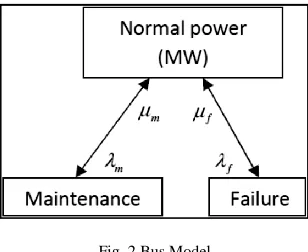
The reliability model of a bus bar is shown in Fig. 2 this includes maintenance and failure modes.
Fig. 2 Bus Model
3). Distribution Line and Switch Model:
The reliability model of the transmission line and switch is shown in Fig. 3, which includes active and passive failure modes and outagemaintenance state.
Fig. 3 Distribution Line and Switch model
D. Evaluating the Reliability at the Load Centers
The computational time can be prohibitively large even for an offline stage of planning and one of the major contribution of this paper is the application of the probabilistic method with very less computational time even for large systems. In this paperhas been identified that the number of components appearing between the feeder and a load point in a distribution system is limited. Hence, the computation of the joint probability of outage of the components is possible within a short time, as explained in the following text. The minimal cut sets between the feeder and the load points are determined by using the algorithm[5]. For the power failure at a load point of all the components of a cut set must fail. In addition, the load point fails if failureof any one of the cut sets occurs, and each cut set is effectively connected in series with all other cut sets and thedetails of evaluating the reliability at the load points for cut sets of different orders are described in the following text. Unreliability at the load point is given by
𝑄 = 𝑃 𝐶𝑖 𝑖 (11)
Where 𝐶𝑖 is the failure event of the 𝑖th minimal cut set
between the feeder and the load point, P(.) denotes the probability of occurrence of an event.
The reliability at the load point is given by
𝑅 = 1 − 𝑄 (12)
1). First-Order Cut Sets:
Fig.4 shows a set of first-order cutsets between the feeder and the load point. The failure event of the ith first-order cut set is denoted byCI; and NI is the total number of
first-order cut sets.
Fig. 4 First Order Cut Sets
The unreliability at the load point due toelements of outage belonging to one or more first-order cut sets is given by
𝑄𝐼 = 𝑝 𝐶
𝑖𝐼 𝑁𝐼
𝑖=1 (13) 2). Second-Order Cut Sets:
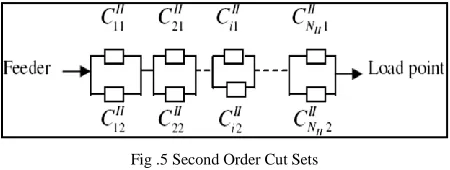
Fig .5 Second Order Cut Sets
The unreliability of the load point due tocomponents outage belonging to one or more second-order cut sets is given by
𝑄𝐼𝐼= 𝑃 𝐶𝐼𝐼 (14)
Where the Failure event CII is given by
𝐶𝐼𝐼= 𝐶
𝑖𝐼𝐼 𝑁𝐼𝐼
𝑖=1 (15)
Here, 𝑁𝐼 is the total number of second-order cut sets. This
cut set can cause a failure only when both of its components fail.
𝐶𝑖𝐼𝐼= 𝐶𝑖1𝐼𝐼 𝐶𝑖2𝐼𝐼 (16)
Once the unreliability is computed for various orders of cut sets in equation (2) can be used to compute the total unreliability of points under load condition. The corresponding measure of the reliability is obtained by using (3). For a distribution system having multiple load points, then the average value of the unreliability is taken as
𝑄𝑆𝐴 =
1
𝐿 𝑄𝑖(𝑙𝑜𝑎𝑑𝑝𝑜𝑖𝑛𝑡)
𝐿
𝑖=1
(17)
Where 𝑄𝑠𝐴 is the average unreliability for the system, and
is the total number of load points considered in the distribution system.
III.BINARYPARTICLESWARMOPTIMIZATION
The reconfiguration of the distribution system discussed in this paper is aimed at maximizing the reliability of the power at the load points and minimizing the system power loss. And the BPSObased algorithm is used to find the optimal configuration of the switches in the network. Reliability at the load points is evaluated by using the probabilistic method described in Section II. It has been successfully applied to optimize various continuous nonlinear functions. The basic principles of PSO are taken from the collective movement of a flock of bird. Number of agents or particles is employed in finding the optimal solution for the problem under consideration. PSO is based on the exchange of information between individuals, so called particles, of the population, so called swarm. Each particle adjusts its own position towards its previous experience and towards the best previous position obtained in the swarm. The movement of particles toward finding the optimal solution is guided by the knowledge of individual and other particles. The position of particle at any instant is determined by its velocity at that instant and the position at the previous instant, as shown in equation (18)
Xi(t) = Xi(t-1)+Vi(t) (18) Where Xi(t)and Xi(t-1) are the position vectors of the ith particle at the instant tand t-1 respectively, andVi(t)is the velocity vector of the particle. The velocity vector is updated by using the experience of the individual particles and the knowledge of the performance of the other particles in its neighborhood and the velocity update rule for a basic PSO is
Vi(t) = Vi(t-1) + ∅1r1 (Pbesti-Xi(t-1))+∅2r2 (gbesti-Xi(t-1)) (19) where ∅1 and ∅2 are adjustable parameters called individual and social acceleration constant respectively; r1 and r2 are random numbers in the range [0, 1]; pbesti is the best position vector found by the ith particle; gbest is the best among the position vectors found by all the particles. The vectors pbestiandgbest are evaluated by
using a suitably defined fitness function. 𝜙1 and 𝜙2 are usually defined such that 𝜙1 + 𝜙2 = 4 , with 𝜙1 = 𝜙2 = 2 . The maximum and minimum values of the components of velocity are limited by the following constraints to avoid large oscillations around the solution.
𝑣𝑖𝑗 =
−𝑣𝑚𝑎𝑥, 𝑖𝑓𝑣𝑖𝑗 < −𝑣𝑚𝑎𝑥
𝑣𝑚𝑎𝑥, 𝑖𝑓𝑣𝑖𝑗 ≥ 𝑣𝑚𝑎𝑥 (20)
In BPSO, each element of position vector can take only binary values i.e. 0 or 1.At each stage of iteration, the element of position vector xi are updated according to the following rule.
𝑥𝑖𝑗(𝑡) =
1, 𝑖𝑓𝜌𝑖𝑗 < 𝑆(𝑣𝑖𝑗)
0, 𝑜𝑡𝑒𝑟𝑤𝑖𝑠𝑒 (21)
Where Pijis a random number in the range[0 1]. S(vij) is a sigmoidal function defined as,
S(vij)= 1/(1 + exp(𝑣𝑖𝑗) (22)
In a BPSO algorithm, population is initiated randomly with particles and evaluated to compute fitnesses together with finding the particle best (best value of each individual so far) and global best (best particle in the whole swarm). Initially, each individual with its dimensions and fitness value is assigned to its particle best. The best individual among particle best population, with its dimension and fitness value, assigned to the global best. Then a loop starts to converge to an optimum solution. In the loop, particle and global bests are determined to update the velocity first. Then the current position of each particle is updated with the current velocity. Evaluation is again performed to compute the fitness of the particles in the swarm. This loop is terminated with a stopping criterion predetermined in advance.
Initialize Parameters Initialize Population Evaluate
Do{
Evaluate } While (termination)
IV.OPTIMALRECONFIGURATIONUSINGBPSO
The distribution reconfiguration problem is essentially the determination of status (open or close) of the switches in the system, depending on desired performance criterion, which, in this case, is the reliability of the power supplied to the customers. The reconfiguration can be an operational or planning problem. In the operating state of a distribution system, the existing sectionalizing and tie switches constitute the set of switches for which the optimal statuses are to be determined. In the planning stage, along with the existing switches in the system, potential locations where new switches may be installed need to be identified. For the present work, it is assumed that the locations of the existing switches and the potential new switches are known. The BPSO algorithm searches through various possible set of switch configurations. At each stage of the search process, reliability of the reconfigured system is evaluated in terms of the chosen reliability index. Constraint imposed on the feasibility of a set of switch configuration is that the system should be radial, and that the electrical connection from the feeder to the end load should be maintained.
In the proposed implementation of the BPSO, the position vectors of the particles represent the potential solutions for the distribution system reconfiguration problem. A fitness function needs to be defined to evaluate the suitability of the solutions found by the particles at each stage. The individual position vector of a particle, pbesti , and the global best position vector gbest are evaluated based on this fitness function. The objective of the distribution system reconfiguration problem in this paper is to maximize the reliability of the power supplied to the customers. The fitness function therefore should evaluate, for the position vector of each particle, (1) whether the reconfigured system is feasible in terms of network constraints, and (2) in case it is feasible, what is the reliability of the power supplied to the customers. 1. LOLE: Loss of load expectation (LOLE) is defined as the average number of hours or days in a given period in which the hourly or daily peak load exceeds the available generating capacity. This is a measure of the adequacy of the power supplied by one or morefeeders to the distribution system.
2. LOEE: Loss of energy expectation (LOEE) is the expected energy (in MWhr) not supplied due to the loads exceeding the available power supplied by the feeders.
The fitness function J (x) for using the BPSO is formulated as follows:
𝐽 𝑥 = 𝑤𝐾, 𝑖𝑓 𝑡𝑒 𝑐𝑜𝑛𝑓𝑖𝑔𝑢𝑟𝑎𝑡𝑖𝑜𝑛 𝑖𝑠 𝑛𝑜𝑡 𝑓𝑒𝑎𝑠𝑖𝑏𝑙𝑒
1𝐽1+ 𝑤2𝐽2, 𝑖𝑓 𝑡𝑒 𝑐𝑜𝑛𝑓𝑖𝑔𝑢𝑟𝑎𝑡𝑖𝑜𝑛 𝑖𝑠 𝑓𝑒𝑎𝑠𝑖𝑏𝑙𝑒
(23)
Where K is a large number assigned to the fitness function if the position vector representing the set of switch configurations is not feasible (i.e., the reconfigured system is not radially connected); w1 and w2 are two weights with values such that w1J1 and w2J2 are comparable in magnitude. J1 and J2are the reliability indices as shown below
J1=LOLE J2=LOEE
The number of elements in the binary position vector x is equal to the number of switches in the system. The elements of xare defined as follows:
𝑥 = 1, 𝑖𝑓𝑡𝑒𝑠𝑤𝑖𝑡𝑐𝑖𝑠𝑐𝑙𝑜𝑠𝑒𝑑
0, 𝑖𝑓𝑡𝑒𝑠𝑤𝑖𝑡𝑐𝑖𝑠𝑜𝑝𝑒𝑛𝑒𝑑(24)
The search process starts with a randomly selected binary position vector x, i.e., each element of x is randomly assigned a value of either 0 or 1. Using this switch configuration, it is examined whether the network constraints are being satisfied or not. If the switch configuration fails to render a connected and radial network, it is considered an infeasible solution, and a large numerical value, K is assigned to the fitness function. When the switch configuration satisfies the network constraints, a Monte Carlo simulation is performed, and the reliability indices LOLE and LOEE are evaluated based on the reliability models of the components that are involved in the network. The fitness function is the weighted sum of LOLE and LOEE.
V. SIMULATION RESULTS
The effectiveness of the proposed methodology is tested on a 9 bus radial distribution system. The possible location of switches is shown in Fig. 6. Each switch can either open or close. The optimal status (open or close) of the switches is determined by using computing techniques of BPSO. For simplified analysis, it is assumed that the reconfigured system should be radial, since the radiality of the system is taken as a necessary constraint.
Line no
Failure rate (failure per year)
Repair rate (hrs)
Load points
No of customers
Demand (kw)
1 0.10 2.0 - - -
Fig.6 Single line diagram of IEEE 9 bus system
The table I shows the line and load data of IEEE 9 Bus system.Bus 1 is taken as a slack bus.
TABLE I
Line and Load Data for IEEE 9 Bus System
Fig. 7Before optimal placement of switches in IEEE 9 bus system
Fig. 8After optimal placement of switches in IEEE 9 bus system
VI. CONCLUSIONS
In this project, reliability of IEEE 9 bus radial distribution system has been improved by Network Reconfiguration using Binary Particle Swarm Optimization (BPSO). Distribution system reconfiguration methodology aimed at maximizing the reliability by reducing the frequency and duration of interruption power supplied to the customers. In the present work, probabilistic reliability models of the components are used to estimate the future behavior of the distribution system in terms of the reliability of supplying
power to its customers. Binary particle swarm (BPSO) algorithm is used to determine the optimal statuses of the switches in the distribution system. By using algorithm BPSO fault rate of the equipment is reduced and the reliability is maximized. Thus frequency and duration of interruptions are reduced after the optimal placement of switches in IEEE 9 bus system and the Reliability is improved.
REFERENCES
[1] A.Moradi, M.Fotuhi-Firuzabad,andM.Rashidi-Nejad,- A reliability cost/worth approach to determine optimum switching placement in distribution systems, presented at the IEEE/power Eng.Soc.Transmission and distribution Conf.Exhibit:Asia and Pacific, Dalian,China,2005
[2] Billinton, R., and Allan, R. N., "Reliability Evaluation of Power
system Pitman Books, New York and London, 1984
[3] M. Tadayon and S. Golestani, ―A New Method for Optimal RCS Placement in Distribution Power System Considering DG
Islanding Impact on Reliability, IEEE Transmission &
Distribution Conference &
[4] Exposition(Asia and Pacific), 2009, 26-30 Oct. 2009, Seoul.
[5] J. Kennedy and R. Eberhart, ―Particle swarm optimization, in Proc. IEEE Int. Conf. Neural Networks, Perth, Australia, 1995, vol. IV, pp.1942–1948.
[6] B.E.Wells, C.Patrick,L.Trevino,J.Weir,andJ.Steinca,-Applying particle swarm optimization to a discrete variable problem on an
FPGA based architecture,Presented at the MAPLD
Int.Conf.,Washington,D.C.,2005.
[7] R. Billinton and R. N. Allan, Reliability Evaluation of Power
Systems. New York: Plenum Press, second ed., 1996.
[8] Power System Outage Task Force, “Final report on the August 14,
2003 blackout in the United States and Canada: causes and recommendations.” Canada, Apr. 2004.
[9] H. L. Willis, Power Distribution Planning Reference Book. New York: Mercel Dekker, Inc., second ed., 2004.
[10] M. E. Baran and F. F. Wu, “Network reconfiguration in
distribution systems for loss reduction and load balancing,” IEEE
Trans. PowerDelivery, vol. 4, pp. 1401–1407, April 1989. [11] S. K. Goswami and S. K. Basu, “A new algorithm for the
reconfiguration of distribution feeders for loss minimization,”
IEEETrans. Power Delivery, vol. 7, pp. 1484–1491, July 1992. [12] B.Morton and I.M.Y. Mareels,”An efficient brute-force solution to
the network reconfiguration problem”,IEEETrans.Power
Delivery, vol. 15,no.3,pp.996-1000,2000.
[13] M. A. Kashem, G. B. Jasmon, and V. Ganapathy, “A new approach of distribution system reconfiguration for loss
minimization,” ElectricPower& Energy Systems, vol. 22, pp. 269–
276, 2000.
[14] A. Abur, “A modified linear programming method for distribution system reconfiguration,” Electrical Power & Energy systems, vol.