Analysis of Various Modulation Techniques
Based on Bit Error Rate for Conventional and
Wavelet Based OFDM in LTE
R.Divya Jyothi
1,
Dr.A.Maheswara Rao
2M.Tech Student, Dept. of ECE, PBR VITS, Kavali, India1 Professor, Dept. of ECE, PBR VITS, Kavali, India2
ABSTRACT: OFDM has been widely adopted in many more applications due to its good spectral performance and low sensitivity to impulse noise andmultipath channels. In OFDM that a cyclic prefixes (CP) is appended to each symbol in order to mitigate the effect of Inter-Symbol-Interference (ISI) and intercarrier interference (ICI). However, this reduces the spectral efficiency. A perfect reconstruction using wavelet based OFDM provides good orthogonality and with its use Bit Error Rate is improved. Wavelet based system does not require CP, so spectrum efficiency is increased. In this paper, I am presenting BER analysis of conventional and wavelet based OFDM in LTE using different modulation techniques like QAM, 4 QAM, 16 QAM, 64 QAM and 256 QAM.
KEYWORDS: LTE; OFDM; DFT; Wavelet; BER.
I.INTRODUCTION
signal processing techniques. Most recently the proposed DWT for multi-carrier modulations are using time domain equalization. Inthis study I present a new way of channel equalization when working with wavelets. I examine the ISI, and compare the performance of different wavelet families in terms of signal reconstruction. DWT and WPT methods are studied in terms of processing time and performance. Another major contribution of this study is the extension of the DWT technique into the MIMO environment where the performance of the system has been evaluated using both receive and transmit diversity techniques.
\
II. RELATED CONTENT
2.1 OFDM and its Orthogonality
In orthogonal frequency division multiplexing communication model, the sub carrier used are orthogonal to each other. The Orthogonality helps in employing the overlapping between the sub carriers in the respective frequency domain. The accuracy of communication model is based on how effective the bandwidth is used and this is technically termed as spectral efficiency or bandwidth efficiency, the acquired bandwidth efficiency is free of Inter carrier interference and the absence of Inter carrier interference (ICI) is mainly because of usage of Orthogonality in orthogonal frequency division multiplexing.
Figure 1: Orthogonality in orthogonal frequency division multiplexing (OFDM)
2.2 Basic OFDM System
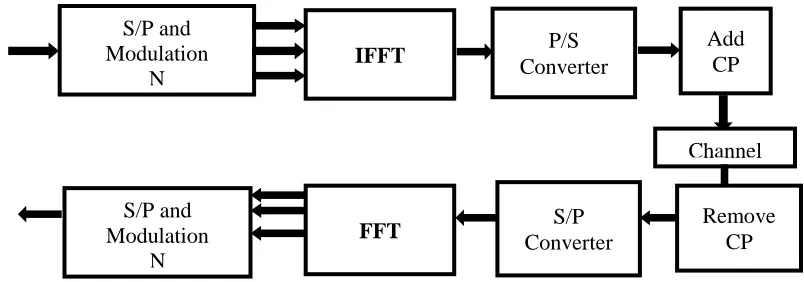
The orthogonal frequency division multiplexing block diagram is illustrated as follows in figure 2. The input random signal data rate streams (high) are converted into data rate streams (low). The important aspect in the OFDM block diagram is the modulation technique which modulates the low data rate streams in parallel way and this parallel stream given input to the IFFT block which transforms the frequency data to time data before it reaches the channel. Adding the cyclic prefix acts as the guard interval and the reverse of transmission is accomplished at receiver end.
Figure 2: Block diagram of Basic OFDM system
S/P and
Modulation
N
IFFT
Converter
P/S
Add
CP
Channel
Remove
CP
S/P and
Modulation
N
2.3 MIMO OFDM System
The below block diagram represents the MIMO-OFDM system which comprises of transmitters and receivers in multiple way. The input data (digital) is generated by binary source generator as shown in below figure and the binary data is modulated with modulation approach such as BPSK, QPSK and QAM with several different constellations. The serial to parallel performs the task to convert the serial data to the parallel mode in N various sub streams. Then these various sub streams are modulated through the IFFT modulation block.The IFFT block in the block diagram in design to transform the frequency to time domain for obtaining the delay related issues at the channel and then guard interval named CP is inserted to tackle the issues like ICI/ISI. The OFDM symbols are initialized in the time domain which has specified length before giving it to the channel then the operation is performed in the inverse direction to remove all the operations which are performed and gets the output as OFDM signal in MIMO format.
III. PROPOSED METHODOLOGY
A. Proposed Wavelet based Multicarrier System
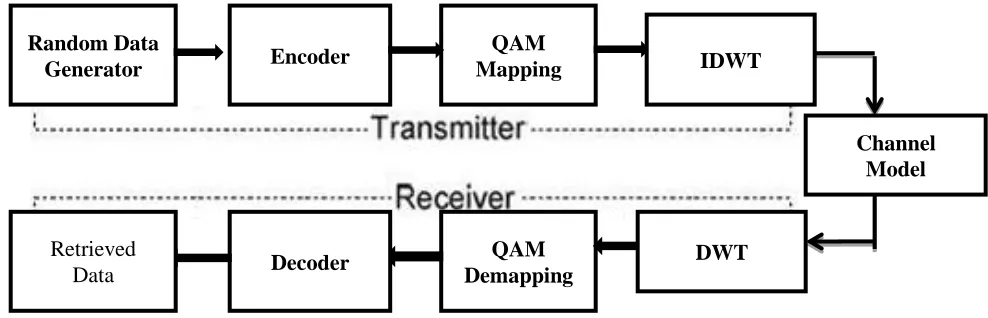
The proposed implementation has similarities to Wavelets in the MIMO-LTE has a analysis period as well as synthesis period ,the analysis period measured by sub-band filter of down sampler while synthesis period is measured by sub-band filter of up sampler. The sub-band filter period used through the channel filter exists exact restoration of Quadrature mirror filter [QMF], subsequently the low pass as well as high pass operation is performed on each level of the individual signal bands and double out puts are taken even for the small sequence. The IDWT as a modulator operation performed at the transmitter and DWT as a demodulator perform at the receiver side.
Figure 3: Wavelet based proposed MIMO systemdesign
Once the received signal is successfully equalized in the frequency domain it is converted back to time domain using IFFT and then analyzed using discrete wavelet transform process. This involves conjugate high pass h*(-n) and low pass filters g*(-followed by down-sampling by a factor of 2. This process is repeated until the initial N parallel streams are obtained, which are passed through a parallel to serial convertor and demodulated.Wavelet transform show the potential to replace the DFT in OFDM. Wavelet transform is a tool for analysis of the signal in time and frequency domain jointly. It is a multi resolution analysis mechanism where input signal is decomposed into different frequency components for the analysis with particular resolution matching to scale. As shown in figure 4, in this proposed model, IDWT and DWT are used instead of the IDFT and DFT. Rayleigh channel is used for transmission and cyclic prefixing is not used. Here first of allconventional encoding is done followed by interleaving then data is converted to decimal form and modulation is done next.
Random Data
Generator
Encoder
QAM
Mapping
IDWT
B.CONVENTIONAL OFDM LTE SYSTEMS
For conventional OFDM system, an orthogonal basis function set is comprised of DFT sinusoids. In DFT the transform correlates the input signal with that of each sinusoidal basis function [4], here orthogonal basis functions are the subcarriers used in OFDM technique. At the receiver side the signals are combined to obtain the information transmitted. OFDM is a technique of multicarrier modulation in which the spectrum of the subcarriers overlap with each other. The spacing in frequency among them is selected in such a manner that orthogonality is obtained among the subcarriers. The basic OFDM system block diagram is shown in Figure 4.
Noise
Channel
Figure 4: DFT Based OFDM system
Wavelet transform have the ability to completely replace the DFT in OFDM. Wavelet transform is a tool for analysis of the signal in time as well as frequency domain. It is a multi resolution analysis mechanism where input signal is decomposed into various frequency components for the performance evaluation with particular resolution matching to scale. Wavelet transform have the ability to completely replace the DFT in OFDM. Wavelet transform is a tool for analysis of the signal in time as well as frequency domain. It is a multi resolution analysis mechanism where input signal is decomposed into various frequency components for the performance evaluation with particular resolution matching to scale.
AWGN Channel
Encoding
Interleaving
Modulation
IDWT
Carrier Mapping
Pilot Insertion
DWT
Demapping
Pilot
Synchronization
Decoding
DeInterleaving
Demodulation
Data Encoding
Modulation
IFFT
Pilot
Synchronization
Removing Cycle
Prefix
Adding Cycle
Prefix
Figure 5: Wavelet based proposed OFDM system design
Figure 5 describes the proposed model with IDWT and DWT instead of IDFT andDFT. AWN channel is implemented for transmission and cyclic prefixing is not used. Here first of all conventional encoding is performed followed by interleaving after that data is converted into the decimal form and modulation is done next.
C. BER PERFORMANCE EVALUATION
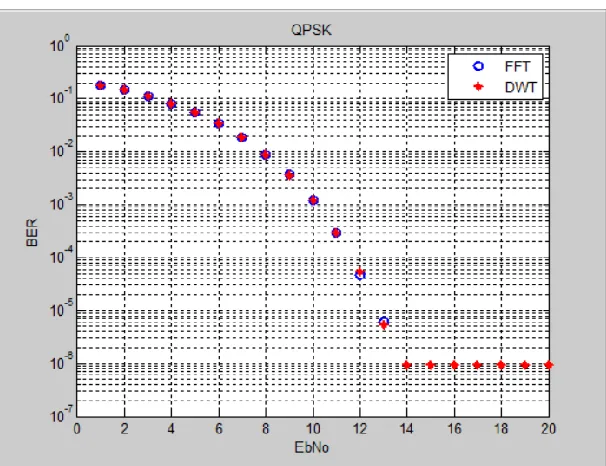
By using MATLAB performance characteristic of DFT based OFDM and wavelet based OFDM are obtained for different modulations that are used for the LTE, as shown in figures 3-5. Modulations that could be used for LTE are QPSK, 16 QAM and 64 QAM (Uplink and downlink). QPSK does not carry data at very high speed. Lower forms of modulation (QPSK) does not require high signal to noise ratio. For the purpose of simulation, signal to noise ratio (SNR) of different values are introduced through AWGN channel. Data of 9600 bits is sent in the form of 100 symbols, so one symbol is of 96 bits. Averaging for a particular value of SNR for all the symbols is done and BER is obtained and same process is repeated for all the values of SNR and final BER’s are obtained. Firstly the performance of DFT based OFDM and wavelet based OFDM are obtained for different modulation techniques. Different wavelet types daubechies2 and Haar is used in wavelet based MIMO for QPSK, 16-QAM, 64-QAM.
IV. SIMULATION RESULTS
Figure 7:BER performance of wavelets and DFT based OFDM system using 16 QAM Modulation
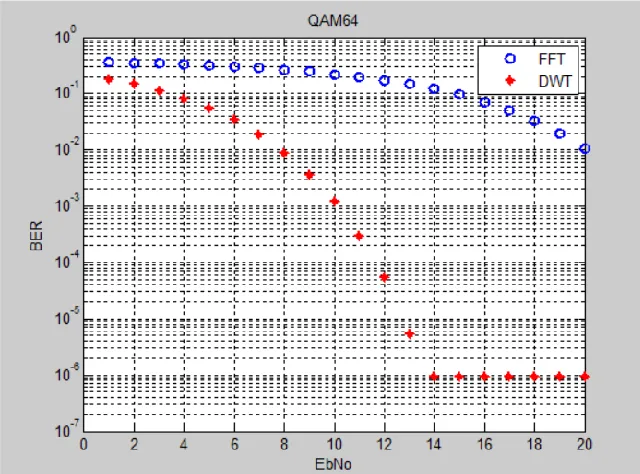
Figure 8:BER performance of wavelets and DFT based OFDM system using 64QAM Modulation
Simulations have been done in MATLAB and also analyzed the performance of various modulation schemes based DFT and DWT.
The proposed system exploits the special property of wavelet transforms such that filter distortions and signal aliasing is completely cancelled using the analysis and synthesis filters. This resulted in the perfect reconstruction of the original input data signal and perfect extraction of the multiplexed input signals. The aliasing cancellation condition that is imposed in the filter banks ensures no cross talk in the corresponding Trans multiplexer. Meanwhile, the proposed wavelet transform multicarrier modulation scheme brought increased spectral efficiency, consequent on the non-inclusion of cyclic prefixing which needs up to 25% of the transmit bandwidth in the conventional FFT-based MIMO. Comparison between two different types of wavelet-based modulations was also presented which showed that the DWT performs better than WPT both in terms of BER performance, and in terms of processing times as WPT decomposition is performed at each node. Diversity techniques were then studied using the proposed DWT-MIMO with frequency domain equalization.
The contribution work continuous to proposed method is accomplished on ETU channel.ETU channel has adoptability approach in it and acts in both environments (indoor &outdoor). The BER analysis is carried out based on ETU instead of AWGN channel to yieldhigh performance and low complexity.
REFERENCES
[1] Anuradha, Naresh Kumar, “BER analysis of conventional and wavelet based OFDM in LTE using different modulation techniques”. Proceeding of 2014 RAECS UIET Punjab UniversityChandigarh, 06-08 March, 2014 IEEE.
[2] G. Sailakshmi, K. Sudha, “BER analysis of wavelet based OFDM using different modulation techniques”, International Journal ofScience and Research, vol. 4 issue 5, May2015
[3] S. Padmaja, S. ChakriSreedhar, “BER analysis of conventional and wavelet based OFDM In LTE using different modulation techniques”, International Journal of Eminent EngineeringTechnologies, vol. 2 issue 4, May 2015
[4] PargteeTomar, Mitra Sharma, Bhawani Shankar Chaudhary, “Bit Error Rate (BER) Analysis of Conventional OFDM (DFT-OFDM) and Wavelet Based OFDM (DWT-OFDM)”,International Journal on Recent and Innovation Trends in Computing and Communication, vol.3, issue 1, pp.423-426, January 2015.
[5] K. Volkan, K. Oguz, “Alamouti coded wavelet based OFDM for multipath fading channels”, IEEE Wireless telecommunications symposium, pp.1-5, April 2009.
[6] G. Mahesh Kumar, S. Tiwari, “Performance evaluation of conventional and wavelet based OFDM system”, International journal of electronics and communications, Elsevier, vol. 67, no. 4, pp. 348-354, April 2013.
[7] J. Antony, M. Petri, “Wavelet packet modulation for wireless communication”, Wireless communication & mobile computing journal, vol. 5, no. 2, pp. 1-18, March 2005.
[8] Mr. Sivanagaraju and Dr. Siddaiah “Comprehensive Analysis of BER and SNR in OFDM Systems” International Journal ofInnovative Research in Computer and Communication Engineering, Vol. 2, Issue 2, February 2014
[9] Mr. SumitDalal, MrPulkitBerwal, Electronics & Communication Dept. ,Ganga Technical Campus, SoldhaBahadurgarh, “A BER Performance Analysis of Shift Keying Technique with MMSE/MLSE estimation in Fading domain” IJIRAE, June 2014
[10] M. Divya “Bit Error Rate Performance of BPSK Modulation and OFDM-BPSK with Rayleigh Multipath Channel” IJEAT, April 2013.
BIOGRAPHY