Abstract—A new concurrent cell formation method for solving a Cell Formation (CF) problem in a Cellular Manufacturing System (CMS) is developed and proposed in this research. To solve such problem, conventionally a facility planner needs to classify parts into families and group machines into cells, respectively. However, existing methods for solving the CF problem are difficult and complicated. Moreover, efficient solutions of some of those methods are not guarantee. So, the efficient method based on two important performance measures, called Exceptional Elements (EE) and the Void Elements (VE) of a perfect grouping, are developed. Preemptive Fuzzy Goal Programming (P-FGP) is applied to these two performance measures for finding the efficient solution. The problems of grouping part family and machine cells can be simultaneously easily solved. Moreover, machines and parts grouping can also be adjustable to find preferred solutions by use of P-FGP. The numerical examples existed in the literatures are shown to demonstrate the efficiency of the proposed model over the conventional method.
Index Terms—Cell Formation Problem, Cellular Manufacturing System, Concurrent Formation Method, Preemptive Fuzzy Goal Programming
I. INTRODUCTION
ECAUSE of fast changes in the market needs and
manufacturing technologies, Cellular Manufacturing System (CMS) based on Group Technology (GT) has been emphasized. The CMS enhances manufacturing flexibility and productivity in order to overcome difficulties concerned with multi-product and batch-production systems [1]-[3]. One of the most crucial problems in the CMS faced in classifying parts into families and grouping machines into cells is called Cell Formation (CF) problem [1], [4]. The common considerations in part family formation can be similar geometry, function, material or process requirement to take benefit of their similarities for designing and manufacturing purposes. Whereas, machines involved part manufacturing will be assigned and dedicated to the part family in machine cell formation [4]-[6].
Manuscript received January 12, 2011.
W. Nunkaew is a Graduate Student of Industrial Statistics and Operational Research Unit (ISO-RU) in Industrial Engineering Department, Faculty of Engineering, Thammasat University, Rangsit campus, Klongluang, Pathum-thani, 12120, Thailand. (e-mail: [email protected])
B. Phruksaphanrat is an Assistant Professor, ISO-RU, Industrial Engineering Department, Faculty of Engineering, Thammasat University, Rangsit campus, Klongluang, Pathum-thani, 12120, Thailand (e-mail: [email protected]).
By the past recent decades, various numbers of methods for solving the CF problem have been presented. However, solving such multivariate data in CF problem is known to be NP-complete [5], [6]. Thus, satisfying method for solving the CF problem is always required. The basic idea to solve the problem is to rearrange the rows and columns of the incidence matrix. The incidence matrix refers to the relationships between parts and machines. So, rearranging the matrix to perform the groups of parts which has corresponding operations and the required machines is preferred. The well-known matrix rearrangement methods are the Bound Energy (BE) algorithm and Rank Order Cluster (ROC) algorithm [1], [3], [7], [8]. Nevertheless, such methods of solving a CF problem are complicated and difficult especially for large scale problems. The facility planner has to pay more attention carefully to the huge incidence matrix, so these kinds of methods are not practical.
Many efficient methods to solve the CF problem are proposed for both mathematical methods and heuristic methods. The p-median presented by Kusiak (1987) is one of the familiar method [3], [7], [9]. This method can obtain the solution satisfyingly. However, using the p-median model requires two processes to solve part family problem and machine cell problem, respectively. So, it is quite inefficient method if the facility planner needs to solve both part family problem and machine cell problem at the same time. For heuristic methods [2], [7], efficient solutions of these methods are not guarantee.
In this research, the concurrent cell formation method by Preemptive Fuzzy Goal Programming (P-FGP) has been proposed for solving the CF problem in the CMS. By the way of perfect grouping which diagonal matrix is preferred, the Exceptional Elements (EE) and the Void Elements (VE) are concerned in the multi-objective programming model. Additionally, setting the membership function for each goal makes flexibility for facility planner in selecting the preferred solution.
The remainder of this research is organized as follows. The cell formation problem is discussed in Section II. Then, the detail discussion of the exceptional elements and the void elements is followed in Section III. Next, mathematical formulation of the proposed model is illustrated in Section IV. In Section V, illustrative examples are shown. Finally, the conclusion of this research is provided in Section VI.
Concurrent Cell Formation for Cellular
Manufacturing System by Preemptive Fuzzy
Goal Programming
Wuttinan Nunkaew and Busaba Phruksaphanrat, Member, IAENG
II. CELL FORMATION PROBLEM
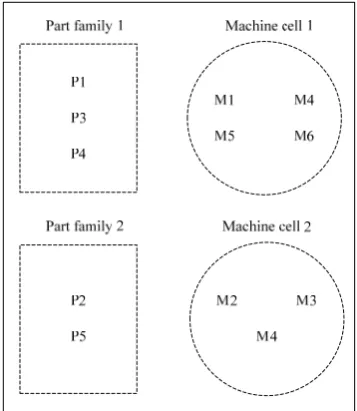
The Cell Formation (CF) problem concerns with designation of part families and machine cells in Cellular Manufacturing System (CMS) based on Group Technology (GT). The most important problems are classification of parts into families and grouping machines into cells [1], [4], as shown in Fig. 1. In part family formation, parts can be formed based on similar geometry, function, material or process requirement to take benefits of their similarities for designing and manufacturing purposes. Meanwhile, in machine cell formation, dissimilar machines are brought together and then dedicated to the involved part family [4]-[6]. So the CF problem is seemly to decompose a manufacturing system into sub-systems [9].
For solving such problem, the machine-part incidence matrix,
aij is set in which rows and columns representmachines and parts, respectively. The zero-one matrix is considered that the (i,j)th element of
aij is 1 if the jth partneeds to operate on the ith machine and is 0, otherwise. The result of part families and machine cells formations is obtained as diagonal block.
As shown in Fig. 2. (a), the machine-part incidence matrix of five parts and four machines is created. Each column in Fig. 2. (a) represents a set of machines required to operate the specific part. For example, part 1 has to operate on machine number 2 and 4. After rearranging rows and columns, the result of part families and machine cells formation can be shown as in the Fig. 2. (b), which can be summarized in Table I.
[image:2.595.77.256.430.636.2]
Fig. 1. A cellular manufacturing system with two part families and two machine cells.
Parts Parts 1 2 3 4 5 1 3 2 4 5
1 1 1 1 1 1 2
1 1 2 1 1 1 4
Machines Machines
1 1 3 1 1 1 1
1 1 1 4 1 1 3
. .
[image:2.595.47.299.675.752.2](a) (b)
Fig. 2. The machine-part incidence matrix of five parts and four machines.
TABLEI
RESULTS OF FORMATION OF AN EXAMPLE
Cell Parts Machines 1 1,3 2,4 2 2,4,5 1,3
1 1 1 0 0 0 0 0 0 0 0 0 0 0 0 1 1 1 0 0 0 0 0 0 0 0 0 0 0 0 0 0 0 1 1 1 1 1 1 0 0 0 0 0 0 0 0 0 1 1 1 1 1 1 0 0 0 0 0 0 0 0 0 1 1 1 1 1 1 0 0 0 0 0 0 0 0 0 0 0 0 0 0 0 1 1 1 0 0 0 0 0 0 0 0 0 0 0 0 1 1 1 0 0 0 0 0 0 0 0 0 0 0 0 1 1 1 0 0 0 0 0 0 0 0 0 0 0 0 0 0 0 1 1 1 0 0 0 0 0 0 0 0 0 0 0 0 1 1 1
Fig. 3. The perfect grouping.
A perfect grouping of part families and machine cells formation is that all 1’s occupy in the diagonal sub-matrices and all 0’s are arranged in the off-diagonal sub-matrices as shown in Fig. 3 [1]. However, the solution of formation depends on the primary input data. Such perfect diagonal form may be not always obtained for a given data set or for the real-world formation problems.
As mentioned in the former section, there are many existing methods to solve a CF problem. Some of those methods emphasize the mutuality in a group of parts or machines. Some methods attempt to create the block diagonalization of matrices. However, obtaining solutions from the existing methods are still inefficient when there are many parts and machines to be considered in the CMS. This research uses two aspects of the perfect grouping concept. Firstly, the optimal solutions of CF should have no any ‘exceptional element’. Secondly, no ‘void element’ is preferred. These two aspects are the important performance measures of the perfect grouping. The details of these elements are explained in the following section.
III. EXCEPTIONAL ELEMENTS AND VOID ELEMENTS
Such mentioned previously, the exceptional elements and the void elements are considered in this research in order to obtain the efficient solution of cell formation by the viewpoint of the perfect grouping.
A. Exceptional Elements
the formation results. Definitely, the number of EE can be quantitatively calculated from (1).
1 1 1
1 2
p n m
ij ik jk k i j
EE a x y .
(1) Where p parts, m machines and n cells are considered, xikis
1 if machine i is assigned to cell k and 0, otherwise. Whereasyjkis 1 if part j is assigned to cell k and 0,
otherwise. B. Void Elements
Void Elements (VE) are used to evaluate the compactness of a formation within block sub-matrices. The VE can be observed easily when part j does not require machine i which is the machine in the machine cell of part j’s family. This phenomenon indicates that the ineffective solutions occur in the sub-matrices because there is a part which does not use all machines of the machine cell for example as shown in Fig. 2. (b). The element a35(the element of part 5 and machine 3) is the VE because part 5 does not require machine 3 that is one of the machine in the machine cell for part 5’s family. We can clearly see that cell formation will be better if part 5 requires machine 3 and it is assigned to that cell because that sub-matrix will be a perfect grouping. The number of VE can be defined as follow;
1 1 1 1 p n m
ij ik jk k i j
VE a x y .
(2) Both of these elements are important in determining the formation results. The details of using these elements in the proposed model will be shown and described in the next section.
IV. MATHEMATICAL FORMULATION
In this section, we propose a fuzzy multi-objective programming model for concurrent formation of part families and machine cells for CMS. The following notations are used in the proposed model.
Index sets:
i index for machine, for all i=1,2,…,m. j index for part, for all j=1,2,…,p. k index for cell, for all k=1,2,…,n.
g index for objective or goal, for all g=1,2,…,l. Decision variables:
ik
x is 1 if machine i is assigned to cell k and 0, otherwise.
jk
y is 1 if part j is assigned to family k and 0, otherwise. Parameters:
aijis 1 if the jth part needs to operate on the ith machine
and is 0, otherwise.
A. Objective Functions
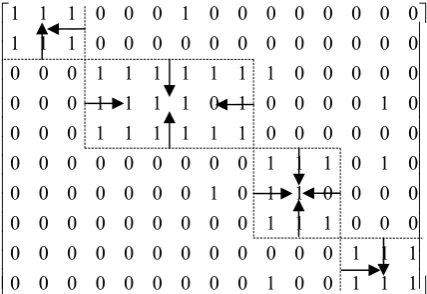
This research aims to propose the method for solving the cell formation based on a perfect grouping. Two elements of a perfect grouping, EE and VE, are considered in the proposed model. These elements should not exist in the perfect resulting matrix as shown in Fig. 3. So, two objective functions can be constructed as follows:
1 1 1 0 0 0 1 0 0 0 0 0 0 0 0 1 1 1 0 0 0 0 0 0 0 0 0 0 0 0 0 0 0 1 1 1 1 1 1 1 0 0 0 0 0 0 0 0 1 1 1 1 0 1 0 0 0 0 1 0 0 0 0 1 1 1 1 1 1 0 0 0 0 0 0 0 0 0 0 0 0 0 0 0 1 1 1 0 1 0 0 0 0 0 0 0 0 1 0 1 1 0 0 0 0 0 0 0 0 0 0 0 0 0 1 1 1 0 0 0 0 0 0 0 0 0 0 0 0 0 0 0 1 1 1 0 0 0 0 0 0 0 0 0 1 0 0 1 1 1
[image:3.595.315.532.50.199.2]
Fig. 4. The expansion of boundary of the sub-matrices.
1 1 1 0 0 0 1 0 0 0 0 0 0 0 0 1 1 1 0 0 0 0 0 0 0 0 0 0 0 0 0 0 0 1 1 1 1 1 1 1 0 0 0 0 0 0 0 0 1 1 1 1 0 1 0 0 0 0 1 0 0 0 0 1 1 1 1 1 1 0 0 0 0 0 0 0 0 0 0 0 0 0 0 0 1 1 1 0 1 0 0 0 0 0 0 0 0 1 0 1 1 0 0 0 0 0 0 0 0 0 0 0 0 0 1 1 1 0 0 0 0 0 0 0 0 0 0 0 0 0 0 0 1 1 1 0 0 0 0 0 0 0 0 0 1 0 0 1 1 1
Fig. 5. The contraction of boundary of the sub-matrices.
The First Objective Function is to Minimize the Number of the Exceptional Elements
1
1 1 1
1 min
2
p n m
ik jk ij ik jk
k i j
f ( x , y ) a x y .
(3) This objective function is concerned in the proposed model in order to find the solutions of cell formation that have as less as possible of EE. By the idea of a perfect grouping, the boundary of each sub-matrix is expanded to cover as many as possible numbers of elements in the machine-part incidence matrix as illustrated in Fig. 4. Most of elements are assigned to sub-matrices which mean that less of EE is occurred.
The Second Objective Function is to Minimize the Number of the Void Elements
2
1 1 1
min 1ik jk n m p ij ik jk k i j
f ( x , y ) a x y .
(4) Similarly, the second objective function is considered to find the solutions of cell formation that have as less as possible of VE. The boundary of each sub-matrix is retracted to cover as less as possible number of zero elements in each sub-matrix as shown in Fig. 5. Most of zero elements are not assigned to the sub-matrices which mean that less of VE is occurred.
B. Preemptive Fuzzy Goal Programming
[image:3.595.317.531.224.371.2]approaches [13], etc. Furthermore, one of the most popular methods to solve MODM problems is Goal Programming (GP) [12]-[13].
Generally, GP is concerned with conditions of achieving prospective targets or goals. Setting the quantity of goals or targets, and constraints are necessary. They are defined precisely in GP. But in fact, it is difficult for asking the Decision Maker (DM) what achievements are clearly desired for each targets or goals. So, the DM cannot precisely decide how much the value of targets or goals should be set. Appling fuzzy set theory into GP makes easiness of allowing vague aspirations of the DMs. Such vague target or goal can be defined using membership function which is discussed in the following subsections.
In many MODM problems, some goals are extremely important than the others. So, it causes that the DM cannot simultaneously consider the attainments of all goals. Differentiating goals into different levels of importance, in which the high level goal must firstly be satisfied before the low level goals get consideration, is called preemptive or lexicographic ordering. The fuzzy goal programming with a priority structure for ordering goals is called “Preemptive Fuzzy Goal Programming (P-FGP)” [14], [15]. The P-FGP model can be shown as follows,
lex max [p= 1 f ( )1 ,p2 f ( )2 ,...,pt f ( )t ], (5) subject to
*,
g g
for all g. (6)
δ δ =1,
- +
g g g
for all g. (7)
Δ (δ δ ) ,
- +
g g g g g
f () =
for all g. (8) [0,1]
g
for all g. (9)
δ δ- + 0,
g, g δ δ 0,
- +
g g= for all g. (10) Wheregis the satisfactory level of goal g. *
g
is the acceptable satisfactory level of goal g. +
g
and gare the positive and negative deviations of the satisfactory level of goal g.
In the P-FGP, there exist T priority levels (each priority may include mg goals for g = 1,2,...,l) that preemptive weights are pt pt+1whereas f ( )t is the satisfactory function of priority t. The problem is then partitioned into T sub-problems or T fuzzy goal programming. For easiness, the goals are ranked in agreement with the following rule: if
r < s, then the goal set G (x)r has higher priority than the goal set G (x)s [15].
C. Membership Function
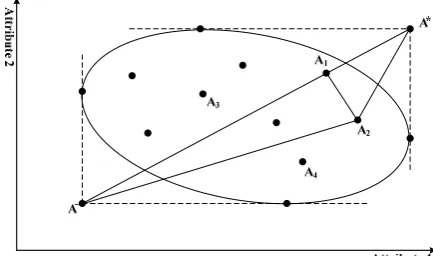
In this research, fuzzy set is applied to each goal of objective function. Defining membership function of each goal is based on the Positive-Ideal Solution (PIS) and the Negative-Ideal Solution (NIS) [16]-[18]. The PIS is the best possible solution
*A when each objective function is
optimized. The NIS is the feasible and worst value
A of [image:4.595.315.532.56.184.2]each objective function as shown in Fig. 6. Assume that a triangular membership functions is used for each goal.
Fig. 6. The PIS and NIS of the two-dimensional space.
(z )g
zg g
1
0
g g
g g
g
g
[image:4.595.324.547.514.636.2]
Fig. 7. The triangularmembership function of gth goal.
In the proposed model, the first goal is to minimize the number of EE to the most preferred value. Similarly, the second goal is to minimize the number of VE to the most preferred value. According to the DM’s viewpoint, PIS is used to set the most preferred value and has the satisfactory degree of 1. By the same way, the satisfactory degree of 0 is assigned to the NIS. Acceptable deviation from the goal can be calculated from the difference between PIS and NIS or it can be evaluated by DM. Then, the triangular membership function of the gth goal based on the DM’s preference can be shown as Fig. 7. Mathematical representation of the membership function can be represented by (11).
0 , if z Δ
z
1 , if Δ z
Δ
(z ) ,
z
1 , if z +Δ
Δ
0 , if z +Δ
g g g
g g
g g g g
g g
g g
g g g g
g
g g g
(11)
where (z ) g is the membership function of the gth goal. g is the specified target for the gth goal, assigned by the PIS.
Δg PIS-NIS is the acceptable deviation of the gth goal.
D. The Proposed Formulation Model
The proposed model has two fuzzy goals. The satisfactory level (g) of each goal needs to be satisfied consecutively.
elements which are assigned outside the cells. But it is acceptable if there are some parts which do not require some machines in cells. So, EE is considered more crucial than VE. Then, two priority levels are constructed. However, designing the target of each goal is difficult. Then, the P-FGP is applied to the proposed model to make easiness by allowing vague aspirations of the DM. Fuzzy goal equations can be derived as follows,
Δ (δ- δ+) ,
1 ik jk 1 1 1 1
f (x , y ) = (12)
Δ (δ- δ+)
2 ik jk 2 2 2 2
f (x , y ) = . (13)
Finally, the Fuzzy Multi-objective Programming (FMOP) model for concurrent formation of part families and machine cells for CMS can be shown as,
lex max [ , ],= 1 2 (14) subject to
*,
g g
for all g. (15) g (z ),g for all g. (16)
δ- δ+ 1,
g g g
for all g. (17)
1 Δ (δ δ ) ,
2
p n m
- + ij ik jk 1 1 1 1 k=1 i=1 j=1
a x - y =
(18)
1
Δ (δ δ ) ,p n m
- + ij ik jk 2 2 2 2 k=1 i=1 j=1
a x y =
(19)1,
n ik k
x =
for all i. (20)
1,
n jk k
y =
for all j. (21)
xik,yjk= 0 or 1, for all i, j and k. (22) , 0,
- +
g g
for all g. (23) - + 0,
g g=
for all g. (24) [0,1],
g
for all g. (25) Equations (15)-(17) are the satisfactory level of each goal. The fuzzy goal constraints are shown in (18) and (19). Equations (20)-(22) are added to ensure that each machine and each part will be assigned to only one cell. Non-negative constraints are represented by (23) and (24). The satisfactory level of each goal is limited to values between 0 and 1 as shown in (25).
The efficient solutions of ‘concurrent formation’ can be obtained by the propose model. For explanation, the formation of part families and machine cells can be solved simultaneously by xikand yjk. Some of existing methods
for solving these problems have to assign machines or parts into group before assigning another group [3], [7], [9], which are complicated and tedious. While some of them may not be able to obtain the efficient results [2], [7].
V. ILLUSTRATIVE EXAMPLES
To demonstrate the capability of the proposed model, two numerical examples proposed in the literatures are used. The solutions obtained from the proposed model will be compared to one which gained from the conventional methods in the aspect of efficiency and easiness to apply.
Parts Parts 1 2 3 4 5 1 3 2 4 5
1 1 1 1 1 1 2
1 1 2 1 1 4
Machines Machines
1 1 3 1 1
.
1 1
1 1 4 1 1 3
.
[image:5.595.305.557.52.133.2](a) (b) Fig. 8. The machine-part incidence matrix of the example I.
Example I
Consider a part families and machine cell formation problems with five parts, four machines, two cells and nine processes introduced by Kusiak (1987) [9]. The incidence matrix can be shown as in Fig. 8. (a). By using p-median model as mentioned in [9] to solve this problem, the optimal solution can be found as shown in Fig. 8. (b).
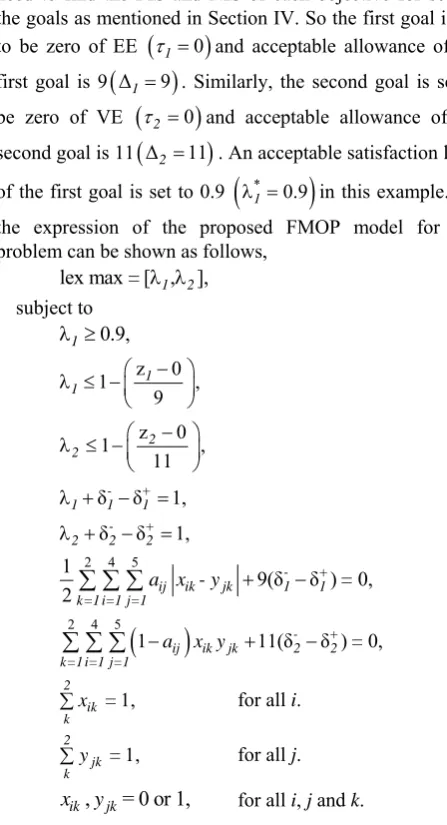
In applying the proposed model to the problem, firstly we need to find the PIS and NIS of each objective for setting the goals as mentioned in Section IV. So the first goal is set to be zero of EE
10
and acceptable allowance of the first goal is 9
Δ1 9
. Similarly, the second goal is set to be zero of VE
2 0
and acceptable allowance of the second goal is 11
Δ2 11
. An acceptable satisfaction level of the first goal is set to 0.9
*1 0.9
in this example. So,the expression of the proposed FMOP model for this problem can be shown as follows,
lex max [ , ],= 1 2 subject to
1 0.9,
1 z 0 ,
9
1 1
z 0
1 ,
11
2 2
δ- δ+ 1,
1 1 1
δ- δ+ 1,
2 2 2
1 2 4 5 9(δ δ ) 0,
2
- + ij ik jk 1 1 k=1 i=1 j=1
a x - y =
2 4 5
1 11(δ- δ+) 0,
ij ik jk 2 2 k=1 i=1 j=1
a x y =
1,
2 ik k
x =
for all i.
1,
2 jk k
y =
for all j.
xik,yjk= 0 or 1, for all i, j and k. , , , 0,
- + - +
1 1 2 2
- +, - + 0,
1 1 2 2=
[image:5.595.307.531.267.680.2]machines are assigned into cells at the same time. It is easier than the p-median model.
Example II
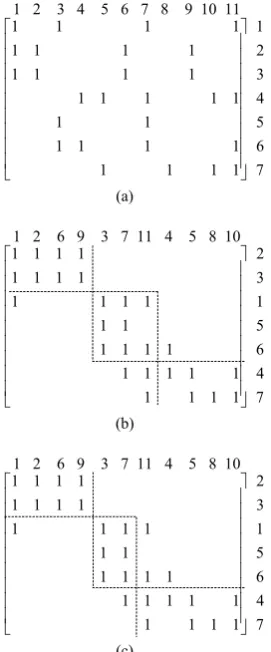
For illustrating the larger scale of the problem, the cell formation problem with eleven parts, seven machines, three cells and twenty-seven processes are considered. This problem is modified from one which was presented in Boctor (1991) [7]. The incidence matrix can be shown as in Fig. 9. (a).
By the same way, the result by heuristic method of Boctor (1991) obtains the solution as shown in Fig. 9. (b). By our proposed model (14)-(25) at a satisfaction level of 0.7 can obtain the efficient solution as presented in Fig. 9. (c). The solution clearly shows that more compact cells can be existed by the proposed model. The EE still be five by using both existing method and the proposed method as shown in Fig. 9. (b), but the VE are decreased from three to only two by using the proposed model. Comparing to the heuristic approach presented in [7], the proposed model is not only easy and efficient but also guarantees the optimal solution. But, the heuristic approach does not guarantee to obtain an efficient solution. Additionally by using the proposed model, planner can adjust *
g
to find the preferred solution.
VI. CONCLUSION
In this research, a fuzzy multi-objective programming model for concurrent formation of part families and machine cells for a cellular manufacturing system is developed. This proposed model is applied for assigning parts into families and grouping machines into cells, simultaneously.
1 2 3 4 5 6 7 8 9 10 11 1 1 1 1 1 1 1 1 1 2 1 1 1 1 3 1 1 1 1 1 4
1 1 5
1 1 1 1 6 1 1 1 1 7
(a)
1 2 6 9 3 7 11 4 5 8 10 1 1 1 1 2 1 1 1 1 3 1 1 1 1 1 1 1 5 1 1 1 1 6 1 1 1 1 1 4 1 1 1 1 7
(b)
1 2 6 9 3 7 11 4 5 8 10 1 1 1 1 2 1 1 1 1 3 1 1 1 1 1 1 1 5 1 1 1 1 6 1 1 1 1 1 4 1 1 1 1 7
[image:6.595.106.242.449.776.2](c)
Fig. 9. The machine-part incidence matrix of the example II.
Conventionally, p-median model is used. It requires two processes to solve part family problem and machine cell problem, respectively. Heuristic approaches are also used. However, an efficient solution is not guarantee. In the proposed model, two objective functions based on the perfect grouping; the exceptional elements and void elements, are set as fuzzy goals for increasing the capability and efficiency. Lexicographic fuzzy goal programming are applied to formulate this efficient model for solving the cell formation problem, which is better than the solution from p-median and the heuristic approach because of it is easy to use and efficient solution can be obtained. Cell formation of the proposed method can increase machine utilization due to reducing of void elements and can reduce unassignable processes by reducing exceptional elements.
For further studies, the other viewpoint of perfect grouping will be considered to enhance the performance of the formation method.
REFERENCES
[1] M. P Chandrasekharan, and R. Rajagopalan, “ZODIAC—an algorithm for concurrent formation of part-families and machine-cells,” International Journal of Production Research, vol. 25, no. 6,
pp. 835-850, 1987.
[2] A. S. Carrie, “Numerical taxonomy applied to group technology and plant layout,” International Journal of Production Research, vol. 11, no. 4, pp. 399-416, 1973.
[3] S. Song and K. Hitomi, “GT cell formation for minimizing the intercell parts flow,” International Journal of Production Research,
vol. 30, no. 12, pp. 2737-2753, 1992.
[4] C. H. Chu and J. C. Hayya, “A fuzzy dlustering approach to manufacturing cell formation,” International Journal of Production
Research, vol. 29, no. 7, pp. 1475-1487, 1991.
[5] J. Wang, “A linear assignment algorithm for formation of machine cells and part families in cellular manufacturing,” Computers
Industrial Engineering, vol. 35, pp. 81-84, 1998.
[6] J. Wang, “Formation of machine cells and part families in cellular manufacturing systems using a linear assignment algorithm,”
Automatica, vol. 39, pp. 1607-1615, 2003.
[7] F. F. Boctor, “A linear formulation of the machine-part cell formation problem,” International Journal of Production Research, vol. 29, no. 2, pp. 343-356, 1991.
[8] J. C. Wei and G. M. Kern, “Commonality analysis: A linear cell clustering algorithm for group technology,” International Journal of
Production Research, vol. 27, no. 12, pp. 2053-2062, 1989.
[9] A. Kusiak, “The generalized group technology concept,”
International Journal of Production Research, vol. 25, no. 4, pp.
561-569, 1987.
[10] L. Li and K. K. Lai, “A fuzzy approach to the multiobjective transportation problem,” Computer & Operation Research, vol. 27, pp. 43-57, 2000.
[11] W. F. A. El-Wahed, “A multi-objective transportation problem under fuzziness,” Fuzzy Sets and Systems. vol. 117, pp. 27-33, 2001.
[12] C. Romero, Handbook of Critical Issues in Goal Programming.
Pergamon Press, 1990.
[13] M. Zeleny, Multiple criteria decision making. McGraw-Hill Book Company, 1982.
[14] E. L. Hannan, “On fuzzy goal programming,” Decision Sciences, pp.
522-531, 1981.
[15] Y. J. Li and C. L. Hwang, Fuzzy multiple objective decision making:
Methods and Applications. Springer-Verlag Berlin Heidelberg, 1994.
[16] K. P. Yoon and C. L. Hwang, Multiple attribute decision making: An
introduction. SAGE Publications, 1995.
[17] C. T. Chen, “Extensions of the TOPSIS for group decision-making under fuzzy environment,” Fuzzy Sets and Systems, vol. 114, pp. 1-9, 2000.
[18] M. A. Abo-Sinna, A. H. Amer, and A. S. Ibrahim, “Extensions of TOPSIS for large scale multi-objective non-linear programming problems with block angular structure,” Applied Mathematical