Exploiting Discourse Structure for
Spoken Dialogue Performance Analysis
Mihai Rotaru
University of Pittsburgh
Pittsburgh, USA
[email protected]
Diane J. Litman
University of Pittsburgh
Pittsburgh, USA
[email protected]
Abstract
In this paper we study the utility of dis-course structure for spoken dialogue per-formance modeling. We experiment with various ways of exploiting the discourse structure: in isolation, as context infor-mation for other factors (correctness and certainty) and through trajectories in the discourse structure hierarchy. Our corre-lation and PARADISE results show that, while the discourse structure is not useful in isolation, using the discourse structure as context information for other factors or via trajectories produces highly predic-tive parameters for performance analysis.
1
Introduction
Predictive models of spoken dialogue system (SDS) performance are an important tool for re-searchers and practitioners in the SDS domain. These models offer insights on what factors are important for the success of a SDS and allow researchers to assess the performance of future system improvements without running additional costly user experiments.
One of the most popular models of perform-ance is the PARADISE framework proposed by (Walker et al., 2000). In PARADISE, a set of
interaction parameters are measured in a SDS corpus, and then used in a multivariate linear regression to predict the target performance met-ric. A critical ingredient in this approach is the relevance of the interaction parameters for the SDS success. A number of parameters that measure the dialogue efficiency (e.g. number of system/user turns, task duration) and the dia-logue quality (e.g. recognition accuracy, rejec-tions, helps) have been shown to be successful in
(Walker et al., 2000). An extensive set of pa-rameters can be found in (Möller, 2005a).
In this paper we study the utility of discourse structure as an information source for SDS per-formance analysis. The discourse structure hier-archy has been shown to be useful for other tasks: understanding specific lexical and pro-sodic phenomena (Hirschberg and Nakatani, 1996; Levow, 2004), natural language generation (Hovy, 1993), predictive/generative models of postural shifts (Cassell et al., 2001), and essay scoring (Higgins et al., 2004).
We perform our analysis on a corpus of speech-based tutoring dialogues. A tutoring SDS (Litman and Silliman, 2004; Pon-Barry et al., 2004) has to discuss concepts, laws and relation-ships and to engage in complex subdialogues to correct student misconceptions. As a result, dia-logues with such systems have a rich discourse structure.
We perform three experiments to measure three ways of exploiting the discourse structure. In our first experiment, we test the predictive utility of the discourse structure in itself. For ex-ample, we look at whether the number of pop-up transitions in the discourse structure hierarchy predicts performance in our system.
The second experiment measures the utility of the discourse structure as contextual information for two types of student states: correctness and certainty. The intuition behind this experiment is that interaction events should be treated differ-ently based on their position in the discourse structure hierarchy. For example, we test if the number of incorrect answers after a pop-up tran-sition has a higher predictive utility than the total number of incorrect student answers. In contrast, the majority of the previous work either ignores this contextual information (Möller, 2005a; Walker et al., 2000) or makes limited use of the
discourse structure hierarchy by flattening it (Walker et al., 2001) (Section 5).
As another way to exploit the discourse struc-ture, in our third experiment we look at whether specific trajectories in the discourse structure are indicative of performance. For example, we test if two consecutive pushes in the discourse struc-ture are correlated with higher learning.
To measure the predictive utility of our inter-action parameters, we focus primarily on corre-lations with our performance metric (Section 4). There are two reasons for this. First, a significant correlation between an interaction parameter and the performance metric is a good indicator of the parameter’s relevance for PARADISE modeling. Second, correlations between factors and the per-formance metric are commonly used in tutoring research to analyze the tutoring/learning process (Chi et al., 2001).
Our correlation and PARADISE results show that, while the discourse structure is not useful in isolation, using the discourse structure as context information for other factors or via trajectories produces highly predictive parameters for per-formance analysis.
2
Annotation
Our annotation for discourse structure and stu-dent state has been performed on a corpus of 95 experimentally obtained spoken tutoring dia-logues between 20 students and our system
ITSPOKE (Litman and Silliman, 2004). ITSPOKE is a speech-enabled version of the text-based Why2-Atlas conceptual physics tutor-ing system (VanLehn et al., 2002). When inter-acting with ITSPOKE, students first type an es-say answering a qualitative physics problem us-ing a graphical user interface. ITSPOKE then engages the student in spoken dialogue (using head-mounted microphone input and speech out-put) to correct misconceptions and elicit more complete explanations, after which the student revises the essay, thereby ending the tutoring or causing another round of tutoring/essay revision. Each student went through the same procedure: 1) read a short introductory material, 2) took a pretest to measure the initial physics knowledge, 3) work through a set of 5 problems with ITSPOKE, and 4) took a posttest similar to the pretest. The resulting corpus had 2334 student turns and a comparable number of system turns.
2.1 Discourse structure
We base our annotation of discourse structure on the Grosz & Sidner theory of discourse structure
[image:2.595.307.525.228.555.2](Grosz and Sidner, 1986). A critical ingredient of this theory is the intentional structure. According to the theory, each discourse has a discourse pur-pose/intention. Satisfying the main discourse purpose is achieved by satisfying several smaller purposes/intentions organized in a hierarchical structure. As a result, the discourse is segmented in discourse segments each with an associated discourse segment purpose/intention. This theory has inspired several generic dialogue managers for spoken dialogue systems (Bohus and Rud-nicky, 2003).
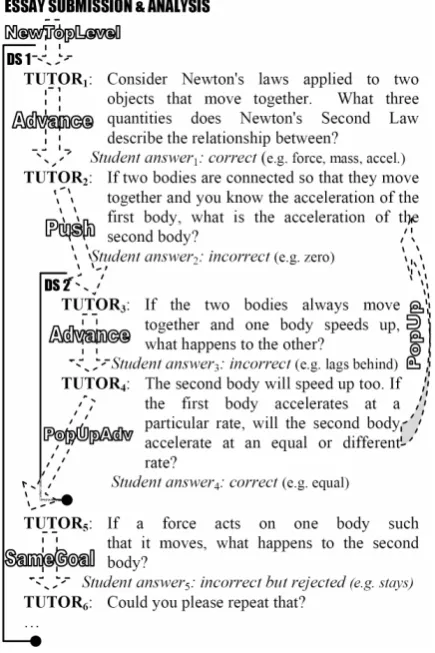
Figure 1. The discourse structure and transition anno-tation
ITSPOKE there are question segments discuss-ing about forces actdiscuss-ing on the objects, others dis-cussing about objects’ acceleration, etc.
In Figure 1 we illustrate ITSPOKE’s behavior and our discourse structure annotation. First, based on the analysis of the student essay, ITSPOKE selects a question segment to correct misconceptions or to elicit more complete expla-nations. This question segment will correspond to the top level discourse segment (e.g. DS1). Next, ITSPOKE asks the student each question in DS1. If the student answer is correct, the sys-tem moves on to the next question (e.g. Tu-tor1→Tutor2). If the student answer is incorrect, there are two alternatives. For simple questions, the system will simply give out the correct an-swer and move on to the next question (e.g. Tu-tor3→Tutor4). For complex questions (e.g. apply-ing physics laws), ITSPOKE will engage into a
remediation subdialogue that attempts to reme-diate the student’s lack of knowledge or skills. The remediation subdialogue is specified in an-other question segment and corresponds to a new discourse segment (e.g DS2). The new discourse segment is dominated by the current discourse segment (e.g. DS2 dominated by DS1). Tutor2 system turn is a typical example; if the student answers it incorrectly, ITSPOKE will enter dis-course segment DS2 and go through its questions (Tutor3 and Tutor4). Once all the questions in DS2 have been answered, a heuristic determines whether ITSPOKE should ask the original ques-tion again (Tutor2) or simply move on to the next question (Tutor5).
To compute interaction parameters from the discourse structure, we focus on the transitions in the discourse structure hierarchy. For each sys-tem turn we define a transition feature. This fea-ture capfea-tures the position in the discourse struc-ture of the current system turn relative to the previous system turn. We define six labels (see Table 1). NewTopLevel label is used for the first question after an essay submission (e.g. Tutor1). If the previous question is at the same level with the current question we label the current question as Advance (e.g. Tutor2,4). The first question in a remediation subdialogue is labeled as Push (e.g. Tutor3). After a remediation subdialogue is com-pleted, ITSPOKE will pop up and it will either ask the original question again or move on to the next question. In the first case, we label the sys-tem turn as PopUp. Please note that Tutor2 will not be labeled with PopUp because, in such cases, an extra system turn will be created be-tween Tutor4 and Tutor5 with the same content as
Tutor2. In addition, variations of “Ok, back to the original question” are also included in the new system turn to mark the discourse segment boundary transition. If the system moves on to the next question after finishing the remediation subdialogue, we label the system turn as
PopUpAdv (e.g. Tutor5). Note that while the sum of PopUp and PopUpAdv should be equal with Push, it is smaller in our corpus because in some cases ITSPOKE popped up more than one level in the discourse structure hierarchy. In case of rejections, the system question is repeated us-ing variations of “Could you please repeat that?”. We label such cases as SameGoal (e.g. Tutor6).
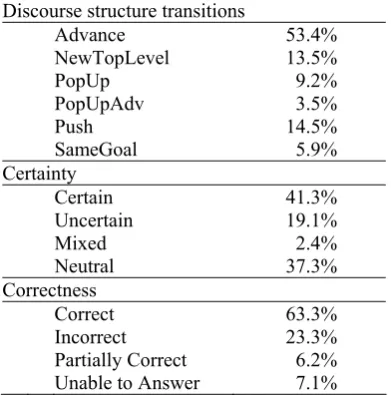
Discourse structure transitions
Advance NewTopLevel PopUp PopUpAdv Push SameGoal
53.4% 13.5% 9.2% 3.5% 14.5% 5.9% Certainty
Certain Uncertain Mixed Neutral
41.3% 19.1% 2.4% 37.3% Correctness
Correct Incorrect Partially Correct Unable to Answer
[image:3.595.324.520.249.447.2]63.3% 23.3% 6.2% 7.1% Table 1: Transition and student state distribution. Please note that each student dialogue has a specific discourse structure based on the dialogue that dynamically emerges based on the correct-ness of her answers. For this reason, the same system question in terms of content may get a different transition label for different students. For example, in Figure 1, if the student would have answered Tutor2 correctly, the next tutor turn would have had the same content as Tutor5 but the Advance label. Also, while a human an-notation of the discourse structure will be more complex but more time consuming (Hirschberg and Nakatani, 1996; Levow, 2004), its advan-tages are outweighed by the automatic nature of our discourse structure annotation.
transition information can be automatically com-puted using the procedure described above.
2.2 Student state
Because for our tutoring system student learning is the relevant performance metric, we hypothe-size that information about student state in each student turn, in terms of correctness and cer-tainty, will be an important indicator. For exam-ple, a student being more correct and certain dur-ing her interaction with ITSPOKE might be indicative of a higher learning gain. Also, previous studies have shown that tutoring specific parameters can improve the quality of SDS performance models that model the learning gain (Forbes-Riley and Litman, 2006).
In our corpus, each student turn was manually labeled for correctness and certainty (Table 1). While our system assigns a correctness label to each student turn to plan its next move, we choose to use a manual annotation of correctness to eliminate the noise introduced by the auto-matic speech recognition component and the natural language understanding component. A human annotator used the human transcripts and his physics knowledge to label each student turn for various degrees of correctness: correct, par-tially correct, incorrect and unable to answer. “Unable to Answer” label was used for turns where the student did not answer the system question or used variants of “I don’t know”.
Previous work has shown that certainty plays an important role in the learning and tutoring process (Pon-Barry et al., 2006; VanLehn et al., 2003). A human annotator listened to the dia-logues between students and ITSPOKE and la-beled each student turn for its perceived degree of certainness. Four labels were used: certain, uncertain, neutral and mixed (both certain and uncertain). To date, one annotator has labeled all student turns in our corpus1.
3
Interaction parameters
For each user, interaction parameters measure specific aspects of the dialogue with the system. We use our transition and student state annota-tion to create two types of interacannota-tion
1 The agreement between the manual correctness an-notation and the correctness assigned by ITSPOKE is 90% (kappa of 0.79). In a preliminary agreement study, a second annotator labeled our corpus for a binary version of certainty (uncertainty versus other), resulting in a 90% inter-annotator agreement and a kappa of 0.68.
ters: unigrams and bigrams. The difference be-tween the two types of parameters is whether the discourse structure context is used or not. For each of our 12 labels (4 for correctness, 4 for certainty and 6 for discourse structure), we de-rive two unigram parameters per student over the 5 dialogues for that student: a total parameter and a percentage parameter. For example, for the ‘Incorrect’ unigram we compute, for each stu-dent, the total number of student turns labeled with ‘Incorrect’ (parameter Incorrect) and the percentage of such student turns out of all stu-dent turns (parameter Incorrect%). For example, if we consider only the dialogue in Figure 1, In-correct = 3 (Student2,3,5) and Incorrect% = 60% (3 out of 5).
Bigram parameters exploit the discourse struc-ture context. We create two classes of bigram parameters by looking at transition–student state
bigrams and transition–transition bigrams. The transition–student state bigrams combine the in-formation about the student state with the transi-tion informatransi-tion of the previous system turn. Go-ing back to Figure 1, the three incorrect answers will be distributed to three bigrams: Advance– Incorrect (Tutor2–Student2), Push–Incorrect (Tu-tor3–Student3) and PopUpAdv–Incorrect (Tutor5– Student5). The transition–transition bigram looks at the transition labels of two consecutive system turns. For example, the Tutor4–Tutor5 pair will be counted as an Advance–PopUpAdv bigram.
Similar to the unigrams, we compute a total parameter and a percentage parameter for each bigram. The percentage denominator is number of student turns for the transition–student state bigrams and the number of system turns minus one for the transition–transition bigram. In addi-tion, for each bigram we compute a relative per-centage parameter (bigram followed by %rel) by computing the percentage relative to the total number of times the transition unigram appears for that student. For example, we will compute the Advance–Incorrect %rel parameter by divid-ing the number of Advance–Incorrect bigrams with the number of Advance unigrams (1 divided by 2 in Figure 1); this value will capture the per-centage of times an Advance transition is fol-lowed by an incorrect student answer.
4
Results
suc-cessfully used student learning as the perform-ance metric in the PARADISE framework. Two quantities are used to measure student learning: the pretest score and the posttest score. Both tests consist of 40 multiple-choice questions; the test’s score is computed as the percentage of correctly answered questions. The average score and stan-dard deviation for each test are: pretest 0.47 (0.17) and posttest 0.68 (0.17).
We focus primarily on correlations between our interaction parameters and student learning. Because in our data the pretest score is signifi-cantly correlated with the posttest score, we study partial Pearson’s correlations between our parameters and the posttest score that account for the pretest score. This correlation methodology is commonly used in the tutoring research (Chi et al., 2001). For each trend or significant correla-tion we report the unigram/bigram, its average and standard deviation over all students, the Pearson’s Correlation Coefficient (R) and the statistical significance of R (p).
First we report significant correlations for uni-grams to test our first hypothesis. Next, for our second and third experiment, we report correla-tions for transition–student state and transition– transition parameters. Finally, we report our pre-liminary results on PARADISE modeling.
4.1 Unigram correlations
In our first proposed experiment, we want to test the predictive utility of discourse structure in isolation. We compute correlations between our transition unigram parameters and learning. We find no trends or significant correlations. This result suggests that discourse structure in isola-tion has no predictive utility.
Here we also report all trends and significant correlations for student state unigrams as the baseline for contextual correlations to be pre-sented in Section 4.2. We find only one signifi-cant correlation (Table 2): students with a higher percentage of neutral turns (in terms of certainty) are negatively correlated with learning. We hy-pothesize that this correlation captures the stu-dent involvement in the tutoring process: more involved students will try harder thus expressing more certainty or uncertainty. In contrast, less involved students will have fewer certain/uncer-tain/mixed turns and, in consequence, more neu-tral turns. Surprisingly, student correctness does not significantly correlate with learning.
Parameter Mean (SD) R. p
Neutral % 37% (8%) -.47 .04
Table 2: Trend and significant unigram correlations
4.2 Transition–student state correlations
For our second experiment, we need to determine the predictive utility of transition–student state bigram parameters. We find a large number of correlations for both transition–correctness bi-grams and transition–certainty bibi-grams.
Transition–correctness bigrams
This type of bigram informs us whether ac-counting for the discourse structure transition when looking at student correctness has any pre-dictive value. We find several interesting trends and significant correlations (Table 3).
The student behavior, in terms of correctness, after a PopUp or a PopUpAdv transition is very informative about the student learning process. In both situations, the student has just finished a remediation subdialogue and the system is pop-ping up either by reasking the original question again (PopUp) or by moving on to the next ques-tion (PopUpAdv). We find that after PopUp, the number of correct student answers is positively correlated with learning. In contrast, the number, the percentage and the relative percentage of in-correct student answers are negatively correlated with learning. We hypothesize that this correla-tion indicates whether the student took advantage of the additional learning opportunities offered by the remediation subdialogue. By answering correctly the original system question (PopUp– Correct), the student demonstrates that she has absorbed the information from the remediation dialogue. This bigram is an indication of a suc-cessful learning event. In contrast, answering the original system question incorrectly (PopUp– Incorrect) is an indication of a missed learning opportunity; the more events like this happen the less the student learns.
Parameter Mean (SD) R. p
PopUp–Correct 7 (3.3) .45 .05
PopUp–Incorrect 2 (1.8) -.42 .07
PopUp–Incorrect % 1.6% (1.2%) -.46 .05
PopUp–Incorrect %rel 17% (13%) -.39 .10
PopUpAdv–Correct 2.5 (2) .43 .06
PopUpAdv–Correct % 2% (1.3%) .52 .02
NewTopLevel–Incorrect 2.3 (1.8) .56 .01
NewTopLevel–Incorrect % 1.9% (1.4%) .49 .03
NewTopLevel–Incorrect %rel 15% (12%) .51 .02
Advance–Correct 40.5 (9.8) .45 .05
Table 3: Trend and significant transition–correctness bigram correlations
the knowledge taught in the remediation subdia-logues, we hypothesize that this correlation also captures successful learning opportunities.
Another set of interesting correlations is pro-duced by the NewTopLevel–Incorrect bigram. We find that the number, the percentage and the relative percentage of times ITSPOKE starts a new essay revision dialogue that results in an incorrect student answer is positively correlated with learning. The content of the essay revision dialogue is determined based on ITSPOKE’s analysis of the student essay. We hypothesize that an incorrect answer to the first tutor question is indicative of the system’s picking of a topic that is problematic for the student. Thus, we see more learning in students for which more knowl-edge gaps are discovered and addressed by ITSPOKE.
Finally, we find the number of times the stu-dent answers correctly after an advance transition is positively correlated with learning (the Ad-vance–Correct bigram). We hypothesize that this correlation captures the relationship between students that advance without having major prob-lems and a higher learning gains.
Transition–certainty bigrams
Next we look at the combination between the transition in the dialogue structure and the stu-dent certainty (Table 4). These correlations offer more insight on the negative correlation between the Neutral % unigram parameter and student learning. We find that out of all neutral student answers, those that follow an Advance transi-tions are negatively correlated with learning. Similar to the Neutral % correlation, we hy-pothesize that Advance–Neutral correlations cap-ture the lack of involvement of the student in the tutoring process. This might be also due to ITSPOKE engaging in teaching concepts that the student is already familiar with.
Parameter Mean (SD) R. p
Advance–Neutral 27 (8.3) -.40 .08
Advance–Neutral % 21% (6%) -.62 .00
Advance–Neutral %rel 38% (10%) -.73 .00 SameGoal–Neutral %rel 35% (31%) .46 .05
Table 4: Trend and significant transition–certainty bigram correlations
In contrast, staying neutral in terms of cer-tainty after a system rejection is positively corre-lated with learning. These correlations show that based on their position in the discourse structure, neutral student answers will be correlated either negatively or positively with learning.
Unlike student state unigram parameters which produce only one significant correlation,
transition–student state bigram parameters pro-duce a large number of trend and significant cor-relations (14). This result suggests that exploiting the discourse structure as a contextual informa-tion source can be beneficial for performance modeling.
4.3 Transition–transition bigrams
For our third experiment, we are looking at the transition–transition bigram correlations (Table 5). These bigrams help us find trajectories of length two in the discourse structure that are as-sociated with better student learning. Because our student state is domain dependent, translating the transition–student state bigrams to a new domain will require finding a new set of relevant factors to replace the student state. In contrast, because our transition information is domain in-dependent, transition–transition bigrams can be easily implemented in a new domain.
The Advance–Advance bigram covers situa-tions where the student is covering tutoring ma-terial without major knowledge gaps. This is be-cause an Advance transition happens when the student either answers correctly or his incorrect answer can be corrected without going into a remediation subdialogue. Just like with the Ad-vance–Correct correlation (recall Table 3), we hypothesize that these correlations links higher learning gains to students that cover a lot of ma-terial without many knowledge gap.
Parameter Mean (SD) R. p
Advance–Advance 35 (9.1) .47 .04
Push–Push 2.2 (1.7) .50 .03
Push–Push % 1.8% (1.3%) .52 .02
Push–Push %rel 11% (7%) .52 .02
SameGoal–Push %rel 18% (23%) .49 .03
Table 5: Trend and significant transition–transition bigram correlations
The Push–Push bigrams capture another inter-esting behavior. In these cases, the student incor-rectly answers a question, entering a remediation subdialogue; she also incorrectly answers the first question in the remediation dialogue enter-ing an even deeper remediation subdialogue. We hypothesize that these situations are indicative of big student knowledge gaps. In our corpus, we find that the more such big knowledge gaps are discovered and addressed by the system the higher the learning gain.
per-formed an analysis of the rejected student turns and studied how rejections affect the student state. The results of our analysis suggested a new strategy for handling rejections in the tutoring domain: instead of rejecting student answers, a tutoring SDS should make use of the available information. Since the recognition hypothesis for a rejected student turn would be interpreted most likely as an incorrect answer thus activating a remediation subdialogue, the positive correlation between SameGoal–Push and learning suggests that the new strategy will not impact learning.
Similar to the second experiment, the results of our third experiment are also positive: in con-trast to transition unigrams, our domain inde-pendent trajectories can produce parameters with a high predictive utility.
4.4 PARADISE modeling
Here we present our preliminary results on ap-plying the PARADISE framework to model ITSPOKE performance. A stepwise multivariate linear regression procedure (Walker et al., 2000) is used to automatically select the parameters to be included in the model. Similar to (Forbes-Riley and Litman, 2006), in order to model the learning gain, we use posttest as the dependent variable and force the inclusion of the pretest score as the first variable in the model.
For the first experiment, we feed the model all transition unigrams. As expected due to lack of correlations, the stepwise procedure does not select any transition unigram parameter. The only variable in the model is pretest resulting in a model with a R2 of .22.
For the second and third experiment, we first build a baseline model using only unigram pa-rameters. The resulting model achieves an R2 of .39 by including the only significantly correlated unigram parameter: Neutral %. Next, we build a model using all unigram parameters and all sig-nificantly correlated bigram parameters. The new model almost doubles the R2 to 0.75. Besides the pretest, the parameters included in the resulting model are (ordered by the degree of contribution from highest to lowest): Advance–Neutral %rel, and PopUp–Incorrect %. These results strengthen our correlation conclusions: discourse structure used as context information or as trajectories in-formation is useful for performance modeling. Also, note that the inclusion of student certainty in the final PARADISE model provides addi-tional support to a hypothesis that has gained a lot of attention lately: detecting and responding to student emotions has the potential to improve
learning (Craig et al., 2004; Forbes-Riley and Litman, 2005; Pon-Barry et al., 2006).
The performance of our best model is compa-rable or higher than training performances re-ported in previous work (Forbes-Riley and Lit-man, 2006; Möller, 2005b; Walker et al., 2001). Since our training data is relatively small (20 data points) and overfitting might be involved here, in the future we plan to do a more in-depth evaluation by testing if our model generalizes on a larger ITSPOKE corpus we are currently anno-tating.
5
Related work
Previous work has proposed a large number of interaction parameters for SDS performance modeling (Möller, 2005a; Walker et al., 2000; Walker et al., 2001). Several information sources are being tapped to devise parameters classified by (Möller, 2005a) in several categories: logue and communication parameters (e.g. dia-logue duration, number of system/user turns), speech input parameters (e.g. word error rate, recognition/concept accuracy) and meta-communication parameters (e.g. number of help request, cancel requests, corrections).
But most of these parameters do not take into account the discourse structure information. A notable exception is the DATE dialogue act an-notation from (Walker et al., 2001). The DATE annotation captures information on three dimen-sions: speech acts (e.g. acknowledge, confirm), conversation domain (e.g. conversation- versus task-related) and the task model (e.g. subtasks like getting the date, time, origin, and destina-tion). All these parameters can be linked to the discourse structure but flatten the discourse structure. Moreover, the most informative of these parameters (the task model parameters) are domain dependent. Similar approximations of the discourse structure are also common for other SDS tasks like predictive models of speech rec-ognition problems (Gabsdil and Lemon, 2004).
bi-gram parameters. Forth, via the transition– transition bigram parameters, we exploit trajecto-ries in the discourse structure as another domain independent source of information for perform-ance modeling. Finally, similar to (Forbes-Riley and Litman, 2006), we are tackling a more prob-lematic performance metric: the student learning gain. While the requirements for a successful information access SDS are easier to spell out, the same can not be said about tutoring SDS due to the current limited understanding of the hu-man learning process.
6
Conclusion
In this paper we highlight the role of discourse structure for SDS performance modeling. We experiment with various ways of using the dis-course structure: in isolation, as context informa-tion for other factors (correctness and certainty) and through trajectories in the discourse structure hierarchy. Our correlation and PARADISE re-sults show that, while the discourse structure is not useful in isolation, using the discourse struc-ture as context information for other factors or via trajectories produces highly predictive pa-rameters for performance analysis. Moreover, the PARADISE framework selects in the final model only discourse-based parameters ignoring pa-rameters that do not use the discourse structure (certainty and correctness unigrams are ignored).
Our significant correlations also suggest ways we should modify our system. For example, the PopUp–Incorrect negative correlations suggest that after a failed learning opportunity the system should not give out the correct answer but en-gage in a secondary remediation subdialogue specially tailored for these situations.
In the future, we plan to test the generality of our PARADISE model on other corpora and to compare models built using our interaction pa-rameters against models based on papa-rameters commonly used in previous work (Möller, 2005a). Testing if our results generalize to a hu-man annotation of the discourse structure and automated models of certainty and correctness is also of importance. We also want to see if our results hold for performance metrics based on user satisfaction questionnaires; in the new ITSPOKE corpus we are currently annotating, each student also completed a user satisfaction survey (Forbes-Riley and Litman, 2006) similar to the one used in the DARPA Communicator multi-site evaluation (Walker et al., 2002).
Our work contributes to both the computa-tional linguistics domain and the tutoring do-main. For the computational linguistics research community, we show that discourse structure is an important information source for SDS per-formance modeling. Our analysis can be ex-tended easily to other SDS. First, a similar auto-matic annotation of the discourse structure can be performed in SDS that rely on dialogue man-agers inspired by the Grosz & Sidner theory of discourse (Bohus and Rudnicky, 2003). Second, the transition–transition bigram parameters are domain independent. Finally, for the other suc-cessful usage of discourse structure (transition– student state bigrams) researchers have only to identify relevant factors and then combine them with the discourse structure information. In our case, we show that instead of looking at the user state in isolation (Forbes-Riley and Litman, 2006), combining it with the discourse structure transition can generate informative interaction parameters.
For the tutoring research community, we show that discourse structure, an important concept in computational linguistics theory, can provide useful insights regarding the learning process. The correlations we observe in our corpus have intuitive interpretations (successful/failed learn-ing opportunities, discovery of deep student knowledge gaps, providing relevant tutoring).
Acknowledgements
This work is supported by NSF Grant No. 0328431. We would like to thank Kate Forbes-Riley, Joel Tetreault and our anonymous review-ers for their helpful comments.
References
D. Bohus and A. Rudnicky. 2003. RavenClaw: Dialog Management Using Hierarchical Task Decomposition and an Expectation Agenda. In Proc. of Eurospeech.
J. Cassell, Y. I. Nakano, T. W. Bickmore, C. L. Sidner and C. Rich. 2001. Non-Verbal Cues for Discourse Structure. In Proc. of ACL.
M. T. H. Chi, S. A. Siler, H. Jeong, T. Yamauchi and R. G. Hausmann. 2001. Learning from human tutoring. Cognitive Science, 25.
S. D. Craig, A. C. Graesser, J. Sullins and B. Gholson. 2004. Affect and learning: an exploratory look into the role affect in learning with AutoTutor.
K. Forbes-Riley and D. Litman. 2005. Using Bigrams to Identify Relationships Between Student Certainness States and Tutor Responses in a Spoken Dialogue Corpus. In Proc. of SIGdial.
K. Forbes-Riley and D. Litman. 2006. Modelling User Satisfaction and Student Learning in a Spoken Dialogue Tutoring System with Generic, Tutoring,
and User Affect Parameters. In Proc. of
HLT/NAACL.
M. Gabsdil and O. Lemon. 2004. Combining Acoustic and Pragmatic Features to Predict Recognition Performance in Spoken Dialogue Systems. In Proc. of ACL.
B. Grosz and C. L. Sidner. 1986. Attentions, intentions and the structure of discourse.
Computational Lingustics, 12(3).
D. Higgins, J. Burstein, D. Marcu and C. Gentile. 2004. Evaluating Multiple Aspects of Coherence in Student Essays. In Proc. of HLT-NAACL.
J. Hirschberg and C. Nakatani. 1996. A prosodic analysis of discourse segments in direction-giving monologues. In Proc. of ACL.
E. Hovy. 1993. Automated discourse generation using discourse structure relations. Articial Intelligence, 63(Special Issue on NLP).
G.-A. Levow. 2004. Prosodic Cues to Discourse Segment Boundaries in Human-Computer Dialogue.
In Proc. of SIGdial.
D. Litman and S. Silliman. 2004. ITSPOKE: An intelligent tutoring spoken dialogue system. In Proc. of HLT/NAACL.
S. Möller. 2005a. Parameters for Quantifying the Interaction with Spoken Dialogue Telephone Services.
In Proc. of SIGDial.
S. Möller. 2005b. Towards Generic Quality Prediction Models for Spoken Dialogue Systems - A Case Study. In Proc. of Interspeech.
H. Pon-Barry, B. Clark, E. O. Bratt, K. Schultz and S. Peters. 2004. Evaluating the effectiveness of Scot:a spoken conversational tutor. In Proc. of ITS Workshop on Dialogue-based Intelligent Tutoring Systems.
H. Pon-Barry, K. Schultz, E. O. Bratt, B. Clark and S. Peters. 2006. Responding to Student Uncertainty in Spoken Tutorial Dialogue Systems. International Journal of Artificial Intelligence in Education, 16.
M. Rotaru and D. Litman. 2006. Dependencies between Student State and Speech Recognition Problems in Spoken Tutoring Dialogues. In Proc. of ACL.
K. VanLehn, P. W. Jordan, C. P. Rosé, D. Bhembe, M. Böttner, A. Gaydos, M. Makatchev, U. Pappuswamy, M. Ringenberg, A. Roque, S. Siler and
R. Srivastava. 2002. The Architecture of Why2-Atlas: A Coach for Qualitative Physics Essay Writing. In Proc. of Intelligent Tutoring Systems (ITS).
K. VanLehn, S. Siler, C. Murray, T. Yamauchi and W. B. Baggett. 2003. Why do only some events cause learning during human tutoring? Cognition and Instruction, 21(3).
M. Walker, D. Litman, C. Kamm and A. Abella. 2000. Towards Developing General Models of Usability with PARADISE. Natural Language Engineering.
M. Walker, R. Passonneau and J. Boland. 2001.
Quantitative and Qualitative Evaluation of Darpa Communicator Spoken Dialogue Systems. In Proc. of ACL.