Page 194
PERSONALISED LEARNING: EFFECTIVE E-MATERIAL FORMATTING FOR USERS WITHOUT DISABILITY OR SPECIFIC LIMITATIONS
Kristine Mackare*, Anita Jansone
Liepaja University, Liela str.14, Liepaja, LV-3401, Latvia
Abstract
Personalised learning is up-to-date topic and researchers, pedagogies and learning facilities are trying to invent it in education systems. It is possible because of a more detailed examination of children problems with learning and reading difficulties and more active trying of integration of disabled persons. Technologies and screens are helping tools.
Nowadays opened world people more and more prefer to use different kind of distance, online or Internet-based learning and studying possibilities. There is a huge amount of e-materials to use for gaining knowledge.
It is also a regular pupil and student without disability or specific limitations. Why are not we thinking also about them? As still, not everyone is comfortable with long screen reading. It is based on human evaluation of reading processes what are not adapted to new perception situation on-screen reading.
Analysing guidelines, scientific information, publications of research there are found the huge problem - there is unambiguity in recommendations and no developed and available detailed formatting recommendations and guidelines for e-materials. Mostly suggested to use the same parameters as for printed materials but it is not the best solution for screen reading.
E-material formatting recommendations have been created and developed based on literature research, vision science basics and user’s preference surveys. Automatic e-material formatting app prototype is in progress of developing for easier and comfortable formatting use. The main focus of development is to find the best solution for screen reading, reach a higher comfort level for learners and reach big improvement of reading perception and learning improvement. It is related to the fundamental idea of personalised learning. For now, it is developed to reach the needs of different target groups, but the idea is to create it based on wide usage possibilities in the future as can be adapted to different situations and conditions.
Keywords: app, e-material formatting, e-study, personalised learning, screen reading, user-centric design
1. INTRODUCTION
Personalised Learning (PL) as a concept and practice is still young. [1] Personalized learning (PL) is an educational approach that aims to customise learning for each student's strengths, needs, skills and interests. [2] It gives learners choices about how to learn based on their interests, abilities, and teacher recommendations.[3] PL provides the flexibility of when, how, and what to learn. [4]
It is known how valuable all personalised things can be for users. Users and learners are asking for user/learner-centred design and approach for everything and education is not an exception. Personalised education is important as based on interests, skills, and needs, and learners engage in relevant material and instruction that challenges learners appropriately. [3] Besides, personalised learning:
promotes student agency
creates lifelong learners
increases student engagement
Page 195
is the future of learning. [5]
Personalised learning has four key attributes:
learner profiles,
personal learning paths,
competency-based progression,
flexible learning environments. [6]
Variety of research shows that there is a significant effect of student participation in online education on final outcomes (what can be evaluated, for example, with grades). Participation is a complex phenomenon. The conceptualisation of participation have been changed through time, but mine edges are still related to that as participation involves action, communication with others. It is a complex process that combines doing, talking, thinking, feeling and belonging. [7] Important part of participation is online learners possibility to give feedback on all learning process, including content and its presentation as it creates effective online learning experiences. [8]
There are listed some major benefits of online learning:
can study at a time that suits a learner
can vary learners study schedule each week to match changing work or family commitments
can work at a pace that suits learners
have no travel costs, no parking charges and no books to buy
The Biggest Challenges of Online Courses
Motivation
Accountability
Organisation
Confidence
Lacking technical skills
Being proactive
Loneliness
Persistence [9]
What Do Students Say They Want and Need in the Online Classroom?
Faculty Presence: o Engagement, o Feedback o Assistance.
Course Content:
o Clear Expectations, o Motivation
o Challenge. [8]
Communication
Page 196
Organisation
Personalisation
Connection
Involvement. [10]
What Do Students Say They Struggle With Most Online?
Instructor Presence:
o Social Interaction (i.e. feelings of isolation) o Lack of Support.
Course Content:
o Technical Difficulties, o Social Interaction, o Lack of Structure. [8]
In terms of “digital reading”, “e-reading”, “screen-reading”, then, in mind it is the activity of learning from text presented through any kind of electronic format, whether produced as a native electronic text, or scanned into a PDF from print and accessed via computer screen, dedicated e-reader, tablet or other digital hardware. [11]
Mainly, a focus for adaptation and improvement is on persons with limitations, difficulties and disabilities.
Persons with a disability:
Persons with dyslexia and other reading difficulties;
Persons with intellectual disabilities;
Persons with neuropsychiatric disabilities;
Pre-lingually deaf persons;
Deafblind persons;
Persons with aphasia;
Persons with dementia;
Readers with limited language or reading proficiency:
Persons with limited reading skills caused by other factors;
Non-native language speakers,
people with limited education,
and even native speaking children.
Page 197
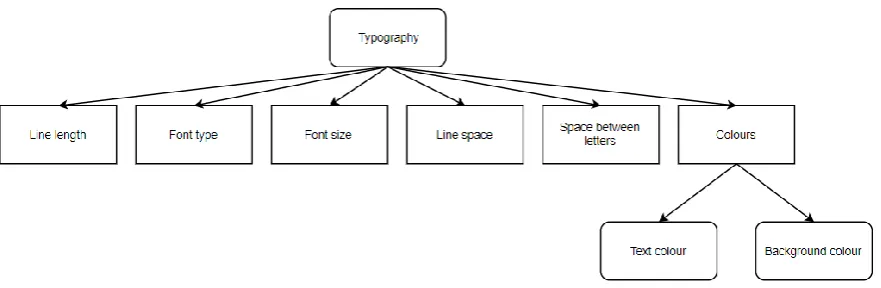
Fig. 1. Personalised learning design elements
There is a need to work on developing a more effective approach that combines digital with personalised learning. It can be reached by using the power of technology and educational design in order to create innovative learning environments that foster personalised learning for everyone. [12] As it gives improvement to flexible content, gives more adaptive and highly customised content. The benefits of online learner participation are almost taken for granted. [7] But the actually wide range of users are meeting with different problems and are not completely satisfied. Reasons can be found a different but significant part of it is based on screen reading discomfort. Same dissatisfied users can be found also in blended learning and all type of modern learning approaches with technology use.
Mostly, personalised learning is concentrating on appropriate learning and teaching approaches, but it is a need to look on content visualisation. As the easy-to-read concept pertains not only to language and content but also includes illustrations, design and layout. [13]
Researchers admit current knowledge about the suitability and impact of reading formats, especially electronic, for different purposes including learning, comprehension and usability is far from complete. [11]
Current research represents focus on content visualisation such as typographic aspects like font, font size, spacing and colours. They are regulated by formatting parameters. It creates a more individual learning environment that is more comfortable for educational material perception from the screen.
Page 198
In nearest future technologies are based on automatization process and expansion of it. So, education material automatic formatting based on the personalization approach is topical.
2. MATERIALS AND METHODS 2.1.Materials
Theoretical literature. The prototype of the developed app. 2.2.Methods
Literature research. Parameter and age-group range analysis. Recommendation development.
3. RESULTS
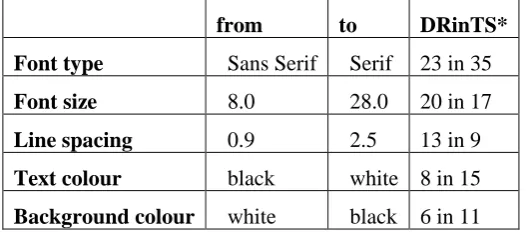
Parameter unambiguity in current recommendations and suggestions for e-materials have been found. It is based on an analysis of more than 100 different sources. A wider overview can be found in previous publication Mackare, Jansone 2017 [49]. Followed four parameters are chosen for modification use. These are important parameters for content presentation as well as have more possible variations to be used in formatting. Also, this is crucial to affect perception, readability and comprehension. See table 1.
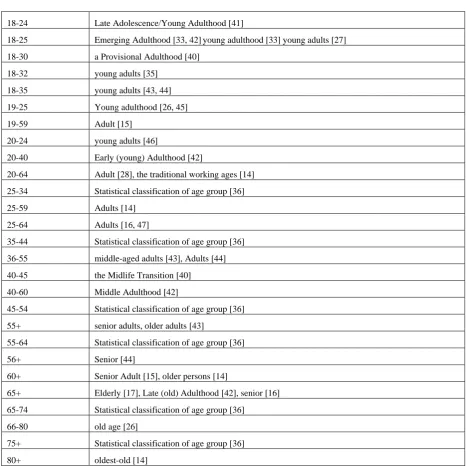
Age group developing for recommendation creation. The first step is literature research for finding out age-group range possibilities, suggestions and regulated parameters in different orientations, for example, education and healthcare. It is represented in table 2.
from to DRinTS*
Font type Sans Serif Serif 23 in 35
Font size 8.0 28.0 20 in 17
Line spacing 0.9 2.5 13 in 9 Text colour black white 8 in 15 Background colour white black 6 in 11 Table 1. Representation of suggested parameters variety.
*Different parameter recommendations in total sources
Possible age group (years old)
Name or explanation of age group
0-9 Children [14]
0-12 Child [15]
0-14 Children [14, 16]
0-18 Children [17]
Up to 1 Infancy, listening [18]
1-3 Toddlers [18, 19]
1-8 play age [20]
3 Early Preschool: make symbols that resemble writing, recognize the first letter in their name, imitate
Page 199
4 Late Preschool: recognize the letters in their names, write their names, develop awareness of
syllables, understand that print is read from left to right, top to bottom [18]
3-4 Language and cognitive developmental milestones of children [21]
3-5 It is a time when toddlers become pre-schoolers [22, 23]
3-6 early childhood [24]
5-11 Primary school age [20]
5-12 Grade-schooler [19]
6-8 Middle Childhood [25]
6-9 elementary school [22]
6-12 School age [23]
7-8 read longer books independently, read aloud with proper emphasis and expression [18]
7-9 Childhood [26]
7-12 Stage of cognitive development: Concrete operational stage [23]
9-11 Middle Childhood [25]
9-12 Pre-teen [20]
9-13 Pre-adolescence [20], explore and understand different kinds of texts, analyse texts for meaning [18]
9-17 Puberty (girls) [20]
10-14 Young Adolescents [22]
10-17 Adolescents [27]
10-19 Puberty (boys) [20], adolescence [28]
10-24 young people [14, 28, 29]
11-14 early adolescence [28, 30]
11-19 Secondary school age [20]
12+ Stage of cognitive development: Formal operational stage [23]
12-14 Young teens [25]
12-15 Onset of adolescence [31]
12-16 Teen [32]
12-18 Teen [19], adolescence [33]
13-16 early adolescence [34]
13-18 Teen [23], Adolescence [15, 20]
13-19 Teenagers [35]
14-21 youth (employment statistics) [35]
15-17 Teenagers [25], middle adolescence [28, 30]
15-18 High School Years, middle adolescence [22]
15-24 Youth [16, 28, 35, 36], adolescents and youth [14]
15-29 Youth [37]
15-35 youth population [38]
16-25 youth/Young adults [39]
17-22 the Early Adult Transition [40]
17-45 Early Adulthood [40]
Page 200
18-24 Late Adolescence/Young Adulthood [41]
18-25 Emerging Adulthood [33, 42]young adulthood [33] young adults [27]
18-30 a Provisional Adulthood [40]
18-32 young adults [35]
18-35 young adults [43, 44]
19-25 Young adulthood [26, 45]
19-59 Adult [15]
20-24 young adults [46]
20-40 Early (young) Adulthood [42]
20-64 Adult [28], the traditional working ages [14]
25-34 Statistical classification of age group [36]
25-59 Adults [14]
25-64 Adults [16, 47]
35-44 Statistical classification of age group [36]
36-55 middle-aged adults [43], Adults [44]
40-45 the Midlife Transition [40]
40-60 Middle Adulthood [42]
45-54 Statistical classification of age group [36]
55+ senior adults, older adults [43]
55-64 Statistical classification of age group [36]
56+ Senior [44]
60+ Senior Adult [15], older persons [14]
65+ Elderly [17], Late (old) Adulthood [42], senior [16]
65-74 Statistical classification of age group [36]
66-80 old age [26]
75+ Statistical classification of age group [36]
80+ oldest-old [14]
Table 2. Variety of age-group ranges in the literature
Decision made by taking into account all existing age-group range and supported information of range name as well as developing human stages (psychological, linguistical, visual, cognitional, etc.). Primary chosen nine groups for basic recommendation development:
3-5 years old – main reason as pre-school age children when learning reading
6-11 years old - main reason as primary school-age children, a critical time of myopia development by near-work load, reading
12-15 years old - main reason as school-age children before intensive study time in colleges, universities, well-developed reading abilities
16-25 years old - main reason as begins intensive study time in colleges, universities, could be additional near workload at work
Page 201
36-39 years old - main reason as people are in pre-presbyopia age where are possible natural age-related changes in accommodation system, can get tired faster after reading
40-55 years old - main reason as people are in presbyopia age where are natural age-related changes in accommodation system, need of near glasses
55+ years old - main reason as there could be natural age-related changes in eye structure that affect perception, need of near glasses
65+ years old - main reason as there are, most likely, natural age-related changes in eye structure that affect perception, need of near glasses, can be a risk to low vision
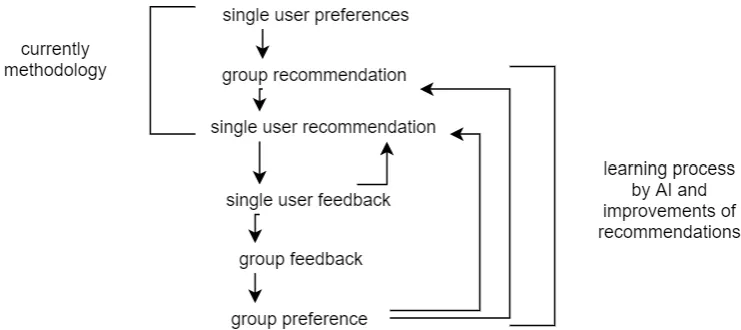
Users’ behaviour, preference and need research have been conducted by using several e-surveys. (See more detailed in previous publication Mackare, Jansone 2018 [48]) The current methodology has been developed by using a method that is represented in Fig. 3 the first part. Future improvements will be improved by using the second part of the scheme and AI approach.
Fig. 3. Scheme of developing formatting recommendation process and their personalisation process
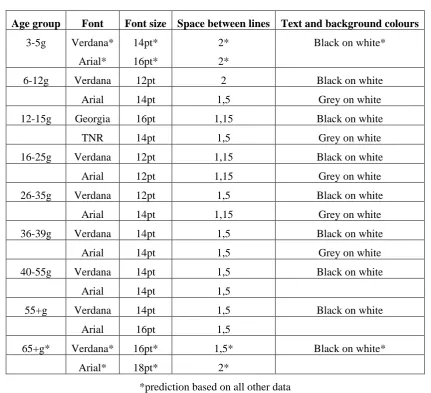
Demo recommendations were made for three age groups. [48] Newly created basic recommendations are wider, more effective for e-material improvement and personalised learning approach. General formatting recommendations for e-material body text parameters are presented in Tabel 3.
The app prototype currently has tree level of e-material formatting:
1. Basic level – general formatting recommendations, appropriate for screen use in general, developed for different age-groups.
2. 1st level of personalisation – simple-middle personalisation, developed and based on the three-question approach
3. 2nd level of personalisation – middle personalisation, developed and based on a wide range of question approach, contains a wide range of possibilities
Page 202
Age group Font Font size Space between lines Text and background colours 3-5g Verdana*
Arial*
14pt* 16pt*
2* 2*
Black on white*
6-12g Verdana 12pt 2 Black on white
Arial 14pt 1,5 Grey on white
12-15g Georgia 16pt 1,15 Black on white
TNR 14pt 1,5 Grey on white
16-25g Verdana 12pt 1,15 Black on white
Arial 12pt 1,15 Grey on white
26-35g Verdana 12pt 1,5 Black on white
Arial 14pt 1,15 Grey on white
36-39g Verdana 14pt 1,5 Black on white
Arial 14pt 1,5 Grey on white
40-55g Verdana 14pt 1,5 Black on white
Arial 14pt 1,5
55+g Verdana 14pt 1,5 Black on white
Arial 16pt 1,5
65+g* Verdana* 16pt* 1,5* Black on white*
Arial* 18pt* 2*
*prediction based on all other data
Table 3. General formatting recommendations for e-material body text parameters
Fig. 4. Scheme of 1st level formatting: from process start to the formatted document including questions and tree forest scheme in the app for decision making.
Techniques for mapping questions or a list of symptoms is used as the focus in AI. App link elements of the query to a possible solution. It is used “if-when” model.
Also, the 2nd level of personalisation use list of symptoms to determine:
Page 203
vision problems,
nearwork / reading tiredness
reading disabilities
It gives the possibility of better personalisation and app can give extra advice to users as tips for additional personal comfort improvement and health care.
4. CONCLUSIONS
Active and wide research of persons with specific limitation and disabilities allow understanding better people needs and relationships of different parameters. It opens possibilities for improvements to education materials for everybody.
Basic e-material formatting for screen use improve perception and decrease discomfort related to screen reading in general. Can be used for everybody and are not limited to education reasons.
Advanced, more personalised formatting improves the individual perception that consequentially improve legibility, readability of text. It improves comprehension of text and memorability of content that is followed by the increase of educational achievements. Appropriate formatting decrease near workload and discomfort related to vision fatigue, accommodative overload. It can be followed by vision and eye health improvement and decrease of related ocular problem development.
Currently, the app prototype and formatting recommendations are developed for regular learners who are without specific limitations and disabilities. However, the complete idea is to make an app for wide usage possibilities in the future as can be adapted to different situations and conditions, and meet wider learners and e-material users’ range.
REFERENCES
1. Grof J.F. 2017, Personalized Learning: The State of the Field & Future Directions, publication of Center for Curriculum Redesign 2017
2. Morin A. 2018, Personalized Learning: What You Need to Know, viewed 30.july 2019 <https://www.understood.org/en/school-learning/partnering-with-childs-school/instructional-strategies/personalized-learning-what-you-need-to-know>.
3. Marshall K. 2018, Why Personalized Learning Is Important, viewed 30.july 2019 <https://blog.thinkcerca.com/the-importance-of-personalized-learning>.
4. Patrick S., Kennedy K., Powell A. 2013, Mean What You Say: Defining and Integrating Personalized, Blended and Competency Education, iNACOL report
5. The Learning Accelerator, 2015, Blended Learning Research Clearinghouse 1.0, Report
6. Pane J.F., Steiner E.D., Baird M.D., Hamilton M.S., 2015, Continued Progress: Promising Evidence on Personalized Learning, RAND Corporation and Bill & Melinda Gates Foundation 7. Hrastinski, S. (2009). A theory of online learning as online participation. Computers & Education,
52(1), 78-82.
8. Wiley, Using Student Feedback to Create Effective Online Learning Experiences, viewed 30.july 2019 <https://edservices.wiley.com/how-student-feedback-creates-better-online-learning/>. 9. GetReskiled 2018,What Are The Biggest Challenges of Online Courses? viewed 30.july 2019
<https://www.getreskilled.com/challenges-of-online-courses/>.
Page 204
11. Mizrachi D., Salaz A.M., Kurbanoglu S., Boustany J., 2018, Academic reading format preferences and behaviors among university students worldwide: A comparative survey analysis, PLoS ONE 13(5): e0197444
12. Kim A. 2019, Personalized learning: The Present and Future of Education, Personalized learning guide
13. Roberts M.C., Barber C.R. 2013, Effects of Reading Formats on the Comprehension of New Independent Readers, Journal of Literacy and Technology 24 Volume 14, Number 2
14. Department of Economic and Social Affairs Population Division, 2015, World Population Ageing, United Nations, New York
15. Nithyashri J., Kulanthaivel G., 2012, Classification of human age based on Neural Network using FG-NET Aging database and Wavelets, 2012 Fourth International Conference on Advanced Computing (ICoAC), IEEE
16. Statistics Canada, 2017, Age Categories, Life Cycle Groupings, Departmental standard
17. Zeitlin C. 2019 How are the different age groups defined? viewed 30.july 2019 < https://help.healthycities.org/hc/en-us/articles/219556208-How-are-the-different-age-groups-defined->.
18. Zettler-Greeley C.M. 2018, Reading Milestones, viewed 30.july 2019 <https://kidshealth.org/en/parents/milestones.html>.
19. American Academy of Pediatrics, 2019, Ages & Stages, viewed 30.july 2019 <https://www.healthychildren.org/English/ages-stages/Pages/default.aspx>.
20. Wikipedia, Adolescence, viewed 30.july 2019 <https://en.wikipedia.org/wiki/Adolescence>. 21. WebMD, 2018, 3- to 4-Year-Olds: Developmental Milestones, viewed 30.july 2019
<https://www.webmd.com/parenting/3-to-4-year-old-milestones#1>.
22. Search Institute, 2019, Ages and Stages: Keeping Connected Through Child Development Stages, Understand Ages & Stages, Minneapolis
23. Parenting Today, 2019, Intellectual and Cognitive Development in Children and Teens, viewed 30.july 2019 < https://childdevelopmentinfo.com/child-development/intellectual-and-cognitive-development-in-children-and-teens/#gs.ta8xuk>.
24. Arnett J.J., Maynard A., 2013, Child Development: A Cultural Approach, Pearson; 2 edition 25. CDC, 2019 Positive Parenting Tips, Division of Human Development and Disability, National
Center on Birth Defects and Developmental Disabilities, Centers for Disease Control and Prevention, U.S.
26. Leversen J.S.R., Haga M., Sigmundsson H., 2012, From Children to Adults: Motor Performance across the Life-Span, PLoS ONE 7(6): e38830.
27. Healthy People GOV, 2019, Adolescent Health, HP2020 by the U.S. Department of Health and Human Services (https://www.healthypeople.gov/2020/topics-objectives/topic/Adolescent-Health) 28. Sunitha S., Gururaj G., 2014, Health behaviours & problems among young people in India: Cause for concern & call for action, Indian J Med Res. 2014 Aug; 140(2): 185–208. (https://www.ncbi.nlm.nih.gov/pmc/articles/PMC4216492/)
29. WHO, 2019, Adolescent health and development, WHO Regional office for South-East Asia,
viewed 30.july 2019 <
Page 205
30. Stang J, Story M. Chapter 1. Adolescent growth and development. Guidelines for adolescent nutrition services. Minneapolis, MN Center for Leadership, Education and Training in Maternal and Child Nutrition, Division of Epidemiology and Community Health, School of Public Health, University of Minnesota.2005. [accessed on June 20, 2012]. Available from: http://www.epi.umn.edu/let/pubs/img/adol_ch1.pdf
31. http://RollerCoaster.ie, 2019, Stages of Development – 10 to 15 year olds, viewed 30.july 2019 < https://rollercoaster.ie/zarchive/parenting-old/your-childs-development/stages-of-development-10-to-15-year-olds/>.
32. Krueger A., 2019, Shyness, Ages 12 to 16, viewed 30.july 2019 < https://consumer.healthday.com/encyclopedia/children-s-health-10/child-development-news-124/shyness-ages-12-to-16-645926.html>.
33. Wikipedia, Emerging adulthood and early adulthood, viewed 30.july 2019 < https://en.wikipedia.org/wiki/Emerging_adulthood_and_early_adulthood>.
34. GreatSchools Staff, 2016, Child development: 13- to 16-year-olds, viewed 30.july 2019 < https://www.greatschools.org/gk/articles/child-development-13-to-16-year-olds/>.
35. Wikipedia, Youth, viewed 30.july 2019 < https://en.wikipedia.org/wiki/Youth>. 36. Statistics Canada, 2017, Classification of age group, Departmental standard
37. OECD, 2019, OECD work on Youth, Policies by Organisation for Economic Co-operation and Development (https://www.oecd.org/youth.htm)
38. the National Youth Policy of India (2003Planning commission. New Delhi: 2008. Sep, [accessed on June 18, 2012]. Report of the Steering committee on youth affairs and sports for the eleventh
five year plan (2007-12) p. 41. Available
from:http://planningcommission.nic.in/aboutus/committee/strgrp11/str_yas.pdf
39. Houghton S, Hunter SC, Rosenberg M, Wood L, Zadow C, Martin K, et al. Virtually impossible: limiting Australian children and adolescents daily screen based media use. BMC Public Health. BioMed Central; 2015; 15: 5. https://doi.org/10.1186/1471-2458-15-5 PMID: 25613954 3. Rideout VJ, Ulla MA, 3.Foehr G, Roberts DF. Generation M2: Media in the Lives of 8-to 18-Year-Olds. Menlo Park, CA; 2010
40. Wikipedia, Young adult (psychology), viewed 30.july 2019
<https://en.wikipedia.org/wiki/Young_adult_(psychology)>.
41. Teipel H., 2018, Understanding Adolescence Seeing Through A Developmental Lens, adolescent development research by The State Adolescent Health Resource Center
42. Al al-Bayt University, Adulthood Age Group Growth & Development, Lecture 11, lecture notes 43. Petry N.M., 2002, A comparison of young, middle-aged, and older adult treatment-seeking
pathological gamblers, Gerontologist. 2002 Feb;42(1):92-9.
44. InReality, 2017, What are the age ranges for youth, young adult, adult, and senior in IntelliSense? viewed 30.july 2019 < https://cenique1.zendesk.com/hc/en-us/articles/202487549-What-are-the-age-ranges-for-youth-young-adult-adult-and-senior-in-IntelliSense->.
45. Weinberg G., 2019, What is the real age range of young adulthood?, viewed 30.july 2019 <
https://www.quora.com/What-are-the-biggest-tracker-networks-and-what-can-I-do-about-them/answer/Gabriel-Weinberg>. (https://www.quora.com/What-is-the-real-age-range-of-young-adulthood)
Page 206
47. World Health Organization. The World Health Report 1998. Life in the 21st Century. A vision for all. Report of the Director-General. Chapter 3. Geneva: World Health Organization; 1998. [accessed on January 8, 2013]. Health across the life span; pp. 66–111. Available from:http://www.who.int/whr/1998/en/whr98_en.pdf
48. Mackare K., Jansone A., "Habits of Using internet and digital devices in education," Proceedings of the International Scientific Conference SOCIETY. INTEGRATION. EDUCATION. May 25th-26th, 2018, Volume V, May 25th-26th 2018, 348-356