ORIGINAL RESEARCH ARTICLE
KNOWLEDGE AND PRACTICE OF ELDERLY PEOPLE OF A SYSTEMIC ARTERIAL
HYPERTENSION PROGRAM IN BELEM-PARA
1
*Eliene do Socorro da Silva Santos,
1Ana Kedma Correa Pinheiro,
1Brunna Susej Guimarães
Gomes,
2Margarete Feio Boulhosa,
3Héllen Cristhina Lobato Jardim Rêgo,
4Wilson Mateus
Gomes da Costa Alves,
5, *Rosiane Pinheiro Rodrigues,
1Manoel Vitor Martins Marinho,
6Silvana
Silva Chaves,
7Tatiana Menezes Noronha Panzetti,
8
Virgínia Mercês Lara Pessoa Oliveira,
9Marcia Andrea da Gama Araujo,
10Milene Gouvêa Tyll,
11Lidiane de Nazaré Mota Trindade, and
11Gracileide Maia Corrêa
1
Nurse, University of Para State, Belém, Para, Brazil
2
Nurse, Master in Nursing from the Federal University of Rio de Janeiro, Teacher at University of Pará State,
Belém, Pará, Brazil
3
Nurse, Master's Degree in Parasitary Biology in the Amazon University of the State of Pará /
InstitutoEvandro Chagas, Belém, Pará, Brazil
4
Physical Education Teacher, University of Pará State, Belém, Pará, Brazil
5
Nurse Master degree in Health, Environment and Society of Amazon by Federal University of Pará,
Professor at University of Pará State, Belém, Pará, Brazil
6
Nurse. Master Student of the Post Graduate Program in Epidemiology and Health Surveillance / Institute
Evandro Chagas, Specialization in Tropical Diseases (Nucleus of Tropical Medicine / UFPA), Specialization in
Auditing and Health Systems – UNAMA, Belém, Pará, Brazil
7
Nurse, Master in Nursing from the University of the State of Pará, Belém, Pará, Brazil
8Nurse, Doctor of Science in Education and Health, Belém, Pará, Brazil
9
Nurse, Master in Health Education in Amazonia from the uepa, Belém, Pará, Brazil
10
Nurse, Master in Environmental and Health Sciences, Nurse of the FPEHCGV coronary unit, Professor at
the University of the Amazon, Belém, Pará, Brazil
11
Nurse, Master student of the Postgraduate Program in Nursing at the University of the State of Para/
Federal University of Amazonas, Belem, Para, Brazil
ARTICLE INFO ABSTRACT
Objective: To analyze the knowledge and practices of elderly people affected by Systemic Arterial Hypertension, enrolled in the HIPERDIA program, in a Health School Center in the metropolitan region of Belem-PA.
Materials and methods: Descriptive research, with a quantitative approach, performed with 81 hypertensive users who were aged ≥ 60 years.
Results: Knowledge about hypertension and healthy living habits, as well as practices, proved to be adequate (p<0,05).
Conclusions: Although the knowledge and practices of the elderly are satisfactory, the changes in the life habits of some users expressed deficiency, since they involve behavioral aspects of risk and this may interfere and / or hinder the effectiveness of the treatment and, consequently, the control of the Systemic Arterial Hypertension.
Copyright © 2019,Eliene do Socorro da Silva Santos et al. This is an open access article distributed under the Creative Commons Attribution License, which
permits unrestricted use, distribution, and reproduction in any medium, provided the original work is properly cited.
ISSN: 2230-9926
International Journal of Development Research
Vol. 09, Issue, 02, pp.25649-25653, February, 2019
Article History:
Received 17th November, 2018
Received in revised form 26th December, 2018 Accepted 07th January, 2019
Published online 27th February, 2019
Key Words:
Hypertension, Health of the Elderly, Knowledge, Life Style.
Citation: Eliene do Socorro da Silva Santos, Ana Kedma Correa Pinheiro, Brunna Susej Guimarães Gomes, et al. 2019. “Knowledge and practice of
elderly people of a systemic arterial hypertension program in Belem-Para”, International Journal of Development Research, 09, (02), 25649-25653.
INTRODUCTION
Systemic Arterial Hypertension (SAH) is a relevant public health problem in our country and stands out as one of the most common chronic Non Communicable Diseases (NCD) in the elderly, denoting the need for public policies focused on this profile of users and the improvement of primary health care (Barreto, MS, Carreira, L. and Marcon, SS, 2015). In Brazil, the Ministry of Health provides the HIPERDIA program, which monitors patients diagnosed with hypertension and/or diabetes mellitus (Brazil, 2017), as well as recommends that lifestyle changes (LSC) be approached, since they are fundamental in SAH treatment and control, because it influences well-being and the aging process (Dias, EG, Souza, BRS, Souza, FE, Jesus M. and Alves JCS, 2017). In addition, it is worth emphasizing the importance of the degree of knowledge of people with SAH about their health condition, since they reflect in a greater independence in the control of the disease and better adherence to the treatment, consequently, a satisfactory and effective therapy (Motter, FR, Olinto, MTA and Paniz, VMV, 2015). All of this contributed to the following question: what are the knowledge and practices that elderly people affected by SAH, and registered in the HIPERDIA program, have about the disease? Therefore, the objective of this study was to analyze the knowledge and practices of elderly people affected by hypertension, enrolled in the HIPERDIA program at a Health School Center in the region of Belem-Para.
MATERIALS AND METHODS
It is a descriptive research, with a quantitative approach. The place chosen was a School Health Center in Belem-Para. 81 users of the HIPERDIA program participated in the study. The sample was defined according to the number of patients with SAH enrolled in the program and the sample size calculation was established using the Cochran sampling technique (Cochran, WG, 1977), with assumptions being the sampling error of 5% and the study power estimated at 80%. Hypertensive users aged ≥60 years old of both sexes were included. Those with cognitive impairment and / or diagnosed neurological disease, described in medical records, were excluded. Data were collected between May and June 2018. After the approach, the users were referred to a reserved room,
in which the Informed Consent Term was signed. A structured form was applied, divided in: sociodemographic data; knowledge about hypertension and healthy lifestyle habits; and practices, which include care related to the person with hypertension. Each question had 3 alternatives, classified as Adequate (AD), Intermediate (IM) or Inadequate (IN). The data were tabulated by the Excel program and the statistical treatment was performed through the statistical package SPSS 22.0, in which descriptive statistics were used to characterize the sample, by presenting the absolute (number) and relative (percentage) prevalence the categorical variables. Inferential statistics were performed using the chi-square test to indicate differences in the prevalence of categorical variables. We adopted a significance level of p <0.05 for statistical inferences. The study was approved by the Ethics and Research Committee of the University of Para State, registry number 2.606.316.
RESULTS
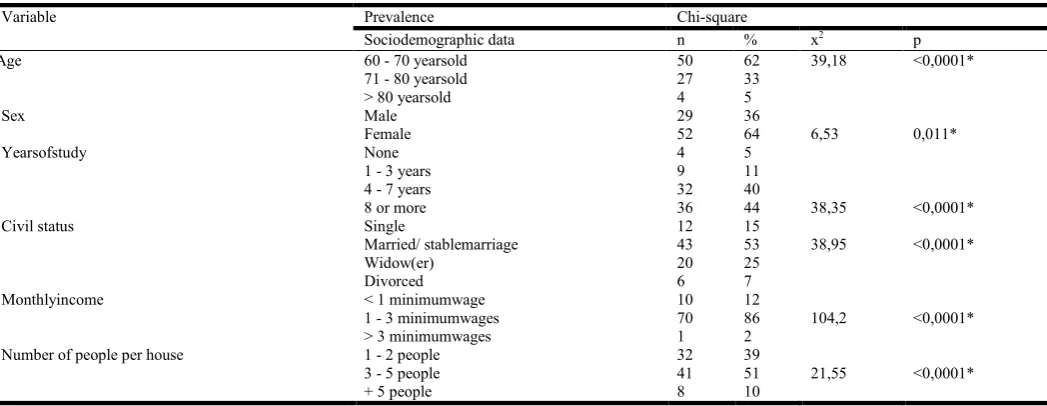
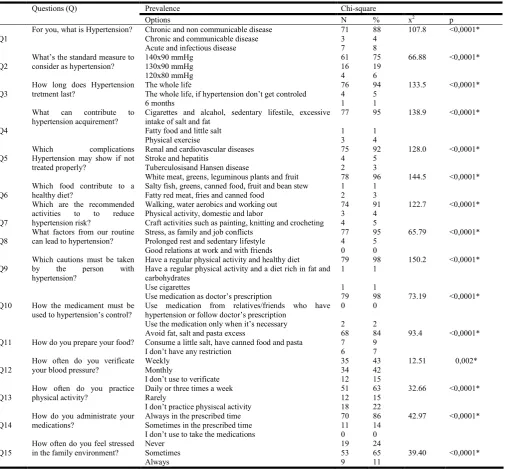
[image:2.595.35.559.596.799.2]Of the 81 elderly interviewed, the age of 60 to 70 years prevailed (62%); female (64%); 8 years of schooling (44%); civil status / stable marriage (53%); monthly income of 1 to 3 salaries (86%); 3 to 5 people per residence (51%), described in Table 1. The variables described were highly significant (p <0.05). As can be seen in Table 2, the sample presented a higher significant prevalence (p <0.05) in the AD alternatives of the questions (Q): Q1 (88%), Q2 (75%), Q3 (94%), Q4 95%), Q5 (92%), Q6 (96%), Q7 (91%), Q8 (95%), Q9 (98%), Q10 (98%), Q11 (84%), Q12 (43%), Q13 (63%) and Q14 (86%). Only Q15 presented a lower prevalence (24%). In general, regarding the questions related to knowledge about hypertension, the results found correspond: Q1- AD (88%), IM (4%), IN (8%); Q2-AD (75%), IM (19%), IN (6%); Q3-AD (94%), IM (5%), IN (1%); Q4-AD (95%), IM (1%), IN (4%); and Q5-AD (92%), IM (5%), IN (3%). Concerning knowledge about healthy habits, the findings are: Q6- AD (96%), IM (1%), IN (3%); Q7- (91%), IM (4%), IN (5%); Q8-AD (95%), IM (5%); Q9-AD (98%), IM (1%), IN (1%); and Q10-AD (98%), IN (2%). Regarding the care practices of the hypertensive person, the results show: Q11- AD (84%), IM (9%), IN (7%); Q12-AD (43%), IM (42%), IN (15%); Q13-AD (63%), IM (15%), IN (22%); Q14-Q13-AD (86%), IM (14%); and Q15- (24%) IM (65%), IN (11%).
Table 1. Sociodemographic profile of the elderly interviewed in the systemic arterial hypertension program
Variable Prevalence Chi-square
Sociodemographic data n % x2 p
Age 60 - 70 yearsold 50 62 39,18 <0,0001*
71 - 80 yearsold 27 33
> 80 yearsold 4 5
Sex Male 29 36
Female 52 64 6,53 0,011*
Yearsofstudy None 4 5
1 - 3 years 9 11
4 - 7 years 32 40
8 or more 36 44 38,35 <0,0001*
Civil status Single 12 15
Married/ stablemarriage 43 53 38,95 <0,0001*
Widow(er) 20 25
Divorced 6 7
Monthlyincome < 1 minimumwage 10 12
1 - 3 minimumwages 70 86 104,2 <0,0001*
> 3 minimumwages 1 2
Number of people per house 1 - 2 people 32 39
3 - 5 people 41 51 21,55 <0,0001*
+ 5 people 8 10
DISCUSSION
The socio-demographic profile found in this study corroborates the findings of other studies about hypertension in Brazil, that points out highest concentration in: the elderly with 60 to 70 years of age (Teixeira, JF, Goulart, MR, Busnello, FM and Lucia, CP, 2016); (Freitas, PDS, Matta, SR, Mendes, LVP, Luiza, VL and Campos MR, 2018); of the sex females (Motter, FR, Olinto, MTA and Paniz, VMV, 2015); (Chagas, JAS and Almeida, ANF, 2016); married / stable union (Teixeira, JF, Goulart, MR, Busnello, FM and Lucia, CP, 2016); (Machado, JC, Cotta, RMM, Moreira TR and Silva, LSD, 2016); patients living with 3 to 5 people (Motter, FR, Olinto, MTA and Paniz, VMV, 2015); (Machado, JC, Cotta, RMM, Moreira TR and Silva, LSD, 2016); people that have monthly income of 1 to 3 minimum wages (Vancini-Campanharo, CR, Oliveira, GN, Andrade, TFL, Okuno, MFP, Lopes, MCBT and Batista, REA, 2015); (Chagas, JAS and Almeida, ANF, 2016) and people
[image:3.595.52.559.83.552.2]that have 8 or more years of study (Mendes, LVP, Luiza, VL and Campos, MR, 2014); (Tibúrcio, MP, Melo, GSM, Balduíno, LSC, Freitas, CCS, Costa, IKF and Torres, GV, 2015). In the context of the knowledge and practices of the elderly surveyed, the study showed that they presented, above all, AD knowledge about hypertension and healthy life habits, which is very significant for the quality of life of these users and leads to the idea that they have access to information. However, despite the percentages of the IM and IN alternatives, in questions 1 and 2 be discrete, it is understood that they merit attention, since they correspond to factors that may contribute to non-compliance and ineffectiveness of the treatment. A survey of 422 people diagnosed with SAH found that, in the majority of hypertensive users, adequate knowledge about the disease was obtained, only two subjects had below-expected scores (<70%). The study also states that this index, when found, may be related to the degree of its knowledge about the disease, to the acceptance of its state, to the incitement to understand the information, as well as to its level
Table 2. Sample prevalence of values (absolute and relative) and comparison of prevalences (chi-square)
Questions (Q) Prevalence Chi-square
Options N % x2 p
Q1
For you, what is Hypertension? Chronic and non communicable disease Chronic and communicable disease Acute and infectious disease
71 3 7 88 4 8
107.8 <0,0001*
Q2
What’s the standard measure to consider as hypertension?
140x90 mmHg 130x90 mmHg 120x80 mmHg 61 16 4 75 19 6
66.88 <0,0001*
Q3
How long does Hypertension tretment last?
The whole life
The whole life, if hypertension don’t get controled 6 months 76 4 1 94 5 1
133.5 <0,0001*
Q4
What can contribute to hypertension acquirement?
Cigarettes and alcahol, sedentary lifestile, excessive intake of salt and fat
Fatty food and little salt Physical exercise 77 1 3 95 1 4
138.9 <0,0001*
Q5
Which complications Hypertension may show if not treated properly?
Renal and cardiovascular diseases Stroke and hepatitis
Tuberculosisand Hansen disease
75 4 2 92 5 3
128.0 <0,0001*
Q6
Which food contribute to a healthy diet?
White meat, greens, leguminous plants and fruit Salty fish, greens, canned food, fruit and bean stew Fatty red meat, fries and canned food
78 1 2 96 1 3
144.5 <0,0001*
Q7
Which are the recommended activities to to reduce hypertension risk?
Walking, water aerobics and working out Physical activity, domestic and labor
Craft activities such as painting, knitting and crocheting 74 3 4 91 4 5
122.7 <0,0001*
Q8
What factors from our routine can lead to hypertension?
Stress, as family and job conflicts Prolonged rest and sedentary lifestyle Good relations at work and with friends
77 4 0 95 5 0
65.79 <0,0001*
Q9
Which cautions must be taken by the person with hypertension?
Have a regular physical activity and healthy diet Have a regular physical activity and a diet rich in fat and carbohydrates Use cigarettes 79 1 1 98 1 1
150.2 <0,0001*
Q10 How the medicament must be used to hypertension’s control?
Use medication as doctor’s prescription
Use medication from relatives/friends who have hypertension or follow doctor’s prescription
Use the medication only when it’s necessary
79 0 2 98 0 2
73.19 <0,0001*
Q11 How do you prepare your food?
Avoid fat, salt and pasta excess
Consume a little salt, have canned food and pasta I don’t have any restriction
68 7 6 84 9 7
93.4 <0,0001*
Q12
How often do you verificate your blood pressure?
Weekly Monthly
I don’t use to verificate
35 34 12 43 42 15
12.51 0,002*
Q13
How often do you practice physical activity?
Daily or three times a week Rarely
I don’t practice physiscal activity
51 12 18 63 15 22
32.66 <0,0001*
Q14
How do you administrate your medications?
Always in the prescribed time Sometimes in the prescribed time I don’t use to take the medications
70 11 0 86 14 0
42.97 <0,0001*
Q15
How often do you feel stressed in the family environment?
Never Sometimes Always 19 53 9 24 65 11
39.40 <0,0001*
Source: Research Protocol
of education (Barreto, MS, Reiners, AAO and Marcon, SS, 2014). It is worth highlighting the importance of the hypertensive person in analyzing their own knowledge, which may favor behaviors aimed at preventing or reducing the appearance of complications due to hypertension (Bezerra, VM, Andrade, ACS, Césa, CCR and Caiaffa, WT, 2015). According to the World Health Organization, in 2008, 9.4 million deaths were due to the complications of SAH, among them Cardiovascular Diseases (CVD), and the estimate is that by 2030, 23 million people will die from CVD (Vancini-Campanharo, CR, Oliveira, GN, Andrade, TFL, Okuno, MFP, Lopes, MCBT and Batista, REA, 2015). Regarding the practices carried out by the participants, this study revealed some shortcomings. Although a satisfactory prevalence was obtained for the AD alternative, between 43% and 86%, in contrast to the percentage rates directed to knowledge, which had its lowest index above 80%, significant percentage rates were evidenced in the alternatives IM and IN. This suggests that the fact that the participants, for the most part, obtain AD knowledge about hypertension, still does not adherence to the LSC. It is fundamental that good lifestyle practices, whether inserted from the beginning of treatment, concomitant or not with pharmacological therapy, should always be encouraged over time by the multiprofessional team, since they involve the primary conditions for the control of hypertension. The same study identified that there was greater adherence to healthy lifestyle habits when the orientation came from more than one health professional (Rohrbacher, I., Corrêa, CJS, Schmitz, GLP, Rômulo, MCB and Gonçalves, PCZ, 2014). It was found in this study that although most avoided the excess of fats, salt and pasta, some consumed little salt, however, they made use of canned and pasta or they had no restriction. A research has pointed out that some risky behavioral conditions, including poor diet, contribute to the prevalent rates of hypertension. It also affirms that the option for a healthy diet is correlated with the maintenance of adequate blood pressure values, reflecting the therapeutic success of HAS (Teixeira, JF, Goulart, MR, Busnello, FM and Lucia, CP, 2016). The frequency of checking blood pressure was identified, which 15% of the participants pointed out not having this habit, what can interfere in the health and quality of life of these elderly people. The verification of pressure levels is recommended for the detection of arterial hypotension and hypertension (Tibúrcio, MP, Melo, GSM, Balduíno, LSC, Freitas, CCS, Costa, IKF and Torres, GV, 2015). This evaluation becomes essential for the control of tension levels (Motter, FR, Olinto, MTA and Paniz, VMV, 2015).
Regarding to physical activity practices, 63% of the participants stated that they practiced regular activities. However, 15% reported practicing physical activity rarely and 22% did not practice, it might be taken in account when considering the importance of non-pharmacological treatment in controlling blood pressure levels, which together with diet, includes benefits that include the decrease of pressure, weight and lipid indices. All of this makes LSC an expressive therapeutic mode. Contrary to the results found, some studies suggest a low adherence to the practice of physical activity. A study found low adherence to non-medicated treatment when only 10.2% of the patients said they practiced physical exercises and 36.7% had a balanced diet (Chagas, JAS and Almeida, ANF, 2016). A similar study, carried out with 212 hypertensive patients, found that the majority of participants did not reach recommended levels of physical activity for health promotion (Machado, JC, Cotta, RMM, Moreira TR and
Silva, LSD, 2016). Although the results of this study related to the practice of physical activity have been expressed positively, it is necessary to emphasize the characteristics of the studied group, since the elderly in general have very ingrained habits, as well as physical and functional limitations characteristic of age. Some studies report that the sedentary lifestyle is common in the elderly and with SAH, which requires planning programs to encourage physical activity that fit their particularities (Machado, JC, Cotta, RMM, Moreira TR and Silva, LSD, 2016). Regarding drug adherence, only 14% do so irregularly. (Girotto, E., Andrade, SMD, Cabrera, MAS and Matsuo, T., 2013)show in their research that 59% of
hypertensive patients were considered adherents to
pharmacological treatment, and (Mendes, LVP, Luiza, VL and Campos, MR, 2014)that approximately 77% of patients reported that they did not stop taking their medications and 80% there were no drugs left. The findings of this study are based on adherence to pharmacological treatment, which may be associated with quality of service, assuming that adherence is linked to follow-up treatment (Martins, AG, Savaglia, SRR, Ohl, RIB, Martins, IML and Gamba, MA, 2014). It should be noted that adherence to treatment is considered as a complex behavioral process that is influenced by several factors, including the biological, psychological, socioeconomic and cultural dimensions (Martins, AG, Savaglia, SRR, Ohl, RIB, Martins, IML and Gamba, MA, 2014).When it does not occur, it may be one of the main causes of reduction of the clinical benefit and control of chronic NCD, causing health and psychosocial complications, as well as the reduction of quality of life (Freitas, PDS, Matta, SR, Mendes, LVP, Luiza, VL and Campos MR, 2018).
Concerning to the frequency the patients related to feel stressed in the family,a prevalence of 65% MI, 11% IN and 24% AD was observer – indicating the presence of the stress factor in 76% of the interviewees, whether it was routinely or not. Changes in blood pressure (BP), among other disorders, are associated with high levels of stress. Researches involving cardiovascular reactivity show that hypertensive subjects submitted to experimental sessions of emotional stress present a significant BP increase (Figueiredo, JO and Castro, EEC, 2015). In a study of the epidemiological characterization of hypertensive patients, stress had a prevalence of 53.1% among the risk factors for hypertension (Chagas, JAS and Almeida, ANF, 2016). In another study carried out with 106 participants, stress was indicated as one of the most harmful factors to the participants' lives, and its control was considered complicated (Pires, CGS and Mussi, FC, 2013). Stress is a factor of important interference in quality of life and is related to the development of several pathologies, affecting the productivity, relationships, motivation and health of the person (Figueiredo, JO and Castro, EEC, 2015).Besides, it’sconsidered one of the risk factors for non-maintenance of blood pressure control, linked to overweight, alcohol intake, smoking and poor diet (Martins, AG, Savaglia, SRR, Ohl, RIB, Martins, IML and Gamba, MA, 2014). Avoiding worries, therefore,becomes a challenge for health control and disease prevention, because it is affected by the environment, people's behavior and living conditions (Pires, CGS and Mussi, FC, 2013).
Final Considerations
practices were less prevalent. Despite not being a discrepant percentage, the changes of habits of some users were deficient, since they involve behavioral aspects of risk, such as: inadequate feeding; partial or absent blood pressure levels verification; partial or absent physical activities; partial antihypertensive medication administration and stress.These factors may interfere and / or hinder the effectiveness of the treatment and, consequently, the control of SAH. Through this study, it was possible to reflect the importance of the commitment of the health team within the HIPERDIA Program, since the work of these professionals could reflect in the levels of knowledge and practices of the users.
REFERENCES
Barreto MS, Carreira L, Marcon SS. 2015. Envelhecimento populacional e doenças crônicas: reflexões sobre os desafios para o Sistema de Saúde Pública. Rev. Kairós, 18(1): 325-39. Retrieved from http://revistas.pucsp.br/
index.php/kairos/article/view/26092/18731 on 10th
november 2018.
Barreto MS, ReinersAAO, Marcon SS. 2014. Conhecimento sobre hipertensão arterial e fatores associados à não adesão à farmacoterapia. Rev. latinoam. Enferm, 22(3): 484-90. Retrieved from https://doi.org/10.1590/0104-1169.3447. 2442 on 30th October 2018.
Bezerra VM, Andrade ACS, Césa CCR, Caiaffa WT. 2015.
Desconhecimento da hipertensão arterial e seus
determinantes em quilombolas do sudoeste da Bahia, Brasil. Cien. Saude Colet. 20(3): 797-807. Retrieved from http://www.scielo.br/pdf/csc/v20n3/1413-8123-csc-20-03-00797 on 07th November 2018.
Chagas JAS, Almeida ANF. 2016. Caracterização
epidemiológica de pacientes hipertensos usuários de uma unidade básica de saúde da região Norte. EstaçãoCientífica. 6(2): 105-16. Retrieved from https://periodicos.unifap.br/ index.php/estacao/article/view/2721 on 10th November 2018.
Cochran WG. 1977. Técnicas de amostragem. 2thedition, Rio
de Janeiro: Fundo de Cultura.
Dias EG, Souza BRS, Souza FE, Jesus M, Alves JCS. 2017. Estilo de vida de idosos usuários de uma unidade básica de saúde. Arq. ciênciassaúde UNIPAR, 21(2): 105-11. Retrieved from http://www.revistas.unipar.br/index.php/ saude/article/view/5875/3458 on 28th October 2018. Figueiredo JO, Castro EEC. 2015. Ajustamento criativo e
estresse na hipertensão arterial sistêmica. Revista da Abordagem Gestáltica, 21(1): 37-46. Retrievedfrom https://dialnet.unirioja.es/servlet/articulo?codigo=5205413 on 16th November 2018.
Freitas PDS, Matta SR, Mendes LVP, Luiza VL, Campos MR 2018. Uso de serviços de saúde e de medicamentos por portadores de Hipertensão e Diabetes no Município do Rio de Janeiro, Brasil. Cien. Saude Colet., 23(7): 2383-92. Retrieved from https://doi.org/10.1590/1413-81232018237. 21602016 on 05th November 2018.
Girotto E, Andrade SMD, Cabrera MAS, Matsuo T. 2013. Adesão ao tratamento farmacológico e não farmacológico e fatores associados na atenção primária da hipertensão arterial. Cien. Saude Colet., 18(6): 1763-72. Retrieved from http://www.scielo.br/revistas/csc/iaboutj.htm on 02th November 2018.
Machado JC, Cotta RMM, Moreira TR, Silva LSD (2016). Análise de três estratégias de educação em saúde para portadores de hipertensão arterial. Cien. Saude Colet., 21(2): 611-20. Retrieved from http://www.scielo.br/ revistas/csc/iaboutj.htm on 02th November 2018.
Martins AG, Savaglia SRR, Ohl RIB, Martins IML, Gamba MA. 2014. Adesão ao tratamento clínico ambulatorial da hipertensão arterial sistêmica. Acta Paul Enfermagem, 27(3): 266-72. Retrieved from http://dx.doi.org/10.1590/ 1982-0194201400045 on 04th November 2018.
Mendes LVP, Luiza VL, Campos MR. 2014. Uso racional de medicamentos entre indivíduos com diabetes mellitus e hipertensão arterial no município do Rio de Janeiro, Brasil. Cien. Saude Colet., 19(6): 1673-84. Retrieved from
http://www.scielo.br/revistas/csc/iaboutj.htm on 03th
November 2018.
Ministério da Saúde (BR). Departamento de Informática do Sistema Único de Saúde (DATASUS) 2017. Brasília:
Ministério da Saúde. Retrievedfrom saúde.gov.br/
informações-de-saude/tabneton 2017 apr 23.
Motter FR, Olinto MTA, Paniz VMV 2015. Avaliação do conhecimento sobre níveis tensionais e cronicidade da hipertensão: estudo com usuários de uma Farmácia Básica no Sul do Brasil. Cad. SaúdePública (Online), 31(2):
395-404. Retrieved from
http://dx.doi.org/10.1590/0102-311X00061914on 29th October 2018.
Pires CGS, Mussi FC. 2013. Crenças em saúde de pessoas negras hipertensas sobre o estresse. Ciência Cuidado e
Saúde, 12(3): 424-33. Retrievedfrom https://www.
researchgate.net/profile/Claudia_Pires10/publication/31437 2216_Crencas_em_saude_de_pessoas_negras_hipertensas_ sobre_o_estresse_DOI_104025cienccuidsaudev12i320838/ links/5aba49cfaca2728f4fa37881/Crencas-em-saude-de- pessoas-negras-hipertensas-sobre-o-estresse-DOI-104025-cienccuidsaudev12i320838.pdf?origin=publication_detail on 18th November 2018.
Rohrbacher I, Corrêa CJS, Schmitz GLP, Rômulo MCB, Gonçalves PCZ. 2014. Orientações de mudanças de estilo de vida em pacientes hipertensos. Revista da AMRIGS, 58(1): 49-53. Retrieved from https://www.amrigs.org.br/ revista/58-01/0000087394-08_1320_Revista%
20AMRIGS.pdf on 09th November 2018.
Teixeira JF, Goulart MR, Busnello FM, PellandaLC. 2016. Conhecimento e Atitudes Sobre Alimentos Ricos em Sódio por Pacientes Hipertensos. Arq. Bras. Cardiol, 106(5): 404-410. Retrieved from http://www.scielo.br/scielo.php?
script=sci_serial&pid=0066-82X&lng=en&nrm=iso on
01th November 2018.
Tibúrcio MP, Melo GSM, Balduíno LSC, Freitas CCS, Costa IKF, et al, 2015. Validação de conteúdo de instrumento para avaliar o conhecimento acerca da medida da pressão arterial. fundam. care. online, 7(2): 2475-85. Retrieved from http://dx.doi.org/10.9789/2175-5361.2015.v7i2.2475-2485 on 15th November 2018.
Vancini-Campanharo CR, Oliveira GN, Andrade TFL, Okuno MFP, Lopes MCBT, et al. 2015. Hipertensão Arterial
Sistêmica no Serviço de Emergência: adesão
medicamentosa e conhecimento da doença. Rev. latinoam.
Enfermagem, 23(6): 1149-56. Retrieved from
http://www.scielo.br/scielo.php?script=sci_arttext&pid=S0
10411692014000500810&lng=pt&nrm=iso&tlng=en on
30th October 2018.