Proceedings of the 3rd Workshop on Representation Learning for NLP, pages 101–106 Melbourne, Australia, July 20, 2018. c2018 Association for Computational Linguistics
101
Evaluating Word Embeddings
in Multi-label Classification
Using Fine-grained Name Typing
Yadollah Yaghoobzadeh1 Katharina Kann2 Hinrich Sch ¨utze3 1Mirosoft Research, Montreal, Canada
2Center for Data Science, New York University, USA 3CIS, LMU Munich, Germany
Abstract
Embedding models typically associate each word with a single real-valued vector, representing its different properties. Eval-uation methods, therefore, need to analyze the accuracy and completeness of these properties in embeddings. This requires fine-grained analysis of embedding sub-spaces. Multi-label classification is an ap-propriate way to do so. We propose a new evaluation method for word embeddings based on multi-label classification given a word embedding. The task we use is fine-grained name typing: given a large cor-pus, find all types that a name can refer to based on the name embedding. Given the scale of entities in knowledge bases, we can build datasets for this task that are complementary to the current embedding evaluation datasets in: they are very large, contain fine-grained classes, and allow the direct evaluation of embeddings without confounding factors like sentence context.
1 Introduction
[image:1.595.328.502.232.336.2]Distributed representation of words, aka word em-bedding, is an important element of many natu-ral language processing applications. The qual-ity of word embeddings is assessed using differ-ent methods. Baroni et al. (2014) evaluate word embeddings on different intrinsic tests: similarity, analogy, synonym detection, categorization and selectional preference. Different concept catego-rization datasets are introduced. These datasets are small (<500) (Baroni et al.,2014;Rubinstein et al., 2015) and therefore measure the goodness of embeddings by the quality of their clustering. Usually cosine is used as the similarity metric be-tween embeddings, ignoring subspace similarities.
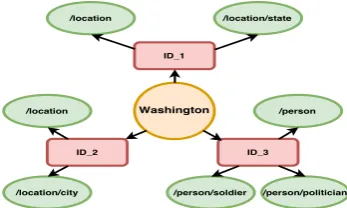
Figure 1: Types (ellipses; green) of the entities (rectangles; red), to which the name “Washington” can refer. Ideally, the embedding for “Washing-ton” should represent all these types.
Extrinsic evaluations are also used, cf. Li and Ju-rafsky(2015). In these tasks, embeddings are used in context/sentence representations with composi-tion involved.
In this paper, we propose a new evaluation method. In contrast to the prior work on intrin-sic evaluation, our method is supervised, large-scale, fine-grained, automatically built, and eval-uates embeddings in a classification setting where different subspaces of embeddings need to be an-alyzed. In contrast to the prior work on extrin-sic evaluation, we evaluate embeddings in iso-lation, without confounding factors like sentence contexts or composition functions.
Freebase. Exceptions are tasks in lexicon genera-tion or populagenera-tion like entity set expansion (ESE) (Thelen and Riloff, 2002), which are global but without entity IDs. ESE usually starts from a few seed entities per set and completes the set using pattern-based methods.
Here, we address the task offine-grained name typing (FNT), a global prediction task, operat-ing on the surface names of entities. FNT and ESE share applications in name lexicon popula-tion. FNT is different from ESE because we as-sume to have sufficient training instances for each type to train supervised models.
The challenging goal of FNT is to find the types of all entities a name can refer to. For example, ”Washington” might refer to several entities which in turn may belong to multiple types, see Figure1. In this example, “Washington” refers to “Washing-ton DC (city)”, “Washing“Washing-ton (state)”, or “George Washington (president)”. Also, each entity can be-long to several types, e.g., “George Washington” is a POLITICIAN, a PERSON and a SOLDIER, or
“Washington (state)” is aSTATEand aLOCATION. Learning global representations for entities is very effective for global prediction tasks in IE (cf.,
Yaghoobzadeh and Sch¨utze(2015)). For our task, FNT, we also learn a global representation for each name. By doing so, we see this task as a chal-lenging evaluation for embedding models. We in-tend to use FNT to answer the following questions: (i) How well can embeddings represent distinctive information, i.e., different types or senses? (ii) Which properties are important for an embedding model to do well on this task?
We build a novel large-scale dataset of (name, types) from Freebase with millions of examples. The size of the dataset enables supervised ap-proaches to work, an important requirement to be able to look at different subspaces of embeddings (Yaghoobzadeh and Sch¨utze,2016). Also, in FNT names are—in contrast to concept categorization datasets—multi-labeled, which requires to look at multiple subspaces of embeddings.
In summary, our contributions are (i) introduc-ing a new evaluation method for word embed-dings (ii) publishing a new dataset that is a good resource for evaluating word embeddings and is complementary to prior work: it is very large, con-tains more different classes than previous word categorization datasets, and allows the direct eval-uation of embeddings without confounding factors
like sentence context1.
2 Related Work
Embedding evaluation.Baroni et al.(2014) eval-uate embeddings on different intrinsic tests: simi-larity, analogy, synonym detection, categorization and selectional preference. Schnabel et al.(2015) introduce tasks with more fine-grained datasets. The concept categorization datasets used for em-bedding evaluation are mostly small (<500) ( Ba-roni et al.,2014) and therefore measure the good-ness of embeddings by the quality of their clus-tering. In contrast, we test embeddings in a clas-sification setting and different subspaces of em-beddings are analyzed. Extrinsic evaluations are also used (Li and Jurafsky,2015;K¨ohn,2015;Lai et al.,2015). In most tasks, embeddings are used in context/sentence representations with composi-tion involved. In this work, we evaluate embed-dings in isolation, on their ability to represent mul-tiple senses.
Related tasks and datasets.Our proposed task is fine-grained name typing (FNT). A related task is entity set expansion (ESE): given a set of a few seed entities of a particular class, find other enti-ties (Thelen and Riloff,2002;Gupta and Manning,
2014). We can formulate FNT as ESE, however, there is a difference in the training data assump-tion. For our task, we assume to have enough in-stances for each type available, and, therefore, to be able to use a supervised learning approach. In contrast, for ESE, mostly only 3-5 seeds are given as training seeds for a set, which makes an evalu-ation like ours impossible.
Named entity recognition (NER)consists of rec-ognizing and classifying mentions of entities lo-cally in a particular context (Finkel et al., 2005). Recently, there has been increased interest in fine-grained typing of mentions (Ling and Weld,2012;
Yogatama et al.,2015;Ren et al.,2016;Shimaoka et al.,2016). One way of solving our task is to col-lect every mention of a name, use NER to predict the context-dependent types of mentions, and then take all predictions as the global types of the name. However, our focus in this paper is on how em-bedding models perform and propose this task as a good evaluation method. We leave the compari-son to an NER-based approach for future work.
Corpus-level fine-grained entity typing is the
1Our dataset is available at: https://github.com/
103
task of predicting all types of entities based on their mentions in a corpus (Yaghoobzadeh and Sch¨utze,2015;Yaghoobzadeh and Sch¨utze,2017;
Yaghoobzadeh et al., 2018). This is similar to our task, FNT, but in FNT the goals is to find the corpus-level types ofnames. Corpus-level entity typing has also been used for embedding evalu-ation (Yaghoobzadeh and Sch¨utze, 2016). How-ever, they need an annotated corpus with entities. For FNT, however, pretrained word embeddings are sufficient for the evaluation.
Finally, there exists some previous work on FNT, e.g., Chesney et al. (2017). In contrast to us, they do not explicitly focus on the evaluation of embedding models, such that their dataset only contains a limited number of types. In contrast, we use 50 different types, making our dataset suitable for the type of evaluation intended.
3 Multi-label Classification of Word Embeddings
Word embeddings are global representations of word properties learned from the context distribu-tion of words. Words are usually ambiguous and belong to multiple classes, e.g., multiple part-of-speech tags or multiple meanings. A good word embedding should represent all information about the word, including its multiple classes. Our eval-uation methodology is based on this hypothesis and tries to test this through multi-label classifi-cation of word embeddings. Here, we focus on the semantic property of nouns and entity names. We try to find all categories or types of a noun given its embedding.
Multi-label classification of embedding has multiple advantages over current evaluation meth-ods: (i) large datasets can be created without much human annotation; (ii) more fine-grained analysis of the results is possible through analyzing classi-fication performance; (iii) it allows the direct eval-uation of embeddings without confounding factors like sentence context.
4 Fine-grained Name Typing
We assume to have the following: a set of names
N, a set of typesTand a membership functionm:
N×T 7→ {0,1}such thatm(n, t) = 1iff namen
has typet; and a large corpusC. In this problem setting, we address the task offine-grained name typing(FNT): we want to infer from the corpus for each pair of namenand typetwhetherm(n, t) =
1holds.
For example, for the name “Hamilton”, we should find all of the following: LOCATION, OR
-GANIZATION,PERSON,CITY,SPORTS TEAMand
SOLDIER, since “Hamilton” can describe entities
belonging to those types. Another example is “Falcon” which is used for ANIMAL, AIRPLANE,
SOFTWARE, ART. FNT sheds light on to which
level these fine-grained types can be inferred from a corpus using embeddings.
4.1 Embedding-based Model
We aim to findP(t|n), i.e., the probability of name
nhaving typet. Given sufficient training instances for each typet, we can formulate the problem as a multi-label classification task. As input, we use a representation forn, learned from the corpusC. Distributional representations have shown to cap-ture various types of information about a word, es-pecially their categories or types (Yaghoobzadeh and Sch¨utze,2015).
After learning an embedding for n, we train two kinds of binary classifiers for each type t to to estimateP(t|n): (i) linear: logistic regression (LR) with stochastic gradient decent; and (ii) non-linear: multi-layer perceptron (MLP) with one hidden layer and ReLU as the non-linearity. We use the Scikit-learn (Pedregosa et al.,2011) toolkit for training our classifiers.
5 Dataset
Using Freebase (Bollacker et al., 2008), we first retrieve the set of all entities En for each name
n.2 Then, we consider the types of alle∈E nthe types ofn. See Figure1for an example: all of the shown types belong to the name ”Washington”.
Since some of the about 1,500 Freebase types have very few instances, we map them first to the FIGER (Ling and Weld,2012) type-set, which contains 113 types. We then further restrict our set to the top 50 most frequent types. See Table5for the list of types.
In order to be able to evaluate each embed-ding on its own, we divide our dataset into single-word (891,241 names) and multi-single-word (8,907,715 names). In this work, the multi-word set is not used. We then set a frequency threshold of 100 in our lowercased Wikipedia corpus 3 and select
2
What we call “names” here are eithernamesoraliases in the Freebase terminology.
/art, /art/film, /astral body, /biology, /broadcast network, /broadcast program, /building, /building/restaurant, /chem-istry, /computer/programming language, /disease, /event, /food, /game, /geography/island, /geography/mountain, /god, /internet/website, /living thing, /location, tion/body of water, /location/cemetery, /location/city, /loca-tion/county, /medicine/drug, /medicine/medical treatment, /medicine/symptom, /music, /organization, /orga-nization/airline, /organization/company, /organiza-tion/educational institution, /organization/sports team, /people/ethnicity, /person, /person/actor, /person/artist, /person/athlete, /person/author, /person/director, /per-son/engineer, /person/musician, /play, /product, /prod-uct/airplane, /product/instrument, /product/ship, /software, /title, /written work
Table 1: List of the 50 types in our FNT dataset.
#names avg #types per name train 50,000 3.78
dev 20,000 3.77 test 30,000 3.77
Table 2: Some statistics (number of names; aver-age number of types per name) for our name typ-ing dataset.
randomly 100,000 of our dataset names that pass this threshold. We then divide the names into train (50%), dev (20%) and test (30%). Some statistics of the single-word FNT dataset are shown in Ta-ble2.
6 Experiments
6.1 FNT for Embedding Evaluation
Embedding models. We choose four different embedding models for our comparisons: (i) Skip-Gram (henceforth SKIP) (skipgram bag-of-words model) (Mikolov et al.,2013), (ii) CBOW (contin-uous bag-of-words model) (Mikolov et al.,2013), (iii) Structured SkipGram (henceforth SSKIP) (Ling et al., 2015), (iv) CWindow (henceforth CWIN) (continuous window model) (Ling et al.,
2015), and SSKIP and CWIN are order-aware, i.e, they take the order of the context tokens into ac-count, while SKIP and CBOW are bag-of-words models.
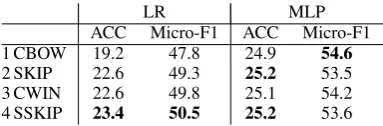
Results and analysis. We report the results for all embedding models using LR and MLP in Ta-ble3. We use the following evaluation measures, which are used in entity typing (Yaghoobzadeh and Sch¨utze,2015): (i) ACC (accuracy): percent-age of test examples where all predictions are cor-rect, (ii) Micro-F1: the global F1 computed over all the predictions.
Models in lines 1-5 in Table 3 are trained on
LR MLP
ACC Micro-F1 ACC Micro-F1 1 CBOW 19.2 47.8 24.9 54.6 2 SKIP 22.6 49.3 25.2 53.5 3 CWIN 22.6 49.8 25.1 54.2 4 SSKIP 23.4 50.5 25.2 53.6
Table 3: Accuracy and micro-F1 results on FNT for different embedding models using two classi-fiers (LR and MLP). Best result in each column is bold.
the Wikipedia corpus. We set the min frequency in corpus to 100. Window size = 3; negative sampling with n = 10. Based on the results of LR, order-aware architectures are better than their bag-of-words counterparts, i.e., SSKIP > SKIP and CWIN>CBOW. Overall, SSKIP is the best using LR classification. In MLP results, how-ever, CBOW works best on micro-F1 measure and SSKIP and SKIP are bests on accuracy. There is no significant difference between CBOW and CWIN, or SSKIP and SKIP, respectively. Over-all, the nonlinear classifier (MLP) with one hidden layer outperforms the linear classifier (LR) sub-stantially, emphasizing that the encoded informa-tion about different types is easier to extract with stronger models.
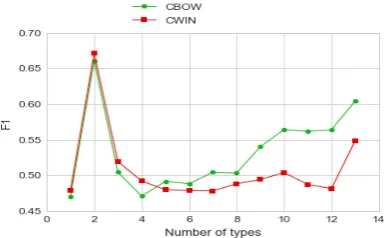
Analysis on the number of name types. As a separate analysis, we measure how the classifi-cation performance depends on theN number of types of a name. To do so, we group test names based on their number of types. We keep the groups that have more than 100 members. Then, we plot the F1 results of CBOW and CWIN mod-els trained using MLP classifier in Figure2.
As it is shown, both models get their best results on names withN = 2. We suppose that the bad performance ofN = 1 is related to the fact that one-type names have missing types in our dataset due to the incompleteness of Freebase. The worse F1 of N >= 3 compared toN = 2is expected since biggerNmeans that the models need to pre-dict more types from the name embeddings. From
[image:4.595.107.258.261.303.2]105
Figure 2: Micro-F1 for names with different num-ber of types.
it works clearly better for N > 2. This shows that the embedding models behave differently for different number of classes they belong to. This could also be related to the frequency of words. Analysis of the reasons would be interesting. We leave it for the future work.
7 Conclusion
We proposed multi-label classification of word embeddings using the task of fine-grained typing of entity names. The dataset we built is a resource that is complementary to prior work in embed-ding evaluation: it is very large, its examples are multi-labeled with very fine-grained classes, and it allows the direct evaluation of embeddings with-out the need for context. We analyzed the per-formance of different embedding models on this dataset, showing differences in their performance as well as some of their limits in representing types accurately and completely.
More analysis and evaluation is necessary though, but we believe by using this kind of dataset, we are able to do much more than what we could do before with the small manually built word similarity and categorization benchmarks.
References
Marco Baroni, Georgiana Dinu, and Germ´an
Kruszewski. 2014. Don’t count, predict! A
systematic comparison of context-counting vs. context-predicting semantic vectors. InProceedings of the 52nd Annual Meeting of the Association for Computational Linguistics, ACL 2014, pages 238–247.
Kurt D. Bollacker, Colin Evans, Praveen Paritosh, Tim Sturge, and Jamie Taylor. 2008. Freebase: a col-laboratively created graph database for structuring
human knowledge. InProceedings of the ACM
SIG-MOD International Conference on Management of Data, SIGMOD 2008, Vancouver, BC, Canada, June 10-12, 2008, pages 1247–1250.
Sophie Chesney, Guillaume Jacquet, Ralf Steinberger, and Jakub Piskorski. 2017. Multi-word entity clas-sification in a highly multilingual environment. In
MWE.
Jenny Rose Finkel, Trond Grenager, and Christopher Manning. 2005. Incorporating non-local informa-tion into informainforma-tion extracinforma-tion systems by gibbs
sampling. InProceedings of the 43rd Annual
Meet-ing of the Association for Computational LMeet-inguis- Linguis-tics (ACL’05), pages 363–370, Ann Arbor, Michi-gan. Association for Computational Linguistics.
Sonal Gupta and Christopher D. Manning. 2014.
Im-proved pattern learning for bootstrapped entity ex-traction. InProceedings of the Eighteenth Confer-ence on Computational Natural Language Learning, CoNLL 2014, Baltimore, Maryland, USA, June 26-27, 2014, pages 98–108.
Arne K¨ohn. 2015.What?s in an embedding? analyzing
word embeddings through multilingual evaluation. In Proceedings of the 2015 Conference on Empiri-cal Methods in Natural Language Processing, pages 2067–2073, Lisbon, Portugal.
Siwei Lai, Kang Liu, Liheng Xu, and Jun Zhao. 2015.
How to generate a good word embedding? CoRR, abs/1507.05523.
Jiwei Li and Dan Jurafsky. 2015. Do multi-sense
em-beddings improve natural language understanding?
In Proceedings of the 2015 Conference on Empiri-cal Methods in Natural Language Processing, pages 1722–1732, Lisbon, Portugal.
Wang Ling, Chris Dyer, Alan W. Black, and Isabel
Trancoso. 2015. Two/too simple adaptations of
word2vec for syntax problems. In NAACL HLT
2015, The 2015 Conference of the North American Chapter of the Association for Computational Lin-guistics: Human Language Technologies, Denver, Colorado, USA, May 31 - June 5, 2015, pages 1299– 1304.
Xiao Ling and Daniel S. Weld. 2012. Fine-grained en-tity recognition. InProceedings of the Twenty-Sixth AAAI Conference on Artificial Intelligence, Toronto, Ontario, Canada.
Tomas Mikolov, Kai Chen, Greg Corrado, and Jeffrey
Dean. 2013. Efficient estimation of word
represen-tations in vector space.CoRR, abs/1301.3781.
Fabian Pedregosa, Ga¨el Varoquaux, Alexandre Gram-fort, Vincent Michel, Bertrand Thirion, Olivier Grisel, Mathieu Blondel, Peter Prettenhofer, Ron Weiss, Vincent Dubourg, Jake VanderPlas, Alexan-dre Passos, David Cournapeau, Matthieu Brucher, Matthieu Perrot, and Edouard Duchesnay. 2011.
Scikit-learn: Machine learning in python. Journal
Xiang Ren, Wenqi He, Meng Qu, Lifu Huang, Heng Ji,
and Jiawei Han. 2016. Afet: Automatic fine-grained
entity typing by hierarchical partial-label embed-ding. In Proceedings of the 2016 Conference on Empirical Methods in Natural Language
Process-ing, pages 1369–1378, Austin, Texas. Association
for Computational Linguistics.
Sebastian Riedel, Limin Yao, Andrew McCallum, and
Benjamin M. Marlin. 2013.Relation extraction with
matrix factorization and universal schemas. In Pro-ceedings of the 2013 Conference of the North Amer-ican Chapter of the Association for Computational Linguistics: Human Language Technologies, pages 74–84, Atlanta, Georgia. Association for Computa-tional Linguistics.
Dana Rubinstein, Effi Levi, Roy Schwartz, and Ari Rappoport. 2015. How well do distributional mod-els capture different types of semantic knowledge? In Proceedings of the 53rd Annual Meeting of the Association for Computational Linguistics and the 7th International Joint Conference on Natural Lan-guage Processing of the Asian Federation of Natural Language Processing, ACL 2015, July 26-31, 2015, Beijing, China, Volume 2: Short Papers, pages 726– 730.
Tobias Schnabel, Igor Labutov, David Mimno, and
Thorsten Joachims. 2015. Evaluation methods for
unsupervised word embeddings. InProceedings of the 2015 Conference on Empirical Methods in Nat-ural Language Processing, pages 298–307, Lisbon, Portugal.
Sonse Shimaoka, Pontus Stenetorp, Kentaro Inui, and
Sebastian Riedel. 2016. An attentive neural
ar-chitecture for fine-grained entity type classification. In Proceedings of the 5th Workshop on Automated Knowledge Base Construction, pages 69–74, San Diego, CA. Association for Computational Linguis-tics.
Michael Thelen and Ellen Riloff. 2002. A bootstrap-ping method for learning semantic lexicons using
extraction pattern contexts. In Proceedings of the
2002 Conference on Empirical Methods in Natural Language Processing, pages 214–221. Association for Computational Linguistics.
Yadollah Yaghoobzadeh, Heike Adel, and Hinrich
Schuetze. 2018. Corpus-level fine-grained entity
typing. Journal of Artificial Intelligence Research, 61:835–862.
Yadollah Yaghoobzadeh and Hinrich Sch¨utze. 2015.
Corpus-level fine-grained entity typing using con-textual information. In Proceedings of the 2015 Conference on Empirical Methods in Natural Lan-guage Processing, pages 715–725, Lisbon, Portugal.
Yadollah Yaghoobzadeh and Hinrich Sch¨utze. 2016.
Intrinsic subspace evaluation of word embedding representations. In Proceedings of the 54th An-nual Meeting of the Association for Computational
Linguistics (Volume 1: Long Papers), pages 236– 246, Berlin, Germany. Association for Computa-tional Linguistics.
Yadollah Yaghoobzadeh and Hinrich Sch¨utze. 2017. Multi-level representations for fine-grained typing
of knowledge base entities. InProceedings of the
15th Conference of the European Chapter of the As-sociation for Computational Linguistics: Volume 1, Long Papers, pages 578–589. Association for Com-putational Linguistics.
Dani Yogatama, Daniel Gillick, and Nevena Lazic.
2015. Embedding methods for fine grained entity
type classification. InProceedings of the 53rd An-nual Meeting of the Association for Computational Linguistics and the 7th International Joint Confer-ence on Natural Language Processing (Volume 2: Short Papers), pages 291–296, Beijing, China. As-sociation for Computational Linguistics.
Daojian Zeng, Kang Liu, Siwei Lai, Guangyou Zhou,
and Jun Zhao. 2014. Relation classification via
convolutional deep neural network. In COLING