STransE: a novel embedding model of entities and relationships
in knowledge bases
Dat Quoc Nguyen1, Kairit Sirts1, Lizhen Qu2 and Mark Johnson1
1Department of Computing, Macquarie University, Sydney, Australia
[email protected], {kairit.sirts, mark.johnson}@mq.edu.au 2 NICTA, ACT 2601, Australia
Abstract
Knowledge bases of real-world facts about entities and their relationships are useful re-sources for a variety of natural language pro-cessing tasks. However, because knowledge bases are typically incomplete, it is useful to be able to performlink prediction, i.e., pre-dict whether a relationship not in the knowl-edge base is likely to be true. This paper com-bines insights from several previous link pre-diction models into a new embedding model STransEthat represents each entity as a low-dimensional vector, and each relation by two matrices and a translation vector. STransE is a simple combination of the SE and TransE models, but it obtains better link prediction performance on two benchmark datasets than previous embedding models. Thus, STransE can serve as a new baseline for the more com-plex models in the link prediction task.
1 Introduction
Knowledge bases (KBs), such as WordNet (Fell-baum, 1998), YAGO (Suchanek et al., 2007), Free-base (Bollacker et al., 2008) and DBpedia (Lehmann et al., 2015), represent relationships between en-tities as triples (head entity,relation,tail entity). Even very large knowledge bases are still far from complete (Socher et al., 2013; West et al., 2014).
Link predictionorknowledge base completion sys-tems (Nickel et al., 2015) predict which triples not in a knowledge base are likely to be true (Taskar et al., 2004; Bordes et al., 2011). A variety of differ-ent kinds of information is potdiffer-entially useful here,
including information extracted from external cor-pora (Riedel et al., 2013; Wang et al., 2014a) and the other relationships that hold between the enti-ties (Angeli and Manning, 2013; Zhao et al., 2015). For example, Toutanova et al. (2015) used informa-tion from the external ClueWeb-12 corpus to signif-icantly enhance performance.
While integrating a wide variety of information sources can produce excellent results, there are sev-eral reasons for studying simpler models that di-rectly optimize a score function for the triples in a knowledge base, such as the one presented here. First, additional information sources might not be available, e.g., for knowledge bases for specialized domains. Second, models that don’t exploit external resources are simpler and thus typically much faster to train than the more complex models using addi-tional information. Third, the more complex mod-els that exploit external information are typically extensions of these simpler models, and are often initialized with parameters estimated by such sim-pler models, so improvements to the simsim-pler mod-els should yield corresponding improvements to the more complex models as well.
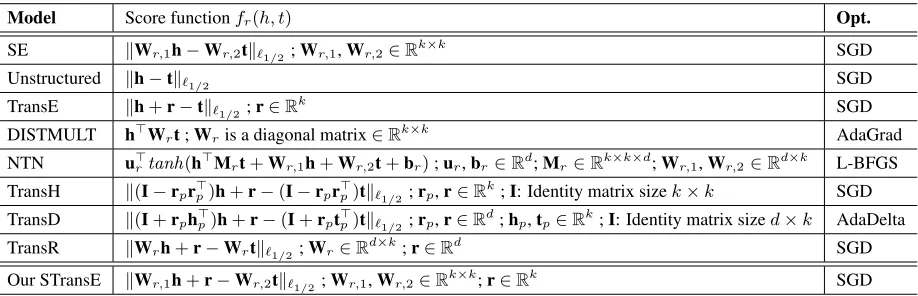
Embedding modelsfor KB completion associate entities and/or relations with dense feature vectors or matrices. Such models obtain state-of-the-art per-formance (Nickel et al., 2011; Bordes et al., 2011; Bordes et al., 2012; Bordes et al., 2013; Socher et al., 2013; Wang et al., 2014b; Guu et al., 2015) and generalize to large KBs (Krompa et al., 2015). Ta-ble 1 summarizes a number of prominent embedding models for KB completion.
Let(h, r, t)represent a triple. In all of the models
Model Score functionfr(h, t) Opt. SE kWr,1h−Wr,2tk`1/2;Wr,1,Wr,2∈Rk×k SGD
Unstructured kh−tk`1/2 SGD
TransE kh+r−tk`1/2;r∈Rk SGD
DISTMULT h>W
rt;Wris a diagonal matrix∈Rk×k AdaGrad
NTN u>
rtanh(h>Mrt+Wr,1h+Wr,2t+br);ur,br∈Rd;Mr∈Rk×k×d;Wr,1,Wr,2∈Rd×k L-BFGS
[image:2.612.79.538.59.207.2]TransH k(I−rpr>p)h+r−(I−rpr>p)tk`1/2;rp,r∈Rk;I: Identity matrix sizek×k SGD TransD k(I+rph>p)h+r−(I+rpt>p)tk`1/2;rp,r∈Rd;hp,tp∈Rk;I: Identity matrix sized×k AdaDelta TransR kWrh+r−Wrtk`1/2;Wr∈Rd×k;r∈Rd SGD Our STransE kWr,1h+r−Wr,2tk`1/2;Wr,1,Wr,2∈Rk×k;r∈Rk SGD
Table 1: The score functionsfr(h, t)and the optimization methods (Opt.) of several prominent embedding models for KB completion. In all of these the entitieshandtare represented by vectorshandt∈Rkrespectively.
discussed here, the head entityhand the tail entity
t are represented by vectorshand t ∈ Rk
respec-tively. TheUnstructuredmodel (Bordes et al., 2012) assumes that h ≈ t. As the Unstructured model does not take the relationshiprinto account, it can-not distinguish different relation types. The Struc-tured Embedding (SE) model (Bordes et al., 2011) extends the unstructured model by assuming thath
andt are similar only in a relation-dependent sub-space. It represents each relationr with two matri-ces Wr,1 and Wr,2 ∈ Rk×k, which are chosen so thatWr,1h≈ Wr,2t. TheTransEmodel (Bordes et al., 2013) is inspired by models such as Word2Vec (Mikolov et al., 2013) where relationships between words often correspond to translations in latent fea-ture space. The TransE model represents each rela-tionr by a translation vectorr∈ Rk, which is
cho-sen so thath+r≈t.
The primary contribution of this paper is that two very simple relation-prediction models, SE and TransE, can be combined into a single model, which we call STransE. Specifically, we use relation-specific matricesWr,1andWr,2 as in the SE model to identify the relation-dependent aspects of bothh
and t, and use a vector r as in the TransE model to describe the relationship betweenh andtin this subspace. Specifically, our new KB completion model STransE chooses Wr,1, Wr,2 and r so that Wr,1h+r ≈ Wr,2t. That is, a TransE-style rela-tionship holds in some relation-dependent subspace, and crucially, this subspace may involve very dif-ferent projections of the headhand tailt. SoWr,1 andWr,2can highlight, suppress, or even change the
sign of, relation-specific attributes ofh and t. For example, for the “purchases” relationship, certain attributes of individualsh (e.g., age, gender, mari-tal status) are presumably strongly correlated with very different attributes of objectst(e.g., sports car, washing machine and the like).
As we show below, STransE performs better than the SE and TransE models and other state-of-the-art link prediction models on two standard link predic-tion datasets WN18 and FB15k, so it can serve as a new baseline for KB completion. We expect that the STransE will also be able to serve as the basis for extended models that exploit a wider variety of information sources, just as TransE does.
2 Our approach
LetE denote the set of entities andRthe set of re-lation types. For each triple(h, r, t), whereh, t∈ E andr ∈ R, the STransE model defines ascore func-tion fr(h, t) of its implausibility. Our goal is to
choose f such that the score fr(h, t) of a
plausi-ble triple(h, r, t)is smaller than the scorefr0(h0, t0)
of an implausible triple (h0, r0, t0). We define the STransE score functionf as follows:
fr(h, t) = kWr,1h+r−Wr,2tk`1/2
L = X (h,r,t)∈G (h0,r,t0)∈G0
(h,r,t)
[γ+fr(h, t)−fr(h0, t0)]+
where [x]+ = max(0, x), γ is the margin hyper-parameter,Gis the training set consisting of correct triples, andG0
(h,r,t)={(h0, r, t)|h0 ∈ E,(h0, r, t)∈/ G} ∪ {(h, r, t0) | t0 ∈ E,(h, r, t0) ∈ G}/ is the set of incorrect triples generated by corrupting a correct triple(h, r, t)∈ G.
We use Stochastic Gradient Descent (SGD) to minimize L, and impose the following constraints during training: khk2 6 1, krk2 6 1, ktk2 6 1, kWr,1hk261andkWr,2tk2 61.
3 Related work
Table 1 summarizes related embedding models for link prediction and KB completion. The models differ in the score functions fr(h, t) and the
algo-rithms used to optimize the margin-based objective function, e.g., SGD, AdaGrad (Duchi et al., 2011), AdaDelta (Zeiler, 2012) and L-BFGS (Liu and No-cedal, 1989).
DISTMULT (Yang et al., 2015) is based on a Bilinear model (Nickel et al., 2011; Bordes et al., 2012; Jenatton et al., 2012) where each relation is represented by a diagonal rather than a full matrix. The neural tensor network (NTN) model (Socher et al., 2013) uses a bilinear tensor operator to repre-sent each relation. Similar quadratic forms are used to model entities and relations in KG2E (He et al., 2015) and TATEC (Garcia-Duran et al., 2015b).
The TransH model (Wang et al., 2014b) asso-ciates each relation with a relation-specific hyper-plane and uses a projection vector to project en-tity vectors onto that hyperplane. TransD (Ji et al., 2015) and TransR/CTransR (Lin et al., 2015b) ex-tend the TransH model using two projection vec-tors and a matrix to project entity vecvec-tors into a relation-specific space, respectively. TransD learns a relation-role specific mapping just as STransE, but represents this mapping by projection vectors rather than full matrices, as in STransE. Thus STransE can be viewed as an extension of the TransR model, where head and tail entities are associated with their own project matrices, rather than using the same ma-trix for both, as in TransR and CTransR.
Dataset #E #R #Train #Valid #Test
WN18 40,943 18 141,442 5,000 5,000 FB15k 14,951 1,345 483,142 50,000 59,071
Table 2: Statistics of the experimental datasets used in this study (and previous works). #E is the number of entities, #R is the number of relation types, and #Train, #Valid and #Test are the numbers of triples in the training, validation and test sets, respectively.
Recently, Lao et al. (2011), Neelakantan et al. (2015), Gardner and Mitchell (2015), Luo et al. (2015), Lin et al. (2015a), Garcia-Duran et al. (2015a) and Guu et al. (2015) showed that rela-tion paths between entities in KBs provide richer in-formation and improve the relationship prediction. Nickel et al. (2015) reviews other approaches for learning from KBs and multi-relational data.
4 Experiments
For link prediction evaluation, we conduct experi-ments and compare the performance of our STransE model with published results on the benchmark WN18 and FB15k datasets (Bordes et al., 2013). In-formation about these datasets is given in Table 2.
4.1 Task and evaluation protocol
The link prediction task (Bordes et al., 2011; Bordes et al., 2012; Bordes et al., 2013) predicts the head or tail entity given the relation type and the other entity, i.e. predictinghgiven(?, r, t)or predictingtgiven
(h, r,?)where?denotes the missing element. The results are evaluated using the ranking induced by the score functionfr(h, t)on test triples.
Following TransR/CTransR (Lin et al., 2015b), TransD (Ji et al., 2015), TATEC (Garcia-Duran et al., 2015b), RTransE (Garcia-Duran et al., 2015a)
and PTransE (Lin et al., 2015a), we used the en-tity and relation vectors produced by TransE (Bor-des et al., 2013) to initialize the entity and relation vectors in STransE, and we initialized the relation matrices with identity matrices. Following Wang et al. (2014b), Lin et al. (2015b), He et al. (2015), Ji et al. (2015) and Lin et al. (2015a), we applied the “Bernoulli” trick for generating head or tail entities when sampling incorrect triples. We ran SGD for 2,000 epochs to estimate the model parameters. Fol-lowing Bordes et al. (2013) we used a grid search on validation set to choose either thel1orl2norm in the score functionf, as well as to set the SGD learning rate λ ∈ {0.0001,0.0005,0.001,0.005,0.01}, the margin hyper-parameterγ ∈ {1,3,5}and the num-ber of vector dimensionsk∈ {50,100}. The lowest mean rank on the validation set was obtained when using thel1 norm inf on both WN18 and FB15k, and when λ = 0.0005, γ = 5, andk = 50 for WN18, and λ = 0.0001, γ = 1, andk = 100 for FB15k.
4.2 Main results
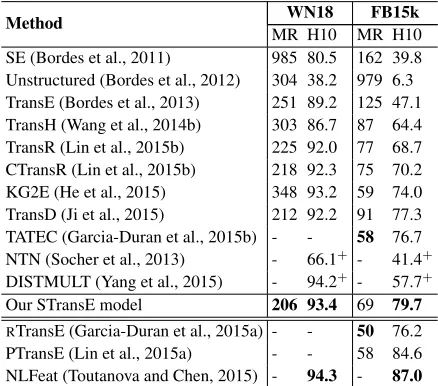
Table 3 compares the link prediction results of our STransE model with results reported in prior work, using the same experimental setup. The first twelve rows report the performance of mod-els that do not exploit information about alterna-tive paths between head and tail entities. The next two rows report results of theRTransE and PTransE
models, which are extensions of the TransE model that exploit information about relation paths. The last row presents results for the log-linear model Node+LinkFeat (Toutanova and Chen, 2015) which makes use of textual mentions derived from the large external ClueWeb-12 corpus.
It is clear that Node+LinkFeat with the additional external corpus information obtained best results. In future work we plan to extend the STransE model to incorporate such additional information. Table 3 also shows that models RTransE and PTransE
em-ploying path information achieve better results than models that do not use such information. In terms of models not exploiting path information or external information, the STransE model scores better than
Method MR H10 MR H10WN18 FB15k
SE (Bordes et al., 2011) 985 80.5 162 39.8 Unstructured (Bordes et al., 2012) 304 38.2 979 6.3 TransE (Bordes et al., 2013) 251 89.2 125 47.1 TransH (Wang et al., 2014b) 303 86.7 87 64.4 TransR (Lin et al., 2015b) 225 92.0 77 68.7 CTransR (Lin et al., 2015b) 218 92.3 75 70.2 KG2E (He et al., 2015) 348 93.2 59 74.0 TransD (Ji et al., 2015) 212 92.2 91 77.3 TATEC (Garcia-Duran et al., 2015b) - - 58 76.7 NTN (Socher et al., 2013) - 66.1+ - 41.4+ DISTMULT (Yang et al., 2015) - 94.2+ - 57.7+ Our STransE model 206 93.4 69 79.7
[image:4.612.319.538.60.253.2]RTransE (Garcia-Duran et al., 2015a) - - 50 76.2 PTransE (Lin et al., 2015a) - - 58 84.6 NLFeat (Toutanova and Chen, 2015) - 94.3 - 87.0 Table 3: Link prediction results. MR and H10 denote evaluation metrics of mean rank and Hits@10 (in %), re-spectively. “NLFeat” abbreviates Node+LinkFeat. The results for NTN (Socher et al., 2013) listed in this table are taken from Yang et al. (2015) since NTN was origi-nally evaluated on different datasets. The results marked with+ are obtained using the optimal hyper-parameters
chosen to optimize Hits@10 on the validation set; trained in this manner, STransE obtains a mean rank of 244 and Hits@10 of94.7% on WN18, while producing the same results on FB15k.
the other models on WN18 and produces the highest Hits@10 score on FB15k. Compared to the closely related models SE, TransE, TransR, CTransR and TransD, STransE does better than these models on both WN18 and FB15k.
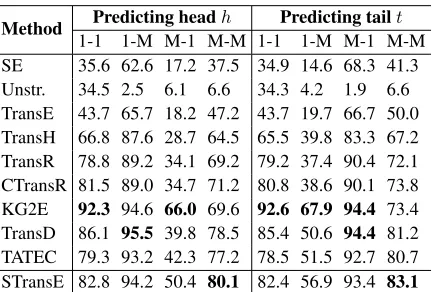
Following Bordes et al. (2013), Table 4 analyzes Hits@10 results on FB15k with respect to the re-lation categories defined as follows: for each rela-tion typer, we computed the averaged numberahof
headshfor a pair(r, t)and the averaged numberat
of tailstfor a pair(h, r). Ifah <1.5andat<1.5,
thenris labeled1-1. Ifah≥1.5andat<1.5, then ris labeledM-1. Ifah<1.5andat≥1.5, thenris
labeled as1-M. Ifah ≥1.5andat ≥1.5, thenris
labeled asM-M. 1.4%, 8.9%, 14.6% and 75.1% of the test triples belong to a relation type classified as
1-1,1-M,M-1andM-M, respectively.
Table 4 shows that in comparison to prior models not using path information, STransE obtains high-est Hits@10 result for M-M relation category at
Method 1-1 1-M M-1 M-M 1-1 1-M M-1 M-MPredicting headh Predicting tailt SE 35.6 62.6 17.2 37.5 34.9 14.6 68.3 41.3 Unstr. 34.5 2.5 6.1 6.6 34.3 4.2 1.9 6.6 TransE 43.7 65.7 18.2 47.2 43.7 19.7 66.7 50.0 TransH 66.8 87.6 28.7 64.5 65.5 39.8 83.3 67.2 TransR 78.8 89.2 34.1 69.2 79.2 37.4 90.4 72.1 CTransR 81.5 89.0 34.7 71.2 80.8 38.6 90.1 73.8 KG2E 92.3 94.6 66.0 69.6 92.6 67.9 94.4 73.4 TransD 86.1 95.5 39.8 78.5 85.4 50.6 94.4 81.2 TATEC 79.3 93.2 42.3 77.2 78.5 51.5 92.7 80.7 STransE 82.8 94.2 50.4 80.1 82.4 56.9 93.4 83.1
Table 4: Hits@10 (in %) by the relation category on FB15k. “Unstr.” abbreviates Unstructured.
also performs better than TransD for1-MandM-1
relation categories. We believe the improved per-formance of the STransE model is due to its use of full matrices, rather than just projection vectors as in TransD. This permits STransE to model diverse and complex relation categories (such as1-M,M-1
and especiallyM-M) better than TransD and other similiar models. However, STransE is not as good as TransD for the 1-1 relations. Perhaps the ex-tra parameters in STransE hurt performance in this case (note that 1-1 relations are relatively rare, so STransE does better overall).
5 Conclusion and future work
This paper presented a new embedding model for link prediction and KB completion. Our STransE combines insights from several simpler embed-ding models, specifically the Structured Embedembed-ding model (Bordes et al., 2011) and the TransE model (Bordes et al., 2013), by using a low-dimensional vector and two projection matrices to represent each relation. STransE, while being conceptually sim-ple, produces highly competitive results on standard link prediction evaluations, and scores better than the embedding-based models it builds on. Thus it is a suitable candidate for serving as future baseline for more complex models in the link prediction task. In future work we plan to extend STransE to ex-ploit relation path information in knowledge bases, in a manner similar to Lin et al. (2015a), Garcia-Duran et al. (2015a) or Guu et al. (2015).
Acknowledgments
This research was supported by a Google award through the Natural Language Understanding Fo-cused Program, and under the Australian Re-search Council’sDiscovery Projectsfunding scheme (project number DP160102156).
NICTA is funded by the Australian Government through the Department of Communications and the Australian Research Council through the ICT Centre of Excellence Program. The first author is supported by an International Postgraduate Research Scholar-ship and a NICTA NRPA Top-Up ScholarScholar-ship.
References
Gabor Angeli and Christopher Manning. 2013. Philoso-phers are Mortal: Inferring the Truth of Unseen Facts. InProceedings of the Seventeenth Conference on Computational Natural Language Learning, pages 133–142.
Kurt Bollacker, Colin Evans, Praveen Paritosh, Tim Sturge, and Jamie Taylor. 2008. Freebase: A Col-laboratively Created Graph Database for Structuring Human Knowledge. InProceedings of the 2008 ACM SIGMOD International Conference on Management of Data, pages 1247–1250.
Antoine Bordes, Jason Weston, Ronan Collobert, and Yoshua Bengio. 2011. Learning Structured Em-beddings of Knowledge Bases. In Proceedings of the Twenty-Fifth AAAI Conference on Artificial Intelli-gence, pages 301–306.
Antoine Bordes, Xavier Glorot, Jason Weston, and Yoshua Bengio. 2012. A Semantic Matching Energy Function for Learning with Multi-relational Data. Ma-chine Learning, 94(2):233–259.
Antoine Bordes, Nicolas Usunier, Alberto Garcia-Duran, Jason Weston, and Oksana Yakhnenko. 2013. Translating Embeddings for Modeling Multi-relational Data. InAdvances in Neural Information Processing Systems 26, pages 2787–2795.
John Duchi, Elad Hazan, and Yoram Singer. 2011. Adaptive Subgradient Methods for Online Learning and Stochastic Optimization. The Journal of Machine Learning Research, 12:2121–2159.
Christiane D. Fellbaum. 1998. WordNet: An Electronic Lexical Database. MIT Press.
Alberto Garcia-Duran, Antoine Bordes, Nicolas Usunier, and Yves Grandvalet. 2015b. Combining Two And Three-Way Embeddings Models for Link Prediction in Knowledge Bases. CoRR, abs/1506.00999.
Matt Gardner and Tom Mitchell. 2015. Efficient and Ex-pressive Knowledge Base Completion Using Subgraph Feature Extraction. InProceedings of the 2015 Con-ference on Empirical Methods in Natural Language Processing, pages 1488–1498.
Kelvin Guu, John Miller, and Percy Liang. 2015. Traversing Knowledge Graphs in Vector Space. In Proceedings of the 2015 Conference on Empirical Methods in Natural Language Processing, pages 318– 327.
Shizhu He, Kang Liu, Guoliang Ji, and Jun Zhao. 2015. Learning to Represent Knowledge Graphs with Gaus-sian Embedding. InProceedings of the 24th ACM In-ternational on Conference on Information and Knowl-edge Management, pages 623–632.
Rodolphe Jenatton, Nicolas L. Roux, Antoine Bordes, and Guillaume R Obozinski. 2012. A latent factor model for highly multi-relational data. In Advances in Neural Information Processing Systems 25, pages 3167–3175.
Guoliang Ji, Shizhu He, Liheng Xu, Kang Liu, and Jun Zhao. 2015. Knowledge Graph Embedding via Dy-namic Mapping Matrix. In Proceedings of the 53rd Annual Meeting of the Association for Computational Linguistics and the 7th International Joint Conference on Natural Language Processing (Volume 1: Long Pa-pers), pages 687–696.
Denis Krompa, Stephan Baier, and Volker Tresp. 2015. Type-Constrained Representation Learning in Knowl-edge Graphs. InProceedings of the 14th International Semantic Web Conference, pages 640–655.
Ni Lao, Tom Mitchell, and William W. Cohen. 2011. Random Walk Inference and Learning in a Large Scale Knowledge Base. InProceedings of the Conference on Empirical Methods in Natural Language Processing, pages 529–539.
Jens Lehmann, Robert Isele, Max Jakob, Anja Jentzsch, Dimitris Kontokostas, Pablo N. Mendes, Sebastian Hellmann, Mohamed Morsey, Patrick van Kleef, S¨oren Auer, and Christian Bizer. 2015. DBpedia - A Large-scale, Multilingual Knowledge Base Extracted from Wikipedia. Semantic Web, 6(2):167–195. Yankai Lin, Zhiyuan Liu, Huanbo Luan, Maosong Sun,
Siwei Rao, and Song Liu. 2015a. Modeling Rela-tion Paths for RepresentaRela-tion Learning of Knowledge Bases. In Proceedings of the 2015 Conference on Empirical Methods in Natural Language Processing, pages 705–714.
Yankai Lin, Zhiyuan Liu, Maosong Sun, Yang Liu, and Xuan Zhu. 2015b. Learning Entity and Relation Em-beddings for Knowledge Graph Completion. In Pro-ceedings of the Twenty-Ninth AAAI Conference on Ar-tificial Intelligence Learning, pages 2181–2187. D. C. Liu and J. Nocedal. 1989. On the Limited Memory
BFGS Method for Large Scale Optimization. Mathe-matical Programming, 45(3):503–528.
Yuanfei Luo, Quan Wang, Bin Wang, and Li Guo. 2015. Context-Dependent Knowledge Graph Embed-ding. In Proceedings of the 2015 Conference on Empirical Methods in Natural Language Processing, pages 1656–1661.
Tomas Mikolov, Wen-tau Yih, and Geoffrey Zweig. 2013. Linguistic Regularities in Continuous Space Word Representations. In Proceedings of the 2013 Conference of the North American Chapter of the As-sociation for Computational Linguistics: Human Lan-guage Technologies, pages 746–751.
Arvind Neelakantan, Benjamin Roth, and Andrew Mc-Callum. 2015. Compositional Vector Space Models for Knowledge Base Completion. InProceedings of the 53rd Annual Meeting of the Association for Com-putational Linguistics and the 7th International Joint Conference on Natural Language Processing (Volume 1: Long Papers), pages 156–166.
Maximilian Nickel, Volker Tresp, and Hans-Peter Kriegel. 2011. A Three-Way Model for Collective Learning on Multi-Relational Data. InProceedings of the 28th International Conference on Machine Learn-ing, pages 809–816.
Maximilian Nickel, Kevin Murphy, Volker Tresp, and Ev-geniy Gabrilovich. 2015. A Review of Relational Ma-chine Learning for Knowledge Graphs. Proceedings of the IEEE, to appear.
Sebastian Riedel, Limin Yao, Andrew McCallum, and Benjamin M. Marlin. 2013. Relation Extraction with Matrix Factorization and Universal Schemas. In Pro-ceedings of the 2013 Conference of the North Ameri-can Chapter of the Association for Computational Lin-guistics: Human Language Technologies, pages 74– 84.
Richard Socher, Danqi Chen, Christopher D Manning, and Andrew Ng. 2013. Reasoning With Neural Ten-sor Networks for Knowledge Base Completion. In Ad-vances in Neural Information Processing Systems 26, pages 926–934.
Fabian M. Suchanek, Gjergji Kasneci, and Gerhard Weikum. 2007. YAGO: A Core of Semantic Knowl-edge. InProceedings of the 16th International Con-ference on World Wide Web, pages 697–706.
Advances in Neural Information Processing Systems 16, pages 659–666.
Kristina Toutanova and Danqi Chen. 2015. Observed Versus Latent Features for Knowledge Base and Text Inference. In Proceedings of the 3rd Workshop on Continuous Vector Space Models and their Composi-tionality, pages 57–66.
Kristina Toutanova, Danqi Chen, Patrick Pantel, Hoifung Poon, Pallavi Choudhury, and Michael Gamon. 2015. Representing Text for Joint Embedding of Text and Knowledge Bases. InProceedings of the 2015 Con-ference on Empirical Methods in Natural Language Processing, pages 1499–1509.
Zhen Wang, Jianwen Zhang, Jianlin Feng, and Zheng Chen. 2014a. Knowledge Graph and Text Jointly Em-bedding. InProceedings of the 2014 Conference on Empirical Methods in Natural Language Processing (EMNLP), pages 1591–1601.
Zhen Wang, Jianwen Zhang, Jianlin Feng, and Zheng Chen. 2014b. Knowledge Graph Embedding by Translating on Hyperplanes. In Proceedings of the Twenty-Eighth AAAI Conference on Artificial Intelli-gence, pages 1112–1119.
Robert West, Evgeniy Gabrilovich, Kevin Murphy, Shao-hua Sun, Rahul Gupta, and Dekang Lin. 2014. Knowledge Base Completion via Search-based Ques-tion Answering. InProceedings of the 23rd Interna-tional Conference on World Wide Web, pages 515–526. Bishan Yang, Wen-tau Yih, Xiaodong He, Jianfeng Gao, and Li Deng. 2015. Embedding Entities and Relations for Learning and Inference in Knowledge Bases. In Proceedings of the International Conference on Learn-ing Representations.
Matthew D. Zeiler. 2012. ADADELTA: An Adaptive Learning Rate Method. CoRR, abs/1212.5701. Yu Zhao, Sheng Gao, Patrick Gallinari, and Jun Guo.